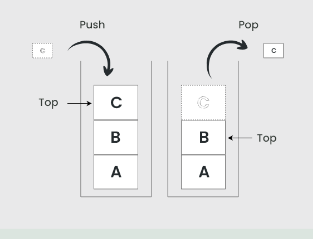
1. Stack: LIFO(Last In First Out)
#include <stdio.h>
#include <stdlib.h>
#include <string.h>

#define PUSH	1
#define POP		2
#define SIZE	3
#define EMPTY	4
#define TOP		5

//stack 배열로 구현
//push, pop, stack top, size, empty

typedef struct stack {
	int* arr;
	int memsize;
	int count;
	int top_idx;
}STACK;

STACK* createStack() {
	STACK* s = (STACK*)malloc(sizeof(STACK));
	s->arr = (int*)malloc(sizeof(int) * 100);
	s->memsize = 100;
	s->count = 0;
	int top_idx = -1;
	return s;
}

void destroyStack(STACK* stack) {
	free(stack->arr);
	free(stack);
}

//insert data to stack
//if success to insert return 1;
int push(STACK* stack, int input_data)
{
	if ((stack->count) >= (stack->memsize))
	{
		stack->memsize += 100;
		stack->arr = (int*)realloc(stack->arr, (stack->memsize)*sizeof(int));
	}

	(stack->arr)[(stack->count)] = input_data;
	stack->top_idx = stack->count;
	stack->count += 1;
	return 1;
}

//return data of stack top, and delete it.
//if underflow, return -1
int pop(STACK* stack)
{
	if (stack->count == 0) return -1;

	int pop_data = (stack->arr)[(stack->top_idx)];
	(stack->arr)[(stack->top_idx)] = 0;
	stack->top_idx -= 1;
	stack->count -= 1;
	return pop_data;
}

//return count of stack;
int size(STACK* stack) {
	return stack->count;
}

//if stack is empty return 1
int empty(STACK* stack) {
	if (stack->count == 0) return 1;
	else return 0;
}

//retrieve top of stack;
int top(STACK* stack) {
	if (stack->count == 0) return -1;
	return (stack->arr)[(stack->top_idx)];
}
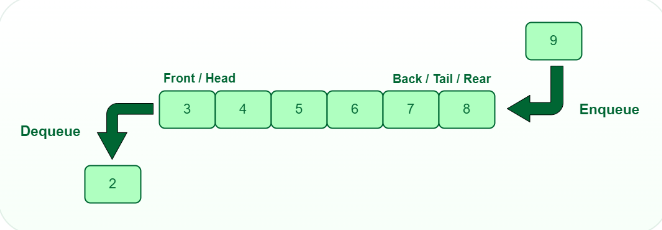
2. Queue: FIFO(First In First Out)
#include <stdio.h>
#include <stdlib.h>
#include <string.h>

#define PUSH    1
#define POP     2
#define SIZE    3
#define EMPTY   4
#define FRONT   5
#define BACK    6

typedef struct queue {
    int count;
    int* arr;
    int front_idx, rear_idx;
    int size;
} Q;

Q* createQ() {
    Q* new_Q = (Q*)malloc(sizeof(Q));
    if (new_Q == NULL) {
        // Handle memory allocation failure
        return NULL;
    }
    new_Q->arr = (int*)malloc(sizeof(int) * 100);
    if (new_Q->arr == NULL) {
        // Handle memory allocation failure
        free(new_Q);
        return NULL;
    }
    new_Q->count = 0;
    new_Q->front_idx = -1;
    new_Q->rear_idx = -1;
    new_Q->size = 100;
    return new_Q;
}

void destroyQ(Q* q) {
    free(q->arr);
    free(q);
}

void Enqueue(Q* q, int input_data) {
    if (q->count == 0) {
        (q->arr)[0] = input_data;
        q->front_idx = 0;
        q->rear_idx = 0;
        q->count += 1;
    }
    else {
        q->count += 1;
        if ((q->count) >= (q->size)) {
            q->size += 100;
            q->arr = realloc(q->arr, sizeof(int) * (q->size));
        }
        q->rear_idx += 1;
        if (q->rear_idx >= (q->size)) {
            q->rear_idx = 0; // circulary array;
        }
        (q->arr)[q->rear_idx] = input_data;
    }
}

int Dequeue(Q* q) {
    int dataout;

    if (q->count == 0) return -1;
    else if (q->count == 1) {
        dataout = (q->arr)[q->front_idx];
        q->front_idx = -1;
        q->rear_idx = -1;
        q->count -= 1;
    }
    else {
        dataout = (q->arr)[q->front_idx];
        (q->arr)[q->front_idx] = 0;
        q->front_idx += 1;

        if (q->front_idx >= (q->size)) {
            q->front_idx = 0;
        }
        q->count -= 1;
    }
    return dataout;
}

int sizeQ(Q* q) {
    return q->count;
}

int is_empty(Q* q) {
    if (q->count == 0) return 1;
    else return 0;
}

int Qfront(Q* q) {
    if (q->count == 0) return -1;
    else return (q->arr)[q->front_idx];
}

int Qrear(Q* q) {
    if (q->count == 0) return -1;
    else return (q->arr)[q->rear_idx];
}
Korea Univ. ; Major. CS