3D Mechanical CAD Design vs 2D Drafting: When to Use Each and Why It Matters for Manufacturers
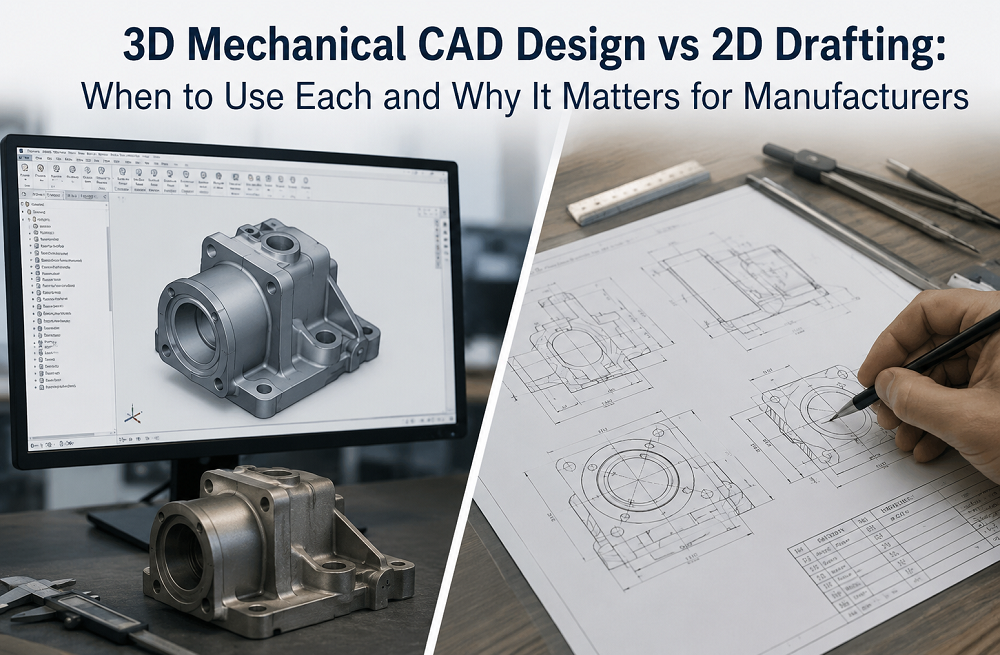
In today’s competitive manufacturing landscape, precision, speed, and cost-efficiency are critical. Yet many manufacturers still struggle with a fundamental question: should they rely on 3D mechanical design or stick with traditional 2D drafting?
The answer isn’t always straightforward. While CAD mechanical design has evolved significantly, both approaches serve distinct purposes depending on project complexity, production stage, and collaboration needs.
Understanding when to use mechanical CAD drafting services versus 3D CAD design services can directly impact product quality, time-to-market, and overall profitability. This guide breaks down the differences, use cases, and strategic importance of each method so you can make informed decisions for your manufacturing workflows.
What is 2D drafting in Mechanical Design?
2D drafting is the traditional method of creating flat technical drawings that represent dimensions, tolerances, and layouts. These drawings are typically created using CAD software and are widely used in manufacturing documentation.
Key Features:
- Orthographic projections (top, front, side views)
- Precise dimensions and annotations
- Easy to interpret for machinists and fabricators
- Lower file size and faster creation
Best Use Cases:
- Simple components and parts
- Legacy projects and documentation updates
- Shop floor manufacturing references
- Cost-sensitive projects
2D drafting remains essential, especially when detailed fabrication drawings are required for production teams.
What is 3D Mechanical CAD Design?
3D mechanical design involves creating detailed, parametric models of components and assemblies in a virtual environment. These models simulate real-world behavior and enable visualization before production begins.
Key Features:
- Realistic 3D models and assemblies
- Parametric and feature-based modeling
- Simulation and interference detection
- Integration with CAM and CNC systems
Best Use Cases:
- Complex assemblies and machinery
- Product development and prototyping
- Design validation and testing
- Client presentations and visualization
Modern 3D CAD design services allow manufacturers to detect design flaws early, reducing costly rework and improving efficiency.
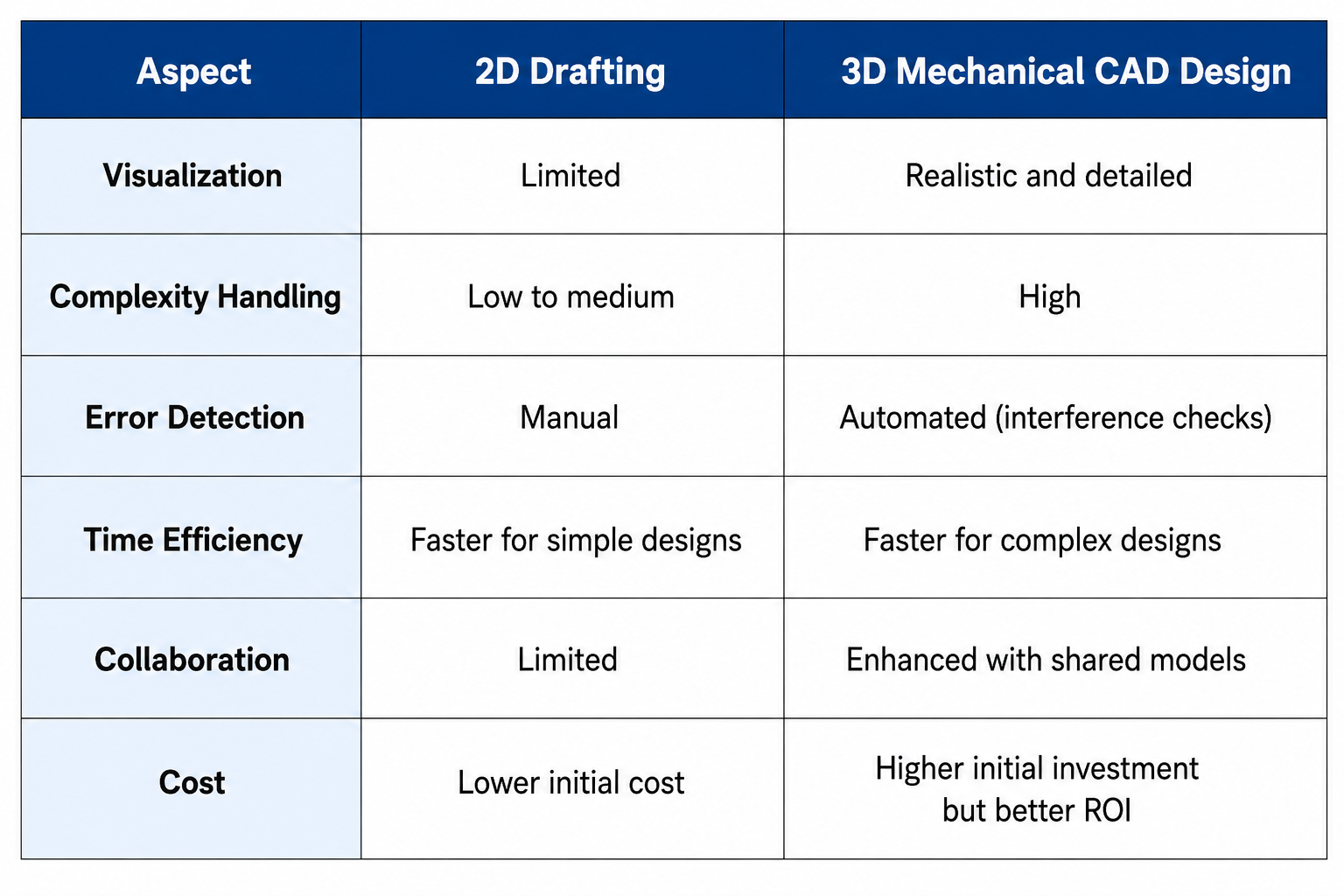
3D Mechanical CAD Design vs 2D Drafting: Key Differences
When Should Manufacturers Use 2D Drafting?
2D drafting is still highly relevant in many scenarios. You should consider using mechanical CAD drafting services when:
- You are working on simple, repeatable components
- The design does not require visualization or simulation
- You need quick documentation updates
- Your production team relies on traditional fabrication drawings
- Budget constraints are a priority
For example, sheet metal parts, brackets, and standard machine components often don’t require full 3D modeling.
When Should You Choose 3D CAD Design Services?
3D modeling is the preferred choice when precision, innovation, and scalability are critical. Opt for 3D CAD design services when:
- Designing complex assemblies or machinery
- Developing new products or prototypes
- Performing simulations (stress, thermal, motion)
- Collaborating with multiple stakeholders
- Integrating with CNC machining or automation systems
For manufacturers adopting Industry 4.0 practices, 3D CAD is no longer optional it’s essential.
Why This Choice Matters for Manufacturers
Selecting between 2D and 3D design is not just a technical decision it’s a strategic one.
1. Reduced Errors and Rework
3D models allow early detection of clashes and design flaws, minimizing costly mistakes during production.
2. Faster Time-to-Market
With better visualization and streamlined workflows, 3D design accelerates product development cycles.
3. Improved Communication
3D models enhance collaboration between engineers, clients, and production teams.
4. Cost Optimization
While 3D design may have higher upfront costs, it significantly reduces long-term expenses due to fewer revisions and improved accuracy.
5. Scalability and Innovation
3D CAD enables manufacturers to scale operations, customize designs, and innovate faster.
Combining 2D and 3D: The Smart Approach
The most effective manufacturing workflows don’t rely on one method alone they combine both.
- Use 3D mechanical design for conceptualization and validation
- Convert models into 2D drawings for production and documentation
This hybrid approach ensures accuracy while maintaining compatibility with shop floor requirements.
FAQs
1. Is 2D drafting outdated in manufacturing?
No, 2D drafting is still widely used for fabrication drawings and documentation. It complements 3D design rather than replacing it.
2. Which is more cost-effective: 2D or 3D CAD design?
2D drafting has lower upfront costs, but 3D CAD offers better long-term ROI by reducing errors and rework.
3. Can 3D CAD models be converted into 2D drawings?
Yes, most CAD software allows automatic generation of 2D drawings from 3D models.
4. Do small manufacturers need 3D CAD design services?
Yes, especially if they are developing new products or working with complex assemblies.
5. How do I choose between 2D and 3D for my project?
It depends on complexity, budget, and project goals. Simple parts can use 2D, while complex designs benefit from 3D modeling.