1.6
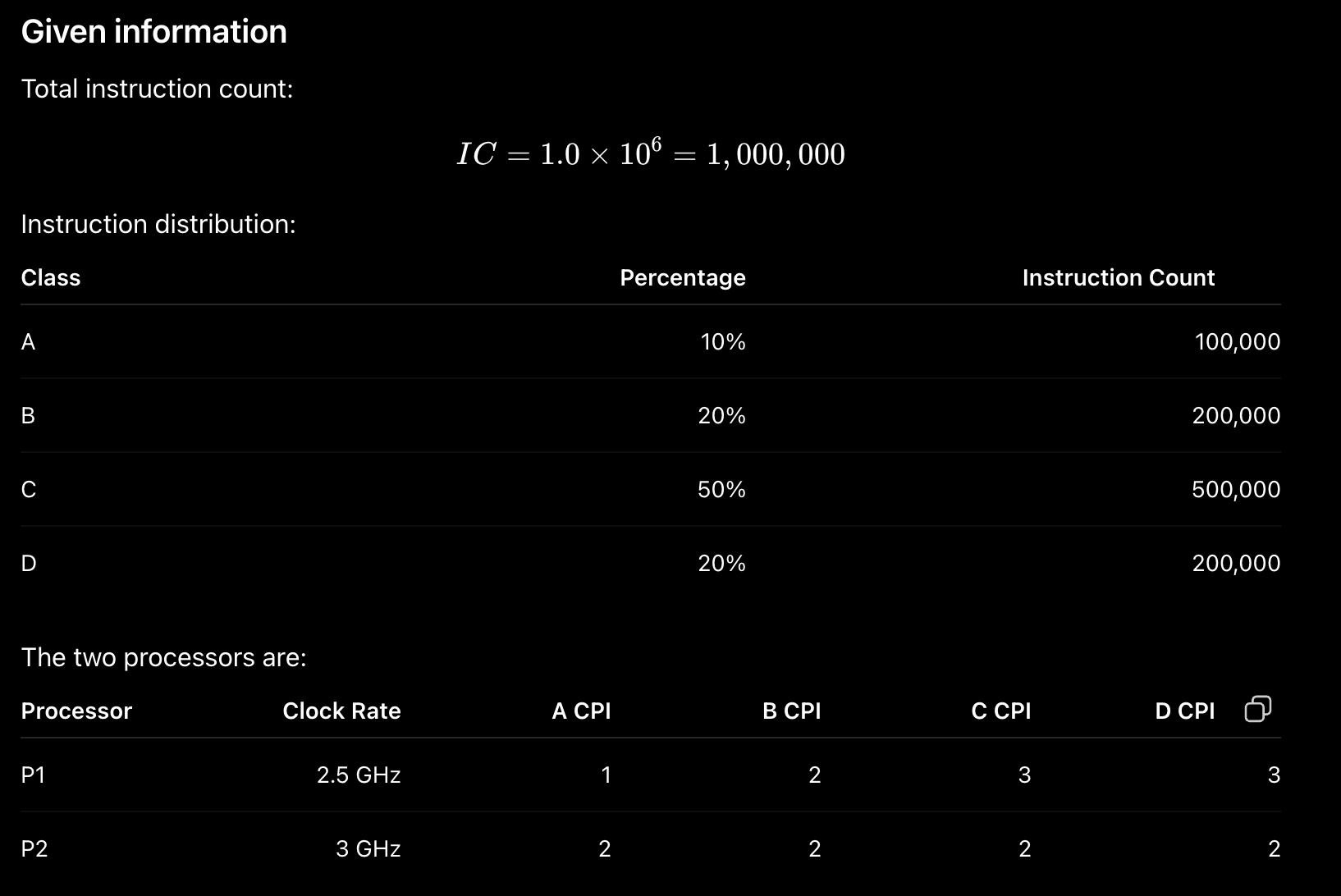
Consider two different implementations of the same instruction set architecture. The instructions can be divided into four classes according to their CPI (class A, B, C, and D). P1 with a clock rate of 2.5 GHz and CPIs of 1, 2, 3, and 3, and P2 with a clock rate of 3 GHz and CPIs of 2, 2, 2, and 2.
Given a program with a dynamic instruction count of 1.0E6 instructions divided into classes as follows: 10% class A, 20% class B, 50% class C, and 20% class D, which implementation is faster?
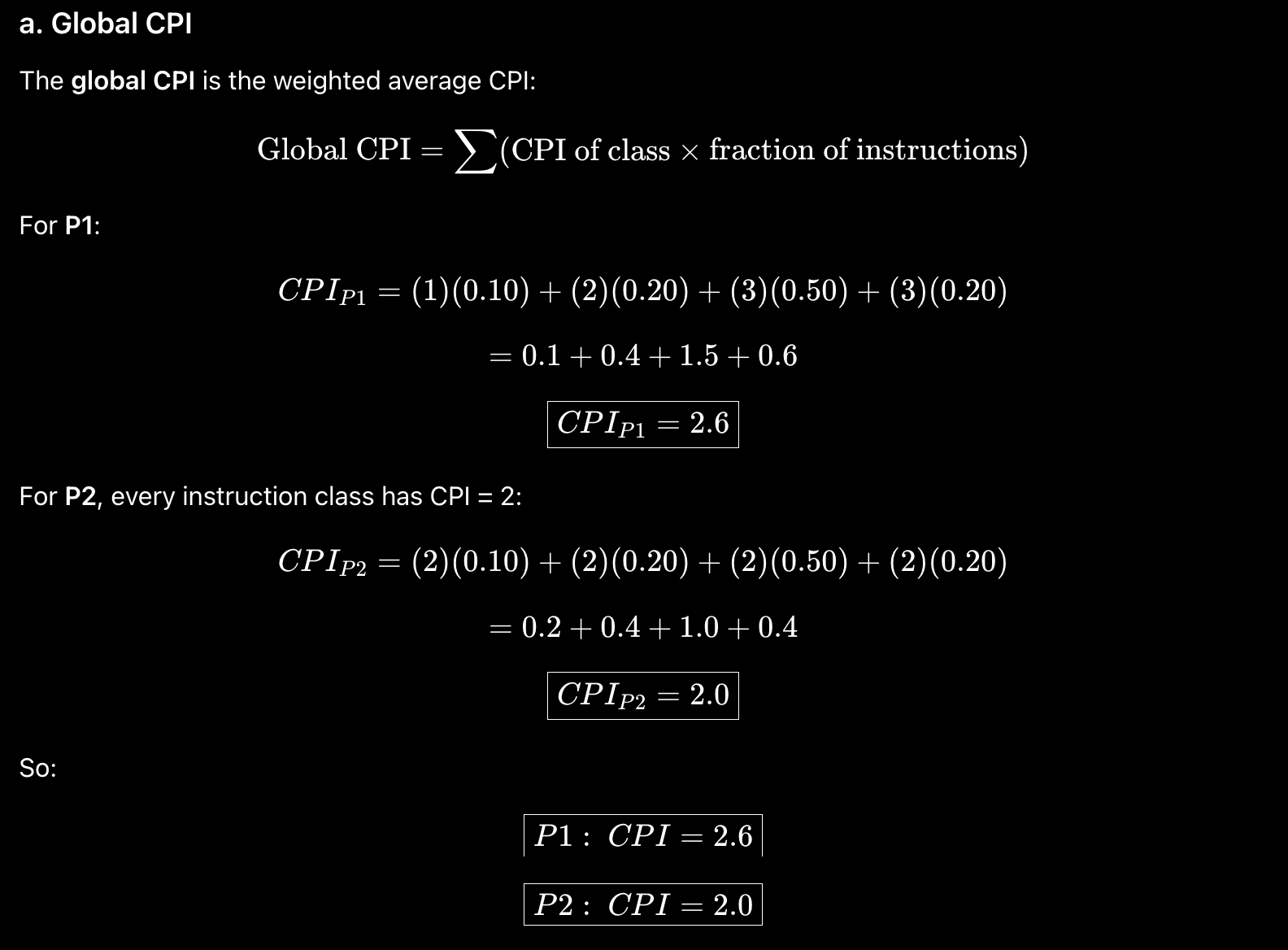
a. What is the global CPI for each implementation?
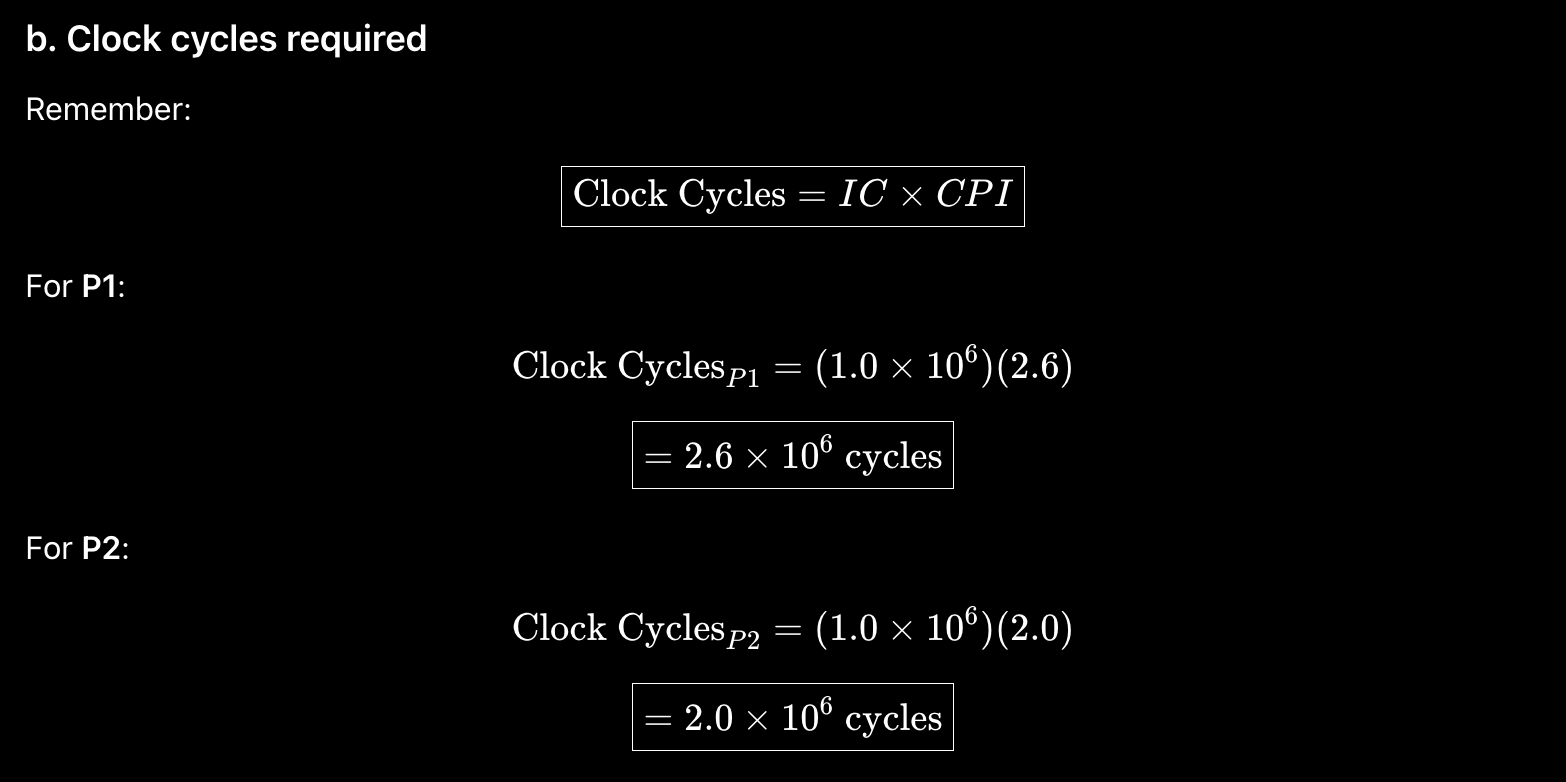
b. Find the clock cycles required in both cases
Answer
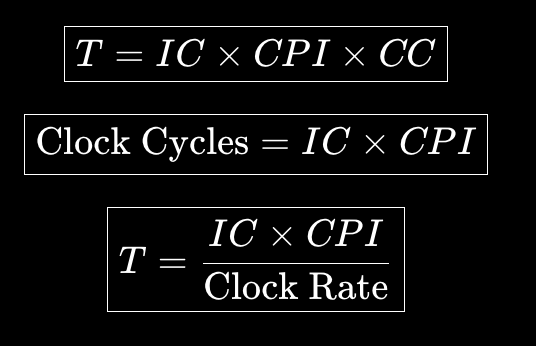
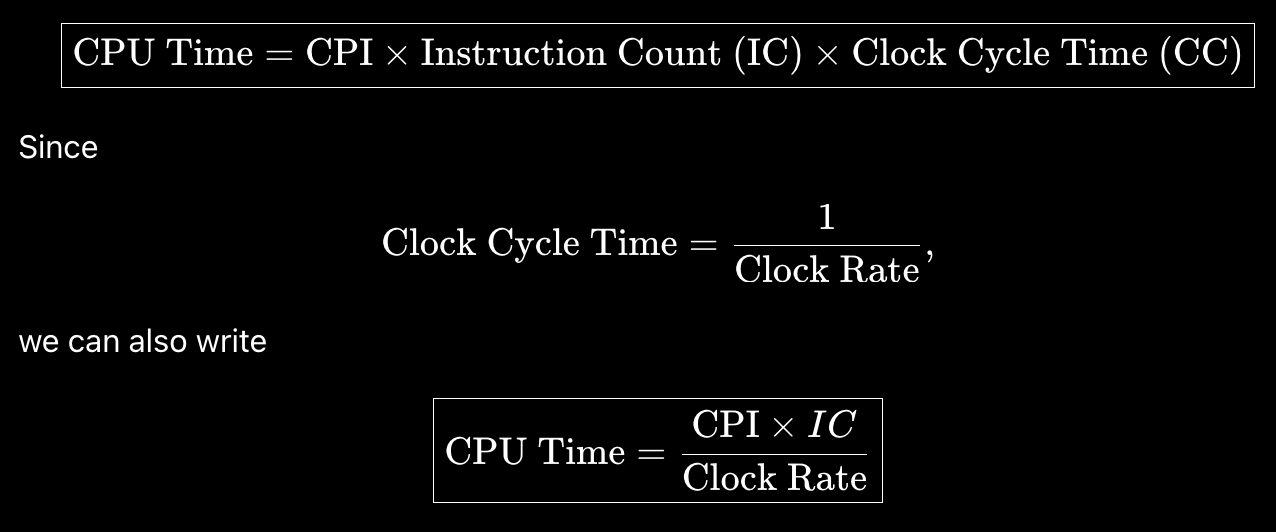
Key equation
A)
B)
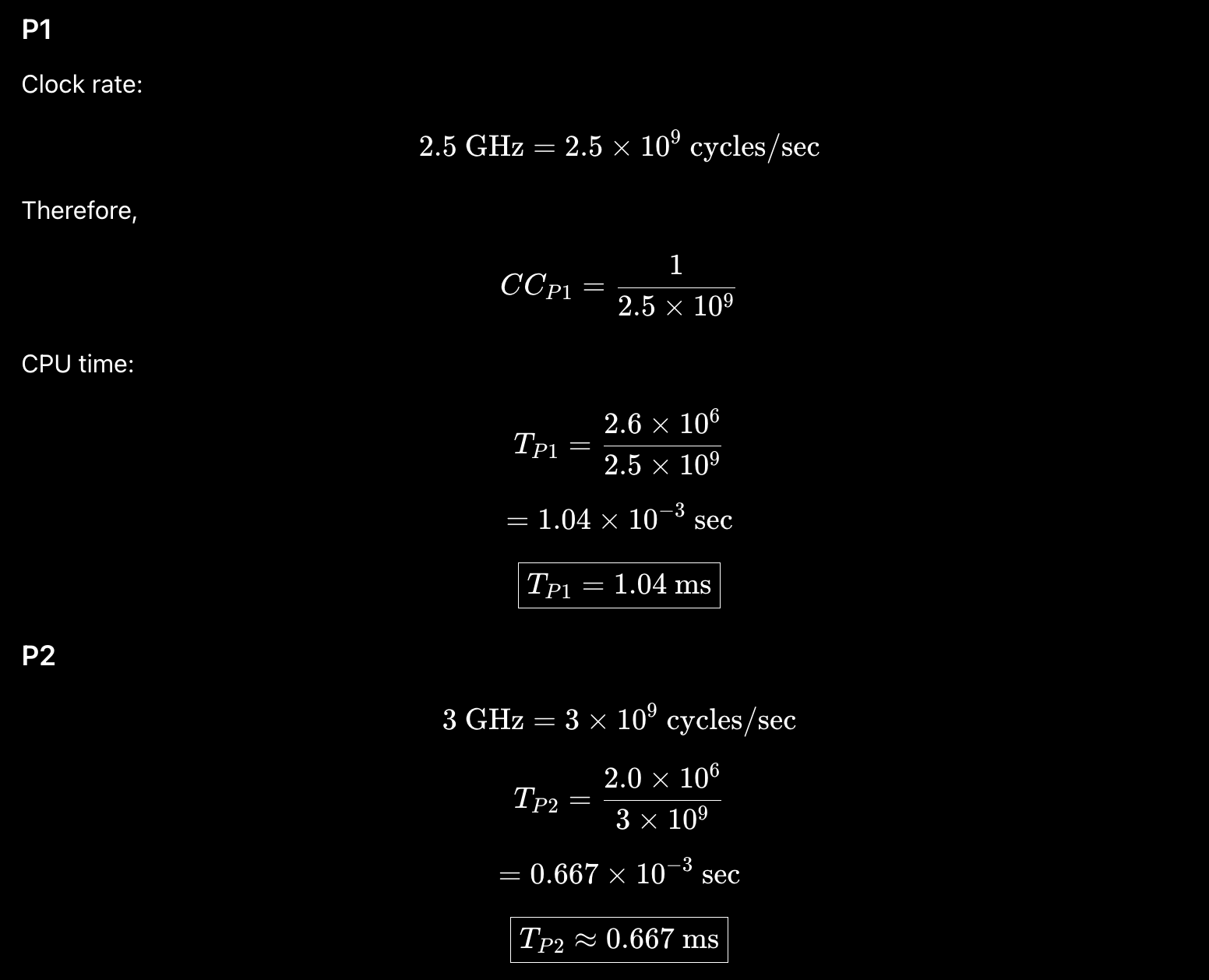
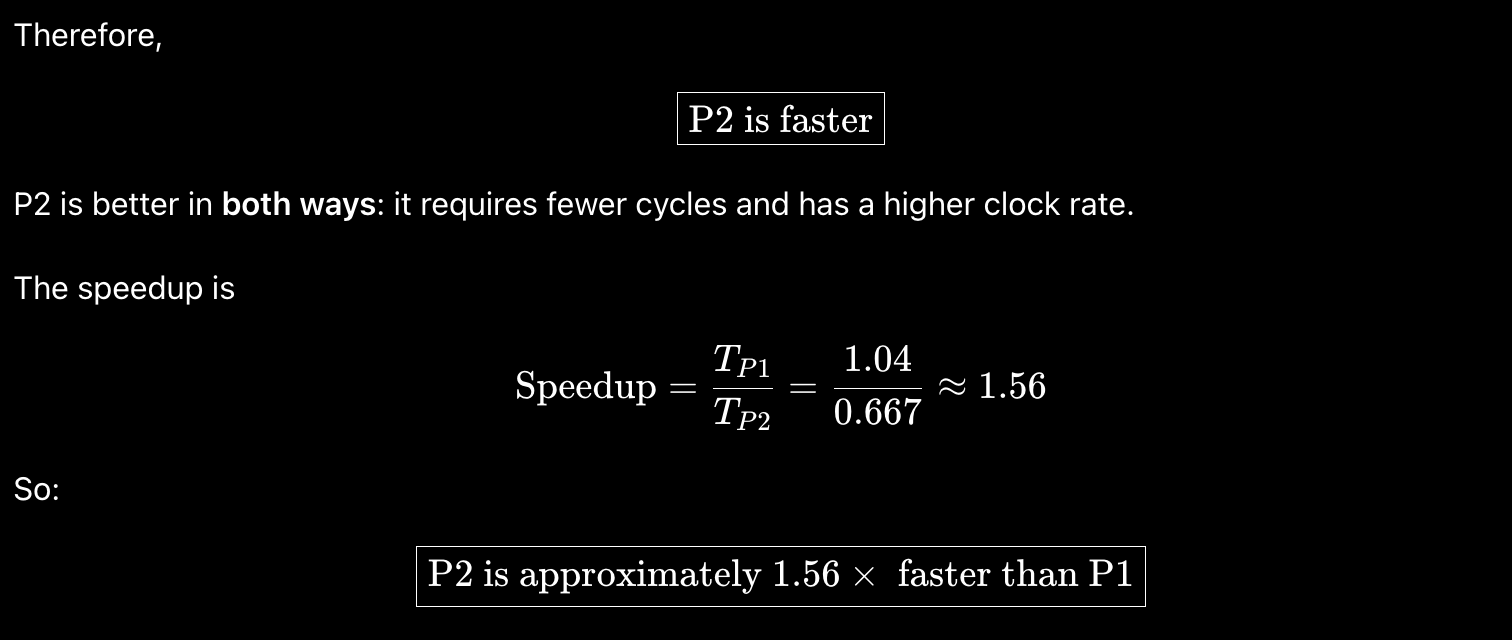
Which implementation is faster?
Now we need CPU time, because fewer clock cycles alone does not always mean faster. Clock rate also matters.
1.7
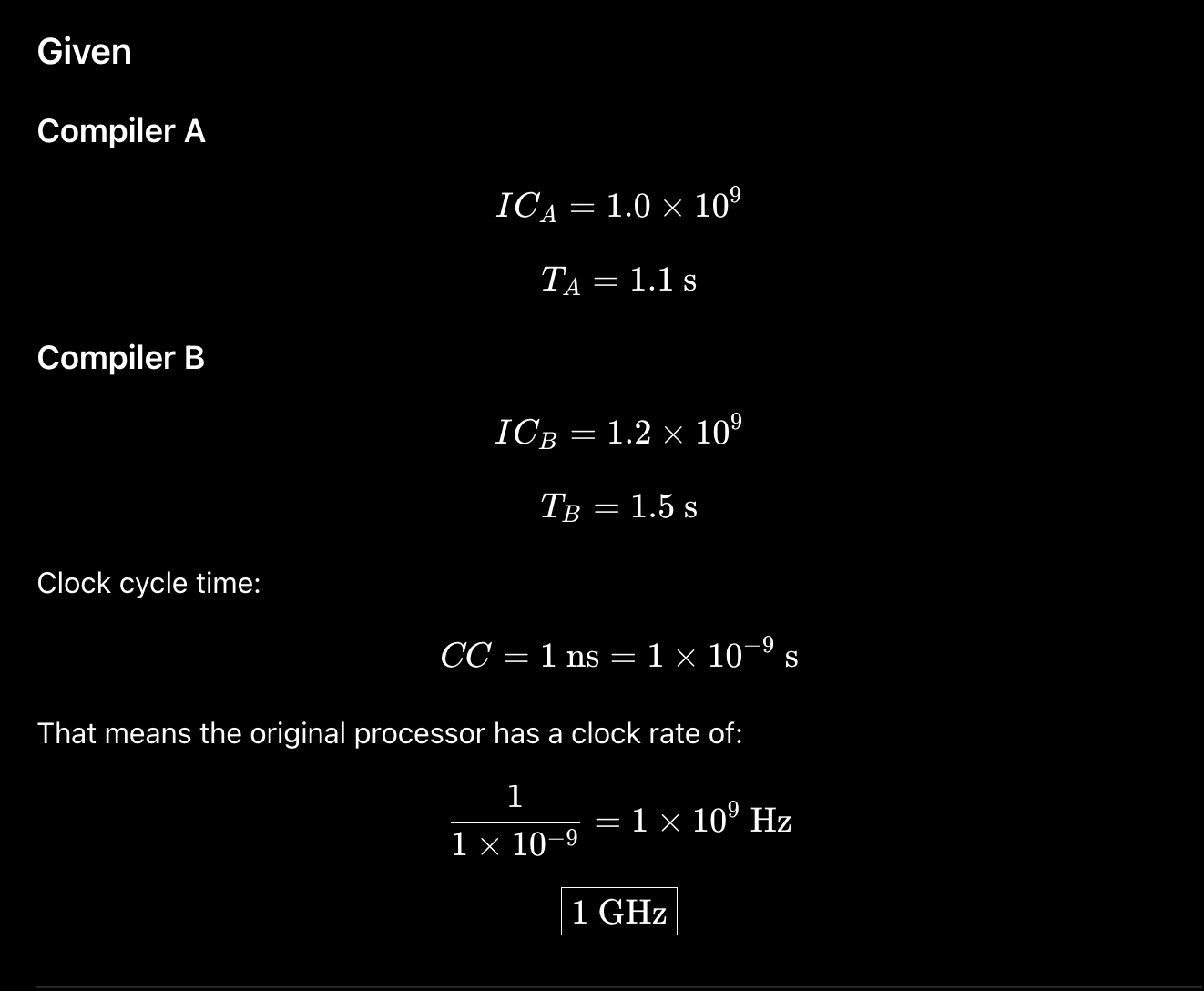
Compilers can have a profound impact on the performance of an application. Assume that for a program, compiler A results in a dynamic instruction count of 1.0E9 and has an execution time of 1.1 s, while compiler B results in a dynamic instruction count of 1.2E9 and an execution time of 1.5 s.
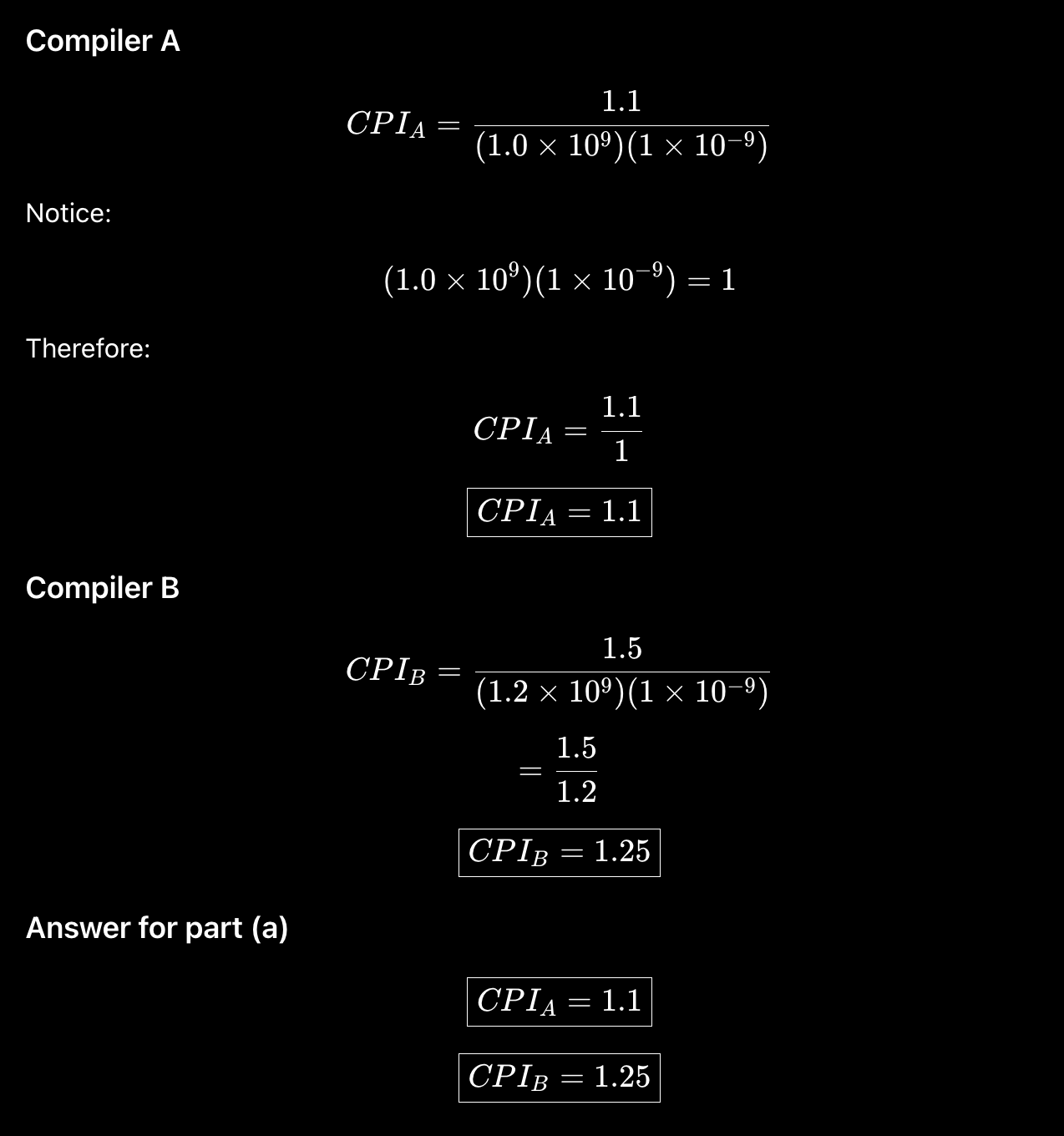
a. Find the average CPI for each program given that the processor has a clock cycle time of 1 ns.
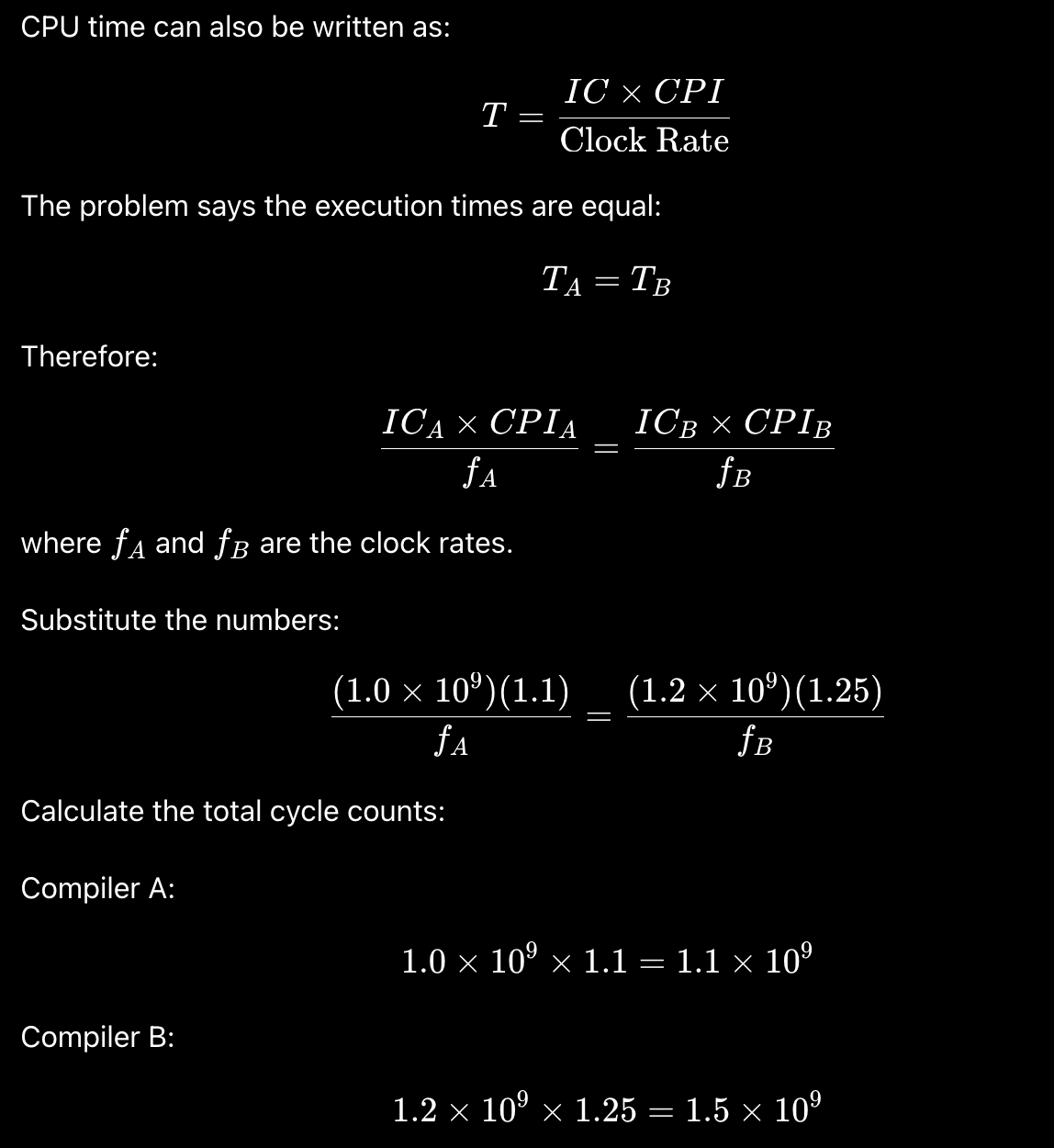
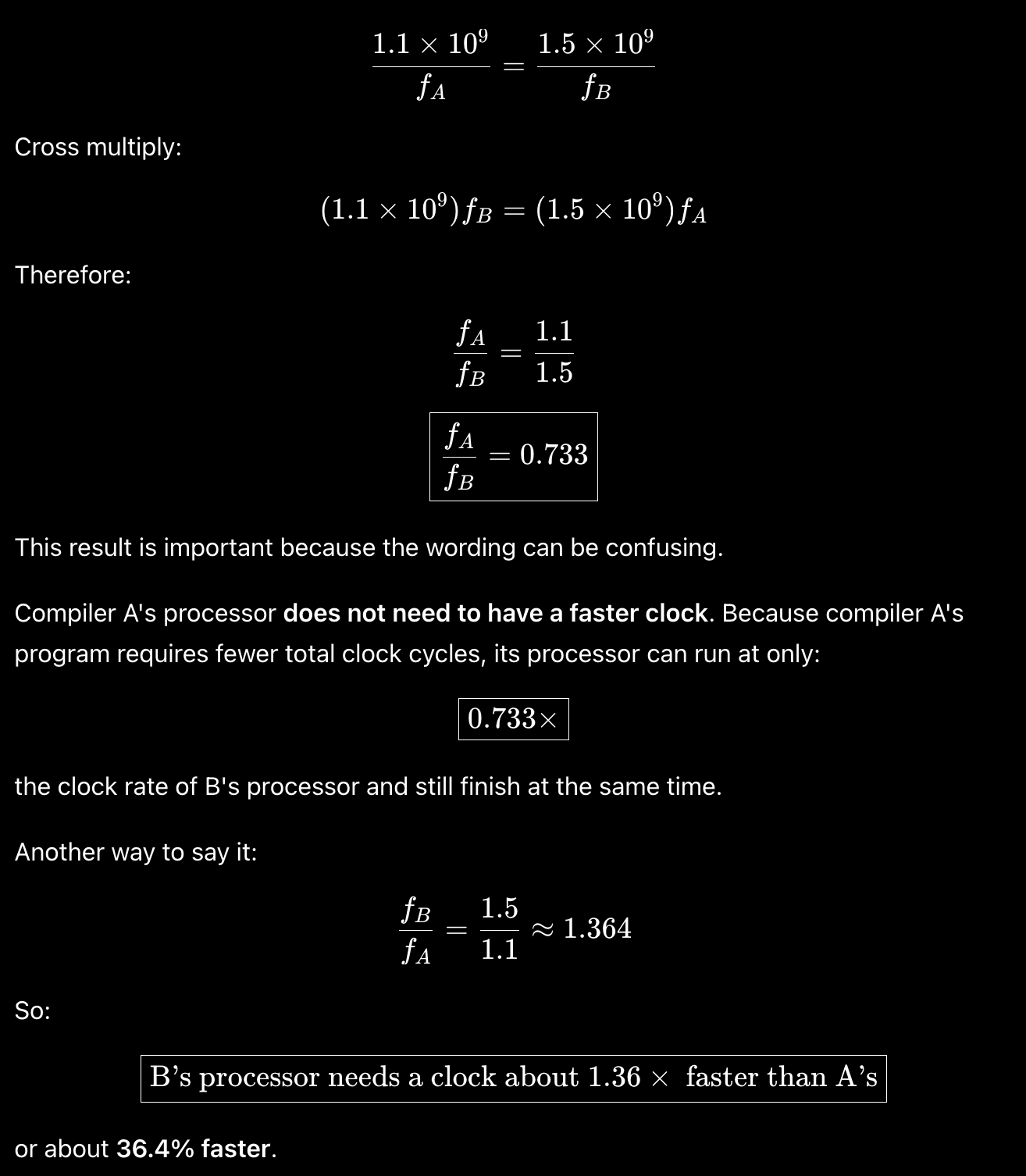
b. Assume the compiled programs run on two different processors. If the execution times on the two processors are the same, how much faster is the clock of the processor running compiler A’s code versus the clock of the processor running compiler B’s code?
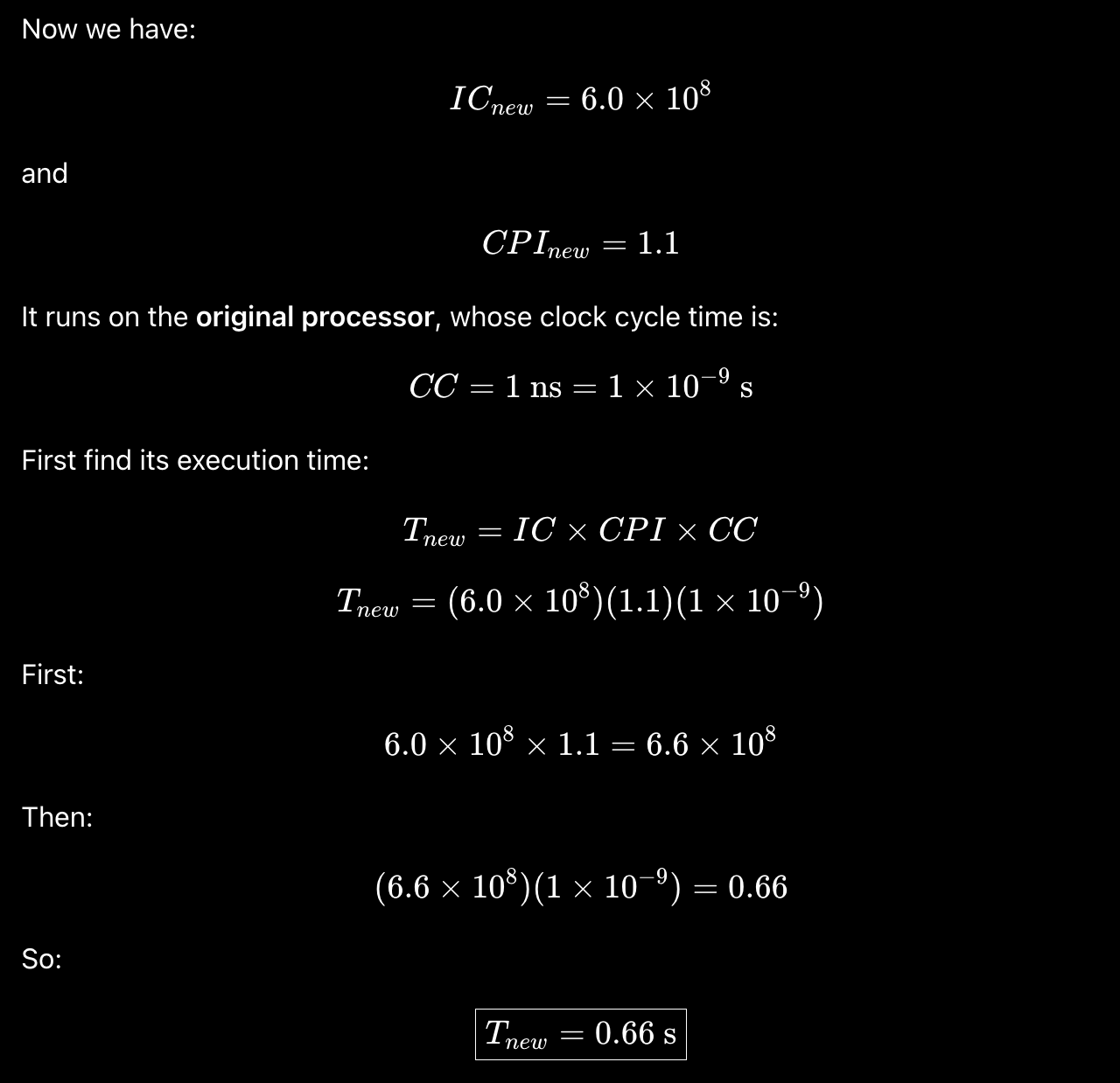
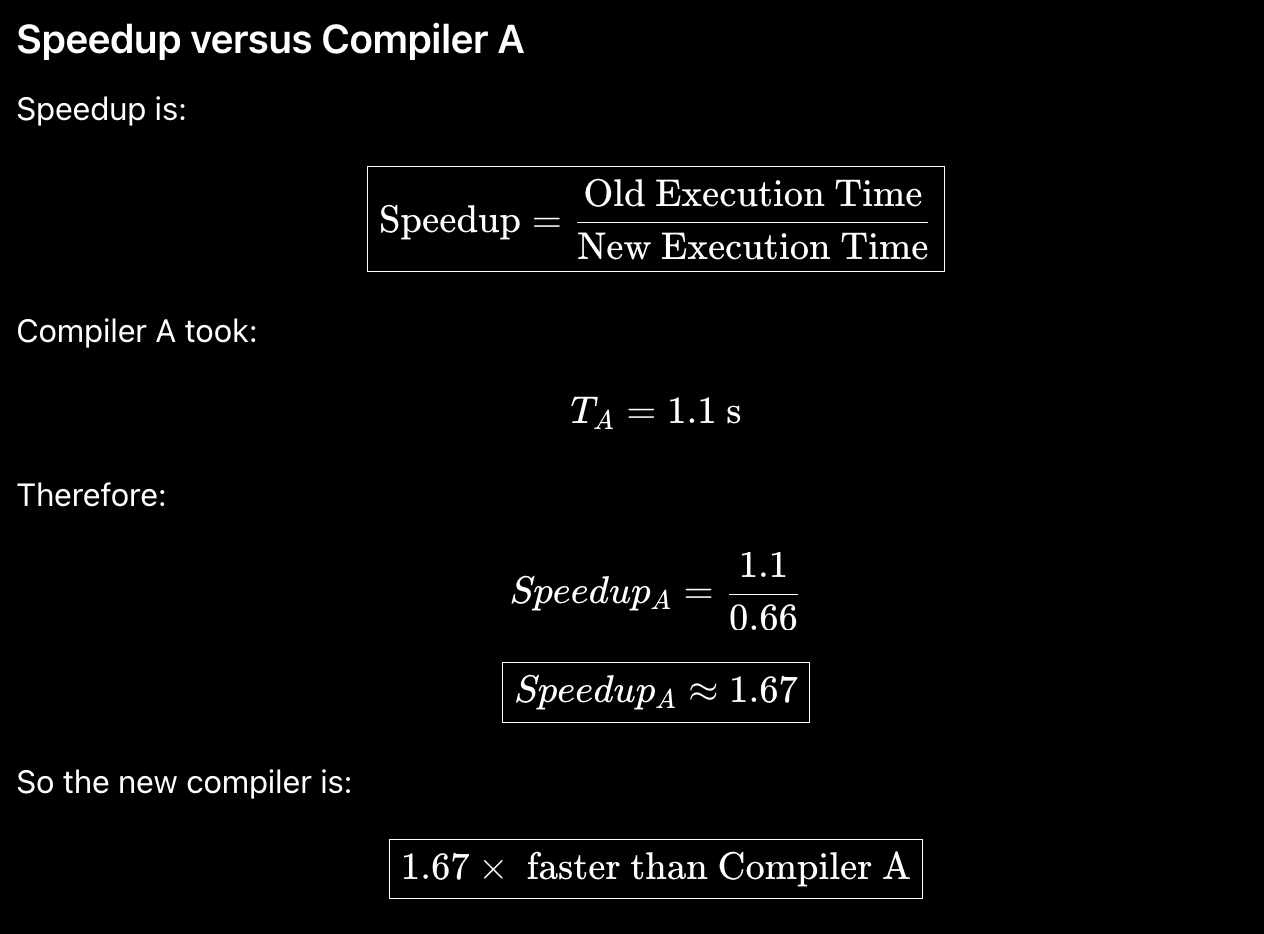
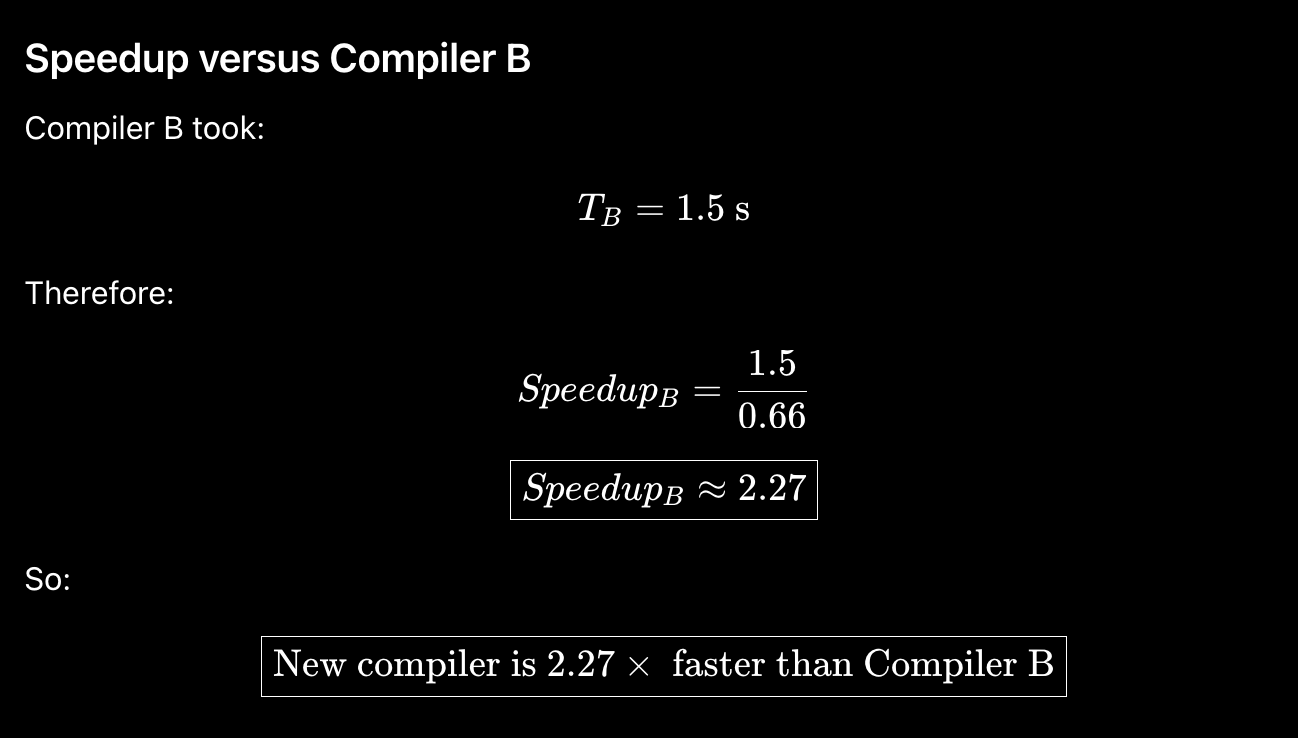
c. A new compiler is developed that uses only 6.0E8 instructions and has an average CPI of 1.1. What is the speedup of using this new compiler versus using compiler A or B on the original processor?
Answer
A)
B)
C)
1.11
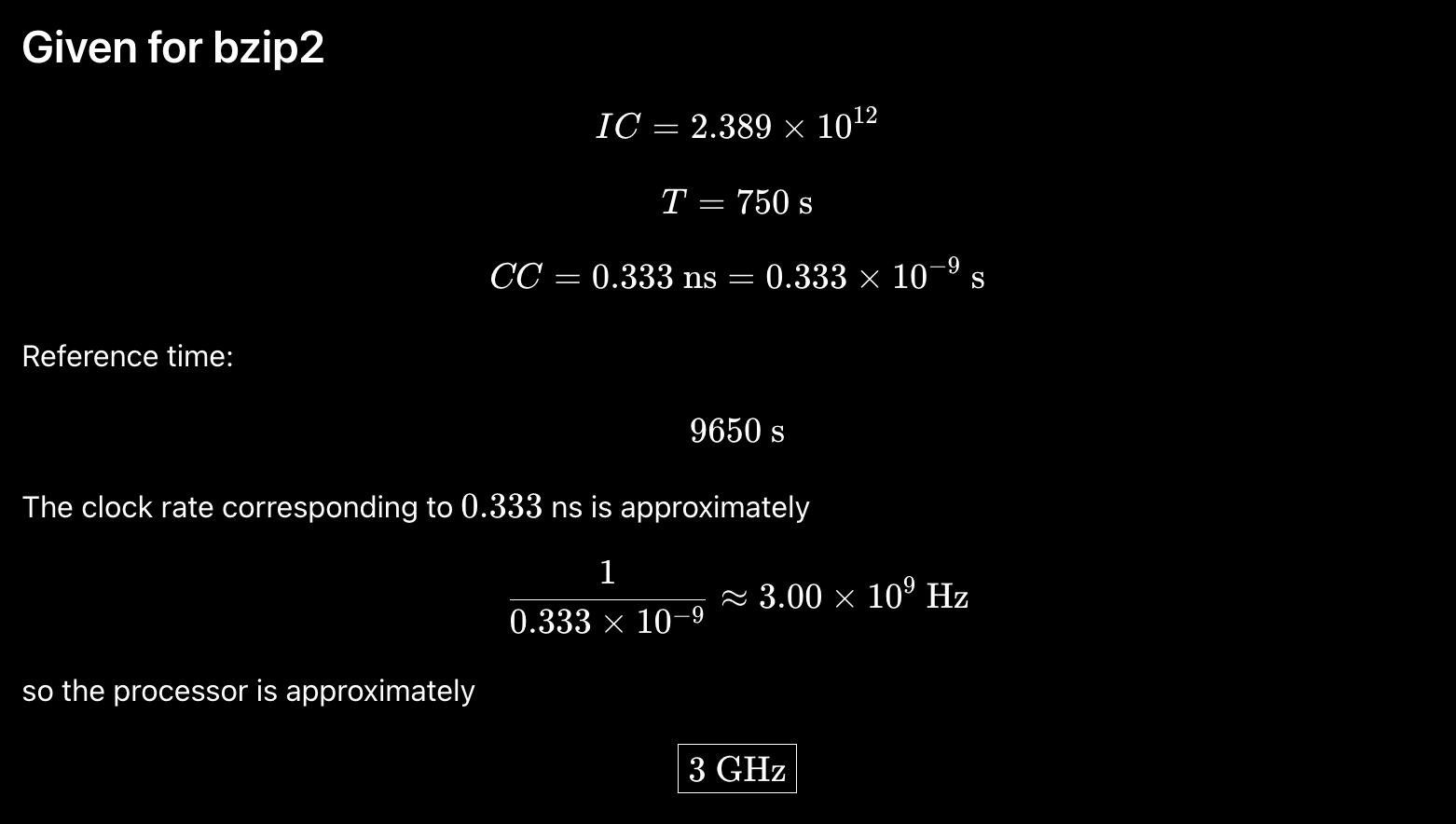
The results of the SPEC CPU2006 bzip2 benchmark running on an AMD Barcelona has an instruction count of 2.389E12, an execution time of 750 s, and a reference time of 9650 s.
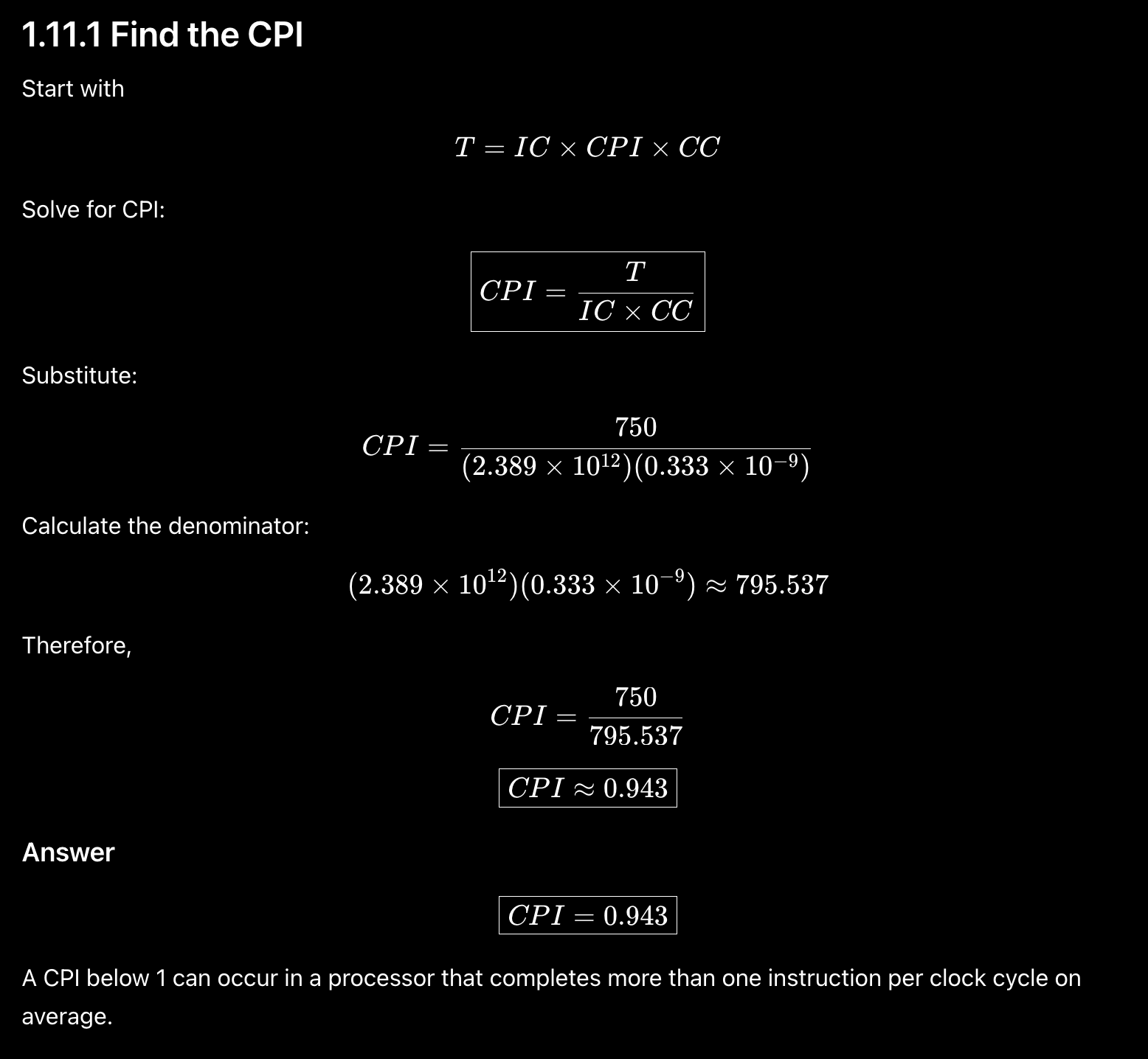
1.11.1.
Find the CPI if the clock cycle time is 0.333 ns.
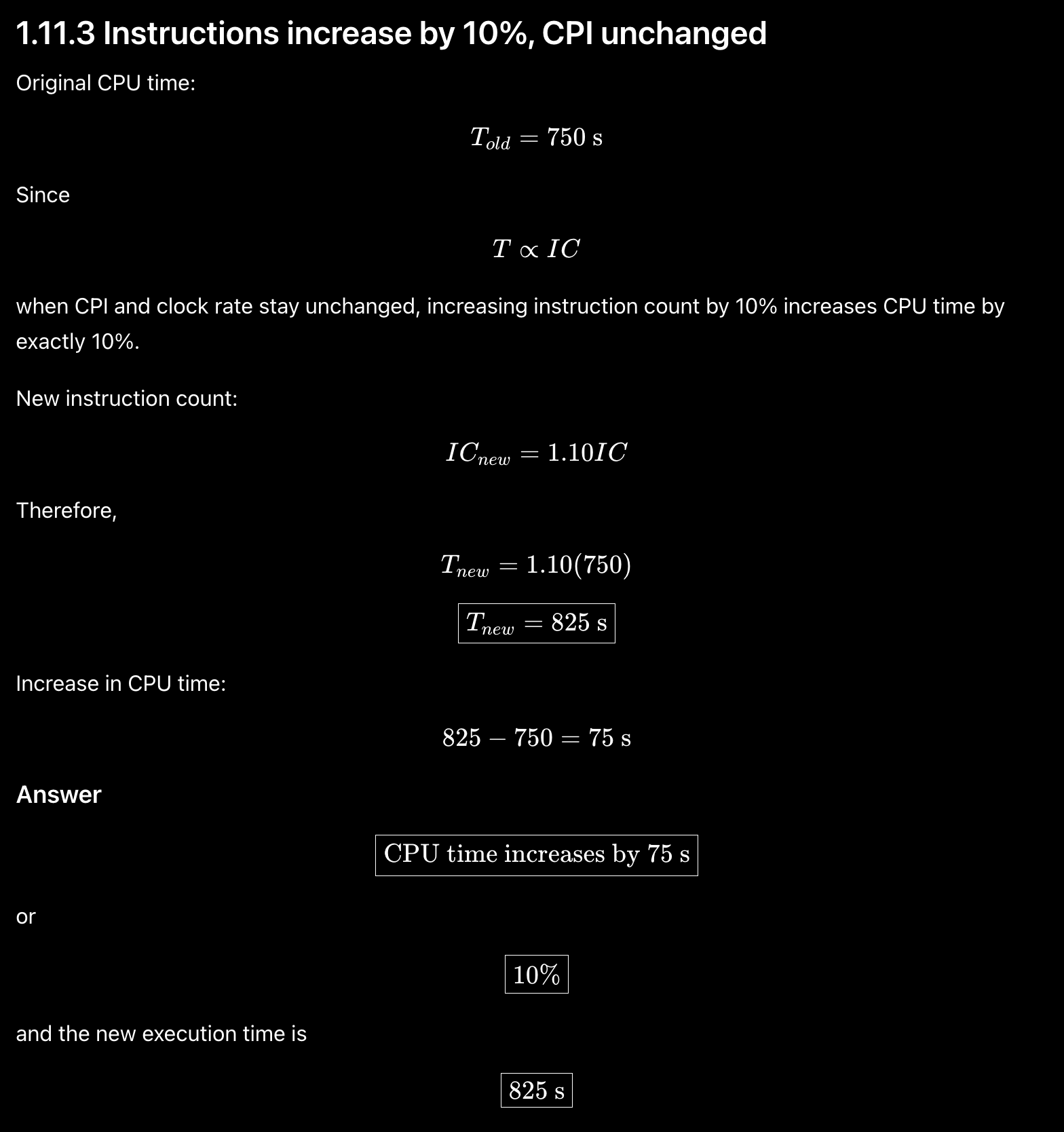
1.11.3.
Find the increase in CPU time if the number of instructions of the benchmark is increased by 10% without affecting the CPI.
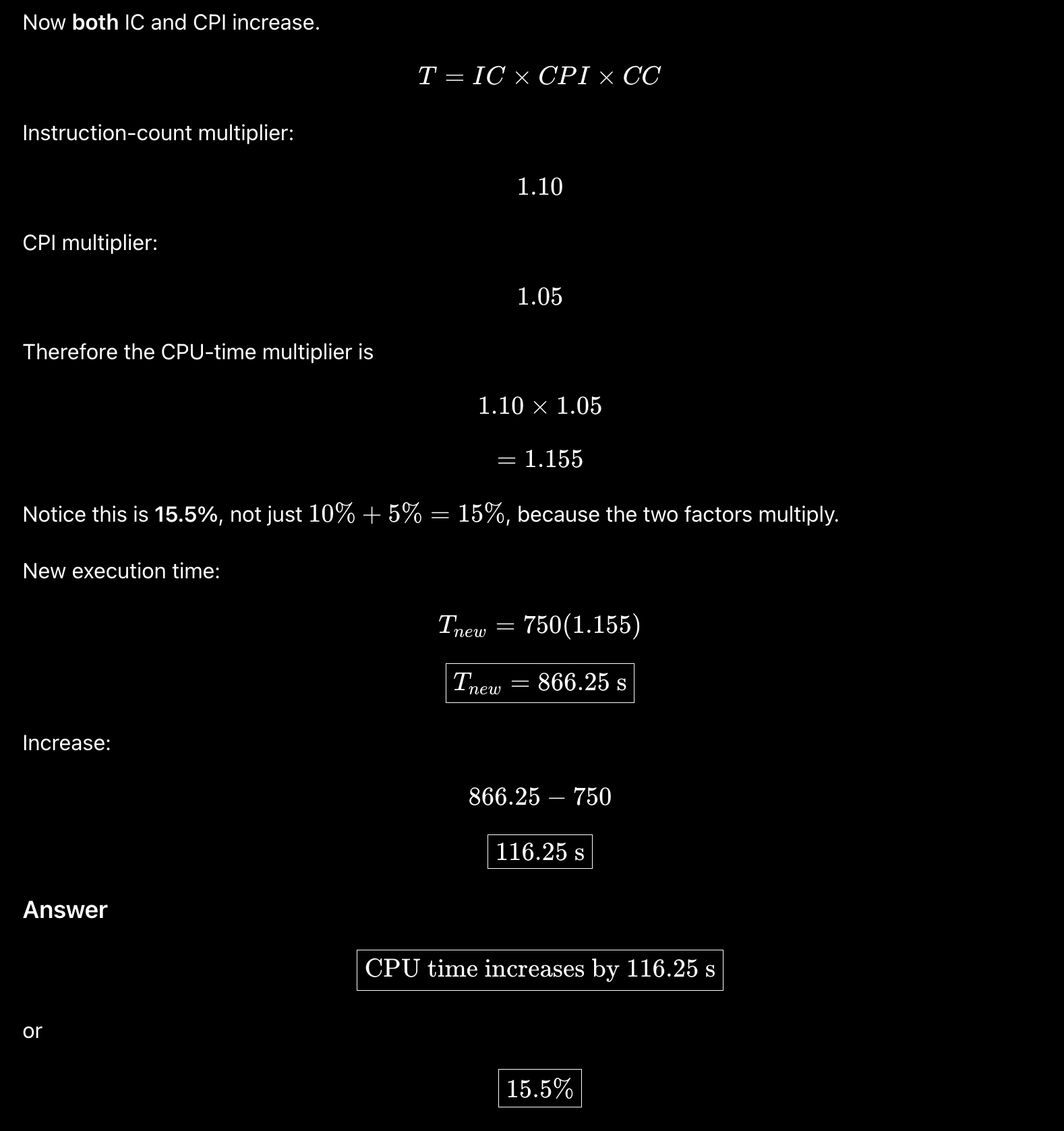
1.11.4.
Find the increase in CPU time if the number of instructions of the benchmark is increased by 10% and the CPI is increased by 5%.
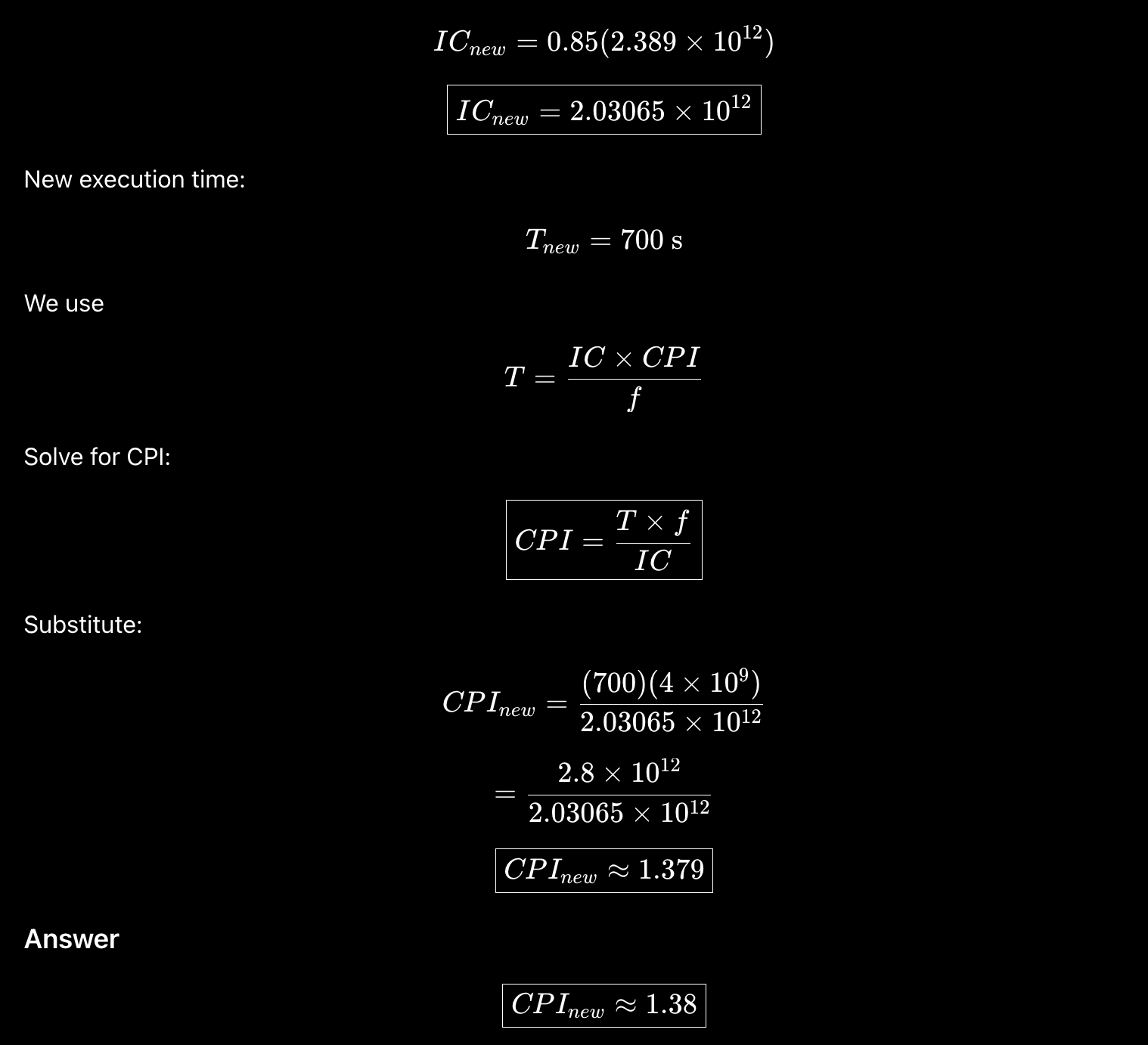
1.11.6.
Suppose that we are developing a new version of the AMD Barcelona processor with a 4 GHz clock rate. We have added some additional instructions to the instruction set in such a way that the number of instructions has been reduced by 15%. The execution time is reduced to 700 s and the new SPECratio is 13.7. Find the new CPI.
15% reduce 면 0.85를 곱해야한다

spec ratio: 필요하진 않는데 그냥 참고해라
1.11.7.
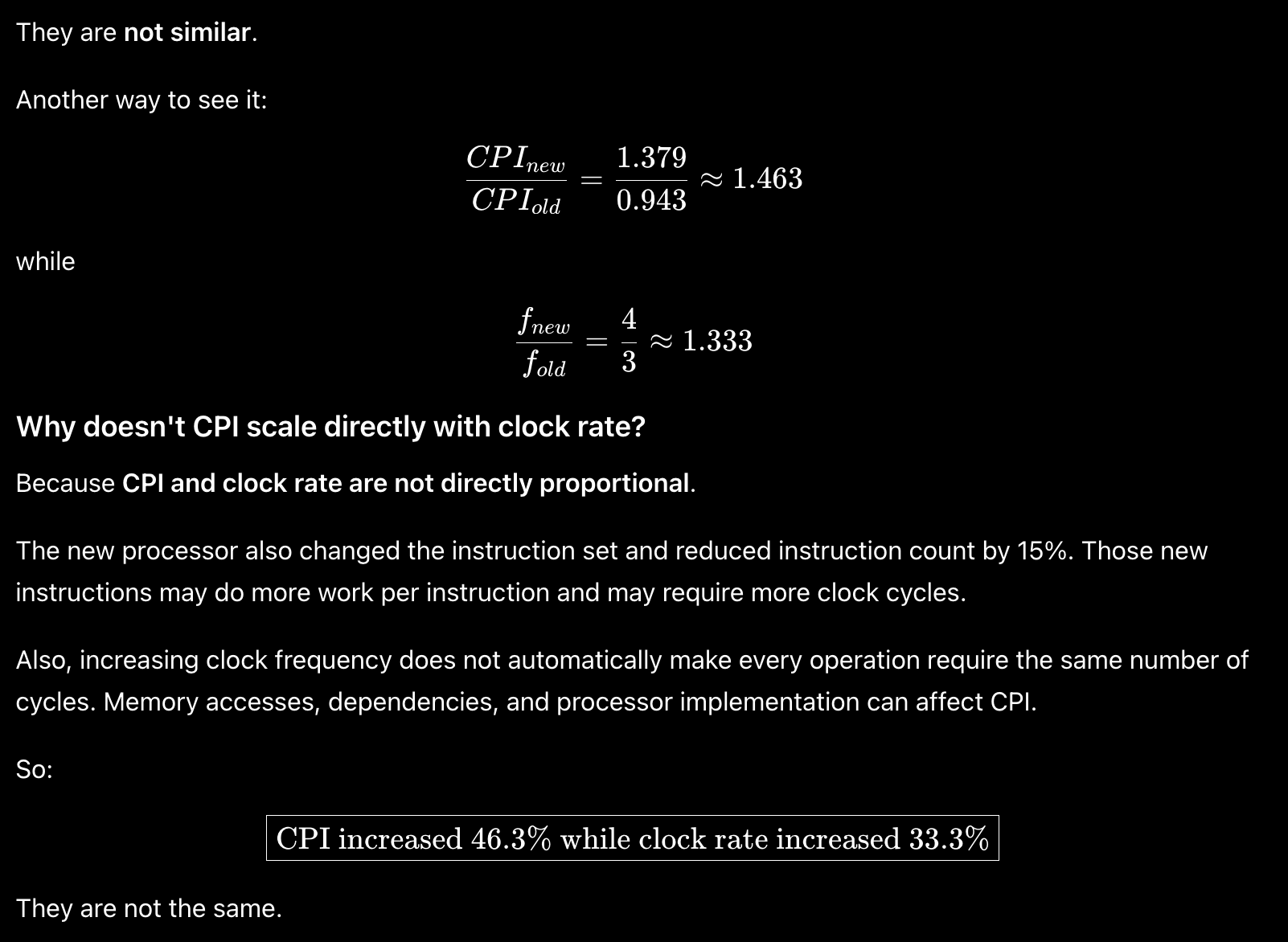
This CPI value is larger than obtained in 1.11.1 as the clock rate was increased from 3 GHz to 4 GHz. Determine whether the increase in the CPI is similar to that of the clock rate. If they are dissimilar, why?
1.11.9.
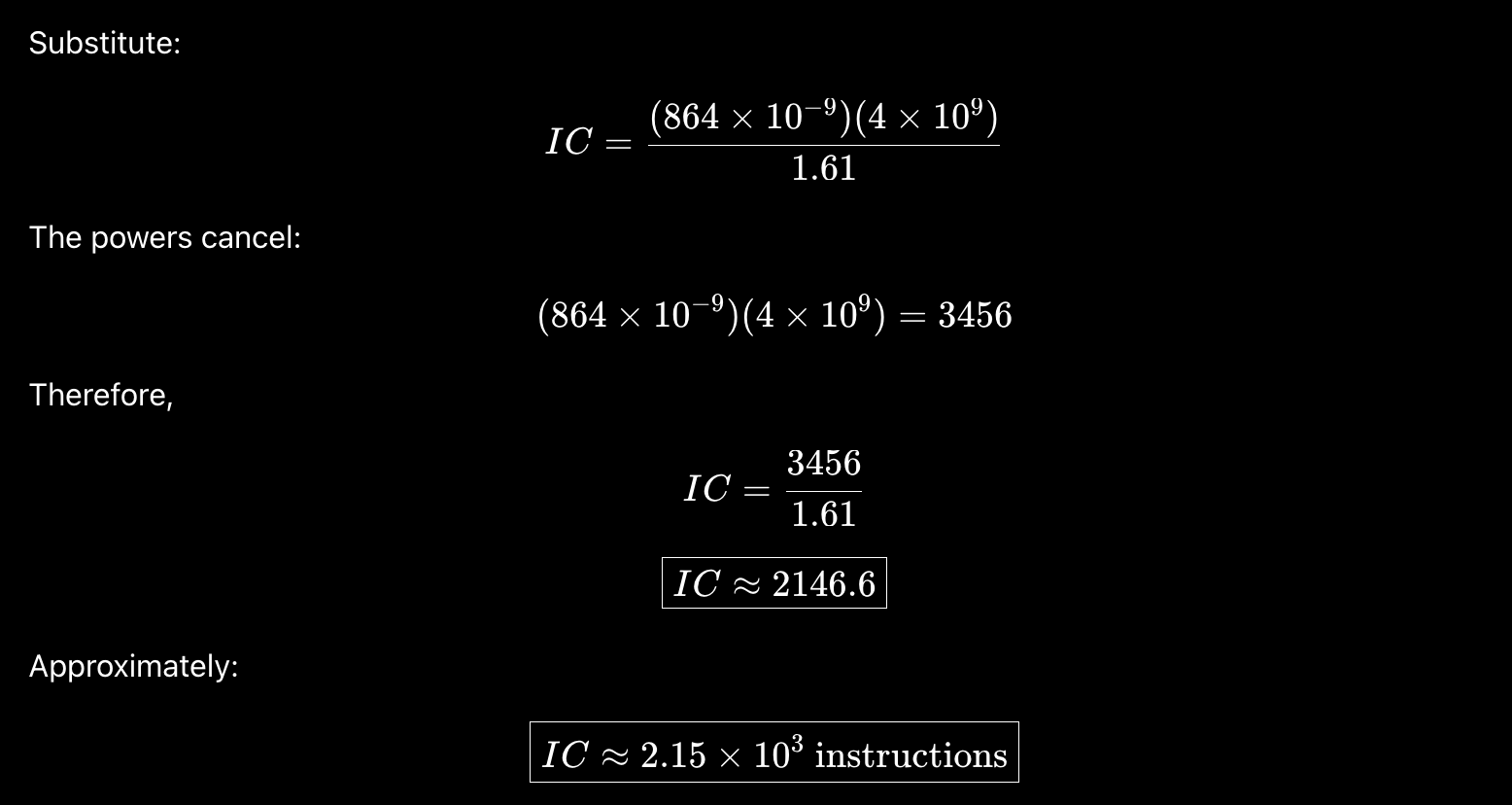
For a second benchmark, libquantum, assume an execution time of 960 ns, CPI of 1.61, and clock rate of 3 GHz. If the execution time is reduced by an additional 10% without affecting to the CPI and with a clock rate of 4 GHz, determine the number of instructions.

1.11.10.
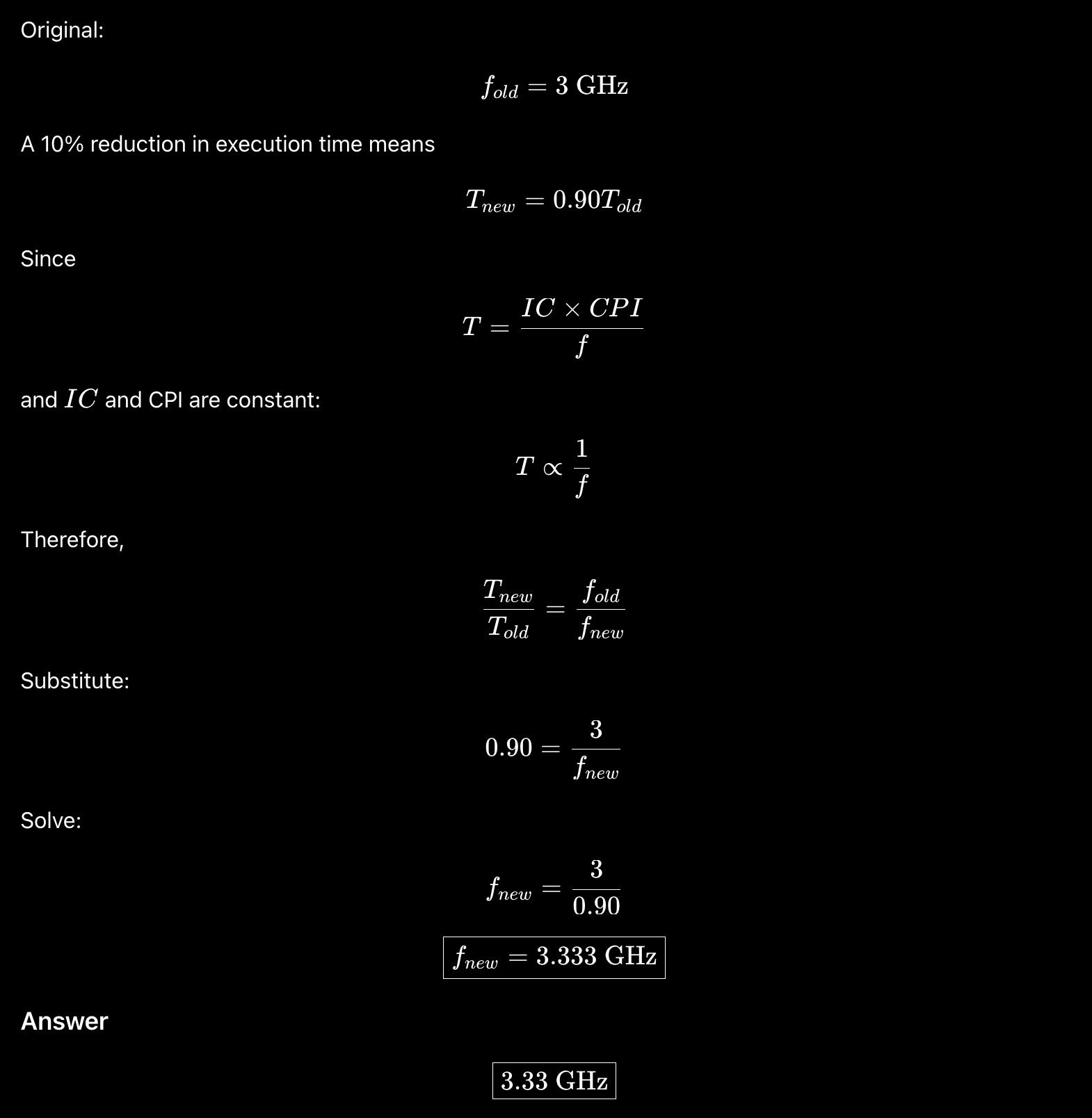
Determine the clock rate required to give a 10% reduction in CPU time while maintaining the number of instructions and with the CPI unchanged.
1.11.11.
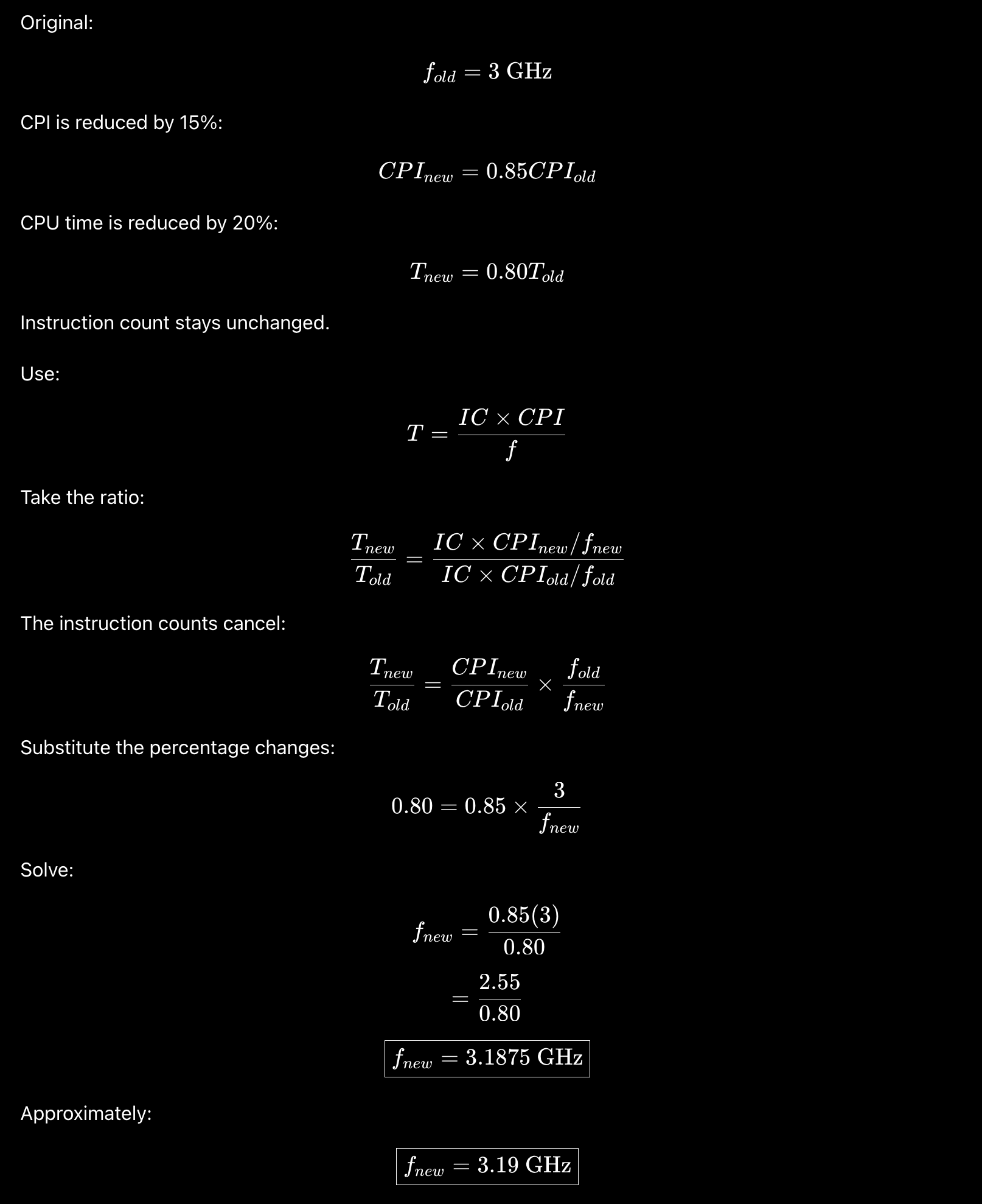
Determine the clock rate if the CPI is reduced by 15% and the CPU time by 20% while the number of instructions is unchanged