The optimized software can greatly reduce the miss rates
Instructions
- Reorder procedures in memory so as to reduce conflict misses, without affecting correctness
- Profiling to look at conflicts(using tools they developed)
- Entry point of basic block at the beginning of a block
- Branch straightening
Data
- Merging Arrays: improve spatial locality by single array of compound elements vs. 2 arrays
- Loop Interchange: change nesting of loops to access data in order stored in memory
- Loop Fusion: Combine 2 independent loops that have same looping and some variables overlap
- Blocking: Improve temporal locality by accessing “blocks” of data repeatedly vs. going down whole columns or rows
1. Merging Arrays
// Before: 2 sequential arrays //
int val[SIZE];
int key[SIZE];

//After: 1 array of stuctures //
struct merge {
	int val;
	int key;
};

struct merge merged_array[SIZE];
Reducing conflicts between val & key (they might conflict for a single block in the cache); improve spatial locality when they are accessed in a interleaved fashion
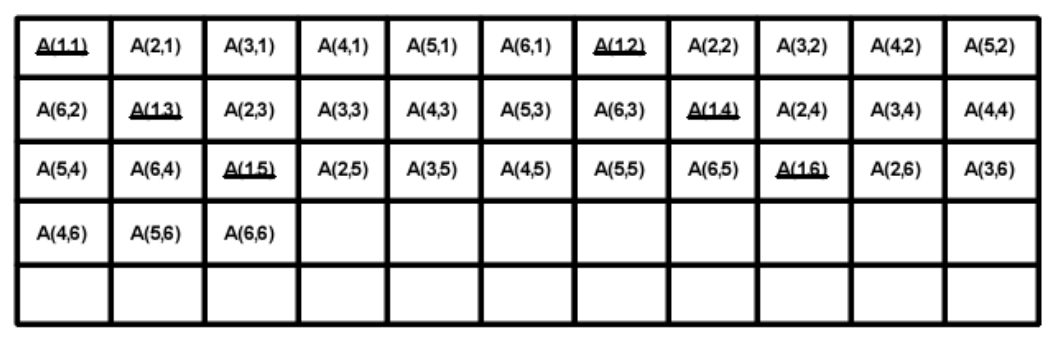
Colum order:
store first colum, then second colum, then third….
Example:
– 6x6 array A
– Each element 1 word
– Block size: 4 word
– For i=1 to 6; X+= a[1,i]; how many blocks are loaded into cache
For final
you need to know how many misses in this pic
and prof will give the code
Row order:
store first row, then second row, then third….
Example:
– 6x6 array A
– Each element 1 word
– Block size: 4 word
– For i=1 to 6; X+= a[1,i]; how many blocks are loaded into cach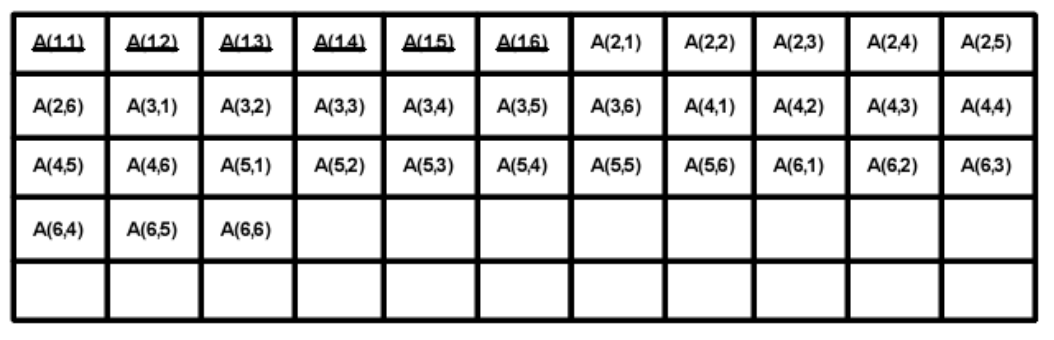
2. Loop Interchange Example
Assume the array storage is in row order
for (k = 0; k < 100; k = k+1)
	for (j = 0; j < 100; j = j+1)
		for (i = 0; i < 5000; i = i+1)
			x[i][j] = 2 * x[i][j];

/* After */
for (k = 0; k < 100; k = k+1)
	for (i = 0; i < 5000; i = i+1)
		for (j = 0; j < 100; j = j+1)
x[i][j] = 2 * x[i][j];- Sequential accesses instead of striding through memory every 100 words; improved spatial locality
3. Loop Fusion Example
/* Before */
for (i = 0; i < N; i = i+1)
	for (j = 0; j < N; j = j+1)
		a[i][j] = 1/b[i][j] * c[i][j];

for (i = 0; i < N; i = i+1)
	for (j = 0; j < N; j = j+1)
d[i][j] = a[i][j] + c[i][j];- Many programs have separate loops that operate on the same data
- Combining these loops allows a program to take advantage of temporal locality by grouping operations on the same (cached) data together.
 /* After */
for (i = 0; i < N; i = i+1)
	for (j = 0; j < N; j = j+1)
		{ a[i][j] = 1/b[i][j] * c[i][j];
d[i][j] = a[i][j] + c[i][j];}- 2 misses per access to a & c vs. one miss per access; improve temporal locality
4. Blocking
행렬 곱셈처럼 큰 데이터를 쓰는 작업에서, 행이나 열을 끝까지 쭉 훑지 않고 캐시에 쏙 들어가는 작은 정사각형 조각(블록) 을 하나 정해요. 그 조각을 여러 번 다 쓴 다음에 다음 조각으로 넘어가요.
비유: 시험공부할 때 책 10권을 동시에 펴서 한 줄씩 왔다 갔다 하지 않고, 한 챕터를 책상에 펴 놓고 끝낸 뒤 다음 챕터로 가는 것.
Prefetching
Idea: fetch data into the cache before processors request them
- Can address cold misses
- Can be done by the programmer, compiler, or hardware
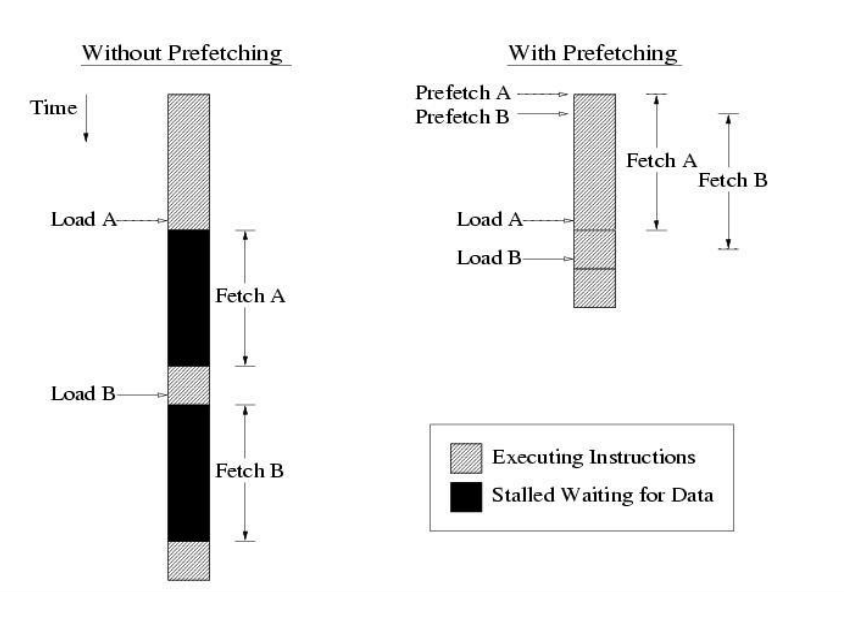
필요해지기 전에 미리 캐시로 가져오는 것이에요. 프로그래머, 컴파일러, 하드웨어 누구든 할 수 있어요. 처음 쓰는 데이터라서 어차피 나는 미스(cold miss)도 막을 수 있어요.
Characteristics of ideal prefetching
You only prefetch data that are truly needed
- Avoid bandwidth waste

You issue prefetch requests early enough
- To hide the memory latency

You don’t issue prefetch requests too early
- To avoid cache pollution
Prefetching relies on having extra memory bandwidth that can be used without penalty
Prefetching Terminology
- Prefetch Hit: Prefetched line that was hit in the cache before being replaced (miss avoided)
- Prefetch Miss: Prefetched line that was replaced before being accessed
- Prefetch Rate: Prefetches per instruction (or 1000inst.)
Accuracy: Percentage of prefetch hits to all prefetches - Coverage: Percentage of misses avoided due to prefetching
100 x (Prefetch Hits / (Prefetch Hits + Cache
Misses))
Classification of Prefetched Lines
Useful Prefetch
- Prefetch hit before being replaced
- Results in avoiding a cache miss
Useless Prefetch
- Prefetch is replaced before being accessed (prefetch miss)
- Downside: Increases demand for cache bandwidth, power
Harmful Prefetch
- Prefetch is replaced before being accessed AND
- Prefetch replaces a line that is requested later (cache pollution)
- Results in an additional cache miss
- power