요즘 RLHF의 분야에서 human preference 데이터의 한계를 뛰어넘고자 하는 self-evolve 아이디어가 많이 나오는 것 같습니다.
오늘 읽어볼 Self-Evolved Reward learning for LLms도 유사한 맥락입니다.
(참고로 이 논문은 제 벨로그의 '연구 주제 찾기(1)'의 To-do에서 언급한 논문 중 하나입니다. )
그럼 리뷰를 시작하겠습니다!
Abstract
- RLHF의 핵심은 RM을 훈련시키는 것 ← human experts/AI system가 제공한 label에 의존
- language model이 발전하면서 human input이 LM의 성능을 높이는데 덜 효과적이게 됨.
- 본 논문에서는 RM이 training data를 생성해 학습하는 Self-Evolved Reward Learning(SER) 제시.
- 실험의 데이터셋: HH-RLHF, UltraFeedback
- 실험에서 사용한 모델: Mistal, Llama3
- Resources of paper: https://microsoft.github.io/DKI_LLM/ser/ser_index.html
6. Conclusion
- SER을 통해
- 모델이 labeled data를 생성
- 적절한 데이터를 선택하도록 모델의 학습 상태 조절
➡️ 뛰어난 성능을 내는 iterative evolution 이뤄냄
➡️ self-improvement of LLMs의 insight를 제공
1. Introduction
기존의 RLHF
- human preference로부터 RM 학습 → learned RM is frozen to tain LLM via RL such as PPO
- RM 학습 없이 human preference로부터 train LLM such as DPO
- 위 방법들의 한계
- human-annotated preference data에 의존
→ 이 데이터들은 제한적이고 비쌈
→ RL 발전에 제약 & LLM의 scalability를 발휘할 수 없게 함.(여기서 scalability: 많은 데이터로 높은 성능을 내는 것)
- human-annotated preference data에 의존
- 한계를 극복하기 위한 해결책
- RLAIF: Reinforcement Learning from AI Feedback
- RLAIF의 한계:
- RLAIF도 LLM이 높은 질의 feedback을 낼 수 있다는 가정을 함
- feedback을 위해선 stronger LLM이 필요함
최근 발전 및 본 논문의 제안
-
LLM이 인간의 입력 없이 세계 지식과 복잡한 패턴을 이해할 수 있다는 word model로서의 능력이 있다고 제안.
→ 이 능력을 RLHF & RLAIF까지 확장; RM에서의 역할을 확장→ 본 논문에서는 더 적은 human-annoated data를 기반으로 feedback loop을 통해 RM이 self-evolve하는 방법 제안
- LLM이 RM으로 동작하며 dataset에 기반한 feedback 산출
- feedback-then-train 루프를 통해 RM이 self-evolve 가능해짐.
- iteration 과정에서 유사한 데이터가 성능 저하를 불러올 수 있기에 RM의 학습 상태를 구별 → 데이터 선별 전략을 사용 for robost RM training
본 논문의 contributions
- 15%의 human-annotated seed data를 가지고 full human-labeled dataset으로 학습시킨 모델과 견줄만한 성과 이룸.
- self-learning paradigms in LLM에 insight 제공
특히 RM 향상에서 - 다양한 실험을 통해 various LLM, model sizes dataset 에 걸친 성능 향상을 증명
2. Related work
2.1 Reinforcement Learning from external feedback
기존 RL의 한계들이 제시됩니다. 위에서 말했던 걸 다시 자세하게 언급합니다.
- RLHF의 방법
- 방법 1
- human preference data로부터 fixed RM 훈련시킴
- trained RM은 PPO 같은 RL을 통해 LLM을 훈련시키는 데 사용
- 방법 2
- DPO가 human preference data를 이용해 RM training 없이 바로 LLM 훈련시킴.
- 방법 3
- preference training schemes가 성능과 안정성을 향상시키도록 조정
- 데이터셋으로 인한 기존 RLHF의 한계
- human preference data는 비싸고 시간도 많이 소요됨.
→ data quality & size는 LL의 성능의 bottleneck이였음.
- human preference data는 비싸고 시간도 많이 소요됨.
- RLAIF 도입
- RLHF의 한계를 극복하고자 RLAIF를 도입했음
- 한계:
- LLM이 높은 질의 피드백으 제공한다는 가정에 의존
- 피드백을 제공하기 위해서는 stronger LLM이 필요
2.2 Self-learning in LLMs
- self-learning의 발전
self-learning in LLMs focuses on enhancing capabilities without external supervision.
- self-alignment through principle-driven reasoning
- self-training to enhance problem-solving abilities
- self-correction & improvement using self-generated data
- LLMs refine reasoning through self-generated augmented answers
- self-rewarding
3. Self-Evolved Reward learning for LLMs
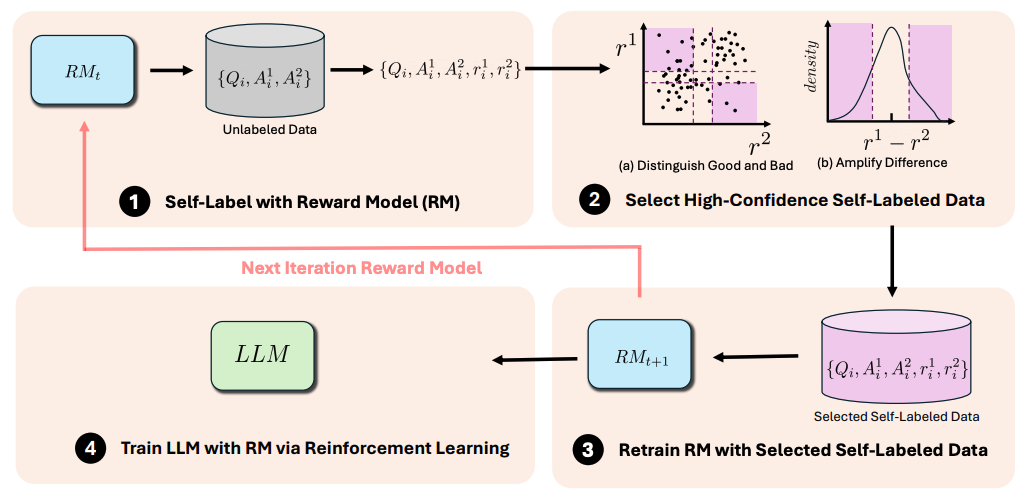
- SER을 통해 RM이 스스로의 예측만으로 학습함으로써 iteratively improve itself하게 됨.
- 간략한 순서는 아래와 같음
-
RM을 작은 human-annotated dataset으로 훈련시킴
-
RM이 self-labeling & iterative retraining를 통해 evolve됨.
-
enhanced RM이 PPO를 통해 LLM 훈련시키는 데 사용
보다 자세한 과정과 구성요소는 아래에서 설명하겠습니다.
3.1 Overview
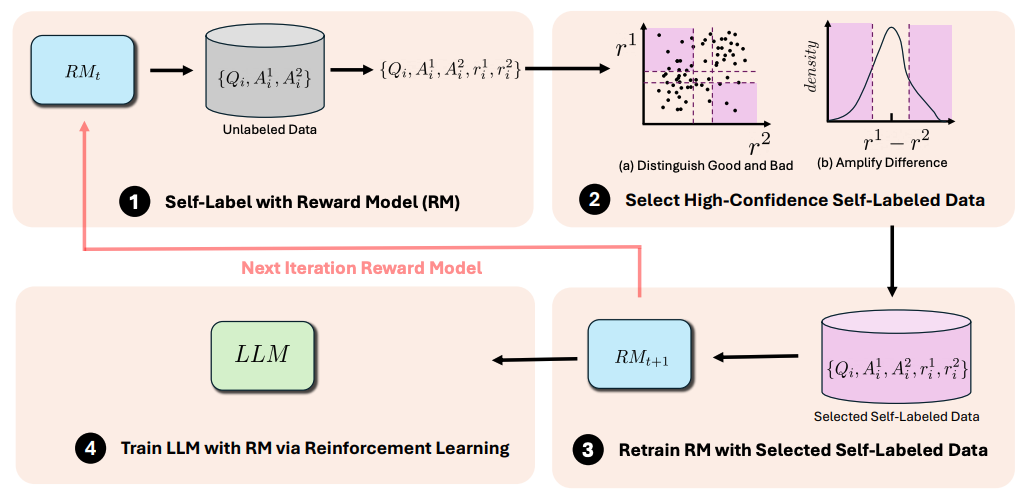
- RM training은 아래의 iterative steps로 이루어짐.
-
self-label with Reward Model
(1) RM이 small set of human-annotated data로 훈련
(2) RM이 unlabeled data에 self-labeling -
Identify the learning status of RM & select high-confidence data
(1) RM이 good/bad answer을 구별하거나 유사한 답변 사이 차이점을 증폭시키는 능력을 평가.
(2)평가를 기반으로 데이터 선정 -
Retrain the RM with pairwise loss
필터링 후, 선정된 데이터들을 pairwise loss와 함께 RM을 재훈련시키는 데 사용됨.
→ 답변의 질을 이해하는 능력 향상
위와 같이 RM training 이후 RM이 PPO를 통해 LLM을 훈련시키는 데 사용됨.
- 2(1)에서 RM의 learning state를 구별하는 이유 3가지
- Targeted skill development
- 다른 learning statuses를 인식 → RM이 특정 skill set에 집중
- 초반: good vs. bad answers 구별
- 중후반: refine with 미묘한 차이
- Adaptive data filtering
- 현재 learning status에 의해 data filtering → 모델이 더 적절한 데이터를 통해 훈련
- Improved self-evaluation
- learning status를 모니터링하며 RM이 learning focus를 결정
- Targeted skill development
Step 1. Self-label with reward model
- human-annotated data로 학습시켜 얻은 seed RM 기반
- unlabeled data(question, answer)에 대해 reward score 예측
Step 2. Identify the learning status of the reward model and select high-confidence data
-
self-labeled dataset은 이렇게 구성됨
-
RM이 이 얼마나 좋은지에 해당하는 가능성을 제시
➡️ -
learnig status S는 의 차이를 이용해 결정됨.
- Status 1 vs. Status 2
| status 1 | status 2 | |
|---|---|---|
| task | easier task | harder task |
| 구별하는 것 | good vs. bad samples | 비슷한 질의 답변 사이 미묘한 변화 |
Step 3. Retrain the reward model with filtered data using pairwise loss
- data filtering strategy는 아래와 같음. 각 status 별 어떤 데이터를 고를지가 제시됨.
-
위 strategy를 통해 filtering을 한 뒤 pairwise loss를 이용해 모델을 재훈련
- : 희망하는 reward score 간 차
-
위 step 1-step 3가 RM이 수렴할 때까지 iterative loop로 반복됨.
Step 4. Train the LLM via RL with self-evolved reward model
앞선 step 1~step 3를 통해 RM을 self-evolving 시켰으니 이제 RL을 이용해 LLM을 훈련시키자!
- policy가 input Q에 대해 response A 생성.
- objective는 RM에 의해 생성되 reward를 극대화하는 방향으로 policy를 최적화
- self-evolved RM이 산출한 기대 reward를 극대화
- policy는 clipped surrogate objective를 최대화하면서 update됨.
- : advantage function based on reward from RM
4. Experiments
4.1 Reward modeling results
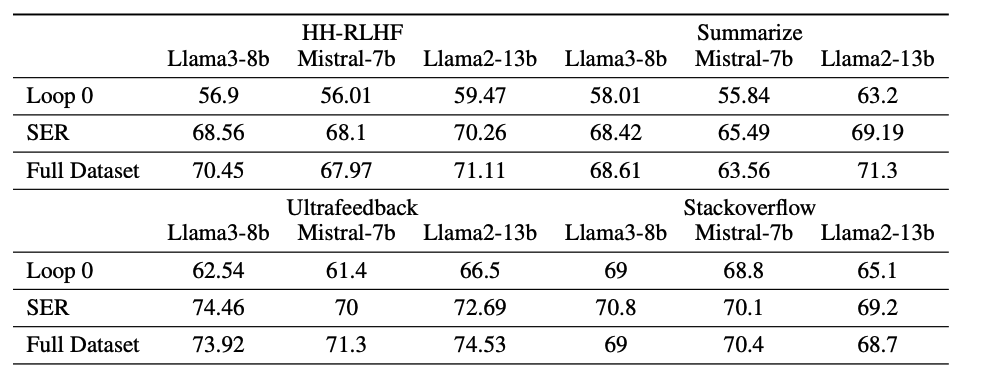
Main findings
- SER consistently and effectively enhances model performance
- SER can approach or even exceed the performance of full-scale human-labeled data
Fine-grained analysis
- The model can iteratively enhances its performance on self-labeled data, or even if the self labeled data contains noise.
- Similar data becomes marginally helpful after multiple iterations and may even harm the model's performance.
- By adjusting the error reduction strategy, more diverse self-labeled data can be obtained, further enhancing the effectiveness of self-learning.
- SER is more data and human-labor efficient than full fine-tuning.
4.2 PPO results
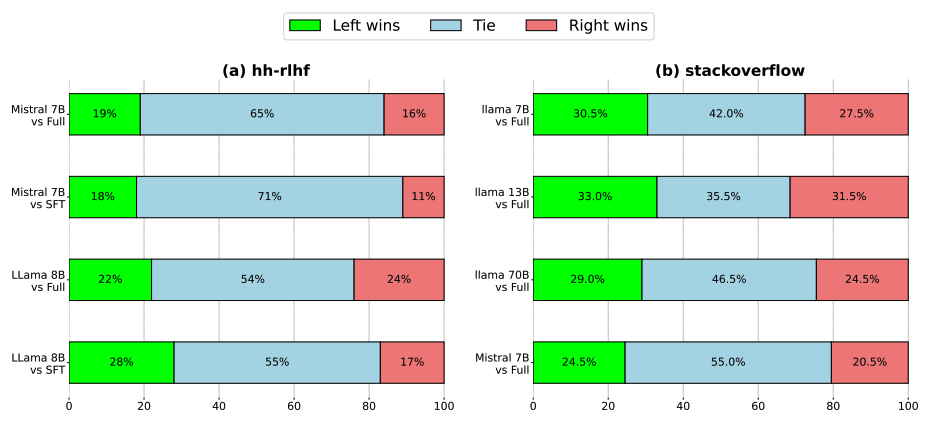
SER enhances the capabilities of LLMs, and the degree of enhancement is positively correlated with the performances of RMs.
5. Discussion
-
미래에는 more robust and autonomous method to identify learning status & filter self-labeled data.
-
generate more diverse responses through LLMs
-
integrate LLMs into the entire self-evolved reward learning loop ← step 4를 loop에 합쳐서 LLM이 RM에 대한 response 생성하도록!
SER에서는 data를 filtering 하는 과정이 굉장히 중요한 것 같다.
filtering 된 data(high confidence sample)를 통해 RM을 다시 훈련시키는 과정이 반복된다.
그리고 최종적으로 self-evolved RM을 기반으로 PPO를 사용해 LLM을 훈련시킨다. 그래서 LLM이 high quality answer을 산출하도록 만든다.