Assessing Time-Varying Causal Effect Moderation in Mobile Health To cite this article: Audrey Boruvka, Daniel Almirall, Katie Witkiewitz & Susan A. Murphy (2018) Assessing Time-Varying Causal Effect Moderation in Mobile Health, Journal of the American Statistical Association, 113:523, 1112-1121, DOI: 10.1080/01621459.2017.1305274 To link to this article: https://doi.org/10.1080/01621459.2017.1305274 Received 01 Jan 2016, Accepted author version posted online: 31 Mar 2017, Published online: 08 Oct 2018
1. Introduction
제안: mHealth inetervention에서 time-varying treatment effect moderation을 인과적으로 정의하고 추정하는 방법
기존 인과추론은 정적인 처치 환경 가정. 모바일 intervetinon에서는 하루에 여러 번 treatment 제공, response 빈번하게 측정, 과거 treatment가 이후의 상태와 availability에 영향. -> treatment effect는 단순 평균 효과가 아니라 시점 t에서의 proximal effect, k 시점 이후의 lag-k effect, moderator에 따라 달라지는 effect를 명확히 정의해야 함.
2. Proximal and Other Lagged Treatment Effects
2.1. Motivating Example
BASICS-Mobile: 대학생의 흡연과 과음을 줄이기 위한 스마트폰 기반
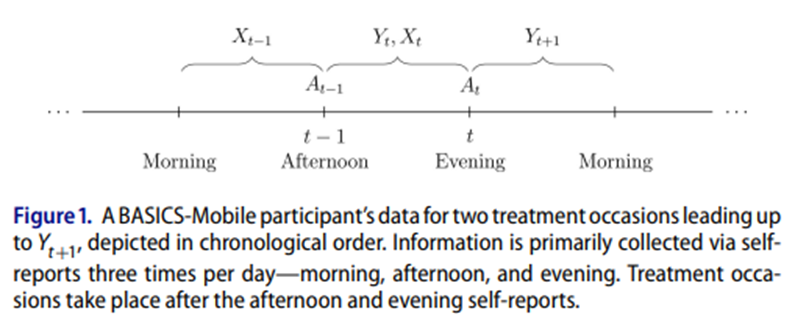
intervention. 하루 세 번 자기보고 받고, 일부 시점에서 mindfulness 메시지 또는 일반 건강 정보 제공.
2.2. Notation and Data
A_t: t번째 치료 시점에서의 치료 (이분형) -> 1: 제공, 0: 미제공
Y_(t+1): 그 이후의 proximal response (연속형) -> 두 자기보고 사이 흡연률
X_t: t 시점의 개인 및 맥락 정보(기분, 이전 반응 요약, 변화량 등) -> 시간대, 최근 보고 횟수, 이전 흡연률, 현재 self-regulate 필요 수준, self-regulate need 증가 여부(1/0)
History: Ht=〖(X ̅〗_t,Y ̅_t,A ̅(t-1))
확률변수/벡터 -> 대문자, realized values(실현값) -> 소문자
2.3. Moderated Treatment Effects
potential outcomes:

예: Y_3 (0,0),Y_3 (0,1),Y_3 (1,0),Y_3 (1,1) …

참고용: past treatment 주어졌을 때 history.
proximal effect:

S1t (A ̅(t-1)): H_t에서 선택된 요약 변수 벡터
S_1t에 포함되지 않은 H_t 변수들에 대해 marginalized
S_1t 선택에 따라 다양한 과학적 질문 가능, 공집합이면 fully marginal proximal effect
(1)은 S_1t에 포함되지 않은 A_u(u번째 시점의 treatment)의 분포에 의존 -> 치료 분포에 의존하는 인과 효과
lag k effect:

K >= 1, k = 1 이면 proximal effect
S_kt는 H_t에서 선택된 변수 벡터
T 이후, t + k -1 사이 치료 분포에 대해 평군화됨
(2)의 인과효과는 SNMM(structural nested mean model (SNMM; Robins 1989, 1994, 1997)) treatment blip의 일반화
A Lagged Treatment Effects
A.1 Connection to Treatment Blips in the Structural Nested Mean Model
SNMM: reference treatment regime는 비확률적(예: 이후 treatment 전부 0).
논문에서는 t 이후 치료 실제 데이터 확률대로.

T 시점 proximal blip.

u 시점에서 treatment 바꿔봤을 때 t+1 반응이 얼마나 달라지는지?
일관성 + sequential ignorability 가정 하에서

임. -> blip은 조건부 평균 0을 가지는 추가 효과 성분.

(2)랑 똑같음.

실제 데이터 확률대로 치료했을 때 평균 + u시점 치료가 추가로 만든 효과 + nuisance functions

어쨌든 lag k effect는 이렇게 나타냄.
S_kt=H_t이면

이렇게 단순화.
3. Estimation
Treatment effect 선형 모형 가정, 서로 다른 lag k는 서로 제약하지 않음.
가정1:

T 시점에서 치료 받았을 때랑 안 받았을 때 차이를 S_kt에 따라 평균낸 것 = 오른쪽식. β_k가 우리가 추론하려 하는 treatment effect parameter.
가정2: mrt 상황임. Treatment는 순차적으로 무작위 배정.
가중치:
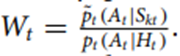
중심화: treatment effect의 추정과 보조함수 parameter 추정 사이에 직교성 만듦. 보조모형 틀려도 β_k는 일관성 유지하게.
Working model:

g_kt (H_t): 보조 특징 벡터
a_k: nuisance parameter
centered and weighted least-square Estimating equation:
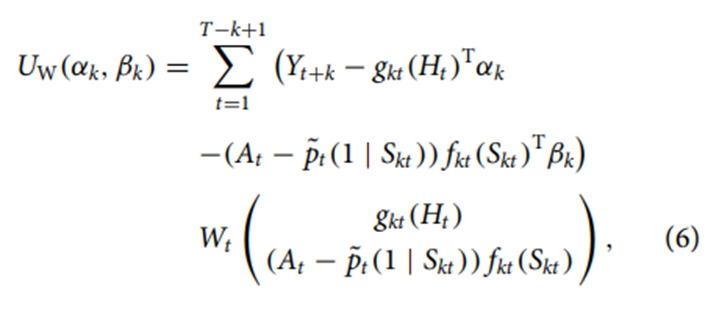
이걸 0으로 두고 풀면 (α_k,β_k ) 추정.
4. Availability
Availability 포함한 treatment effect linear model

5. Implementation
The weighting and centering estimation method는 GEE 소프트웨어를 사용할 수 있으나 반드시: 1) prior weights에 I_t W_t 사용, 2) independence working correlation(corstr="independence") 사용
검정: t distribution or a Hotelling’s T-squared distribution -> 선형은 c⊺β_k=0, multivariate는 z⊺β_k=0
6. Simulation Study
generative model:

세 가지 실험.
- 중요한 moderator가 존재하는데 GEE가 무시하면?
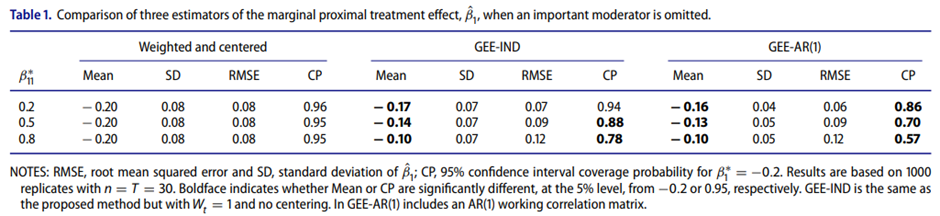
GEE는 biased, weighted and centered는 unbiased, coverage 95% 유지
- weight numerator를 어떻게 선택하느냐
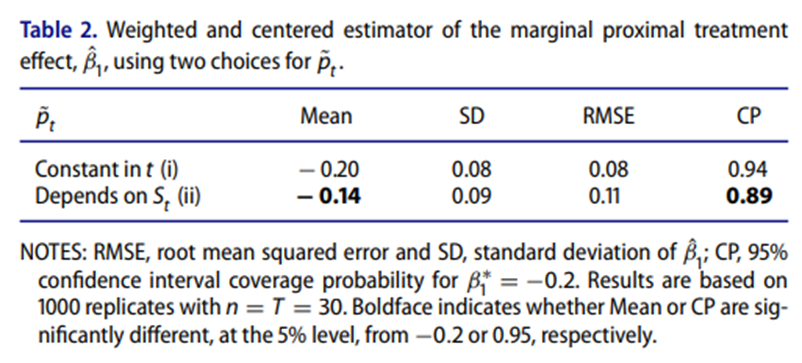
p ̃_t: 1) 상수 -> unbiased, 2) S_t에 의존 -> bias (coverage 89%)
- non-independent working correlation 쓰면?
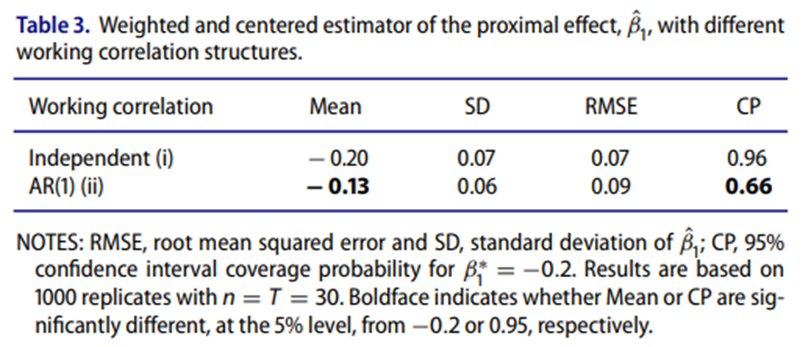
Independent -> unbiased, AR(1) -> bias, coverage 66%
7. Application
BASICS-Mobile, n = 28, T = 28
MRT도 아니고 observation study도 아님. Treatment는 현재 흡연 urge, 초기 3회 시점 여부, 기타 변수 등에 의해 결정됨. 분석에서는 관찰 연구로 간주함.

로지스틱 회귀로 추정.
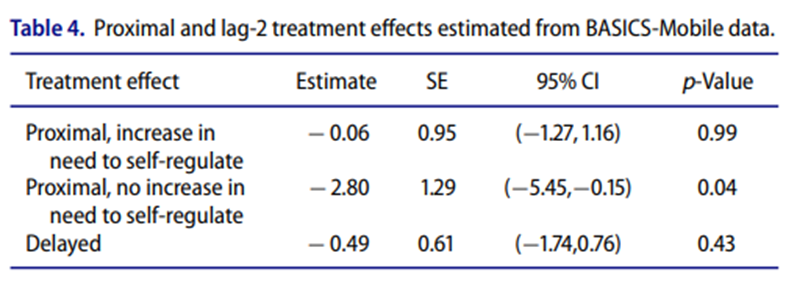
proximal effect: self-regulate need가 증가하지 않은 경우에만 흡연율 감소.
lag-2 effect: 유의하지 않음
8. Discussion
빈번한 측정과 빈번한 처치 제공이 가능한 mobile intervention에 적합한 treatment effect 정의. 효과 정의에 assigned treatment 메커니즘이 포함.
GEE는 가중치 보정 없이는 β_k를 일관되게 추정한다고 보장할 수 없음. 편향 가능성이 있음.
nonindependence working covariance structure가 항상 좋은 건 아님. Time-varying covariate 상황에서는 bias 발생 가능.
향후 과제: 1) 다범주 치료 확장, 2) 이항 반응 확장, 3) 누적 효과 정의, 4) penalized 방법 도입, 5) MRT 중심이지만 관찰 연구와 통합 필요, 6) longitudinal 대신 time-series 또는 Markov process 접근 가능