Lecture 2.1 - Traditional Feature-based Methods: Node
Traditional ML Pipeline
- Desgin features for nodes/links/graphs
- Obtain features for all training data
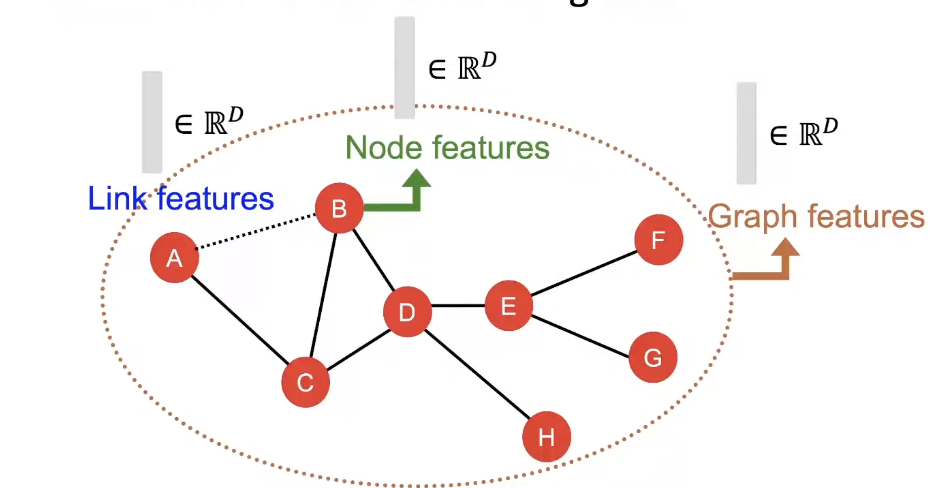
- Structural feature에 집중해서 알아본다. Network의 주변에 무엇이 있는지, 전체적인 graph의 특징은 무엇인지..
Train an ML model - Random forest
- SVM
- Neural network, etc
Apply the model - Given a new node/link/graph, obtain its features and make a prediction
This Lecture: Feature Design
- Using effective features over graphs is the key to achieving good test performance.
- Traditional ML pipeline uses hand-designed features
- In this lecture, we overview the traditional features for:
- Node-level prediction
- Link-level prediction
- Graph-level prediction
- For simplicity, we focus on undirected graphs.
Machine Leraning in Graphs
- Goal : Make predictions for a set of objects
- Design choices
Features : d-dimensional vectors
Objects : Nodes, edges, sets of nodes, entire graphs
Objective function : What task are we aiming to solve?
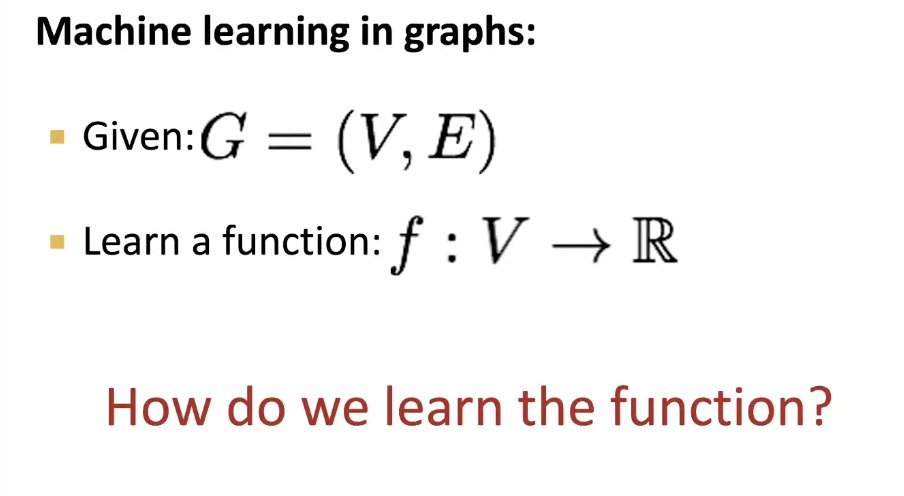
- 해당 함수를 어떻게 학습시킬것인가????
Node-level Tasks
- Node classification → ML needs features
- Goal : Characterize the structure and position of a node in the network: node degree, node centrality, clustering coefficient, graphlets
Node Degree
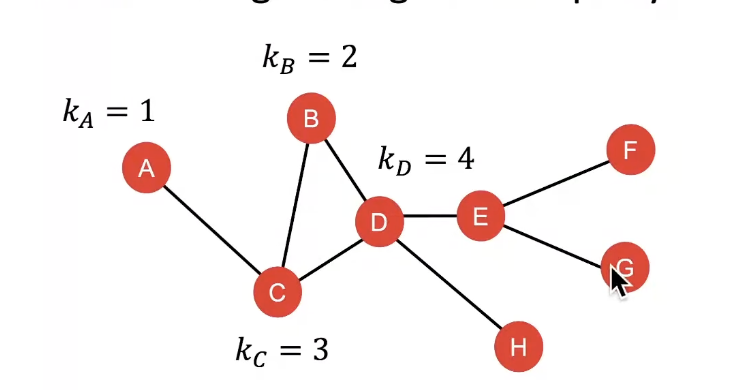
- The degre k_v of node v is the number of edges (neighboring nodes) the node has.
- Treats all neighboring nodes equally
Node Centrality
- Node degree counts the neighboring nodes without capturing their importance.
- Node centrality c_v takes the node importance in a graph into account
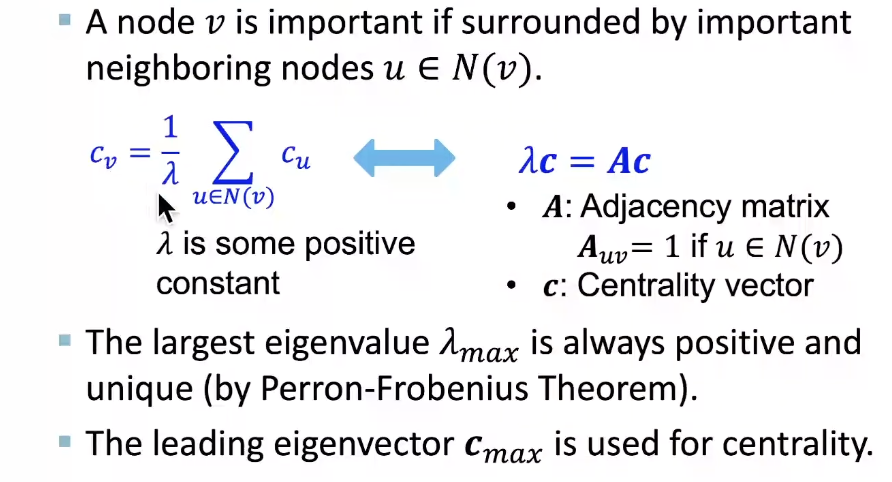
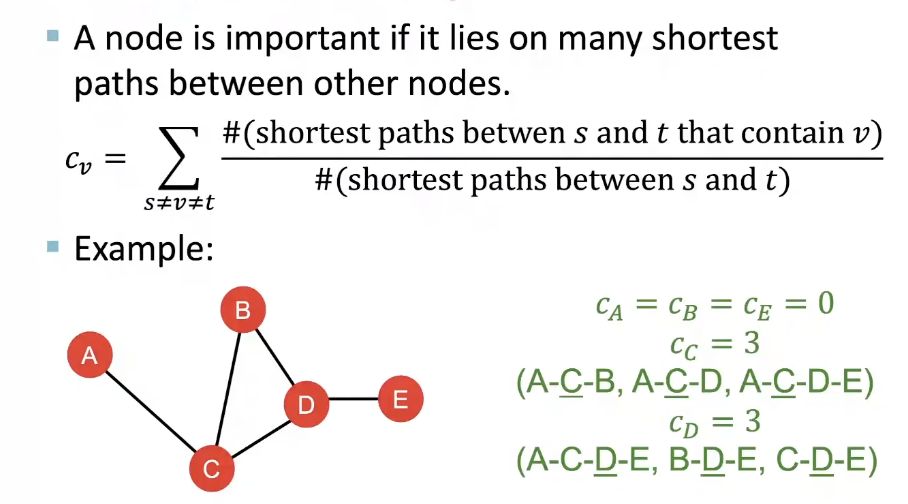
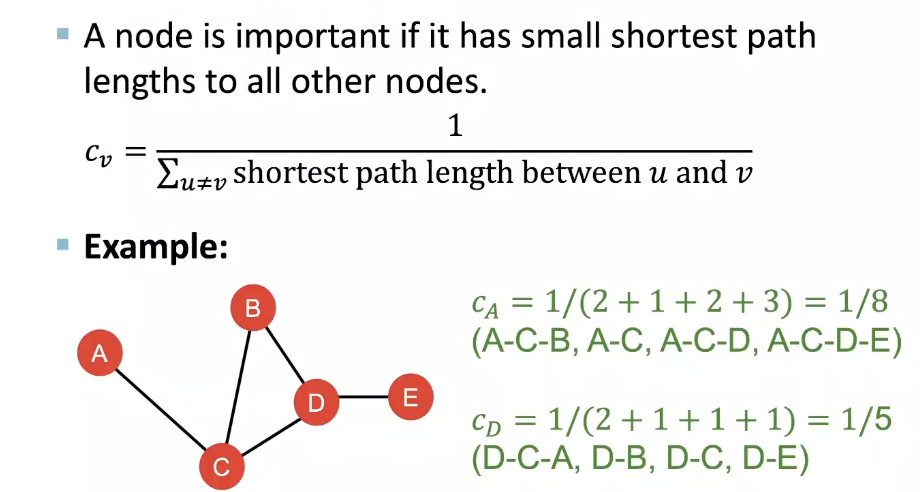
- Engienvector centrality, Betweenness centrality, Closeness centrality, etc..
Eigenvector centrality
Betweenness centrality
Closeness centrality
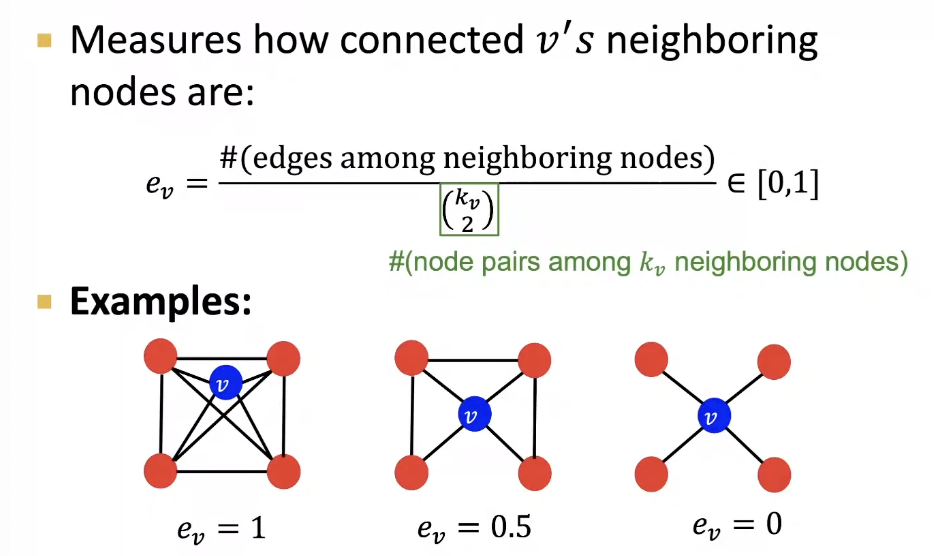
Clustering Coefficient
- 어떻게 주변 노드들과 연결되어 있는가?
Graphlets
- Observation : Clustering coefficient counts the #(triangles) in the ego-network
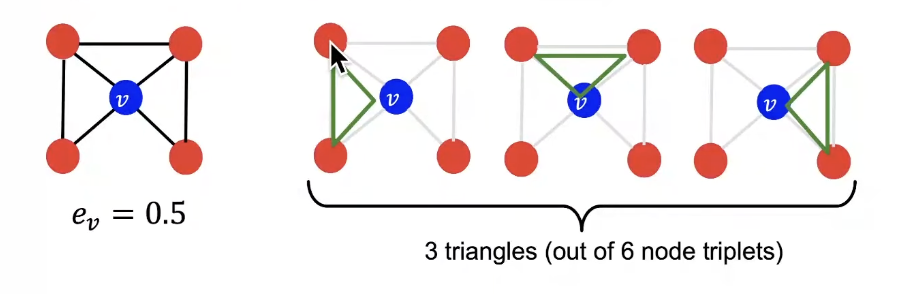
- We can generalize the above by counting #(pre-specified subgraphs, i.e., graphlets)
- Rooted connected non-isomorphic subgraphs
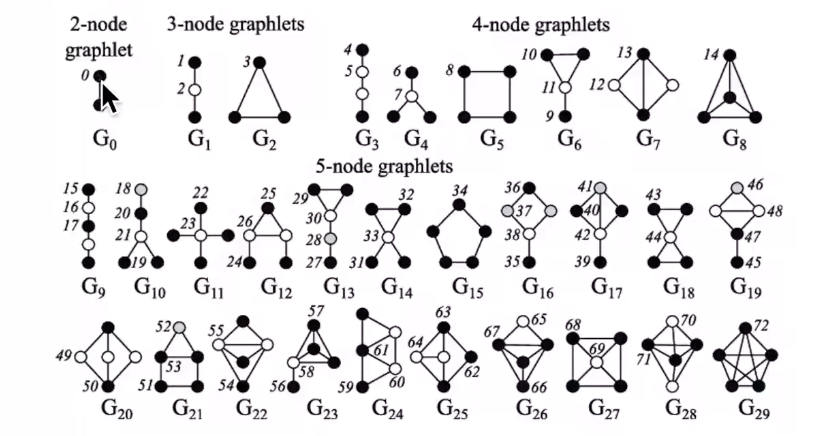
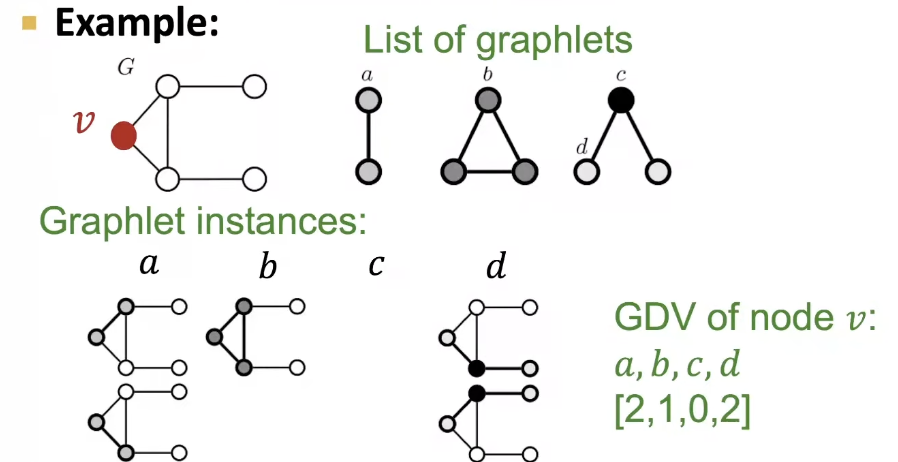
- Graphlet Degree Vector (GDV) : Graphlet-base features for nodes, A count vector of graphlets rooted at a given node!
- Degree count #(edges) that a node touches
- Clustering coefficient counts #(triangles) that a node touches.
- GDV counts #(graphlets) that a node touches
- Considering graphlets on 2 to 5 nodes we get:
Vector of 73 coordinates is a signature of a node that describes the topology of node's neighborhood
Captures its interconnectivities out to a distance of 4 hops - Graphlet degree vector provides a measure of a node's local network topology
Comparing vectors of two nodes provides a more detailed measure of local topological similarity than node degrees or clustering coefficient.
Lecture 2.2 - Traditional Feature-based Methods: Link
Link Prediction as a Task
Two formulations of the link prediction task
1. Links missing at random:
Remove a random set of links and them aim to predict them
2. Links over time: 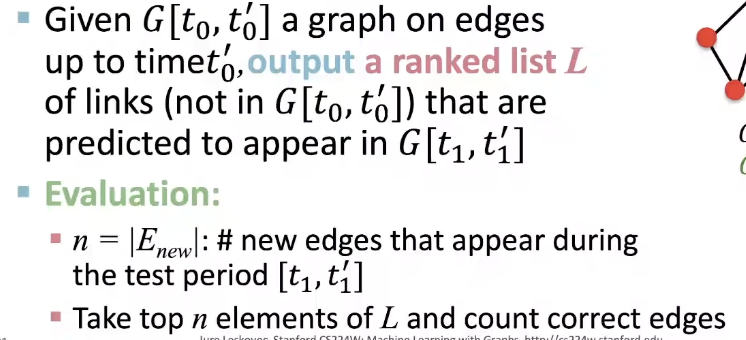
Link Prediction via Proximity
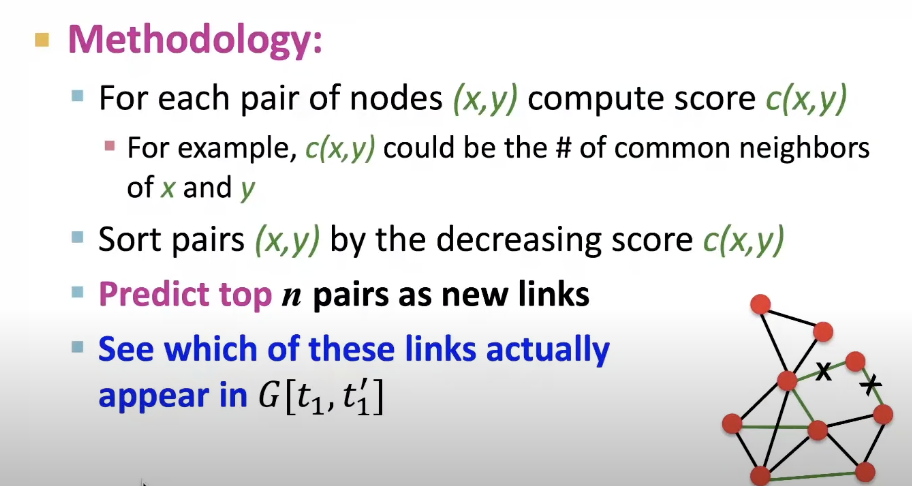
Link-Level Features
Distance-based feature
Shortest-path distance between two nodes
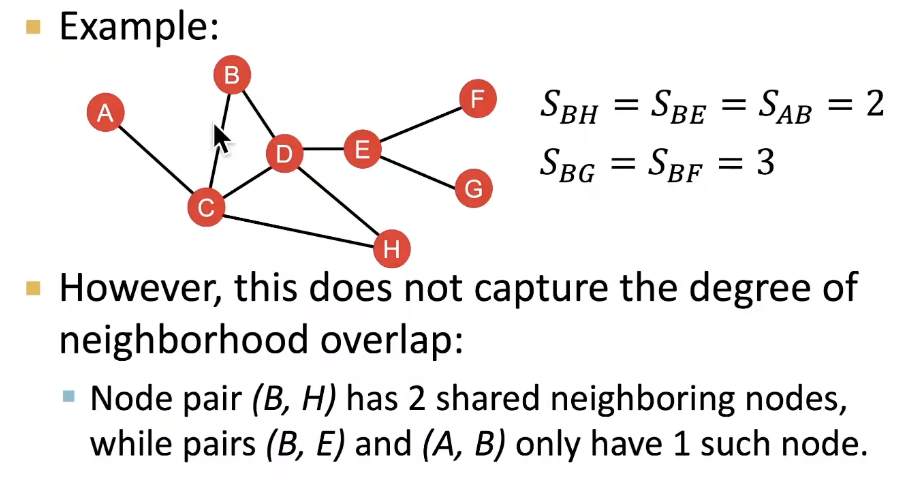
Local Neighborhood Overlap
Captures # neighboring nodes shared between two nodes v1 and v2
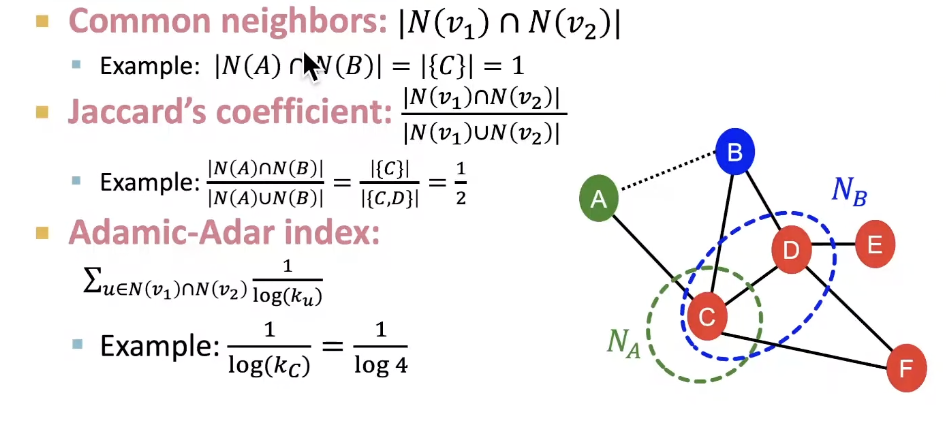
Global Neighborhood Overlap
- Limitaion of Local neighborhood features: Metric is always zero if the two nodes do not have any neighbors in common
- However, the two nodes may still potentially be connected in the future
- Global neighborhood overlap metrics resolve the limitation by considering the entire graph.
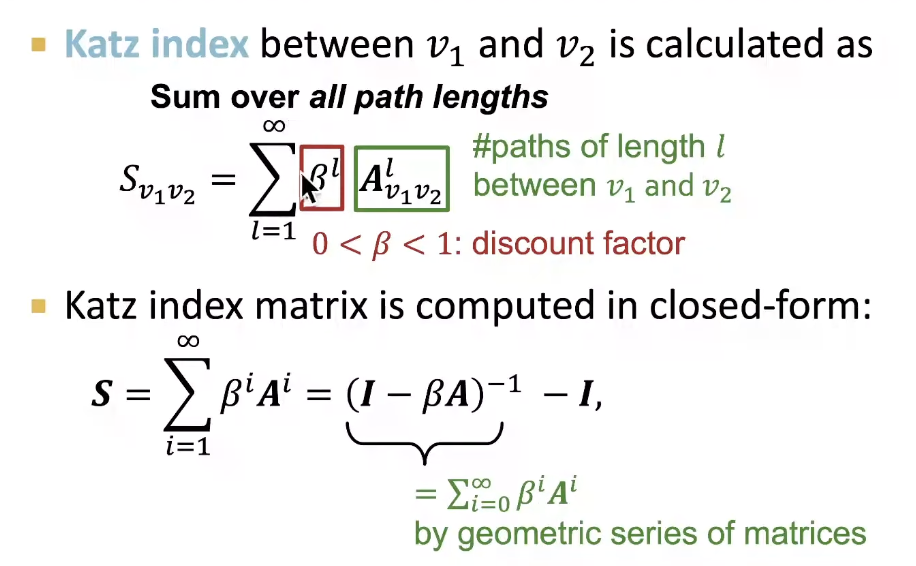
- Katz index: count the number of paths of all lengths between given pair of nodes
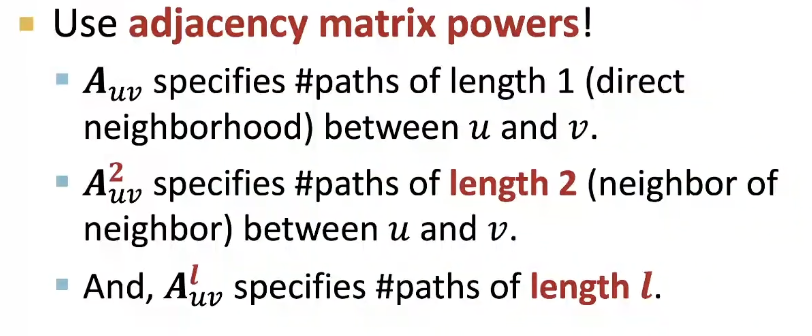
Powers of adjacency matrix
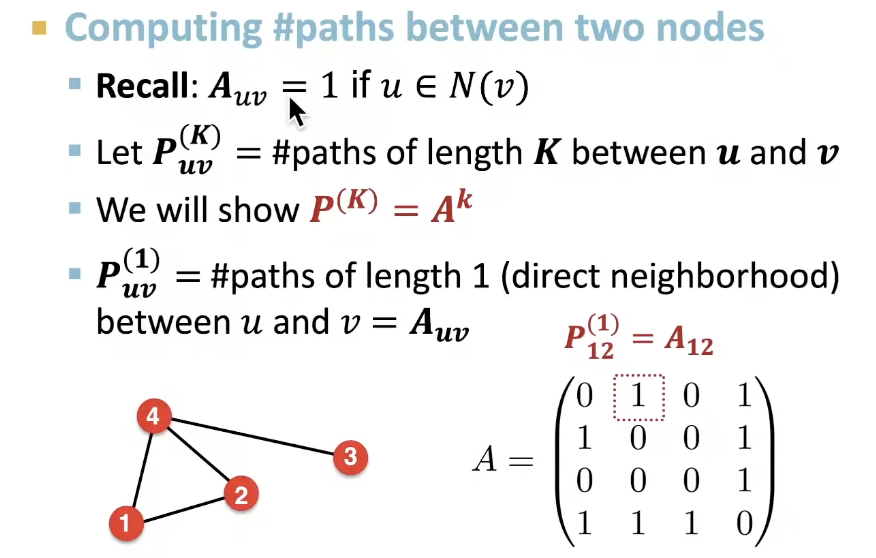
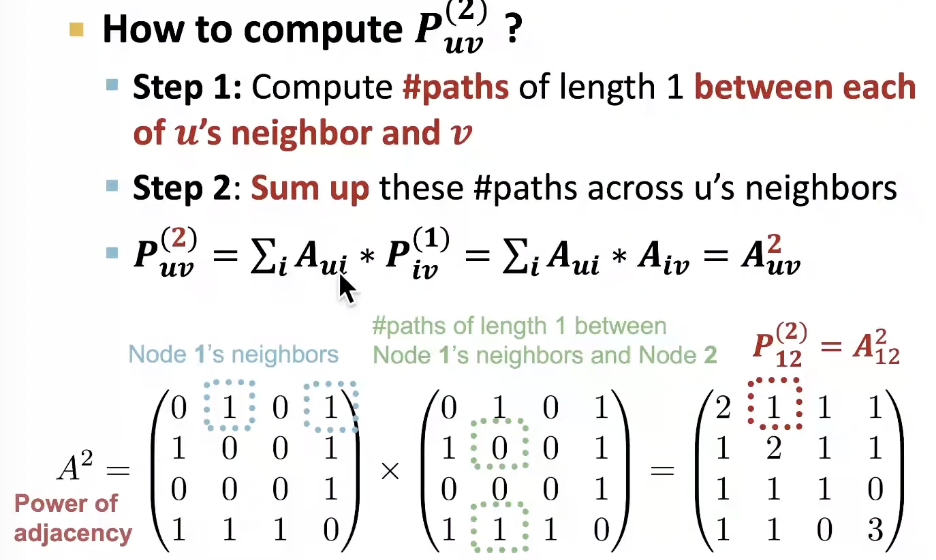
- How to compute # paths between two nodes?
Lecture 2.3 - Traditional Feature-based Methods: Graph
Graph-Level Features
- Goal : We want features that characterize the structure of an entire graph
Background: Kernel Methods
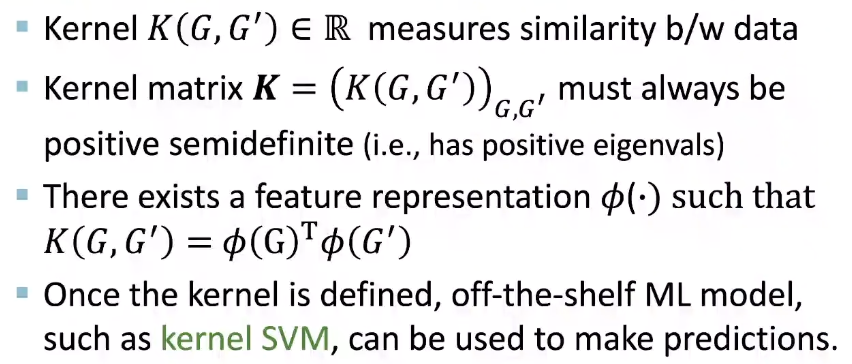
- Idea: Design Kernels instead of feature vectors.
- Graph Kernels: Measure similarity betwen two graphs:
Graphlet Kernel, Wisfeiler-Lehman Kernel
Graph Kernel: Key Idea
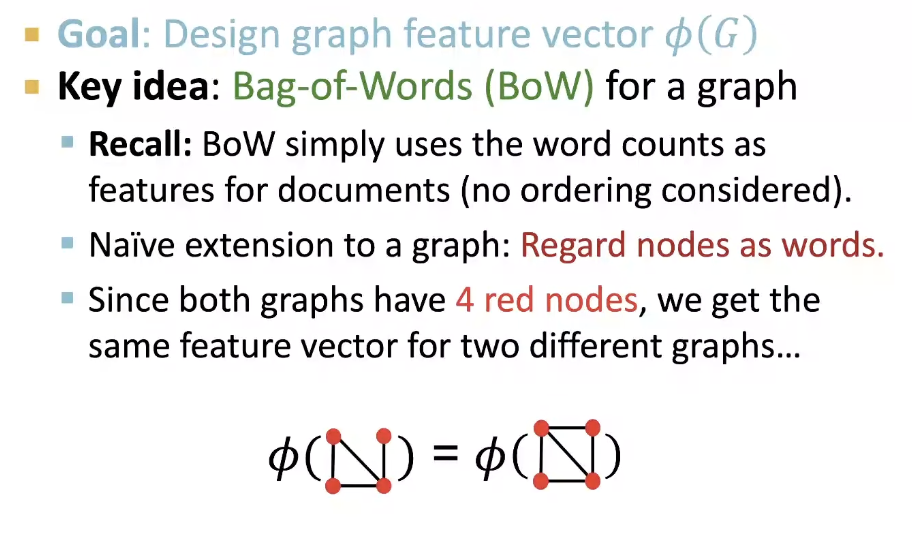
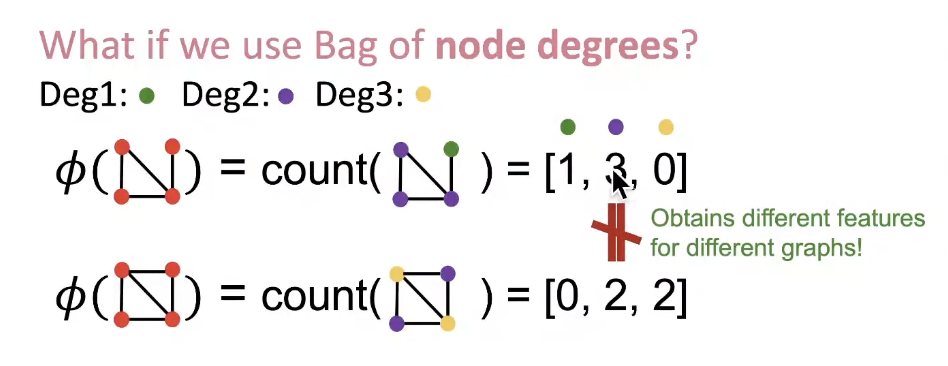
- Both Graphlet Kernel and Weisfeiler-Lehman (WL) Kernel use Bag-of-representation of graph, where is more sophisticated than node degrees!
Graphlet Features
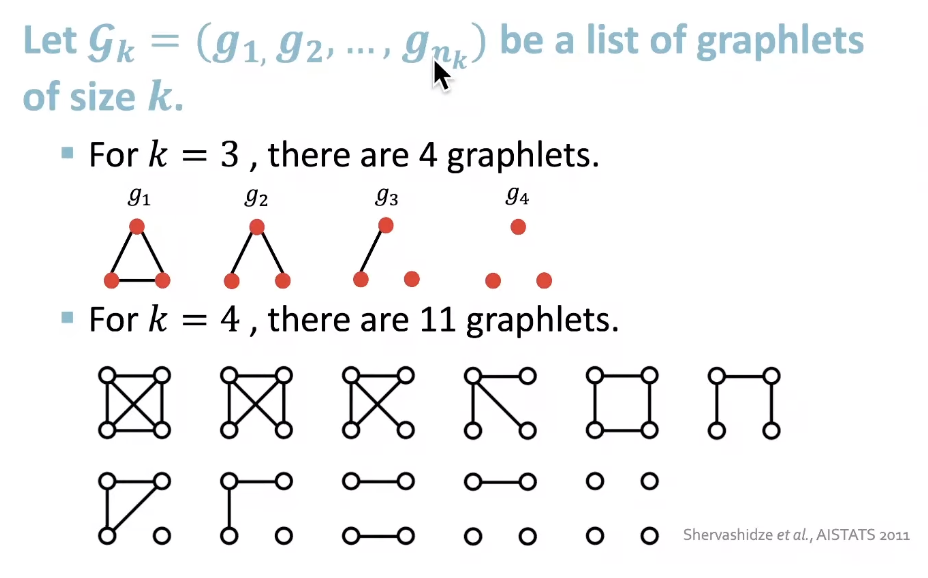
- Key Idea: Count the number of different graphlets in a graph
✓ Definition of graphlets here is slightly different from node-level features.
✓ The two differences are:- Nodes in graphlets here do not need to be connected
- The graphlets here are not rooted.
- Example:
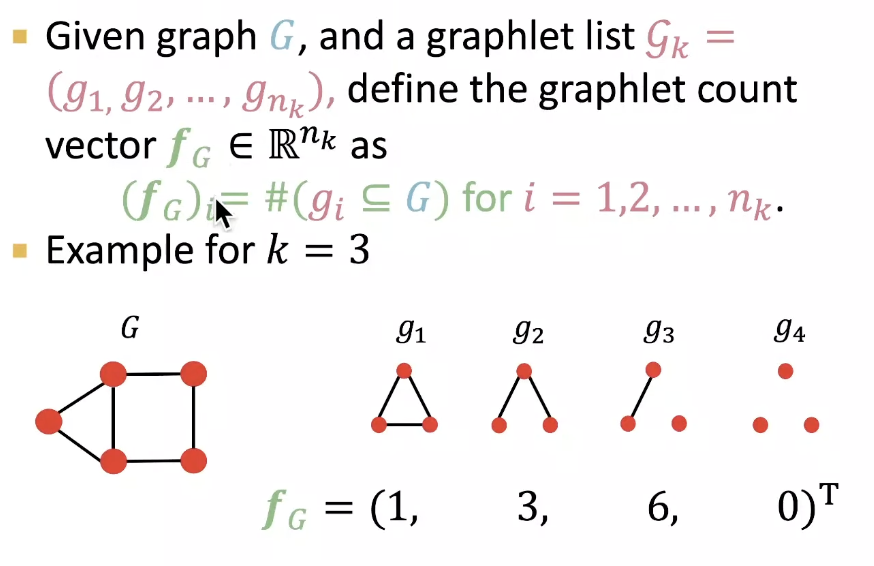
- Given two graphs, G and G', graphlet kernel is computed as

- Problem: if G and G' have different sizes, that will greatly skew the value.
- Solution: normalize each feature vector

- Limitations: Counting graphlets is expensive!
❍ Counting size-k graphlets for a graph with size n by enumeration takes n^k
❍ This is unavoidable in the worst-case since subgraph isomorphism test is NP-hard
❍ If a graph's node degree is bounded by d, an O(nd^{k-1}) algorithm exists to count all the graphlets of size k
Weisfeiler-Lehman Kernel
- Goal : design an efficient graph feature descriptor Φ(G)
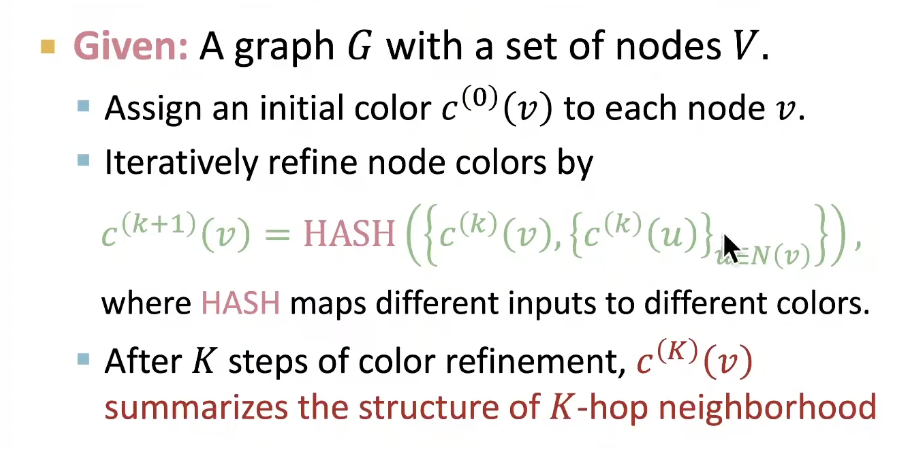
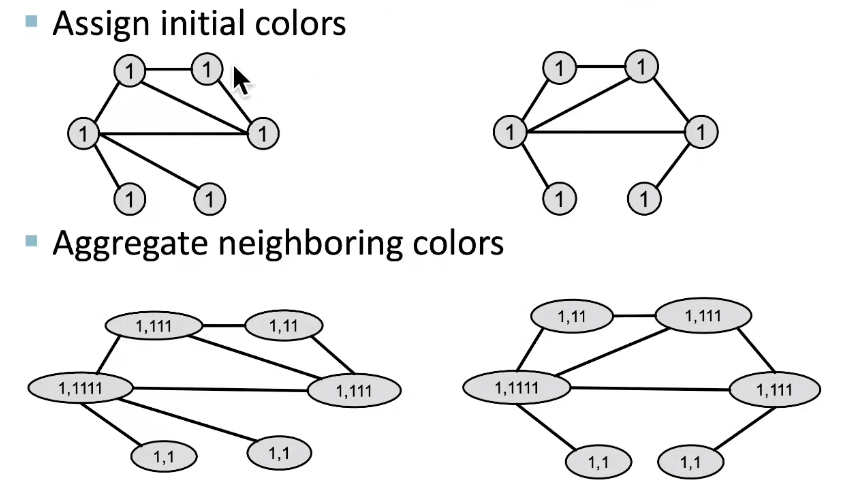
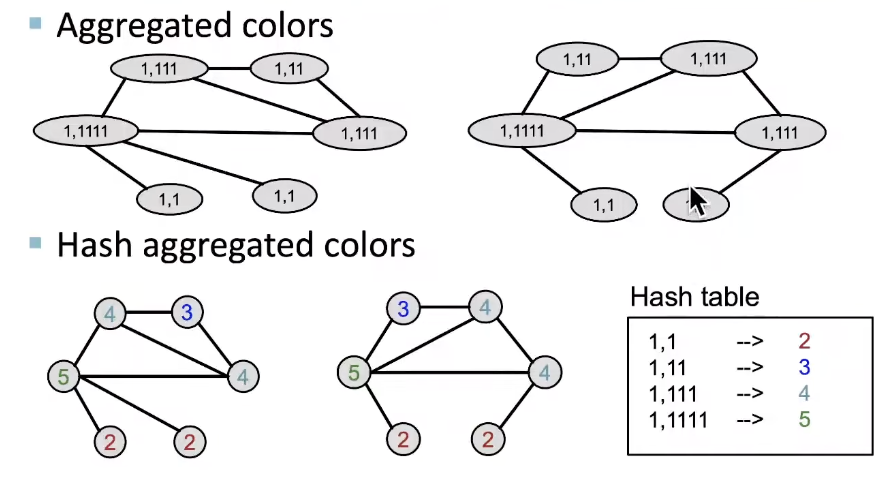
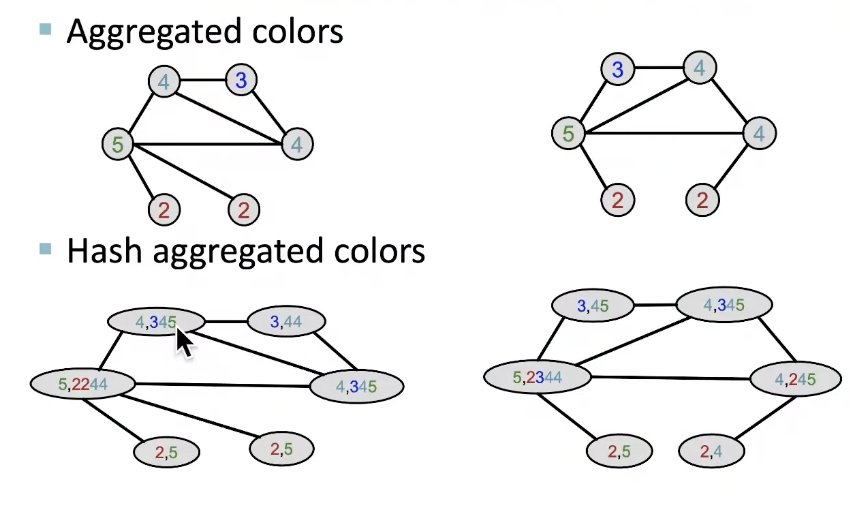
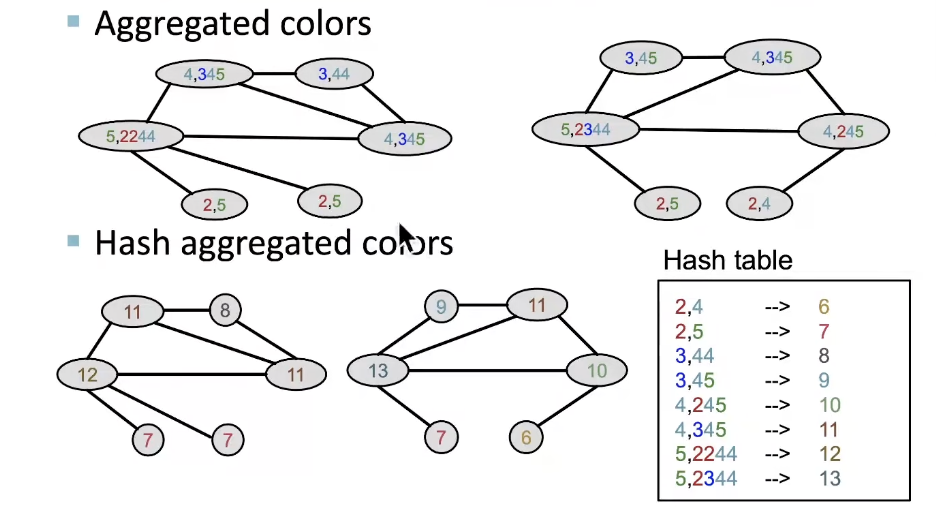
- Idea: use neighborhood structure to iteratively enrich node vocabulary
❍ Generalized version of Bag of node degrees since node degrees are one-hop neighborhood information
Color Refinement
-
Example of color refinement given two graphs:
→
→
→
-
After color refinement, WL kernel counts number of nodes with a given color.
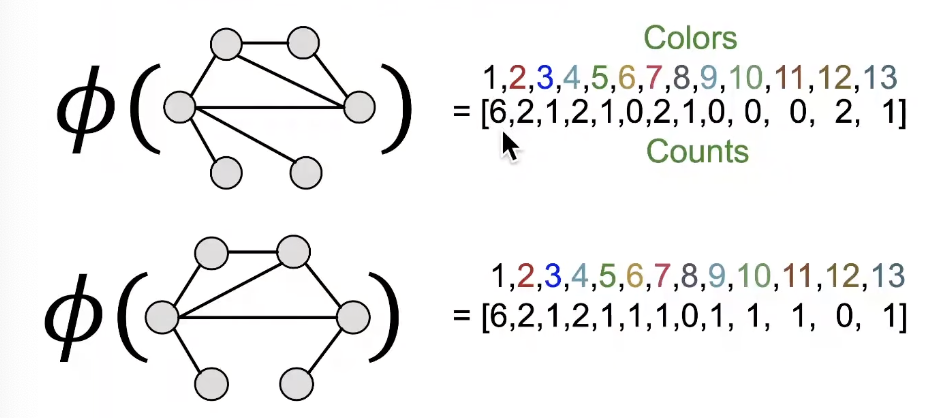
-
The WL kernel value is computed by the inner product of the color count vectors:
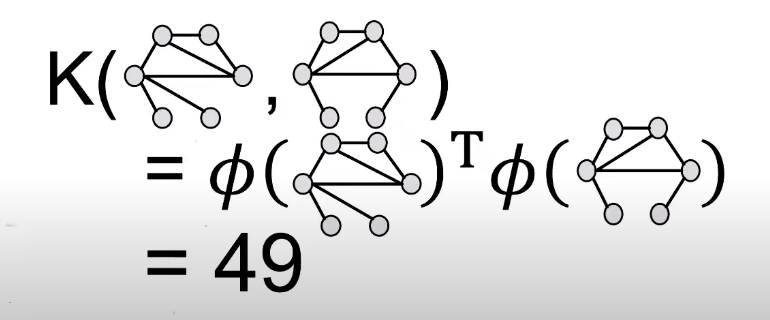
-
WL kernel is computationally efficient
✓ The time complexity for color refinement at each step is linear in #(edges), since it involves aggregating neighboring colors. -
When computing a kernel value, only colors appeared in the two graphs need to be tracked.
✓ Thus, #(colors) is at most the total number of nodes. -
Counting colors takes linear-time w.r.t. #(nodes).
-
In total, time complexity is linear in #(edges).