https://ocw.mit.edu/courses/18-06-linear-algebra-spring-2010/video_galleries/video-lectures/
이번 강의에서는 다음과 같은 내용을 다룬다.
1. Formula for A−1
2. Cramer’s Rule for X=A−1b
3. ∣detA∣ = Volume of box
먼저 1. formular for A−1을 알아보자.
2 x 2 matrix의 역함수 공식은 다음과 같다.
[acbd]−1=ad−bc1[d−c−ba]
그렇다면 2 x 2가 아닌 n x n 행렬의 역행렬 공식은 어떻게 될까?
A−1=detA1CT
위에서 CT는 Cofactors matrix의 Transpose한 행렬이다.
위 2 x 2의 행렬의 예시를 보자.
C=[d−b−ca],CT=[d−c−ba]
그렇다면 어떻게 위 역행렬 공식을 증명할 수 있을까?
이를 위해 ACT=(detA)I 라는 걸 증명해보자.
(지난 강의에서 배운 detA=a11C11+a12C12+...+a1nC1n을 이용한다.)
⎣⎢⎢⎢⎡a11..an1............a1n..ann⎦⎥⎥⎥⎤⎣⎢⎢⎢⎡c11c12.c1n............c1n..cnn⎦⎥⎥⎥⎤=⎣⎢⎢⎢⎡detA0.00detA................detA00.0detA⎦⎥⎥⎥⎤
위와 같이 ACT의 결과가 (detA)I라는 것을 확인할 수가 있다.
왜 주대각 성분을 제외한 나머지가 0인지는 같은 행 혹은 열을 포함한 cofactor와 aij의 연산은 최종적으로 다 합하면 결과가 0이 나오기 때문이다.
다음 예시를 통해 이해할 수 있다.
A=[acbd],CT=[d−c−ba]
ACT=[ad−bc00ad−bc]
이제 2. Cramer's Rule for X=A−1b를 알아보자.
위에서 A−1=detA1CT라는 공식을 알았다. 이를 적용한다.
X=A−1b=detA1CTb
그리고 Cramer's rule은 다음과 같다.
x1=detAdetB1
x2=detAdetB2
A with column 1 replaced by b.=B1=⎣⎢⎡∣b∣∣∣∣n−1 columns of A∣∣∣⎦⎥⎤
즉, B1은 A의 칼럼 중 1번 칼럼을 b로 교체하고 나머지는 그대로 놔둔 행렬이다.
Bj=A with column j replaced by b.
(특별한 수학적 원리가 있기보다는 이러한 규칙을 발견했다는 데 의의가 있다.)
하지만 Cramer's Rule은 연산 비용이 매우 많이 들어 추천되지 않는 방법이다.
다음으로 3. ∣detA∣=Volume of box 를 알아보자.
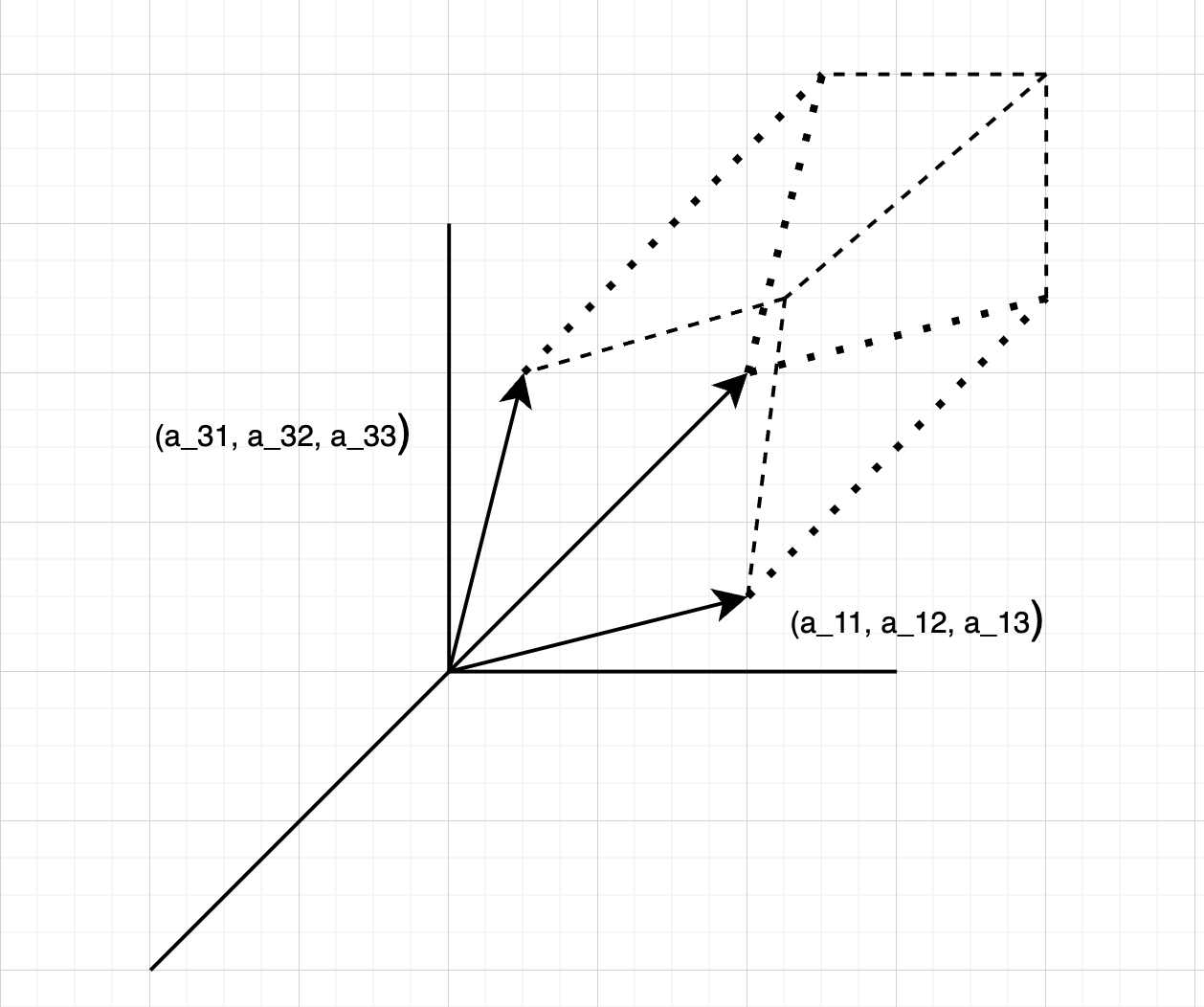
∣detA∣=Volume of box
위와 같이 3 x 3 행렬 A의 determination을 그려보면 박스의 부피로 나오는 것을 알 수가 있다.
- 그렇다면 만약 A=I라면 어떨까?
- 이 경우, box는 unit cube 형태로 나올 것이다.
- 만약 A=Q (Q는 orthogonal matrixf를 의미)라면 어떨까?
- 이 경우, box는 cube 형태로 나오며, 값은 −1 또는 1일 것이다.
- QTQ=I
- det(QTQ)=detI=1
- detQTdetQ=1
- (detQ)2=1
- ∴detQ=1 or−1
∣detA∣=Volume of box 식이 지지난 강의에서 배운 properties of determinations에도 적용이 될까? 한 번 확인해보자.
- detI=1
- 이건 (1,0,0),(0,1,0),(0,0,1) 벡터를 그려보면,
∣detA∣=∣1∣=1=Volume of box 라는 걸 알 수 있다.
- ∣∣∣∣∣0110∣∣∣∣∣=−1
- 마찬가지로 ∣detA∣=∣−1∣=1=Volume of box 라는 걸 알 수 있다.
- (a) ∣∣∣∣∣tactbd∣∣∣∣∣=t∣∣∣∣∣acbd∣∣∣∣∣ (b) ∣∣∣∣∣a+a′cb+b′d∣∣∣∣∣=∣∣∣∣∣acbd∣∣∣∣∣+∣∣∣∣∣a′cb′d∣∣∣∣∣
- (a) 벡터 (a,b)에 t만큼 곱해주면 벡터는 그만큼 더 나아간다. 그리고 역시 부피도 그만큼 증가할 것이다.
- (a) 따라서 ∣detAt∣=∣tdetA∣=t× Volume of box of A 라는 걸 알 수 있다.
- (b)에 대해서는 시간상 확실한 설명은 없었다. 아마 두 개의 평면(박스)이 나올 것이고, 이 두 평면(박스)의 넓이(부피)를 더해주면 같다는 걸 증명할 수 있을 것 같다.