Day2. Data Filtering - Recyclable and Low Fat Products
Problem
Table: Products
| Column Name | Type |
|---|---|
| product_id | int |
| low_fats | enum |
| recyclable | enum |
product_id is the primary key (column with unique values) for this table.
low_fats is an ENUM (category) of type ('Y', 'N') where 'Y' means this product is low fat and 'N' means it is not.
recyclable is an ENUM (category) of types ('Y', 'N') where 'Y' means this product is recyclable and 'N' means it is not.
Write a solution to find the ids of products that are both low fat and recyclable.
Return the result table in any order.
The result format is in the following example.
Example 1:
Input:
Products table:
| product_id | low_fats | recyclable |
|---|---|---|
| 0 | Y | N |
| 1 | Y | Y |
| 2 | N | Y |
| 3 | Y | Y |
| 4 | N | N |
Output:
| product_id |
|---|
| 1 |
| 3 |
Explanation: Only products 1 and 3 are both low fat and recyclable.
Solution
# my solution
import pandas as pd

def find_products(products: pd.DataFrame) -> pd.DataFrame:
    products = products[(products['low_fats'] == 'Y') & (products['recyclable'] == 'Y')]
    return products['product_id'].to_frame()
# check result
data = [['0', 'Y', 'N'], ['1', 'Y', 'Y'], ['2', 'N', 'Y'], ['3', 'Y', 'Y'], ['4', 'N', 'N']]
Products = pd.DataFrame(data, columns=['product_id', 'low_fats', 'recyclable']).astype({'product_id':'int64', 'low_fats':'category', 'recyclable':'category'})
find_products(Products)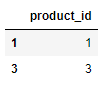
# the others

# 1.
def find_products(products: pd.DataFrame) -> pd.DataFrame:
    result_df = products[(products['low_fats'] == 'Y') & (products['recyclable'] == 'Y')]
    return result_df[['product_id']]

# 2.
def find_products(products: pd.DataFrame) -> pd.DataFrame:
    return products.query('low_fats == "Y" & recyclable == "Y"')[["product_id"]]

# 3.
def find_products(products: pd.DataFrame) -> pd.DataFrame:
    return products[
        (products['low_fats'] == 'Y') & \
        (products['recyclable'] == 'Y')
    ][['product_id']]