[Stanford CS229] Lecture8 - Data Splits, Models & Cross-Validation
Stanford CS229 Lecture Note
.png)
1. Bias/Variance
The generalization error of a hypothesis is its expected error on examples not necessarily in the training set.
Informally we define the bias of a model to be the expected generalization error even if we were to fit it to a very large training set. Thus linear model from large bias may underfit.
Apart from bias, there's a second component to the generalization error, consisting of the variance of a model fitting procedure.
Bias in Machine Learing : Algorithm has very strong preconceptions that the data could be fit by linear functions.
High Variance in Machine Learning : there's a lot of variability in the predictions this algorithm will make
Bias와 Variance를 통해서 Learning Algorithm을 끊임 없이 개선하는 것이 machine learning에서 매우 중요하다.
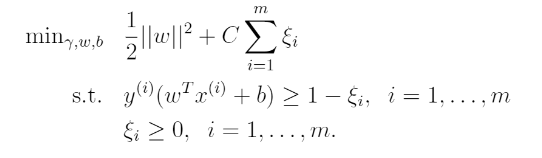
2. Regularization
To make the algorithm work for non-linearly separable datasets as well as be less sensitive to outliers, we reformulate our optimization as follows:
3. Data Split
Train/Development/Test set
Let's suppose we are given a training set S. Given what we know about empirical risk minimization, here's what might initially seem like a algorithm, resulting from using risk minimization for model selection:
(1) Train each model M on S, to get some hypothesis h.
(2) Pick the hypotheses with the smallest training error.
But this algorithm does not work because of choosing the order of a polynomial.
Here's an algorithm that works better. In hold-out cross validation.
(1) Randomly split S into S(train) and S(cv). Here S(cv) is called the hold-out cross validation set. S(train) is usually 70% of the data, and S(cv) is usually remaining 30%.
(2) Train each model M on S(train) only to get some hypothesis h.
(3) Select and output the hypothesis h that had the smallest error on the hold out cross validation set.
By training on a set of exampe S(cv) that the models were not trained on, we obtain a better estimate of each hypothesis h's true generalization error, and can then pick the one with the smallest estimated generalization error.
Usually 30% of the data is used in the hold-oout cross validatoin set and 30% is typical choice.
Also there is method called k-fold cross validation that holds out less data each time:
(1) Randomly split S into k disjoint subsets of m/k training examples each. Let's call these subsets S1...Sk.
(2) For each model M, we evaluate it as follows:
1) For j = 1,...,k Train the model M on to get some hypothesis .
2) Test the hypothesis on to get error of .
3) The estimated generalization error of model M is then calculated as the average of the error of .
(3) Pick the model M with the lowest estimated generalization error, and retrain the model on the entire training set S. The resulting hypothesis is then output as our final answer.
4. Model Selection
.
.
.
TO BE CONTINUED...