Many to Many란?
Many to Many는 자연어 처리에서 개체명 인식, 형태소 분석과 같은 스퀀스 태깅 등에 활용할 수 있다.
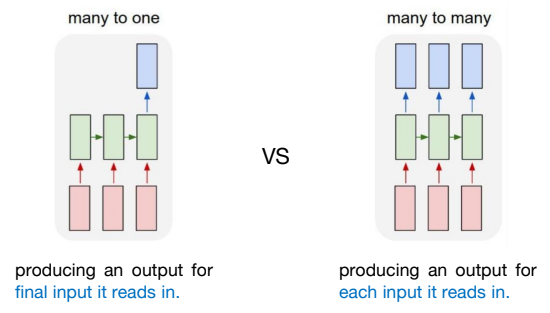
Many to One은 각 토큰을 읽다가 마지막 토큰을 읽었을 때 출력을 내는 구조였다.
그러나 Many to Many는 시퀀스 각각의 토큰에 대해서 출력을 내는 방식이다.
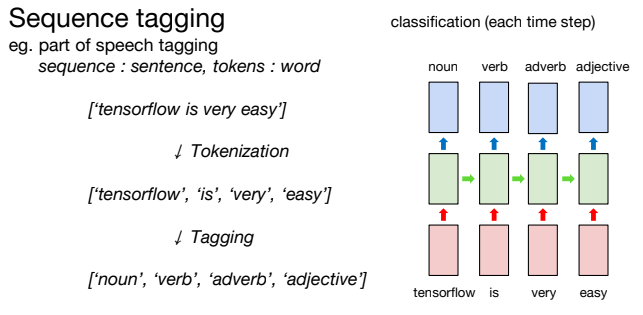
위 형태소 분석 예제에서, 먼저 ['tensorflow is very easy']라는 문장이 주어졌을 때 이를 Tokenization 한다.
['tensorflow is very easy']
=> Tokenization
= ['tensorflow', 'is', 'very', 'easy']
토큰으로 이루어진 시퀀스를 읽고 해당 토큰이 어떤 품사인지를 파악하는 방식으로 Many to Many를 활용할 수 있다.
구현 예제
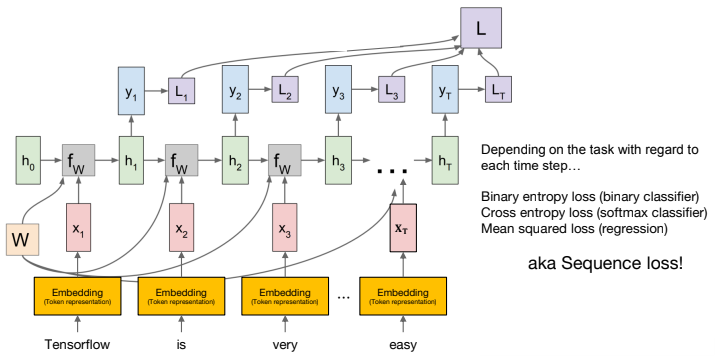
마찬가지로, 각 토큰을 읽을 수 있도록 Embedding layer를 거치게 한다.
RNN은 순서대로 토큰을 읽고 토큰에 대한 출력을 내고, 이를 정답과 비교하여 토큰마다 loss를 계산한다.
출력된 토큰의 loss 평균을 내는 걸 시퀀스 로스라고 하는데, 이 시퀀스 로스를 통해 backpropagation 하여 학습을 진행하게 된다.
이때 loss 계산이 복잡해지게 된다. 특히 시퀀스 길이를 맞추기 위한 pad 토큰을 고려해야 한다.
=> 따라서 데이터의 시퀀스 토큰 중, pad 토큰에 대해서 loss를 계산하지 않는 masking을 사용하게 된다.
구현 코드
1. 데이터셋 준비
import numpy as np
import tensorflow as tf
from tensorflow import keras
from tensorflow.keras import layers
from tensorflow.keras.models import Sequential
from tensorflow.keras.preprocessing.sequence import pad_sequences
from pprint import pprint
import matplotlib.pyplot as plt

# example data
sentences = [
    ['I', 'feel', 'hungry'],
    ['tensorflow', 'is', 'very', 'difficult'],
    ['tensorflow', 'is', 'a', 'framework', 'for', 'deep', 'learning'],
    ['tensorflow', 'is', 'very', 'fast', 'changing'],
]
pos = [
    ['pronoun', 'verb', 'adjective'],
    ['noun', 'verb', 'adverb', 'adjective'],
    ['noun', 'verb', 'determiner', 'noun', 'preposition', 'adjective', 'noun'],
    ['noun', 'verb', 'adverb', 'adjective', 'verb'],
]

# creating a token dictionary for word
word_list = sum(sentences, [])
word_list = sorted(set(word_list))
word_list = ['<pad>'] + word_list
word2idx = {word: idx for idx, word in enumerate(word_list)}
idx2word = {idx: word for idx, word in enumerate(word_list)}

print(word2idx)
print(idx2word)
print(len(idx2word))

# creating a token dictionary for part of speech
pos_list = sum(pos, [])
pos_list = sorted(set(pos_list))
pos_list = ['<pad>'] + pos_list
pos2idx = {pos: idx for idx, pos in enumerate(pos_list)}
idx2pos = {idx: pos for idx, pos in enumerate(pos_list)}

print(pos2idx)
print(idx2pos)
print(len(pos2idx))
# converting sequence of tokens to sequence of indices
max_sequence = 10
x_data = list(map(lambda sentence: [word2idx.get(token) for token in sentence], sentences))
y_data = list(map(lambda sentence: [pos2idx.get(token) for token in sentence], pos))
# padding the sequence of indices
x_data = pad_sequences(sequences=x_data, maxlen=max_sequence, padding='post')
x_data_mask = ((x_data != 0) * 1).astype(np.float32) # 패딩한 부분에 대한 마스킹 정보를 담음
x_data_len = list(map(lambda sentence: len(sentence), sentences)) # 토크나이제이션 되었을 때 문장의 유효한 길이
y_data = pad_sequences(sequences=y_data, maxlen=max_sequence, padding='post')
# checking data
print(x_data, x_data_len)
print(x_data_mask)
print(y_data)2. 모델 생성
# creating rnn for "many to many" sequence tagging
num_classes = len(pos2idx)
hidden_dim = 10

input_dim = len(word2idx)
output_dim = len(word2idx)
one_hot = np.eye(len(word2idx))

model = Sequential()
model.add(
    layers.Embedding(
        input_dim=input_dim,
        output_dim=output_dim,
        mask_zero=True,
        trainable=False,
        input_length=max_sequence,
        embeddings_initializer=keras.initializers.Constant(one_hot),
    )
)

# return_sequences=True : rnn이 모든 토큰에 대해 출력을 내야하기 때문이다.
model.add(layers.SimpleRNN(units=hidden_dim, return_sequences=True))

# TimeDistributed + Dense를 사용해 매 토큰마다 품사가 무엇인지 분류한다.
model.add(layers.TimeDistributed(layers.Dense(units=num_classes)))

model.summary()
=> 결과
| Layer (type) | Output Shape | Param # |
|---|---|---|
| embedding (Embedding) | (None, 10, 15) | 225 |
| simple_rnn (SimpleRNN) | (None, 10, 10) | 260 |
| time_distributed (TimeDistributed) | (None, 10, 8) | 88 |
| 항목 | 값 |
|---|---|
| Total params | 573 |
| Trainable params | 348 |
| Non-trainable params | 225 |
3. 모델 학습
# creating loss function
# 매 토큰마다 loss를 계산해야 하고, 특히 pad 토큰에 대해서는 계산하면 안되기 때문에
# 시퀀스의 유효한 길이(x_len)와 max_sequence를 받아 masking을 생성하고 이를 미니배치 loss에 반영한다.

# reduction을 NONE으로 두면 (batch, time) 형태로 토큰별 loss를 얻을 수 있다.
loss_obj = tf.keras.losses.SparseCategoricalCrossentropy(
    from_logits=True,
    reduction=tf.keras.losses.Reduction.NONE,
)

def loss_fn(model, x, y, x_len, max_sequence):  # pad를 제외한 sequence loss 계산 목적
    logits = model(x, training=True)  # (batch, time, num_classes)

    # 토큰별 loss: (batch, time)
    per_token_loss = loss_obj(y_true=y, y_pred=logits)

    # pad 제외용 masking: (batch, time)
    masking = tf.sequence_mask(x_len, maxlen=max_sequence, dtype=tf.float32)

    # pad 위치 loss=0
    per_token_loss = per_token_loss * masking

    # 샘플별 평균 loss: time축 합 -> 유효길이로 나눔
    valid_time_step = tf.cast(x_len, dtype=tf.float32)
    loss_per_sample = tf.reduce_sum(per_token_loss, axis=-1) / valid_time_step

    # 미니배치 평균
    sequence_loss = tf.reduce_mean(loss_per_sample)
    return sequence_loss

# creating an optimizer
lr = 0.1
epochs = 30
batch_size = 2
opt = tf.keras.optimizers.Adam(learning_rate=lr)

# generating data pipeline
tr_dataset = tf.data.Dataset.from_tensor_slices((x_data, y_data, x_data_len))
tr_dataset = tr_dataset.shuffle(buffer_size=4)
tr_dataset = tr_dataset.batch(batch_size=batch_size)

print(tr_dataset)
# <BatchDataset shapes: ((?, 10), (?, 10), (?,)), types: (tf.int32, tf.int32, tf.int32)>
# training
tr_loss_hist = []
for epoch in range(epochs):
avg_tr_loss = 0.0
tr_step = 0
for x_mb, y_mb, x_mb_len in tr_dataset:
with tf.GradientTape() as tape:
# 이전 예제와는 다르게, loss func가 유효길이 x_len과 최대 시퀀스 max_sequence를 받는다.
tr_loss = loss_fn(model, x=x_mb, y=y_mb, x_len=x_mb_len, max_sequence=max_sequence)
grads = tape.gradient(target=tr_loss, sources=model.trainable_variables)
opt.apply_gradients(grads_and_vars=zip(grads, model.trainable_variables))
avg_tr_loss += float(tr_loss)
tr_step += 1
avg_tr_loss /= tr_step
tr_loss_hist.append(avg_tr_loss)
if (epoch + 1) % 5 == 0:
print('epoch : {:3}, tr_loss : {:.3f}'.format(epoch + 1, avg_tr_loss))=> 출력 결과 (예시)
epoch : 5, tr_loss : 0.249
epoch : 10, tr_loss : 0.040
epoch : 15, tr_loss : 0.006
epoch : 20, tr_loss : 0.002
epoch : 25, tr_loss : 0.001
epoch : 30, tr_loss : 0.001
4. 정확도 확인
yhat = model.predict(x_data, verbose=0)
yhat = np.argmax(yhat, axis=-1) * x_data_mask

pprint(list(map(lambda row: [idx2pos.get(elm) for elm in row], yhat.astype(np.int32).tolist())), width=120)
pprint(pos)

plt.plot(tr_loss_hist)
plt.show()
=> 결과 (예시)
# 모델의 결과
[['pronoun', 'verb', 'adjective', '<pad>', '<pad>', '<pad>', '<pad>', '<pad>', '<pad>', '<pad>'],
 ['noun', 'verb', 'adverb', 'adjective', '<pad>', '<pad>', '<pad>', '<pad>', '<pad>', '<pad>'],
 ['noun', 'verb', 'determiner', 'noun', 'preposition', 'adjective', 'noun', '<pad>', '<pad>', '<pad>'],
 ['noun', 'verb', 'adverb', 'adjective', 'verb', '<pad>', '<pad>', '<pad>', '<pad>', '<pad>']]

# 모델의 정답
[['pronoun', 'verb', 'adjective'],
 ['noun', 'verb', 'adverb', 'adjective'],
 ['noun', 'verb', 'determiner', 'noun', 'preposition', 'adjective', 'noun'],
 ['noun', 'verb', 'adverb', 'adjective', 'verb']]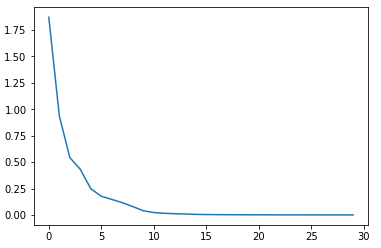
Lec-00. bidirectional이란?
-
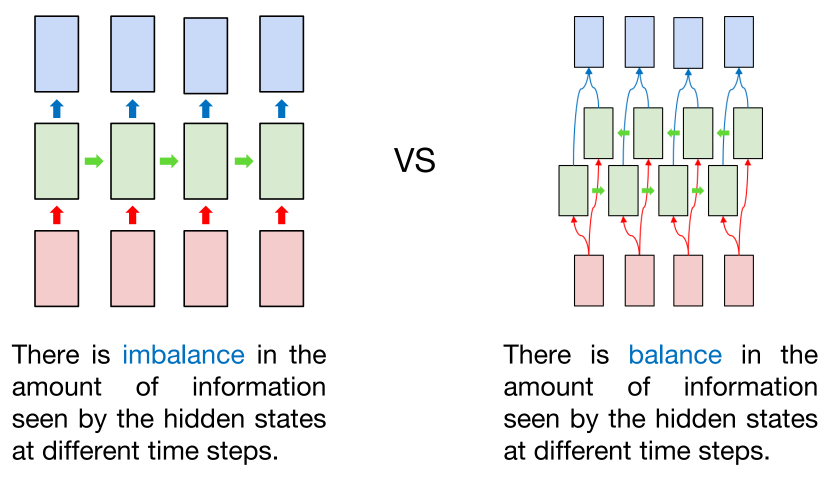
기존에는 RNN을 모두 단방향으로만 활용하였고, 특히 RNN을 Many to Many로 활용할 때 정보의 불균형이 발생하게 된다.
=> 가령 첫 번째 hidden state의 경우 첫 번째 토큰을 읽은 결과로 출력을 내지만, 두 번째 state의 경우 첫 번째 토큰의 결과와 두 번째 토큰의 결과를 종합하여 출력을 낸다. 세 번째 state는 3개의 토큰을, 네 번째는 4개를… 이런 식으로 불균형이 발생하게 된다. -
bidirectional RNN에서는 이 문제를 해결하기 위해 시퀀스를 순서대로 읽는 forward RNN, 시퀀스를 역으로 읽는 backward RNN을 둔다.
=> forward RNN의 경우, 시퀀스를 읽었을 때 hidden state에는 순서대로 1개, 2개, 3개…의 토큰 정보가 누적된다.
=> backward RNN의 경우에는 반대로, 뒤에서부터 읽기 때문에 (원래 시퀀스 기준으로) 앞쪽 토큰도 “뒤쪽 문맥” 정보를 함께 가진 상태로 학습에 반영될 수 있다.
=> 이 두 가지 정보를 합치기 때문에 각 토큰의 출력이 한쪽 방향 문맥에만 치우치지 않게 된다.
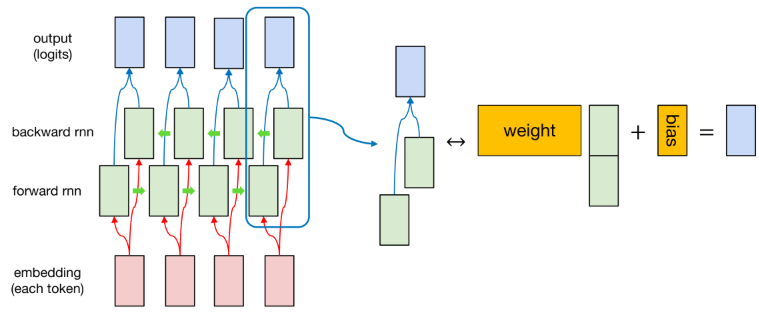
- 이 이미지에서는 시퀀스 -> (Tokenization) -> token -> (Embedding layer) -> numeric vector로 변환한 후, forward RNN, backward RNN이 각각 읽고 각 RNN의 hidden state를 합치게 된다.
=> 정확히는 forward RNN의 hidden state와 backward RNN의 hidden state를 이미지 우측과 같이 Concatenate 방식으로 합쳐서 새로운 벡터를 만들고, 이를 weight와 bias를 활용하여 목적에 맞게 모델링하는 방식이다.
=> 이때 weight와 bias는 모든 토큰의 hidden state에 대해서 동일하게 적용된다.
- *Concatenate : 여러 배열을 특정 축 방향으로 붙여서 하나로 만드는 것.
ex) [1, 2] Concatenate [3, 4] => [1, 2, 3, 4]
구현 예제
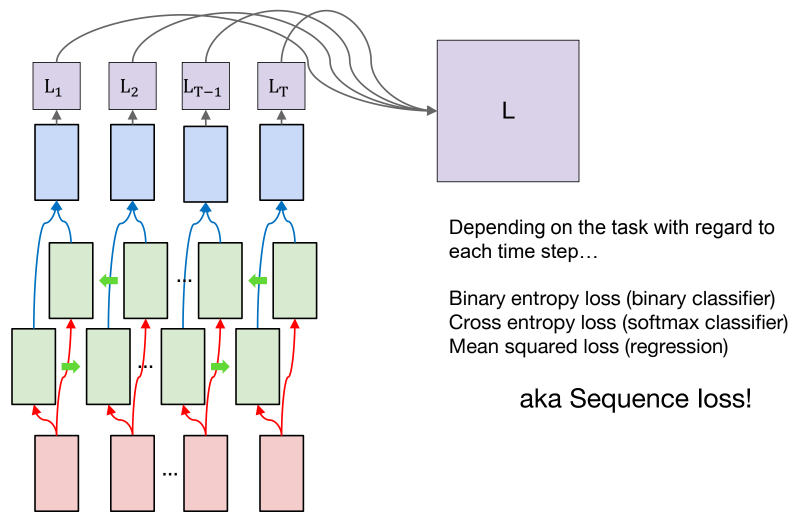
- bidirectional RNN은 기존의 Many to Many 방식과 비교해 큰 차이가 없기 때문에 loss func를 계산하는 것도 동일하게 처리된다.
각 시퀀스의 토큰을 읽고 처리한 결과의 loss들을 계산하고, masking을 활용하여 데이터 간의 길이를 맞추기 위한 pad 토큰을 제외한 실제 데이터의 유효 토큰에 대해 loss를 계산하고 이를 학습에 반영한다.
구현 코드
1. 데이터셋 준비
import numpy as np
import tensorflow as tf
from tensorflow import keras
from tensorflow.keras import layers
from tensorflow.keras.models import Sequential
from tensorflow.keras.preprocessing.sequence import pad_sequences
from pprint import pprint
import matplotlib.pyplot as plt

# example data
# 이전 예제와 동일
sentences = [
    ['I', 'feel', 'hungry'],
    ['tensorflow', 'is', 'very', 'difficult'],
    ['tensorflow', 'is', 'a', 'framework', 'for', 'deep', 'learning'],
    ['tensorflow', 'is', 'very', 'fast', 'changing'],
]
pos = [
    ['pronoun', 'verb', 'adjective'],
    ['noun', 'verb', 'adverb', 'adjective'],
    ['noun', 'verb', 'determiner', 'noun', 'preposition', 'adjective', 'noun'],
    ['noun', 'verb', 'adverb', 'adjective', 'verb'],
]

# creating a token dictionary for word
word_list = sum(sentences, [])
word_list = sorted(set(word_list))
word_list = ['<pad>'] + word_list
word2idx = {word: idx for idx, word in enumerate(word_list)}
idx2word = {idx: word for idx, word in enumerate(word_list)}

print(word2idx)
print(idx2word)
print(len(idx2word))

# creating a token dictionary for part of speech
pos_list = sum(pos, [])
pos_list = sorted(set(pos_list))
pos_list = ['<pad>'] + pos_list
pos2idx = {p: idx for idx, p in enumerate(pos_list)}
idx2pos = {idx: p for idx, p in enumerate(pos_list)}

print(pos2idx)
print(idx2pos)
print(len(pos2idx))
=> word dictionary 출력
{'<pad>': 0, 'I': 1, 'a': 2, 'changing': 3, 'deep': 4, 'difficult': 5, 'fast': 6, 'feel': 7, 'for': 8, 'framework': 9, 'hungry': 10, 'is': 11, 'learning': 12, 'tensorflow': 13, 'very': 14}
{0: '<pad>', 1: 'I', 2: 'a', 3: 'changing', 4: 'deep', 5: 'difficult', 6: 'fast', 7: 'feel', 8: 'for', 9: 'framework', 10: 'hungry', 11: 'is', 12: 'learning', 13: 'tensorflow', 14: 'very'}
15
=> pos dictionary 출력
{'<pad>': 0, 'adjective': 1, 'adverb': 2, 'determiner': 3, 'noun': 4, 'preposition': 5, 'pronoun': 6, 'verb': 7}
{0: '<pad>', 1: 'adjective', 2: 'adverb', 3: 'determiner', 4: 'noun', 5: 'preposition', 6: 'pronoun', 7: 'verb'}
8
# converting sequence of tokens to sequence of indices
max_sequence = 10
x_data = list(map(lambda sentence: [word2idx.get(token) for token in sentence], sentences))
y_data = list(map(lambda sentence: [pos2idx.get(token) for token in sentence], pos))
# padding the sequence of indices
x_data = pad_sequences(sequences=x_data, maxlen=max_sequence, padding='post')
x_data_mask = ((x_data != 0) * 1).astype(np.float32)
x_data_len = list(map(lambda sentence: len(sentence), sentences))
y_data = pad_sequences(sequences=y_data, maxlen=max_sequence, padding='post')
# checking data
print(x_data, x_data_len)
print(x_data_mask)
print(y_data)=> 중간 출력
[[ 1  7 10  0  0  0  0  0  0  0]
 [13 11 14  5  0  0  0  0  0  0]
 [13 11  2  9  8  4 12  0  0  0]
 [13 11 14  6  3  0  0  0  0  0]] [3, 4, 7, 5]
[[1. 1. 1. 0. 0. 0. 0. 0. 0. 0.]
 [1. 1. 1. 1. 0. 0. 0. 0. 0. 0.]
 [1. 1. 1. 1. 1. 1. 1. 0. 0. 0.]
 [1. 1. 1. 1. 1. 0. 0. 0. 0. 0.]]
[[6 7 1 0 0 0 0 0 0 0]
 [4 7 2 1 0 0 0 0 0 0]
 [4 7 3 4 5 1 4 0 0 0]
 [4 7 2 1 7 0 0 0 0 0]]
2. 모델 생성
# creating bidirectional rnn for "many to many" sequence tagging
num_classes = len(pos2idx)
hidden_dim = 10

input_dim = len(word2idx)
output_dim = len(word2idx)
one_hot = np.eye(len(word2idx))

model = Sequential()
model.add(layers.InputLayer(input_shape=(max_sequence,)))
model.add(
    layers.Embedding(
        input_dim=input_dim,
        output_dim=output_dim,
        mask_zero=True,
        trainable=False,
        input_length=max_sequence,
        embeddings_initializer=keras.initializers.Constant(one_hot),
    )
)

# 기존 예제에서 Bidirectional만 추가하면 Bidirectional RNN이 된다.
model.add(layers.Bidirectional(layers.SimpleRNN(units=hidden_dim, return_sequences=True)))
model.add(layers.TimeDistributed(layers.Dense(units=num_classes)))

model.summary()
=> 중간 결과
| Layer (type) | Output Shape | Param # |
|---|---|---|
| embedding (Embedding) | (None, 10, 15) | 225 |
| bidirectional (Bidirectional) | (None, 10, 20) | 520 |
| time_distributed (TimeDistributed) | (None, 10, 8) | 168 |
| 항목 | 값 |
|---|---|
| Total params | 913 |
| Trainable params | 688 |
| Non-trainable params | 225 |
3. 모델 학습
# creating loss function
# 토큰별 loss를 얻기 위해 reduction을 NONE으로 둔다.
loss_obj = tf.keras.losses.SparseCategoricalCrossentropy(
    from_logits=True,
    reduction=tf.keras.losses.Reduction.NONE,
)

def loss_fn(model, x, y, x_len, max_sequence):
    logits = model(x, training=True)  # (batch, time, num_classes)

    # 토큰별 loss: (batch, time)
    per_token_loss = loss_obj(y_true=y, y_pred=logits)

    # pad 제외용 masking: (batch, time)
    masking = tf.sequence_mask(x_len, maxlen=max_sequence, dtype=tf.float32)

    # pad 위치 loss=0
    per_token_loss = per_token_loss * masking

    # 샘플별 평균 loss
    valid_time_step = tf.cast(x_len, dtype=tf.float32)
    loss_per_sample = tf.reduce_sum(per_token_loss, axis=-1) / valid_time_step

    # 미니배치 평균
    sequence_loss = tf.reduce_mean(loss_per_sample)
    return sequence_loss

# creating an optimizer
lr = 0.1
epochs = 30
batch_size = 2
opt = tf.keras.optimizers.Adam(learning_rate=lr)

# generating data pipeline
tr_dataset = tf.data.Dataset.from_tensor_slices((x_data, y_data, x_data_len))
tr_dataset = tr_dataset.shuffle(buffer_size=4)
tr_dataset = tr_dataset.batch(batch_size=batch_size)

print(tr_dataset)
# <BatchDataset shapes: ((?, 10), (?, 10), (?,)), types: (tf.int32, tf.int32, tf.int32)>
# training
tr_loss_hist = []
for epoch in range(epochs):
avg_tr_loss = 0.0
tr_step = 0
for x_mb, y_mb, x_mb_len in tr_dataset:
with tf.GradientTape() as tape:
tr_loss = loss_fn(model, x=x_mb, y=y_mb, x_len=x_mb_len, max_sequence=max_sequence)
grads = tape.gradient(target=tr_loss, sources=model.trainable_variables)
opt.apply_gradients(grads_and_vars=zip(grads, model.trainable_variables))
avg_tr_loss += float(tr_loss)
tr_step += 1
avg_tr_loss /= tr_step
tr_loss_hist.append(avg_tr_loss)
if (epoch + 1) % 5 == 0:
print('epoch : {:3}, tr_loss : {:.3f}'.format(epoch + 1, avg_tr_loss))=> 결과 (예시)
epoch : 5, tr_loss : 0.052
epoch : 10, tr_loss : 0.002
epoch : 15, tr_loss : 0.000
epoch : 20, tr_loss : 0.000
epoch : 25, tr_loss : 0.000
epoch : 30, tr_loss : 0.000
4. 정확도 확인
yhat = model.predict(x_data, verbose=0)
yhat = np.argmax(yhat, axis=-1) * x_data_mask

pprint(list(map(lambda row: [idx2pos.get(elm) for elm in row], yhat.astype(np.int32).tolist())), width=120)
pprint(pos)

plt.plot(tr_loss_hist)
plt.show()
=> 결과 확인 (예시)
[['pronoun', 'verb', 'adjective', '<pad>', '<pad>', '<pad>', '<pad>', '<pad>', '<pad>', '<pad>'],
 ['noun', 'verb', 'adverb', 'adjective', '<pad>', '<pad>', '<pad>', '<pad>', '<pad>', '<pad>'],
 ['noun', 'verb', 'determiner', 'noun', 'preposition', 'adjective', 'noun', '<pad>', '<pad>', '<pad>'],
 ['noun', 'verb', 'adverb', 'adjective', 'verb', '<pad>', '<pad>', '<pad>', '<pad>', '<pad>']]
[['pronoun', 'verb', 'adjective'],
 ['noun', 'verb', 'adverb', 'adjective'],
 ['noun', 'verb', 'determiner', 'noun', 'preposition', 'adjective', 'noun'],
 ['noun', 'verb', 'adverb', 'adjective', 'verb']]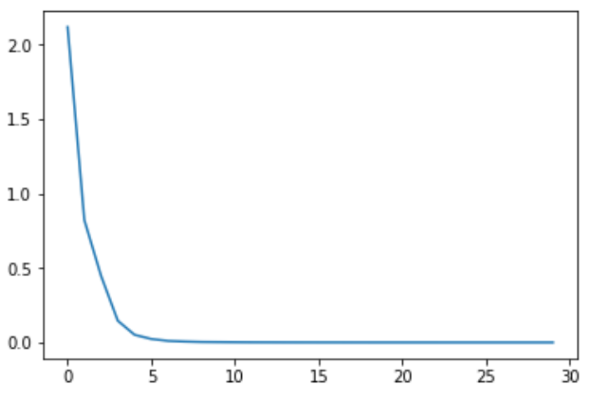
모두를 위한 딥러닝 강좌 2
https://www.youtube.com/watch?v=7eldOrjQVi0&list=PLQ28Nx3M4Jrguyuwg4xe9d9t2XE639e5C
