[DetnEst] 2. Minimum variance unbiased(MVU) estimator

KBC·2024년 9월 10일
0

Detection and Estimation

목록 보기
2/23
post-thumbnail

Review-Estimation

  • Parameter : we wish to estimate the parameter θ\theta from the observation(s) xx. Theses can be vectors
    θ=[θ1,θ2,,θp]T\theta=[\theta_1, \theta_2, \cdots, \theta_p]^T and
    x=[x[0],x[1],,x[N1]]Tx=[x[0], x[1],\cdots,x[N-1]]^T or scalars.
  • Parmetrized PDF : the unknown parameter θ\theta is to be estimated. θ\theta parametrizes the probability density function of the received data p(x;θ)p(x;\theta).
  • Estimator : Rule or Function that assigns a value θ^\hat \theta to θ\theta for each realization of xx.
  • Estimate : Value of θ\theta obtained for a given realization of xx. θ^\hat \theta will be used for the estimate, while θ\theta will represent the true value of the unknown paramete.
  • Mean and Variance of the estimator : E(θ^)E(\hat \theta) and var(θ^)=E[(θ^E(θ^))2]var(\hat \theta) = E\left[(\hat \theta - E(\hat \theta))^2 \right].
    Expectations are taken over xx (meaning θ^\hat \theta is random, not θ\theta.)

Unbiased Estimators

  • An estimator θ^\hat \theta is called unbiased, if E(θ^)=θE(\hat \theta) = \theta for all possible θ\theta.
    θ^=g(x)E(θ^)=g(x)p(x;θ)dx=θ\hat \theta = g(x) \rightarrow E(\hat \theta) = \int g(x)p(x;\theta)dx = \theta
  • If E(θ^)θE(\hat \theta) \neq \theta, the bias is b(θ)=E(θ^)θb(\theta) = E(\hat \theta) - \theta
    (Expectation is taken with respect to xx or p(x;θ)p(x;\theta))

Revisit example of the DC level in noise, two candidate estimators
A^=1Nn=0N1x[n]\hat A=\frac{1}{N}\displaystyle \sum_{n=0}^{N-1}x[n] (Sample mean) and Aˇ=x[0]\widecheck{A} = x[0] (First sample value)
are unbiased since E(A^)=E(Aˇ)=AE(\hat A) = E(\widecheck A) = A

  • E(θ^)=θE(\hat \theta) = \theta may hold for some values of θ\theta for biased estimators, i.e., modified sample mean estimator
    Aˇ=12Nn=0N1x[n]E(Aˇ)=12A{=Aif A=0Aif A0  biased\widecheck{A} = \frac{1}{2N}\sum_{n=0}^{N-1} x[n] \rightarrow E(\widecheck{A}) = \frac{1}{2}A \left\{ \begin{array}{ll} = A & \text{if } A = 0 \\ \neq A & \text{if } A \neq 0 \end{array} \right. \rightarrow \;biased

    An Unbiased estimator is not necessarily a good estimator;
    But a biased estimator is a poor estimator.

Mean-Squared Error(MSE) Criterion

mse(θ^)=E[(θ^θ)2]=E{[(θ^E(θ^))+(E(θ^)θ)]2}=var(θ^)+[E(θ^)θ]2=var(θ^)+b2(θ)mse(\hat \theta) = E\left[(\hat \theta-\theta)^2\right]\\ =E\left\{\left[(\hat \theta -E(\hat \theta)) + (E(\hat \theta) - \theta)\right]^2\right\}\\ =var(\hat \theta) + [E(\hat \theta) - \theta]^2\\[0.2cm] =var(\hat \theta) + b^2(\theta)

  • σ^2=1Nn=0N1(x[n]xˉ)2,  xˉ:sample  mean\hat \sigma^2=\frac{1}{N}\displaystyle\sum_{n=0}^{N-1}(x[n]-\bar x)^2,\;\bar x:sample \; mean

  • E[x[n]]=μ,  Var[x[n]]=σ2=E[x2[n]]E2[x[n]],  E[x2[n]]=σ2+μ2()E[x[n]] = \mu,\;Var[x[n]] = \sigma^2=E[x^2[n]]-E^2[x[n]],\;E[x^2[n]]=\textcolor{red}{\sigma^2+\mu^2 \cdots(*)}

  • Var(xˉ)=σ2N=E[xˉ2]μ2E[xˉ2]=σ2N+μ2()Var(\bar x) = \frac{\sigma^2}{N} = E[\bar x^2]-\mu^2 \rightarrow E[\bar x^2] = \textcolor{red}{\frac{\sigma^2}{N}+\mu^2\cdots(**)}

  • E[σ^2]=1NE[n=0N1(x2[n])2xˉn=0N1x[n]+Nxˉ2]=1NE[n=0N1x2[n]Nxˉ2]=1N(n=0N1(E[x2[n]])NE[xˉ2])=1N(n=0N1(E[x2[n]]())N(E[xˉ2]())=1N(N×(σ2+μ2)N(σ2N+μ2))=1N(Nσ2σ2)=N1Nσ2"biased  estimator"E[\hat \sigma ^2] \\= \frac{1}{N}E\left[ \displaystyle \sum_{n=0}^{N-1}(x^2[n]) -2\bar x\displaystyle\sum_{n=0}^{N-1}x[n]+N\bar x^2\right]\\ =\frac{1}{N}E\left[ \displaystyle \sum_{n=0}^{N-1}x^2[n]-\textcolor{blue}{N\bar x^2}\right]\\ =\frac{1}{N}(\displaystyle\sum_{n=0}^{N-1}(E[x^2[n]]) - NE[\bar x^2])\\[0.5cm] =\frac{1}{N}\left(\displaystyle\sum_{n=0}^{N-1}(E[x^2[n]]\textcolor{red}{\cdots(*)}\right) - N\left(E[\bar x^2]\textcolor{red}{\cdots(**)}\right)\\ =\frac{1}{N}\left(N\times(\sigma^2 +\mu^2) - N(\frac{\sigma^2}{N} + \mu^2)\right)\\ =\frac{1}{N}(N\sigma^2 - \sigma^2)\\[0.3cm] =\frac{N-1}{N}\sigma^2 \textcolor{red}{\cdots "biased\; estimator"}

  • Note that, in many cases, minimum MSE criterion leads to unrealizable estimator, which cannot be written solely as a function of the data, i.e.,
    Aˇ=a1Nn=0N1x[n]\widecheck A = a\dfrac{1}{N}\displaystyle\sum_{n=0}^{N-1}x[n], where aa is chosen to minimize MSE
    Then, E(Aˇ)=aA,  var(Aˇ)=a2σ2Nmse(Aˇ)=a2σ2N+(a1)2A2E(\widecheck A) = aA,\; var(\widecheck A) = \dfrac{a^2\sigma^2}{N} \rightarrow mse(\widecheck A) = \dfrac{a^2\sigma^2}{N}+(a-1)^2A^2

    dmse(Aˇ)da=2aσ2N+2(a1)A2=0aopt=A2A2+σ2N\dfrac{dmse(\widecheck A)}{da} = \dfrac{2a\sigma^2}{N}+2(a-1)A^2 =0\\[0.3cm] \rightarrow a_{opt} = \dfrac{A^2}{A^2 +\dfrac{\sigma^2}{N}}

    Unrealizable, a function of unknown A

Unbiased Estimator...?

σ2^=1N1n=0N1(x[n]xˉ)2unbiased  for  sample  variance\hat {\sigma^2}' = \dfrac{1}{N-1}\displaystyle\sum_{n=0}^{N-1}(x[n]-\bar x)^2 \rightarrow unbiased \;for\;sample \;variance

Minimum Variance Unbiased Estimation(MVUE)

  • Any criterion that depends on the bias is likely to be unrealizable
    \rightarrow Practically minimum MSE estimator needs to be abandoned

Minimum variance unbiased(MVU) estimator

  • Alternatively, contrain the bias to be zero
  • Find the estimator which minimizes the variance (minimizing the MSE as well for unbiased case)
    mse(θ^)=var(θ^)+b2(θ),  E[b2(θ)]=0var(θ^)mse(\hat \theta) = var(\hat \theta) + b^2(\theta),\;E[b^2(\theta)] =0\\ \rightarrow var(\hat \theta)

    Minimum variance unbiased(MVU) Estimator

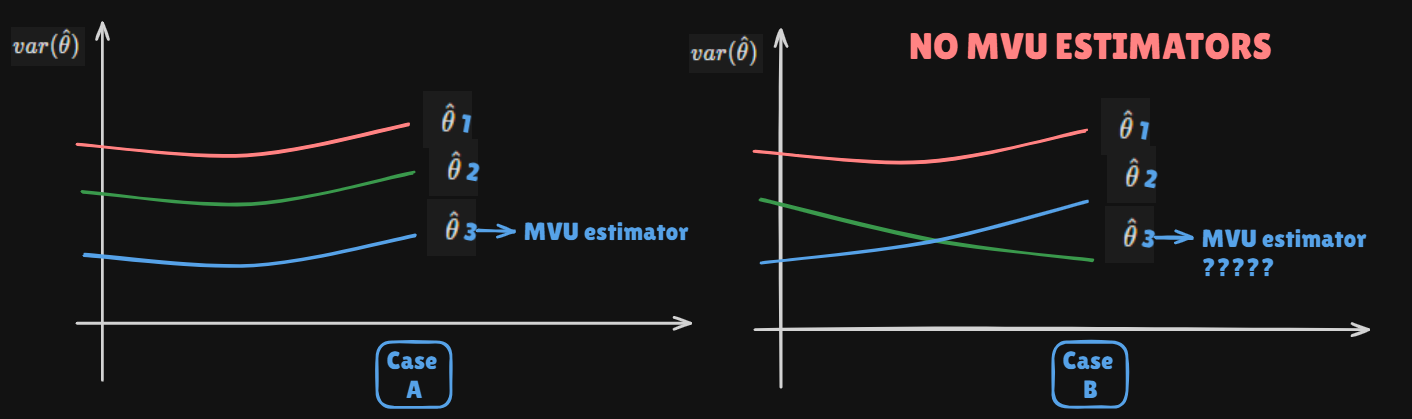
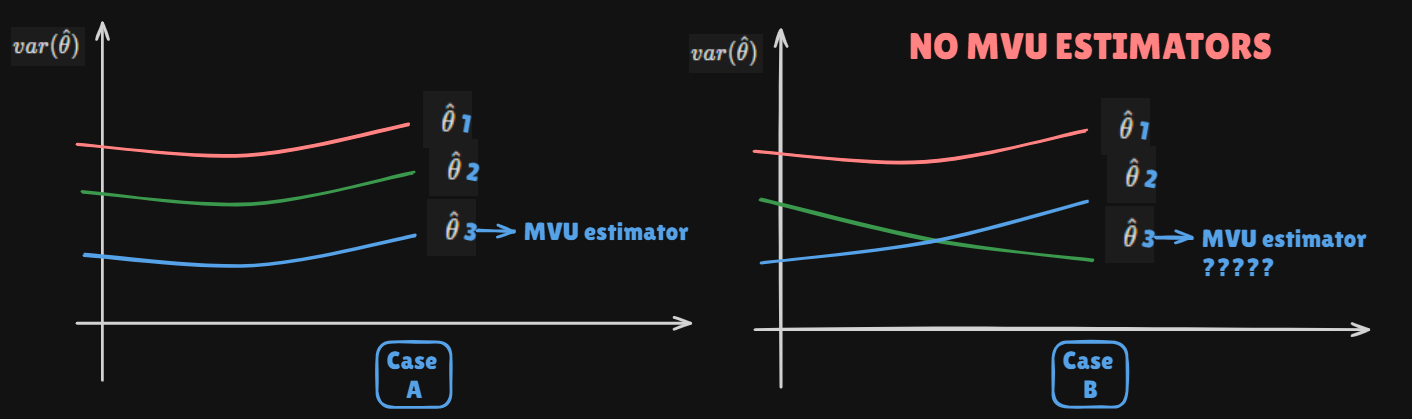
Existence of the MVU Estimator

  • An unbiased estimator with minimum variance for all θ\theta
  • Examples
    θ^\hat \theta
  • There might be some problems
    • Problem 1 : We can not try All functions to find MVUE
    • Problem 2 : We can not try All theta intervals to confirm whether it minimizes variance or not

Fining the MVU Estimator

  • There is no general framework to find MVU estimator even if it exists.

    Possible approaches:

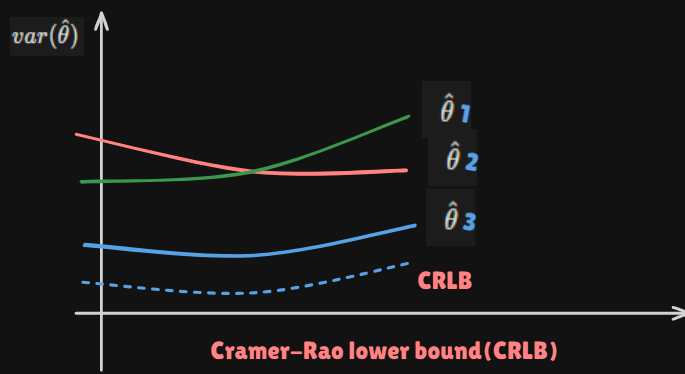
    • Determine the Cramer-Rao lower bound(CRLB) and check if some estimator satisfies it
    • Apply the Rao-Blackwell-Lehmann-Scheffe(RBLS) theorem
    • Find unbiased linear estimator with minimum variance(best linear unbiased estimator, BLUE)

All Content has been written based on lecture of Prof. eui-seok.Hwang in GIST(Detection and Estimation)

profile
AI, Security

0개의 댓글