[DetnEst] 1. Introduction to Statiscal Signal Processing

KBC·2024년 9월 5일
0

Detection and Estimation

목록 보기
1/23

Formal Description

Detection vs Estimation

Detection(Classification)

: Discrete set of hypotheses(right or wrong, Classification etc.)

Estimation(Regression)

: Continuous set of hypotheses(almost always wrong - minimize error instead)

Sort of Detection & Estimation

Classical : Fixed, non-random Hypotheses/parameters

Bayesian : Random, non-fixed Hypotheses/parameters

Bayesian problem assume priors or priori distributions

Mathematical Estimation Problem

Parameter estimation

  • From discrete-time waveform or data set, i.e., N-point data set depending on θ\theta

    • Fixed(Deterministic) θ\theta \rightarrow Classical Estimation
      {x[0],x[1],,x[N1]}θ^=g(x[0],x[1],,x[N1])\{x[0], x[1], \cdots, x[N-1]\} \rightarrow \hat{\theta} = g(x[0], x[1], \cdots, x[N-1])
  • Mathematically model the data \rightarrow probability density funcion(PDF) due to the randomness

    • ,x[N1];  θ)\cdots, x[N-1]; \;\theta) : ; means it's deterministic
      p(x[0],x[1],,x[N1];θ),x[i]=θ+n[i],n[i]N(0,σ2):white  gaussian  noisep(x[0], x[1], \cdots, x[N-1]; \theta), \quad x[i] = \theta + n[i], \quad n[i] \sim N(0, \sigma^2):white\;gaussian\;noise
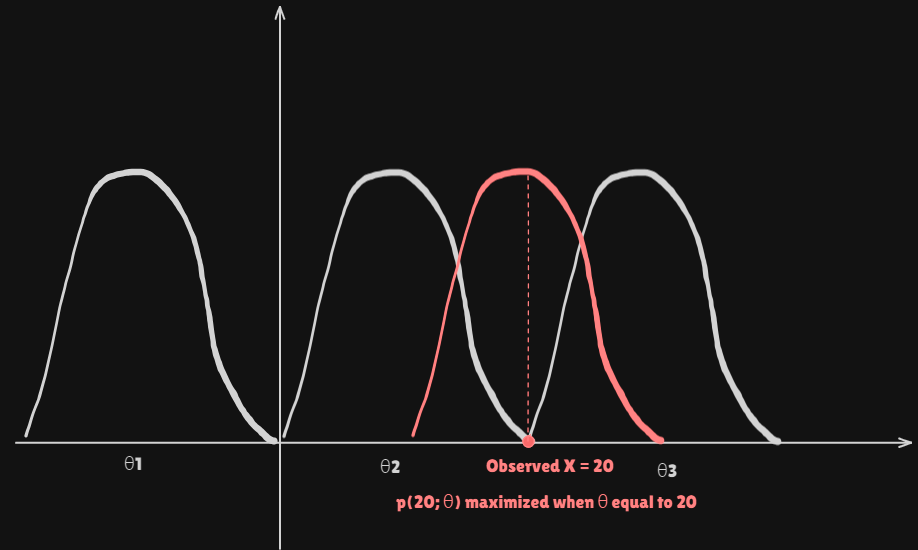
  • Example assume that it's Gaussian : N=1,  θN=1, \;\theta denotes the mean, x[0]N(θ,σ2)x[0]\sim N(\theta, {\sigma}^2) (N: Gaussian Normal Distribution)

    p(x[0];θ)=12πσ2exp[12σ2(x[0]θ2)]p(x[0];\theta)=\frac{1}{\sqrt{2\pi\sigma^2}}exp[-\frac{1}{2\sigma^2}(x[0]-\theta^2)]
  • Infer the value of θ\theta from the observed value of x[0]x[0]

    • If observed value equal to 20 than probaility of observation 20 maximized when θ\theta is 20.
  • In actual problems, PDF is not given but chosen

    • Consistent with constraints and prior knowledge
    • Mathematically tractable

      We don't know the actual distribution \rightarrow The thing only we can do is Guess the distribution using every background, knowledge etc.

  • Example : Dow-Jones industrial average

    • x[n]=A+Bn+w[n]x[n] = A + Bn + w[n]
    • w[n]w[n] : White Guassian noise(WGN) N(0,σ2)\sim N(0, \sigma ^ 2)
      • White : i.i.d \rightarrow independent and identically distributed
    • θ=[A,B]T,  x=[x[0]  x[1]    x[N1]]T\theta = [A, B]^T, \;x= [x[0]\;x[1]\;\cdots\;x[N-1]]^T
      p(x;θ)  =  1(2πσ2)N2exp[12σ2n=0N1(x[n]ABn)2]=  p(x[0],x[1],,x[n1];θ)=p(x[0];θ)××P(x[n1];θ)p(x;\theta)\;=\;\frac{1}{(2\pi\sigma^2)^{\frac{N}{2}}}exp\left[ \begin{array}{ll} -\frac{1}{2\sigma^2} \displaystyle \sum_{n=0}^{N-1} (x[n] -A-Bn)^2 \end{array} \right]\\ =\;p(x[0], x[1], \cdots,x[n-1];\theta)\\ = p(x[0];\theta) \times \cdots \times P(x[n-1];\theta)
        - It can be just Product of marginal Probs because it'd White(iid)

      Why Gaussian?

      Widely used and convience of calculation

      CLT(Central Limit Theorem)

      Add enough observations \rightarrow Follow Gaussian Distribution
      For Guassian When WSS(Wide Sense Stationary) \rightarrow SSS(Stric Sence Stationary)

Types of estimation

  • Classical Estimation : Parameters of interest are assumed to be Deterministic
  • Baysian Estimation : Parameters are assumed to be Random Variables to exploit any prior knowledge
    • Example : Average of Dow-Jones industrial average is in [2800, 3200] \leftarrow background knowledge(prior)

Estimator and Estimate

  • Estimator : A rule(Function) that assigns a value to θ\theta for each realization of xx

    Function of Random Variable xx\quad\rightarrow Random Variable
    θ^=g(x)  \hat \theta = g(x)\;\rightarrow Function g(x)g(x) is Estimator

  • Estimate : The value of θ\theta obtained for a given realization of xx

    θ^=g(x)  \hat \theta = g(x)\;\rightarrow Getting value of θ\theta into θ^\hat\theta$ is Estimation

Accessing Estimator Performance

Better Estimator? (Sample mean vs First sample value)

  • Example of the DC level in noise
    • x[n]=A+w[n]x[n]=A+w[n]
    • AA : unknown DC level target
    • w[n]w[n] : zero mean Gaussian process N(0,σ2)\sim N(0, \sigma^2)
    • NN observations : {x[0],x[1],,x[N1]}\{x[0], x[1], \cdots,x[N-1]\}
  • Two candidate estimators : Sample Mean vs First sample value
    A^=1Nn=0N1x[n],Aˇ=x[0]\hat A = \frac{1}{N}\displaystyle\sum_{n=0}^{N-1}x[n], \quad \check A=x[0]
  • Statiscal Analysis
    • Mean
      x[n]=A+w[n]E[x[n]]=A+E[w[n]]=A,E[w[n]]=0E(A^)=E(1Nn=0N1x[n])=1Nn=0N1E(x[n])=AE(Aˇ)=E(x[0])=Ax[n] = A+w[n]\\E[x[n]] = A + E[w[n]] = A,\quad E[w[n]] =0\\[1cm] E(\hat A) = E(\frac{1}{N}\displaystyle\sum_{n=0}^{N-1}x[n])=\frac{1}{N}\displaystyle\sum_{n=0}^{N-1}E(x[n]) = \textcolor{red}A\\ E(\check A) = E(x[0]) = \textcolor{red}A\\

      We can switch EE and \sum

    • Variance
      Var(x[n])=E[(x[n]E[x[μ]])2]=E[w2[n]]=Var(w[n])+E[w2[n]],E[w2[n]]=0Var(x[n])=σ2Var(A^)=Var(1Nn=0N1x[n])=1N2n=0N1Var(x[n])=1N2Nσ2=σ2NVar(Aˇ)=Var(x[0])=σ2Var(x[n]) = E[(x[n]-E[x[\mu]])^2]\\ =E[w^2[n]]\\ =Var(w[n]) + E[w^2[n]],\quad E[w^2[n]] = 0\\ \therefore Var(x[n]) = \sigma ^2\\[1cm] Var(\hat A) = Var\left(\frac{1}{N} \displaystyle \sum_{n=0}^{N-1}x[n]\right) = \frac{1}{N^2}\displaystyle\sum_{n=0}^{N-1}Var(x[n])\\ =\frac{1}{N^2}N\sigma^2 = \textcolor{red}{\frac{\sigma^2}{N}}\\[0.5cm] Var(\check A) = Var(x[0] ) = \textcolor{red}{\sigma^2}
    • What's better? \rightarrow Sample mean is better estimator than First value
      EstimatorMeanVariance
      Sample meanAAσ2N\frac{\sigma^2}{N}
      First valueAAσ2\sigma^2

Mathematical Detection Problem

Binary Hypothesis Test

  • Noise only hypothesis vs. signal present hypothesis(Deterministic signals)
    H0:x[n]=w[n]H1:x[n]=s[n]+w[n]H_0 :x[n]=w[n]\\H_1:x[n]=s[n]+w[n]
  • Example of the DC level in noise
    s[n]=A=1,  w[n]s[n] = A = 1, \;w[n]: zero mean Gaussian process N(0,σ2)\sim N(0, \sigma^2)
    p(x[0];  H0)=12πσ2exp[12σ2x[0]2]p(x[0];  H1)=12πσ2exp[12σ2(x[0]1)2]p(x[0];\;H_0)=\frac{1}{\sqrt{2\pi\sigma^2}}exp\left[-\frac{1}{2\sigma^2}x[0]^2\right]\\[0.3cm] p(x[0];\;H_1) = \frac{1}{\sqrt{2\pi\sigma^2}}exp\left[-\frac{1}{2\sigma^2}(x[0]-1)^2\right]
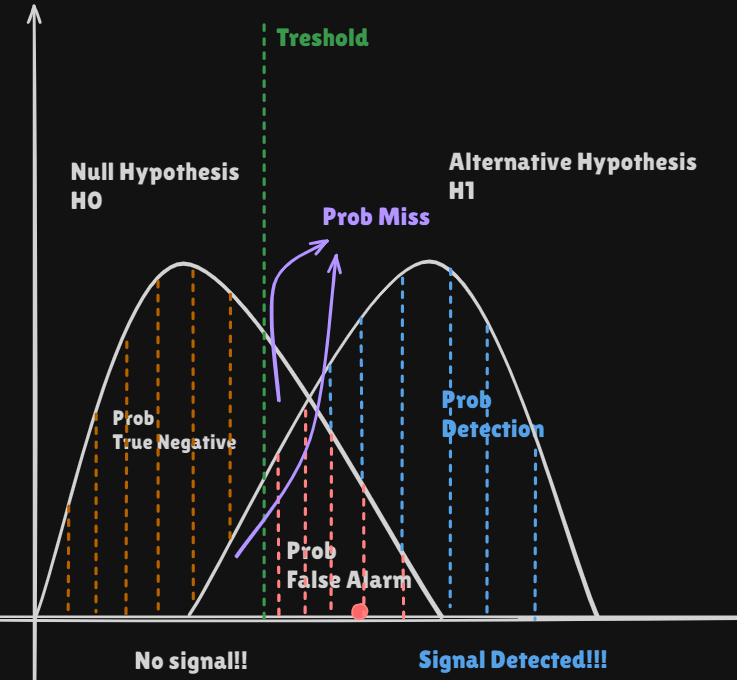
  • Which Detector is better?
    H1:x[0]>1/2H_1\quad: x[0] > 1/2 vs H0:otherwiseH_0 \quad :otherwise
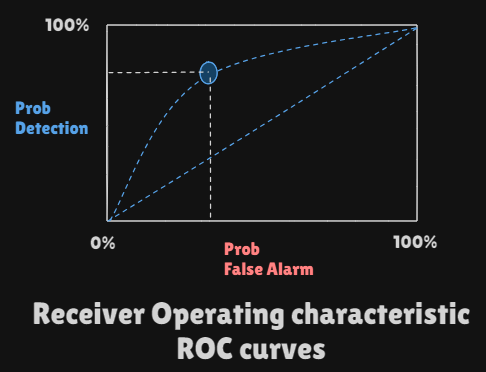
  • Receiver Operating Characteristic(ROC) curves
    • Probability of false alarm(PFA=P(P_{FA}=P(decide H1H_1 when H0H_0 is true)) : Correct
    • Probability of detection(PD=P(P_D=P(decide H1H_1 when H1H_1 is true)) : Wrong

All Content has been written based on lecture of Prof. eui-seok.Hwang in GIST(Detection and Estimation)

profile
AI, Security

0개의 댓글