[DetnEst] 5. General MVUE

KBC·2024년 10월 23일
0

Detection and Estimation

목록 보기
8/23

Recap

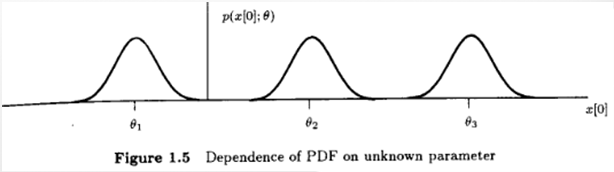
Revisit : Likelihood Function

  • The Likelihood Function p(x;θ)p(x;\theta) (same description of PDF)
  • But as a function of parameter θ\theta w/ the data vector xx fixed

Likelihood Function Characteristics

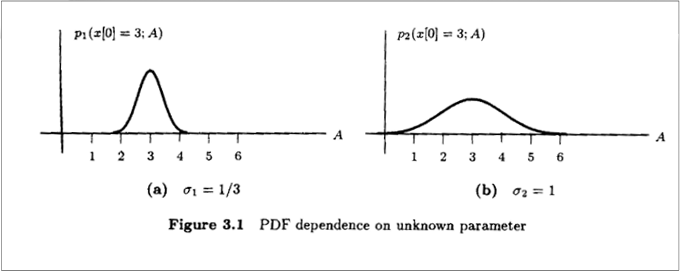
  • Intuitively : sharpness of the Likelihood Function sets accuracy
  • Sharpness is measured using curvature :
    2lnp(x;θ)θ2x=x0,θ-\left.\frac{\partial^2 \ln p(\mathbf{x}; \theta)}{\partial \theta^2}\right|_{\mathbf{x}=\mathbf{x}_0, \theta}
  • Curvature ↑ ⇒ PDF concentration ↑ ⇒ Accuracy ↑
  • Expected sharpness of likelihood function
    E[2lnp(x;θ)θ2]θ-E\left[\left.\frac{\partial^2 \ln p(\mathbf{x}; \theta)}{\partial \theta^2}\right]\right|_\theta

Vector Form of the CRLB

  • Assuming p(x;θ)p(x;\theta) satisfies the regularity condition
    E[lnp(x;θ)θ]=0,for all θE\left[\frac{\partial\ln p(x;\theta)}{\partial\theta}\right]=0,\quad\text{for all }\theta
  • The covariance matrix of any unbiased estimator θ^\hat\theta satisfies
    Cθ^I1(θ)0[I(θ)]ij=E[2lnp(x;θ)θiθj]C_{\hat\theta}-I^{-1}(\theta)\geq0\quad[I(\theta)]_{ij}=-E\left[\frac{\partial^2\ln p(x;\theta)}{\partial\theta_i\partial\theta_j}\right]
    where 0\geq 0 means the matrix is positive semidefinite
  • Furthermore, an unbiased estimator may be found that attains the bound
    Cθ^=I1(θ)C_{\hat\theta}=I^{-1}(\theta) if and only if
    lnp(x;θ)θ=I(θ)(g(x)θ)\frac{\partial \ln p(x;\theta)}{\partial\theta}=I(\theta)(g(x)-\theta)
  • In that case, θ^=g(x)\hat\theta=g(x) is the MVUE with variance I1(θ)I^{-1}(\theta)

MVUE for the Linear Model - Theorem

  • If the observed data can be modeled as x=Hθ+w\text{x}=H\theta+\text{w},
    lnp(x;θ)θ=HTHσ2[(HTH)1HTxθ]\frac{\partial\ln p(x;\theta)}{\partial\theta}=\frac{\text{H}^T\text{H}}{\sigma^2}[(\text{H}^T\text{H})^{-1}\text{H}^T\text{x}-\theta]
  • The MVUE is
    θ^=(HTH)1HTx\hat \theta=(\text{H}^T\text{H})^{-1}\text{H}^T\text{x}
  • And the covariance matrix of θ^\hat\theta is
    Cθ^=I1(θ)=σ2(HTH)1C_{\hat\theta}=I^{-1}(\theta)=\sigma^2(\text{H}^T\text{H})^{-1}
  • For the linear model, the MVUE is efficient in that attains the CRLB
  • Also, the statiscal performance of θ^\hat\theta is completely specified, because θ^\hat\theta is a linear transformation of a Gaussian vector x\text{x} and hence
    θ^N(θ,σ2(HTH)1)\hat\theta\sim N(\theta, \sigma^2(\text{H}^T\text{H})^{-1})

Finding the MVUE so far

  • When the observations and the data are related in a linear way x=Hθ+w\text{x}=\text{H}\theta+\text{w},
  • and the noise was Gaussian, then the MVUE was easy to find:
    θ^=(HTH)1HTx\hat \theta=(\text{H}^T\text{H})^{-1}\text{H}^T\text{x}
    with covariance matrix, Cθ^=I1(θ)=σ2(HTH)1C_{\hat\theta}=I^{-1}(\theta)=\sigma^2(\text{H}^T\text{H})^{-1}
  • Using the CRLB, if you got lucky, then you could write
    lnp(x;θ)θ=I(θ)(g(x)θ)\frac{\partial \ln p(x;\theta)}{\partial\theta}=I(\theta)(g(x)-\theta)
    where θ^=g(x)\hat\theta=g(x) would be your MVUE, an efficient estimator(meet the CRLB)
  • Even if no efficient estimator exists, an MVUE may exist
  • In this section, we try to find a systematic way of determining the MVUE if it exists

Finding the MVUE

  • We wish to estimate the parameter(s) θ\theta from the observations x\text{x}
    • Step 1
      • Determine (if possible) a sufficient statistic T(x)T(x) for the parameter to be estimated θ\theta
      • This may be done using the Neyman-Fisher factorization theorem
    • Step 2
      • Determine whether the sufficient statistic is also complete

        This is generally hard to do

      • If it is not complete, we can say nothing more about the MVUE
      • If it is, continue to Step 3
    • Step 3
      • Find the MVUE θ^\hat\theta from T(x)T(x) is one of two ways using the
        Rao-Blackwell-Lehmann-Scheffe(RBLS) theorem

        Rao-Blackwell-Lehmann_Scheffe(RBLS) theorem

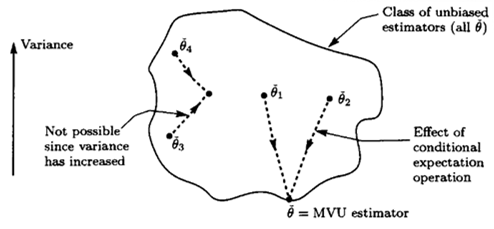
        • Find a function g()g(\cdot) of the sufficient statistic that yields an unbiased estimator θ^=g(T(x))\hat\theta = g(T(x)), the MVUE
        • By definition of completeness of the statistic, this will yield the MVUE
        • Find any unbiased estimator θˉ\bar\theta for θ\theta, and then determine
          θ^=E[θˉT(x)]\hat \theta=E[\bar\theta|T(x)]
        • This is usually very tedious/difficult to do
        • The expectation is taken over the distribution p(θˉT(x))p(\bar\theta|T(x))

Sufficient Statistics

  • Example : Estimating a DC Level in WGN
    • A^=1Nn=0N1x[n]\hat A = \frac{1}{N}\sum_{n=0}^{N-1}x[n] : MVUE with variance σ2N\frac{\sigma^2}{N}
    • Aˇ=x[0]\check{A}=x[0] : unbiased estimator with variance σ2\sigma^2
      Aˇ\check A disarded the data points {x[1],,x[N1]}\{x[1],\cdots,x[N-1]\} which carry information about AA
  • Is there a set of data that is sufficient?
    • S1={x[0],,x[N1]}S_1=\{x[0],\cdots,x[N-1]\} : sufficient statistic
      (Original data set is always sufficient)
    • S2={x[0]+x[1],,x[N1]}S_2=\{x[0]+x[1],\cdots,x[N-1]\} : sufficient statistic
    • S3={n=0N1x[n]}S_3=\{\sum_{n=0}^{N-1}x[n]\} : minimal sufficient statistis (least # of elements)
  • For estimation of AA, once we know n=0N1x[n]\sum_{n=0}^{N-1}x[n], we no longer need the individual data values

    Since all information has been summarized in the sufficient statistic

  • A statistic is the result of applying a function to a set of data - our observations
  • A single statistic is a single function of the observations, T(x)T(x)
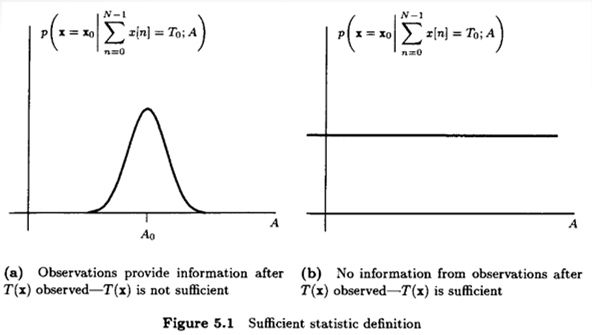
  • And it is called sufficient statistics if the PDF p(xT(x)=T0;θ)p(\text{x}|T(\text{x})=T_0;\theta) is independent of θ\theta

  • Example : Estimating a DC Level in WGN
    p(x;A)=1(2πσ2)N2exp[12σ2n=0N1(x[n]A)2]T(x)=n=0N1x[n]=T0 observedp(\mathbf{x}; A) = \frac{1}{(2\pi\sigma^2)^{\frac{N}{2}}} \exp\left[ -\frac{1}{2\sigma^2} \sum_{n=0}^{N-1} (x[n] - A)^2 \right]\\[0.3cm] T(\mathbf{x}) = \sum_{n=0}^{N-1} x[n] = T_0 \text{ observed}
  • Conditional PDF p(xn=0N1x[n]=T0;A)p(\text{x}|\sum_{n=0}^{N-1} x[n]=T_0;A) should not depend on AA
  • Verification of a sufficient statistic
    p(xT(x)=T0;A)=p(x,T(x)=T0;A)p(T(x)=T0;A)p(T(x)=T0;A)=12πNσ2exp(12Nσ2(T0NA)2)p(T(x)N(NA,Nσ2))p(x;A)δ(T(x)T0)=1(2πσ2)N2exp[12σ2n=0N1(x[n]A)2]δ(T(x)T0)=1(2πσ2)N2exp[12σ2((n=0N1x2[n])2AT(x)+NA2)]δ(T(x)T0)=1(2πσ2)N2exp[12σ2((n=0N1x2[n])2AT0+NA2)]δ(T(x)T0)p(\mathbf{x} | T(\mathbf{x}) = T_0; A) = \frac{p(\mathbf{x}, T(\mathbf{x}) = T_0; A)}{p(T(\mathbf{x}) = T_0; A)}\\[0.3cm] p(T(\mathbf{x}) = T_0; A) = \frac{1}{\sqrt{2\pi N\sigma^2}} \exp\left( -\frac{1}{2N\sigma^2} (T_0 - NA)^2 \right) \\[0.3cm] p(T(\mathbf{x}) \sim \mathcal{N}(NA, N\sigma^2))\\[0.5cm] p(\mathbf{x}; A) \delta(T(\mathbf{x}) - T_0) = \frac{1}{(2\pi\sigma^2)^{\frac{N}{2}}} \exp\left[ -\frac{1}{2\sigma^2} \sum_{n=0}^{N-1} (x[n] - A)^2 \right] \delta(T(\mathbf{x}) - T_0)\\[0.3cm] = \frac{1}{(2\pi\sigma^2)^{\frac{N}{2}}} \exp \left[ -\frac{1}{2\sigma^2} \left(\left( \sum_{n=0}^{N-1} x^2[n]\right) - 2AT(\mathbf{x}) + NA^2 \right) \right] \delta(T(\mathbf{x}) - T_0)\\[0.3cm] = \frac{1}{(2\pi\sigma^2)^{\frac{N}{2}}} \exp \left[ -\frac{1}{2\sigma^2} \left( \left(\sum_{n=0}^{N-1} x^2[n]\right) - 2AT_0 + NA^2 \right) \right] \delta(T(\mathbf{x}) - T_0)
    Then,
    p(xT(x)=T0;A)=1(2πσ2)N2exp[12σ2n=0N1x2[n]]exp[12σ2(2AT0+NA2)]12πNσ2exp[12Nσ2(T0NA)2]δ(T(x)T0)=N(2πσ2)N12exp[12σ2n=0N1x2[n]]exp[T022Nσ2]δ(T(x)T0)exp[12Nσ2(T0NA)2]=exp[T022Nσ2+NAT0Nσ2NA22Nσ2]=exp[T022Nσ2]p(\mathbf{x} | T(\mathbf{x}) = T_0; A) \\[0.3cm] =\frac{\frac{1}{(2\pi\sigma^2)^{\frac{N}{2}}} \exp\left[ -\frac{1}{2\sigma^2} \sum_{n=0}^{N-1} x^2[n] \right] \exp\left[ -\frac{1}{2\sigma^2} (-2AT_0 + NA^2) \right] }{\frac{1}{\sqrt{2\pi N \sigma^2}} \exp\left[-\frac{1}{2N\sigma^2} (T_0 - NA)^2 \right]}\delta(T(\mathbf{x}) - T_0)\\[0.3cm] = \frac{\sqrt{N}}{(2\pi\sigma^2)^{\frac{N-1}{2}}} \exp\left[ -\frac{1}{2\sigma^2} \sum_{n=0}^{N-1} x^2[n] \right] \exp\left[ \frac{T_0^2}{2N\sigma^2} \right] \delta(T(\mathbf{x}) - T_0)\\[0.4cm] \exp\left[-\frac{1}{2N\sigma^2} (T_0 - NA)^2 \right]=\exp\left[ -\frac{T_0^2}{2N\sigma^2} + \frac{NA T_0}{N\sigma^2} - \frac{NA^2}{2N\sigma^2} \right]\\[0.3cm]=\exp\left[\frac{T_0^2}{2N\sigma^2}\right]

    Independent of the parameter AA
    T(x)=n=0N1x[n]T(x)=\sum_{n=0}^{N-1}x[n] is sufficient statistic for the estimation of AA


  • Evaluation of the conditional PDF is difficult
  • Guessing a potential sufficient statistics is even more difficult
  • General framework to find sufficient statistic : Neyman-Fisher facorization

Neyman-Fisher Factorization

  • If we can factor the PDF p(x;θ)p(\text{x};\theta) as
    p(x;θ)=g(T(x),θ)h(x)p(\text{x};\theta)=g(T(\text{x}),\theta)h(\text{x})
    where g()g(\cdot) is a function depending on x\text{x} only through T(x)T(\text{x}) and h()h(\cdot) is a function
    depending only on x\text{x}
  • Then T(x)T(\text{x}) is a sufficient statistic for θ\theta
  • Conversely, if T(x)T(\text{x}) is a sufficient statistic for θ\theta, then the PDF can be factored as in the above equation
  • Proof : Appendix 5A

Example 1

  • Example : Estimating a DC Level in WGN
    p(x;A)=1(2πσ2)N2exp[12σ2n=0N1(x[n]A)2]=1(2πσ2)N2exp[12σ2(n=0N1x2[n]2An=0N1x[n]+NA2)]=g(T(x);A)h(x)g(T(x),A)=1(2πσ2)N2exp[12σ2(2An=0N1x[n]+NA2)],h(x)=exp[12σ2n=0N1x2[n]]T(x)=n=0N1x[n] is a sufficient statistic for Ap(\mathbf{x}; A) = \frac{1}{(2\pi\sigma^2)^{\frac{N}{2}}} \exp\left[ -\frac{1}{2\sigma^2} \sum_{n=0}^{N-1} (x[n] - A)^2 \right]\\[0.3cm] = \frac{1}{(2\pi\sigma^2)^{\frac{N}{2}}} \exp\left[ -\frac{1}{2\sigma^2} \left( \sum_{n=0}^{N-1} x^2[n] - 2A \sum_{n=0}^{N-1} x[n] + NA^2 \right) \right]\\[0.3cm] =g(T(\text{x});A)h(\text{x})\\[0.4cm] \Rightarrow g(T(\mathbf{x}), A) = \frac{1}{(2\pi\sigma^2)^{\frac{N}{2}}} \exp\left[ -\frac{1}{2\sigma^2} \left( -2A \sum_{n=0}^{N-1} x[n] + NA^2 \right) \right],\\[0.3cm]\quad h(\mathbf{x}) = \exp\left[ -\frac{1}{2\sigma^2} \sum_{n=0}^{N-1} x^2[n] \right]\\[0.3cm] \therefore T(\mathbf{x}) = \sum_{n=0}^{N-1} x[n] \text{ is a sufficient statistic for } A
  • Note that any one-to-one function of T(x)T(\text{x}) is a sufficient statistic

Example 2

  • Example : Power of WGN
    A=0,  σ2A=0,\;\sigma^2 is the unknown parameter
    p(x;σ2)=1(2πσ2)N2exp[12σ2n=0N1x2[n]]=g(T(x),σ2)h(x)T(x)=n=0N1x2[n]p(\mathbf{x}; \sigma^2) = \frac{1}{(2\pi\sigma^2)^{\frac{N}{2}}} \exp\left[ -\frac{1}{2\sigma^2} \sum_{n=0}^{N-1} x^2[n] \right]\\[0.3cm] = g(T(\mathbf{x}), \sigma^2) \cdot h(\mathbf{x})\\[0.4cm] T(\mathbf{x}) = \sum_{n=0}^{N-1} x^2[n]

Naturally Extended Neyman-Fisher Factorization

  • The rr statistics T1(x),T2(x),,Tr(x)T_1(\text{x}),T_2(\text{x}),\cdots,T_r(\text{x}) are joint sufficient statistics
    if the conditional pdf p(xT1(x),T2(x),,Tr(x);θ)p(\text{x}|T_1(\text{x}),T_2(\text{x}),\cdots,T_r(\text{x});\theta) does not depend on θ\theta
  • They are joint sufficient statistics if and only if the pdf may be factored as
    p(x;θ)=g(T1(x),T2(x),,Tr(x),θ)h(x)p(\text{x};\theta)=g(T_1(\text{x}),T_2(\text{x}),\cdots,T_r(\text{x}),\theta)h(\text{x})
  • The original data x\text{x} are always sufficient statistics
    g(T1(x),T2(x),,Tr(x),θ)=p(x;θ),h(x)=1g(T_1(\text{x}),T_2(\text{x}),\cdots,T_r(\text{x}),\theta)=p(x;\theta),\quad h(\text{x})=1

Phase Examples

x[n]=Acos(2πf0n+ϕ)+w[n],n=0,1,,N1x[n] = A \cos(2\pi f_0 n + \phi) + w[n], \quad n = 0, 1, \dots, N-1
  • A,f0,σ2:knownA, f_0, \sigma^2 : \text{known}
  • w[n]:WGNw[n] : \text{WGN}
  • ϕ:Unknown\phi : \text{Unknown}
  • The exponent may be expanded as
    n=0N1x2[n]2An=0N1x[n]cos(2πf0n+ϕ)+n=0N1A2cos2(2πf0n+ϕ)=n=0N1x2[n]2A(n=0N1x[n]cos2πf0n)cosϕ+2A(n=0N1x[n]sin2πf0n)sinϕ+n=0N1A2cos2(2πf0n+ϕ)\sum_{n=0}^{N-1} x^2[n] - 2A \sum_{n=0}^{N-1} x[n] \cos(2\pi f_0 n + \phi) + \sum_{n=0}^{N-1} A^2 \cos^2(2\pi f_0 n + \phi)\\[0.3cm] = \sum_{n=0}^{N-1} x^2[n] - 2A \left( \sum_{n=0}^{N-1} x[n] \cos 2\pi f_0 n \right) \cos \phi \\[0.3cm]+ 2A \left( \sum_{n=0}^{N-1} x[n] \sin 2\pi f_0 n \right) \sin \phi + \sum_{n=0}^{N-1} A^2 \cos^2(2\pi f_0 n + \phi)
  • No single sufficient statistic exists, but jointly sufficient statistics exist
    g(T1(x),T2(x),ϕ)p(x;ϕ)=exp(12σ2[n=0N1A2cos2(2πf0n+ϕ)2AT1(x)cosϕ+2AT2(x)sinϕ])1(2πσ2)N2exp(12σ2n=0N1x2[n])=h(x)T1(x)=n=0N1x[n]cos2πf0n,T2(x)=n=0N1x[n]sin2πf0ng(T_1(\text{x}),T_2(\text{x}),\phi)\\[0.3cm] p(\mathbf{x}; \phi) = \exp\left( -\frac{1}{2\sigma^2} \left[ \sum_{n=0}^{N-1} A^2 \cos^2(2\pi f_0 n + \phi) - 2A T_1(\mathbf{x}) \cos \phi + 2A T_2(\mathbf{x}) \sin \phi \right] \right)\\[0.3cm] \cdot \frac{1}{(2\pi \sigma^2)^{\frac{N}{2}}} \exp\left( -\frac{1}{2\sigma^2} \sum_{n=0}^{N-1} x^2[n] \right) = h(\mathbf{x})\\[0.4cm] T_1(\mathbf{x}) = \sum_{n=0}^{N-1} x[n] \cos 2\pi f_0 n, \quad T_2(\mathbf{x}) = \sum_{n=0}^{N-1} x[n] \sin 2\pi f_0 n

Sufficient Statistics and MVUEs

  • If we determined a sufficient statistic T(x)T(\text{x}) for θ\theta

  • Then we can use this to improve any unbiased estimator of θ\theta

  • As is proven in the Rao-Blackwell-Lehmann-Scheffe(RBLS) theorem

  • If we're lucky and the statistic is also complete, we can use it to find the MVUE

    • There are many definitions for the completeness of a statistic
      One that is easy for us to use in the context of estimation is the following :

      It is called complete if only 1 function of it yields an unbiased estimator of θ\theta
      g(T(x)): only one unbiased functiong(T(\text{x})) :\text{ only one unbiased function}

      • This is generally difficult to check but is easy conceptually
    • Another way of checking if a statistic is complete :

    v(T)p(T;θ)dT=0\int_{-\infty}^{\infty} v(T) p(T; \theta) \, dT = 0

    • A statistic TT is complete it contains above for all θ\theta is only
      satisfied by v(T)=0v(\text{T}) =0 for all TT

Example : DC Level in WGN

  • Suppose we don't know that the sample mean is MVUE, but know that
    T(x)=n=0N1x[n]T(\text{x})=\sum_{n=0}^{N-1}x[n]
    is a sufficient statistic
  • Two ways to find the MVUE :
    • Find any unbiased estimator of AA, say Aˇ=x[0]\check A = x[0], and determine A^=E(AˇT)\hat A = E(\check A|T)
      The expectation is taken with respect to p(AˇT)p(\check A|T)
    • Find some function gg so that A^=g(T)\hat A = g(T) is an unbiased estimator of AA

First Approach to find

A^=E[x[0]n=0N1x[n]]\hat A =E\left[\left.x[0]\right|\sum_{n=0}^{N-1}x[n]\right]
  • For jointly Gaussian random variables xx and yy
    E(xy)=E(x)+cov(x,y)var(y)(yE(y))E(x|y)=E(x)+\frac{\text{cov}(x,y)}{\text{var}(y)}(y-E(y))
    (Appendix 10A)
    [xy]=n=0N1x[n]=[10001111][x[0]x[1]x[N1]]=LxN(μ,C)L=[10001111]μ=LE(x)=[ANA],C=σ2LLT=σ2[111N]A^=E(xy)=A+σ2Nσ2(n=0N1x[n]NA)=1Nn=0N1x[n]\begin{bmatrix} x \\ y \end{bmatrix} = \sum_{n=0}^{N-1} x[n] = \begin{bmatrix} 1 & 0 & 0 & \dots & 0 \\ 1 & 1 & 1 & \dots & 1 \end{bmatrix} \begin{bmatrix} x[0] \\ x[1] \\ \vdots \\ x[N-1] \end{bmatrix} = Lx \sim \mathcal{N}(\mu, C)\\[0.5cm]L = \begin{bmatrix} 1 & 0 & 0 & \dots & 0 \\ 1 & 1 & 1 & \dots & 1 \end{bmatrix}\\[0.3cm] \mu = L E(x) = \begin{bmatrix} A \\ NA \end{bmatrix}, \quad C = \sigma^2 L L^T = \sigma^2 \begin{bmatrix} 1 & 1 \\ 1 & N \end{bmatrix}\\[0.3cm] \Rightarrow \hat{A} = E(x | y) = A + \frac{\sigma^2}{N\sigma^2} \left( \sum_{n=0}^{N-1} x[n] - NA \right) = \frac{1}{N} \sum_{n=0}^{N-1} x[n]

Second Approach

A^=g(n=0N1x[n])\hat A=g\left(\sum_{n=0}^{N-1}x[n]\right)
  • E[A^]=AE[\hat A]=A
  • E[T]=NAE[T] = NA
  • For unbiased
    g(x)=xNA^=1Nn=0N1x[n]g(x)=\frac{x}{N} \rightarrow \hat A=\frac{1}{N}\sum_{n=0}^{N-1}x[n]

Rao-Blackwell-Lehmann-Scheffe(RBLS) Theorem

  • If θˇ\check \theta is an unbiased estimator of θ\theta and T(x)T(\text{x}) is a sufficient statistic for θ\theta,
    Then θ^=E[θˇT(x)]\hat\theta = E[\check\theta|T(\text{x})]
    1. A valid estimator for θ\theta (not dependent on θ\theta)
    2. Unbiased
    3. Of lesser or equal variance thant that of θˇ\check \theta, for all θ\theta
  • Additionally, if the sufficient statistic is complete, then θ^\hat \theta is the MVUE
  • A statistic is complete if there is only one function of the statistic that is unbiased
    θ^=E(θ~T(x))=θ~(x)p(xT(x);θ)dxnot depend on θvalid estimator\hat{\theta} = E(\tilde{\theta} | T(\mathbf{x})) = \int \tilde{\theta}(\mathbf{x}) p(\mathbf{x} | T(\mathbf{x}); \theta) d\mathbf{x} \quad \Rightarrow \text{not depend on } \theta \Rightarrow \text{valid estimator}
  • p(xT(x);θ)p(\text{x}|T(\text{x});\theta) doesn't depend on θ\theta by the definition of sufficient statistic
    \rightarrow 1 is proven
    E(θ^)=θ~(x)p(xT(x);θ)dxp(T(x);θ)dT=θ~(x)(p(xT(x);θ)p(T(x);θ)dT)dx=θ~(x)p(x;θ)dx=E(θ~)=θunbiased (2 is proven)E(\hat{\theta}) = \int \int \tilde{\theta}(\mathbf{x}) p(\mathbf{x} | T(\mathbf{x}); \theta) d\mathbf{x} p(T(\mathbf{x}); \theta) dT\\[0.3cm] = \int \tilde{\theta}(\mathbf{x}) \left( \int p(\mathbf{x} | T(\mathbf{x}); \theta) p(T(\mathbf{x}); \theta) dT \right) d\mathbf{x}\\[0.3cm] = \int \tilde{\theta}(\mathbf{x}) p(\mathbf{x}; \theta) d\mathbf{x} = E(\tilde{\theta}) = \theta \quad \Rightarrow \text{unbiased (2 is proven)}
    var(θˇ)=E[(θˇE(θˇ))2]=E[(θˇθ^+θ^θ)2]=E[(θˇθ^)2]+2E[(θˇθ^)(θ^θ)]+E[(θ^θ)2]var(θ^)=E[(θ^θ)2]\text{var}(\check{\theta}) = E\left[ \left( \check{\theta} - E(\check{\theta}) \right)^2 \right] = E\left[ \left( \check{\theta} - \hat{\theta} + \hat{\theta} - \theta \right)^2 \right]\\[0.3cm] = E\left[ (\check{\theta} - \hat{\theta})^2 \right] + 2E\left[ (\check{\theta} - \hat{\theta})(\hat{\theta} - \theta) \right] + E\left[ (\hat{\theta} - \theta)^2 \right]\\[0.3cm] \text{var}(\hat\theta)=E\left[(\hat\theta-\theta)^2\right]
  • Note that E[(θ~θ^)(θ^θ)]=0E\left[ (\tilde{\theta} - \hat{\theta})(\hat{\theta} - \theta) \right] = 0 since
    ET,θˇ[(θˇθ^)(θ^θ)]=ETEθˇT[(θˇθ^)(θ^θ)]=ET[EθˇT[(θˇθ^)(θ^θ)]]=ET[(EθˇT[θˇ]θ^)(θ^θ)]ET[(θ^θ^)(θ^θ)]=0E_{T,\check\theta}\left[(\check\theta-\hat\theta)(\hat\theta-\theta)\right]=E_TE_{\check\theta|T}\left[(\check\theta-\hat\theta)(\hat\theta-\theta)\right]\\[0.3cm] =E_T\left[E_{\check\theta|T}\left[(\check\theta-\hat\theta)(\hat\theta-\theta)\right]\right]=E_T\left[(E_{\check\theta|T}\left[\check\theta\right]-\hat\theta)(\hat\theta-\theta)\right]\\[0.3cm] E_T\left[(\hat\theta-\hat\theta)(\hat\theta-\theta)\right] =0
  • Thus, var(θˇ)=E[(θˇθ^)2]+var(θ^)var(θ^)\text{var}(\check\theta)=E\left[(\check\theta-\hat\theta)^2\right] + \text{var}(\hat\theta) \geq\text{var}(\hat\theta) : 3 is proven

θ^=E(θ~T(x))=θ~p(θ~T(x))dθ~=g(T(x))\hat{\theta} = E(\tilde{\theta} | T(\mathbf{x})) = \int \tilde{\theta} p(\tilde{\theta} | T(\mathbf{x})) d\tilde{\theta} = g(T(\mathbf{x}))
  • If T(x)T(\text{x}) is complete, there is only one function of TT that is an unbiased estimator
    • θ^\hat\theta is unique independent of θ^\hat\theta
    • var(θ^)var(θˇ)\text{var}(\hat\theta)\leq\text{var}(\check\theta) for all θˇ\check\theta
    • θ^\hat\theta must be an MVUE
  • Completeness depends on the PDF of x\text{x}
  • This condition is satisfied for the exponential family of PDFs

RBLS Example

  • Incomplete sufficient statistic
    x[0]=A+w[0],wU[12,12]x[0]=A+w[0],\quad w\sim U\left[-\frac{1}{2},\frac{1}{2}\right]
  • E[x[0]]=A+E[w[0]]=AE[x[0]]=A+E[w[0]]=A
  • x[0]x[0] is sufficient statistic and an unbiased estimator

    Is g(x[0])=x[0]g(x[0])=x[0] a MVUE?

    • Suppose that there exists another function hh w/ the unbiased property
      E[h(x[0])]=AE[h(x[0])] =A and see if h=gh=g
    • Let v(T)=g(T)h(T)v(T)=g(T)-h(T), then v(T)p(x;A)dx=0\int_{-\infty}^{\infty} v(T) p(\mathbf{x}; A) d\mathbf{x} = 0 for all AA
    • Since x=x[0]=T,  v(T)p(T;A)dT=0\text{x}=x[0]=T,\;\int_{-\infty}^{\infty} v(T) p(T; A) dT = 0 for all AA
      p(T;A)={1,A12TA+120,otherwiseA12A+12v(T)dT=0 for all Ap(T; A) = \begin{cases} 1, & A - \frac{1}{2} \leq T \leq A + \frac{1}{2} \\ 0, & \text{otherwise} \end{cases} \quad \Rightarrow \int_{A-\frac{1}{2}}^{A+\frac{1}{2}} v(T) dT = 0 \text{ for all } A
    • v(T)=sin2πTv(T) =\sin2\pi T satisfies the condition
      A^=x[0]sin2πx[0]\hat A=x[0]-\sin2\pi x[0] based on the sufficient statistic and is unbiasedNo
  • Completeness condition is that only the zero function v(T)=0v(T)=0 satisfies
    v(T)p(T;A)dT=0\int_{-\infty}^{\infty} v(T) p(T; A) dT = 0

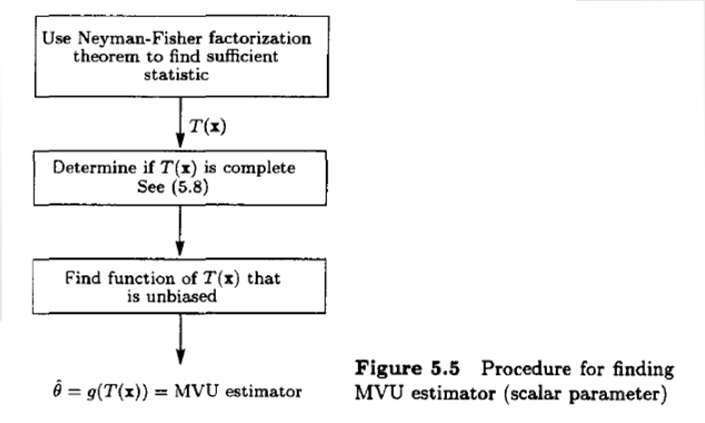
    Procedure for finding MVUE(Scalar)

    1. Use Neyman-Fisher Factorization to find sufficient statistic T(x)T(\text{x})
    2. Determine if T(x)T(\text{x}) is complete;
      The condition for completeness is that only the zero function
      v(T)=0v(T)=0 satisfies v(T)p(T;θ)dT=0\int_{-\infty}^{\infty} v(T) p(T; \theta) dT = 0 for all θ\theta
    3. Find a function gg of T(x)T(\text{x}) that is unbiased
      Then θ^=g(T(x))\hat \theta = g(T(\text{x})) is the MVUE
      Or alternatively, evaluate θ^=E[θˇT(x)]\hat\theta=E\left[\check\theta|T(\text{x})\right] where θˇ\check\theta is any unbiased estimator

Example : Mean of Uniform Noise

  • Consider estimating the mean θ=β/2\theta = \beta/2 of the i.i.d. uniform noise
    w[n]U[0,β]w[n]\sim U[0,\beta]
  • x[n]=w[n],n=0,1,,N1x[n]=w[n],\quad n=0,1,\cdots,N-1
  • Find an efficient estimator
    • The regularity condition does not hold : CRLB cannot be applied
    • Natural guess : sample mean estimator
      θ^=1Nn=0N1x[n]unbiasedvar(θ^)=1N2Nvar(x[n])=1Nvar(x[n])=β212N\hat \theta =\frac{1}{N}\sum_{n=0}^{N-1} x[n]\rightarrow\text{unbiased}\\[0.3cm] \text{var}(\hat\theta)=\frac{1}{N^2}\cdot N\cdot\text{var}(x[n])=\frac{1}{N}\text{var}(x[n])=\frac{\beta^2}{12N}
    • Is the sample mean estimator MVUE?
  • Follow Figure 5.5 unit step function
    p(x[n];β)=1β[u(x[n])u(x[n]β)],u(x):unit step functionp(x;β)=1βNn=0N1[u(x[n])u(x[n]β)]p(x;β)={1βN,maxx[n]<β,minx[n]>00,otherwisep(x;β)=1βNu(βmaxx[n])u(minx[n])T(x)=maxx[n]p(x[n]; \beta) = \frac{1}{\beta} [u(x[n]) - u(x[n] - \beta)], \quad u(x): \text{unit step function}\\[0.3cm] p(x; \beta) = \frac{1}{\beta^N} \prod_{n=0}^{N-1} [u(x[n]) - u(x[n] - \beta)]\\[0.3cm] p(x; \beta) = \begin{cases} \frac{1}{\beta^N}, & \max x[n] < \beta, \min x[n] > 0 \\ 0, & \text{otherwise} \end{cases}\\[0.3cm] \Rightarrow p(x; \beta) = \frac{1}{\beta^N} u(\beta - \max x[n]) u(\min x[n])\\[0.3cm] \Rightarrow T(x) = \max x[n]
  • T(x)T(\text{x}) : sufficient statistic for θ\theta, and also complete
  • Next, we need to find a function gg of T(x)T(\text{x}) that is unbiased
    px[n](ξ;β)={1β,0<ξ<β0,otherwisePDF of x[n]CDF: Pr{x[n]ξ}={0,ξ<0ξβ,0<ξ<β1,ξβPr{Tξ}=n=0N1Pr{x[n]ξ}=Pr{x[n]ξ}N:CDF of T(x)pT(ξ)={0,ξ<0N(ξβ)N11β,0<ξ<β0,ξ>βPDF of T(x)E(T)=ξpT(ξ)dξ=0βξN(ξβ)N11βdξ=NN+1β=2NN+1θp_{x[n]}(\xi; \beta) = \begin{cases} \frac{1}{\beta}, & 0 < \xi < \beta \\ 0, & \text{otherwise} \end{cases} \quad \text{PDF of } x[n]\\[0.3cm] \text{CDF: } \Pr\{x[n] \leq \xi\} = \begin{cases} 0, & \xi < 0 \\ \frac{\xi}{\beta}, & 0 < \xi < \beta \\ 1, & \xi \geq \beta \end{cases}\\[0.3cm] \Pr\{T \leq \xi\} = \prod_{n=0}^{N-1} \Pr\{x[n] \leq \xi\} = \Pr\{x[n] \leq \xi\}^N : \text{CDF of } T(x)\\[0.3cm] p_T(\xi) = \begin{cases} 0, & \xi < 0 \\ N \left(\frac{\xi}{\beta}\right)^{N-1} \frac{1}{\beta}, & 0 < \xi < \beta \\ 0, & \xi > \beta \end{cases} \quad \text{PDF of } T(x)\\[0.3cm] E(T) = \int_{-\infty}^{\infty} \xi p_T(\xi) d\xi = \int_0^{\beta} \xi N \left(\frac{\xi}{\beta}\right)^{N-1} \frac{1}{\beta} d\xi = \frac{N}{N+1} \beta = \frac{2N}{N+1} \theta
  • To make this unbiased
    θ^=N+12Nmaxx[n]:MVUE\hat\theta=\frac{N+1}{2N}\max x[n]:\text{MVUE}
    \therefore The sample mean estimator was not the MVUE
    var(θ^)=(N+12N)2var(T)var(T)=(N+12N)2(ξ2pT(ξ)dξ(NβN+1)2)=(N+12N)2(Nβ2(N+1)2(N+2))=β24N(N+2)β212N\text{var}(\hat{\theta}) = \left( \frac{N+1}{2N} \right)^2 \text{var}(T)\\[0.3cm] \text{var}(T) = \left( \frac{N+1}{2N} \right)^2 \left( \int_{-\infty}^{\infty} \xi^2 p_T(\xi) d\xi - \left( \frac{N\beta}{N+1} \right)^2 \right)\\[0.3cm] = \left( \frac{N+1}{2N} \right)^2 \left( \frac{N\beta^2}{(N+1)^2 (N+2)} \right) = \frac{\beta^2}{4N(N+2)}\leq\frac{\beta^2}{12N}
  • Smaller than the variance of sample mean estimator for N2N\geq2
  • Not easy to apply when there is no single sufficient statistic

Extensions to Vector Parameters

  • If we can factor the PDF p(x;θ)p(x;\theta) as
    p(x;θ)=g(T(x),θ)h(x)p(\text{x};\theta)=g(T(\text{x}),\theta)h(\text{x})
  • gg is a function depending on x\text{x} only through T(x)T(\text{x}), an r×1r\times 1 statistic
  • And hh is function depending on x\text{x}
  • Then T(x)T(\text{x}) is a sufficient statistic for θ\theta
  • Conversely, if T(x)T(\text{x}) is a sufficient statistic for θ\theta, then the PDF can be factored as above
  • Sufficiency :T(x)=[T1(x)Tr(x)]TT(\text{x})=[T_1(\text{x})\cdots T_r(\text{x})]^T is sufficient for the estimation of θ\theta if
    p(xT(x);θ)=p(xT(x))p(\text{x}|T(\text{x});\theta)=p(\text{x}|T(\text{x}))

RBLS

  • If θˇ\check\theta is an unbiased estimator of θ\theta and T(x)T(\text{x}) is an r×1r\times 1 sufficient statistic for θ\theta
    Then θ^=E[θˇT(x)]\hat \theta = E[\check \theta|T(\text{x})] is
    1. A valid estimator for θ\theta ( not dependent on θ\theta)
    2. Unbiased
    3. Of lesser or equal variance than that of θˇ\check\theta (each element of θ^\hat\theta has less or equal variance)
  • Additionally, if the sufficient statistic is complete
    then θ^\hat\theta is the MVUE
    • Completeness : if for v(T)v(T), an arbitrary r×1r\times1 function of TT
    • E(v(T))=v(T)p(T;θ)dT=0E(v(T)) = \int_{-\infty}^{\infty} v(T) p(T; \theta) dT = 0 for all θ\theta, then v(T)=0v(T) =0 for all TT

All Content has been written based on lecture of Prof. eui-seok.Hwang in GIST(Detection and Estimation)

profile
AI, Security

0개의 댓글