P1
Determine the electricity market structure that exists in your region or country or in another area where you have access to sufficient information. Discuss any difference that you observe between the basic model and the electricity market implementation in this area.
- In South Korea, the electricity market structure is similar to the traditional model, as consumers cannot choose their electricity provider. A monopolistic producer supplies all electricity in South Korea. However, there are some differences. A degree of competitiveness exists in the renewable energy market. Power plants that use renewable energy compete based on both quantitative and qualitative factors to sell their electricity. Therefore, I believe there is a slight difference between the South Korean electricity market and the traditional model.
P2
Identify the companies that participate in the electricity market in the area that you chose for Problem 1. Map the basic functions defined in this chapter with these companies and discuss any difference that you observe. Identify the companies that enjoy a monopoly status in some or all their activities.
-
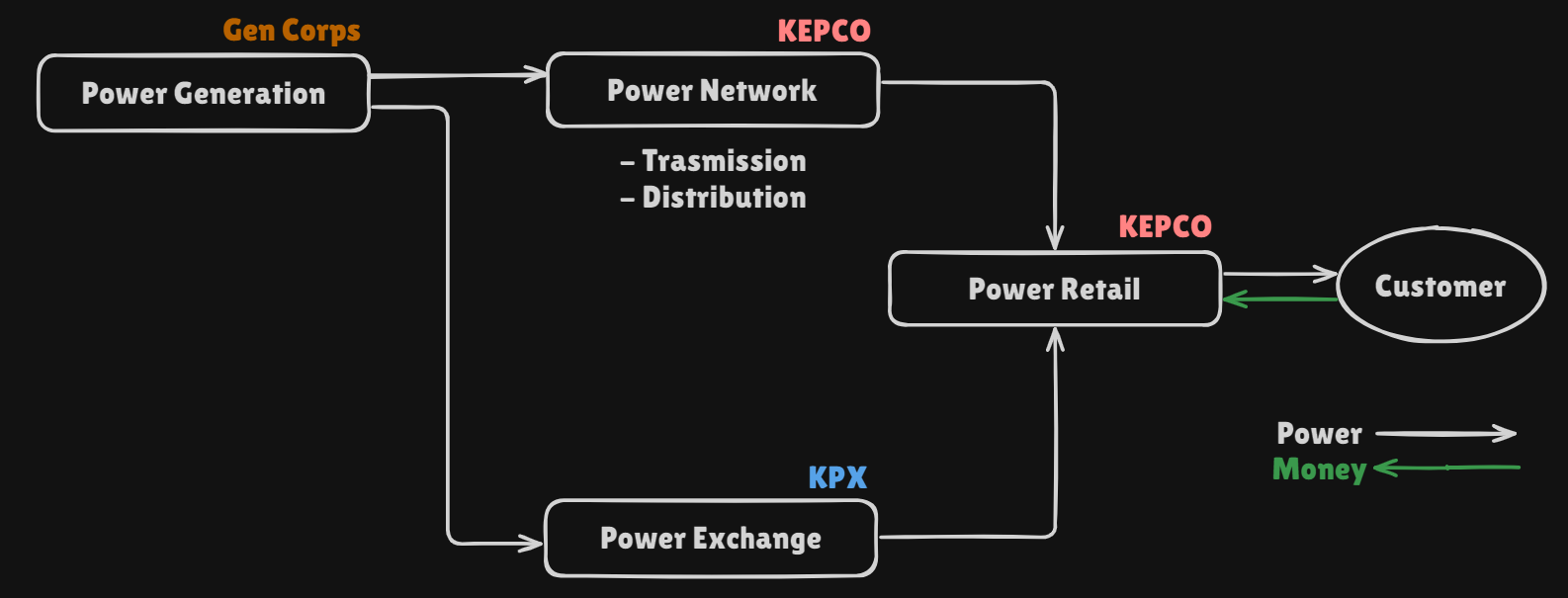
The structure of the South Korean electricity market can be illustrated by the following diagram.
-
There are a few power generation companies, both government and private, that contribute to the electricity supply. While there is some potential for competition in power generation, the high entry costs make it difficult for new companies to enter the market. Therefore, power generation operates in an oligopolistic, rather than monopolistiㅊ way.
-
However, tasks like transmission, distribution, and retailing are managed by a single company, KEPCO, which creates a monopoly in these areas. KEPCO has many subsidiaries responsible for maintaining the power grid and handling related tasks, such as metering. In an overall view, the market can be seen as monopolistic, but a closer look reveals competitive elements in certain aspects.
P3
Identify the regulatory agencies that oversee the electricity supply industry in the area that you chose for Problem 1
- In South Korea, the Ministry of Trade, Industry and Energy oversees the electricity supply industry. For example, when fuel costs rise, which could justify an increase in electricity prices, KEPCO, the retailing company, must seek approval from the Ministry because it does not have the authority to set electricity prices independently.
P4
Identify the organizations that fulfill the functions of market operator and system operator in the area that you chose for Problem 1
-
In South Korea, the organization responsible for the functions of the market operator and system operator is the Korea Power Exchange (KPX).
-
Market Operator: KPX manages the electricity market by overseeing trading, setting market prices, and ensuring fair competition among generators. KPX facilitates the buying and selling of electricity, enabling efficient market operations.
-
System Operator: KPX also serves as the system operator, ensuring the stability and reliability of the power system. It monitors and balances electricity supply and demand in real time, managing the grid to avoid disruptions and maintaining system integrity.
-
-
By handling both market and system operations, KPX plays a central role in South Korea's electricity market, ensuring it functions smoothly and reliably.
P5
Identify policies that have been implemented to promote the development of renewable energy sources in the area that you chose for Problem 1
1. 신에너지 및 재생에너지 개발・이용・보급 촉진법
This law promotes the development, utilization, and dissemination of new and renewable energy sources in South Korea. It sets the legal framework for government support in research, subsidies, and tax incentives to encourage companies and individuals to invest in renewable energy technologies, such as solar, wind, and biomass energy.
-
REC
The REC system is designed to promote renewable energy by issuing certificates that represent the environmental benefits of renewable energy generation. Power generators can trade these certificates to meet renewable energy obligations or to benefit financially from their renewable energy output. This incentivizes companies to produce and use more renewable energy, as it provides a revenue stream beyond just selling electricity. -
RE100 (Renewable Energy 100%)
RE100 is a global initiative where companies commit to sourcing 100% of their electricity from renewable energy sources by a certain date. In South Korea, this policy encourages domestic companies and multinational corporations to transition to renewable energy, often in partnership with the government and renewable energy providers. By joining RE100, companies demonstrate their commitment to sustainability and environmental responsibility. -
분산형 에너지 특별법
This special act aims to promote decentralized energy systems, such as microgrids and small-scale renewable energy installations, which can generate and distribute energy locally. The policy is intended to reduce dependence on centralized power plants and enhance energy security, particularly in remote or underserved areas. It also supports local governments and communities in implementing their own renewable energy projects, promoting energy independence and resilience.