
Image classification : a core computer vision task
input: image —> output : assign image to one of a fixed set of categories
fine-grained categories
an image classifier
no obvious way to hard-code the algorithm for recognizing a cat, or other classes.
machine learning : data- drvien approach
- collect a dataset of images and labels
- use machine learning to train a classifier
- evaluate the classifier on new images
def train(images, labels):
# Machine Learning
	return model

def predict(model, test_images):
	# Use model to predict labels
	return test_labels
Dataset
MNIST, CIFAR10, CIFAR100, ImageNet,
ImageNet : Performance metric - top 5 accuracy : algortihm predicts 5 labels for each image; one of them needs to be right
Omniglot
1623 categories : characters from 50 different alphabet
20 images per category
Meant to test few shot learning
Nearest Neighbor
def train(images, labels):
# Machine Learning
	return model
→ memorize all data and labels
def predict(model, test_images):
	# Use model to predict labels
	return test_labels
→ predict the label of the most similar training image
Distance Metric to compare images
L1 distance (Manhattan)
L2 distance (Euclidean)
k-Nearest Neighbors
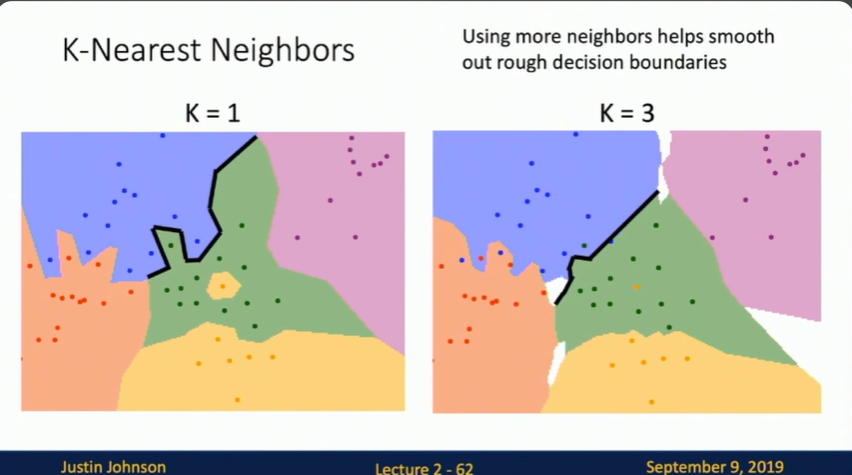
tf-idf similarity
robust and can apply various type od data
hyperparameters
choices about our learning algorithm that we don’t learn from the training data; instead we set them at the start of the learning process
very problem-dependent.
how to set hyperparameters
- choose hyperparameters that work best on the data —> K=1 always works perfectly on training data
- split data into train and test, chosse hyperparameters that work best on test data —> no idea how algorithm will perform on new data
- split data into train, val, and test ; choose hyperparameters on val and evaluate on test —> Better!
- cross-validation : split data into folds, try each fold as validation and average the results.
curse of dimensionality
curse of dimensionality : for uniform coverage of space, number of training points needed grows exponentially with demension
K-Nearest Neighbor on raw pixels is seldom used
- very slow at test time
- distance metrics on pixels are not informative
nearest neighbor with convNet features works well!
image captioning with nearest neighbor approach works well