Theorem)
Let X∼Nn(μ,Σ) with μ∈Rn×n,Σ: n×n positive definite matrix.
Then, Y=AX+b∼Nm(Aμ+b,AΣAT)
pf)
MY(t)=E(exp(tTY))=exp(tTb)E(exp(tTAX))=exp(tTb)exp(tTAμ+21tTAΣATt): mgf of Nm(Aμ+b,AΣAT)
Corallary)
Suppose X∼Nn(μ,Σ) and X=(X1X2), μ=(μ1μ2), Σ=(Σ11Σ21Σ12Σ22) where X1,μ1∈Rm and Σ11∈Rm×m(m<n)
Then, X1∼Nm(μ1,Σ11) and X2∼Nn−m(μ2,Σ22)
∵
X1=AX+b where A=(Im0m×(n−m)), b=0
X2=AX+b where A=(0mIm×(n−m)), b=0
Independence
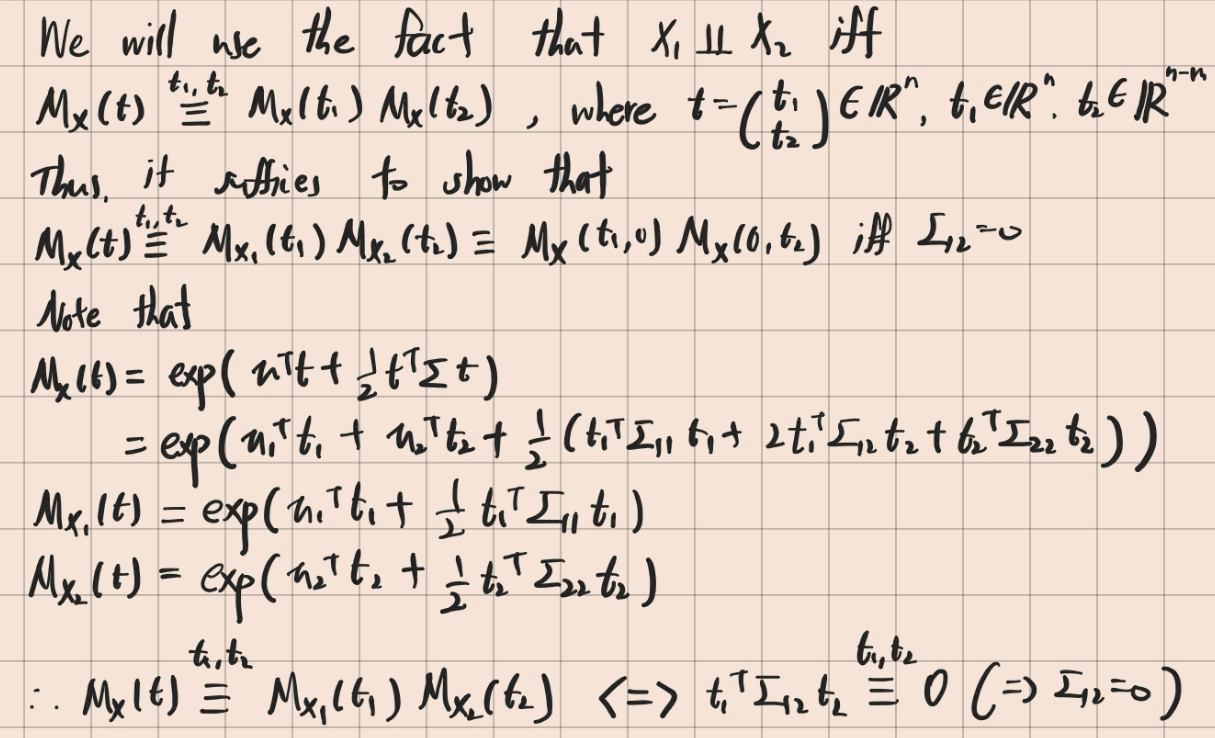
Theorem)
Suppose X∼Nn(μ,Σ) and X=(X1X2),μ=(μ1μ2), Σ=(Σ11Σ21Σ12Σ22) where X1,μ1∈Rm and Σ11∈Rm×m(m<n)
Then, X1∈Rm and X2∈Rn−m are indep. <=> Σ12=0
pf)
Corallary)
If X∼Nn(μ,Σ), then AX⊥⊥BX<=>AΣBT=0
∵
Note that (AXBX)=(AB)X∼Normal
AX⊥⊥BX<=>Cov(AX,BX)=AΣBT=0
Conditional distribution
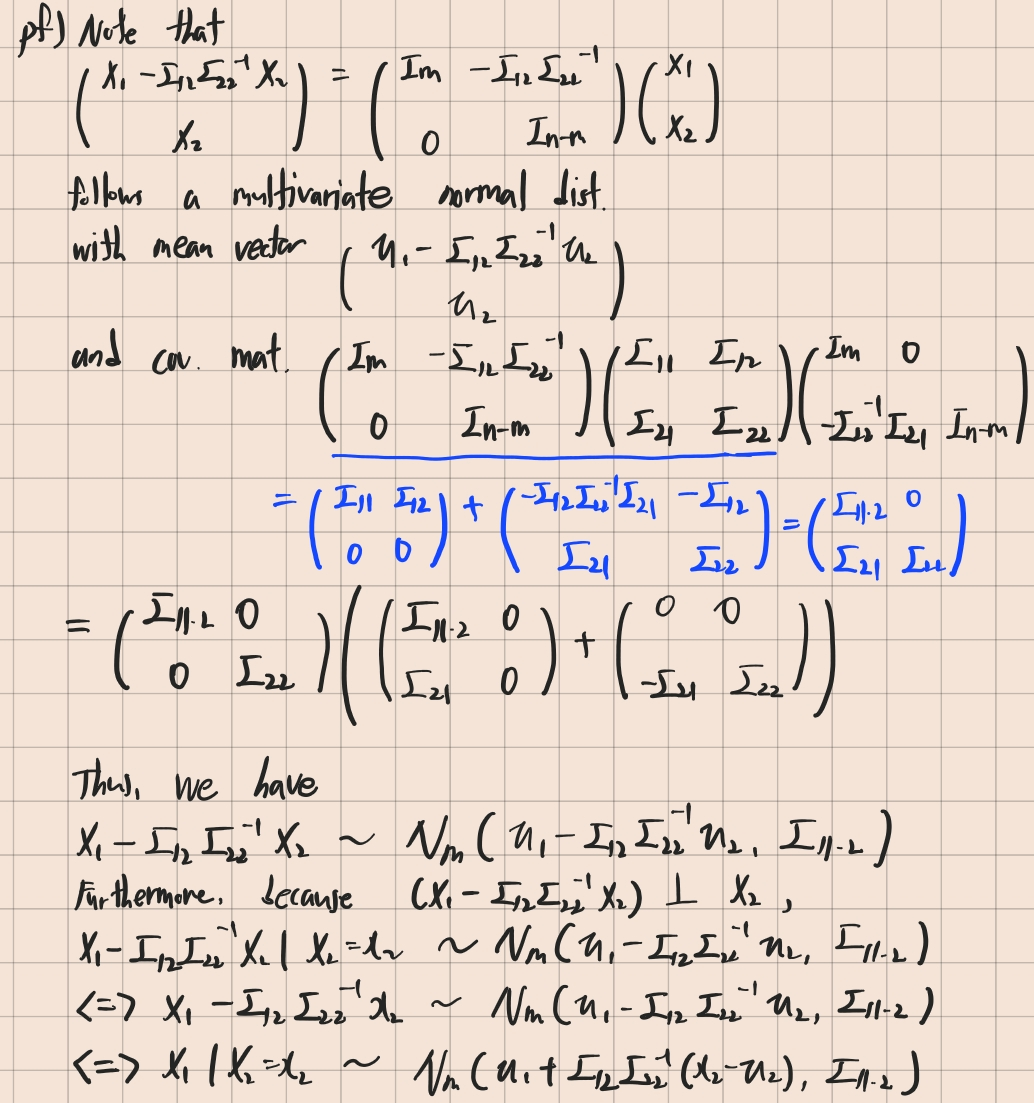
Theorem)
Suppose X∼Nn(μ,Σ) and X=(X1X2),μ=(μ1μ2), Σ=(Σ11Σ21Σ12Σ22) where X1,μ1∈Rm and Σ11∈Rm×m(m<n)
Then, if Σ22 is positive definite, X1∣X2=x2∼Nm(μ1+Σ12Σ22−1(x2−μ2),Σ11−Σ12Σ22−1Σ21)
pf)
Relationship with χ2 distribution
Theorem)
Let X∼Nn(μ,Σ) with μ∈Rn, Σ: n×n positive definite matrix
Then, Y=(X−μ)TΣ−1(X−μ)∼χn2
∵
Since X≡dΣ1/2Z+μ,Y=(X−μ)TΣ−1/2Σ−1/2(X−μ)=ZTZ=∑iZi2∼χn2
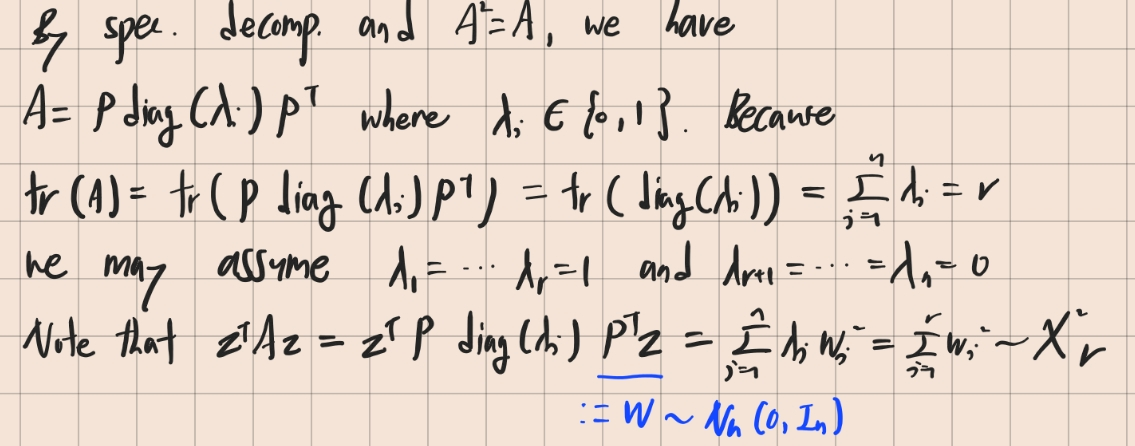
Theorem) Distribution of quadratic form
Suppose Z∼Nn(0,In) and A∈Rn×n is symmetric
If A2=A with tr(A)=r, then ZTAZ∼χr2
pf)