Appendix D. Adding bells and whistles to the training loop

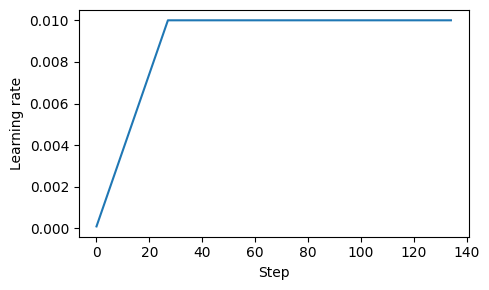
1. Learning rate warmup
- 복잡한 모델을 훈련할 때, learning rate warmup을 구현하면 안정화에 도움이 된다.
- 학습률을 매우 낮은 값에서 지정한 최대값까지 증가시켜서, 불안정한 업데이트 위험을 줄인다.
- 대게 warmup step의 수는 전체 step의 0.1% ~ 20%이다.
- 전체 step 수 = data_loader 길이 * 에포크 수
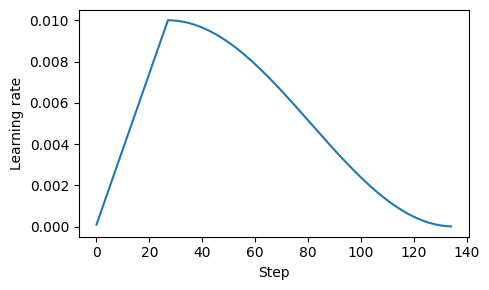
2. Cosine decay
- training 동안 learning rate가 cosion 곡선을 따르며, 초기 값에서 코사인의 절반 사이클 후 0에 가까이 감소한다.
- 이는 모델이 weight를 개선하는 동안 학습 속도를 늦추기 위해 설계되어, 안정화에 도움을 준다.
- linear한 형태로 감소하는 linear dacay가 사용되기도 한다.
3. Gredient clipping
- 임계값을 설정하여 이를 초과하는 기울기를 최대 크기로 축소하여 역전파 중 모델 매개변수에 대한 업데이트가 처리하기 쉬운 범위 내에 유지되도록 한다.
- PyTorch에서
clip_grad_norm_에서max_norm을 설정하면 norm이 1.0을 초과하지 않는다.- norm은 파라미터 공간의 gradient vector의 길이를 측정한 것으로, L2 norm이나 Euclidean norm으로도 불린다.
3가지 방법론을 training에 적용하면 아래와 같다.
ORIG_BOOK_VERSION = False


def train_model(model, train_loader, val_loader, optimizer, device,
                n_epochs, eval_freq, eval_iter, start_context, tokenizer,
                warmup_steps, initial_lr=3e-05, min_lr=1e-6):

    train_losses, val_losses, track_tokens_seen, track_lrs = [], [], [], []
    tokens_seen, global_step = 0, -1

    # Retrieve the maximum learning rate from the optimizer
    peak_lr = optimizer.param_groups[0]["lr"]

    # Calculate the total number of iterations in the training process
    total_training_steps = len(train_loader) * n_epochs

    # Calculate the learning rate increment during the warmup phase
    lr_increment = (peak_lr - initial_lr) / warmup_steps

    for epoch in range(n_epochs):
        model.train()
        for input_batch, target_batch in train_loader:
            optimizer.zero_grad()
            global_step += 1

            # Adjust the learning rate based on the current phase (warmup or cosine annealing)
            if global_step < warmup_steps:
                # Linear warmup
                lr = initial_lr + global_step * lr_increment
            else:
                # Cosine annealing after warmup
                progress = ((global_step - warmup_steps) /
                            (total_training_steps - warmup_steps))
                lr = min_lr + (peak_lr - min_lr) * 0.5 * (1 + math.cos(math.pi * progress))

            # Apply the calculated learning rate to the optimizer
            for param_group in optimizer.param_groups:
                param_group["lr"] = lr
            track_lrs.append(lr)  # Store the current learning rate

            # Calculate and backpropagate the loss
            loss = calc_loss_batch(input_batch, target_batch, model, device)
            loss.backward()

            # Apply gradient clipping after the warmup phase to avoid exploding gradients
            if ORIG_BOOK_VERSION:
                if global_step > warmup_steps:
                    torch.nn.utils.clip_grad_norm_(model.parameters(), max_norm=1.0)
            else:
                if global_step >= warmup_steps:  # the book originally used global_step > warmup_steps, which lead to a skipped clipping step after warmup
                    torch.nn.utils.clip_grad_norm_(model.parameters(), max_norm=1.0)

            optimizer.step()
            tokens_seen += input_batch.numel()

            # Periodically evaluate the model on the training and validation sets
            if global_step % eval_freq == 0:
                train_loss, val_loss = evaluate_model(
                    model, train_loader, val_loader,
                    device, eval_iter
                )
                train_losses.append(train_loss)
                val_losses.append(val_loss)
                track_tokens_seen.append(tokens_seen)
                # Print the current losses
                print(f"Ep {epoch+1} (Iter {global_step:06d}): "
                      f"Train loss {train_loss:.3f}, "
                      f"Val loss {val_loss:.3f}"
                )

        # Generate and print a sample from the model to monitor progress
        generate_and_print_sample(
            model, tokenizer, device, start_context
        )

    return train_losses, val_losses, track_tokens_seen, track_lrs
It’s always white night here.