Why End-to-End Testing Is Essential for Modern Software Development
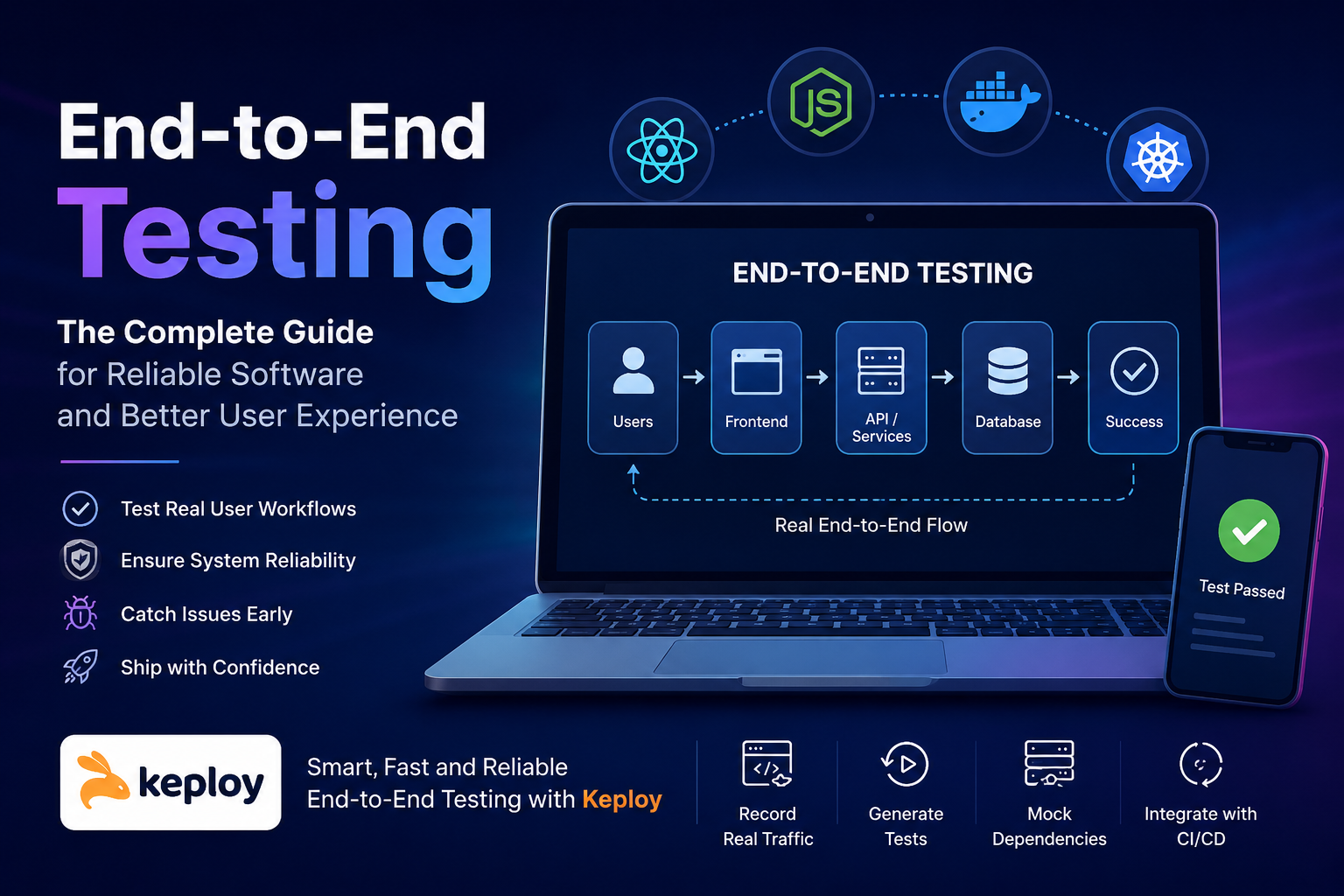
Modern applications are more complex than ever before.
Today’s software systems include:
- Frontend interfaces
- APIs
- Databases
- Authentication services
- Third-party integrations
- Cloud infrastructure
- Microservices
Even if individual components work perfectly, the overall application can still fail when these systems interact together.
For example, a user may successfully log in, but the payment gateway might fail during checkout. Or an API may return valid data while the frontend displays incorrect information because of integration issues.
This is exactly why end-to-end testing (E2E testing) has become one of the most important parts of modern software testing strategies.
According to Keploy’s End-to-End Testing Guide, E2E testing validates complete user workflows from start to finish, ensuring that all integrated components behave correctly under real-world conditions.
What Is End-to-End Testing?
End-to-end testing is a software testing approach that validates an application’s complete workflow by simulating real user interactions.
Instead of testing isolated components, E2E testing verifies the entire system as a unified experience.
This includes validating:
- User interface
- Backend services
- APIs
- Databases
- External integrations
- Authentication systems
The goal is to ensure users can complete important workflows successfully.
Real-World Example of End-to-End Testing
Example 1: ECommerce Platform
A typical E2E test for an online shopping application may validate:
- User logs in
- Searches for a product
- Adds product to cart
- Completes checkout
- Makes payment
- Receives confirmation email
If any step fails, the entire workflow fails because from the customer’s perspective, the feature did not work correctly.
Example 2: Banking Application
In banking systems, E2E testing may validate:
- User authentication
- Account balance loading
- Fund transfers
- Transaction confirmation
- Notification delivery
Even small failures in these workflows can impact user trust significantly.
Why End-to-End Testing Matters
Detects Real User Workflow Failures
Unit and integration tests validate individual components, but most production issues happen between systems.
E2E testing helps identify:
- Broken integrations
- API communication failures
- Database inconsistencies
- UI-to-backend mismatches
- Third-party service issues
This helps teams detect issues before users experience them.
Improves Release Confidence
Modern development teams deploy code frequently through CI/CD pipelines.
E2E testing ensures critical workflows continue working after deployments, helping teams release software with greater confidence.
This reduces production bugs and improves application stability.
Protects Business-Critical Features
Certain workflows directly affect business revenue and customer trust.
Examples include:
- Checkout systems
- User onboarding
- Payment processing
- Authentication
- Subscription management
E2E testing validates these flows under realistic conditions before deployment.
End-to-End Testing vs Other Testing Types
| Testing Type | Focus | Goal |
|---|---|---|
| Unit Testing | Individual functions | Validate isolated logic |
| Integration Testing | Component communication | Validate system interaction |
| End-to-End Testing | Complete workflows | Validate real user journeys |
| Smoke Testing | Basic application stability | Validate deployment health |
E2E testing sits at the top of the testing pyramid because it validates complete business workflows instead of isolated functionality.
Common Challenges in End-to-End Testing
Although E2E testing is extremely valuable, it also introduces several challenges.
Flaky Tests
E2E tests often fail because of:
- Network delays
- Environment instability
- External dependencies
- Timing issues
These unreliable failures reduce developer trust in test suites.
Slow Execution
E2E tests usually involve complete workflows, making them slower than unit or integration tests.
Large test suites can significantly increase CI/CD pipeline duration.
Test Maintenance
Applications change constantly.
UI updates, API modifications, and workflow changes often require E2E test updates, increasing maintenance overhead.
Best Practices for End-to-End Testing
Focus on Critical User Journeys
Avoid testing every possible workflow.
Instead, prioritize:
- Authentication
- Checkout
- Payments
- Account creation
- Core business functionality
Keep Tests Independent
Tests should not depend on the results of previous tests.
Independent tests improve reliability and simplify debugging.
Use Realistic Test Data
Test environments should mimic real-world user scenarios as closely as possible.
Realistic data improves testing accuracy.
Integrate E2E Testing Into CI/CD
Modern teams automate E2E testing inside CI/CD pipelines to detect failures quickly after deployment.
How Modern Tools Simplify End-to-End Testing
Traditional E2E testing often requires:
- Manual test writing
- Mock setup
- Test data management
- Environment configuration
Modern tools help reduce this complexity significantly.
For example, Keploy generates reusable API tests and mocks from real traffic, helping teams automate integration and end-to-end workflows more efficiently.
This helps teams:
- Reduce manual testing effort
- Improve API validation
- Simplify test generation
- Accelerate CI/CD workflows
End-to-End Testing in CI/CD Pipelines
Most modern DevOps teams integrate E2E testing into deployment workflows.
A typical CI/CD process may look like this:
- Developer pushes code
- Application builds automatically
- Unit tests run
- Integration tests run
- End-to-end tests validate workflows
- Deployment proceeds if all tests pass
This process improves deployment confidence and reduces production failures.
Final Thoughts
End-to-end testing plays a critical role in modern software quality assurance because it validates applications the same way real users experience them.
Even if individual services work correctly, users care only about whether the complete workflow succeeds.
E2E testing helps teams:
- Detect integration failures
- Validate real user journeys
- Improve release confidence
- Reduce production bugs
- Deliver better user experiences
As applications continue becoming more distributed and complex, end-to-end testing will remain essential for building stable, reliable, and scalable software systems.
Reference: https://keploy.io/blog/community/end-to-end-testing-guide
