- 유방암 환자 데이터를 통하여 유방암 여부를 분류
- 딥러닝을 활용하여 이진분류 딥러닝 모델 설계 및 학습
- sklearn.datasets 에서 제공하는 breast_cancer (유방암) 데이터 활용
- 목차
-
라이브러리 불러오기
import numpy as np import pandas as pd import matplotlib.pyplot as plt from sklearn.datasets import load_breast_cancer -
데이터 불러오기 및 분리
data = load_breast_cancer() # 문제, 정답 분리 X = data['data'] y = data['target'] # train, test split from sklearn.model_selection import train_test_split X_train, X_test, y_train, y_test = train_test_split(X, y, test_size=0.25, random_state=42, stratify=y)- sklearn data 셋 이름 = 번치
# data: 입력 특성 # feature_names: 입력 특성의 실제 이름 (컬럼명) # target: label, 정답 데이터 (인덱스 형태) # target_names: 정답 데이터의 실제 이름 # DESCR: 데이터에 대한 설명 - 정답데이터(label) 정보
data['target_names'] # = data.target_names
# 0 - 'malignant' : 악성 (암)
# 1 - 'benign' : 양성 (깨끗한 종양)
# 클래스가 2개 -> 이진분류 학습이 필요하다~
- sklearn data 셋 이름 = 번치
-
신경모델망 설계
from tensorflow.keras import Sequential from tensorflow.keras.layers import Input, Dense, Activation model = Sequential() # input model.add(Input(shape=(30,))) # hidden model.add(Dense(units=8, activation='sigmoid')) model.add(Dense(units=16, activation='sigmoid')) model.add(Dense(units=32, activation='sigmoid')) # output -> 이진분류 (직선 1개 필요) model.add(Dense(uniuts=1, activation='sigmoid'))- 여기서 activation 함수의 역할은 추가 연산
- 분류에서는 선형모델에서 나온 값을 확률 값으로 바꿔주는 역할! sigmoid 함수는 0~1사이 값으로 반환해주므로, 확률값으로 변환해줌!
- 이진분류 → class 1인지 아닌지 판별 → class 1에 대한 확률값 1개만 필요 확률값 0.5 이상 → class 1, 0.5 미만 → class 0
-
학습 방법 및 평가 방법 설정
model.compile(loss = 'binary_crossentropy', optimizer = 'SGD', metrics = ['accuracy']) -
모델 학습
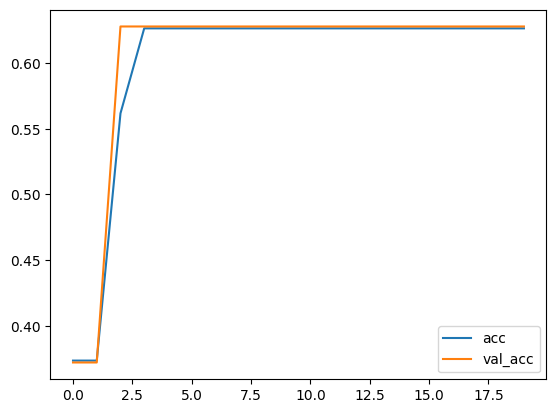
h1 = model.fit(X_train, y_train, validation_split=0.2, epochs=20) -
결과 확인
plt.plot(h1.history['accuracy'], label = 'acc')
plt.plot(h1.history['val_accuracy'], label = 'val_acc')
plt.legend()