오늘은 가장 기본의 되는 NeRF의 코드 분석을 하고자 한다.
코드가 넘 길고 많지만..꼭 넘어야 하는 산이기에 열심히 해보자.
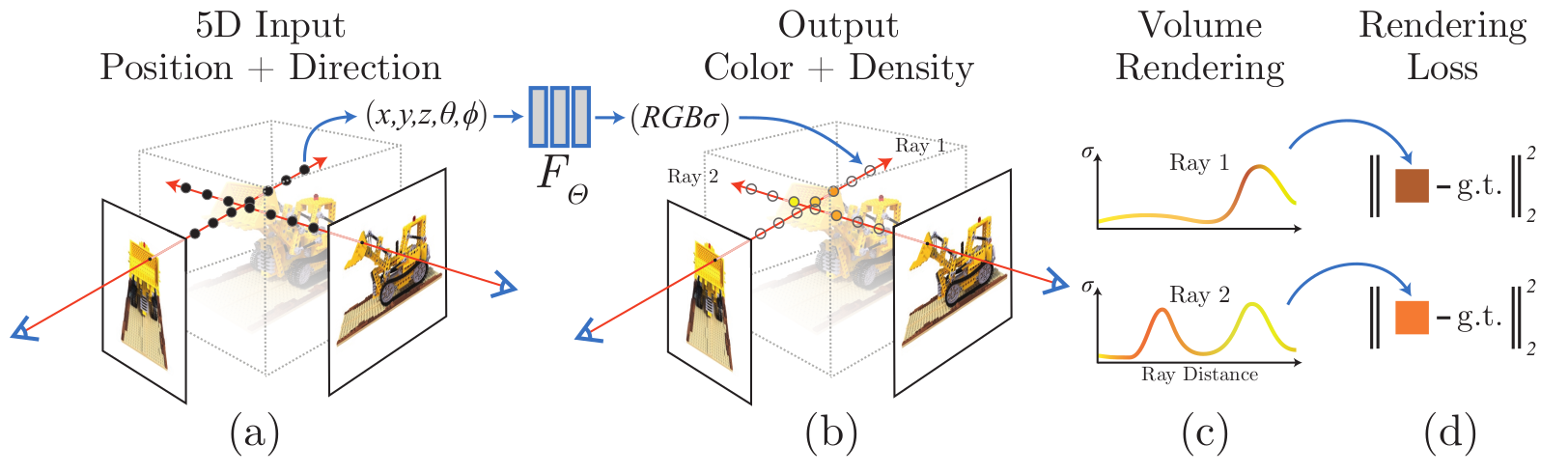
NeRF 오픈소스 코드: https://github.com/yenchenlin/nerf-pytorch
분석할 코드는 run_nerf.py이다.
코드 분석
batchfy

- chunk는 한번에 처리할 수 있는 ray의 개수이다. input을 chunk 단위로 나눠서 fn에 넣고 torch.cat으로 합친다.
batchify_rays
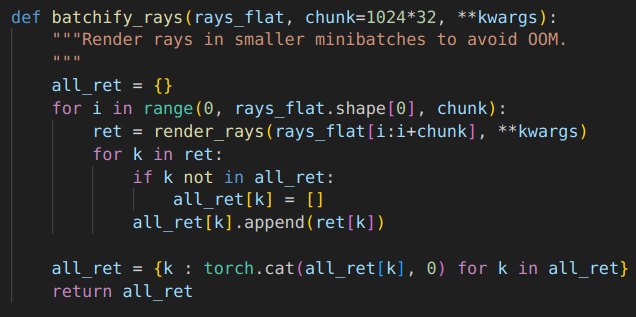
- render_rays() 결과인 ret을 all_ret dictionary에 담는다.
render
def render(H, W, K, chunk=1024*32, rays=None, c2w=None, ndc=True,
                  near=0., far=1.,
                  use_viewdirs=False, c2w_staticcam=None,
                  **kwargs):
    """Render rays
    Args:
      H: int. Height of image in pixels.
      W: int. Width of image in pixels.
      focal: float. Focal length of pinhole camera.
      chunk: int. Maximum number of rays to process simultaneously. Used to
        control maximum memory usage. Does not affect final results.
      rays: array of shape [2, batch_size, 3]. Ray origin and direction for
        each example in batch.
      c2w: array of shape [3, 4]. Camera-to-world transformation matrix.
      ndc: bool. If True, represent ray origin, direction in NDC coordinates.
      near: float or array of shape [batch_size]. Nearest distance for a ray.
      far: float or array of shape [batch_size]. Farthest distance for a ray.
      use_viewdirs: bool. If True, use viewing direction of a point in space in model.
      c2w_staticcam: array of shape [3, 4]. If not None, use this transformation matrix for
       camera while using other c2w argument for viewing directions.
    Returns:
      rgb_map: [batch_size, 3]. Predicted RGB values for rays.
      disp_map: [batch_size]. Disparity map. Inverse of depth.
      acc_map: [batch_size]. Accumulated opacity (alpha) along a ray.
      extras: dict with everything returned by render_rays().
    """
    if c2w is not None:
        # special case to render full image
        rays_o, rays_d = get_rays(H, W, K, c2w)
    else:
        # use provided ray batch
        rays_o, rays_d = rays

    if use_viewdirs:
        # provide ray directions as input
        viewdirs = rays_d
        if c2w_staticcam is not None:
            # special case to visualize effect of viewdirs
            rays_o, rays_d = get_rays(H, W, K, c2w_staticcam)
        viewdirs = viewdirs / torch.norm(viewdirs, dim=-1, keepdim=True)
        viewdirs = torch.reshape(viewdirs, [-1,3]).float()

    sh = rays_d.shape # [..., 3]
    if ndc:
        # for forward facing scenes
        rays_o, rays_d = ndc_rays(H, W, K[0][0], 1., rays_o, rays_d)

    # Create ray batch
    rays_o = torch.reshape(rays_o, [-1,3]).float()
    rays_d = torch.reshape(rays_d, [-1,3]).float()

    near, far = near * torch.ones_like(rays_d[...,:1]), far * torch.ones_like(rays_d[...,:1])
    rays = torch.cat([rays_o, rays_d, near, far], -1)
    if use_viewdirs:
        rays = torch.cat([rays, viewdirs], -1)

    # Render and reshape
    all_ret = batchify_rays(rays, chunk, **kwargs)
    for k in all_ret:
        k_sh = list(sh[:-1]) + list(all_ret[k].shape[1:])
        all_ret[k] = torch.reshape(all_ret[k], k_sh)

    k_extract = ['rgb_map', 'disp_map', 'acc_map']
    ret_list = [all_ret[k] for k in k_extract]
    ret_dict = {k : all_ret[k] for k in all_ret if k not in k_extract}
    return ret_list + [ret_dict]
- c2w: Camera to World paramter
- get_rays(H, W, K, c2w)를 통해 rays_o, rays_d를 추출
- k_sh는 sh tensor를 변형한 것이며 ret_list는 k가 'rgb_map', 'disp_map', 'acc_map' 중 하나일 때 all_ret[k]를 원소로 하는 리스트이며 ret_dict는 k가 위 3가지 map에 속하지 않을 때 key를 k, value를 all_ret[k]로 하는 리스트이다.
render_path
def render_path(render_poses, hwf, K, chunk, render_kwargs, gt_imgs=None, savedir=None, render_factor=0):

    H, W, focal = hwf

    if render_factor!=0:
        # Render downsampled for speed
        H = H//render_factor
        W = W//render_factor
        focal = focal/render_factor

    rgbs = []
    disps = []

    t = time.time()
    for i, c2w in enumerate(tqdm(render_poses)):
        print(i, time.time() - t)
        t = time.time()
        rgb, disp, acc, _ = render(H, W, K, chunk=chunk, c2w=c2w[:3,:4], **render_kwargs)
        rgbs.append(rgb.cpu().numpy())
        disps.append(disp.cpu().numpy())
        if i==0:
            print(rgb.shape, disp.shape)

        """
        if gt_imgs is not None and render_factor==0:
            p = -10. * np.log10(np.mean(np.square(rgb.cpu().numpy() - gt_imgs[i])))
            print(p)
        """

        if savedir is not None:
            rgb8 = to8b(rgbs[-1])
            filename = os.path.join(savedir, '{:03d}.png'.format(i))
            imageio.imwrite(filename, rgb8)


    rgbs = np.stack(rgbs, 0)
    disps = np.stack(disps, 0)

    return rgbs, disps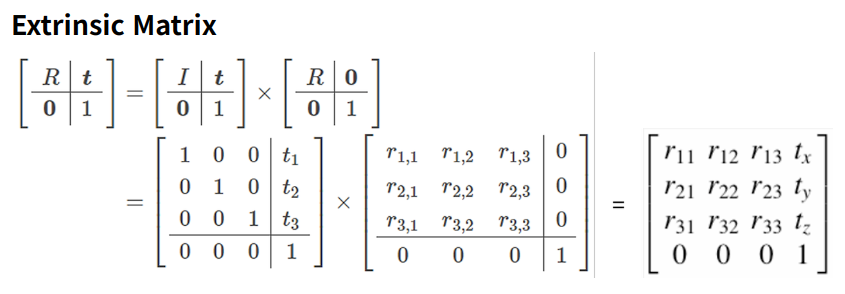
- Speed를 위해 downsample하기
- render() 함수를 통해 rgbs, disps를 구하고 np.stack으로 처리하여 return
create_nerf
def create_nerf(args):
    """Instantiate NeRF's MLP model.
    """
    embed_fn, input_ch = get_embedder(args.multires, args.i_embed)

    input_ch_views = 0
    embeddirs_fn = None
    if args.use_viewdirs:
        embeddirs_fn, input_ch_views = get_embedder(args.multires_views, args.i_embed)
    output_ch = 5 if args.N_importance > 0 else 4
    skips = [4]
    model = NeRF(D=args.netdepth, W=args.netwidth,
                 input_ch=input_ch, output_ch=output_ch, skips=skips,
                 input_ch_views=input_ch_views, use_viewdirs=args.use_viewdirs).to(device)
    grad_vars = list(model.parameters())

    model_fine = None
    if args.N_importance > 0:
        model_fine = NeRF(D=args.netdepth_fine, W=args.netwidth_fine,
                          input_ch=input_ch, output_ch=output_ch, skips=skips,
                          input_ch_views=input_ch_views, use_viewdirs=args.use_viewdirs).to(device)
        grad_vars += list(model_fine.parameters())

    network_query_fn = lambda inputs, viewdirs, network_fn : run_network(inputs, viewdirs, network_fn,
                                                                embed_fn=embed_fn,
                                                                embeddirs_fn=embeddirs_fn,
                                                                netchunk=args.netchunk)

    # Create optimizer
    optimizer = torch.optim.Adam(params=grad_vars, lr=args.lrate, betas=(0.9, 0.999))

    start = 0
    basedir = args.basedir
    expname = args.expname

    ##########################

    # Load checkpoints
    if args.ft_path is not None and args.ft_path!='None':
        ckpts = [args.ft_path]
    else:
        ckpts = [os.path.join(basedir, expname, f) for f in sorted(os.listdir(os.path.join(basedir, expname))) if 'tar' in f]

    print('Found ckpts', ckpts)
    if len(ckpts) > 0 and not args.no_reload:
        ckpt_path = ckpts[-1]
        print('Reloading from', ckpt_path)
        ckpt = torch.load(ckpt_path)

        start = ckpt['global_step']
        optimizer.load_state_dict(ckpt['optimizer_state_dict'])

        # Load model
        model.load_state_dict(ckpt['network_fn_state_dict'])
        if model_fine is not None:
            model_fine.load_state_dict(ckpt['network_fine_state_dict'])

    ##########################

    render_kwargs_train = {
        'network_query_fn' : network_query_fn,
        'perturb' : args.perturb,
        'N_importance' : args.N_importance,
        'network_fine' : model_fine,
        'N_samples' : args.N_samples,
        'network_fn' : model,
        'use_viewdirs' : args.use_viewdirs,
        'white_bkgd' : args.white_bkgd,
        'raw_noise_std' : args.raw_noise_std,
    }

    # NDC only good for LLFF-style forward facing data
    if args.dataset_type != 'llff' or args.no_ndc:
        print('Not ndc!')
        render_kwargs_train['ndc'] = False
        render_kwargs_train['lindisp'] = args.lindisp

    render_kwargs_test = {k : render_kwargs_train[k] for k in render_kwargs_train}
    render_kwargs_test['perturb'] = False
    render_kwargs_test['raw_noise_std'] = 0.

    return render_kwargs_train, render_kwargs_test, start, grad_vars, optimizer
raw2outputs
def raw2outputs(raw, z_vals, rays_d, raw_noise_std=0, white_bkgd=False, pytest=False):
    """Transforms model's predictions to semantically meaningful values.
    Args:
        raw: [num_rays, num_samples along ray, 4]. Prediction from model.
        z_vals: [num_rays, num_samples along ray]. Integration time.
        rays_d: [num_rays, 3]. Direction of each ray.
    Returns:
        rgb_map: [num_rays, 3]. Estimated RGB color of a ray.
        disp_map: [num_rays]. Disparity map. Inverse of depth map.
        acc_map: [num_rays]. Sum of weights along each ray.
        weights: [num_rays, num_samples]. Weights assigned to each sampled color.
        depth_map: [num_rays]. Estimated distance to object.
    """
    raw2alpha = lambda raw, dists, act_fn=F.relu: 1.-torch.exp(-act_fn(raw)*dists)

    dists = z_vals[...,1:] - z_vals[...,:-1]
    dists = torch.cat([dists, torch.Tensor([1e10]).expand(dists[...,:1].shape)], -1)  # [N_rays, N_samples]

    dists = dists * torch.norm(rays_d[...,None,:], dim=-1)

    rgb = torch.sigmoid(raw[...,:3])  # [N_rays, N_samples, 3]
    noise = 0.
    if raw_noise_std > 0.:
        noise = torch.randn(raw[...,3].shape) * raw_noise_std

        # Overwrite randomly sampled data if pytest
        if pytest:
            np.random.seed(0)
            noise = np.random.rand(*list(raw[...,3].shape)) * raw_noise_std
            noise = torch.Tensor(noise)

    alpha = raw2alpha(raw[...,3] + noise, dists)  # [N_rays, N_samples]
    # weights = alpha * tf.math.cumprod(1.-alpha + 1e-10, -1, exclusive=True)
    weights = alpha * torch.cumprod(torch.cat([torch.ones((alpha.shape[0], 1)), 1.-alpha + 1e-10], -1), -1)[:, :-1]
    rgb_map = torch.sum(weights[...,None] * rgb, -2)  # [N_rays, 3]

    depth_map = torch.sum(weights * z_vals, -1)
    disp_map = 1./torch.max(1e-10 * torch.ones_like(depth_map), depth_map / torch.sum(weights, -1))
    acc_map = torch.sum(weights, -1)

    if white_bkgd:
        rgb_map = rgb_map + (1.-acc_map[...,None])

return rgb_map, disp_map, acc_map, weights, depth_map- NeRF() 함수는 coarse sampling이며 model.parameters()를 list에 담아 grad_vars에 저장함.
- if args.N_importance > 0 이라면 NeRF()함수는 fine_sampling 역할을 하며 이를 model 변수에 저장한다. 이 때 model.parameters()는 list로 형 변환하여 grad_vars 변수에 더해준다.
render_rays
def render_rays(ray_batch,
                network_fn,
                network_query_fn,
                N_samples,
                retraw=False,
                lindisp=False,
                perturb=0.,
                N_importance=0,
                network_fine=None,
                white_bkgd=False,
                raw_noise_std=0.,
                verbose=False,
                pytest=False):
    """Volumetric rendering.
    Args:
      ray_batch: array of shape [batch_size, ...]. All information necessary
        for sampling along a ray, including: ray origin, ray direction, min
        dist, max dist, and unit-magnitude viewing direction.
      network_fn: function. Model for predicting RGB and density at each point
        in space.
      network_query_fn: function used for passing queries to network_fn.
      N_samples: int. Number of different times to sample along each ray.
      retraw: bool. If True, include model's raw, unprocessed predictions.
      lindisp: bool. If True, sample linearly in inverse depth rather than in depth.
      perturb: float, 0 or 1. If non-zero, each ray is sampled at stratified
        random points in time.
      N_importance: int. Number of additional times to sample along each ray.
        These samples are only passed to network_fine.
      network_fine: "fine" network with same spec as network_fn.
      white_bkgd: bool. If True, assume a white background.
      raw_noise_std: ...
      verbose: bool. If True, print more debugging info.
    Returns:
      rgb_map: [num_rays, 3]. Estimated RGB color of a ray. Comes from fine model.
      disp_map: [num_rays]. Disparity map. 1 / depth.
      acc_map: [num_rays]. Accumulated opacity along each ray. Comes from fine model.
      raw: [num_rays, num_samples, 4]. Raw predictions from model.
      rgb0: See rgb_map. Output for coarse model.
      disp0: See disp_map. Output for coarse model.
      acc0: See acc_map. Output for coarse model.
      z_std: [num_rays]. Standard deviation of distances along ray for each
        sample.
    """
    N_rays = ray_batch.shape[0]
    rays_o, rays_d = ray_batch[:,0:3], ray_batch[:,3:6] # [N_rays, 3] each
    viewdirs = ray_batch[:,-3:] if ray_batch.shape[-1] > 8 else None
    bounds = torch.reshape(ray_batch[...,6:8], [-1,1,2])
    near, far = bounds[...,0], bounds[...,1] # [-1,1]

    t_vals = torch.linspace(0., 1., steps=N_samples)
    if not lindisp:
        z_vals = near * (1.-t_vals) + far * (t_vals)
    else:
        z_vals = 1./(1./near * (1.-t_vals) + 1./far * (t_vals))

    z_vals = z_vals.expand([N_rays, N_samples])

    if perturb > 0.:
        # get intervals between samples
        mids = .5 * (z_vals[...,1:] + z_vals[...,:-1])
        upper = torch.cat([mids, z_vals[...,-1:]], -1)
        lower = torch.cat([z_vals[...,:1], mids], -1)
        # stratified samples in those intervals
        t_rand = torch.rand(z_vals.shape)

        # Pytest, overwrite u with numpy's fixed random numbers
        if pytest:
            np.random.seed(0)
            t_rand = np.random.rand(*list(z_vals.shape))
            t_rand = torch.Tensor(t_rand)

        z_vals = lower + (upper - lower) * t_rand

    pts = rays_o[...,None,:] + rays_d[...,None,:] * z_vals[...,:,None] # [N_rays, N_samples, 3]


#     raw = run_network(pts)
    raw = network_query_fn(pts, viewdirs, network_fn)
    rgb_map, disp_map, acc_map, weights, depth_map = raw2outputs(raw, z_vals, rays_d, raw_noise_std, white_bkgd, pytest=pytest)

    if N_importance > 0:

        rgb_map_0, disp_map_0, acc_map_0 = rgb_map, disp_map, acc_map

        z_vals_mid = .5 * (z_vals[...,1:] + z_vals[...,:-1])
        z_samples = sample_pdf(z_vals_mid, weights[...,1:-1], N_importance, det=(perturb==0.), pytest=pytest)
        z_samples = z_samples.detach()

        z_vals, _ = torch.sort(torch.cat([z_vals, z_samples], -1), -1)
        pts = rays_o[...,None,:] + rays_d[...,None,:] * z_vals[...,:,None] # [N_rays, N_samples + N_importance, 3]

        run_fn = network_fn if network_fine is None else network_fine
#         raw = run_network(pts, fn=run_fn)
        raw = network_query_fn(pts, viewdirs, run_fn)

        rgb_map, disp_map, acc_map, weights, depth_map = raw2outputs(raw, z_vals, rays_d, raw_noise_std, white_bkgd, pytest=pytest)

    ret = {'rgb_map' : rgb_map, 'disp_map' : disp_map, 'acc_map' : acc_map}
    if retraw:
        ret['raw'] = raw
    if N_importance > 0:
        ret['rgb0'] = rgb_map_0
        ret['disp0'] = disp_map_0
        ret['acc0'] = acc_map_0
        ret['z_std'] = torch.std(z_samples, dim=-1, unbiased=False)  # [N_rays]

    for k in ret:
        if (torch.isnan(ret[k]).any() or torch.isinf(ret[k]).any()) and DEBUG:
            print(f"! [Numerical Error] {k} contains nan or inf.")

return ret-
N_rays: 레이의 개수를 나타내는 변수입니다. ray_batch의 첫 번째 차원의 크기입니다.
-
rays_o, rays_d: 각 레이의 출발점(origin)과 방향(direction)을 나타내는 변수입니다. ray_batch에서 각각 첫 3개의 값과 그 다음 3개의 값을 가져와서 형태를 [N_rays, 3]로 만듭니다.
-
viewdirs: 뷰 디렉션(view direction)을 나타내는 변수입니다. ray_batch의 마지막 3개의 값입니다. 그러나 ray_batch의 마지막 차원이 8보다 큰 경우에만 존재하며, 그렇지 않으면 None으로 설정됩니다.
-
bounds: 각 레이의 시작과 끝을 나타내는 변수입니다. ray_batch에서 6번째와 7번째 값으로 구성되며, 이를 [N_rays, 1, 2]의 형태로 재구성합니다.
-
near, far: bounds에서 추출된 값으로, 각 레이의 시작점과 끝점을 나타냅니다.
-
t_vals: 레이의 거리 값을 나타내는 변수입니다. 0부터 1까지의 값을 N_samples 수만큼 등간격으로 생성합니다.
-
z_vals: 레이의 깊이(depth) 값을 나타내는 변수입니다. lindisp가 False인 경우에는 선형으로 거리를 계산하고, True인 경우에는 로그 스케일로 거리를 계산합니다. 이 값은 각 레이와 각 샘플에 대해 계산되며, [N_rays, N_samples]의 형태로 확장됩니다.
-
if perturb > 0일 때
- mids, upper, lower를 계산한 뒤, z_vals와 같은 크기의 t_rand 생성.
- z_vals = lower + (upper - lower) * t_rand와 같이 ray의 깊이를 구한 뒤
- pts = rays_o[...,None,:] + rays_d[...,None,:] * z_vals[...,:,None] 에서 point의 위치 계산
if N_importance > 0:

        rgb_map_0, disp_map_0, acc_map_0 = rgb_map, disp_map, acc_map

        z_vals_mid = .5 * (z_vals[...,1:] + z_vals[...,:-1])
        z_samples = sample_pdf(z_vals_mid, weights[...,1:-1], N_importance, det=(perturb==0.), pytest=pytest)
        z_samples = z_samples.detach()

        z_vals, _ = torch.sort(torch.cat([z_vals, z_samples], -1), -1)
        pts = rays_o[...,None,:] + rays_d[...,None,:] * z_vals[...,:,None] # [N_rays, N_samples + N_importance, 3]

        run_fn = network_fn if network_fine is None else network_fine
#         raw = run_network(pts, fn=run_fn)
        raw = network_query_fn(pts, viewdirs, run_fn)

        rgb_map, disp_map, acc_map, weights, depth_map = raw2outputs(raw, z_vals, rays_d, raw_noise_std, white_bkgd, pytest=pytest)

    ret = {'rgb_map' : rgb_map, 'disp_map' : disp_map, 'acc_map' : acc_map}
    if retraw:
        ret['raw'] = raw
    if N_importance > 0:
        ret['rgb0'] = rgb_map_0
        ret['disp0'] = disp_map_0
        ret['acc0'] = acc_map_0
        ret['z_std'] = torch.std(z_samples, dim=-1, unbiased=False)  # [N_rays]

    for k in ret:
        if (torch.isnan(ret[k]).any() or torch.isinf(ret[k]).any()) and DEBUG:
            print(f"! [Numerical Error] {k} contains nan or inf.")

    return ret
- N_importance > 0 이면 추가 샘플링이 가능하며 이 때 fine sampling을 진행한다.
이 때 위와 같은 방식으로 ray의 깊이인 z_vals와 포인트의 위치인 pts를 계산한다. - raw = network_query_fn(pts, viewdirs, run_fn)를 통해 raw값을 구한다.
- rgb_map, disp_map, acc_map, weights, depth_map = raw2outputs(raw, z_vals, rays_d, raw_noise_std, white_bkgd, pytest=pytest)
- raw2outputs 함수를 통해 raw를 입력으로 넣었을 때 output으로 rgb_map, disp_map, acc_map, weights, depth_map을 얻을 수 있다.
- 최종적으로 ret dictionary에 rgb, disp, acc, z_std를 key로 하여 값들을 저장하고 ret을 return하게 된다.
- 참고 블로그
https://xoft.tistory.com/15