Const
- const with primitive types and pointers:
const int* ptr; // can’t modify the value being pointed to
int* const ptr; // can’t modify the pointer's address
const int* const ptr; // can’t modify either the value or the address
- Overloading with const:
class AAA {
public:
	int func();
	int func() const;
private:
	int a;
	int b;
};
Reference: Alias of Memory Space
- A reference works like a pointer but is safer because:
- A reference cannot be null.
- A reference binds only once.
- A reference can refer to a const value:
Example:A temporary variable is created, and the reference becomes its alias. This is useful when passing const values as arguments.```cpp const int& ref = 30; ```
int Add(const int& num1, const int& num2) {
	return num1 + num2;
}

Add(3, 4);
Class
Example:
class AAA {
private:
	int a;
	int b;
};
Member Initializer
A member initializer declares and defines member variables at once, unlike assignment in the constructor body.
class AAA {
public:
	AAA() : a(0), b(10) {}
private:
	int a;
	int b;
};
Object Array
Objects in an array are initialized using the default constructor.
Copy Constructor
- Default Copy Constructor:
AAA(const AAA& other) {
	a = other.a;
	b = other.b;
}
- Implicit conversion from the assignment operator to the copy constructor:
AAA aaa1;
AAA aaa2 = aaa1;  // Implicitly converted to AAA aaa2(aaa1);
- Using the explicit keyword to prevent initialization with the assignment operator:
explicit AAA(const AAA& other) { ... }
When is the copy constructor called?
-
During assignment:
AAA aaa1 = aaa2; -
When passing arguments:
AAA func(AAA aaa1) { ... } -
On return:
return aaa2;
RVO (Return Value Optimization) and NRVO (Named Return Value Optimization) minimize temporary object creation.
Temporary Objects
AAA();           // Temporary object created and destroyed immediately.
AAA().func();    // Temporary object created, func() called, then destroyed.
const AAA& aaa = AAA(); // Lifetime of temporary object extends as long as aaa exists.
Inheritance
- Construction of a subclass follows that of its superclass.
- Destruction of a subclass precedes that of its superclass.
- Objects are destroyed in reverse order of their creation.
Virtual Destructor
- A subclass’s destructor calls the superclass’s destructor.
- The superclass's destructor must be virtual; otherwise, only the superclass’s destructor is called when a superclass-typed object is destroyed.
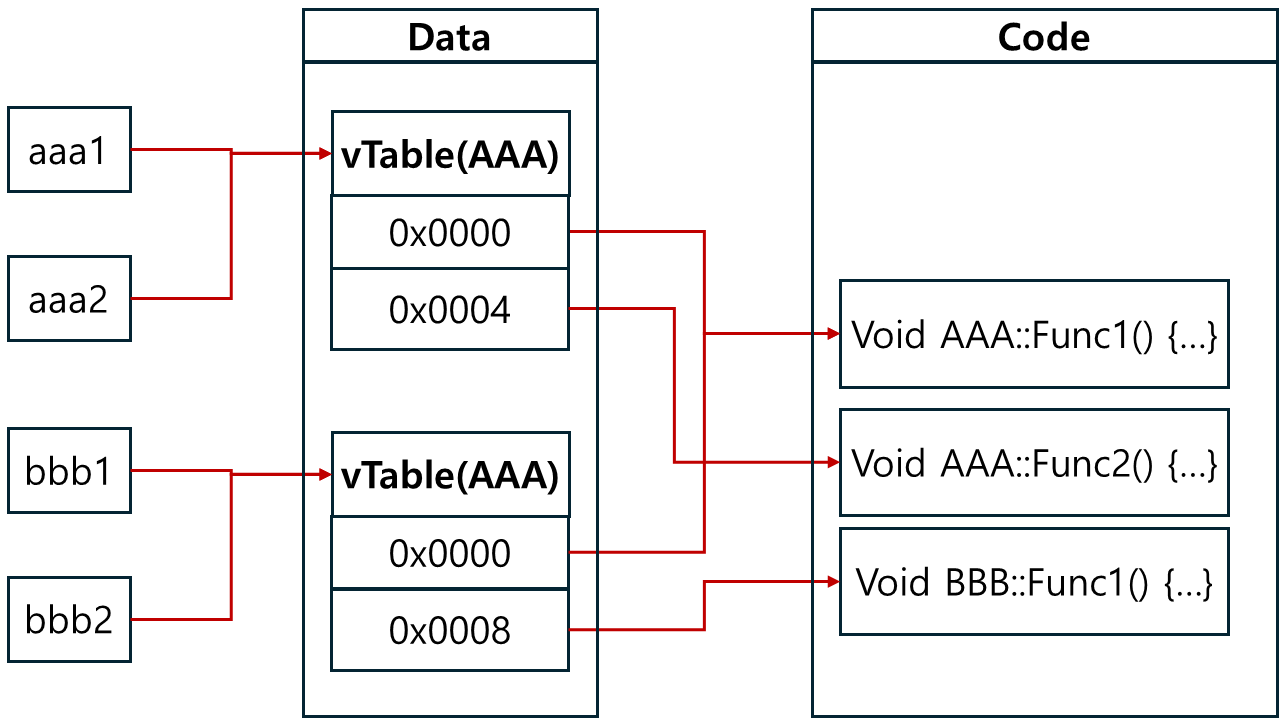
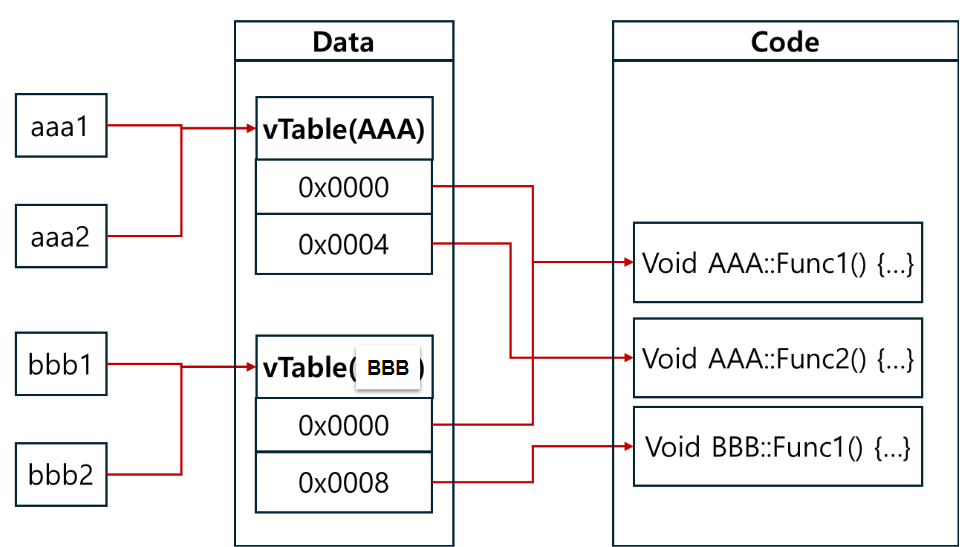
Virtual Function Table
- The virtual table is an array of function pointers.
- An object with virtual functions or one that inherits from a class with virtual functions contains a pointer to the virtual table, which is used to look up functions.
class AAA {
public:
	virtual void Func1() { ... }
	virtual void Func2() { ... }
};

class BBB : public AAA {
public:
	void Func1() override { ... }
};
Optimization with final
- A method marked as
finalis called directly by its address, bypassing the vtable. - This removes indirection and allows inlining of the method.
Operator Overloading
Two Ways to Implement Operator Overloading:
- As a member function
- As a global function
Member functions have higher priority.
// Member function operator overloading
class AAA {
public:
	AAA operator+(const AAA& other) { ... }
};

// Global function operator overloading
AAA operator+(const AAA& operand1, const AAA& operand2) { ... }
Assignment Operator
- The default assignment operator performs a shallow copy.
- Copy Constructor vs. Assignment Operator:
// Copy Constructor
AAA aaa1;
AAA aaa2 = aaa1;

// Assignment Operator
AAA aaa1;
AAA aaa2;
aaa2 = aaa1;
- A subclass’s assignment operator does not implicitly call the superclass’s assignment operator.
Type Conversion
static_cast
Performs compile-time type checking and conversion.
- No runtime overhead
- Type unsafe
Examples:
- Subclass ↔ Superclass
- Primitive type ↔ Primitive type
dynamic_cast
Performs runtime type checking and conversion.
- Runtime overhead
- Type safe
Examples:
- Subclass → Superclass
- Superclass → Subclass (if superclass has at least one virtual function)
reinterpret_cast
Interprets the bits of an address as another type without type checking.

People live above layers of abstraction beneath which engineers reside