Multivariate Linear Regression
실제 상황에서는 하나의 변수만으로 예측하기 어려움
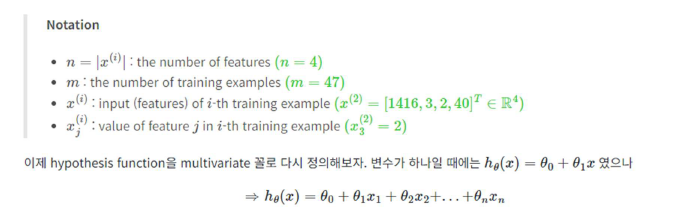
집값 추정 문제의 hypothesis를 (x) = 와 같이 나타내고:
- = 80은 기본 집값
- = 0.1은 제곱미터당 가격
- = 0.01은 층당 가격
...
로 볼 수 있다.
Matrix multiplication을 통한 hypothesis function
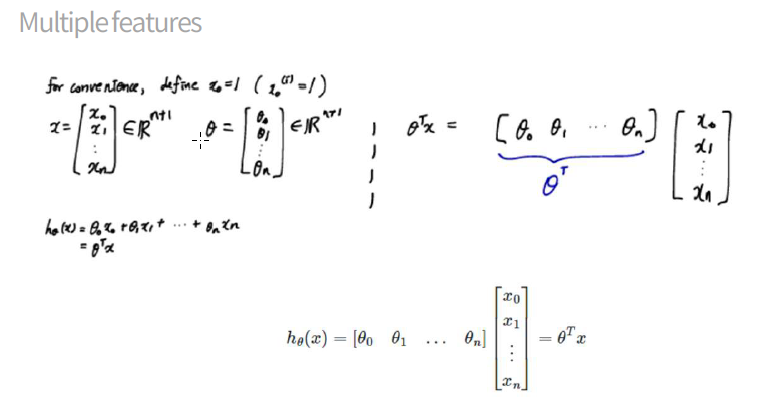
1) 계산을 편하게 하기 위해 = 1
- 를
같은 형태로 만들기 위해서
2) x를 벡터로 표현(입력데이터=feature를 벡터로)하고 (파라미터, 모델의 weight들)도 벡터로 표현
3) 이 두 벡터를 서로 곱한다.
곱하기 위해 transpose (세로 벡터를 가로로)
4) 곱한 결과:
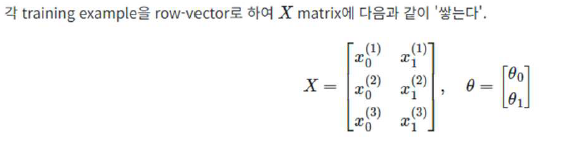
위와 같이 행렬을 이용해 표시하면:
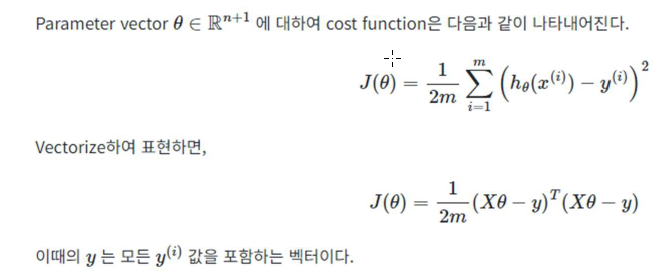
Cost Function:
예제
PyTorch 에서 model은ㅇ Module 클래스로부터 상속된 클래스로 만든다.
가장 기본적으로 두 개 method를 구현해야한다.
- __init__(self)
- forward(self, x)
forward(x) 메서드를 직접 호출하지 않는다. model(x)와 같이 전체 model을 호출한다.
class ManualLinearRegressor(nn.Module):
	def __init__(self):
    super().__init__()

    self.a = nn.Parameter(torch.rand(1, requires_grad=True, dtype=torch.float)
    self.b = nn.Parameter(torch.rand(1, requires_trad=True, dtype=torch.gloat))

    def forward(self, x):
    	return self.a + self.b*x

model = ManualLinearRegressor().to(device)

print(model.state_dict())

loss_fn = nn.MSELoss(reduction='mean')
optimizer = optim.SGD(model.parameters(), lr=lr)

for epoch in range(n_epochs):
	model.train()

    yhat = model(x_train_tensor)

    loss = loss_fn(yhat, y_train_tensor)
    loss.backward()
    optimizer.step()
    optimizer.zero_grad()
수동으로 linear regression parameter를 생성하는 대신 PyTorch의 Linear 모델을 만들어 nested model 생성
class LasyerLinearRegressor(nn.Module):
	def __init__(self):
      super().__init__()
      self.linear = nn.Linear(in_feaures=1, out_features=1)

    def forward(self, x):
    	return self.linear(x)
Sequential model을 이용하면 class 생성도 불필요
model=nn.Sequential(nn.Linear(in_features=1, out_features=1)).to(device)loop 일반화
def make_train_step(model, loss_fn, optimizer):

	def train_step(x,y):
    	#Sets model to train mode
        model.train()

        #Make predictions
        yhat = model(x)

        # Compute loss
        loss = loss_fn(yhat, y)

        # Compute gradients
        loss.backward()

        # Update parameters and zero gradients
        optimizer.step()
        optimizer.zero_grad()

        # Return the loss
        return loss.item()

   return train_step
model=nn.Sequential(nn.Linear(in_features=1, out_features=1)).to(device)
loss_fn = nn.MSELoss(reduction='mean')
optimizer = optim,SGD(model.parameters(), lr=lr)
train_step=make_train_step(model, loss_fn, optimizer)
losses = []
for epoch in range(n_epochS):
loss = train_step(x_train_tensor, y_train_tensor)
losses.append(loss)피쳐 스케일링
모든 feature가 비슷한 범위에 있으면 gradient descent가 더 빠르게 수렴하는 데에 도움이 된다.
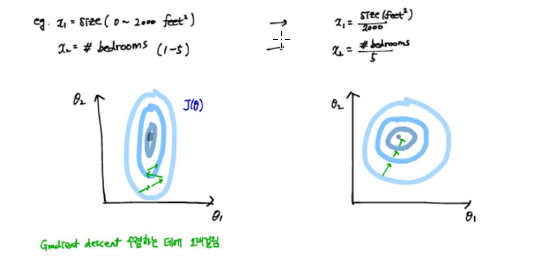
방법들:
1) Standardization
평균을 뺀 후 표준편차로 나누기
= 평균
= 표준편차
2) Min-Max Scaling
결과:
3) Mean Normalization
결과: -1 ~ 1
필요할 때
| 모델 | 필요성 |
|---|---|
| Linear Regression | 매우 중요 |
| Logistic Regression | 매우 중요 |
| Neural Network | 필수 |
| SVM | 매우 중요 |
| KNN | 매우 중요 |
안 필요할 때 (Tree 기반 모델)
| 모델 |
|---|
| Random Forest |
| Decision Tree |
| XGBoost |
예)
from sklearn.preprocessing import StandardScaler
scaler = StandardScaler()
X_scaled = scaler.fit_transform(X)
오랜시간 망설였던 코딩을 다시 해보려고 노력하고 있는 사람