Finding Critical Users for Social Network Engagement: The Collapsed k-Core Problem
Graph Paper Reivew
목록 보기
1/2
Background
K-core
- Remaining maximal sub-graph, after iteratively pruning nodes which have less than k degrees
- Indicates the influence of node
- Unique in one graph
Abstract
- In social networks, the leave of critical users may break network engagement
- A popular model to measure social network engagement is k-core
- To identify critical users for social network engagement, propose the collapsed k-core problem
- Given a graph , a positive integer and a budget ,
aim to find vertices in such that the deletion of the vertices leads to the smallest k-core
- Given a graph , a positive integer and a budget ,
- Proposal : An efficient algorithm which significantly reduces the number of candidate vertices to speed up the computation
Introduction
k-core
- k-core is a simple and popular model based on degree constraint used to measure the network engagement
- A user with less than friends engaged will drop out, and his leave may be contagious
collapsed k-core problem
- Given a limited budget , how to find vertices(users) so that we can get the smallest k-core by removing these vertices
= then, these appears to be influencial - Aims to collapse the engagement of the network with the greatest extent for a given budget
- Identifying critical users
= Identifying most valuable users to sustain or destroy the engagement of the networks - Also, we can evaluate the robustness of network engagement against the vertex attack
Example
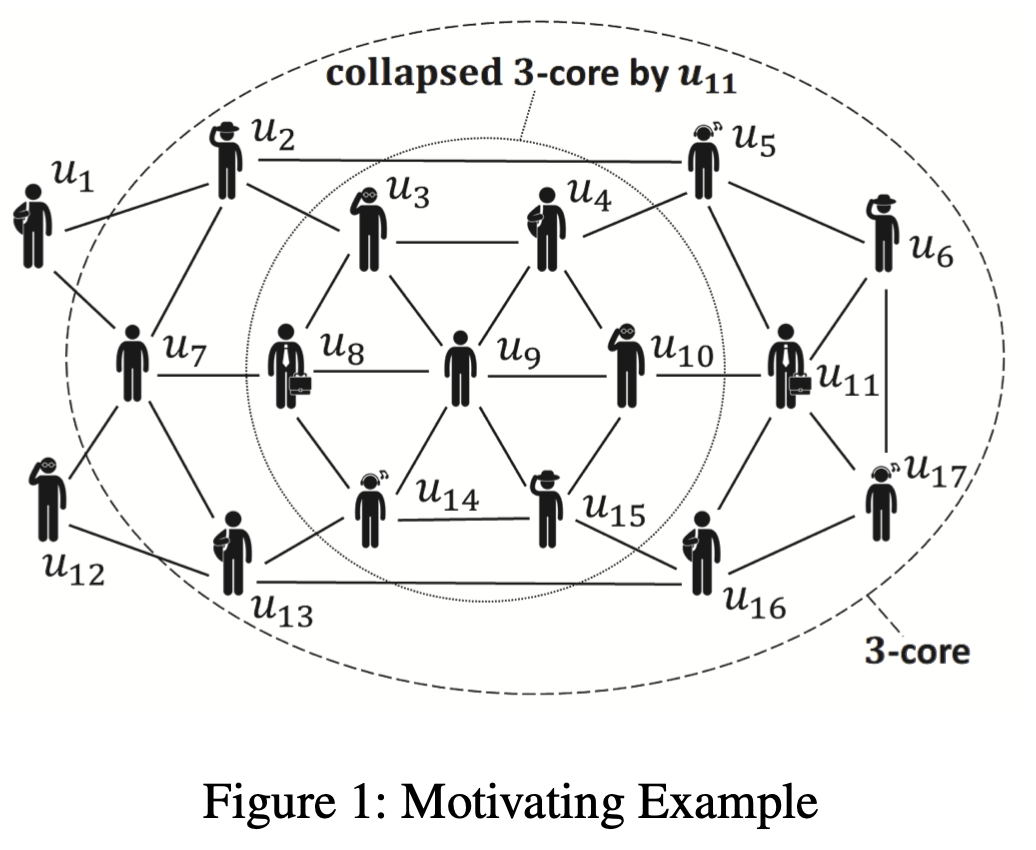
- The extent of the collapse varies among different users
- Although has 6 friends in 3-core, the departure of will not further lead to the leave of the other users
- On the contrary, the leave of will lead to the leave of 7 members
- In this sense, it is more cost-effecitve to give the incentive to ensure to his/her engagement to leave the group
Challenges and Contributions
- First proposal to handle the collapsed k-core problem
- Resort to greedy heuristics where the best vertex is obtained in each iteration
- Through theoretical analyses, significantly reduce the number of candidate vertices to speed up the computation
Preliminaries
Notation
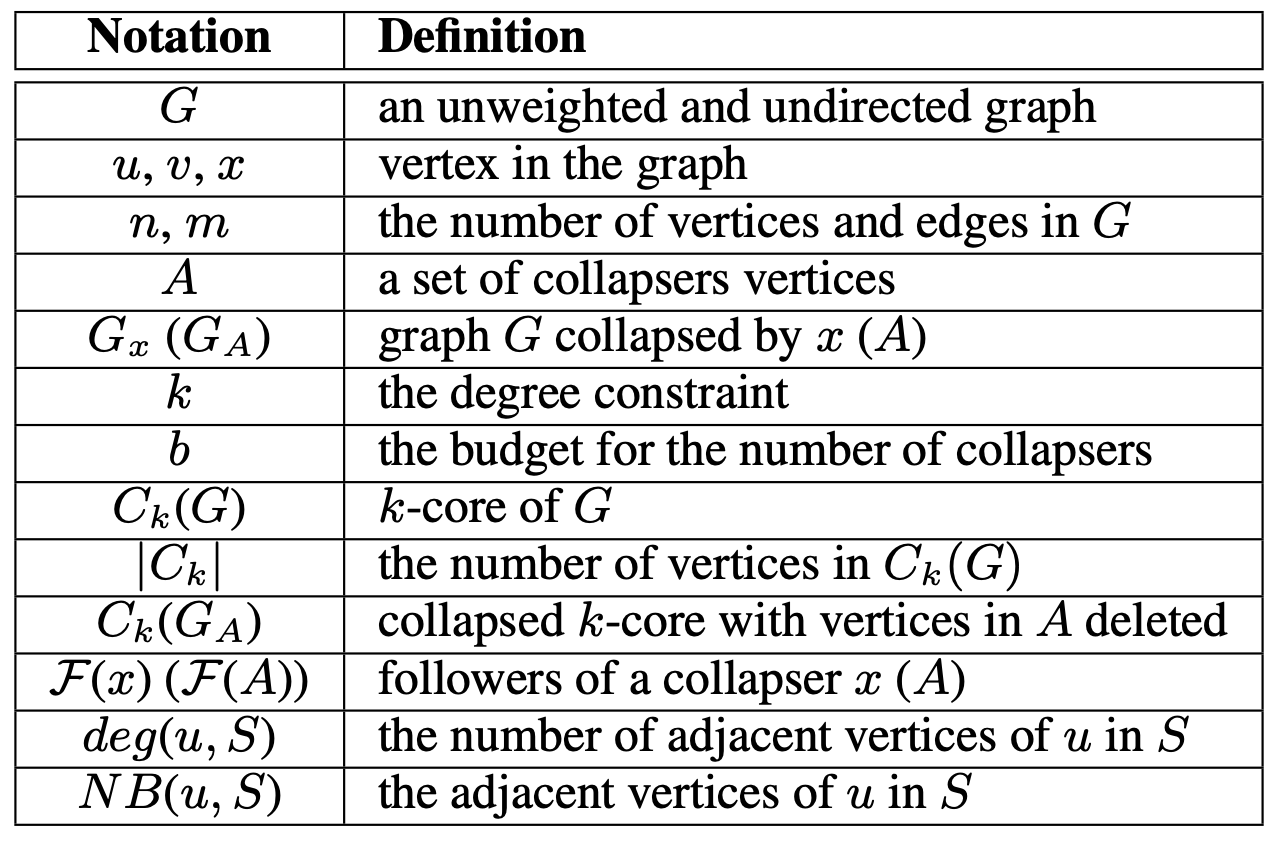
k-core
- The k-core of a graph can be obtained with
- The value of is determined by users based on their requirement for cohesiveness
The resulting k-core will be more cohesive if the value becomes larger
collapsed k-core
- In addition to the deletion of the collapsed vertices in , more vertices in might be deleted due to the contagious nature of the k-core
- These vertices are called followers of the collapsed vertices
- The size of the followers reflects the effectiveness of the collapsed vertices
Problem Statement
- Given a graph , a degree constraint and a budget ,
Find a set of collapsed vertices in so that
the size of the resulting collapsed k-core, is minimized,
that is, is maximized
Complexity
Theorem 1. The collapsed k-core problem is NP-hard for any
- Reduce Collapsed 1-core Problem to Maximum Independent Set Problem
- Maximum Independent Set
- 그래프에서 서로 연결되지 않은 정점들 중 최대한 많은 수를 찾는 문제
- 임의의 두 정점 에 대해 이어야함
- Reduction
- 1-core 에서 임의의 정점 를 제거하려면 의 모든 이웃 제거 필요
- 의 차수 = 0
- 가 Independent Set 이라면
- 내의 정점들은 서로 연결되어 있지 않음
- = 에는 모든 간선이 몰려 있음
- 를 제거하면
- 에 있는 모든 정점은 더 이상 연결된 간선이 없음 ( 차수=0)
- 따라서 1-core 에서 에 속한 모든 정점이 탈락
- 즉, 를 살리고 를 제거하면 전체 1-core 가 붕괴
- Reduce Collapsed 2-core Problem to Collapsed 1-core Problem
- Reduction
- Given graph , construct another graph
- Each edge in , add two virtual vertices and and construct four edges in $G_2 : (v_1,w), (w,v_2), (v_1,w'), (w',v_2)
- Do not need to include any virtual vertices in the optimal solution of collapsed 2-core
because the influence of deleting a virtual vertex can be covered by deleting non-virtual vertices - Therefore, deletion of edge in is mapped to the deletion of four edges in
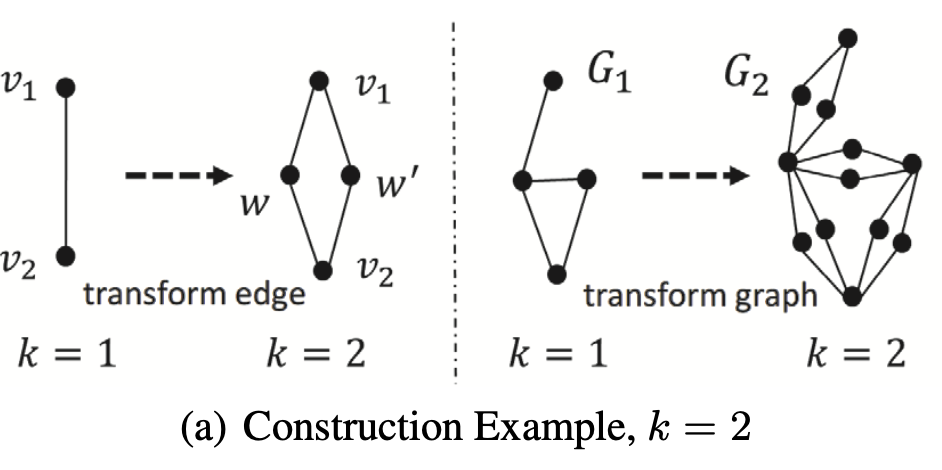
- Reduce Collapsed k-core Problem to Maximum Coverage Problem
- Maximum Coverage Problem
- Finding at most sets to cover the largest number of elements, where is a given budget
- Reduction
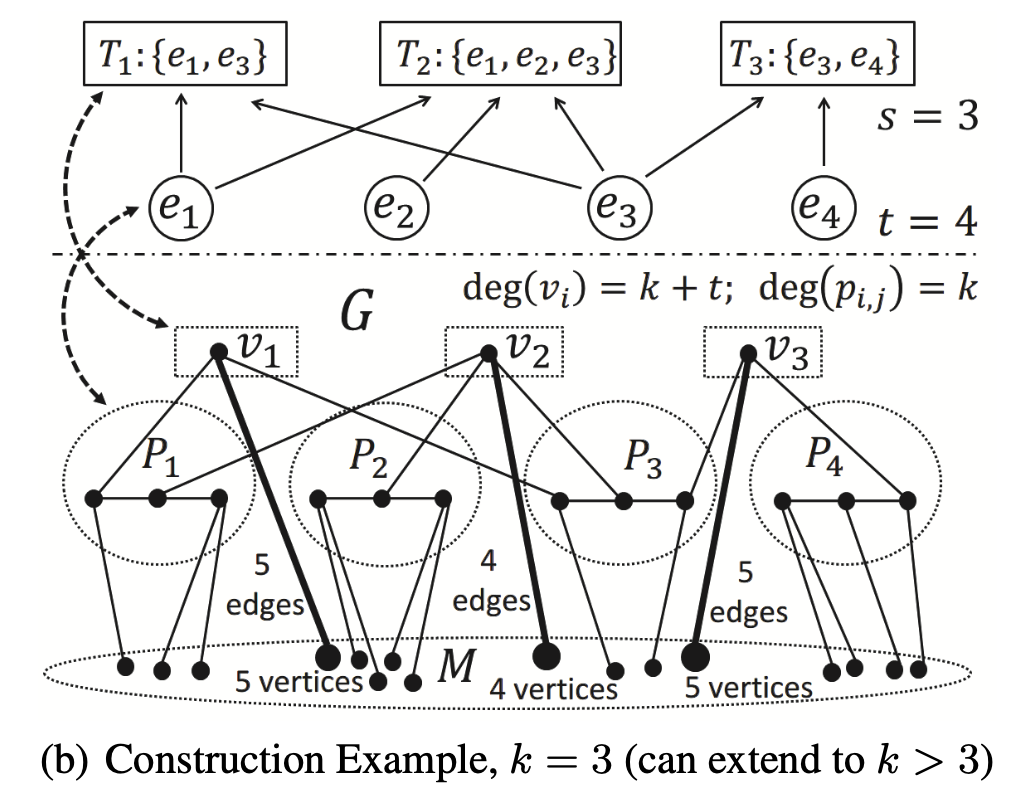
- Instance of maximum coverage problem with sets and elements
- The set of vertices in consists of
- consists of vertices in which every pair of vertices in are adjacent
- consists of vertices, each vertex corresponds to the set
For each vertex , add edges from to unique vertices in- Maximum Coverage 의 원소 를 하나의 정점 로 대응
- 제거의 결과로 차수가 미만이 되면, follower 로 간주되어 k-core 에서 탈락
- consists of parts, each part corresponds to the element and consists of vertices
- For each add edges, for each and each element
- Add edge from to
- For each set and each element , if , add an edge
- Key idea
- Follower 수는 로만 계산하면 됨
- 은 제거되지 않음, 구조 유지
- 모든 는 동일한 사이즈 유지
- 제거하면 연결된 특정 가 함께 삭제
Theorem 2. Let . We have is monotone but not submodular for any
Monotonicity
- , removes more vertices than
- Thus and is monotone
Submodularity
- For two arbitrary collapsers sets and ,
Solution
Motivation
- A straightforward solution is to enumerate all possible set with size
Time complexity of is cost-prohibitive - We only need to consider the vertices in since all other vertices will be deleted by degree constraint
- Thus, a greedy algorithm is , and correspond to the number of candidate collapsers in each iteration and the cost of follower computation
- The number of vertices in at Line 3 is considerably large
Reducing Candidate Collapsers
Two pruning rules to find the vertex with the largest number of followers
- Only vertices with degree in k-core and their neighbors in k-core can have followers
- denotes the vertices in k-core of with degree
- : 에 있고 이웃 중 적어도 하나가 에 속한 정점들
Theorem 3. Given a graph and the set , if a collapsed vertex has at least one follower, is from
- : 차수가 인 vertices set
- : 에 있고 이웃 중 적어도 하나가 에 속한 정점들
- Proof
- If , x will be deleted in k-core computation,
- If , survived in k-core computation and for each 's neighbor within , since
Theorem 4. Given two vertices and in graph, we have if
- Every vertex which is a follower of a vertex can be excluded from candidate collapsers
- A vertex with more neighbors in the set is more promising because all its neighbors in will follow the vertex to be deleted
CKC Algorithm
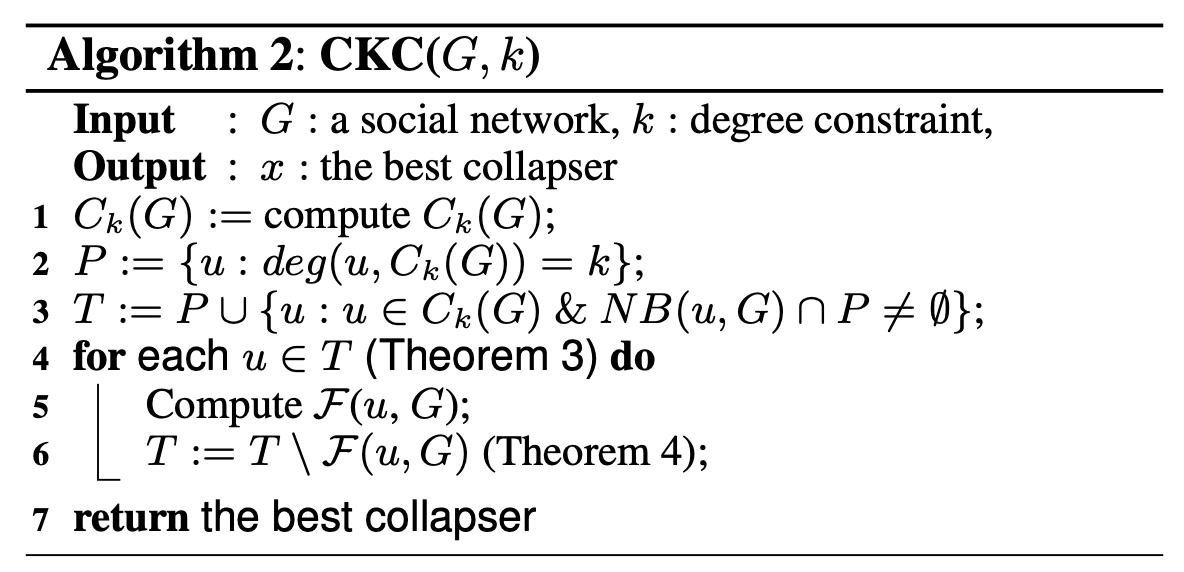
- To avoid the re-computation of and in the following iterations,
update two sets at the end of each iteration - : vertices whose degrees are decreased to during the computation
- : vertices which are discarded during the computation
- Include new vertices in
- Delete vertices in
- Order the candidates by their number of neighbors in in each iteration to prune more candidate collapsers
Evaluation
Effectiveness
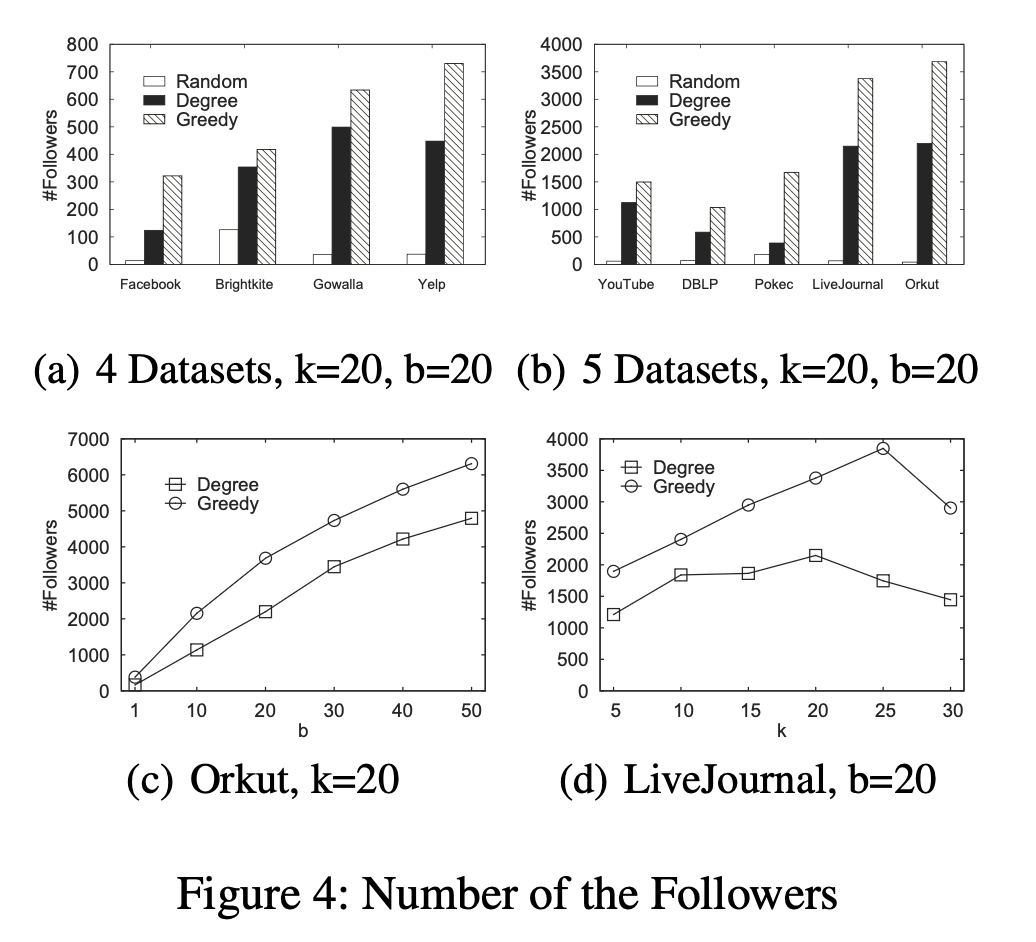
Baseline
- Random
- Randomly chooose collapsers in k-core
- Degree
- Choose collapsers in the candidate set with the largest degrees
Analysis
- Degree based approach is outperformed by CKC with a big margin
- This Implies that it is not effective to find collapsers simply based on degree information
Efficiency
Evaluation of Individual Techniques
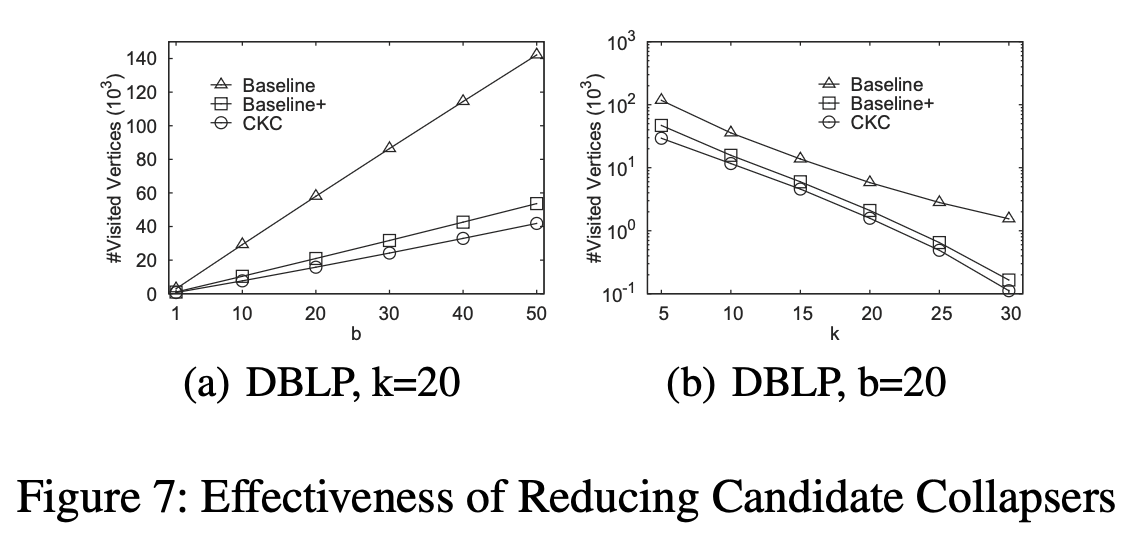
- Baseline+ represents Baseline equipped with Theorem 3
- Theorem 3, 4 reduces the number of candidate collapsers
Performance Evaluation
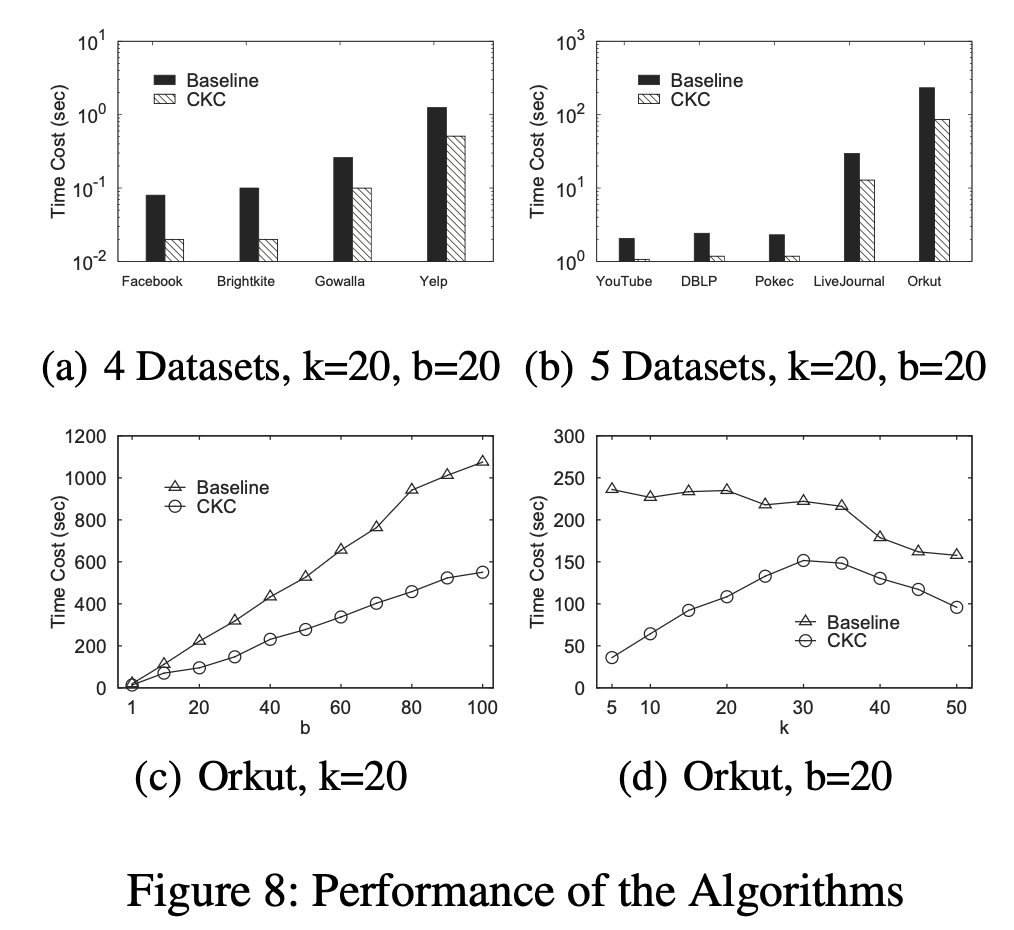
- (a) and (b)
- CKC is scalable to the growth of the network size
- (c) and (d)
- CKC is scalable to the different and
