Introduction
Open set을 알기 전에 ϵ-disc에 대해서 알아야 한다.
Definition 1
For each fixed x∈Rn and ϵ>0, the set D(x,ϵ)={y∈Rn∣d(x,y)<ϵ}.
neighbor이라고도 불리는 해당 disc는 하나의 x에 대해서 그 주변을 둘러싸는 하나의 원이라고 생각하면 된다.
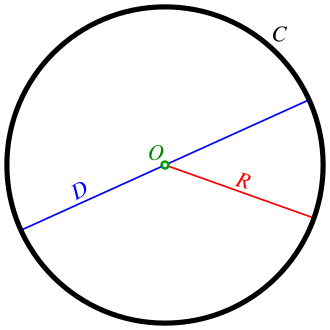
Open set은 모든 x∈S에서 disc가 생성되는 set을 얘기한다.
Open set
Definition을 먼저 살펴보자.
Definition 2
If ∀x∈S,∃ϵ>0 such that B(x,ϵ)⊂S, then S is an open set.
해당 정의를 보면, S에 속하는 모든 x들은 해당 x를 중심으로 하는 disc가 존재한다는 것이다.
가령 예를 들면, [1,2]의 set이 주어졌다고 한다면, x=2일 때는 epsilon을 어떻게 잡는다고 하더라도, B(x,ϵ)이 [1,2]에 속하지 않는다는 것을 알 수 있다.
해당 집합은 Open set이 되지 않는 것이다.
Theorem 1
In Rn, for every ϵ>0 and x∈Rn, the set D(x,ϵ) is open.
해당 내용을 살펴보면, D(x,ϵ)은 열린 집합임을 의미한다.
D(x,ϵ)이 열린 집합임을 보이기 위해서는, D(x,ϵ) 에 속하는 임의의 점 y에 대해, 그 점을 중심으로 하는 충분히 작은 열린 볼(open ball)이 D(x,ϵ) 안에 포함됨을 보여주어야 한다.
Proof
Let y∈D(x,ϵ). Define ϵ′:=ϵ−d(x,y).
∀z∈D(y,ϵ′), we have:
d(x,z)≤d(x,y)+d(y,z)≤d(x,y)+ϵ′=epsilon.
Thus, d(x,z)≤ϵ, which implies z∈D(x,ϵ).
Therefore, the set D(x,ϵ) is open.
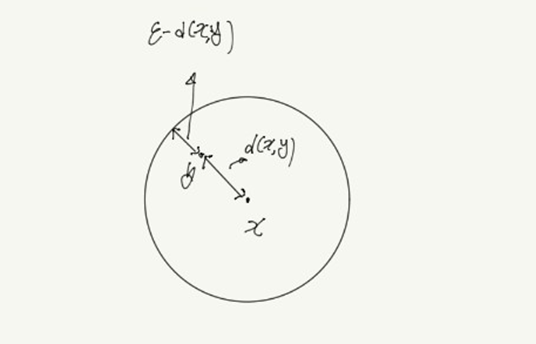
여기서 우리는 해당 D(y,ϵ′)이 D(x,ϵ)에 속한다는 것을 보여주면 된다.
z∈D(y,ϵ′)인 z을 하나 뽑아보자. 해당 z는 y와 거리가 ϵ′보다 작다. (d(z,y)<ϵ′)
고로, d(z,x)≤d(z,y)+d(y,x)≤ϵ′+d(x,y) 임을 알 수 있다. 우리는 ϵ′의 정의에 의해 ϵ′+d(x,y)=ϵ임을 알고 있다.
그러므로, d(z,x)≤ϵ임을 알 수 있으니, z∈D(x,ϵ)인 것을 확인할 수 있다.
고로, D(y,ϵ′)⊂D(x,ϵ)을 증명할 수 있고, 모든 y에 대해서 ϵ′이 존재하므로 D(x,ϵ)이 Open set임을 증명할 수 있다.
Theorem 2
1. The intersection of a finite number of open subsets of Rn is an open subset of Rn2. The union of an arbitrary collection of open subsets of Rn is an open subset of Rn
1번에 대한 직관적인 이해는 여러 개의 open set이 존재할 때, 해당 open set (유한한)의 교집합은 open set이라는 것이다.
2번에 대한 직관적인 이해는 open set의 합집합은 open set이라는 것인데, arbitrary collection이라는 조건이 붙었다. 해당 arbitrary collection은 임의의 개수의 열린 집합들의 모임으로,
제한이 없다는 의미이다. 어떻게 선택되든 몇 개를 선택하든 합집합은 open set이라는 것이다.
고로, open set의 교집합은 유한할때, 합집합은 무한하더라도 open set이라는 것이다.
Proof
-
Let {Oi}i∈I be a collection of open sets. Since ∣I∣ is finite, we can pick x∈∩i∈IOi.
Then, ∀i∈I, x∈Oi.
Since each Oi is an open set, ∃ϵi>0 such that B(x,ϵi)⊂Oi.
Set ϵ:=mini∈I{ϵi}>0.
Then, ∀i∈I,B(x,ϵ)⊂B(x,ϵi)⊂Oi.
Therefore, B(x,ϵ)⊂∩i∈IOi.
-
Let {Oi}i∈I be a collection of open sets. Pick x∈∪i∈IOi.
Then, there exists i∗∈I such that x∈Oi∗.
Since Oi∗ is open, there exists ϵ>0 such that B(x,ϵ)⊂Oi∗.
Thus, B(x,ϵ)⊂Oi∗⊂∪i∈IOi.
Since x∈∪i∈IOi was arbitrary, ∪i∈IOi is open.
Example
1.
O:={x∈Rn;x1>0} then O is open.
proof)
큰 틀에서 그려서 생각을 해보면, O가 open set임을 증명하기 위해, O에 속하는 모든 점들을 중심을 한 disc가 그려지면 되는 것이다.
ϵ을 2x1로 잡아보자. 그렇게 되면, ϵ은 항상 양수가 된다.
그 다음, 우리는 B(x,ϵ)⊂O임을 보여주면 된다.
y∈B(x,ϵ)을 선택을 하고, 해당 y가 O에 속하는지 확인. 즉, y>0임을 보여주어야 한다.
y=(y−x)+x=(y−x)+2ϵ≥−∣y−x∣+2ϵ>ϵ>0
고로, y>0이기 때문에 O에 속하게 된다.