기수 정렬은 숫자를 구성하는 각 자릿수를 기준으로 정렬하는 선형 정렬 알고리즘으로 크기가 고정되어있는 문자나 숫자 정렬에 유용합니다.
기수 정렬의 단계
설명을 위해 {170, 45, 75, 90, 803, 24, 2, 66} 라는 배열이 있다고 가정하고
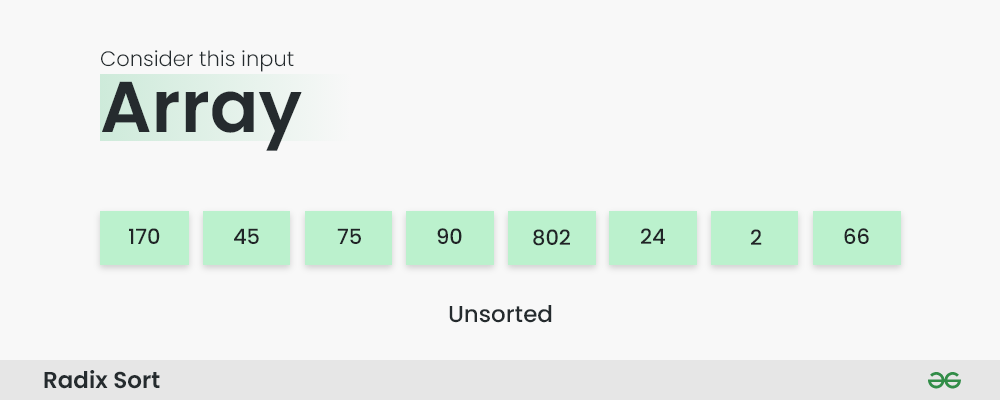
해당 배열에서 자릿수가 가장 큰 값을 확인하고 그 자릿수를 key값으로 정렬합니다.
LSD 방식으로 정렬한다면
먼저 1의자리 숫자를 기준으로 정렬합니다.
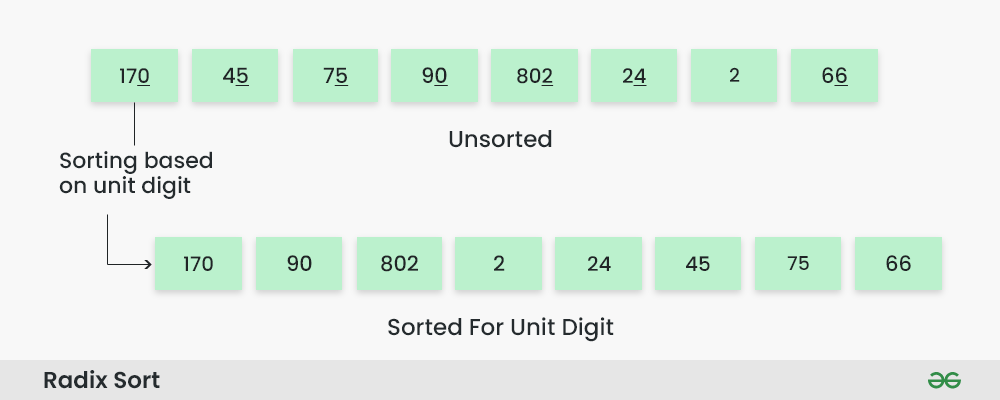
만약 같은 값이 존재한다면 Unsorted 배열에서 우선순위대로 정렬합니다.
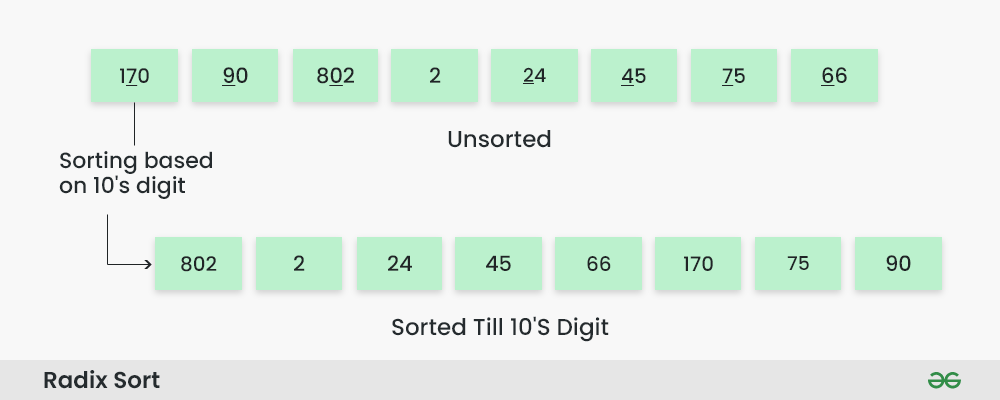
그 다음 10의 자리수로 정렬을하면
(n의 자리 수가없으면 0으로 표시합니다.)
이제 마지막으로 100의 자리 수로 정렬을 진행하면
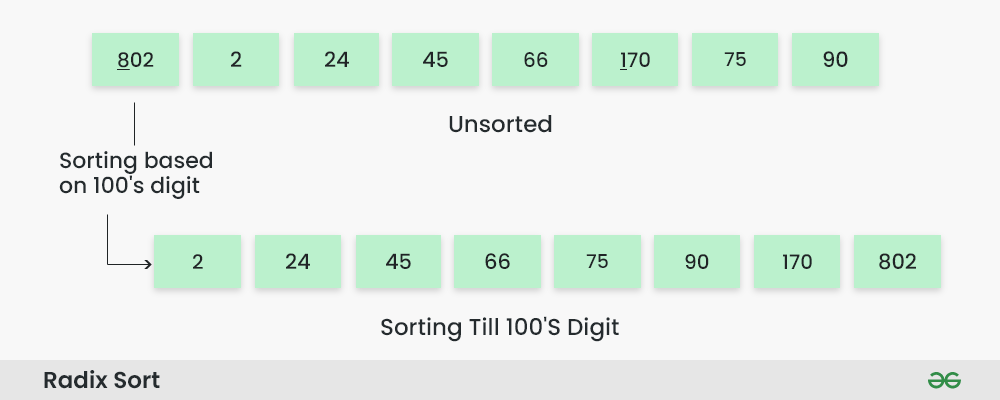
이렇게 오름차순으로 정렬이 됩니다.
기수 정렬 예시 코드
c언어로 구현 코드입니다.
#include <stdio.h>
#include <stdlib.h>

#define MAX_NUM 1000000

void countingSort(int arr[], int n, int exp) {
    int output[n];
    int count[10] = {0};

    // Count occurrences of each digit
    for (int i = 0; i < n; i++)
        count[(arr[i] / exp) % 10]++;

    // Calculate cumulative frequencies
    for (int i = 1; i < 10; i++)
        count[i] += count[i - 1];

    // Build output array
    for (int i = n - 1; i >= 0; i--) {
        output[count[(arr[i] / exp) % 10] - 1] = arr[i];
        count[(arr[i] / exp) % 10]--;

    }

    // Copy output array back to original array
    for (int i = 0; i < n; i++)
        arr[i] = output[i];
}

void radixSort(int arr[], int n) {
    int max = arr[0];
    for (int i = 1; i < n; i++)
        if (arr[i] > max)
            max = arr[i];

    // Do counting
 sort for every digit.
    for (int exp = 1; max / exp > 0; exp *= 10)
        countingSort(arr,
 n, exp);
}

int main() {
    int arr[] = {170, 45, 75, 90, 802, 24, 2, 66};
    int n = sizeof(arr) / sizeof(arr[0]);

    radixSort(arr, n);

    printf("Sorted
 array: \n");
    for (int i = 0; i < n; i++)
        printf("%d ", arr[i]);
    printf("\n");

    return
 0;
}
성능평가
복잡도는
b는 최대값의 자릿수에 따라 달라집니다.
장점
-
Fast when the keys are short i.e. when the range of the array elements is less.
-
Used in suffix array constuction algorithms like Manber's algorithm and DC3 algorithm.
단점
-
Since Radix Sort depends on digits or letters, Radix Sort is much less flexible than other sorts. Hence , for every different type of data it needs to be rewritten.
-
The constant for Radix sort is greater compared to other sorting algorithms.
-
It takes more space compared to Quicksort which is inplace sorting.
정리
- Since Radix Sort depends on digits or letters, Radix Sort is much less flexible than other sorts. Hence , for every different type of data it needs to be rewritten.
- The constant for Radix sort is greater compared to other sorting algorithms.
- It takes more space compared to Quicksort which is inplace sorting.
