[24.arXiv]KVQuant: Towards 10M Context Length LLM Inference with KV Cache Quantization
LLM-KV-Cache-Q


- parent: SqueezeLLM
- Settings
- LLaMA, Llama-2, Llama-3, Mistral
- Wikitext-2, C4
- 1M on a single A100-80GB GPU, 10M on 8-GPU
Motivation
-
small batch size에 대해서, LLM inference의 generation 단계는 memory bound함. (SqueezeLLM)
-
memory bottleneck은 context size와 강한 연관이 있음.
-
short sequence lengths: memory consumption의 주 요인 = weight matrix
따라서, model size를 minimize해서, memory consumption과 bandwith requirement를 줄이는게 최선의 방법. -
하지만, long sequence lengths: memory bottleneck의 주 요인 = Key와 Value를 Caching하기 위한 memory requirement.
(batched inference를 고려한다면, 이 문제는 더욱 심각함.)
Background
LLM Inference
-
small batch size에 대해서, LLM inference의 generation 단계는 memory-bandwidth bound하다.
-
generation 동안, model은 이전에 generated된 output tokens에 condition generation하기 위해서,
intermediate Key, Value activations를 store해야 한다. -
future tokens를 generation하기 위해, 각 prior token에 대해, 각 layer의 Keys와 Values를 store 해야 한다.
-
이 stored activations를 Key-Value(KV) cache라고 부른다.
-
a model with
- layers
- attention heads with dimension that is stored using bytes per element,
- KV cache size for batch size and sequence length is
- KV cache becomes the dominant contributor to memory consumption for longer sequence lengths and larger batch sizes.
-
batch inference에서 각 sequence가 독립적인 KV 캐시를 필요로 함.
이로 인해 memory bandwidth가 주요 bottleneck이 됨.
따라서 KV Cache의 compression이 LLM의 성능 향상에 중요한 역할.
KV Cache Compression
-
이전 관련 연구들은 KV cache에서 중요한 token들만 store하고, 나머지 token들은 제거하는 방법들을 사용함.-
-
각 step마다 a subset of tokens를 retrieve해서 memory bandwidth를 줄이는 연구도 있음.
-
KVQuant는 KV cache Quantization 방향으로 연구.
Methods
Per-Channel Key Quantization ➡️ Pre-RoPE Key Quantization ➡️ Non-Uniform KV Cache Quantization ➡️ Per-vector Dense-and-Sparse Quantization
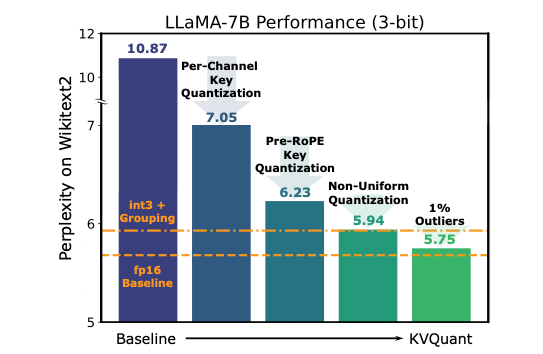
1.Per-Channel Key Quantization
-
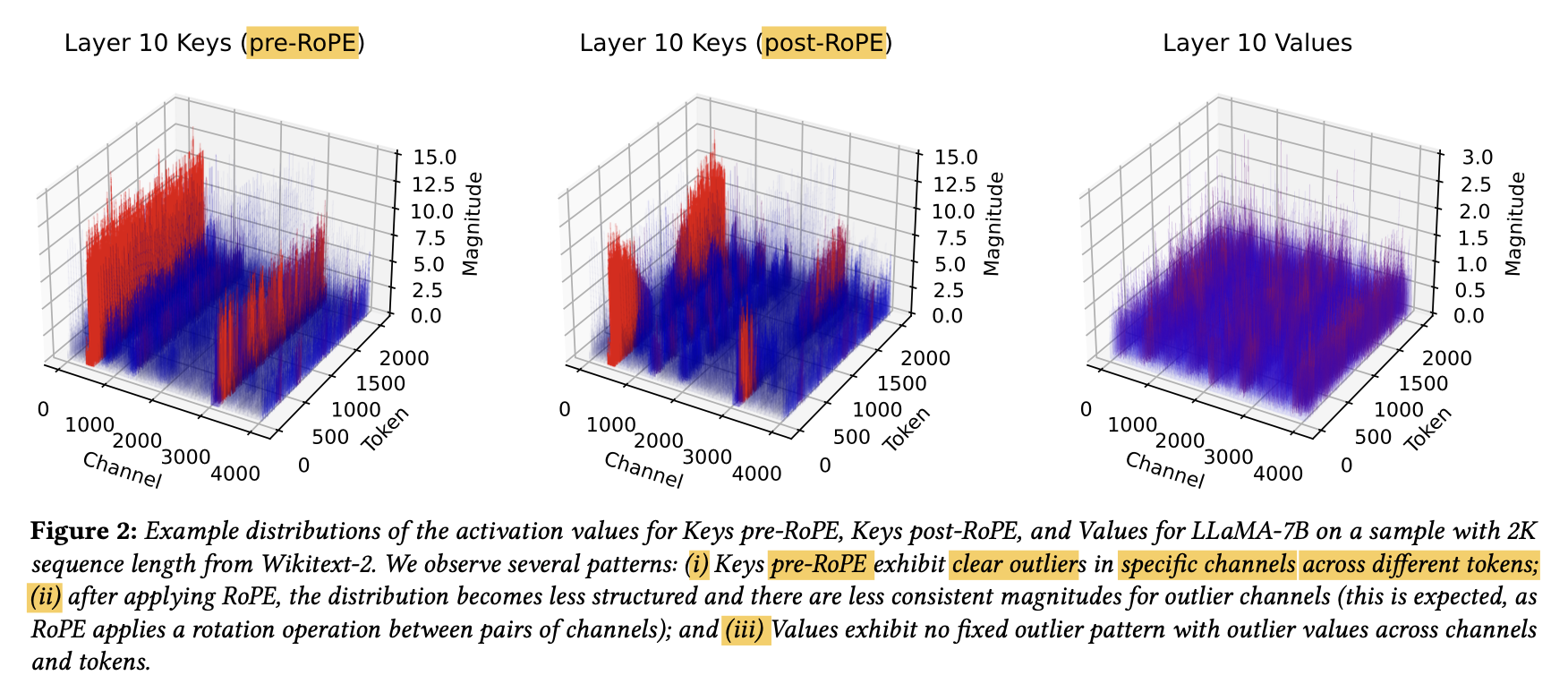
KV Cache distribution
- Key matrix들에서 distinct한 outlier channels를 가짐을 observe.
- Value matrix들에선 outlier channels와 outlier tokens를 둘 다 가지며, Key 보다는 outlier magnitude가 작음을 observe.
-
이전 KV cache Q 연구들은 "per-token quantization"
- scaling factor, zero-point are shared by elements in the same token
-
이 연구에선, "per-channel KV cache Q"
-
scaling factor, zero-point are shared by elements in the same channel.
-
Keys에서는 효과적이지만, Values에서는 효과적 X를 발견 (Appendix E).
- 따라서, Key는 per-chanel, Value는 per-token으로 Q

-
2. Pre-RoPE Key Quantization
-
Keys를 Q할 때 issue중 하나는, rotary positional embedding (RoPE)를 handling하는 것.
-
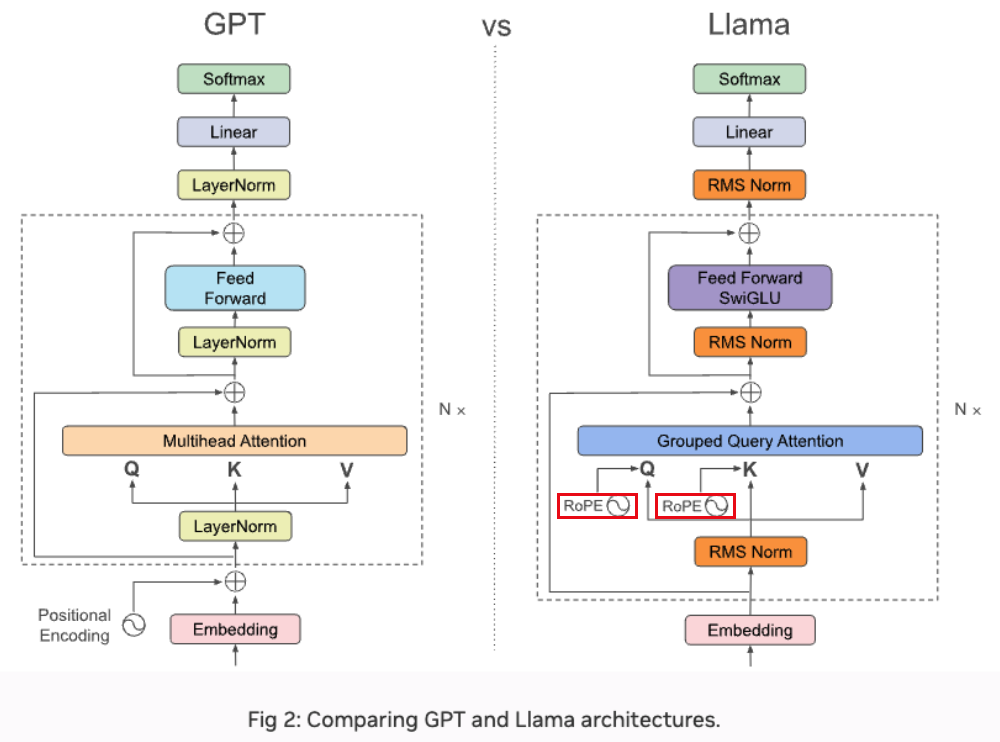
RoPE는 대부분의 public LLMs에서, Keys와 Queries에 적용된다.
-
Query vector at position ,
Key vector at position , 이 주어질 때, -
RoPE는 Query와 Key 벡터 사이의 relative position을 해당 position index의 배수에 해당하는 angle로 표현한다(embed).
-
RoPE는 self-attention에서 다음과 같이 적용된다.

-
Key vector를 caching할 때, 을 cache하거나, (after applying RoPE)
inference 도중에 on-the-fly로 을 cache하고 을 적용해야 한다. (before RoPE) -
RoPE 즉, rotation을 적용한 이후 key vectors를 caching 할 때의 challenge는
sequence 내 서로 다른 position에 대해 channel 쌍들이 서로 다른 정도로 mix된다는 점이다.
sequence 내 position에 따라 channel pair들이 서로 다른 angle로 함께 rotate되기 때문이다.- post-RoPE ativation distribution을 보면, channel pair들 간의 rotation이 channel magnitude의 일관성을 떨어뜨림(less consistent)을 볼 수 있다.
- 이로 인해 일반적으로 일관된 큰 크기의 값을 갖는 Key activation channel을 Q하는 것이 더 어려워진다. (Motivation)
- post-RoPE ativation distribution을 보면, channel pair들 간의 rotation이 channel magnitude의 일관성을 떨어뜨림(less consistent)을 볼 수 있다.
-
그래서, pre-RoPE Key Q를 하고, (을 Q)
deQ 이후에, on-the-fly로 positional embeddings를 적용하는 방법을 연구했다.
(결과적으로, perplexity 향상됨)

-
참고: RoPE의 rotation matrix

3. nuqX: X-Bit Per-Layer Sensitivity-Weighted Non-Uniform Datatype
(🫶 SqueezeLLM)
-
"각 layer에서 Q error에 대한 sensitivity를 분석하여,
non-uniform Q의 quantization bins의 위치를 최적화하는 방법." -
non-uniform Q를 할거야.
-
Query와 Key activations는 non-uniform이잖아.
-
"overhead 문제 없어"
KV cache loading은 memory bandwidth bound함
(batch sizse 또는 sequence length에 상관없이),
이는 non-uniform Q를 사용함으로써 발생되는 deQ overhead가 문제가 되지 않음을 뜻함.
(더 computation 하는게 추가적인 latency를 발생시키진 않기 때문)
-
-
"squeezeLLM가 sensitivity를 측정해서 non-uniform Q bins를 최적화하는 방법"을 따를건데, KV cache는 좀 다르게 해야함."
- squeezeLLM
- sensitivity-weighted k-means approach를 사용해 non-uniform quantization signposts를 compute함.
- 하지만, 이 방법을 KV cache Q에 그대로 적용할 수 없음.
- Values가 runtime에 online으로 quantized 되기 때문.
- 즉, 우리가 inference 도중에 K-means를 적용해야 한다는 것인데,
online으로 activation sensitivity를 estimation하는 것은 어려움.
- squeezeLLM
-
따라서, "per-tensor non-uniform datatype" offline on calibration data를 도출해서,
efiicient한 online non-uniform KV cache Q를 하겠어.- 이 data type은 key와 value distribution을 정확히 represent하도록, per-channel 또는 per-token으로 rescale됨.
-
inference 이전에 calibration set에서 offline으로 sensitivity-weighted Q signposts를 계산
- 이 때 shared datatype을 도출하기 전에, 각 channel을 별도로 [−1, 1] 범위로 정규화함으로써
per-vector quantization과의 호환성을 유지
- 이 때 shared datatype을 도출하기 전에, 각 channel을 별도로 [−1, 1] 범위로 정규화함으로써
-
"SqueezeLLM처럼, Fisher info matrix는 똑같이 사용할거야."
Appendix B에서 유도된 대각 Fisher information matrix와 activation 에 대한 quantization error를 사용하여, 다음과 같이 error minimization objective를 공식화한다.-

-
여기서 A는 1차원으로 flattened되며, N은 calibration set의 모든 샘플에서 얻은 요소들의 수를 나타낸다.
-
정규화된 activation 값들을 사용하여 적용할 수 있도록 Appendix C에 설명된 대로 Equation 2의 objective function을 수정.
-
이후, calibration set에서 k-means solver를 사용하여 offline으로 이를 최소화함으로써,
각 Key 또는 Value layer에 대한 non-uniform datatype의 quantization signposts를 얻음.
-
-
Fisher Information Matrix(FIM)가 모델의 민감도를 측정하는 원리
4.Per-Vector Dense-and-Sparse Q
(🫶 SqueezeLLM)
-
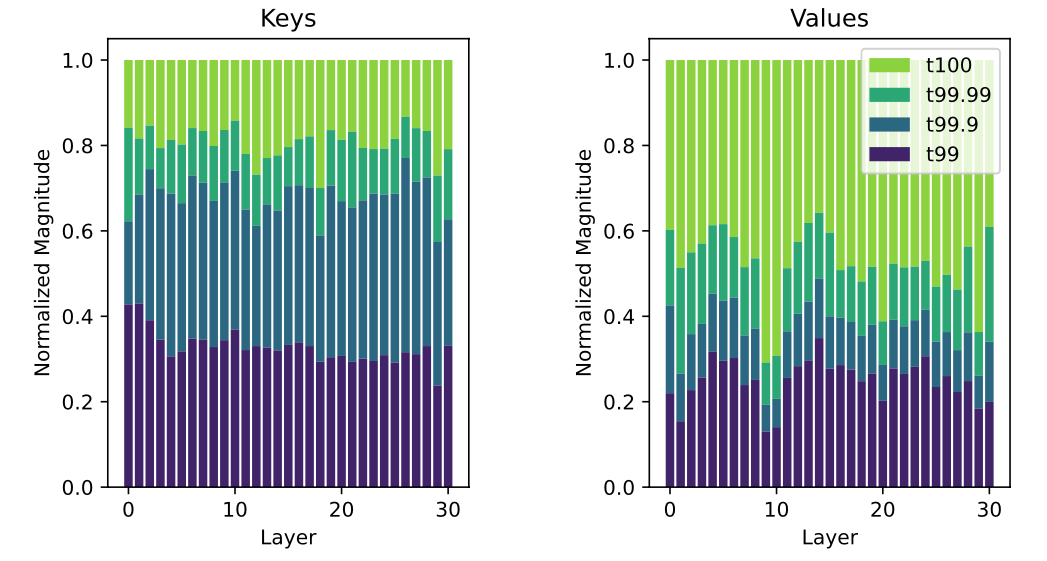
Key와 Value activation들의 값 분포 ➡️ 대부분 집중되어 있고, 몇몇 outlier가 range를 넓힘.
-
-
t100, t99.99란?
- t100: 모든 값들을 포함하는 전체 범위.
즉, 최소값부터 최대값까지의 전체 dynamic range. - t99.99: 전체 값들 중 99.99%를 포함하는 범위.
즉, 가장 극단적인 0.01%의 값들을 제외한 범위.
- t100: 모든 값들을 포함하는 전체 범위.
-
해석
-
대부분의 값들이 전체 dynamic range의 작은 부분에 집중되어 있음.
-
예를 들어, t99 선은 전체 값들의 99%가 그 아래에 있음을 보여주며, 이는 극소수의 outlier 값들이 전체 dynamic range를 크게 확장시키고 있음을 의미.
-
이러한 분석은 왜 dense-and-sparse approach가 효과적인지를 보여줌.
소수의 outlier들을 별도로 처리함으로써, 대부분의 값들을 더 정확하게 표현할 수 있는 좁은 범위에 집중할 수 있음.
-
-
-
SqueezeLLM처럼, dense-and-sparse quantization을 활용하여 소수의 numerical outlier들을 분리함으로써, 표현 범위를 제한하고, 나머지 요소들을 더 높은 정밀도로 표현할 수 있음.
- 하지만 Key와 Value 분포를 보면, 서로 다른 channel과 token들이 각기 다른 평균 크기를 가지고 있음.
- 따라서 한 channel에서는 outlier로 간주되는 요소가 다른 channel에서는 outlier가 아닐 수 있음.(해당 channel의 평균 크기가 더 클 수 있기 때문에).
- 이로 인해 dense-and-sparse quantization을 단순히 적용하는 것은 최적의 결과를 내지 못할 수 있음.
-
따라서 range를 왜곡시키는 outlier 값들을 직접 타겟팅하는 것이 중요.
-
KVQuant는 per-vector dense-and-sparse quantization을 활용.
-
각 layer마다 하나의 outlier threshold를 사용하는 대신,
per-vector outlier threshold를 사용.- per-channel quantization의 경우 channel마다 별도의 threshold 사용
- per-token quantization의 경우 token마다 별도의 threshold를 사용).
-
per-channel quantization for ,
per-token quantization for ,
outperforms the standard per-token quantization approach for both Keys and Values. (Appendix E)
-
상한과 하한의 outlier threshold를 결정한 후, 벡터에 남아있는 숫자들은 [−1, 1] 범위로 정규화.
-
그 다음 Equation 2를 최소화(이때 outlier들은 무시(제거)).
-
남은 숫자들에 대한 non-uniform datatype의 quantization signpost를 얻음.
-
-
per-vector dense-and-sparse quantization을 위한 outlier threshold를 계산하는 것은 정확성과 효율성 측면에서 어려움을 가질 수 있음.
- per-channel outlier threshold를 offline으로 정확하게 calibrate.
- per-token outlier threshold는 online으로 효율적으로 계산할 수 있음을 보임. (Section 3.6에서)
5. Attention Sink-Aware Q
-
이전 연구에 따르면, LLM의 첫 몇 개 layer를 지난 후에는
모델이 첫 번째 token에 큰 attention score를 할당하는 경향.- 첫 번째 token이 의미적으로(semantically) 중요하지 않은 경우에도 발생.
- 모델이 첫 번째 token을 "sink"(흡수체)로 사용하는 경향이 있기 때문.
-
Attention Sink 현상으로 인해 모델은 첫 번째 토큰의 quantization 오류에 불균형적으로 sensitive함.
- 첫 번째 token만 fp16으로 유지함으로써 perplexity 개선을 얻을 수 있음. (특히 2-bit quantization에서 두드러짐.)
- calibration 과정에서도 첫 번째 token을 fp16으로 유지.
- nuqX datatype을 도출할 때 첫 번째 token 무시.
- Key에 대한 scaling factor와 zero point를 offline으로 calibrate할 때도 첫 번째 token 무시.
6. Offline Calibration vs Online Computation
-
-
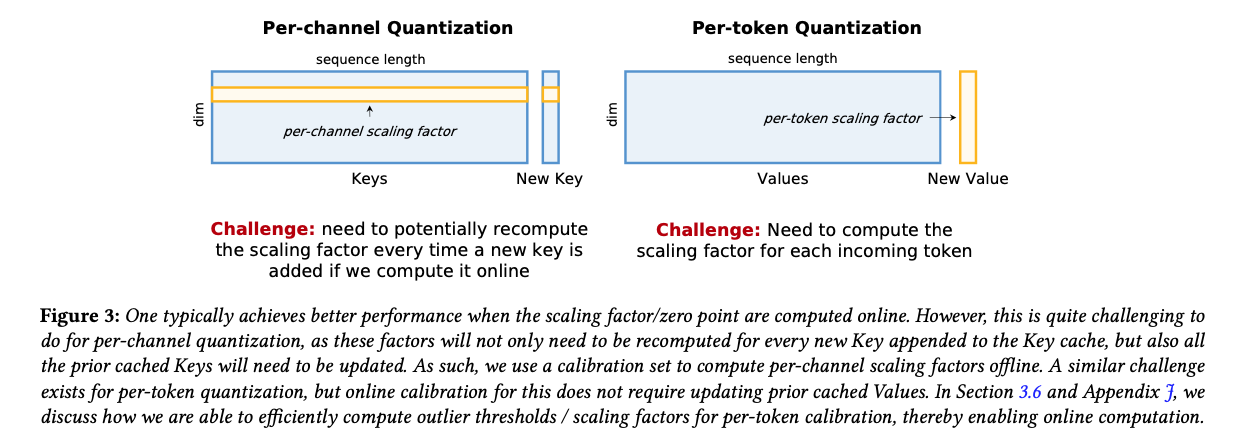
activation quantization의 중요한 challenge
- online computation: compute statistics on-the-fly (expensive)
- offline computation: use offline calibration data
(accuracy에 악영향)
-
K: per-channel Q (for K) ➡️ Offline
-
scaling factor를 online으로 update하는 것은 어려움.
-
KV cache에 새로운 token이 추가될 때마다 각 incoming channel에 해당하는 scaling factor를 update 해야 함.
-
따라서 statistics를 offline으로 계산.
(즉, inference를 실행하기 전에 calibration 데이터를 사용하여 계산)
-
-
V: per-token Q ➡️ Online
-
scaling factor를 offline으로 calibrate하는 것은 outlier Value token의 존재 때문에 어려움.
(즉, 각 token마다 특성이 크게 다를 수 있어 offline calibration으로는 정확한 처리가 어렵다.) -
따라서 scaling factor와 outlier threshold를 online으로 계산.
(각 incoming token에 대해 계산함.) -
CPU로 offload하여 효율적으로 per-token outlier threshold를 online으로 계산 가능.(Appendix J)
-
Limitations
-
모델 훈련의 한계
- 100K 이상의 긴 context length 모델 훈련에는 여전히 많은 작업이 필요함.
- 본 연구는 긴 context length 모델의 효율적인 inference에 국한됨.
-
Latency 벤치마킹의 한계
- 현재 memory-bandwidth bound generation에 초점을 맞춤.
- Prompt processing (여러 Key와 Value를 동시에 압축해야 하는 경우)에 대한 고려가 부족함.
-
현재 end-to-end 구현의 비효율성
- Sparse matrix 업데이트를 위한 메모리 할당 처리에 비효율성 존재.
- 이전 token의 데이터를 새 token의 데이터와 연결할 때 복사 작업 필요
-
향후 계획
- Blocked allocation을 통해 메모리 재할당으로 인한 overhead 최소화.
Fisher Information Matrix(FIM)가 모델의 민감도를 측정하는 원리
1. Fisher Information의 정의
확률 변수 가 파라미터 를 가지는 확률 밀도 함수 를 따른다고 하자.
이때, Fisher Information Matrix 는 log-likelihood 함수의 곡률을 기반으로 다음과 같이 정의된다:
또는 Hessian 형태로 표현하면,
여기서,
- : log-likelihood 함수
- : score function (점수 함수, likelihood의 기울기)
- : 에 대한 기대값
FIM은 log-likelihood의 변화율의 변화율(즉, log-likelihood의 곡률)을 측정하는 값이다.
2. Fisher Information이 민감도를 측정하는 이유
2.1. Score Function의 역할
우선 score function을 정의하면,
이 함수는 파라미터 에 대한 log-likelihood의 기울기를 나타내며, 특정 에서 likelihood가 얼마나 빠르게 변하는지를 나타낸다.
- 가 크면: 작은 변화에도 likelihood가 급격히 변하므로, 모델이 해당 파라미터에 매우 민감하다.
- 가 작으면: likelihood가 완만하게 변하므로, 모델이 해당 파라미터 변화에 둔감하다.
따라서 의 분산이 클수록 모델이 해당 파라미터 변화에 민감함을 의미한다.
2.2. Fisher Information과 Score Function의 관계
FIM은 score function의 분산(즉, 2차 모멘트 기대값)으로 정의된다.
즉, FIM은 score function의 변동성을 측정하며, 파라미터 가 변화할 때 모델의 출력이 얼마나 민감하게 반응하는지를 나타낸다.
- 가 크면: 작은 변화에도 likelihood가 급격히 변하므로, 모델이 민감하게 반응한다.
- 가 작으면: likelihood가 천천히 변하므로, 모델이 덜 민감하게 반응한다.
따라서 FIM은 모델이 특정 파라미터 변화에 대해 얼마나 "불확실성"을 가지는지 측정하는 척도이다.
3. 직관적인 해석
3.1. "정보량이 많을수록 작은 변화에도 큰 영향을 미친다"
FIM이 크다는 것은 log-likelihood의 변화가 크다는 의미이다. 즉, 파라미터가 살짝만 바뀌어도 확률 분포가 크게 변하는 경우이다.
예를 들어:
- 만약 카메라 초점이 맞춰진 사진이라면, 조금만 움직여도 초점이 흐려진다 (FIM 큼).
- 초점이 흐릿한 사진이라면, 조금 움직여도 별 차이가 없다 (FIM 작음).
즉, FIM이 크면 모델이 작은 변화에도 민감하게 반응하고, FIM이 작으면 모델이 무덤덤하게 반응한다.
3.2. "파라미터를 잘 추정할 수 있다면 모델이 민감한 것이다"
FIM이 크다는 것은 해당 파라미터를 더 정확하게 추정할 수 있다는 의미이기도 하다.
즉, 파라미터의 변화를 감지하기 쉽다는 뜻이며, 모델이 해당 파라미터에 민감하다는 의미이다.
예를 들어:
- 실험에서 어떤 변수를 조정했을 때 결과값이 크게 변하면 → 그 변수에 모델이 매우 민감함 (FIM 큼).
- 변수를 조정해도 결과가 거의 변하지 않으면 → 그 변수에 모델이 둔감함 (FIM 작음).
결론
- Fisher Information Matrix(FIM)는 likelihood 함수의 곡률을 측정하여, 모델이 특정 파라미터 변화에 얼마나 민감한지를 수학적으로 표현한다.
- Score function의 분산이 클수록 모델이 해당 파라미터에 대해 민감하게 반응한다는 의미.
- Cramér-Rao 하한을 통해, FIM이 클수록 파라미터를 더 정확하게 추정할 수 있으며, 이는 곧 해당 파라미터가 모델에서 중요한 역할을 한다는 것을 의미한다.