[24.08]The Impact of Quantization on Retrieval-Augmented Generation: An Analysis of Small LLMs
Quantization[논문핵심]
목록 보기
8/11
"LLMs, 즉 Generator에 AWQ 적용해서 Q. Retrieval 사용해서 RAG. Generator를 Q한거랑 Q안한거랑 성능 비교한 논문"
-
LLMs
- LLaMA 3 - 8B
- Zephyr
- OpenChat
- Starling
-
Tasks & Datasets
- LaMP-3 "Personalized Product Rating"
- LaMP-5 "Personalized Scholarly Title Generation"
-
Evaluation
- LaMP-3: MAE
- LaMP-5: Rouge-L
-
Retrieval
- number of retrieved documents
-
- 0: zero-shot w/o retrieval
- max: max number of documents that can be put into the prompt,
given the contex window of the LLM.- max_4k: 4096 token context window (15-18 for LaMP-5U)
- max_8k: 8192 token context window (25-28 for LaMP-5U)
-
- number of retrieved documents
-
Retrievals
- BM25
- Contriever
- DPR
-
Quantizatoin Methods
- AWQ
-
Results
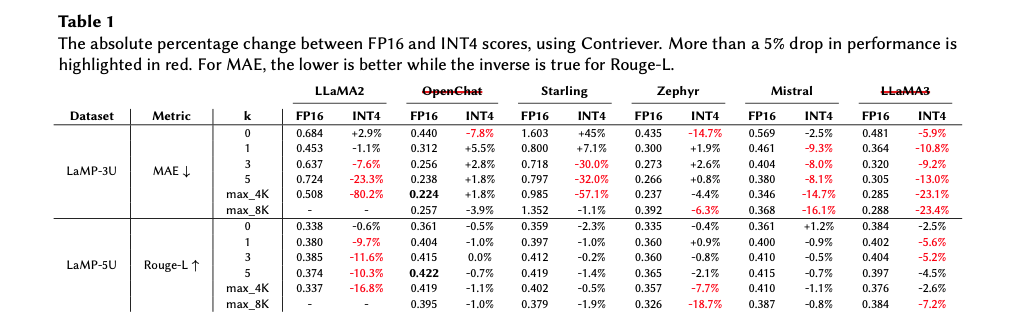
- LLM Models: Openchat 승
- Quantization: Openchat 승
- number of retrieved documents
- LaMP-3U (MAE 🔽)
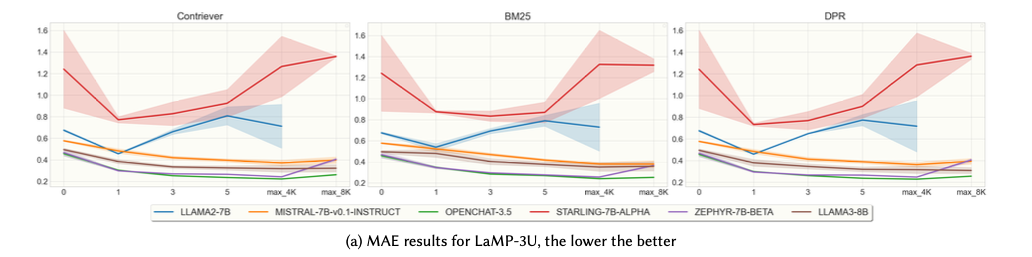
- 증가함에 따라 성능 증가하다가, max_8k 부터는 악화
- LaMP-5U (Rouge-L 🔼)
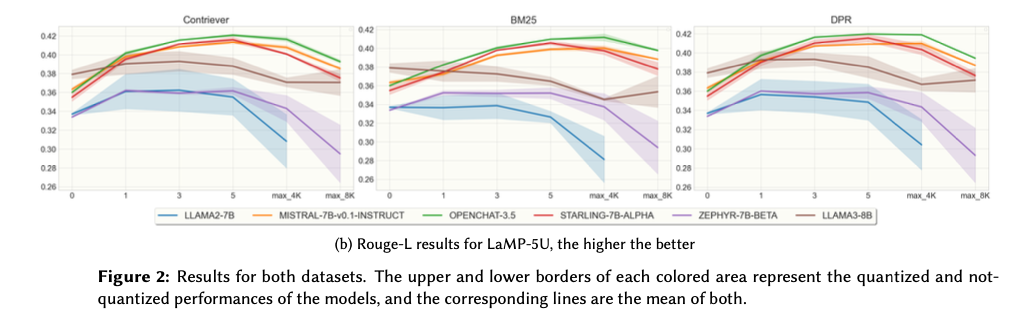
- 이상부터 악화
- Retrievers
- Contriever DPR > BM25 (큰 차이 없음)
-
Discussion
-
Quantization 이후 RAG pipelines의 LLMs는 "LLM Model dependent" & "task-dependent" 하다.
-
Quantization Method는 LLM Model 마다 각기 다른 영향을 주기에, quantization과 RAG 성능간의 관계는 straightforward하지 않다.
-
prompt sensitive
- LLM의 dataset 간의 성능 차이는 prompting이 부분적인 원인이 될 수 있다.
- LLMs는 prompts에 sensitive하기에, 한 LLM에서 동작하는 prompt가 다른 LLM에는 동작하지 않을 수 있다.
-
knowledge conflict
-
LLM의 parametric information과 retrieval한 contextual information 간의 knowledge conflict로 성능 하락.
-
ex) LaMP-5U에서, 만약 LLaMA3가 이미 abstract-title를 memorized 했다면, 같은 author의 유사한 abstract-title pairs가 주어졌을 때 knowledge conflict 발생 가능.
-
너무 많은 retrieved documents의 경우, 오히려 성능 악화. (실험에서도 보듯이 5개 초과 documents)
-
-