Description
Given a stream of integers and a window size, calculate the moving average of all integers in the sliding window.
Implement the MovingAverage class:
MovingAverage(int size) Initializes the object with the size of the window size.
double next(int val) Returns the moving average of the last size values of the stream.
Example
Input
["MovingAverage", "next", "next", "next", "next"][[3], [1], [10], [3], [5]]
Output
[null, 1.0, 5.5, 4.66667, 6.0]
Explanation
MovingAverage movingAverage = new MovingAverage(3);
movingAverage.next(1); // return 1.0 = 1 / 1
movingAverage.next(10); // return 5.5 = (1 + 10) / 2
movingAverage.next(3); // return 4.66667 = (1 + 10 + 3) / 3
movingAverage.next(5); // return 6.0 = (10 + 3 + 5) / 3
Approach
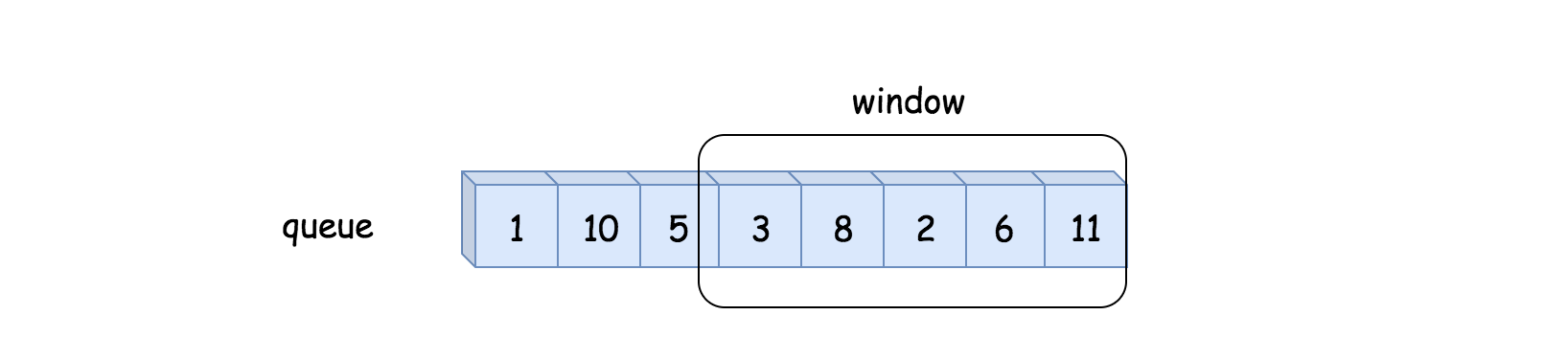
Foremost, I would like to acknowledge how terribly this problem is phrased. To restate the problem, we are only asked to create the class movingaverage, which allows to initiate a queue with a maximum size, and the function next continues to insert values inside the queue, returning the average value. If the queue exceeds the maximum value, it removes the value that has been inserted at the beginning (FIFO - first in first out).
Solution
The solution itself is a simple queue problem, where I used the collections library to create queues.
import collections
class MovingAverage(object):

    def __init__(self, size):
        self.size = size
        self.queue = collections.deque()
        self.total = 0

    def next(self, val):
        if len(self.queue) == self.size:
            self.total -= self.queue.popleft()
        self.queue.append(val)
        self.total += val
        return float(self.total) / len(self.queue)