1. 자연어
자연어란?
자연어란 인간이 일상적으로 사용하고 이해하는 언어를 말한다.
예를 들어 한국어, 영어, 중국어, 스페인어 등이 있다.
자연어는 문자와 음성으로 이루어져 있으며, 사람들이 서로 소통하기 위해 사용하는 다양한 규칙과 관습을 포함한다.
자연어는 형식 언어나 프로그래밍 언어와는 다르다.
형식 언어나 프로그래밍 언어는 특정한 목적을 위해 고안된 인공적인 언어로, 엄격한 문법 규칙과 구조를 따른다.
반면에 자연어는 훨씬 더 유연하고 복잡한 문법과 구조를 가지고 있으며, 의미와 맥락에 따라 해석될 수 있다.
자연어 처리는 컴퓨터가 이러한 인간의 언어를 이해하고 처리할 수 있도록 하는 기술 분야이다.
자연어 처리 기술은 텍스트 분석, 음성 인식, 번역, 감정 분석 등 다양한 응용 분야에서 사용된다.
자연어 처리 이유?
1. 의사소통 향상:
- 인공지능 기반의 대화형 시스템: 챗봇, 가상 비서(예: Siri, Google Assistant) 등이 사용자와 자연스럽게 대화할 수 있도록 한다.
- 자동 번역: Google 번역이나 DeepL과 같은 도구는 서로 다른 언어를 사용하는 사람들 간의 의사소통을 돕는다.
2. 정보 검색과 정리:
- 검색 엔진: Google과 같은 검색 엔진은 자연어 처리를 사용하여 사용자의 질문을 이해하고 관련 있는 정보를 제공한다.
- 문서 요약: 방대한 문서를 자동으로 요약하여 중요한 정보를 빠르게 파악할 수 있게 한다.
3. 데이터 분석:
- 감정 분석: 소셜 미디어, 리뷰, 설문 조사 등의 텍스트에서 감정을 분석하여 마케팅, 고객 서비스 등에 활용한다.
- 트렌드 분석: 대량의 텍스트 데이터를 분석하여 현재의 트렌드나 여론을 파악한다.
4. 사용자 경험 개선:
- 맞춤법 및 문법 검사: 글을 작성할 때 맞춤법 및 문법 오류를 자동으로 교정 해준다.
- 추천 시스템: 사용자의 선호도에 맞춰 콘텐츠(책, 영화, 뉴스 등)를 추천한다.
5. 업무 자동화:
- 자연어 생성: 보고서, 기사 등의 문서를 자동으로 생성한다.
- 이메일 분류 및 응답: 이메일을 자동으로 분류하고 적절한 응답을 생성한다.
6. 특수 목적:
- 의료 분야: 의사의 진단 기록을 분석하여 중요한 정보를 추출하거나, 의료 논문을 요약하여 최신 연구 동향을 파악한다.
- 법률 분야: 법률 문서를 분석하여 중요한 법적 정보를 추출하거나, 관련 판례를 찾아준다.
2. 텍스트 마이닝
텍스트 마이닝이란:
- 텍스트 마이닝은 대량의 텍스트 데이터에서 유용한 정보를 추출하고 패턴을 식별하는 과정이다.
- 자연어 처리(NLP)와 데이터 마이닝 기술을 결합하여 수행된다.
- 텍스트 분석, 감정 분석, 주제 모델링 등 다양한 기법을 포함한다.
텍스트 마이닝의 사용 방법:
- 텍스트 데이터를 수집하고 전처리하여 분석할 수 있도록 준비한다.
- 토큰화, 형태소 분석, 불용어 제거 등의 전처리 과정을 거친다.
- 주제 모델링을 통해 문서의 주제를 파악하거나, 감정 분석을 통해 텍스트의 감정을 분석한다.
- 결과를 시각화하여 패턴이나 트렌드를 도출한다.
텍스트 마이닝을 사용하는 이유:
- 대량의 비정형 데이터에서 유용한 인사이트를 얻을 수 있기 때문이다.
- 고객 리뷰나 소셜 미디어 데이터를 분석하여 마케팅 전략을 수립할 수 있기 때문이다.
- 연구 논문이나 기술 문서를 분석하여 최신 트렌드를 파악할 수 있기 때문이다.
- 조직 내 문서나 이메일을 자동으로 분류하고 요약할 수 있기 때문이다.
텍스트 마이닝의 종류
1. 감정 분석(Sentiment Analysis):
- 감정 분석은 텍스트에서 긍정, 부정, 중립과 같은 감정 상태를 식별하는 과정이다.
- 소셜 미디어, 리뷰, 설문 조사 등의 데이터를 분석하여 고객의 감정이나 여론을 파악할 수 있다.
2. 주제 모델링(Topic Modeling):
- 주제 모델링은 대량의 문서에서 주제를 자동으로 추출하고 식별하는 기술이다.
- LDA(Latent Dirichlet Allocation)와 같은 알고리즘을 사용하여 문서 집합에서 주제를 도출할 수 있다.
3. 문서 분류(Document Classification):
- 문서 분류는 텍스트를 미리 정의된 카테고리나 클래스에 자동으로 할당하는 과정이다.
- 스팸 이메일 필터링, 뉴스 기사 분류 등의 작업에 활용된다.
4. 클러스터링(Clustering):
- 클러스터링은 유사한 텍스트 데이터를 그룹화하는 기법이다.
- 비슷한 주제의 문서를 묶어 그룹으로 나누거나, 유사한 리뷰를 그룹화할 수 있다.
5. 정보 추출(Information Extraction):
- 정보 추출은 텍스트에서 특정한 정보를 자동으로 식별하고 추출하는 기술이다.
- 엔티티 인식(예: 사람 이름, 날짜, 장소)이나 관계 추출(예: 누가 누구와 어떤 관계인지) 등이 포함된다.
6. 단어 빈도 분석(Word Frequency Analysis):
- 단어 빈도 분석은 텍스트에서 특정 단어가 얼마나 자주 등장하는지 분석하는 방법이다.
- TF-IDF(Term Frequency-Inverse Document Frequency)와 같은 기법을 사용하여 중요한 단어를 식별할 수 있다.
7. 텍스트 요약(Text Summarization):
- 텍스트 요약은 긴 문서를 짧게 요약하여 중요한 내용을 추출하는 기술이다.
- 추출적 요약(문장에서 중요한 문장을 추출)과 생성적 요약(새로운 요약문을 생성)이 있다.
8. 명명 엔티티 인식(Named Entity Recognition, NER):
- 명명 엔티티 인식은 텍스트에서 사람, 장소, 조직 등 특정 엔티티를 식별하는 과정이다.
- 정보 검색, 문서 요약, 자동 응답 시스템 등에 사용된다.
예제 1)
# NLTK(Natural Language ToolKit) : 파이썬으로 자연어 데이터를 분석할 수 있도록 만들어진 패키지

import nltk

# 400만 어절 규모의 펜 트리뱅크(Penn Treebankk, 미국, 1990~92), Wall Street Journal 문장으로 구성
nltk.download('treebank')

from nltk.corpus import treebank
print(treebank.fileids())

### 출력 결과
['wsj_0001.mrg', 'wsj_0002.mrg', 'wsj_0003.mrg', 'wsj_0004.mrg', 'wsj_0005.mrg', 'wsj_0006.mrg', 'wsj_0007.mrg', 'wsj_0008.mrg', 'wsj_0009.mrg', 'wsj_0010.mrg', 'wsj_0011.mrg', 'wsj_0012.mrg', 'wsj_0013.mrg', 'wsj_0014.mrg', 'wsj_0015.mrg', 'wsj_0016.mrg', 'wsj_0017.mrg', 'wsj_0018.mrg', 'wsj_0019.mrg', 'wsj_0020.mrg', 'wsj_0021.mrg', 'wsj_0022.mrg', 'wsj_0023.mrg', 'wsj_0024.mrg', 'wsj_0025.mrg', 'wsj_0026.mrg', 'wsj_0027.mrg', 'wsj_0028.mrg', 'wsj_0029.mrg', 'wsj_0030.mrg', 'wsj_0031.mrg', 'wsj_0032.mrg', 'wsj_0033.mrg', 'wsj_0034.mrg', 'wsj_0035.mrg', 'wsj_0036.mrg', 'wsj_0037.mrg', 'wsj_0038.mrg', 'wsj_0039.mrg', 'wsj_0040.mrg', 'wsj_0041.mrg', 'wsj_0042.mrg', 'wsj_0043.mrg', 'wsj_0044.mrg', 'wsj_0045.mrg', 'wsj_0046.mrg', 'wsj_0047.mrg', 'wsj_0048.mrg', 'wsj_0049.mrg', 'wsj_0050.mrg', 'wsj_0051.mrg', 'wsj_0052.mrg', 'wsj_0053.mrg', 'wsj_0054.mrg', 'wsj_0055.mrg', 'wsj_0056.mrg', 'wsj_0057.mrg', 'wsj_0058.mrg', 'wsj_0059.mrg', 'wsj_0060.mrg', 'wsj_0061.mrg', 'wsj_0062.mrg', 'wsj_0063.mrg', 'wsj_0064.mrg', 'wsj_0065.mrg', 'wsj_0066.mrg', 'wsj_0067.mrg', 'wsj_0068.mrg', 'wsj_0069.mrg', 'wsj_0070.mrg', 'wsj_0071.mrg', 'wsj_0072.mrg', 'wsj_0073.mrg', 'wsj_0074.mrg', 'wsj_0075.mrg', 'wsj_0076.mrg', 'wsj_0077.mrg', 'wsj_0078.mrg', 'wsj_0079.mrg', 'wsj_0080.mrg', 'wsj_0081.mrg', 'wsj_0082.mrg', 'wsj_0083.mrg', 'wsj_0084.mrg', 'wsj_0085.mrg', 'wsj_0086.mrg', 'wsj_0087.mrg', 'wsj_0088.mrg', 'wsj_0089.mrg', 'wsj_0090.mrg', 'wsj_0091.mrg', 'wsj_0092.mrg', 'wsj_0093.mrg', 'wsj_0094.mrg', 'wsj_0095.mrg', 'wsj_0096.mrg', 'wsj_0097.mrg', 'wsj_0098.mrg', 'wsj_0099.mrg', 'wsj_0100.mrg', 'wsj_0101.mrg', 'wsj_0102.mrg', 'wsj_0103.mrg', 'wsj_0104.mrg', 'wsj_0105.mrg', 'wsj_0106.mrg', 'wsj_0107.mrg', 'wsj_0108.mrg', 'wsj_0109.mrg', 'wsj_0110.mrg', 'wsj_0111.mrg', 'wsj_0112.mrg', 'wsj_0113.mrg', 'wsj_0114.mrg', 'wsj_0115.mrg', 'wsj_0116.mrg', 'wsj_0117.mrg', 'wsj_0118.mrg', 'wsj_0119.mrg', 'wsj_0120.mrg', 'wsj_0121.mrg', 'wsj_0122.mrg', 'wsj_0123.mrg', 'wsj_0124.mrg', 'wsj_0125.mrg', 'wsj_0126.mrg', 'wsj_0127.mrg', 'wsj_0128.mrg', 'wsj_0129.mrg', 'wsj_0130.mrg', 'wsj_0131.mrg', 'wsj_0132.mrg', 'wsj_0133.mrg', 'wsj_0134.mrg', 'wsj_0135.mrg', 'wsj_0136.mrg', 'wsj_0137.mrg', 'wsj_0138.mrg', 'wsj_0139.mrg', 'wsj_0140.mrg', 'wsj_0141.mrg', 'wsj_0142.mrg', 'wsj_0143.mrg', 'wsj_0144.mrg', 'wsj_0145.mrg', 'wsj_0146.mrg', 'wsj_0147.mrg', 'wsj_0148.mrg', 'wsj_0149.mrg', 'wsj_0150.mrg', 'wsj_0151.mrg', 'wsj_0152.mrg', 'wsj_0153.mrg', 'wsj_0154.mrg', 'wsj_0155.mrg', 'wsj_0156.mrg', 'wsj_0157.mrg', 'wsj_0158.mrg', 'wsj_0159.mrg', 'wsj_0160.mrg', 'wsj_0161.mrg', 'wsj_0162.mrg', 'wsj_0163.mrg', 'wsj_0164.mrg', 'wsj_0165.mrg', 'wsj_0166.mrg', 'wsj_0167.mrg', 'wsj_0168.mrg', 'wsj_0169.mrg', 'wsj_0170.mrg', 'wsj_0171.mrg', 'wsj_0172.mrg', 'wsj_0173.mrg', 'wsj_0174.mrg', 'wsj_0175.mrg', 'wsj_0176.mrg', 'wsj_0177.mrg', 'wsj_0178.mrg', 'wsj_0179.mrg', 'wsj_0180.mrg', 'wsj_0181.mrg', 'wsj_0182.mrg', 'wsj_0183.mrg', 'wsj_0184.mrg', 'wsj_0185.mrg', 'wsj_0186.mrg', 'wsj_0187.mrg', 'wsj_0188.mrg', 'wsj_0189.mrg', 'wsj_0190.mrg', 'wsj_0191.mrg', 'wsj_0192.mrg', 'wsj_0193.mrg', 'wsj_0194.mrg', 'wsj_0195.mrg', 'wsj_0196.mrg', 'wsj_0197.mrg', 'wsj_0198.mrg', 'wsj_0199.mrg']

# 원문을 보기 위한 처리 :
wsj_0010 = treebank.sents('wsj_0010.mrg')

for line in wsj_0010:
    print(line)

### 출력 결과
['When', 'it', "'s", 'time', 'for', 'their', 'biannual', 'powwow', '*T*-1', ',', 'the', 'nation', "'s", 'manufacturing', 'titans', 'typically', 'jet', 'off', 'to', 'the', 'sunny', 'confines', 'of', 'resort', 'towns', 'like', 'Boca', 'Raton', 'and', 'Hot', 'Springs', '.']
['Not', 'this', 'year', '.']
['The', 'National', 'Association', 'of', 'Manufacturers', 'settled', 'on', 'the', 'Hoosier', 'capital', 'of', 'Indianapolis', 'for', 'its', 'fall', 'board', 'meeting', '.']
['And', 'the', 'city', 'decided', '*-1', 'to', 'treat', 'its', 'guests', 'more', 'like', 'royalty', 'or', 'rock', 'stars', 'than', 'factory', 'owners', '.']
['The', 'idea', ',', 'of', 'course', ':', '*', 'to', 'prove', 'to', '125', 'corporate', 'decision', 'makers', 'that', 'the', 'buckle', 'on', 'the', 'Rust', 'Belt', 'is', "n't", 'so', 'rusty', 'after', 'all', ',', 'that', 'it', "'s", 'a', 'good', 'place', '0', 'for', 'a', 'company', 'to', 'expand', '*T*-1', '.']
['On', 'the', 'receiving', 'end', 'of', 'the', 'message', 'were', '*T*-1', 'officials', 'from', 'giants', 'like', 'Du', 'Pont', 'and', 'Maytag', ',', 'along', 'with', 'lesser', 'knowns', 'like', 'Trojan', 'Steel', 'and', 'the', 'Valley', 'Queen', 'Cheese', 'Factory', '.']
['For', 'starters', ',', 'the', 'executives', 'joined', 'Mayor', 'William', 'H.', 'Hudnut', 'III', 'for', 'an', 'evening', 'of', 'the', 'Indianapolis', 'Symphony', 'Orchestra', 'and', 'a', 'guest', 'pianist-comedian', 'Victor', 'Borge', '.']
['Champagne', 'and', 'dessert', 'followed', '.']
['The', 'next', 'morning', ',', 'with', 'a', 'police', 'escort', ',', 'busloads', 'of', 'executives', 'and', 'their', 'wives', 'raced', 'to', 'the', 'Indianapolis', 'Motor', 'Speedway', ',', '*-1', 'unimpeded', 'by', 'traffic', 'or', 'red', 'lights', '.']
['The', 'governor', 'could', "n't", 'make', 'it', ',', 'so', 'the', 'lieutenant', 'governor', 'welcomed', 'the', 'special', 'guests', '.']
['A', 'buffet', 'breakfast', 'was', 'held', '*-1', 'in', 'the', 'museum', ',', 'where', 'food', 'and', 'drinks', 'are', 'banned', '*-2', 'to', 'everyday', 'visitors', '*T*-3', '.']
['Then', ',', 'in', 'the', 'guests', "'", 'honor', ',', 'the', 'speedway', 'hauled', 'out', 'four', 'drivers', ',', 'crews', 'and', 'even', 'the', 'official', 'Indianapolis', '500', 'announcer', 'for', 'a', '10-lap', 'exhibition', 'race', '.']
['After', 'the', 'race', ',', 'Fortune', '500', 'executives', 'drooled', 'like', 'schoolboys', 'over', 'the', 'cars', 'and', 'drivers', '.']
['*-1', 'No', 'dummies', ',', 'the', 'drivers', 'pointed', 'out', '0', 'they', 'still', 'had', 'space', 'on', 'their', 'machines', 'for', 'another', 'sponsor', "'s", 'name', 'or', 'two', '.']
['Back', 'downtown', ',', 'the', 'execs', 'squeezed', 'in', 'a', 'few', 'meetings', 'at', 'the', 'hotel', 'before', '*-1', 'boarding', 'the', 'buses', 'again', '.']
['This', 'time', ',', 'it', 'was', 'for', 'dinner', 'and', 'dancing', '--', 'a', 'block', 'away', '.']
['Under', 'the', 'stars', 'and', 'moons', 'of', 'the', 'renovated', 'Indiana', 'Roof', 'ballroom', ',', 'nine', 'of', 'the', 'hottest', 'chefs', 'in', 'town', 'fed', 'them', 'Indiana', 'duckling', 'mousseline', ',', 'lobster', 'consomme', ',', 'veal', 'mignon', 'and', 'chocolate', 'terrine', 'with', 'a', 'raspberry', 'sauce', '.']
['*-2', 'Knowing', 'a', 'tasty', '--', 'and', 'free', '--', 'meal', 'when', 'they', 'eat', 'one', '*T*-1', ',', 'the', 'executives', 'gave', 'the', 'chefs', 'a', 'standing', 'ovation', '.']
['More', 'than', 'a', 'few', 'CEOs', 'say', '0', 'the', 'red-carpet', 'treatment', 'tempts', 'them', 'to', 'return', 'to', 'a', 'heartland', 'city', 'for', 'future', 'meetings', '.']
['But', 'for', 'now', ',', 'they', "'re", 'looking', 'forward', 'to', 'their', 'winter', 'meeting', '--', 'Boca', 'in', 'February', '.']

# 품사정보를 확인하는 처리 :
print(treebank.tagged_words('wsj_0010.mrg'))

### 출력 결과
[('When', 'WRB'), ('it', 'PRP'), ("'s", 'VBZ'), ...]

print(treebank.parsed_sents('wsj_0010.mrg'))    # 각 단어들의 상세 태깅 내용

### 출력 결과
[Tree('S', [Tree('SBAR-TMP', [Tree('WHADVP-1', [Tree('WRB', ['When'])]), Tree('S', [Tree('NP-SBJ', [Tree('PRP', ['it'])]), Tree('VP', [Tree('VBZ', ["'s"]), Tree('NP-PRD', [Tree('NP', [Tree('NN', ['time'])]), Tree('PP', [Tree('IN', ['for']), Tree('NP', [Tree('PRP$', ['their']), Tree('JJ', ['biannual']), Tree('NN', ['powwow'])])])]), Tree('ADVP-TMP', [Tree('-NONE-', ['*T*-1'])])])])]), Tree(',', [',']), Tree('NP-SBJ', [Tree('NP', [Tree('DT', ['the']), Tree('NN', ['nation']), Tree('POS', ["'s"])]), Tree('VBG', ['manufacturing']), Tree('NNS', ['titans'])]), Tree('ADVP', [Tree('RB', ['typically'])]), Tree('VP', [Tree('VBP', ['jet']), Tree('PRT', [Tree('RP', ['off'])]), Tree('PP-DIR', [Tree('TO', ['to']), Tree('NP', [Tree('NP', [Tree('DT', ['the']), Tree('JJ', ['sunny']), Tree('NNS', ['confines'])]), Tree('PP', [Tree('IN', ['of']), Tree('NP', [Tree('NP', [Tree('NN', ['resort']), Tree('NNS', ['towns'])]), Tree('PP', [Tree('IN', ['like']), Tree('NP', [Tree('NP', [Tree('NNP', ['Boca']), Tree('NNP', ['Raton'])]), Tree('CC', ['and']), Tree('NP', [Tree('NNP', ['Hot']), Tree('NNP', ['Springs'])])])])])])])])]), Tree('.', ['.'])]), Tree('FRAG', [Tree('RB', ['Not']), Tree('NP-TMP', [Tree('DT', ['this']), Tree('NN', ['year'])]), Tree('.', ['.'])]), ...]

print(treebank.parsed_sents('wsj_0010.mrg')[0])

### 출력 결과
(S
  (SBAR-TMP
    (WHADVP-1 (WRB When))
    (S
      (NP-SBJ (PRP it))
      (VP
        (VBZ 's)
        (NP-PRD
          (NP (NN time))
          (PP (IN for) (NP (PRP$ their) (JJ biannual) (NN powwow))))
        (ADVP-TMP (-NONE- *T*-1)))))
  (, ,)
  (NP-SBJ
    (NP (DT the) (NN nation) (POS 's))
    (VBG manufacturing)
    (NNS titans))
  (ADVP (RB typically))
  (VP
    (VBP jet)
    (PRT (RP off))
    (PP-DIR
      (TO to)
      (NP
        (NP (DT the) (JJ sunny) (NNS confines))
        (PP
          (IN of)
          (NP
            (NP (NN resort) (NNS towns))
            (PP
              (IN like)
              (NP
                (NP (NNP Boca) (NNP Raton))
                (CC and)
                (NP (NNP Hot) (NNP Springs)))))))))
  (. .))
태깅(Tagging)이란?
- 자연어 처리에서 태깅은 텍스트의 각 단어에 ㄷ특정한 정보를 부여하는 과정이다.
태깅의 종류
1. 품사 태깅(Part-of-Speech Tagging, POS 태깅):
- 품사 태깅은 텍스트의 각 단어에 품사(예: 명사, 동사, 형용사 등)를 할당하는 과정이다.
- 문법적 구조를 분석하고 문맥을 이해하는 데 도움이 된다.
- 예: “The quick brown fox jumps over the lazy dog” ---> “The/DT quick/JJ brown/JJ fox/NN jumps/VBZ over/IN the/DT lazy/JJ dog/NN”
2. 명명 엔티티 인식(Named Entity Recognition, NER):
- NER은 텍스트에서 사람, 장소, 조직 등 고유 명사를 식별하고 태그를 부여하는 과정이다.
- 정보 추출, 요약, 검색 시스템에서 중요하다.
- 예: “Barack Obama was born in Hawaii” ---> “Barack Obama/PERSON was born in Hawaii/LOCATION”
3. 의미역 결정(Semantic Role Labeling, SRL):
- 의미역 결정은 문장에서 각 단어가 어떤 의미적 역할을 하는지 태그를 부여하는 과정이다.
- 주어, 목적어, 동작 등 문장의 의미 구조를 분석하는 데 사용된다.
- 예: “John gave a book to Mary” ---> “John/A0 gave/V a book/A1 to Mary/A2”
4. 속성 태깅(Attribute Tagging):
- 속성 태깅은 단어의 속성이나 특성을 태깅하는 과정이다.
- 예를 들어, 감정 분석에서 긍정, 부정 등의 감정 태그를 부여할 수 있다.
- 예: “I love this movie” ---> “I/O love/Positive this/O movie/O”
5. 기타 태깅(Collocation Tagging, Chunking):
- Collocation Tagging은 단어들의 연속된 묶음을 식별하고 태그를 부여하는 과정이다.
- Chunking은 문장을 구나 절 단위로 나누고 태그를 부여하는 과정이다.
- 예: “He reckons the current account deficit will narrow to only $1.8 billion in September” ---> “He/NP reckons/VP the/NP current account deficit/NP will/VP narrow/VP to/PP only/ADVP $1.8 billion/NP in/PP September/NP”
예제 2) Book 데이터
nltk.download('book', quiet=True)

from nltk.book import text1
#from nltk.book import *      #전체 Book 데이터 읽어들일 경우,

### 출력 결과
*** Introductory Examples for the NLTK Book ***
Loading text1, ..., text9 and sent1, ..., sent9
Type the name of the text or sentence to view it.
Type: 'texts()' or 'sents()' to list the materials.
text1: Moby Dick by Herman Melville 1851
text2: Sense and Sensibility by Jane Austen 1811
text3: The Book of Genesis
text4: Inaugural Address Corpus
text5: Chat Corpus
text6: Monty Python and the Holy Grail
text7: Wall Street Journal
text8: Personals Corpus
text9: The Man Who Was Thursday by G . K . Chesterton 1908

type(text1)

### 출력 결과
nltk.text.Text

text1

### 출력 결과
<Text: Moby Dick by Herman Melville 1851>
예제 3) 구텐베르크 데이터
nltk.corpus.gutenberg.fileids()

### 출력 결과
['austen-emma.txt',
 'austen-persuasion.txt',
 'austen-sense.txt',
 'bible-kjv.txt',
 'blake-poems.txt',
 'bryant-stories.txt',
 'burgess-busterbrown.txt',
 'carroll-alice.txt',
 'chesterton-ball.txt',
 'chesterton-brown.txt',
 'chesterton-thursday.txt',
 'edgeworth-parents.txt',
 'melville-moby_dick.txt',
 'milton-paradise.txt',
 'shakespeare-caesar.txt',
 'shakespeare-hamlet.txt',
 'shakespeare-macbeth.txt',
 'whitman-leaves.txt']

 emma = nltk.corpus.gutenberg.raw('austen-emma.txt')
print(emma[:289])

### 출력 결과
[Emma by Jane Austen 1816]

VOLUME I

CHAPTER I


Emma Woodhouse, handsome, clever, and rich, with a comfortable home
and happy disposition, seemed to unite some of the best blessings
of existence; and had lived nearly twenty-one years in the world
with very little to distress or vex her.
3. 토큰 생성
토큰 생성이란?
자연어 처리(NLP)에서 토큰 생성(Tokenization)은 텍스트를 작은 단위로 나누는 과정이다.
이 단위들은 일반적으로 단어나 문장으로 구성되며, 다양한 NLP 작업의 기초가 된다.
토큰 생성은 언어와 응용 분야에 따라 여러 방법으로 수행될 수 있다.
토큰 생성의 종류
1. 단어 토큰화(Word Tokenization):
- 텍스트를 개별 단어로 나누는 과정이다.
- 공백이나 구두점(문장 부호)을 기준으로 단어를 구분한다.
- 예: "Hello, world!" → ["Hello", ",", "world", "!"]
2. 문장 토큰화(Sentence Tokenization):
- 텍스트를 개별 문장으로 나누는 과정이다.
- 마침표, 느낌표, 물음표 등 문장 부호를 기준으로 문장을 구분한다.
- 예: "Hello, world! How are you?" → ["Hello, world!", "How are you?"]
3. 하위 단위 토큰화(Subword Tokenization):
- 단어를 더 작은 단위로 나누는 과정이다.
- BPE(Byte Pair Encoding), WordPiece, SentencePiece 등의 알고리즘을 사용한다.
- 예: "unhappiness" → ["un", "##happiness"] (WordPiece 방식)
4. 문자 토큰화(Character Tokenization):
- 텍스트를 개별 문자로 나누는 과정이다.
- 단어 토큰화가 어려운 경우(예: 신조어나 이모티콘)나 특정 응용 분야에서 사용된다.
- 예: "Hello" → ["H", "e", "l", "l", "o"]
토큰 생성의 과정
1. 텍스트 정제(Text Cleaning):
- 불필요한 문자나 공백을 제거한다.
- 예: "Hello, world!"에서 불필요한 공백이나 특수 문자를 제거.
2. 토큰화(Tokenization):
- 텍스트를 정의된 기준에 따라 나눈다.
- 단어 토큰화, 문장 토큰화, 하위 단위 토큰화, 문자 토큰화 중 하나를 선택하여 수행.
3. 불용어 제거(Stopword Removal):
- 분석에 필요하지 않은 흔히 사용되는 단어를 제거한다.
- 예: "is", "and", "the" 등의 단어.
4. 어간 추출(Stemming) 및 표제어 추출(Lemmatization):
- 단어의 원형을 찾거나 어간을 추출하여 같은 의미의 단어를 하나로 통일한다.
- 예: "running" → "run" (어간 추출), "better" → "good" (표제어 추출)
토큰 생성의 중요성
- 텍스트 분석의 기초: 토큰 생성은 텍스트 분석의 첫 단계로, 다른 모든 NLP 작업의 기초가 된다.
- 정확한 문맥 이해: 적절한 토큰화를 통해 텍스트의 문맥을 더 잘 이해할 수 있다.
- 효율성 향상: 텍스트 데이터를 작은 단위로 나눔으로써, 분석 및 처리의 효율성을 높일 수 있다.
- 언어 및 응용 분야별 최적화: 다양한 언어와 응용 분야에 맞춰 적절한 토큰화 방법을 선택할 수 있다.
# 문장 단위의 토큰 리스트 :
from nltk.tokenize import sent_tokenize
print(sent_tokenize(emma[:1000]))

### 출력 결과
['[Emma by Jane Austen 1816]\n\nVOLUME I\n\nCHAPTER I\n\n\nEmma Woodhouse, handsome, clever, and rich, with a comfortable home\nand happy disposition, seemed to unite some of the best blessings\nof existence; and had lived nearly twenty-one years in the world\nwith very little to distress or vex her.', "She was the youngest of the two daughters of a most affectionate,\nindulgent father; and had, in consequence of her sister's marriage,\nbeen mistress of his house from a very early period.", 'Her mother\nhad died too long ago for her to have more than an indistinct\nremembrance of her caresses; and her place had been supplied\nby an excellent woman as governess, who had fallen little short\nof a mother in affection.', "Sixteen years had Miss Taylor been in Mr. Woodhouse's family,\nless as a governess than a friend, very fond of both daughters,\nbut particularly of Emma.", 'Between _them_ it was more the intimacy\nof sisters.', 'Even before Miss Taylor had ceased to hold the nominal\noffice of governess, the mildness o']

print(sent_tokenize(emma[:1000])[3])

### 출력 결과
Sixteen years had Miss Taylor been in Mr. Woodhouse's family,
less as a governess than a friend, very fond of both daughters,
but particularly of Emma.

# 단어 단위의 토큰 리스트 :
from nltk.tokenize import word_tokenize
print(word_tokenize(sent_tokenize(emma[:1000])[3]))

### 출력 결과
['Sixteen', 'years', 'had', 'Miss', 'Taylor', 'been', 'in', 'Mr.', 'Woodhouse', "'s", 'family', ',', 'less', 'as', 'a', 'governess', 'than', 'a', 'friend', ',', 'very', 'fond', 'of', 'both', 'daughters', ',', 'but', 'particularly', 'of', 'Emma', '.']
4. 형태소 분석
형태소 분석이란?
형태소 분석(Morphological Analysis)은 자연어 처리에서 텍스트를 형태소라는 최소 의미 단위로 분할하고, 각 형태소의 문법적 및 의미적 속성을 파악하는 과정이다.
형태소 분석의 과정
1. 형태소 분할 (Tokenization):
- 텍스트를 형태소 단위로 나누는 과정
- 주어진 텍스트에서 공백이나 문장 부호를 기준으로 형태소를 구분
- 예: "그는 오늘 학교에 가고 있어요." → ["그", "는", "오늘", "학교", "에", "가", "고", "있", "어요"]
2. 품사 부착 (Part-of-Speech Tagging, POS Tagging):
- 각 형태소에 대해 그것의 품사(명사, 동사, 형용사 등)를 부착하는 과정
- 품사 정보는 문법적 역할을 이해하는 데 중요
- 예: "그는 오늘 학교에 가고 있어요." → ["그/대명사", "는/조사", "오늘/명사", "학교/명사", "에/조사", "가/동사", "고/연결어미", "있/동사", "어요/종결어미"]
3. 어간 추출 (Stemming) 및 표제어 추출 (Lemmatization):
- 형태소 분석 과정에서 일반적으로 수행되는 추가적인 처리
- 어간 추출은 단어의 기본 형태(어간)를 추출하는 과정으로, 단어의 다양한 변형을 하나로 통일
- 예: "running" → "run"
- 표제어 추출은 단어의 표준형(표제어)을 찾는 과정으로, 사전을 기반으로 단어를 정규화함
- 예: "better" → "good"
형태소 분석의 중요성
- 정확한 문법 분석: 각 형태소의 품사를 분석하여 문장의 구조와 문법적인 의미를 이해할 수 있다.
- 의미 분석: 단어의 원형을 추출하거나 표제어를 분석하여 문장의 의미를 보다 정확히 이해할 수 있다.
- 자연어 이해의 기초: 다양한 자연어 처리 작업에서 필수적인 전처리 과정으로, 효율적이고 정확한 분석을 위한 기반이 된다.
# 정규표현식(RegexpTokenizer) 을 이용해 Text 객체로 만들기
import nltk
emma = nltk.corpus.gutenberg.raw('austen-emma.txt')
emma

### 출력 결과
'[Emma by Jane Austen 1816]\n\nVOLUME I\n\nCHAPTER I\n\n\nEmma Woodhouse, handsome, clever, and rich, with a comfortable home\nand happy disposition, seemed to unite some of the best blessings\nof existence; and had lived nearly twenty-one years in the world\nwith very little to distress or vex her.\n\nShe was the youngest of the two daughters of a most affectionate,\nindulgent father; and had, in consequence of her sister\'s marriage,\nbeen mistress of his house from a very early period.  Her mother\nhad died too long ago for her to have more than an indistinct\nremembrance of her caresses; and her place had been supplied\nby an excellent woman as governess, who had fallen little short\nof a mother in affection.\n\nSixteen years had Miss Taylor been in Mr. Woodhouse\'s family,\nless as a governess than a friend, very fond of both daughters,\nbut particularly of Emma.  Between _them_ it was more the intimacy\nof sisters.  Even before Miss Taylor had ceased to hold the nominal\noffice of governess, the mildness of her temper had hardly allowed\nher to impose any restraint; and the shadow of authority being\nnow long passed away, they had been living together as friend and\nfriend very mutually attached, and Emma doing just what she liked;\nhighly esteeming Miss Taylor\'s judgment, but directed chiefly by\nher own.\n\nThe real evils, indeed, of Emma\'s situation were the power of having\nrather too much her own way, and a disposition to think a little\ntoo well of herself; these were the disadvantages which threatened\nalloy to her many enjoyments.  The danger, however, was at present\nso unperceived, that they did not by any means rank as misfortunes\nwith her.\n\nSorrow came--a gentle sorrow--but not at all in the shape of any\ndisagreeable consciousness.--Miss Taylor married.  It was Miss\nTaylor\'s loss which first brought grief.  It was on the wedding-day\nof this beloved friend that Emma first sat in mournful thought\nof any continuance.  The wedding over, and the bride-people gone,\nher father and herself were left to dine together, with no prospect\nof a third to cheer a long evening.  Her father composed himself\nto sleep after dinner, as usual, and she had then only to sit\nand think of what she had lost.\n\nThe event had every promise of happiness for her friend.  Mr. Weston\nwas a man of unexceptionable character, easy fortune, suitable age,\nand pleasant manners; and there was some satisfaction in considering\nwith what self-denying, generous friendship she had always wished\nand promoted the match; but it was a black morning\'s work for her.\nThe want of Miss Taylor would be felt every hour of every day.\nShe recalled her past kindness--the kindness, the affection of sixteen\nyears--how she had taught and how she had played with her from five\nyears old--how she had devoted all her powers to attach and amuse\nher in health--and how nursed her through the various illnesses\nof childhood.  A large debt of gratitude was owing here; but the\nintercourse of the last seven years, the equal footing and perfect\nunreserve which had soon followed Isabella\'s marriage, on their\nbeing left to each other, was yet a dearer, tenderer recollection.\nShe had been a friend and companion such as few possessed: intelligent,\nwell-informed, useful, gentle, knowing all the ways of the family,\ninterested in all its concerns, and peculiarly interested in herself,\nin every pleasure, every scheme of hers--one to whom she could speak\nevery thought as it arose, and who had such an affection for her\nas could never find fault.\n\nHow was she to bear the change?--It was true that her friend was\ngoing only half a mile from them; but Emma was aware that great must\nbe the difference between a Mrs. Weston, only half a mile from them,\nand a Miss Taylor in the house; and with all her advantages,\nnatural and domestic, she was now in great danger of suffering\nfrom intellectual solitude.  She dearly loved her father, but he\nwas no companion for her.  He could not meet her in conversation,\nrational or playful.\n\nThe evil of the actual disparity in their ages (and Mr. Woodhouse had\nnot married early) was much increased by his constitution and habits;\nfor having been a valetudinarian all his life, without activity\nof mind or body, he was a much older man in ways than in years;\nand though everywhere beloved for the friendliness of his heart\nand his amiable temper, his talents could not have recommended him\nat any time.\n\nHer sister, though comparatively but little removed by matrimony,\nbeing settled in London, only sixteen miles off, was much beyond\nher daily reach; and many a long October and November evening must\nbe struggled through at Hartfield, before Christmas brought the next\nvisit from Isabella and her husband, and their little children,\nto fill the house, and give her pleasant society again.\n\nHighbury, the large and populous village, almost amounting to a town,\nto which Hartfield, in spite of its separate lawn, and shrubberies,\nand name, did really belong, afforded her no equals.  The Woodhouses\nwere first in consequence there.  All looked up to them.  She had\nmany acquaintance in the place, for her father was universally civil,\nbut not one among them who could be accepted in lieu of Miss\nTaylor for even half a day.  It was a melancholy change; and Emma\ncould not but sigh over it, and wish for impossible things,\ntill her father awoke, and made it necessary to be cheerful.\nHis spirits required support.  He was a nervous man, easily depressed;\nfond of every body that he was used to, and hating to part with them;\nhating change of every kind.  Matrimony, as the origin of change,\nwas always disagreeable; and he was by no means yet reconciled\nto his own daughter\'s marrying, nor could ever speak of her but\nwith compassion, though it had been entirely a match of affection,\nwhen he was now obliged to part with Miss Taylor too; and from\nhis habits of gentle selfishness, and of being never able to\nsuppose that other people could feel differently from himself,\nhe was very much disposed to think Miss Taylor had done as sad\na thing for herself as for them, and would have been a great deal\nhappier if she had spent all the rest of her life at Hartfield.\nEmma smiled and chatted as cheerfully as she could, to keep him\nfrom such thoughts; but when tea came, it was impossible for him\nnot to say exactly as he had said at dinner,\n\n"Poor Miss Taylor!--I wish she were here again.  What a pity it\nis that Mr. Weston ever thought of her!"\n\n"I cannot agree with you, papa; you know I cannot.  Mr. Weston is such\na good-humoured, pleasant, excellent man, that he thoroughly deserves\na good wife;--and you would not have had Miss Taylor live with us\nfor ever, and bear all my odd humours, when she might have a house of her own?"\n\n"A house of her own!--But where is the advantage of a house of her own?\nThis is three times as large.--And you have never any odd humours,\nmy dear."\n\n"How often we shall be going to see them, and they coming to see\nus!--We shall be always meeting! _We_ must begin; we must go and pay\nwedding visit very soon."\n\n"My dear, how am I to get so far? Randalls is such a distance.\nI could not walk half so far."\n\n"No, papa, nobody thought of your walking.  We must go in the carriage,\nto be sure."\n\n"The carriage! But James will not like to put the horses to for\nsuch a little way;--and where are the poor horses to be while we\nare paying our visit?"\n\n"They are to be put into Mr. Weston\'s stable, papa.  You know we\nhave settled all that already.  We talked it all over with Mr. Weston\nlast night.  And as for James, you may be very sure he will always like\ngoing to Randalls, because of his daughter\'s being housemaid there.\nI only doubt whether he will ever take us anywhere else.  That was\nyour doing, papa.  You got Hannah that good place.  Nobody thought\nof Hannah till you mentioned her--James is so obliged to you!"\n\n"I am very glad I did think of her.  It was very lucky, for I would\nnot have had poor James think himself slighted upon any account;\nand I am sure she will make a very good servant: she is a civil,\npretty-spoken girl; I have a great opinion of her.  Whenever I see her,\nshe always curtseys and asks me how I do, in a very pretty manner;\nand when you have had her here to do needlework, I observe she\nalways turns the lock of the door the right way and never bangs it.\nI am sure she will be an excellent servant; and it will be a great\ncomfort to poor Miss Taylor to have somebody about her that she is\nused to see.  Whenever James goes over to see his daughter, you know,\nshe will be hearing of us.  He will be able to tell her how we\nall are."\n\nEmma spared no exertions to maintain this happier flow of ideas,\nand hoped, by the help of backgammon, to get her father tolerably\nthrough the evening, and be attacked by no regrets but her own.\nThe backgammon-table was placed; but a visitor immediately afterwards\nwalked in and made it unnecessary.\n\nMr. Knightley, a sensible man about seven or eight-and-thirty, was not\nonly a very old and intimate friend of the family, but particularly\nconnected with it, as the elder brother of Isabella\'s husband.\nHe lived about a mile from Highbury, was a frequent visitor,\nand always welcome, and at this time more welcome than usual,\nas coming directly from their mutual connexions in London.  He had\nreturned to a late dinner, after some days\' absence, and now walked\nup to Hartfield to say that all were well in Brunswick Square.\nIt was a happy circumstance, and animated Mr. Woodhouse for some time.\nMr. Knightley had a cheerful manner, which always did him good;\nand his many inquiries after "poor Isabella" and her children were\nanswered most satisfactorily.  When this was over, Mr. Woodhouse\ngratefully observed, "It is very kind of you, Mr. Knightley, to come\nout at this late hour to call upon us.  I am afraid you must have\nhad a shocking walk."\n\n"Not at all, sir.  It is a beautiful moonlight night; and so mild\nthat I must draw back from your great fire."\n\n"But you must have found it very damp and dirty.  I wish you may\nnot catch cold."\n\n"Dirty, sir! Look at my shoes.  Not a speck on them."\n\n"Well! that is quite surprising, for we have had a vast deal\nof rain here.  It rained dreadfully hard for half an hour\nwhile we were at breakfast.  I wanted them to put off the wedding."\n\n"By the bye--I have not wished you joy.  Being pretty well aware\nof what sort of joy you must both be feeling, I have been in no hurry\nwith my congratulations; but I hope it all went off tolerably well.\nHow did you all behave? Who cried most?"\n\n"Ah! poor Miss Taylor! \'Tis a sad business."\n\n"Poor Mr. and Miss Woodhouse, if you please; but I cannot possibly\nsay `poor Miss Taylor.\' I have a great regard for you and Emma;\nbut when it comes to the question of dependence or independence!--At\nany rate, it must be better to have only one to please than two."\n\n"Especially when _one_ of those two is such a fanciful, troublesome creature!"\nsaid Emma playfully.  "That is what you have in your head,\nI know--and what you would certainly say if my father were not by."\n\n"I believe it is very true, my dear, indeed," said Mr. Woodhouse,\nwith a sigh.  "I am afraid I am sometimes very fanciful and troublesome."\n\n"My dearest papa! You do not think I could mean _you_, or suppose\nMr. Knightley to mean _you_.  What a horrible idea! Oh no! I meant\nonly myself.  Mr. Knightley loves to find fault with me, you know--\nin a joke--it is all a joke.  We always say what we like to one another."\n\nMr. Knightley, in fact, was one of the few people who could see\nfaults in Emma Woodhouse, and the only one who ever told her of them:\nand though this was not particularly agreeable to Emma herself,\nshe knew it would be so much less so to her father, that she would\nnot have him really suspect such a circumstance as her not being\nthought perfect by every body.\n\n"Emma knows I never flatter her," said Mr. Knightley, "but I\nmeant no reflection on any body.  Miss Taylor has been used\nto have two persons to please; she will now have but one.\nThe chances are that she must be a gainer."\n\n"Well," said Emma, willing to let it pass--"you want to hear\nabout the wedding; and I shall be happy to tell you, for we all\nbehaved charmingly.  Every body was punctual, every body in their\nbest looks: not a tear, and hardly a long face to be seen.  Oh no;\nwe all felt that we were going to be only half a mile apart,\nand were sure of meeting every day."\n\n"Dear Emma bears every thing so well," said her father.\n"But, Mr. Knightley, she is really very sorry to lose poor Miss Taylor,\nand I am sure she _will_ miss her more than she thinks for."\n\nEmma turned away her head, divided between tears and smiles.\n"It is impossible that Emma should not miss such a companion,"\nsaid Mr. Knightley.  "We should not like her so well as we do, sir,\nif we could suppose it; but she knows how much the marriage is to\nMiss Taylor\'s advantage; she knows how very acceptable it must be,\nat Miss Taylor\'s time of life, to be settled in a home of her own,\nand how important to her to be secure of a comfortable provision,\nand therefore cannot allow herself to feel so much pain as pleasure.\nEvery friend of Miss Taylor must be glad to have her so happily\nmarried."\n\n"And you have forgotten one matter of joy to me," said Emma,\n"and a very considerable one--that I made the match myself.\nI made the match, you know, four years ago; and to have it take place,\nand be proved in the right, when so many people said Mr. Weston would\nnever marry again, may comfort me for any thing."\n\nMr. Knightley shook his head at her.  Her father fondly replied,\n"Ah! my dear, I wish you would not make matches and foretell things,\nfor whatever you say always comes to pass.  Pray do not make any\nmore matches."\n\n"I promise you to make none for myself, papa; but I must, indeed,\nfor other people.  It is the greatest amusement in the world! And\nafter such success, you know!--Every body said that Mr. Weston would\nnever marry again.  Oh dear, no! Mr. Weston, who had been a widower\nso long, and who seemed so perfectly comfortable without a wife,\nso constantly occupied either in his business in town or among his\nfriends here, always acceptable wherever he went, always cheerful--\nMr. Weston need not spend a single evening in the year alone if he did\nnot like it.  Oh no! Mr. Weston certainly would never marry again.\nSome people even talked of a promise to his wife on her deathbed,\nand others of the son and the uncle not letting him.  All manner\nof solemn nonsense was talked on the subject, but I believed none\nof it.\n\n"Ever since the day--about four years ago--that Miss Taylor and I\nmet with him in Broadway Lane, when, because it began to drizzle,\nhe darted away with so much gallantry, and borrowed two umbrellas\nfor us from Farmer Mitchell\'s, I made up my mind on the subject.\nI planned the match from that hour; and when such success has blessed\nme in this instance, dear papa, you cannot think that I shall leave\noff match-making."\n\n"I do not understand what you mean by `success,\'" said Mr. Knightley.\n"Success supposes endeavour.  Your time has been properly and\ndelicately spent, if you have been endeavouring for the last four\nyears to bring about this marriage.  A worthy employment for a young\nlady\'s mind! But if, which I rather imagine, your making the match,\nas you call it, means only your planning it, your saying to yourself\none idle day, `I think it would be a very good thing for Miss Taylor\nif Mr. Weston were to marry her,\' and saying it again to yourself\nevery now and then afterwards, why do you talk of success? Where\nis your merit? What are you proud of? You made a lucky guess;\nand _that_ is all that can be said."\n\n"And have you never known the pleasure and triumph of a lucky guess?--\nI pity you.--I thought you cleverer--for, depend upon it a lucky\nguess is never merely luck.  There is always some talent in it.\nAnd as to my poor word `success,\' which you quarrel with, I do not\nknow that I am so entirely without any claim to it.  You have drawn\ntwo pretty pictures; but I think there may be a third--a something\nbetween the do-nothing and the do-all. If I had not promoted Mr. Weston\'s\nvisits here, and given many little encouragements, and smoothed\nmany little matters, it might not have come to any thing after all.\nI think you must know Hartfield enough to comprehend that."\n\n"A straightforward, open-hearted man like Weston, and a rational,\nunaffected woman like Miss Taylor, may be safely left to manage their\nown concerns.  You are more likely to have done harm to yourself,\nthan good to them, by interference."\n\n"Emma never thinks of herself, if she can do good to others,"\nrejoined Mr. Woodhouse, understanding but in part.  "But, my dear,\npray do not make any more matches; they are silly things, and break up\none\'s family circle grievously."\n\n"Only one more, papa; only for Mr. Elton.  Poor Mr. Elton! You\nlike Mr. Elton, papa,--I must look about for a wife for him.\nThere is nobody in Highbury who deserves him--and he has been\nhere a whole year, and has fitted up his house so comfortably,\nthat it would be a shame to have him single any longer--and I thought\nwhen he was joining their hands to-day, he looked so very much as if\nhe would like to have the same kind office done for him! I think\nvery well of Mr. Elton, and this is the only way I have of doing\nhim a service."\n\n"Mr. Elton is a very pretty young man, to be sure, and a very\ngood young man, and I have a great regard for him.  But if you\nwant to shew him any attention, my dear, ask him to come\nand dine with us some day.  That will be a much better thing.\nI dare say Mr. Knightley will be so kind as to meet him."\n\n"With a great deal of pleasure, sir, at any time," said Mr. Knightley,\nlaughing, "and I agree with you entirely, that it will be a much\nbetter thing.  Invite him to dinner, Emma, and help him to the best\nof the fish and the chicken, but leave him to chuse his own wife.\nDepend upon it, a man of six or seven-and-twenty can take care\nof himself."\n\n\n\nCHAPTER II\n\n\nMr. Weston was a native of Highbury, and born of a respectable family,\nwhich for the last two or three generations had been rising into\ngentility and property.  He had received a good education, but,\non succeeding early in life to a small independence, had become\nindisposed for any of the more homely pursuits in which his brothers\nwere engaged, and had satisfied an active, cheerful mind and social\ntemper by entering into the militia of his county, then embodied.\n\nCaptain Weston was a general favourite; and when the chances\nof his military life had introduced him to Miss Churchill,\nof a great Yorkshire family, and Miss Churchill fell in love\nwith him, nobody was surprized, except her brother and his wife,\nwho had never seen him, and who were full of pride and importance,\nwhich the connexion would offend.\n\nMiss Churchill, however, being of age, and with the full command\nof her fortune--though her fortune bore no proportion to the\nfamily-estate--was not to be dissuaded from the marriage, and it\ntook place, to the infinite mortification of Mr. and Mrs. Churchill,\nwho threw her off with due decorum.  It was an unsuitable connexion,\nand did not produce much happiness.  Mrs. Weston ought to have found\nmore in it, for she had a husband whose warm heart and sweet temper\nmade him think every thing due to her in return for the great goodness\nof being in love with him; but though she had one sort of spirit,\nshe had not the best.  She had resolution enough to pursue\nher own will in spite of her brother, but not enough to refrain\nfrom unreasonable regrets at that brother\'s unreasonable anger,\nnor from missing the luxuries of her former home.  They lived beyond\ntheir income, but still it was nothing in comparison of Enscombe:\nshe did not cease to love her husband, but she wanted at once\nto be the wife of Captain Weston, and Miss Churchill of Enscombe.\n\nCaptain Weston, who had been considered, especially by the Churchills,\nas making such an amazing match, was proved to have much the worst\nof the bargain; for when his wife died, after a three years\' marriage,\nhe was rather a poorer man than at first, and with a child to maintain.\nFrom the expense of the child, however, he was soon relieved.\nThe boy had, with the additional softening claim of a lingering\nillness of his mother\'s, been the means of a sort of reconciliation;\nand Mr. and Mrs. Churchill, having no children of their own,\nnor any other young creature of equal kindred to care for, offered to\ntake the whole charge of the little Frank soon after her decease.\nSome scruples and some reluctance the widower-father may be supposed\nto have felt; but as they were overcome by other considerations,\nthe child was given up to the care and the wealth of the Churchills,\nand he had only his own comfort to seek, and his own situation to\nimprove as he could.\n\nA complete change of life became desirable.  He quitted the militia\nand engaged in trade, having brothers already established in a\ngood way in London, which afforded him a favourable opening.\nIt was a concern which brought just employment enough.  He had still\na small house in Highbury, where most of his leisure days were spent;\nand between useful occupation and the pleasures of society,\nthe next eighteen or twenty years of his life passed cheerfully away.\nHe had, by that time, realised an easy competence--enough to secure\nthe purchase of a little estate adjoining Highbury, which he had\nalways longed for--enough to marry a woman as portionless even\nas Miss Taylor, and to live according to the wishes of his own\nfriendly and social disposition.\n\nIt was now some time since Miss Taylor had begun to influence\nhis schemes; but as it was not the tyrannic influence of youth\non youth, it had not shaken his determination of never settling\ntill he could purchase Randalls, and the sale of Randalls was long\nlooked forward to; but he had gone steadily on, with these objects\nin view, till they were accomplished.  He had made his fortune,\nbought his house, and obtained his wife; and was beginning a new\nperiod of existence, with every probability of greater happiness\nthan in any yet passed through.  He had never been an unhappy man;\nhis own temper had secured him from that, even in his first marriage;\nbut his second must shew him how delightful a well-judging and truly\namiable woman could be, and must give him the pleasantest proof\nof its being a great deal better to choose than to be chosen,\nto excite gratitude than to feel it.\n\nHe had only himself to please in his choice: his fortune was\nhis own; for as to Frank, it was more than being tacitly brought\nup as his uncle\'s heir, it had become so avowed an adoption\nas to have him assume the name of Churchill on coming of age.\nIt was most unlikely, therefore, that he should ever want his\nfather\'s assistance.  His father had no apprehension of it.\nThe aunt was a capricious woman, and governed her husband entirely;\nbut it was not in Mr. Weston\'s nature to imagine that any caprice\ncould be strong enough to affect one so dear, and, as he believed,\nso deservedly dear.  He saw his son every year in London,\nand was proud of him; and his fond report of him as a very fine\nyoung man had made Highbury feel a sort of pride in him too.\nHe was looked on as sufficiently belonging to the place to make his\nmerits and prospects a kind of common concern.\n\nMr. Frank Churchill was one of the boasts of Highbury, and a lively\ncuriosity to see him prevailed, though the compliment was so little\nreturned that he had never been there in his life.  His coming\nto visit his father had been often talked of but never achieved.\n\nNow, upon his father\'s marriage, it was very generally proposed,\nas a most proper attention, that the visit should take place.\nThere was not a dissentient voice on the subject, either when\nMrs. Perry drank tea with Mrs. and Miss Bates, or when Mrs. and\nMiss Bates returned the visit.  Now was the time for Mr. Frank\nChurchill to come among them; and the hope strengthened when it was\nunderstood that he had written to his new mother on the occasion.\nFor a few days, every morning visit in Highbury included some mention\nof the handsome letter Mrs. Weston had received.  "I suppose you\nhave heard of the handsome letter Mr. Frank Churchill has written\nto Mrs. Weston? I understand it was a very handsome letter, indeed.\nMr. Woodhouse told me of it.  Mr. Woodhouse saw the letter, and he\nsays he never saw such a handsome letter in his life."\n\nIt was, indeed, a highly prized letter.  Mrs. Weston had, of course,\nformed a very favourable idea of the young man; and such a pleasing\nattention was an irresistible proof of his great good sense,\nand a most welcome addition to every source and every expression\nof congratulation which her marriage had already secured.  She felt\nherself a most fortunate woman; and she had lived long enough\nto know how fortunate she might well be thought, where the only\nregret was for a partial separation from friends whose friendship\nfor her had never cooled, and who could ill bear to part with her.\n\nShe knew that at times she must be missed; and could not think,\nwithout pain, of Emma\'s losing a single pleasure, or suffering\nan hour\'s ennui, from the want of her companionableness: but dear\nEmma was of no feeble character; she was more equal to her situation\nthan most girls would have been, and had sense, and energy,\nand spirits that might be hoped would bear her well and happily\nthrough its little difficulties and privations.  And then there was\nsuch comfort in the very easy distance of Randalls from Hartfield,\nso convenient for even solitary female walking, and in Mr. Weston\'s\ndisposition and circumstances, which would make the approaching\nseason no hindrance to their spending half the evenings in the\nweek together.\n\nHer situation was altogether the subject of hours of gratitude\nto Mrs. Weston, and of moments only of regret; and her\nsatisfaction--her more than satisfaction--her cheerful enjoyment,\nwas so just and so apparent, that Emma, well as she knew her father,\nwas sometimes taken by surprize at his being still able to pity\n`poor Miss Taylor,\' when they left her at Randalls in the centre\nof every domestic comfort, or saw her go away in the evening\nattended by her pleasant husband to a carriage of her own.\nBut never did she go without Mr. Woodhouse\'s giving a gentle sigh,\nand saying, "Ah, poor Miss Taylor! She would be very glad to stay."\n\nThere was no recovering Miss Taylor--nor much likelihood of\nceasing to pity her; but a few weeks brought some alleviation\nto Mr. Woodhouse.  The compliments of his neighbours were over;\nhe was no longer teased by being wished joy of so sorrowful an event;\nand the wedding-cake, which had been a great distress to him,\nwas all eat up.  His own stomach could bear nothing rich, and he\ncould never believe other people to be different from himself.\nWhat was unwholesome to him he regarded as unfit for any body;\nand he had, therefore, earnestly tried to dissuade them from having\nany wedding-cake at all, and when that proved vain, as earnestly\ntried to prevent any body\'s eating it.  He had been at the pains\nof consulting Mr. Perry, the apothecary, on the subject.  Mr. Perry\nwas an intelligent, gentlemanlike man, whose frequent visits were one\nof the comforts of Mr. Woodhouse\'s life; and upon being applied to,\nhe could not but acknowledge (though it seemed rather against the\nbias of inclination) that wedding-cake might certainly disagree\nwith many--perhaps with most people, unless taken moderately.\nWith such an opinion, in confirmation of his own, Mr. Woodhouse hoped\nto influence every visitor of the newly married pair; but still the\ncake was eaten; and there was no rest for his benevolent nerves till\nit was all gone.\n\nThere was a strange rumour in Highbury of all the little Perrys\nbeing seen with a slice of Mrs. Weston\'s wedding-cake in their\nhands: but Mr. Woodhouse would never believe it.\n\n\n\nCHAPTER III\n\n\nMr. Woodhouse was fond of society in his own way.  He liked very much\nto have his friends come and see him; and from various united causes,\nfrom his long residence at Hartfield, and his good nature,\nfrom his fortune, his house, and his daughter, he could command the\nvisits of his own little circle, in a great measure, as he liked.\nHe had not much intercourse with any families beyond that circle;\nhis horror of late hours, and large dinner-parties, made him unfit\nfor any acquaintance but such as would visit him on his own terms.\nFortunately for him, Highbury, including Randalls in the same parish,\nand Donwell Abbey in the parish adjoining, the seat of Mr. Knightley,\ncomprehended many such.  Not unfrequently, through Emma\'s persuasion,\nhe had some of the chosen and the best to dine with him: but evening\nparties were what he preferred; and, unless he fancied himself at any\ntime unequal to company, there was scarcely an evening in the week\nin which Emma could not make up a card-table for him.\n\nReal, long-standing regard brought the Westons and Mr. Knightley;\nand by Mr. Elton, a young man living alone without liking it,\nthe privilege of exchanging any vacant evening of his own blank solitude\nfor the elegancies and society of Mr. Woodhouse\'s drawing-room,\nand the smiles of his lovely daughter, was in no danger of being\nthrown away.\n\nAfter these came a second set; among the most come-at-able\nof whom were Mrs. and Miss Bates, and Mrs. Goddard, three ladies\nalmost always at the service of an invitation from Hartfield,\nand who were fetched and carried home so often, that Mr. Woodhouse\nthought it no hardship for either James or the horses.  Had it\ntaken place only once a year, it would have been a grievance.\n\nMrs. Bates, the widow of a former vicar of Highbury, was a\nvery old lady, almost past every thing but tea and quadrille.\nShe lived with her single daughter in a very small way, and was\nconsidered with all the regard and respect which a harmless old lady,\nunder such untoward circumstances, can excite.  Her daughter enjoyed\na most uncommon degree of popularity for a woman neither young,\nhandsome, rich, nor married.  Miss Bates stood in the very worst\npredicament in the world for having much of the public favour;\nand she had no intellectual superiority to make atonement to herself,\nor frighten those who might hate her into outward respect.\nShe had never boasted either beauty or cleverness.  Her youth\nhad passed without distinction, and her middle of life was devoted\nto the care of a failing mother, and the endeavour to make a small\nincome go as far as possible.  And yet she was a happy woman,\nand a woman whom no one named without good-will.  It was her own\nuniversal good-will and contented temper which worked such wonders.\nShe loved every body, was interested in every body\'s happiness,\nquicksighted to every body\'s merits; thought herself a most fortunate\ncreature, and surrounded with blessings in such an excellent mother,\nand so many good neighbours and friends, and a home that wanted\nfor nothing.  The simplicity and cheerfulness of her nature,\nher contented and grateful spirit, were a recommendation to every body,\nand a mine of felicity to herself.  She was a great talker upon\nlittle matters, which exactly suited Mr. Woodhouse, full of trivial\ncommunications and harmless gossip.\n\nMrs. Goddard was the mistress of a School--not of a seminary,\nor an establishment, or any thing which professed, in long sentences of\nrefined nonsense, to combine liberal acquirements with elegant morality,\nupon new principles and new systems--and where young ladies for\nenormous pay might be screwed out of health and into vanity--but\na real, honest, old-fashioned Boarding-school, where a reasonable\nquantity of accomplishments were sold at a reasonable price,\nand where girls might be sent to be out of the way, and scramble\nthemselves into a little education, without any danger of coming\nback prodigies.  Mrs. Goddard\'s school was in high repute--and\nvery deservedly; for Highbury was reckoned a particularly healthy\nspot: she had an ample house and garden, gave the children plenty\nof wholesome food, let them run about a great deal in the summer,\nand in winter dressed their chilblains with her own hands.\nIt was no wonder that a train of twenty young couple now walked\nafter her to church.  She was a plain, motherly kind of woman,\nwho had worked hard in her youth, and now thought herself entitled\nto the occasional holiday of a tea-visit; and having formerly\nowed much to Mr. Woodhouse\'s kindness, felt his particular claim\non her to leave her neat parlour, hung round with fancy-work,\nwhenever she could, and win or lose a few sixpences by his fireside.\n\nThese were the ladies whom Emma found herself very frequently\nable to collect; and happy was she, for her father\'s sake,\nin the power; though, as far as she was herself concerned,\nit was no remedy for the absence of Mrs. Weston.  She was delighted\nto see her father look comfortable, and very much pleased with\nherself for contriving things so well; but the quiet prosings\nof three such women made her feel that every evening so spent\nwas indeed one of the long evenings she had fearfully anticipated.\n\nAs she sat one morning, looking forward to exactly such a close\nof the present day, a note was brought from Mrs. Goddard, requesting,\nin most respectful terms, to be allowed to bring Miss Smith with her;\na most welcome request: for Miss Smith was a girl of seventeen,\nwhom Emma knew very well by sight, and had long felt an interest in,\non account of her beauty.  A very gracious invitation was returned,\nand the evening no longer dreaded by the fair mistress of the mansion.\n\nHarriet Smith was the natural daughter of somebody.  Somebody had\nplaced her, several years back, at Mrs. Goddard\'s school,\nand somebody had lately raised her from the condition of scholar\nto that of parlour-boarder. This was all that was generally known\nof her history.  She had no visible friends but what had been\nacquired at Highbury, and was now just returned from a long visit\nin the country to some young ladies who had been at school there with her.\n\nShe was a very pretty girl, and her beauty happened to be of a sort\nwhich Emma particularly admired.  She was short, plump, and fair,\nwith a fine bloom, blue eyes, light hair, regular features,\nand a look of great sweetness, and, before the end of the evening,\nEmma was as much pleased with her manners as her person, and quite\ndetermined to continue the acquaintance.\n\nShe was not struck by any thing remarkably clever in Miss Smith\'s\nconversation, but she found her altogether very engaging--not\ninconveniently shy, not unwilling to talk--and yet so far from pushing,\nshewing so proper and becoming a deference, seeming so pleasantly\ngrateful for being admitted to Hartfield, and so artlessly\nimpressed by the appearance of every thing in so superior a style\nto what she had been used to, that she must have good sense,\nand deserve encouragement.  Encouragement should be given.\nThose soft blue eyes, and all those natural graces, should not be\nwasted on the inferior society of Highbury and its connexions.\nThe acquaintance she had already formed were unworthy of her.\nThe friends from whom she had just parted, though very good sort\nof people, must be doing her harm.  They were a family of the name\nof Martin, whom Emma well knew by character, as renting a large farm\nof Mr. Knightley, and residing in the parish of Donwell--very creditably,\nshe believed--she knew Mr. Knightley thought highly of them--but they\nmust be coarse and unpolished, and very unfit to be the intimates\nof a girl who wanted only a little more knowledge and elegance\nto be quite perfect.  _She_ would notice her; she would improve her;\nshe would detach her from her bad acquaintance, and introduce her\ninto good society; she would form her opinions and her manners.\nIt would be an interesting, and certainly a very kind undertaking;\nhighly becoming her own situation in life, her leisure, and powers.\n\nShe was so busy in admiring those soft blue eyes, in talking\nand listening, and forming all these schemes in the in-betweens, that\nthe evening flew away at a very unusual rate; and the supper-table,\nwhich always closed such parties, and for which she had been\nused to sit and watch the due time, was all set out and ready,\nand moved forwards to the fire, before she was aware.  With an\nalacrity beyond the common impulse of a spirit which yet was never\nindifferent to the credit of doing every thing well and attentively,\nwith the real good-will of a mind delighted with its own ideas,\ndid she then do all the honours of the meal, and help and recommend\nthe minced chicken and scalloped oysters, with an urgency which she\nknew would be acceptable to the early hours and civil scruples of their guests.\n\nUpon such occasions poor Mr. Woodhouses feelings were in sad warfare.\nHe loved to have the cloth laid, because it had been the fashion\nof his youth, but his conviction of suppers being very unwholesome\nmade him rather sorry to see any thing put on it; and while his\nhospitality would have welcomed his visitors to every thing,\nhis care for their health made him grieve that they would eat.\n\nSuch another small basin of thin gruel as his own was all that\nhe could, with thorough self-approbation, recommend; though he\nmight constrain himself, while the ladies were comfortably clearing\nthe nicer things, to say:\n\n"Mrs. Bates, let me propose your venturing on one of these eggs.\nAn egg boiled very soft is not unwholesome.  Serle understands boiling\nan egg better than any body.  I would not recommend an egg boiled\nby any body else; but you need not be afraid, they are very small,\nyou see--one of our small eggs will not hurt you.  Miss Bates,\nlet Emma help you to a _little_ bit of tart--a _very_ little bit.\nOurs are all apple-tarts. You need not be afraid of unwholesome\npreserves here.  I do not advise the custard.  Mrs. Goddard, what say\nyou to _half_ a glass of wine? A _small_ half-glass, put into a tumbler\nof water? I do not think it could disagree with you."\n\nEmma allowed her father to talk--but supplied her visitors in\na much more satisfactory style, and on the present evening had\nparticular pleasure in sending them away happy.  The happiness\nof Miss Smith was quite equal to her intentions.  Miss Woodhouse\nwas so great a personage in Highbury, that the prospect of the\nintroduction had given as much panic as pleasure; but the humble,\ngrateful little girl went off with highly gratified feelings,\ndelighted with the affability with which Miss Woodhouse had treated\nher all the evening, and actually shaken hands with her at last!\n\n\n\nCHAPTER IV\n\n\nHarriet Smith\'s intimacy at Hartfield was soon a settled thing.\nQuick and decided in her ways, Emma lost no time in inviting, encouraging,\nand telling her to come very often; and as their acquaintance increased,\nso did their satisfaction in each other.  As a walking companion,\nEmma had very early foreseen how useful she might find her.\nIn that respect Mrs. Weston\'s loss had been important.  Her father\nnever went beyond the shrubbery, where two divisions of the ground\nsufficed him for his long walk, or his short, as the year varied;\nand since Mrs. Weston\'s marriage her exercise had been too much confined.\nShe had ventured once alone to Randalls, but it was not pleasant;\nand a Harriet Smith, therefore, one whom she could summon at any\ntime to a walk, would be a valuable addition to her privileges.\nBut in every respect, as she saw more of her, she approved her,\nand was confirmed in all her kind designs.\n\nHarriet certainly was not clever, but she had a sweet, docile,\ngrateful disposition, was totally free from conceit, and only desiring\nto be guided by any one she looked up to.  Her early attachment\nto herself was very amiable; and her inclination for good company,\nand power of appreciating what was elegant and clever, shewed that\nthere was no want of taste, though strength of understanding must\nnot be expected.  Altogether she was quite convinced of Harriet\nSmith\'s being exactly the young friend she wanted--exactly the\nsomething which her home required.  Such a friend as Mrs. Weston\nwas out of the question.  Two such could never be granted.\nTwo such she did not want.  It was quite a different sort of thing,\na sentiment distinct and independent.  Mrs. Weston was the object\nof a regard which had its basis in gratitude and esteem.\nHarriet would be loved as one to whom she could be useful.\nFor Mrs. Weston there was nothing to be done; for Harriet every thing.\n\nHer first attempts at usefulness were in an endeavour to find out who\nwere the parents, but Harriet could not tell.  She was ready to tell\nevery thing in her power, but on this subject questions were vain.\nEmma was obliged to fancy what she liked--but she could never\nbelieve that in the same situation _she_ should not have discovered\nthe truth.  Harriet had no penetration.  She had been satisfied\nto hear and believe just what Mrs. Goddard chose to tell her;\nand looked no farther.\n\nMrs. Goddard, and the teachers, and the girls and the affairs of the\nschool in general, formed naturally a great part of the conversation--and\nbut for her acquaintance with the Martins of Abbey-Mill Farm,\nit must have been the whole.  But the Martins occupied her thoughts\na good deal; she had spent two very happy months with them,\nand now loved to talk of the pleasures of her visit, and describe\nthe many comforts and wonders of the place.  Emma encouraged her\ntalkativeness--amused by such a picture of another set of beings,\nand enjoying the youthful simplicity which could speak with so much\nexultation of Mrs. Martin\'s having "_two_ parlours, two very good parlours,\nindeed; one of them quite as large as Mrs. Goddard\'s drawing-room;\nand of her having an upper maid who had lived five-and-twenty years\nwith her; and of their having eight cows, two of them Alderneys,\nand one a little Welch cow, a very pretty little Welch cow indeed;\nand of Mrs. Martin\'s saying as she was so fond of it, it should be\ncalled _her_ cow; and of their having a very handsome summer-house\nin their garden, where some day next year they were all to drink\ntea:--a very handsome summer-house, large enough to hold a dozen people."\n\nFor some time she was amused, without thinking beyond the immediate cause;\nbut as she came to understand the family better, other feelings arose.\nShe had taken up a wrong idea, fancying it was a mother and daughter,\na son and son\'s wife, who all lived together; but when it appeared\nthat the Mr. Martin, who bore a part in the narrative, and was always\nmentioned with approbation for his great good-nature in doing something\nor other, was a single man; that there was no young Mrs. Martin,\nno wife in the case; she did suspect danger to her poor little\nfriend from all this hospitality and kindness, and that, if she\nwere not taken care of, she might be required to sink herself forever.\n\nWith this inspiriting notion, her questions increased in number\nand meaning; and she particularly led Harriet to talk more of Mr. Martin,\nand there was evidently no dislike to it.  Harriet was very ready\nto speak of the share he had had in their moonlight walks and merry\nevening games; and dwelt a good deal upon his being so very good-humoured\nand obliging.  He had gone three miles round one day in order to bring\nher some walnuts, because she had said how fond she was of them,\nand in every thing else he was so very obliging.  He had his\nshepherd\'s son into the parlour one night on purpose to sing to her.\nShe was very fond of singing.  He could sing a little himself.\nShe believed he was very clever, and understood every thing.\nHe had a very fine flock, and, while she was with them,\nhe had been bid more for his wool than any body in the country.\nShe believed every body spoke well of him.  His mother and sisters\nwere very fond of him.  Mrs. Martin had told her one day (and there\nwas a blush as she said it,) that it was impossible for any body\nto be a better son, and therefore she was sure, whenever he married,\nhe would make a good husband.  Not that she _wanted_ him to marry.\nShe was in no hurry at all.\n\n"Well done, Mrs. Martin!" thought Emma.  "You know what you are about."\n\n"And when she had come away, Mrs. Martin was so very kind as to send\nMrs. Goddard a beautiful goose--the finest goose Mrs. Goddard had\never seen.  Mrs. Goddard had dressed it on a Sunday, and asked all\nthe three teachers, Miss Nash, and Miss Prince, and Miss Richardson,\nto sup with her."\n\n"Mr. Martin, I suppose, is not a man of information beyond the line\nof his own business? He does not read?"\n\n"Oh yes!--that is, no--I do not know--but I believe he has\nread a good deal--but not what you would think any thing of.\nHe reads the Agricultural Reports, and some other books that lay\nin one of the window seats--but he reads all _them_ to himself.\nBut sometimes of an evening, before we went to cards, he would read\nsomething aloud out of the Elegant Extracts, very entertaining.\nAnd I know he has read the Vicar of Wakefield.  He never read the\nRomance of the Forest, nor The Children of the Abbey.  He had never\nheard of such books before I mentioned them, but he is determined\nto get them now as soon as ever he can."\n\nThe next question was--\n\n"What sort of looking man is Mr. Martin?"\n\n"Oh! not handsome--not at all handsome.  I thought him very plain\nat first, but I do not think him so plain now.  One does not, you know,\nafter a time.  But did you never see him? He is in Highbury every\nnow and then, and he is sure to ride through every week in his way\nto Kingston.  He has passed you very often."\n\n"That may be, and I may have seen him fifty times, but without\nhaving any idea of his name.  A young farmer, whether on horseback\nor on foot, is the very last sort of person to raise my curiosity.\nThe yeomanry are precisely the order of people with whom I feel I\ncan have nothing to do.  A degree or two lower, and a creditable\nappearance might interest me; I might hope to be useful to their\nfamilies in some way or other.  But a farmer can need none of my help,\nand is, therefore, in one sense, as much above my notice as in every\nother he is below it."\n\n"To be sure.  Oh yes! It is not likely you should ever have\nobserved him; but he knows you very well indeed--I mean by sight."\n\n"I have no doubt of his being a very respectable young man.\nI know, indeed, that he is so, and, as such, wish him well.\nWhat do you imagine his age to be?"\n\n"He was four-and-twenty the 8th of last June, and my birthday is\nthe 23rd just a fortnight and a day\'s difference--which is very odd."\n\n"Only four-and-twenty. That is too young to settle.  His mother is\nperfectly right not to be in a hurry.  They seem very comfortable\nas they are, and if she were to take any pains to marry him,\nshe would probably repent it.  Six years hence, if he could meet\nwith a good sort of young woman in the same rank as his own,\nwith a little money, it might be very desirable."\n\n"Six years hence! Dear Miss Woodhouse, he would be thirty years old!"\n\n"Well, and that is as early as most men can afford to marry,\nwho are not born to an independence.  Mr. Martin, I imagine,\nhas his fortune entirely to make--cannot be at all beforehand with\nthe world.  Whatever money he might come into when his father died,\nwhatever his share of the family property, it is, I dare say,\nall afloat, all employed in his stock, and so forth; and though,\nwith diligence and good luck, he may be rich in time, it is next to\nimpossible that he should have realised any thing yet."\n\n"To be sure, so it is.  But they live very comfortably.\nThey have no indoors man, else they do not want for any thing;\nand Mrs. Martin talks of taking a boy another year."\n\n"I wish you may not get into a scrape, Harriet, whenever he does\nmarry;--I mean, as to being acquainted with his wife--for though\nhis sisters, from a superior education, are not to be altogether\nobjected to, it does not follow that he might marry any body at all fit\nfor you to notice.  The misfortune of your birth ought to make you\nparticularly careful as to your associates.  There can be no doubt\nof your being a gentleman\'s daughter, and you must support your\nclaim to that station by every thing within your own power, or there\nwill be plenty of people who would take pleasure in degrading you."\n\n"Yes, to be sure, I suppose there are.  But while I visit\nat Hartfield, and you are so kind to me, Miss Woodhouse,\nI am not afraid of what any body can do."\n\n"You understand the force of influence pretty well, Harriet; but I\nwould have you so firmly established in good society, as to be\nindependent even of Hartfield and Miss Woodhouse.  I want to see you\npermanently well connected, and to that end it will be advisable\nto have as few odd acquaintance as may be; and, therefore, I say\nthat if you should still be in this country when Mr. Martin marries,\nI wish you may not be drawn in by your intimacy with the sisters,\nto be acquainted with the wife, who will probably be some mere\nfarmer\'s daughter, without education."\n\n"To be sure.  Yes.  Not that I think Mr. Martin would ever marry any body\nbut what had had some education--and been very well brought up.\nHowever, I do not mean to set up my opinion against your\'s--and I\nam sure I shall not wish for the acquaintance of his wife.  I shall\nalways have a great regard for the Miss Martins, especially Elizabeth,\nand should be very sorry to give them up, for they are quite as well\neducated as me.  But if he marries a very ignorant, vulgar woman,\ncertainly I had better not visit her, if I can help it."\n\nEmma watched her through the fluctuations of this speech,\nand saw no alarming symptoms of love.  The young man had been\nthe first admirer, but she trusted there was no other hold,\nand that there would be no serious difficulty, on Harriet\'s side,\nto oppose any friendly arrangement of her own.\n\nThey met Mr. Martin the very next day, as they were walking on the\nDonwell road.  He was on foot, and after looking very respectfully\nat her, looked with most unfeigned satisfaction at her companion.\nEmma was not sorry to have such an opportunity of survey;\nand walking a few yards forward, while they talked together, soon made\nher quick eye sufficiently acquainted with Mr. Robert Martin.\nHis appearance was very neat, and he looked like a sensible young man,\nbut his person had no other advantage; and when he came to be\ncontrasted with gentlemen, she thought he must lose all the ground\nhe had gained in Harriet\'s inclination.  Harriet was not insensible\nof manner; she had voluntarily noticed her father\'s gentleness\nwith admiration as well as wonder.  Mr. Martin looked as if he\ndid not know what manner was.\n\nThey remained but a few minutes together, as Miss Woodhouse must\nnot be kept waiting; and Harriet then came running to her with a\nsmiling face, and in a flutter of spirits, which Miss Woodhouse\nhoped very soon to compose.\n\n"Only think of our happening to meet him!--How very odd! It was\nquite a chance, he said, that he had not gone round by Randalls.\nHe did not think we ever walked this road.  He thought we walked\ntowards Randalls most days.  He has not been able to get the\nRomance of the Forest yet.  He was so busy the last time he was\nat Kingston that he quite forgot it, but he goes again to-morrow.\nSo very odd we should happen to meet! Well, Miss Woodhouse, is he\nlike what you expected? What do you think of him? Do you think him\nso very plain?"\n\n"He is very plain, undoubtedly--remarkably plain:--but that is\nnothing compared with his entire want of gentility.  I had no\nright to expect much, and I did not expect much; but I had no\nidea that he could be so very clownish, so totally without air.\nI had imagined him, I confess, a degree or two nearer gentility."\n\n"To be sure," said Harriet, in a mortified voice, "he is not\nso genteel as real gentlemen."\n\n"I think, Harriet, since your acquaintance with us, you have been\nrepeatedly in the company of some such very real gentlemen,\nthat you must yourself be struck with the difference in Mr. Martin.\nAt Hartfield, you have had very good specimens of well educated,\nwell bred men.  I should be surprized if, after seeing them,\nyou could be in company with Mr. Martin again without perceiving\nhim to be a very inferior creature--and rather wondering at\nyourself for having ever thought him at all agreeable before.\nDo not you begin to feel that now? Were not you struck? I am sure\nyou must have been struck by his awkward look and abrupt manner,\nand the uncouthness of a voice which I heard to be wholly unmodulated\nas I stood here."\n\n"Certainly, he is not like Mr. Knightley.  He has not such a fine\nair and way of walking as Mr. Knightley.  I see the difference\nplain enough.  But Mr. Knightley is so very fine a man!"\n\n"Mr. Knightley\'s air is so remarkably good that it is not fair\nto compare Mr. Martin with _him_.  You might not see one in a hundred\nwith _gentleman_ so plainly written as in Mr. Knightley.  But he is\nnot the only gentleman you have been lately used to.  What say you\nto Mr. Weston and Mr. Elton? Compare Mr. Martin with either of _them_.\nCompare their manner of carrying themselves; of walking; of speaking;\nof being silent.  You must see the difference."\n\n"Oh yes!--there is a great difference.  But Mr. Weston is almost\nan old man.  Mr. Weston must be between forty and fifty."\n\n"Which makes his good manners the more valuable.  The older a\nperson grows, Harriet, the more important it is that their manners\nshould not be bad; the more glaring and disgusting any loudness,\nor coarseness, or awkwardness becomes.  What is passable in youth\nis detestable in later age.  Mr. Martin is now awkward and abrupt;\nwhat will he be at Mr. Weston\'s time of life?"\n\n"There is no saying, indeed," replied Harriet rather solemnly.\n\n"But there may be pretty good guessing.  He will be a completely gross,\nvulgar farmer, totally inattentive to appearances, and thinking\nof nothing but profit and loss."\n\n"Will he, indeed? That will be very bad."\n\n"How much his business engrosses him already is very plain from the\ncircumstance of his forgetting to inquire for the book you recommended.\nHe was a great deal too full of the market to think of any thing\nelse--which is just as it should be, for a thriving man.  What has\nhe to do with books? And I have no doubt that he _will_ thrive,\nand be a very rich man in time--and his being illiterate and coarse\nneed not disturb _us_."\n\n"I wonder he did not remember the book"--was all Harriet\'s answer,\nand spoken with a degree of grave displeasure which Emma thought might\nbe safely left to itself.  She, therefore, said no more for some time.\nHer next beginning was,\n\n"In one respect, perhaps, Mr. Elton\'s manners are superior\nto Mr. Knightley\'s or Mr. Weston\'s. They have more gentleness.\nThey might be more safely held up as a pattern.  There is an openness,\na quickness, almost a bluntness in Mr. Weston, which every body\nlikes in _him_, because there is so much good-humour with it--but\nthat would not do to be copied.  Neither would Mr. Knightley\'s\ndownright, decided, commanding sort of manner, though it suits\n_him_ very well; his figure, and look, and situation in life seem\nto allow it; but if any young man were to set about copying him,\nhe would not be sufferable.  On the contrary, I think a young man\nmight be very safely recommended to take Mr. Elton as a model.\nMr. Elton is good-humoured, cheerful, obliging, and gentle.\nHe seems to me to be grown particularly gentle of late.  I do not\nknow whether he has any design of ingratiating himself with either\nof us, Harriet, by additional softness, but it strikes me that his\nmanners are softer than they used to be.  If he means any thing,\nit must be to please you.  Did not I tell you what he said of you\nthe other day?"\n\nShe then repeated some warm personal praise which she had drawn\nfrom Mr. Elton, and now did full justice to; and Harriet blushed\nand smiled, and said she had always thought Mr. Elton very agreeable.\n\nMr. Elton was the very person fixed on by Emma for driving\nthe young farmer out of Harriet\'s head.  She thought it would\nbe an excellent match; and only too palpably desirable, natural,\nand probable, for her to have much merit in planning it.\nShe feared it was what every body else must think of and predict.\nIt was not likely, however, that any body should have equalled\nher in the date of the plan, as it had entered her brain during\nthe very first evening of Harriet\'s coming to Hartfield.  The longer\nshe considered it, the greater was her sense of its expediency.\nMr. Elton\'s situation was most suitable, quite the gentleman himself,\nand without low connexions; at the same time, not of any family\nthat could fairly object to the doubtful birth of Harriet.  He had a\ncomfortable home for her, and Emma imagined a very sufficient income;\nfor though the vicarage of Highbury was not large, he was known\nto have some independent property; and she thought very highly\nof him as a good-humoured, well-meaning, respectable young man,\nwithout any deficiency of useful understanding or knowledge of the world.\n\nShe had already satisfied herself that he thought Harriet a beautiful\ngirl, which she trusted, with such frequent meetings at Hartfield,\nwas foundation enough on his side; and on Harriet\'s there could be\nlittle doubt that the idea of being preferred by him would have all\nthe usual weight and efficacy.  And he was really a very pleasing\nyoung man, a young man whom any woman not fastidious might like.\nHe was reckoned very handsome; his person much admired in general,\nthough not by her, there being a want of elegance of feature which\nshe could not dispense with:--but the girl who could be gratified\nby a Robert Martin\'s riding about the country to get walnuts\nfor her might very well be conquered by Mr. Elton\'s admiration.\n\n\n\nCHAPTER V\n\n\n"I do not know what your opinion may be, Mrs. Weston," said Mr. Knightley, "of\nthis great intimacy between Emma and Harriet Smith, but I think it a bad thing."\n\n"A bad thing! Do you really think it a bad thing?--why so?"\n\n"I think they will neither of them do the other any good."\n\n"You surprize me! Emma must do Harriet good: and by supplying her\nwith a new object of interest, Harriet may be said to do Emma good.\nI have been seeing their intimacy with the greatest pleasure.\nHow very differently we feel!--Not think they will do each other any\ngood! This will certainly be the beginning of one of our quarrels\nabout Emma, Mr. Knightley."\n\n"Perhaps you think I am come on purpose to quarrel with you,\nknowing Weston to be out, and that you must still fight your own battle."\n\n"Mr. Weston would undoubtedly support me, if he were here,\nfor he thinks exactly as I do on the subject.  We were speaking\nof it only yesterday, and agreeing how fortunate it was for Emma,\nthat there should be such a girl in Highbury for her to associate with.\nMr. Knightley, I shall not allow you to be a fair judge in this case.\nYou are so much used to live alone, that you do not know the value\nof a companion; and, perhaps no man can be a good judge of the comfort\na woman feels in the society of one of her own sex, after being used\nto it all her life.  I can imagine your objection to Harriet Smith.\nShe is not the superior young woman which Emma\'s friend ought to be.\nBut on the other hand, as Emma wants to see her better informed,\nit will be an inducement to her to read more herself.  They will\nread together.  She means it, I know."\n\n"Emma has been meaning to read more ever since she was twelve\nyears old.  I have seen a great many lists of her drawing-up at\nvarious times of books that she meant to read regularly through--and\nvery good lists they were--very well chosen, and very neatly\narranged--sometimes alphabetically, and sometimes by some other rule.\nThe list she drew up when only fourteen--I remember thinking it\ndid her judgment so much credit, that I preserved it some time;\nand I dare say she may have made out a very good list now.  But I\nhave done with expecting any course of steady reading from Emma.\nShe will never submit to any thing requiring industry and patience,\nand a subjection of the fancy to the understanding.  Where Miss Taylor\nfailed to stimulate, I may safely affirm that Harriet Smith will do\nnothing.--You never could persuade her to read half so much as you\nwished.--You know you could not."\n\n"I dare say," replied Mrs. Weston, smiling, "that I thought\nso _then_;--but since we have parted, I can never remember Emma\'s\nomitting to do any thing I wished."\n\n"There is hardly any desiring to refresh such a memory as _that_,"--said\nMr. Knightley, feelingly; and for a moment or two he had done.  "But I,"\nhe soon added, "who have had no such charm thrown over my senses,\nmust still see, hear, and remember.  Emma is spoiled by being the\ncleverest of her family.  At ten years old, she had the misfortune of\nbeing able to answer questions which puzzled her sister at seventeen.\nShe was always quick and assured: Isabella slow and diffident.\nAnd ever since she was twelve, Emma has been mistress of the house\nand of you all.  In her mother she lost the only person able to cope\nwith her.  She inherits her mother\'s talents, and must have been\nunder subjection to her."\n\n"I should have been sorry, Mr. Knightley, to be dependent on\n_your_ recommendation, had I quitted Mr. Woodhouse\'s family and wanted\nanother situation; I do not think you would have spoken a good word for\nme to any body.  I am sure you always thought me unfit for the office I held."\n\n"Yes," said he, smiling.  "You are better placed _here_; very fit\nfor a wife, but not at all for a governess.  But you were preparing\nyourself to be an excellent wife all the time you were at Hartfield.\nYou might not give Emma such a complete education as your powers would\nseem to promise; but you were receiving a very good education from _her_,\non the very material matrimonial point of submitting your own will,\nand doing as you were bid; and if Weston had asked me to recommend\nhim a wife, I should certainly have named Miss Taylor."\n\n"Thank you.  There will be very little merit in making a good wife\nto such a man as Mr. Weston."\n\n"Why, to own the truth, I am afraid you are rather thrown away,\nand that with every disposition to bear, there will be nothing\nto be borne.  We will not despair, however.  Weston may grow cross\nfrom the wantonness of comfort, or his son may plague him."\n\n"I hope not _that_.--It is not likely.  No, Mr. Knightley, do not\nforetell vexation from that quarter."\n\n"Not I, indeed.  I only name possibilities.  I do not pretend to Emma\'s\ngenius for foretelling and guessing.  I hope, with all my heart,\nthe young man may be a Weston in merit, and a Churchill in fortune.--But\nHarriet Smith--I have not half done about Harriet Smith.  I think\nher the very worst sort of companion that Emma could possibly have.\nShe knows nothing herself, and looks upon Emma as knowing every thing.\nShe is a flatterer in all her ways; and so much the worse,\nbecause undesigned.  Her ignorance is hourly flattery.  How can\nEmma imagine she has any thing to learn herself, while Harriet\nis presenting such a delightful inferiority? And as for Harriet,\nI will venture to say that _she_ cannot gain by the acquaintance.\nHartfield will only put her out of conceit with all the other places\nshe belongs to.  She will grow just refined enough to be uncomfortable\nwith those among whom birth and circumstances have placed her home.\nI am much mistaken if Emma\'s doctrines give any strength of mind,\nor tend at all to make a girl adapt herself rationally to the varieties\nof her situation in life.--They only give a little polish."\n\n"I either depend more upon Emma\'s good sense than you do, or am more\nanxious for her present comfort; for I cannot lament the acquaintance.\nHow well she looked last night!"\n\n"Oh! you would rather talk of her person than her mind, would you?\nVery well; I shall not attempt to deny Emma\'s being pretty."\n\n"Pretty! say beautiful rather.  Can you imagine any thing nearer\nperfect beauty than Emma altogether--face and figure?"\n\n"I do not know what I could imagine, but I confess that I have\nseldom seen a face or figure more pleasing to me than hers.\nBut I am a partial old friend."\n\n"Such an eye!--the true hazle eye--and so brilliant! regular features,\nopen countenance, with a complexion! oh! what a bloom of full health,\nand such a pretty height and size; such a firm and upright figure!\nThere is health, not merely in her bloom, but in her air, her head,\nher glance.  One hears sometimes of a child being `the picture\nof health;\' now, Emma always gives me the idea of being the complete\npicture of grown-up health.  She is loveliness itself.  Mr. Knightley,\nis not she?"\n\n"I have not a fault to find with her person," he replied.\n"I think her all you describe.  I love to look at her; and I\nwill add this praise, that I do not think her personally vain.\nConsidering how very handsome she is, she appears to be little\noccupied with it; her vanity lies another way.  Mrs. Weston, I am\nnot to be talked out of my dislike of Harriet Smith, or my dread\nof its doing them both harm."\n\n"And I, Mr. Knightley, am equally stout in my confidence of its\nnot doing them any harm.  With all dear Emma\'s little faults,\nshe is an excellent creature.  Where shall we see a better daughter,\nor a kinder sister, or a truer friend? No, no; she has qualities\nwhich may be trusted; she will never lead any one really wrong;\nshe will make no lasting blunder; where Emma errs once, she is in the\nright a hundred times."\n\n"Very well; I will not plague you any more.  Emma shall be an angel,\nand I will keep my spleen to myself till Christmas brings John\nand Isabella.  John loves Emma with a reasonable and therefore\nnot a blind affection, and Isabella always thinks as he does;\nexcept when he is not quite frightened enough about the children.\nI am sure of having their opinions with me."\n\n"I know that you all love her really too well to be unjust or unkind;\nbut excuse me, Mr. Knightley, if I take the liberty (I consider myself,\nyou know, as having somewhat of the privilege of speech that Emma\'s\nmother might have had) the liberty of hinting that I do not think\nany possible good can arise from Harriet Smith\'s intimacy being made\na matter of much discussion among you.  Pray excuse me; but supposing\nany little inconvenience may be apprehended from the intimacy,\nit cannot be expected that Emma, accountable to nobody but her father,\nwho perfectly approves the acquaintance, should put an end to it,\nso long as it is a source of pleasure to herself.  It has been so\nmany years my province to give advice, that you cannot be surprized,\nMr. Knightley, at this little remains of office."\n\n"Not at all," cried he; "I am much obliged to you for it.\nIt is very good advice, and it shall have a better fate than your\nadvice has often found; for it shall be attended to."\n\n"Mrs. John Knightley is easily alarmed, and might be made unhappy\nabout her sister."\n\n"Be satisfied," said he, "I will not raise any outcry.  I will keep\nmy ill-humour to myself.  I have a very sincere interest in Emma.\nIsabella does not seem more my sister; has never excited a\ngreater interest; perhaps hardly so great.  There is an anxiety,\na curiosity in what one feels for Emma.  I wonder what will become\nof her!"\n\n"So do I," said Mrs. Weston gently, "very much."\n\n"She always declares she will never marry, which, of course,\nmeans just nothing at all.  But I have no idea that she has yet\never seen a man she cared for.  It would not be a bad thing for her\nto be very much in love with a proper object.  I should like to see\nEmma in love, and in some doubt of a return; it would do her good.\nBut there is nobody hereabouts to attach her; and she goes so seldom\nfrom home."\n\n"There does, indeed, seem as little to tempt her to break\nher resolution at present," said Mrs. Weston, "as can well be;\nand while she is so happy at Hartfield, I cannot wish her to be\nforming any attachment which would be creating such difficulties\non poor Mr. Woodhouse\'s account.  I do not recommend matrimony\nat present to Emma, though I mean no slight to the state, I assure you."\n\nPart of her meaning was to conceal some favourite thoughts of\nher own and Mr. Weston\'s on the subject, as much as possible.\nThere were wishes at Randalls respecting Emma\'s destiny, but it\nwas not desirable to have them suspected; and the quiet transition\nwhich Mr. Knightley soon afterwards made to "What does Weston\nthink of the weather; shall we have rain?" convinced her that he\nhad nothing more to say or surmise about Hartfield.\n\n\n\nCHAPTER VI\n\n\nEmma could not feel a doubt of having given Harriet\'s fancy\na proper direction and raised the gratitude of her young vanity\nto a very good purpose, for she found her decidedly more sensible\nthan before of Mr. Elton\'s being a remarkably handsome man, with most\nagreeable manners; and as she had no hesitation in following up\nthe assurance of his admiration by agreeable hints, she was soon\npretty confident of creating as much liking on Harriet\'s side,\nas there could be any occasion for.  She was quite convinced\nof Mr. Elton\'s being in the fairest way of falling in love,\nif not in love already.  She had no scruple with regard to him.\nHe talked of Harriet, and praised her so warmly, that she could\nnot suppose any thing wanting which a little time would not add.\nHis perception of the striking improvement of Harriet\'s manner,\nsince her introduction at Hartfield, was not one of the least\nagreeable proofs of his growing attachment.\n\n"You have given Miss Smith all that she required," said he;\n"you have made her graceful and easy.  She was a beautiful creature\nwhen she came to you, but, in my opinion, the attractions you have\nadded are infinitely superior to what she received from nature."\n\n"I am glad you think I have been useful to her; but Harriet\nonly wanted drawing out, and receiving a few, very few hints.\nShe had all the natural grace of sweetness of temper and artlessness\nin herself.  I have done very little."\n\n"If it were admissible to contradict a lady," said the gallant\nMr. Elton--\n\n"I have perhaps given her a little more decision of character,\nhave taught her to think on points which had not fallen in her\nway before."\n\n"Exactly so; that is what principally strikes me.  So much superadded\ndecision of character! Skilful has been the hand!"\n\n"Great has been the pleasure, I am sure.  I never met with\na disposition more truly amiable."\n\n"I have no doubt of it." And it was spoken with a sort\nof sighing animation, which had a vast deal of the lover.\nShe was not less pleased another day with the manner\nin which he seconded a sudden wish of hers, to have Harriet\'s picture.\n\n"Did you ever have your likeness taken, Harriet?" said she: "did\nyou ever sit for your picture?"\n\nHarriet was on the point of leaving the room, and only stopt to say,\nwith a very interesting naivete,\n\n"Oh! dear, no, never."\n\nNo sooner was she out of sight, than Emma exclaimed,\n\n"What an exquisite possession a good picture of her would be! I would\ngive any money for it.  I almost long to attempt her likeness myself.\nYou do not know it I dare say, but two or three years ago I had\na great passion for taking likenesses, and attempted several of\nmy friends, and was thought to have a tolerable eye in general.\nBut from one cause or another, I gave it up in disgust.\nBut really, I could almost venture, if Harriet would sit to me.\nIt would be such a delight to have her picture!"\n\n"Let me entreat you," cried Mr. Elton; "it would indeed be a delight!\nLet me entreat you, Miss Woodhouse, to exercise so charming a\ntalent in favour of your friend.  I know what your drawings are.\nHow could you suppose me ignorant? Is not this room rich in\nspecimens of your landscapes and flowers; and has not Mrs. Weston\nsome inimitable figure-pieces in her drawing-room, at Randalls?"\n\nYes, good man!--thought Emma--but what has all that to do with taking\nlikenesses? You know nothing of drawing.  Don\'t pretend to be\nin raptures about mine.  Keep your raptures for Harriet\'s face.\n"Well, if you give me such kind encouragement, Mr. Elton, I believe\nI shall try what I can do.  Harriet\'s features are very delicate,\nwhich makes a likeness difficult; and yet there is a peculiarity\nin the shape of the eye and the lines about the mouth which one ought\nto catch."\n\n"Exactly so--The shape of the eye and the lines about the mouth--I\nhave not a doubt of your success.  Pray, pray attempt it.\nAs you will do it, it will indeed, to use your own words,\nbe an exquisite possession."\n\n"But I am afraid, Mr. Elton, Harriet will not like to sit.\nShe thinks so little of her own beauty.  Did not you observe her\nmanner of answering me? How completely it meant, `why should my\npicture be drawn?\'"\n\n"Oh! yes, I observed it, I assure you.  It was not lost on me.\nBut still I cannot imagine she would not be persuaded."\n\nHarriet was soon back again, and the proposal almost immediately made;\nand she had no scruples which could stand many minutes against the earnest\npressing of both the others.  Emma wished to go to work directly,\nand therefore produced the portfolio containing her various attempts\nat portraits, for not one of them had ever been finished, that they\nmight decide together on the best size for Harriet.  Her many\nbeginnings were displayed.  Miniatures, half-lengths, whole-lengths,\npencil, crayon, and water-colours had been all tried in turn.\nShe had always wanted to do every thing, and had made more progress\nboth in drawing and music than many might have done with so little\nlabour as she would ever submit to.  She played and sang;--and drew\nin almost every style; but steadiness had always been wanting;\nand in nothing had she approached the degree of excellence which she\nwould have been glad to command, and ought not to have failed of.\nShe was not much deceived as to her own skill either as an artist\nor a musician, but she was not unwilling to have others deceived,\nor sorry to know her reputation for accomplishment often higher\nthan it deserved.\n\nThere was merit in every drawing--in the least finished, perhaps the most;\nher style was spirited; but had there been much less, or had there\nbeen ten times more, the delight and admiration of her two companions\nwould have been the same.  They were both in ecstasies.  A likeness\npleases every body; and Miss Woodhouse\'s performances must be capital.\n\n"No great variety of faces for you," said Emma.  "I had only my\nown family to study from.  There is my father--another of my\nfather--but the idea of sitting for his picture made him so nervous,\nthat I could only take him by stealth; neither of them very\nlike therefore.  Mrs. Weston again, and again, and again, you see.\nDear Mrs. Weston! always my kindest friend on every occasion.\nShe would sit whenever I asked her.  There is my sister; and really\nquite her own little elegant figure!--and the face not unlike.\nI should have made a good likeness of her, if she would have\nsat longer, but she was in such a hurry to have me draw her four\nchildren that she would not be quiet.  Then, here come all my\nattempts at three of those four children;--there they are,\nHenry and John and Bella, from one end of the sheet to the other,\nand any one of them might do for any one of the rest.  She was so\neager to have them drawn that I could not refuse; but there is no\nmaking children of three or four years old stand still you know;\nnor can it be very easy to take any likeness of them, beyond the\nair and complexion, unless they are coarser featured than any\nof mama\'s children ever were.  Here is my sketch of the fourth,\nwho was a baby.  I took him as he was sleeping on the sofa, and it\nis as strong a likeness of his cockade as you would wish to see.\nHe had nestled down his head most conveniently.  That\'s very like.\nI am rather proud of little George.  The corner of the sofa is very good.\nThen here is my last,"--unclosing a pretty sketch of a gentleman\nin small size, whole-length--"my last and my best--my brother,\nMr. John Knightley.--This did not want much of being finished, when I\nput it away in a pet, and vowed I would never take another likeness.\nI could not help being provoked; for after all my pains, and when I\nhad really made a very good likeness of it--(Mrs. Weston and I\nwere quite agreed in thinking it _very_ like)--only too handsome--too\nflattering--but that was a fault on the right side--after\nall this, came poor dear Isabella\'s cold approbation of--"Yes,\nit was a little like--but to be sure it did not do him justice."\nWe had had a great deal of trouble in persuading him to sit at all.\nIt was made a great favour of; and altogether it was more than I\ncould bear; and so I never would finish it, to have it apologised\nover as an unfavourable likeness, to every morning visitor in\nBrunswick Square;--and, as I said, I did then forswear ever drawing\nany body again.  But for Harriet\'s sake, or rather for my own,\nand as there are no husbands and wives in the case _at_ _present_,\nI will break my resolution now."\n\nMr. Elton seemed very properly struck and delighted by the idea,\nand was repeating, "No husbands and wives in the case at present\nindeed, as you observe.  Exactly so.  No husbands and wives,"\nwith so interesting a consciousness, that Emma began to consider\nwhether she had not better leave them together at once.  But as she\nwanted to be drawing, the declaration must wait a little longer.\n\nShe had soon fixed on the size and sort of portrait.\nIt was to be a whole-length in water-colours, like Mr. John\nKnightley\'s, and was destined, if she could please herself,\nto hold a very honourable station over the mantelpiece.\n\nThe sitting began; and Harriet, smiling and blushing, and afraid\nof not keeping her attitude and countenance, presented a very sweet\nmixture of youthful expression to the steady eyes of the artist.\nBut there was no doing any thing, with Mr. Elton fidgeting behind\nher and watching every touch.  She gave him credit for stationing\nhimself where he might gaze and gaze again without offence;\nbut was really obliged to put an end to it, and request him to\nplace himself elsewhere.  It then occurred to her to employ him\nin reading.\n\n"If he would be so good as to read to them, it would be a kindness\nindeed! It would amuse away the difficulties of her part, and lessen\nthe irksomeness of Miss Smith\'s."\n\nMr. Elton was only too happy.  Harriet listened, and Emma drew\nin peace.  She must allow him to be still frequently coming to look;\nany thing less would certainly have been too little in a lover;\nand he was ready at the smallest intermission of the pencil,\nto jump up and see the progress, and be charmed.--There was no\nbeing displeased with such an encourager, for his admiration\nmade him discern a likeness almost before it was possible.\nShe could not respect his eye, but his love and his complaisance\nwere unexceptionable.\n\nThe sitting was altogether very satisfactory; she was quite\nenough pleased with the first day\'s sketch to wish to go on.\nThere was no want of likeness, she had been fortunate in the attitude,\nand as she meant to throw in a little improvement to the figure,\nto give a little more height, and considerably more elegance, she had\ngreat confidence of its being in every way a pretty drawing at last,\nand of its filling its destined place with credit to them both--a\nstanding memorial of the beauty of one, the skill of the other,\nand the friendship of both; with as many other agreeable associations\nas Mr. Elton\'s very promising attachment was likely to add.\n\nHarriet was to sit again the next day; and Mr. Elton, just as he ought,\nentreated for the permission of attending and reading to them again.\n\n"By all means.  We shall be most happy to consider you as one\nof the party."\n\nThe same civilities and courtesies, the same success and satisfaction,\ntook place on the morrow, and accompanied the whole progress\nof the picture, which was rapid and happy.  Every body who saw it\nwas pleased, but Mr. Elton was in continual raptures, and defended\nit through every criticism.\n\n"Miss Woodhouse has given her friend the only beauty she\nwanted,"--observed Mrs. Weston to him--not in the least suspecting\nthat she was addressing a lover.--"The expression of the eye is\nmost correct, but Miss Smith has not those eyebrows and eyelashes.\nIt is the fault of her face that she has them not."\n\n"Do you think so?" replied he.  "I cannot agree with you.\nIt appears to me a most perfect resemblance in every feature.\nI never saw such a likeness in my life.  We must allow for the effect\nof shade, you know."\n\n"You have made her too tall, Emma," said Mr. Knightley.\n\nEmma knew that she had, but would not own it; and Mr. Elton warmly added,\n\n"Oh no! certainly not too tall; not in the least too tall.  Consider,\nshe is sitting down--which naturally presents a different--which\nin short gives exactly the idea--and the proportions must\nbe preserved, you know.  Proportions, fore-shortening.--Oh no! it\ngives one exactly the idea of such a height as Miss Smith\'s. Exactly so indeed!"\n\n"It is very pretty," said Mr. Woodhouse.  "So prettily done! Just\nas your drawings always are, my dear.  I do not know any body who draws\nso well as you do.  The only thing I do not thoroughly like is,\nthat she seems to be sitting out of doors, with only a little shawl\nover her shoulders--and it makes one think she must catch cold."\n\n"But, my dear papa, it is supposed to be summer; a warm day in summer.\nLook at the tree."\n\n"But it is never safe to sit out of doors, my dear."\n\n"You, sir, may say any thing," cried Mr. Elton, "but I must confess\nthat I regard it as a most happy thought, the placing of Miss\nSmith out of doors; and the tree is touched with such inimitable\nspirit! Any other situation would have been much less in character.\nThe naivete of Miss Smith\'s manners--and altogether--Oh, it is\nmost admirable! I cannot keep my eyes from it.  I never saw such\na likeness."\n\nThe next thing wanted was to get the picture framed; and here were a\nfew difficulties.  It must be done directly; it must be done in London;\nthe order must go through the hands of some intelligent person whose taste\ncould be depended on; and Isabella, the usual doer of all commissions,\nmust not be applied to, because it was December, and Mr. Woodhouse\ncould not bear the idea of her stirring out of her house in the fogs\nof December.  But no sooner was the distress known to Mr. Elton,\nthan it was removed.  His gallantry was always on the alert.\n"Might he be trusted with the commission, what infinite pleasure\nshould he have in executing it! he could ride to London at any time.\nIt was impossible to say how much he should be gratified by being\nemployed on such an errand."\n\n"He was too good!--she could not endure the thought!--she would\nnot give him such a troublesome office for the world,"--brought\non the desired repetition of entreaties and assurances,--and\na very few minutes settled the business.\n\nMr. Elton was to take the drawing to London, chuse the frame,\nand give the directions; and Emma thought she could so pack it\nas to ensure its safety without much incommoding him, while he\nseemed mostly fearful of not being incommoded enough.\n\n"What a precious deposit!" said he with a tender sigh, as he\nreceived it.\n\n"This man is almost too gallant to be in love," thought Emma.\n"I should say so, but that I suppose there may be a hundred different\nways of being in love.  He is an excellent young man, and will suit\nHarriet exactly; it will be an `Exactly so,\' as he says himself;\nbut he does sigh and languish, and study for compliments rather more\nthan I could endure as a principal.  I come in for a pretty good\nshare as a second.  But it is his gratitude on Harriet\'s account."\n\n\n\nCHAPTER VII\n\n\nThe very day of Mr. Elton\'s going to London produced a fresh occasion\nfor Emma\'s services towards her friend.  Harriet had been at Hartfield,\nas usual, soon after breakfast; and, after a time, had gone home\nto return again to dinner: she returned, and sooner than had been\ntalked of, and with an agitated, hurried look, announcing something\nextraordinary to have happened which she was longing to tell.\nHalf a minute brought it all out.  She had heard, as soon as she got\nback to Mrs. Goddard\'s, that Mr. Martin had been there an hour before,\nand finding she was not at home, nor particularly expected, had left\na little parcel for her from one of his sisters, and gone away;\nand on opening this parcel, she had actually found, besides the two\nsongs which she had lent Elizabeth to copy, a letter to herself;\nand this letter was from him, from Mr. Martin, and contained a direct\nproposal of marriage.  "Who could have thought it? She was so surprized\nshe did not know what to do.  Yes, quite a proposal of marriage;\nand a very good letter, at least she thought so.  And he wrote\nas if he really loved her very much--but she did not know--and so,\nshe was come as fast as she could to ask Miss Woodhouse what she\nshould do.--" Emma was half-ashamed of her friend for seeming so\npleased and so doubtful.\n\n"Upon my word," she cried, "the young man is determined not to lose\nany thing for want of asking.  He will connect himself well if he can."\n\n"Will you read the letter?" cried Harriet.  "Pray do.  I\'d rather\nyou would."\n\nEmma was not sorry to be pressed.  She read, and was surprized.\nThe style of the letter was much above her expectation.\nThere were not merely no grammatical errors, but as a composition it\nwould not have disgraced a gentleman; the language, though plain,\nwas strong and unaffected, and the sentiments it conveyed very much\nto the credit of the writer.  It was short, but expressed good sense,\nwarm attachment, liberality, propriety, even delicacy of feeling.\nShe paused over it, while Harriet stood anxiously watching for\nher opinion, with a "Well, well," and was at last forced to add,\n"Is it a good letter? or is it too short?"\n\n"Yes, indeed, a very good letter," replied Emma rather slowly--"so\ngood a letter, Harriet, that every thing considered, I think one of\nhis sisters must have helped him.  I can hardly imagine the young\nman whom I saw talking with you the other day could express himself\nso well, if left quite to his own powers, and yet it is not the\nstyle of a woman; no, certainly, it is too strong and concise;\nnot diffuse enough for a woman.  No doubt he is a sensible man,\nand I suppose may have a natural talent for--thinks strongly and\nclearly--and when he takes a pen in hand, his thoughts naturally find\nproper words.  It is so with some men.  Yes, I understand the sort\nof mind.  Vigorous, decided, with sentiments to a certain point,\nnot coarse.  A better written letter, Harriet (returning it,)\nthan I had expected."\n\n"Well," said the still waiting Harriet;--"well--and--and what\nshall I do?"\n\n"What shall you do! In what respect? Do you mean with regard\nto this letter?"\n\n"Yes."\n\n"But what are you in doubt of? You must answer it of course--and speedily."\n\n"Yes. But what shall I say? Dear Miss Woodhouse, do advise me."\n\n"Oh no, no! the letter had much better be all your own.  You will\nexpress yourself very properly, I am sure.  There is no danger of your\nnot being intelligible, which is the first thing.  Your meaning must\nbe unequivocal; no doubts or demurs: and such expressions of gratitude\nand concern for the pain you are inflicting as propriety requires,\nwill present themselves unbidden to _your_ mind, I am persuaded.\nYou need not be prompted to write with the appearance of sorrow\nfor his disappointment."\n\n"You think I ought to refuse him then," said Harriet, looking down.\n\n"Ought to refuse him! My dear Harriet, what do you mean? Are you\nin any doubt as to that? I thought--but I beg your pardon, perhaps I\nhave been under a mistake.  I certainly have been misunderstanding\nyou, if you feel in doubt as to the _purport_ of your answer.\nI had imagined you were consulting me only as to the wording of it."\n\nHarriet was silent.  With a little reserve of manner, Emma continued:\n\n"You mean to return a favourable answer, I collect."\n\n"No, I do not; that is, I do not mean--What shall I do? What would\nyou advise me to do? Pray, dear Miss Woodhouse, tell me what I\nought to do."\n\n"I shall not give you any advice, Harriet.  I will have nothing to\ndo with it.  This is a point which you must settle with your feelings."\n\n"I had no notion that he liked me so very much," said Harriet,\ncontemplating the letter.  For a little while Emma persevered\nin her silence; but beginning to apprehend the bewitching flattery\nof that letter might be too powerful, she thought it best to say,\n\n"I lay it down as a general rule, Harriet, that if a woman _doubts_\nas to whether she should accept a man or not, she certainly ought\nto refuse him.  If she can hesitate as to `Yes,\' she ought to say\n`No\' directly.  It is not a state to be safely entered into\nwith doubtful feelings, with half a heart.  I thought it my duty\nas a friend, and older than yourself, to say thus much to you.\nBut do not imagine that I want to influence you."\n\n"Oh! no, I am sure you are a great deal too kind to--but if you\nwould just advise me what I had best do--No, no, I do not mean\nthat--As you say, one\'s mind ought to be quite made up--One should\nnot be hesitating--It is a very serious thing.--It will be safer\nto say `No,\' perhaps.--Do you think I had better say `No?\'"\n\n"Not for the world," said Emma, smiling graciously, "would I advise\nyou either way.  You must be the best judge of your own happiness.\nIf you prefer Mr. Martin to every other person; if you think him\nthe most agreeable man you have ever been in company with, why should\nyou hesitate? You blush, Harriet.--Does any body else occur to you\nat this moment under such a definition? Harriet, Harriet, do not\ndeceive yourself; do not be run away with by gratitude and compassion.\nAt this moment whom are you thinking of?"\n\nThe symptoms were favourable.--Instead of answering, Harriet turned\naway confused, and stood thoughtfully by the fire; and though\nthe letter was still in her hand, it was now mechanically twisted\nabout without regard.  Emma waited the result with impatience,\nbut not without strong hopes.  At last, with some hesitation,\nHarriet said--\n\n"Miss Woodhouse, as you will not give me your opinion, I must\ndo as well as I can by myself; and I have now quite determined,\nand really almost made up my mind--to refuse Mr. Martin.  Do you\nthink I am right?"\n\n"Perfectly, perfectly right, my dearest Harriet; you are doing just\nwhat you ought.  While you were at all in suspense I kept my feelings\nto myself, but now that you are so completely decided I have no\nhesitation in approving.  Dear Harriet, I give myself joy of this.\nIt would have grieved me to lose your acquaintance, which must have\nbeen the consequence of your marrying Mr. Martin.  While you were in\nthe smallest degree wavering, I said nothing about it, because I would\nnot influence; but it would have been the loss of a friend to me.\nI could not have visited Mrs. Robert Martin, of Abbey-Mill Farm.\nNow I am secure of you for ever."\n\nHarriet had not surmised her own danger, but the idea of it struck\nher forcibly.\n\n"You could not have visited me!" she cried, looking aghast.\n"No, to be sure you could not; but I never thought of that before.\nThat would have been too dreadful!--What an escape!--Dear Miss Woodhouse,\nI would not give up the pleasure and honour of being intimate with you\nfor any thing in the world."\n\n"Indeed, Harriet, it would have been a severe pang to lose you;\nbut it must have been.  You would have thrown yourself out of all\ngood society.  I must have given you up."\n\n"Dear me!--How should I ever have borne it! It would have killed\nme never to come to Hartfield any more!"\n\n"Dear affectionate creature!--_You_ banished to Abbey-Mill Farm!--_You_\nconfined to the society of the illiterate and vulgar all your life!\nI wonder how the young man could have the assurance to ask it.\nHe must have a pretty good opinion of himself."\n\n"I do not think he is conceited either, in general," said Harriet,\nher conscience opposing such censure; "at least, he is very good natured,\nand I shall always feel much obliged to him, and have a great regard\nfor--but that is quite a different thing from--and you know,\nthough he may like me, it does not follow that I should--and\ncertainly I must confess that since my visiting here I have seen\npeople--and if one comes to compare them, person and manners,\nthere is no comparison at all, _one_ is so very handsome and agreeable.\nHowever, I do really think Mr. Martin a very amiable young man,\nand have a great opinion of him; and his being so much attached\nto me--and his writing such a letter--but as to leaving you,\nit is what I would not do upon any consideration."\n\n"Thank you, thank you, my own sweet little friend.  We will not\nbe parted.  A woman is not to marry a man merely because she is asked,\nor because he is attached to her, and can write a tolerable letter."\n\n"Oh no;--and it is but a short letter too."\n\nEmma felt the bad taste of her friend, but let it pass with a\n"very true; and it would be a small consolation to her, for the\nclownish manner which might be offending her every hour of the day,\nto know that her husband could write a good letter."\n\n"Oh! yes, very.  Nobody cares for a letter; the thing is, to be always\nhappy with pleasant companions.  I am quite determined to refuse him.\nBut how shall I do? What shall I say?"\n\nEmma assured her there would be no difficulty in the answer,\nand advised its being written directly, which was agreed to,\nin the hope of her assistance; and though Emma continued to protest\nagainst any assistance being wanted, it was in fact given in the\nformation of every sentence.  The looking over his letter again,\nin replying to it, had such a softening tendency, that it was\nparticularly necessary to brace her up with a few decisive expressions;\nand she was so very much concerned at the idea of making him unhappy,\nand thought so much of what his mother and sisters would think and say,\nand was so anxious that they should not fancy her ungrateful,\nthat Emma believed if the young man had come in her way at that moment,\nhe would have been accepted after all.\n\nThis letter, however, was written, and sealed, and sent.\nThe business was finished, and Harriet safe.  She was rather low\nall the evening, but Emma could allow for her amiable regrets,\nand sometimes relieved them by speaking of her own affection,\nsometimes by bringing forward the idea of Mr. Elton.\n\n"I shall never be invited to Abbey-Mill again," was said in rather\na sorrowful tone.\n\n"Nor, if you were, could I ever bear to part with you, my Harriet.\nYou are a great deal too necessary at Hartfield to be spared\nto Abbey-Mill."\n\n"And I am sure I should never want to go there; for I am never happy\nbut at Hartfield."\n\nSome time afterwards it was, "I think Mrs. Goddard would be very\nmuch surprized if she knew what had happened.  I am sure Miss Nash\nwould--for Miss Nash thinks her own sister very well married,\nand it is only a linen-draper."\n\n"One should be sorry to see greater pride or refinement in the\nteacher of a school, Harriet.  I dare say Miss Nash would envy you\nsuch an opportunity as this of being married.  Even this conquest\nwould appear valuable in her eyes.  As to any thing superior for you,\nI suppose she is quite in the dark.  The attentions of a certain\nperson can hardly be among the tittle-tattle of Highbury yet.\nHitherto I fancy you and I are the only people to whom his looks\nand manners have explained themselves."\n\nHarriet blushed and smiled, and said something about wondering\nthat people should like her so much.  The idea of Mr. Elton was\ncertainly cheering; but still, after a time, she was tender-hearted\nagain towards the rejected Mr. Martin.\n\n"Now he has got my letter," said she softly.  "I wonder what they\nare all doing--whether his sisters know--if he is unhappy,\nthey will be unhappy too.  I hope he will not mind it so very much."\n\n"Let us think of those among our absent friends who are more\ncheerfully employed," cried Emma.  "At this moment, perhaps, Mr. Elton\nis shewing your picture to his mother and sisters, telling how much\nmore beautiful is the original, and after being asked for it five\nor six times, allowing them to hear your name, your own dear name."\n\n"My picture!--But he has left my picture in Bond-street."\n\n"Has he so!--Then I know nothing of Mr. Elton.  No, my dear\nlittle modest Harriet, depend upon it the picture will not be\nin Bond-street till just before he mounts his horse to-morrow.\nIt is his companion all this evening, his solace, his delight.\nIt opens his designs to his family, it introduces you among them,\nit diffuses through the party those pleasantest feelings of our nature,\neager curiosity and warm prepossession.  How cheerful, how animated,\nhow suspicious, how busy their imaginations all are!"\n\nHarriet smiled again, and her smiles grew stronger.\n\n\n\nCHAPTER VIII\n\n\nHarriet slept at Hartfield that night.  For some weeks past she\nhad been spending more than half her time there, and gradually\ngetting to have a bed-room appropriated to herself; and Emma\njudged it best in every respect, safest and kindest, to keep her\nwith them as much as possible just at present.  She was obliged\nto go the next morning for an hour or two to Mrs. Goddard\'s,\nbut it was then to be settled that she should return to Hartfield,\nto make a regular visit of some days.\n\nWhile she was gone, Mr. Knightley called, and sat some time with\nMr. Woodhouse and Emma, till Mr. Woodhouse, who had previously made up\nhis mind to walk out, was persuaded by his daughter not to defer it,\nand was induced by the entreaties of both, though against the scruples\nof his own civility, to leave Mr. Knightley for that purpose.\nMr. Knightley, who had nothing of ceremony about him, was offering\nby his short, decided answers, an amusing contrast to the protracted\napologies and civil hesitations of the other.\n\n"Well, I believe, if you will excuse me, Mr. Knightley, if you\nwill not consider me as doing a very rude thing, I shall take\nEmma\'s advice and go out for a quarter of an hour.  As the sun\nis out, I believe I had better take my three turns while I can.\nI treat you without ceremony, Mr. Knightley.  We invalids think we\nare privileged people."\n\n"My dear sir, do not make a stranger of me."\n\n"I leave an excellent substitute in my daughter.  Emma will be happy\nto entertain you.  And therefore I think I will beg your excuse\nand take my three turns--my winter walk."\n\n"You cannot do better, sir."\n\n"I would ask for the pleasure of your company, Mr. Knightley,\nbut I am a very slow walker, and my pace would be tedious to you;\nand, besides, you have another long walk before you, to Donwell Abbey."\n\n"Thank you, sir, thank you; I am going this moment myself; and I\nthink the sooner _you_ go the better.  I will fetch your greatcoat\nand open the garden door for you."\n\nMr. Woodhouse at last was off; but Mr. Knightley, instead of being\nimmediately off likewise, sat down again, seemingly inclined\nfor more chat.  He began speaking of Harriet, and speaking\nof her with more voluntary praise than Emma had ever heard before.\n\n"I cannot rate her beauty as you do," said he; "but she is a\npretty little creature, and I am inclined to think very well of\nher disposition.  Her character depends upon those she is with;\nbut in good hands she will turn out a valuable woman."\n\n"I am glad you think so; and the good hands, I hope, may not be wanting."\n\n"Come," said he, "you are anxious for a compliment, so I will\ntell you that you have improved her.  You have cured her of her\nschool-girl\'s giggle; she really does you credit."\n\n"Thank you.  I should be mortified indeed if I did not believe I\nhad been of some use; but it is not every body who will bestow\npraise where they may.  _You_ do not often overpower me with it."\n\n"You are expecting her again, you say, this morning?"\n\n"Almost every moment.  She has been gone longer already than\nshe intended."\n\n"Something has happened to delay her; some visitors perhaps."\n\n"Highbury gossips!--Tiresome wretches!"\n\n"Harriet may not consider every body tiresome that you would."\n\nEmma knew this was too true for contradiction, and therefore\nsaid nothing.  He presently added, with a smile,\n\n"I do not pretend to fix on times or places, but I must tell you\nthat I have good reason to believe your little friend will soon\nhear of something to her advantage."\n\n"Indeed! how so? of what sort?"\n\n"A very serious sort, I assure you;" still smiling.\n\n"Very serious! I can think of but one thing--Who is in love\nwith her? Who makes you their confidant?"\n\nEmma was more than half in hopes of Mr. Elton\'s having dropt a hint.\nMr. Knightley was a sort of general friend and adviser, and she knew\nMr. Elton looked up to him.\n\n"I have reason to think," he replied, "that Harriet Smith will\nsoon have an offer of marriage, and from a most unexceptionable\nquarter:--Robert Martin is the man.  Her visit to Abbey-Mill,\nthis summer, seems to have done his business.  He is desperately\nin love and means to marry her."\n\n"He is very obliging," said Emma; "but is he sure that Harriet\nmeans to marry him?"\n\n"Well, well, means to make her an offer then.  Will that do? He came\nto the Abbey two evenings ago, on purpose to consult me about it.\nHe knows I have a thorough regard for him and all his family, and,\nI believe, considers me as one of his best friends.  He came to ask\nme whether I thought it would be imprudent in him to settle so early;\nwhether I thought her too young: in short, whether I approved his\nchoice altogether; having some apprehension perhaps of her being\nconsidered (especially since _your_ making so much of her) as in a line\nof society above him.  I was very much pleased with all that he said.\nI never hear better sense from any one than Robert Martin.\nHe always speaks to the purpose; open, straightforward, and very\nwell judging.  He told me every thing; his circumstances and plans,\nand what they all proposed doing in the event of his marriage.  He is\nan excellent young man, both as son and brother.  I had no hesitation\nin advising him to marry.  He proved to me that he could afford it;\nand that being the case, I was convinced he could not do better.\nI praised the fair lady too, and altogether sent him away very happy.\nIf he had never esteemed my opinion before, he would have thought\nhighly of me then; and, I dare say, left the house thinking me the\nbest friend and counsellor man ever had.  This happened the night\nbefore last.  Now, as we may fairly suppose, he would not allow\nmuch time to pass before he spoke to the lady, and as he does not\nappear to have spoken yesterday, it is not unlikely that he should\nbe at Mrs. Goddard\'s to-day; and she may be detained by a visitor,\nwithout thinking him at all a tiresome wretch."\n\n"Pray, Mr. Knightley," said Emma, who had been smiling to herself\nthrough a great part of this speech, "how do you know that Mr. Martin\ndid not speak yesterday?"\n\n"Certainly," replied he, surprized, "I do not absolutely know it;\nbut it may be inferred.  Was not she the whole day with you?"\n\n"Come," said she, "I will tell you something, in return for what\nyou have told me.  He did speak yesterday--that is, he wrote,\nand was refused."\n\nThis was obliged to be repeated before it could be believed;\nand Mr. Knightley actually looked red with surprize and displeasure,\nas he stood up, in tall indignation, and said,\n\n"Then she is a greater simpleton than I ever believed her.\nWhat is the foolish girl about?"\n\n"Oh! to be sure," cried Emma, "it is always incomprehensible\nto a man that a woman should ever refuse an offer of marriage.\nA man always imagines a woman to be ready for any body who asks her."\n\n"Nonsense! a man does not imagine any such thing.  But what is\nthe meaning of this? Harriet Smith refuse Robert Martin? madness,\nif it is so; but I hope you are mistaken."\n\n"I saw her answer!--nothing could be clearer."\n\n"You saw her answer!--you wrote her answer too.  Emma, this is\nyour doing.  You persuaded her to refuse him."\n\n"And if I did, (which, however, I am far from allowing) I should\nnot feel that I had done wrong.  Mr. Martin is a very respectable\nyoung man, but I cannot admit him to be Harriet\'s equal; and am\nrather surprized indeed that he should have ventured to address her.\nBy your account, he does seem to have had some scruples.  It is\na pity that they were ever got over."\n\n"Not Harriet\'s equal!" exclaimed Mr. Knightley loudly and warmly;\nand with calmer asperity, added, a few moments afterwards, "No, he\nis not her equal indeed, for he is as much her superior in sense\nas in situation.  Emma, your infatuation about that girl blinds you.\nWhat are Harriet Smith\'s claims, either of birth, nature or education,\nto any connexion higher than Robert Martin? She is the natural\ndaughter of nobody knows whom, with probably no settled provision\nat all, and certainly no respectable relations.  She is known only\nas parlour-boarder at a common school.  She is not a sensible girl,\nnor a girl of any information.  She has been taught nothing useful,\nand is too young and too simple to have acquired any thing herself.\nAt her age she can have no experience, and with her little wit,\nis not very likely ever to have any that can avail her.\nShe is pretty, and she is good tempered, and that is all.\nMy only scruple in advising the match was on his account, as being\nbeneath his deserts, and a bad connexion for him.  I felt that,\nas to fortune, in all probability he might do much better; and that as\nto a rational companion or useful helpmate, he could not do worse.\nBut I could not reason so to a man in love, and was willing\nto trust to there being no harm in her, to her having that sort\nof disposition, which, in good hands, like his, might be easily led\naright and turn out very well.  The advantage of the match I felt\nto be all on her side; and had not the smallest doubt (nor have I now)\nthat there would be a general cry-out upon her extreme good luck.\nEven _your_ satisfaction I made sure of.  It crossed my mind immediately\nthat you would not regret your friend\'s leaving Highbury, for the\nsake of her being settled so well.  I remember saying to myself,\n`Even Emma, with all her partiality for Harriet, will think this a\ngood match.\'"\n\n"I cannot help wondering at your knowing so little of Emma as to say\nany such thing.  What! think a farmer, (and with all his sense and all\nhis merit Mr. Martin is nothing more,) a good match for my intimate\nfriend! Not regret her leaving Highbury for the sake of marrying\na man whom I could never admit as an acquaintance of my own! I\nwonder you should think it possible for me to have such feelings.\nI assure you mine are very different.  I must think your statement\nby no means fair.  You are not just to Harriet\'s claims.\nThey would be estimated very differently by others as well as myself;\nMr. Martin may be the richest of the two, but he is undoubtedly\nher inferior as to rank in society.--The sphere in which she moves\nis much above his.--It would be a degradation."\n\n"A degradation to illegitimacy and ignorance, to be married\nto a respectable, intelligent gentleman-farmer!"\n\n"As to the circumstances of her birth, though in a legal sense\nshe may be called Nobody, it will not hold in common sense.\nShe is not to pay for the offence of others, by being held below\nthe level of those with whom she is brought up.--There can scarcely\nbe a doubt that her father is a gentleman--and a gentleman of\nfortune.--Her allowance is very liberal; nothing has ever been grudged\nfor her improvement or comfort.--That she is a gentleman\'s daughter,\nis indubitable to me; that she associates with gentlemen\'s daughters,\nno one, I apprehend, will deny.--She is superior to Mr. Robert Martin."\n\n"Whoever might be her parents," said Mr. Knightley, "whoever may\nhave had the charge of her, it does not appear to have been any part\nof their plan to introduce her into what you would call good society.\nAfter receiving a very indifferent education she is left in\nMrs. Goddard\'s hands to shift as she can;--to move, in short,\nin Mrs. Goddard\'s line, to have Mrs. Goddard\'s acquaintance.\nHer friends evidently thought this good enough for her; and it _was_\ngood enough.  She desired nothing better herself.  Till you chose\nto turn her into a friend, her mind had no distaste for her own set,\nnor any ambition beyond it.  She was as happy as possible with the\nMartins in the summer.  She had no sense of superiority then.\nIf she has it now, you have given it.  You have been no friend to\nHarriet Smith, Emma.  Robert Martin would never have proceeded so far,\nif he had not felt persuaded of her not being disinclined to him.\nI know him well.  He has too much real feeling to address any\nwoman on the haphazard of selfish passion.  And as to conceit,\nhe is the farthest from it of any man I know.  Depend upon it he\nhad encouragement."\n\nIt was most convenient to Emma not to make a direct reply to this\nassertion; she chose rather to take up her own line of the subject again.\n\n"You are a very warm friend to Mr. Martin; but, as I said before,\nare unjust to Harriet.  Harriet\'s claims to marry well are not\nso contemptible as you represent them.  She is not a clever girl,\nbut she has better sense than you are aware of, and does not\ndeserve to have her understanding spoken of so slightingly.\nWaiving that point, however, and supposing her to be, as you\ndescribe her, only pretty and good-natured, let me tell you, that in\nthe degree she possesses them, they are not trivial recommendations\nto the world in general, for she is, in fact, a beautiful girl,\nand must be thought so by ninety-nine people out of an hundred;\nand till it appears that men are much more philosophic on the subject\nof beauty than they are generally supposed; till they do fall\nin love with well-informed minds instead of handsome faces, a girl,\nwith such loveliness as Harriet, has a certainty of being admired\nand sought after, of having the power of chusing from among many,\nconsequently a claim to be nice.  Her good-nature, too, is not so very\nslight a claim, comprehending, as it does, real, thorough sweetness\nof temper and manner, a very humble opinion of herself, and a great\nreadiness to be pleased with other people.  I am very much mistaken\nif your sex in general would not think such beauty, and such temper,\nthe highest claims a woman could possess."\n\n"Upon my word, Emma, to hear you abusing the reason you have,\nis almost enough to make me think so too.  Better be without sense,\nthan misapply it as you do."\n\n"To be sure!" cried she playfully.  "I know _that_ is the feeling\nof you all.  I know that such a girl as Harriet is exactly\nwhat every man delights in--what at once bewitches his senses\nand satisfies his judgment.  Oh! Harriet may pick and chuse.\nWere you, yourself, ever to marry, she is the very woman for you.\nAnd is she, at seventeen, just entering into life, just beginning\nto be known, to be wondered at because she does not accept the first\noffer she receives? No--pray let her have time to look about her."\n\n"I have always thought it a very foolish intimacy," said Mr. Knightley\npresently, "though I have kept my thoughts to myself; but I now\nperceive that it will be a very unfortunate one for Harriet.\nYou will puff her up with such ideas of her own beauty, and of what\nshe has a claim to, that, in a little while, nobody within her\nreach will be good enough for her.  Vanity working on a weak head,\nproduces every sort of mischief.  Nothing so easy as for a young lady\nto raise her expectations too high.  Miss Harriet Smith may not find\noffers of marriage flow in so fast, though she is a very pretty girl.\nMen of sense, whatever you may chuse to say, do not want silly wives.\nMen of family would not be very fond of connecting themselves\nwith a girl of such obscurity--and most prudent men would be\nafraid of the inconvenience and disgrace they might be involved in,\nwhen the mystery of her parentage came to be revealed.  Let her marry\nRobert Martin, and she is safe, respectable, and happy for ever;\nbut if you encourage her to expect to marry greatly, and teach\nher to be satisfied with nothing less than a man of consequence\nand large fortune, she may be a parlour-boarder at Mrs. Goddard\'s\nall the rest of her life--or, at least, (for Harriet Smith is a\ngirl who will marry somebody or other,) till she grow desperate,\nand is glad to catch at the old writing-master\'s son."\n\n"We think so very differently on this point, Mr. Knightley,\nthat there can be no use in canvassing it.  We shall only be making\neach other more angry.  But as to my _letting_ her marry Robert Martin,\nit is impossible; she has refused him, and so decidedly, I think,\nas must prevent any second application.  She must abide by the evil\nof having refused him, whatever it may be; and as to the refusal itself,\nI will not pretend to say that I might not influence her a little;\nbut I assure you there was very little for me or for any body to do.\nHis appearance is so much against him, and his manner so bad,\nthat if she ever were disposed to favour him, she is not now.\nI can imagine, that before she had seen any body superior,\nshe might tolerate him.  He was the brother of her friends,\nand he took pains to please her; and altogether, having seen\nnobody better (that must have been his great assistant)\nshe might not, while she was at Abbey-Mill, find him disagreeable.\nBut the case is altered now.  She knows now what gentlemen are;\nand nothing but a gentleman in education and manner has any chance\nwith Harriet."\n\n"Nonsense, errant nonsense, as ever was talked!" cried Mr. Knightley.--"Robert\nMartin\'s manners have sense, sincerity, and good-humour to recommend\nthem; and his mind has more true gentility than Harriet Smith could understand."\n\nEmma made no answer, and tried to look cheerfully unconcerned, but was\nreally feeling uncomfortable and wanting him very much to be gone.\nShe did not repent what she had done; she still thought herself\na better judge of such a point of female right and refinement than he\ncould be; but yet she had a sort of habitual respect for his judgment\nin general, which made her dislike having it so loudly against her;\nand to have him sitting just opposite to her in angry state,\nwas very disagreeable.  Some minutes passed in this unpleasant silence,\nwith only one attempt on Emma\'s side to talk of the weather,\nbut he made no answer.  He was thinking.  The result of his thoughts\nappeared at last in these words.\n\n"Robert Martin has no great loss--if he can but think so; and I\nhope it will not be long before he does.  Your views for Harriet\nare best known to yourself; but as you make no secret of your love\nof match-making, it is fair to suppose that views, and plans,\nand projects you have;--and as a friend I shall just hint to you\nthat if Elton is the man, I think it will be all labour in vain."\n\nEmma laughed and disclaimed.  He continued,\n\n"Depend upon it, Elton will not do.  Elton is a very good sort of man,\nand a very respectable vicar of Highbury, but not at all likely\nto make an imprudent match.  He knows the value of a good income\nas well as any body.  Elton may talk sentimentally, but he will\nact rationally.  He is as well acquainted with his own claims, as you\ncan be with Harriet\'s. He knows that he is a very handsome young man,\nand a great favourite wherever he goes; and from his general way\nof talking in unreserved moments, when there are only men present,\nI am convinced that he does not mean to throw himself away.\nI have heard him speak with great animation of a large family\nof young ladies that his sisters are intimate with, who have all\ntwenty thousand pounds apiece."\n\n"I am very much obliged to you," said Emma, laughing again.\n"If I had set my heart on Mr. Elton\'s marrying Harriet, it would\nhave been very kind to open my eyes; but at present I only want\nto keep Harriet to myself.  I have done with match-making indeed.\nI could never hope to equal my own doings at Randalls.  I shall leave\noff while I am well."\n\n"Good morning to you,"--said he, rising and walking off abruptly.\nHe was very much vexed.  He felt the disappointment of the young man,\nand was mortified to have been the means of promoting it, by the\nsanction he had given; and the part which he was persuaded Emma had\ntaken in the affair, was provoking him exceedingly.\n\nEmma remained in a state of vexation too; but there was more\nindistinctness in the causes of her\'s, than in his.  She did not always\nfeel so absolutely satisfied with herself, so entirely convinced that\nher opinions were right and her adversary\'s wrong, as Mr. Knightley.\nHe walked off in more complete self-approbation than he left for her.\nShe was not so materially cast down, however, but that a little\ntime and the return of Harriet were very adequate restoratives.\nHarriet\'s staying away so long was beginning to make her uneasy.\nThe possibility of the young man\'s coming to Mrs. Goddard\'s\nthat morning, and meeting with Harriet and pleading his own cause,\ngave alarming ideas.  The dread of such a failure after all became the\nprominent uneasiness; and when Harriet appeared, and in very good spirits,\nand without having any such reason to give for her long absence,\nshe felt a satisfaction which settled her with her own mind,\nand convinced her, that let Mr. Knightley think or say what he would,\nshe had done nothing which woman\'s friendship and woman\'s feelings\nwould not justify.\n\nHe had frightened her a little about Mr. Elton; but when she considered\nthat Mr. Knightley could not have observed him as she had done,\nneither with the interest, nor (she must be allowed to tell herself,\nin spite of Mr. Knightley\'s pretensions) with the skill of such\nan observer on such a question as herself, that he had spoken it\nhastily and in anger, she was able to believe, that he had rather\nsaid what he wished resentfully to be true, than what he knew\nany thing about.  He certainly might have heard Mr. Elton speak\nwith more unreserve than she had ever done, and Mr. Elton might not\nbe of an imprudent, inconsiderate disposition as to money matters;\nhe might naturally be rather attentive than otherwise to them;\nbut then, Mr. Knightley did not make due allowance for the influence\nof a strong passion at war with all interested motives.  Mr. Knightley\nsaw no such passion, and of course thought nothing of its effects;\nbut she saw too much of it to feel a doubt of its overcoming any\nhesitations that a reasonable prudence might originally suggest;\nand more than a reasonable, becoming degree of prudence, she was very\nsure did not belong to Mr. Elton.\n\nHarriet\'s cheerful look and manner established hers: she came back,\nnot to think of Mr. Martin, but to talk of Mr. Elton.  Miss Nash\nhad been telling her something, which she repeated immediately\nwith great delight.  Mr. Perry had been to Mrs. Goddard\'s to attend\na sick child, and Miss Nash had seen him, and he had told Miss Nash,\nthat as he was coming back yesterday from Clayton Park, he had met\nMr. Elton, and found to his great surprize, that Mr. Elton was\nactually on his road to London, and not meaning to return till\nthe morrow, though it was the whist-club night, which he had been\nnever known to miss before; and Mr. Perry had remonstrated with him\nabout it, and told him how shabby it was in him, their best player,\nto absent himself, and tried very much to persuade him to put off\nhis journey only one day; but it would not do; Mr. Elton had been\ndetermined to go on, and had said in a _very_ _particular_ way indeed,\nthat he was going on business which he would not put off for any\ninducement in the world; and something about a very enviable commission,\nand being the bearer of something exceedingly precious.  Mr. Perry\ncould not quite understand him, but he was very sure there must\nbe a _lady_ in the case, and he told him so; and Mr. Elton only\nlooked very conscious and smiling, and rode off in great spirits.\nMiss Nash had told her all this, and had talked a great deal more\nabout Mr. Elton; and said, looking so very significantly at her,\n"that she did not pretend to understand what his business might be,\nbut she only knew that any woman whom Mr. Elton could prefer,\nshe should think the luckiest woman in the world; for, beyond a doubt,\nMr. Elton had not his equal for beauty or agreeableness."\n\n\n\nCHAPTER IX\n\n\nMr. Knightley might quarrel with her, but Emma could not quarrel\nwith herself.  He was so much displeased, that it was longer than\nusual before he came to Hartfield again; and when they did meet,\nhis grave looks shewed that she was not forgiven.  She was sorry,\nbut could not repent.  On the contrary, her plans and proceedings\nwere more and more justified and endeared to her by the general\nappearances of the next few days.\n\nThe Picture, elegantly framed, came safely to hand soon after\nMr. Elton\'s return, and being hung over the mantelpiece of the common\nsitting-room, he got up to look at it, and sighed out his half sentences\nof admiration just as he ought; and as for Harriet\'s feelings, they were\nvisibly forming themselves into as strong and steady an attachment\nas her youth and sort of mind admitted.  Emma was soon perfectly\nsatisfied of Mr. Martin\'s being no otherwise remembered, than as\nhe furnished a contrast with Mr. Elton, of the utmost advantage to the latter.\n\nHer views of improving her little friend\'s mind, by a great deal\nof useful reading and conversation, had never yet led to more than\na few first chapters, and the intention of going on to-morrow.\nIt was much easier to chat than to study; much pleasanter to let\nher imagination range and work at Harriet\'s fortune, than to be\nlabouring to enlarge her comprehension or exercise it on sober facts;\nand the only literary pursuit which engaged Harriet at present,\nthe only mental provision she was making for the evening of life,\nwas the collecting and transcribing all the riddles of every sort\nthat she could meet with, into a thin quarto of hot-pressed paper,\nmade up by her friend, and ornamented with ciphers and trophies.\n\nIn this age of literature, such collections on a very grand scale\nare not uncommon.  Miss Nash, head-teacher at Mrs. Goddard\'s,\nhad written out at least three hundred; and Harriet, who had taken\nthe first hint of it from her, hoped, with Miss Woodhouse\'s help,\nto get a great many more.  Emma assisted with her invention,\nmemory and taste; and as Harriet wrote a very pretty hand,\nit was likely to be an arrangement of the first order, in form\nas well as quantity.\n\nMr. Woodhouse was almost as much interested in the business as the girls,\nand tried very often to recollect something worth their putting in.\n"So many clever riddles as there used to be when he was young--he\nwondered he could not remember them! but he hoped he should in time."\nAnd it always ended in "Kitty, a fair but frozen maid."\n\nHis good friend Perry, too, whom he had spoken to on the subject,\ndid not at present recollect any thing of the riddle kind;\nbut he had desired Perry to be upon the watch, and as he went about\nso much, something, he thought, might come from that quarter.\n\nIt was by no means his daughter\'s wish that the intellects of\nHighbury in general should be put under requisition.  Mr. Elton\nwas the only one whose assistance she asked.  He was invited\nto contribute any really good enigmas, charades, or conundrums\nthat he might recollect; and she had the pleasure of seeing him\nmost intently at work with his recollections; and at the same time,\nas she could perceive, most earnestly careful that nothing ungallant,\nnothing that did not breathe a compliment to the sex should pass\nhis lips.  They owed to him their two or three politest puzzles;\nand the joy and exultation with which at last he recalled,\nand rather sentimentally recited, that well-known charade,\n\n    My first doth affliction denote,\n      Which my second is destin\'d to feel\n    And my whole is the best antidote\n      That affliction to soften and heal.--\n\nmade her quite sorry to acknowledge that they had transcribed it\nsome pages ago already.\n\n"Why will not you write one yourself for us, Mr. Elton?" said she;\n"that is the only security for its freshness; and nothing could be\neasier to you."\n\n"Oh no! he had never written, hardly ever, any thing of the kind\nin his life.  The stupidest fellow! He was afraid not even Miss\nWoodhouse"--he stopt a moment--"or Miss Smith could inspire him."\n\nThe very next day however produced some proof of inspiration.\nHe called for a few moments, just to leave a piece of paper on the\ntable containing, as he said, a charade, which a friend of his had\naddressed to a young lady, the object of his admiration, but which,\nfrom his manner, Emma was immediately convinced must be his own.\n\n"I do not offer it for Miss Smith\'s collection," said he.\n"Being my friend\'s, I have no right to expose it in any degree\nto the public eye, but perhaps you may not dislike looking at it."\n\nThe speech was more to Emma than to Harriet, which Emma\ncould understand.  There was deep consciousness about him,\nand he found it easier to meet her eye than her friend\'s.\nHe was gone the next moment:--after another moment\'s pause,\n\n"Take it," said Emma, smiling, and pushing the paper towards\nHarriet--"it is for you.  Take your own."\n\nBut Harriet was in a tremor, and could not touch it; and Emma,\nnever loth to be first, was obliged to examine it herself.\n\n        To Miss--\n\n          CHARADE.\n\n    My first displays the wealth and pomp of kings,\n      Lords of the earth! their luxury and ease.\n    Another view of man, my second brings,\n      Behold him there, the monarch of the seas!\n\n    But ah! united, what reverse we have!\n      Man\'s boasted power and freedom, all are flown;\n    Lord of the earth and sea, he bends a slave,\n      And woman, lovely woman, reigns alone.\n\n      Thy ready wit the word will soon supply,\n      May its approval beam in that soft eye!\n\nShe cast her eye over it, pondered, caught the meaning, read it through\nagain to be quite certain, and quite mistress of the lines, and then\npassing it to Harriet, sat happily smiling, and saying to herself,\nwhile Harriet was puzzling over the paper in all the confusion\nof hope and dulness, "Very well, Mr. Elton, very well indeed.\nI have read worse charades.  _Courtship_--a very good hint.  I give\nyou credit for it.  This is feeling your way.  This is saying very\nplainly--`Pray, Miss Smith, give me leave to pay my addresses to you.\nApprove my charade and my intentions in the same glance.\'\n\n      May its approval beam in that soft eye!\n\nHarriet exactly.  Soft is the very word for her eye--of all epithets,\nthe justest that could be given.\n\n      Thy ready wit the word will soon supply.\n\nHumph--Harriet\'s ready wit! All the better.  A man must be very much\nin love, indeed, to describe her so.  Ah! Mr. Knightley, I wish\nyou had the benefit of this; I think this would convince you.\nFor once in your life you would be obliged to own yourself mistaken.\nAn excellent charade indeed! and very much to the purpose.\nThings must come to a crisis soon now.\n\nShe was obliged to break off from these very pleasant observations,\nwhich were otherwise of a sort to run into great length, by the\neagerness of Harriet\'s wondering questions.\n\n"What can it be, Miss Woodhouse?--what can it be? I have not an idea--I\ncannot guess it in the least.  What can it possibly be? Do try\nto find it out, Miss Woodhouse.  Do help me.  I never saw any thing\nso hard.  Is it kingdom? I wonder who the friend was--and who could\nbe the young lady.  Do you think it is a good one? Can it be woman?\n\n      And woman, lovely woman, reigns alone.\n\nCan it be Neptune?\n\n      Behold him there, the monarch of the seas!\n\nOr a trident? or a mermaid? or a shark? Oh, no! shark is only\none syllable.  It must be very clever, or he would not have brought it.\nOh! Miss Woodhouse, do you think we shall ever find it out?"\n\n"Mermaids and sharks! Nonsense! My dear Harriet, what are you\nthinking of? Where would be the use of his bringing us a charade made\nby a friend upon a mermaid or a shark? Give me the paper and listen.\n\nFor Miss ----------, read Miss Smith.\n\n    My first displays the wealth and pomp of kings,\n      Lords of the earth! their luxury and ease.\n\nThat is _court_.\n\n    Another view of man, my second brings;\n      Behold him there, the monarch of the seas!\n\nThat is _ship_;--plain as it can be.--Now for the cream.\n\n    But ah! united, (_courtship_, you know,) what reverse we have!\n      Man\'s boasted power and freedom, all are flown.\n    Lord of the earth and sea, he bends a slave,\n      And woman, lovely woman, reigns alone.\n\nA very proper compliment!--and then follows the application,\nwhich I think, my dear Harriet, you cannot find much difficulty\nin comprehending.  Read it in comfort to yourself.  There can\nbe no doubt of its being written for you and to you."\n\nHarriet could not long resist so delightful a persuasion.\nShe read the concluding lines, and was all flutter and happiness.\nShe could not speak.  But she was not wanted to speak.  It was enough\nfor her to feel.  Emma spoke for her.\n\n"There is so pointed, and so particular a meaning in this compliment,"\nsaid she, "that I cannot have a doubt as to Mr. Elton\'s intentions.\nYou are his object--and you will soon receive the completest proof\nof it.  I thought it must be so.  I thought I could not be so deceived;\nbut now, it is clear; the state of his mind is as clear and decided,\nas my wishes on the subject have been ever since I knew you.\nYes, Harriet, just so long have I been wanting the very circumstance\nto happen what has happened.  I could never tell whether an attachment\nbetween you and Mr. Elton were most desirable or most natural.\nIts probability and its eligibility have really so equalled each\nother! I am very happy.  I congratulate you, my dear Harriet, with all\nmy heart.  This is an attachment which a woman may well feel pride\nin creating.  This is a connexion which offers nothing but good.\nIt will give you every thing that you want--consideration, independence,\na proper home--it will fix you in the centre of all your real friends,\nclose to Hartfield and to me, and confirm our intimacy for ever.\nThis, Harriet, is an alliance which can never raise a blush in either\nof us."\n\n"Dear Miss Woodhouse!"--and "Dear Miss Woodhouse," was all that Harriet,\nwith many tender embraces could articulate at first; but when they\ndid arrive at something more like conversation, it was sufficiently\nclear to her friend that she saw, felt, anticipated, and remembered\njust as she ought.  Mr. Elton\'s superiority had very ample acknowledgment.\n\n"Whatever you say is always right," cried Harriet, "and therefore\nI suppose, and believe, and hope it must be so; but otherwise I could\nnot have imagined it.  It is so much beyond any thing I deserve.\nMr. Elton, who might marry any body! There cannot be two opinions\nabout _him_.  He is so very superior.  Only think of those sweet\nverses--`To Miss --------.\' Dear me, how clever!--Could it really\nbe meant for me?"\n\n"I cannot make a question, or listen to a question about that.\nIt is a certainty.  Receive it on my judgment.  It is a sort\nof prologue to the play, a motto to the chapter; and will be soon\nfollowed by matter-of-fact prose."\n\n"It is a sort of thing which nobody could have expected.  I am sure,\na month ago, I had no more idea myself!--The strangest things do\ntake place!"\n\n"When Miss Smiths and Mr. Eltons get acquainted--they do indeed--and\nreally it is strange; it is out of the common course that what is\nso evidently, so palpably desirable--what courts the pre-arrangement\nof other people, should so immediately shape itself into the proper form.\nYou and Mr. Elton are by situation called together; you belong\nto one another by every circumstance of your respective homes.\nYour marrying will be equal to the match at Randalls.  There does\nseem to be a something in the air of Hartfield which gives love\nexactly the right direction, and sends it into the very channel\nwhere it ought to flow.\n\n      The course of true love never did run smooth--\n\nA Hartfield edition of Shakespeare would have a long note on that passage."\n\n"That Mr. Elton should really be in love with me,--me, of all people,\nwho did not know him, to speak to him, at Michaelmas! And he,\nthe very handsomest man that ever was, and a man that every body\nlooks up to, quite like Mr. Knightley! His company so sought after,\nthat every body says he need not eat a single meal by himself if he\ndoes not chuse it; that he has more invitations than there are days\nin the week.  And so excellent in the Church! Miss Nash has put down\nall the texts he has ever preached from since he came to Highbury.\nDear me! When I look back to the first time I saw him! How little\ndid I think!--The two Abbots and I ran into the front room and\npeeped through the blind when we heard he was going by, and Miss\nNash came and scolded us away, and staid to look through herself;\nhowever, she called me back presently, and let me look too,\nwhich was very good-natured. And how beautiful we thought he looked!\nHe was arm-in-arm with Mr. Cole."\n\n"This is an alliance which, whoever--whatever your friends may be,\nmust be agreeable to them, provided at least they have common sense;\nand we are not to be addressing our conduct to fools.  If they\nare anxious to see you _happily_ married, here is a man whose amiable\ncharacter gives every assurance of it;--if they wish to have you\nsettled in the same country and circle which they have chosen\nto place you in, here it will be accomplished; and if their only\nobject is that you should, in the common phrase, be _well_ married,\nhere is the comfortable fortune, the respectable establishment,\nthe rise in the world which must satisfy them."\n\n"Yes, very true.  How nicely you talk; I love to hear you.\nYou understand every thing.  You and Mr. Elton are one as clever\nas the other.  This charade!--If I had studied a twelvemonth,\nI could never have made any thing like it."\n\n"I thought he meant to try his skill, by his manner of declining\nit yesterday."\n\n"I do think it is, without exception, the best charade I ever read."\n\n"I never read one more to the purpose, certainly."\n\n"It is as long again as almost all we have had before."\n\n"I do not consider its length as particularly in its favour.\nSuch things in general cannot be too short."\n\nHarriet was too intent on the lines to hear.  The most satisfactory\ncomparisons were rising in her mind.\n\n"It is one thing," said she, presently--her cheeks in a glow--"to\nhave very good sense in a common way, like every body else,\nand if there is any thing to say, to sit down and write a letter,\nand say just what you must, in a short way; and another, to write\nverses and charades like this."\n\nEmma could not have desired a more spirited rejection of Mr. Martin\'s prose.\n\n"Such sweet lines!" continued Harriet--"these two last!--But\nhow shall I ever be able to return the paper, or say I have found\nit out?--Oh! Miss Woodhouse, what can we do about that?"\n\n"Leave it to me.  You do nothing.  He will be here this evening,\nI dare say, and then I will give it him back, and some nonsense\nor other will pass between us, and you shall not be committed.--Your\nsoft eyes shall chuse their own time for beaming.  Trust to me."\n\n"Oh! Miss Woodhouse, what a pity that I must not write this beautiful\ncharade into my book! I am sure I have not got one half so good."\n\n"Leave out the two last lines, and there is no reason why you\nshould not write it into your book."\n\n"Oh! but those two lines are"--\n\n--"The best of all.  Granted;--for private enjoyment; and for private\nenjoyment keep them.  They are not at all the less written you know,\nbecause you divide them.  The couplet does not cease to be, nor does\nits meaning change.  But take it away, and all _appropriation_ ceases,\nand a very pretty gallant charade remains, fit for any collection.\nDepend upon it, he would not like to have his charade slighted,\nmuch better than his passion.  A poet in love must be encouraged in\nboth capacities, or neither.  Give me the book, I will write it down,\nand then there can be no possible reflection on you."\n\nHarriet submitted, though her mind could hardly separate the parts,\nso as to feel quite sure that her friend were not writing down\na declaration of love.  It seemed too precious an offering for any\ndegree of publicity.\n\n"I shall never let that book go out of my own hands," said she.\n\n"Very well," replied Emma; "a most natural feeling; and the longer\nit lasts, the better I shall be pleased.  But here is my father\ncoming: you will not object to my reading the charade to him.\nIt will be giving him so much pleasure! He loves any thing of\nthe sort, and especially any thing that pays woman a compliment.\nHe has the tenderest spirit of gallantry towards us all!--You must\nlet me read it to him."\n\nHarriet looked grave.\n\n"My dear Harriet, you must not refine too much upon this\ncharade.--You will betray your feelings improperly, if you are\ntoo conscious and too quick, and appear to affix more meaning,\nor even quite all the meaning which may be affixed to it.\nDo not be overpowered by such a little tribute of admiration.\nIf he had been anxious for secrecy, he would not have left the paper\nwhile I was by; but he rather pushed it towards me than towards you.\nDo not let us be too solemn on the business.  He has encouragement\nenough to proceed, without our sighing out our souls over this charade."\n\n"Oh! no--I hope I shall not be ridiculous about it.  Do as you please."\n\nMr. Woodhouse came in, and very soon led to the subject again,\nby the recurrence of his very frequent inquiry of "Well, my dears,\nhow does your book go on?--Have you got any thing fresh?"\n\n"Yes, papa; we have something to read you, something quite fresh.\nA piece of paper was found on the table this morning--(dropt,\nwe suppose, by a fairy)--containing a very pretty charade, and we\nhave just copied it in."\n\nShe read it to him, just as he liked to have any thing read,\nslowly and distinctly, and two or three times over, with explanations\nof every part as she proceeded--and he was very much pleased, and,\nas she had foreseen, especially struck with the complimentary conclusion.\n\n"Aye, that\'s very just, indeed, that\'s very properly said.\nVery true.  `Woman, lovely woman.\' It is such a pretty charade,\nmy dear, that I can easily guess what fairy brought it.--Nobody\ncould have written so prettily, but you, Emma."\n\nEmma only nodded, and smiled.--After a little thinking,\nand a very tender sigh, he added,\n\n"Ah! it is no difficulty to see who you take after! Your dear mother\nwas so clever at all those things! If I had but her memory! But I\ncan remember nothing;--not even that particular riddle which you\nhave heard me mention; I can only recollect the first stanza;\nand there are several.\n\n    Kitty, a fair but frozen maid,\n      Kindled a flame I yet deplore,\n    The hood-wink\'d boy I called to aid,\n    Though of his near approach afraid,\n      So fatal to my suit before.\n\nAnd that is all that I can recollect of it--but it is very clever\nall the way through.  But I think, my dear, you said you had got it."\n\n"Yes, papa, it is written out in our second page.  We copied it\nfrom the Elegant Extracts.  It was Garrick\'s, you know."\n\n"Aye, very true.--I wish I could recollect more of it.\n\n    Kitty, a fair but frozen maid.\n\nThe name makes me think of poor Isabella; for she was very near\nbeing christened Catherine after her grandmama.  I hope we shall\nhave her here next week.  Have you thought, my dear, where you\nshall put her--and what room there will be for the children?"\n\n"Oh! yes--she will have her own room, of course; the room she always\nhas;--and there is the nursery for the children,--just as usual,\nyou know.  Why should there be any change?"\n\n"I do not know, my dear--but it is so long since she was here!--not\nsince last Easter, and then only for a few days.--Mr. John Knightley\'s\nbeing a lawyer is very inconvenient.--Poor Isabella!--she is sadly\ntaken away from us all!--and how sorry she will be when she comes,\nnot to see Miss Taylor here!"\n\n"She will not be surprized, papa, at least."\n\n"I do not know, my dear.  I am sure I was very much surprized\nwhen I first heard she was going to be married."\n\n"We must ask Mr. and Mrs. Weston to dine with us, while Isabella\nis here."\n\n"Yes, my dear, if there is time.--But--(in a very depressed tone)--she\nis coming for only one week.  There will not be time for any thing."\n\n"It is unfortunate that they cannot stay longer--but it seems a case\nof necessity.  Mr. John Knightley must be in town again on the 28th,\nand we ought to be thankful, papa, that we are to have the whole\nof the time they can give to the country, that two or three days\nare not to be taken out for the Abbey.  Mr. Knightley promises\nto give up his claim this Christmas--though you know it is longer\nsince they were with him, than with us."\n\n"It would be very hard, indeed, my dear, if poor Isabella were\nto be anywhere but at Hartfield."\n\nMr. Woodhouse could never allow for Mr. Knightley\'s claims on\nhis brother, or any body\'s claims on Isabella, except his own.\nHe sat musing a little while, and then said,\n\n"But I do not see why poor Isabella should be obliged to go back\nso soon, though he does.  I think, Emma, I shall try and persuade\nher to stay longer with us.  She and the children might stay very well."\n\n"Ah! papa--that is what you never have been able to accomplish,\nand I do not think you ever will.  Isabella cannot bear to stay\nbehind her husband."\n\nThis was too true for contradiction.  Unwelcome as it was, Mr. Woodhouse\ncould only give a submissive sigh; and as Emma saw his spirits\naffected by the idea of his daughter\'s attachment to her husband,\nshe immediately led to such a branch of the subject as must raise them.\n\n"Harriet must give us as much of her company as she can while\nmy brother and sister are here.  I am sure she will be pleased\nwith the children.  We are very proud of the children, are not we,\npapa? I wonder which she will think the handsomest, Henry or John?"\n\n"Aye, I wonder which she will.  Poor little dears, how glad they\nwill be to come.  They are very fond of being at Hartfield, Harriet."\n\n"I dare say they are, sir.  I am sure I do not know who is not."\n\n"Henry is a fine boy, but John is very like his mama.  Henry is the eldest,\nhe was named after me, not after his father.  John, the second,\nis named after his father.  Some people are surprized, I believe,\nthat the eldest was not, but Isabella would have him called Henry,\nwhich I thought very pretty of her.  And he is a very clever boy,\nindeed.  They are all remarkably clever; and they have so many\npretty ways.  They will come and stand by my chair, and say,\n`Grandpapa, can you give me a bit of string?\' and once Henry asked me\nfor a knife, but I told him knives were only made for grandpapas.\nI think their father is too rough with them very often."\n\n"He appears rough to you," said Emma, "because you are so very\ngentle yourself; but if you could compare him with other papas,\nyou would not think him rough.  He wishes his boys to be active and hardy;\nand if they misbehave, can give them a sharp word now and then;\nbut he is an affectionate father--certainly Mr. John Knightley\nis an affectionate father.  The children are all fond of him."\n\n"And then their uncle comes in, and tosses them up to the ceiling\nin a very frightful way!"\n\n"But they like it, papa; there is nothing they like so much.\nIt is such enjoyment to them, that if their uncle did not lay down\nthe rule of their taking turns, whichever began would never give way\nto the other."\n\n"Well, I cannot understand it."\n\n"That is the case with us all, papa.  One half of the world cannot\nunderstand the pleasures of the other."\n\nLater in the morning, and just as the girls were going to separate\nin preparation for the regular four o\'clock dinner, the hero\nof this inimitable charade walked in again.  Harriet turned away;\nbut Emma could receive him with the usual smile, and her quick eye\nsoon discerned in his the consciousness of having made a push--of\nhaving thrown a die; and she imagined he was come to see how it\nmight turn up.  His ostensible reason, however, was to ask whether\nMr. Woodhouse\'s party could be made up in the evening without him,\nor whether he should be in the smallest degree necessary at Hartfield.\nIf he were, every thing else must give way; but otherwise his friend\nCole had been saying so much about his dining with him--had made\nsuch a point of it, that he had promised him conditionally to come.\n\nEmma thanked him, but could not allow of his disappointing his\nfriend on their account; her father was sure of his rubber.\nHe re-urged--she re-declined; and he seemed then about to make\nhis bow, when taking the paper from the table, she returned it--\n\n"Oh! here is the charade you were so obliging as to leave with us;\nthank you for the sight of it.  We admired it so much, that I have\nventured to write it into Miss Smith\'s collection.  Your friend\nwill not take it amiss I hope.  Of course I have not transcribed\nbeyond the first eight lines."\n\nMr. Elton certainly did not very well know what to say.\nHe looked rather doubtingly--rather confused; said something about\n"honour,"--glanced at Emma and at Harriet, and then seeing the book\nopen on the table, took it up, and examined it very attentively.\nWith the view of passing off an awkward moment, Emma smilingly said,\n\n"You must make my apologies to your friend; but so good a charade\nmust not be confined to one or two.  He may be sure of every woman\'s\napprobation while he writes with such gallantry."\n\n"I have no hesitation in saying," replied Mr. Elton, though hesitating\na good deal while he spoke; "I have no hesitation in saying--at\nleast if my friend feels at all as _I_ do--I have not the smallest\ndoubt that, could he see his little effusion honoured as _I_ see it,\n(looking at the book again, and replacing it on the table), he\nwould consider it as the proudest moment of his life."\n\nAfter this speech he was gone as soon as possible.  Emma could not\nthink it too soon; for with all his good and agreeable qualities,\nthere was a sort of parade in his speeches which was very apt\nto incline her to laugh.  She ran away to indulge the inclination,\nleaving the tender and the sublime of pleasure to Harriet\'s share.\n\n\n\nCHAPTER X\n\n\nThough now the middle of December, there had yet been no weather\nto prevent the young ladies from tolerably regular exercise;\nand on the morrow, Emma had a charitable visit to pay to a poor\nsick family, who lived a little way out of Highbury.\n\nTheir road to this detached cottage was down Vicarage Lane, a lane\nleading at right angles from the broad, though irregular, main street\nof the place; and, as may be inferred, containing the blessed abode\nof Mr. Elton.  A few inferior dwellings were first to be passed,\nand then, about a quarter of a mile down the lane rose the Vicarage,\nan old and not very good house, almost as close to the road as it\ncould be.  It had no advantage of situation; but had been very much\nsmartened up by the present proprietor; and, such as it was,\nthere could be no possibility of the two friends passing it without\na slackened pace and observing eyes.--Emma\'s remark was--\n\n"There it is.  There go you and your riddle-book one of these days."--\nHarriet\'s was--\n\n"Oh, what a sweet house!--How very beautiful!--There are the yellow\ncurtains that Miss Nash admires so much."\n\n"I do not often walk this way _now_," said Emma, as they proceeded,\n"but _then_ there will be an inducement, and I shall gradually get\nintimately acquainted with all the hedges, gates, pools and pollards\nof this part of Highbury."\n\nHarriet, she found, had never in her life been within side the Vicarage,\nand her curiosity to see it was so extreme, that, considering exteriors\nand probabilities, Emma could only class it, as a proof of love,\nwith Mr. Elton\'s seeing ready wit in her.\n\n"I wish we could contrive it," said she; "but I cannot think\nof any tolerable pretence for going in;--no servant that I want\nto inquire about of his housekeeper--no message from my father."\n\nShe pondered, but could think of nothing.  After a mutual silence\nof some minutes, Harriet thus began again--\n\n"I do so wonder, Miss Woodhouse, that you should not be married,\nor going to be married! so charming as you are!"--\n\nEmma laughed, and replied,\n\n"My being charming, Harriet, is not quite enough to induce me to marry;\nI must find other people charming--one other person at least.\nAnd I am not only, not going to be married, at present, but have\nvery little intention of ever marrying at all."\n\n"Ah!--so you say; but I cannot believe it."\n\n"I must see somebody very superior to any one I have seen yet,\nto be tempted; Mr. Elton, you know, (recollecting herself,)\nis out of the question:  and I do _not_ wish to see any such person.\nI would rather not be tempted.  I cannot really change for the better.\nIf I were to marry, I must expect to repent it."\n\n"Dear me!--it is so odd to hear a woman talk so!"--\n\n"I have none of the usual inducements of women to marry.\nWere I to fall in love, indeed, it would be a different thing!\nbut I never have been in love; it is not my way, or my nature;\nand I do not think I ever shall.  And, without love, I am sure I\nshould be a fool to change such a situation as mine.  Fortune I\ndo not want; employment I do not want; consequence I do not want:\nI believe few married women are half as much mistress of their\nhusband\'s house as I am of Hartfield; and never, never could I expect\nto be so truly beloved and important; so always first and always\nright in any man\'s eyes as I am in my father\'s."\n\n"But then, to be an old maid at last, like Miss Bates!"\n\n"That is as formidable an image as you could present, Harriet; and if I\nthought I should ever be like Miss Bates! so silly--so satisfied--\nso smiling--so prosing--so undistinguishing and unfastidious--\nand so apt to tell every thing relative to every body about me,\nI would marry to-morrow. But between _us_, I am convinced there never\ncan be any likeness, except in being unmarried."\n\n"But still, you will be an old maid! and that\'s so dreadful!"\n\n"Never mind, Harriet, I shall not be a poor old maid; and it is\npoverty only which makes celibacy contemptible to a generous public!\nA single woman, with a very narrow income, must be a ridiculous,\ndisagreeable old maid! the proper sport of boys and girls,\nbut a single woman, of good fortune, is always respectable,\nand may be as sensible and pleasant as any body else.  And the\ndistinction is not quite so much against the candour and common\nsense of the world as appears at first; for a very narrow income\nhas a tendency to contract the mind, and sour the temper.\nThose who can barely live, and who live perforce in a very small,\nand generally very inferior, society, may well be illiberal and cross.\nThis does not apply, however, to Miss Bates; she is only too good\nnatured and too silly to suit me; but, in general, she is very\nmuch to the taste of every body, though single and though poor.\nPoverty certainly has not contracted her mind:  I really believe,\nif she had only a shilling in the world, she would be very likely\nto give away sixpence of it; and nobody is afraid of her:  that is a\ngreat charm."\n\n"Dear me! but what shall you do? how shall you employ yourself\nwhen you grow old?"\n\n"If I know myself, Harriet, mine is an active, busy mind, with a great\nmany independent resources; and I do not perceive why I should be\nmore in want of employment at forty or fifty than one-and-twenty.\nWoman\'s usual occupations of hand and mind will be as open to me then\nas they are now; or with no important variation.  If I draw less,\nI shall read more; if I give up music, I shall take to carpet-work.\nAnd as for objects of interest, objects for the affections,\nwhich is in truth the great point of inferiority, the want of which\nis really the great evil to be avoided in _not_ marrying, I shall\nbe very well off, with all the children of a sister I love so much,\nto care about.  There will be enough of them, in all probability,\nto supply every sort of sensation that declining life can need.\nThere will be enough for every hope and every fear; and though my\nattachment to none can equal that of a parent, it suits my ideas\nof comfort better than what is warmer and blinder.  My nephews\nand nieces!--I shall often have a niece with me."\n\n"Do you know Miss Bates\'s niece?  That is, I know you must have\nseen her a hundred times--but are you acquainted?"\n\n"Oh! yes; we are always forced to be acquainted whenever she comes\nto Highbury.  By the bye, _that_ is almost enough to put one out\nof conceit with a niece.  Heaven forbid! at least, that I should\never bore people half so much about all the Knightleys together,\nas she does about Jane Fairfax.  One is sick of the very name\nof Jane Fairfax.  Every letter from her is read forty times over;\nher compliments to all friends go round and round again; and if she\ndoes but send her aunt the pattern of a stomacher, or knit a pair\nof garters for her grandmother, one hears of nothing else for a month.\nI wish Jane Fairfax very well; but she tires me to death."\n\nThey were now approaching the cottage, and all idle topics\nwere superseded.  Emma was very compassionate; and the distresses\nof the poor were as sure of relief from her personal attention\nand kindness, her counsel and her patience, as from her purse.\nShe understood their ways, could allow for their ignorance and\ntheir temptations, had no romantic expectations of extraordinary\nvirtue from those for whom education had done so little; entered into\ntheir troubles with ready sympathy, and always gave her assistance\nwith as much intelligence as good-will.  In the present instance,\nit was sickness and poverty together which she came to visit;\nand after remaining there as long as she could give comfort or advice,\nshe quitted the cottage with such an impression of the scene\nas made her say to Harriet, as they walked away,\n\n"These are the sights, Harriet, to do one good.  How trifling they\nmake every thing else appear!--I feel now as if I could think of\nnothing but these poor creatures all the rest of the day; and yet,\nwho can say how soon it may all vanish from my mind?"\n\n"Very true," said Harriet.  "Poor creatures! one can think\nof nothing else."\n\n"And really, I do not think the impression will soon be over,"\nsaid Emma, as she crossed the low hedge, and tottering footstep\nwhich ended the narrow, slippery path through the cottage garden,\nand brought them into the lane again.  "I do not think it will,"\nstopping to look once more at all the outward wretchedness of the place,\nand recall the still greater within.\n\n"Oh! dear, no," said her companion.\n\nThey walked on.  The lane made a slight bend; and when that bend\nwas passed, Mr. Elton was immediately in sight; and so near\nas to give Emma time only to say farther,\n\n"Ah!  Harriet, here comes a very sudden trial of our stability\nin good thoughts.  Well, (smiling,) I hope it may be allowed that\nif compassion has produced exertion and relief to the sufferers,\nit has done all that is truly important.  If we feel for the wretched,\nenough to do all we can for them, the rest is empty sympathy,\nonly distressing to ourselves."\n\nHarriet could just answer, "Oh! dear, yes," before the gentleman\njoined them.  The wants and sufferings of the poor family, however,\nwere the first subject on meeting.  He had been going to call\non them.  His visit he would now defer; but they had a very\ninteresting parley about what could be done and should be done.\nMr. Elton then turned back to accompany them.\n\n"To fall in with each other on such an errand as this," thought Emma;\n"to meet in a charitable scheme; this will bring a great increase\nof love on each side.  I should not wonder if it were to bring\non the declaration.  It must, if I were not here.  I wish I were\nanywhere else."\n\nAnxious to separate herself from them as far as she could, she soon\nafterwards took possession of a narrow footpath, a little raised\non one side of the lane, leaving them together in the main road.\nBut she had not been there two minutes when she found that Harriet\'s\nhabits of dependence and imitation were bringing her up too, and that,\nin short, they would both be soon after her.  This would not do;\nshe immediately stopped, under pretence of having some alteration\nto make in the lacing of her half-boot, and stooping down in complete\noccupation of the footpath, begged them to have the goodness to walk on,\nand she would follow in half a minute.  They did as they were desired;\nand by the time she judged it reasonable to have done with her boot,\nshe had the comfort of farther delay in her power, being overtaken\nby a child from the cottage, setting out, according to orders,\nwith her pitcher, to fetch broth from Hartfield.  To walk by the side\nof this child, and talk to and question her, was the most natural\nthing in the world, or would have been the most natural, had she been\nacting just then without design; and by this means the others were\nstill able to keep ahead, without any obligation of waiting for her.\nShe gained on them, however, involuntarily:  the child\'s pace was quick,\nand theirs rather slow; and she was the more concerned at it,\nfrom their being evidently in a conversation which interested them.\nMr. Elton was speaking with animation, Harriet listening with a very\npleased attention; and Emma, having sent the child on, was beginning\nto think how she might draw back a little more, when they both\nlooked around, and she was obliged to join them.\n\nMr. Elton was still talking, still engaged in some interesting detail;\nand Emma experienced some disappointment when she found that he\nwas only giving his fair companion an account of the yesterday\'s\nparty at his friend Cole\'s, and that she was come in herself for\nthe Stilton cheese, the north Wiltshire, the butter, the cellery,\nthe beet-root, and all the dessert.\n\n"This would soon have led to something better, of course," was her\nconsoling reflection; "any thing interests between those who love;\nand any thing will serve as introduction to what is near the heart.\nIf I could but have kept longer away!"\n\nThey now walked on together quietly, till within view of the vicarage\npales, when a sudden resolution, of at least getting Harriet into\nthe house, made her again find something very much amiss about her boot,\nand fall behind to arrange it once more.  She then broke the lace\noff short, and dexterously throwing it into a ditch, was presently\nobliged to entreat them to stop, and acknowledged her inability to\nput herself to rights so as to be able to walk home in tolerable comfort.\n\n"Part of my lace is gone," said she, "and I do not know how I am\nto contrive.  I really am a most troublesome companion to you both,\nbut I hope I am not often so ill-equipped. Mr. Elton, I must beg\nleave to stop at your house, and ask your housekeeper for a bit\nof ribband or string, or any thing just to keep my boot on."\n\nMr. Elton looked all happiness at this proposition; and nothing\ncould exceed his alertness and attention in conducting them into\nhis house and endeavouring to make every thing appear to advantage.\nThe room they were taken into was the one he chiefly occupied,\nand looking forwards; behind it was another with which it immediately\ncommunicated; the door between them was open, and Emma passed\ninto it with the housekeeper to receive her assistance in the most\ncomfortable manner.  She was obliged to leave the door ajar as she\nfound it; but she fully intended that Mr. Elton should close it.\nIt was not closed, however, it still remained ajar; but by engaging\nthe housekeeper in incessant conversation, she hoped to make it\npracticable for him to chuse his own subject in the adjoining room.\nFor ten minutes she could hear nothing but herself.  It could\nbe protracted no longer.  She was then obliged to be finished,\nand make her appearance.\n\nThe lovers were standing together at one of the windows.  It had a\nmost favourable aspect; and, for half a minute, Emma felt the glory\nof having schemed successfully.  But it would not do; he had not\ncome to the point.  He had been most agreeable, most delightful;\nhe had told Harriet that he had seen them go by, and had purposely\nfollowed them; other little gallantries and allusions had been dropt,\nbut nothing serious.\n\n"Cautious, very cautious," thought Emma; "he advances inch by inch,\nand will hazard nothing till he believes himself secure."\n\nStill, however, though every thing had not been accomplished\nby her ingenious device, she could not but flatter herself\nthat it had been the occasion of much present enjoyment to both,\nand must be leading them forward to the great event.\n\n\n\nCHAPTER XI\n\n\nMr. Elton must now be left to himself.  It was no longer in Emma\'s\npower to superintend his happiness or quicken his measures.\nThe coming of her sister\'s family was so very near at hand,\nthat first in anticipation, and then in reality, it became henceforth\nher prime object of interest; and during the ten days of their stay\nat Hartfield it was not to be expected--she did not herself expect--\nthat any thing beyond occasional, fortuitous assistance could\nbe afforded by her to the lovers.  They might advance rapidly\nif they would, however; they must advance somehow or other whether\nthey would or no.  She hardly wished to have more leisure for them.\nThere are people, who the more you do for them, the less they will\ndo for themselves.\n\nMr. and Mrs. John Knightley, from having been longer than usual\nabsent from Surry, were exciting of course rather more than the\nusual interest.  Till this year, every long vacation since their\nmarriage had been divided between Hartfield and Donwell Abbey;\nbut all the holidays of this autumn had been given to sea-bathing\nfor the children, and it was therefore many months since they had\nbeen seen in a regular way by their Surry connexions, or seen at all\nby Mr. Woodhouse, who could not be induced to get so far as London,\neven for poor Isabella\'s sake; and who consequently was now most\nnervously and apprehensively happy in forestalling this too short visit.\n\nHe thought much of the evils of the journey for her, and not a\nlittle of the fatigues of his own horses and coachman who were to\nbring some of the party the last half of the way; but his alarms\nwere needless; the sixteen miles being happily accomplished,\nand Mr. and Mrs. John Knightley, their five children, and a competent\nnumber of nursery-maids, all reaching Hartfield in safety.\nThe bustle and joy of such an arrival, the many to be talked to,\nwelcomed, encouraged, and variously dispersed and disposed of,\nproduced a noise and confusion which his nerves could not have borne\nunder any other cause, nor have endured much longer even for this;\nbut the ways of Hartfield and the feelings of her father were\nso respected by Mrs. John Knightley, that in spite of maternal\nsolicitude for the immediate enjoyment of her little ones,\nand for their having instantly all the liberty and attendance,\nall the eating and drinking, and sleeping and playing,\nwhich they could possibly wish for, without the smallest delay,\nthe children were never allowed to be long a disturbance to him,\neither in themselves or in any restless attendance on them.\n\nMrs. John Knightley was a pretty, elegant little woman, of gentle,\nquiet manners, and a disposition remarkably amiable and affectionate;\nwrapt up in her family; a devoted wife, a doating mother,\nand so tenderly attached to her father and sister that, but for\nthese higher ties, a warmer love might have seemed impossible.\nShe could never see a fault in any of them.  She was not a woman\nof strong understanding or any quickness; and with this resemblance\nof her father, she inherited also much of his constitution;\nwas delicate in her own health, over-careful of that of her children,\nhad many fears and many nerves, and was as fond of her own Mr. Wingfield\nin town as her father could be of Mr. Perry.  They were alike too,\nin a general benevolence of temper, and a strong habit of regard\nfor every old acquaintance.\n\nMr. John Knightley was a tall, gentleman-like, and very clever man;\nrising in his profession, domestic, and respectable in his\nprivate character; but with reserved manners which prevented his being\ngenerally pleasing; and capable of being sometimes out of humour.\nHe was not an ill-tempered man, not so often unreasonably cross\nas to deserve such a reproach; but his temper was not his\ngreat perfection; and, indeed, with such a worshipping wife,\nit was hardly possible that any natural defects in it should not\nbe increased.  The extreme sweetness of her temper must hurt his.\nHe had all the clearness and quickness of mind which she wanted,\nand he could sometimes act an ungracious, or say a severe thing.\n\nHe was not a great favourite with his fair sister-in-law. Nothing\nwrong in him escaped her.  She was quick in feeling the little\ninjuries to Isabella, which Isabella never felt herself.\nPerhaps she might have passed over more had his manners been\nflattering to Isabella\'s sister, but they were only those of a calmly\nkind brother and friend, without praise and without blindness;\nbut hardly any degree of personal compliment could have made her\nregardless of that greatest fault of all in her eyes which he sometimes\nfell into, the want of respectful forbearance towards her father.\nThere he had not always the patience that could have been wished.\nMr. Woodhouse\'s peculiarities and fidgetiness were sometimes provoking\nhim to a rational remonstrance or sharp retort equally ill-bestowed.\nIt did not often happen; for Mr. John Knightley had really a great\nregard for his father-in-law, and generally a strong sense of what was\ndue to him; but it was too often for Emma\'s charity, especially as\nthere was all the pain of apprehension frequently to be endured,\nthough the offence came not.  The beginning, however, of every visit\ndisplayed none but the properest feelings, and this being of necessity\nso short might be hoped to pass away in unsullied cordiality.\nThey had not been long seated and composed when Mr. Woodhouse,\nwith a melancholy shake of the head and a sigh, called his daughter\'s\nattention to the sad change at Hartfield since she had been there last.\n\n"Ah, my dear," said he, "poor Miss Taylor--It is a grievous business."\n\n"Oh yes, sir," cried she with ready sympathy, "how you must\nmiss her!  And dear Emma, too!--What a dreadful loss to you both!--\nI have been so grieved for you.--I could not imagine how you could\npossibly do without her.--It is a sad change indeed.--But I hope\nshe is pretty well, sir."\n\n"Pretty well, my dear--I hope--pretty well.--I do not know\nbut that the place agrees with her tolerably."\n\nMr. John Knightley here asked Emma quietly whether there were any\ndoubts of the air of Randalls.\n\n"Oh! no--none in the least.  I never saw Mrs. Weston better in my life--\nnever looking so well.  Papa is only speaking his own regret."\n\n"Very much to the honour of both," was the handsome reply.\n\n"And do you see her, sir, tolerably often?" asked Isabella\nin the plaintive tone which just suited her father.\n\nMr. Woodhouse hesitated.--"Not near so often, my dear, as I could wish."\n\n"Oh! papa, we have missed seeing them but one entire day since\nthey married.  Either in the morning or evening of every day,\nexcepting one, have we seen either Mr. Weston or Mrs. Weston,\nand generally both, either at Randalls or here--and as you\nmay suppose, Isabella, most frequently here.  They are very,\nvery kind in their visits.  Mr. Weston is really as kind as herself.\nPapa, if you speak in that melancholy way, you will be giving\nIsabella a false idea of us all.  Every body must be aware that Miss\nTaylor must be missed, but every body ought also to be assured\nthat Mr. and Mrs. Weston do really prevent our missing her by any\nmeans to the extent we ourselves anticipated--which is the exact truth."\n\n"Just as it should be," said Mr. John Knightley, "and just as I hoped\nit was from your letters.  Her wish of shewing you attention could\nnot be doubted, and his being a disengaged and social man makes it\nall easy.  I have been always telling you, my love, that I had no idea\nof the change being so very material to Hartfield as you apprehended;\nand now you have Emma\'s account, I hope you will be satisfied."\n\n"Why, to be sure," said Mr. Woodhouse--"yes, certainly--I cannot deny\nthat Mrs. Weston, poor Mrs. Weston, does come and see us pretty often--\nbut then--she is always obliged to go away again."\n\n"It would be very hard upon Mr. Weston if she did not, papa.--\nYou quite forget poor Mr. Weston."\n\n"I think, indeed," said John Knightley pleasantly, "that Mr. Weston\nhas some little claim.  You and I, Emma, will venture to take the part\nof the poor husband.  I, being a husband, and you not being a wife,\nthe claims of the man may very likely strike us with equal force.\nAs for Isabella, she has been married long enough to see the convenience\nof putting all the Mr. Westons aside as much as she can."\n\n"Me, my love," cried his wife, hearing and understanding only in part.--\n"Are you talking about me?--I am sure nobody ought to be, or can be,\na greater advocate for matrimony than I am; and if it had not been\nfor the misery of her leaving Hartfield, I should never have thought\nof Miss Taylor but as the most fortunate woman in the world;\nand as to slighting Mr. Weston, that excellent Mr. Weston, I think\nthere is nothing he does not deserve.  I believe he is one of the\nvery best-tempered men that ever existed.  Excepting yourself\nand your brother, I do not know his equal for temper.  I shall\nnever forget his flying Henry\'s kite for him that very windy day\nlast Easter--and ever since his particular kindness last September\ntwelvemonth in writing that note, at twelve o\'clock at night,\non purpose to assure me that there was no scarlet fever at Cobham,\nI have been convinced there could not be a more feeling heart nor\na better man in existence.--If any body can deserve him, it must be\nMiss Taylor."\n\n"Where is the young man?" said John Knightley.  "Has he been here\non this occasion--or has he not?"\n\n"He has not been here yet," replied Emma.  "There was a strong\nexpectation of his coming soon after the marriage, but it ended\nin nothing; and I have not heard him mentioned lately."\n\n"But you should tell them of the letter, my dear," said her father.\n"He wrote a letter to poor Mrs. Weston, to congratulate her,\nand a very proper, handsome letter it was.  She shewed it to me.\nI thought it very well done of him indeed.  Whether it was his own idea\nyou know, one cannot tell.  He is but young, and his uncle, perhaps--"\n\n"My dear papa, he is three-and-twenty. You forget how time passes."\n\n"Three-and-twenty!--is he indeed?--Well, I could not have thought it--\nand he was but two years old when he lost his poor mother!  Well,\ntime does fly indeed!--and my memory is very bad.  However, it was\nan exceeding good, pretty letter, and gave Mr. and Mrs. Weston\na great deal of pleasure.  I remember it was written from Weymouth,\nand dated Sept. 28th--and began, `My dear Madam,\' but I forget\nhow it went on; and it was signed `F. C. Weston Churchill.\'--\nI remember that perfectly."\n\n"How very pleasing and proper of him!" cried the good-hearted Mrs. John\nKnightley.  "I have no doubt of his being a most amiable young man.\nBut how sad it is that he should not live at home with his father!\nThere is something so shocking in a child\'s being taken away from his\nparents and natural home!  I never could comprehend how Mr. Weston\ncould part with him.  To give up one\'s child!  I really never\ncould think well of any body who proposed such a thing to any body else."\n\n"Nobody ever did think well of the Churchills, I fancy,"\nobserved Mr. John Knightley coolly.  "But you need not imagine\nMr. Weston to have felt what you would feel in giving up Henry\nor John.  Mr. Weston is rather an easy, cheerful-tempered man,\nthan a man of strong feelings; he takes things as he finds them,\nand makes enjoyment of them somehow or other, depending, I suspect,\nmuch more upon what is called society for his comforts, that is,\nupon the power of eating and drinking, and playing whist with his\nneighbours five times a week, than upon family affection, or any\nthing that home affords."\n\nEmma could not like what bordered on a reflection on Mr. Weston,\nand had half a mind to take it up; but she struggled, and let\nit pass.  She would keep the peace if possible; and there was\nsomething honourable and valuable in the strong domestic habits,\nthe all-sufficiency of home to himself, whence resulted her brother\'s\ndisposition to look down on the common rate of social intercourse,\nand those to whom it was important.--It had a high claim to forbearance.\n\n\n\nCHAPTER XII\n\n\nMr. Knightley was to dine with them--rather against the inclination\nof Mr. Woodhouse, who did not like that any one should share with him\nin Isabella\'s first day.  Emma\'s sense of right however had decided it;\nand besides the consideration of what was due to each brother,\nshe had particular pleasure, from the circumstance of the late\ndisagreement between Mr. Knightley and herself, in procuring him\nthe proper invitation.\n\nShe hoped they might now become friends again.  She thought it\nwas time to make up.  Making-up indeed would not do.  _She_ certainly\nhad not been in the wrong, and _he_ would never own that he had.\nConcession must be out of the question; but it was time to appear\nto forget that they had ever quarrelled; and she hoped it might rather\nassist the restoration of friendship, that when he came into the room\nshe had one of the children with her--the youngest, a nice little girl\nabout eight months old, who was now making her first visit to Hartfield,\nand very happy to be danced about in her aunt\'s arms.  It did assist;\nfor though he began with grave looks and short questions, he was soon\nled on to talk of them all in the usual way, and to take the child\nout of her arms with all the unceremoniousness of perfect amity.\nEmma felt they were friends again; and the conviction giving\nher at first great satisfaction, and then a little sauciness,\nshe could not help saying, as he was admiring the baby,\n\n"What a comfort it is, that we think alike about our nephews and nieces.\nAs to men and women, our opinions are sometimes very different;\nbut with regard to these children, I observe we never disagree."\n\n"If you were as much guided by nature in your estimate of men\nand women, and as little under the power of fancy and whim in your\ndealings with them, as you are where these children are concerned,\nwe might always think alike."\n\n"To be sure--our discordancies must always arise from my being\nin the wrong."\n\n"Yes," said he, smiling--"and reason good.  I was sixteen years\nold when you were born."\n\n"A material difference then," she replied--"and no doubt you were\nmuch my superior in judgment at that period of our lives; but does\nnot the lapse of one-and-twenty years bring our understandings\na good deal nearer?"\n\n"Yes--a good deal _nearer_."\n\n"But still, not near enough to give me a chance of being right,\nif we think differently."\n\n"I have still the advantage of you by sixteen years\' experience, and by\nnot being a pretty young woman and a spoiled child.  Come, my dear Emma,\nlet us be friends, and say no more about it.  Tell your aunt, little Emma,\nthat she ought to set you a better example than to be renewing\nold grievances, and that if she were not wrong before, she is now."\n\n"That\'s true," she cried--"very true.  Little Emma, grow up\na better woman than your aunt.  Be infinitely cleverer and not\nhalf so conceited.  Now, Mr. Knightley, a word or two more, and I\nhave done.  As far as good intentions went, we were _both_ right,\nand I must say that no effects on my side of the argument have yet\nproved wrong.  I only want to know that Mr. Martin is not very,\nvery bitterly disappointed."\n\n"A man cannot be more so," was his short, full answer.\n\n"Ah!--Indeed I am very sorry.--Come, shake hands with me."\n\nThis had just taken place and with great cordiality, when John\nKnightley made his appearance, and "How d\'ye do, George?" and "John,\nhow are you?" succeeded in the true English style, burying under\na calmness that seemed all but indifference, the real attachment\nwhich would have led either of them, if requisite, to do every thing\nfor the good of the other.\n\nThe evening was quiet and conversable, as Mr. Woodhouse declined\ncards entirely for the sake of comfortable talk with his\ndear Isabella, and the little party made two natural divisions;\non one side he and his daughter; on the other the two Mr. Knightleys;\ntheir subjects totally distinct, or very rarely mixing--and Emma\nonly occasionally joining in one or the other.\n\nThe brothers talked of their own concerns and pursuits, but principally\nof those of the elder, whose temper was by much the most communicative,\nand who was always the greater talker.  As a magistrate, he had\ngenerally some point of law to consult John about, or, at least,\nsome curious anecdote to give; and as a farmer, as keeping in hand\nthe home-farm at Donwell, he had to tell what every field was to bear\nnext year, and to give all such local information as could not fail\nof being interesting to a brother whose home it had equally been\nthe longest part of his life, and whose attachments were strong.\nThe plan of a drain, the change of a fence, the felling of a tree,\nand the destination of every acre for wheat, turnips, or spring corn,\nwas entered into with as much equality of interest by John, as his\ncooler manners rendered possible; and if his willing brother ever\nleft him any thing to inquire about, his inquiries even approached\na tone of eagerness.\n\nWhile they were thus comfortably occupied, Mr. Woodhouse was enjoying\na full flow of happy regrets and fearful affection with his daughter.\n\n"My poor dear Isabella," said he, fondly taking her hand,\nand interrupting, for a few moments, her busy labours for some one\nof her five children--"How long it is, how terribly long since you\nwere here!  And how tired you must be after your journey!  You must\ngo to bed early, my dear--and I recommend a little gruel to you\nbefore you go.--You and I will have a nice basin of gruel together.\nMy dear Emma, suppose we all have a little gruel."\n\nEmma could not suppose any such thing, knowing as she did,\nthat both the Mr. Knightleys were as unpersuadable on that article\nas herself;--and two basins only were ordered.  After a little\nmore discourse in praise of gruel, with some wondering at its\nnot being taken every evening by every body, he proceeded to say,\nwith an air of grave reflection,\n\n"It was an awkward business, my dear, your spending the autumn\nat South End instead of coming here.  I never had much opinion\nof the sea air."\n\n"Mr. Wingfield most strenuously recommended it, sir--or we\nshould not have gone.  He recommended it for all the children,\nbut particularly for the weakness in little Bella\'s throat,--\nboth sea air and bathing."\n\n"Ah! my dear, but Perry had many doubts about the sea doing her\nany good; and as to myself, I have been long perfectly convinced,\nthough perhaps I never told you so before, that the sea is very\nrarely of use to any body.  I am sure it almost killed me once."\n\n"Come, come," cried Emma, feeling this to be an unsafe subject, "I must\nbeg you not to talk of the sea.  It makes me envious and miserable;--\nI who have never seen it!  South End is prohibited, if you please.\nMy dear Isabella, I have not heard you make one inquiry about\nMr. Perry yet; and he never forgets you."\n\n"Oh! good Mr. Perry--how is he, sir?"\n\n"Why, pretty well; but not quite well.  Poor Perry is bilious,\nand he has not time to take care of himself--he tells me he has\nnot time to take care of himself--which is very sad--but he is\nalways wanted all round the country.  I suppose there is not a man\nin such practice anywhere.  But then there is not so clever a man\nany where."\n\n"And Mrs. Perry and the children, how are they? do the children grow?\nI have a great regard for Mr. Perry.  I hope he will be calling soon.\nHe will be so pleased to see my little ones."\n\n"I hope he will be here to-morrow, for I have a question or two to ask\nhim about myself of some consequence.  And, my dear, whenever he comes,\nyou had better let him look at little Bella\'s throat."\n\n"Oh! my dear sir, her throat is so much better that I have hardly\nany uneasiness about it.  Either bathing has been of the greatest\nservice to her, or else it is to be attributed to an excellent\nembrocation of Mr. Wingfield\'s, which we have been applying\nat times ever since August."\n\n"It is not very likely, my dear, that bathing should have been\nof use to her--and if I had known you were wanting an embrocation,\nI would have spoken to--\n\n"You seem to me to have forgotten Mrs. and Miss Bates," said Emma,\n"I have not heard one inquiry after them."\n\n"Oh! the good Bateses--I am quite ashamed of myself--but you\nmention them in most of your letters.  I hope they are quite well.\nGood old Mrs. Bates--I will call upon her to-morrow, and take\nmy children.--They are always so pleased to see my children.--\nAnd that excellent Miss Bates!--such thorough worthy people!--\nHow are they, sir?"\n\n"Why, pretty well, my dear, upon the whole.  But poor Mrs. Bates\nhad a bad cold about a month ago."\n\n"How sorry I am!  But colds were never so prevalent as they have been\nthis autumn.  Mr. Wingfield told me that he has never known them\nmore general or heavy--except when it has been quite an influenza."\n\n"That has been a good deal the case, my dear; but not to the degree\nyou mention.  Perry says that colds have been very general,\nbut not so heavy as he has very often known them in November.\nPerry does not call it altogether a sickly season."\n\n"No, I do not know that Mr. Wingfield considers it _very_ sickly except--\n\n"Ah! my poor dear child, the truth is, that in London it is always\na sickly season.  Nobody is healthy in London, nobody can be.\nIt is a dreadful thing to have you forced to live there! so far off!--\nand the air so bad!"\n\n"No, indeed--_we_ are not at all in a bad air.  Our part of London is\nvery superior to most others!--You must not confound us with London\nin general, my dear sir.  The neighbourhood of Brunswick Square\nis very different from almost all the rest.  We are so very airy!\nI should be unwilling, I own, to live in any other part of the town;--\nthere is hardly any other that I could be satisfied to have my\nchildren in:  but _we_ are so remarkably airy!--Mr. Wingfield thinks\nthe vicinity of Brunswick Square decidedly the most favourable as\nto air."\n\n"Ah! my dear, it is not like Hartfield.  You make the best of it--\nbut after you have been a week at Hartfield, you are all of you\ndifferent creatures; you do not look like the same.  Now I cannot say,\nthat I think you are any of you looking well at present."\n\n"I am sorry to hear you say so, sir; but I assure you, excepting those\nlittle nervous head-aches and palpitations which I am never entirely\nfree from anywhere, I am quite well myself; and if the children were\nrather pale before they went to bed, it was only because they were\na little more tired than usual, from their journey and the happiness\nof coming.  I hope you will think better of their looks to-morrow;\nfor I assure you Mr. Wingfield told me, that he did not believe\nhe had ever sent us off altogether, in such good case.  I trust,\nat least, that you do not think Mr. Knightley looking ill,"\nturning her eyes with affectionate anxiety towards her husband.\n\n"Middling, my dear; I cannot compliment you.  I think Mr. John\nKnightley very far from looking well."\n\n"What is the matter, sir?--Did you speak to me?" cried Mr. John\nKnightley, hearing his own name.\n\n"I am sorry to find, my love, that my father does not think you\nlooking well--but I hope it is only from being a little fatigued.\nI could have wished, however, as you know, that you had seen\nMr. Wingfield before you left home."\n\n"My dear Isabella,"--exclaimed he hastily--"pray do not concern\nyourself about my looks.  Be satisfied with doctoring and coddling\nyourself and the children, and let me look as I chuse."\n\n"I did not thoroughly understand what you were telling your brother,"\ncried Emma, "about your friend Mr. Graham\'s intending to have a bailiff\nfrom Scotland, to look after his new estate.  What will it answer?\nWill not the old prejudice be too strong?"\n\nAnd she talked in this way so long and successfully that, when forced\nto give her attention again to her father and sister, she had nothing\nworse to hear than Isabella\'s kind inquiry after Jane Fairfax;\nand Jane Fairfax, though no great favourite with her in general,\nshe was at that moment very happy to assist in praising.\n\n"That sweet, amiable Jane Fairfax!" said Mrs. John Knightley.--\n"It is so long since I have seen her, except now and then for a moment\naccidentally in town!  What happiness it must be to her good old\ngrandmother and excellent aunt, when she comes to visit them!\nI always regret excessively on dear Emma\'s account that she cannot\nbe more at Highbury; but now their daughter is married, I suppose\nColonel and Mrs. Campbell will not be able to part with her at all.\nShe would be such a delightful companion for Emma."\n\nMr. Woodhouse agreed to it all, but added,\n\n"Our little friend Harriet Smith, however, is just such another\npretty kind of young person.  You will like Harriet.  Emma could\nnot have a better companion than Harriet."\n\n"I am most happy to hear it--but only Jane Fairfax one knows to be\nso very accomplished and superior!--and exactly Emma\'s age."\n\nThis topic was discussed very happily, and others succeeded of\nsimilar moment, and passed away with similar harmony; but the evening\ndid not close without a little return of agitation.  The gruel came\nand supplied a great deal to be said--much praise and many comments--\nundoubting decision of its wholesomeness for every constitution,\nand pretty severe Philippics upon the many houses where it was\nnever met with tolerable;--but, unfortunately, among the failures\nwhich the daughter had to instance, the most recent, and therefore\nmost prominent, was in her own cook at South End, a young woman\nhired for the time, who never had been able to understand what she\nmeant by a basin of nice smooth gruel, thin, but not too thin.\nOften as she had wished for and ordered it, she had never been able\nto get any thing tolerable.  Here was a dangerous opening.\n\n"Ah!" said Mr. Woodhouse, shaking his head and fixing his eyes on\nher with tender concern.--The ejaculation in Emma\'s ear expressed,\n"Ah! there is no end of the sad consequences of your going to\nSouth End.  It does not bear talking of."  And for a little while\nshe hoped he would not talk of it, and that a silent rumination\nmight suffice to restore him to the relish of his own smooth gruel.\nAfter an interval of some minutes, however, he began with,\n\n"I shall always be very sorry that you went to the sea this autumn,\ninstead of coming here."\n\n"But why should you be sorry, sir?--I assure you, it did the children\na great deal of good."\n\n"And, moreover, if you must go to the sea, it had better not\nhave been to South End.  South End is an unhealthy place.\nPerry was surprized to hear you had fixed upon South End."\n\n"I know there is such an idea with many people, but indeed it is\nquite a mistake, sir.--We all had our health perfectly well there,\nnever found the least inconvenience from the mud; and Mr. Wingfield\nsays it is entirely a mistake to suppose the place unhealthy;\nand I am sure he may be depended on, for he thoroughly understands\nthe nature of the air, and his own brother and family have been\nthere repeatedly."\n\n"You should have gone to Cromer, my dear, if you went anywhere.--\nPerry was a week at Cromer once, and he holds it to be the best\nof all the sea-bathing places.  A fine open sea, he says, and very\npure air.  And, by what I understand, you might have had lodgings there\nquite away from the sea--a quarter of a mile off--very comfortable.\nYou should have consulted Perry."\n\n"But, my dear sir, the difference of the journey;--only consider how\ngreat it would have been.--An hundred miles, perhaps, instead of forty."\n\n"Ah! my dear, as Perry says, where health is at stake, nothing else\nshould be considered; and if one is to travel, there is not much\nto chuse between forty miles and an hundred.--Better not move at all,\nbetter stay in London altogether than travel forty miles to get\ninto a worse air.  This is just what Perry said.  It seemed to him\na very ill-judged measure."\n\nEmma\'s attempts to stop her father had been vain; and when he\nhad reached such a point as this, she could not wonder at her\nbrother-in-law\'s breaking out.\n\n"Mr. Perry," said he, in a voice of very strong displeasure,\n"would do as well to keep his opinion till it is asked for.\nWhy does he make it any business of his, to wonder at what I do?--\nat my taking my family to one part of the coast or another?--I may\nbe allowed, I hope, the use of my judgment as well as Mr. Perry.--\nI want his directions no more than his drugs."  He paused--\nand growing cooler in a moment, added, with only sarcastic dryness,\n"If Mr. Perry can tell me how to convey a wife and five children\na distance of an hundred and thirty miles with no greater expense\nor inconvenience than a distance of forty, I should be as willing to\nprefer Cromer to South End as he could himself."\n\n"True, true," cried Mr. Knightley, with most ready interposition--\n"very true.  That\'s a consideration indeed.--But John, as to what I\nwas telling you of my idea of moving the path to Langham, of turning\nit more to the right that it may not cut through the home meadows,\nI cannot conceive any difficulty.  I should not attempt it,\nif it were to be the means of inconvenience to the Highbury people,\nbut if you call to mind exactly the present line of the path. . . .\nThe only way of proving it, however, will be to turn to our maps.\nI shall see you at the Abbey to-morrow morning I hope, and then we\nwill look them over, and you shall give me your opinion."\n\nMr. Woodhouse was rather agitated by such harsh reflections on\nhis friend Perry, to whom he had, in fact, though unconsciously,\nbeen attributing many of his own feelings and expressions;--\nbut the soothing attentions of his daughters gradually removed\nthe present evil, and the immediate alertness of one brother,\nand better recollections of the other, prevented any renewal of it.\n\n\n\nCHAPTER XIII\n\n\nThere could hardly be a happier creature in the world than Mrs. John\nKnightley, in this short visit to Hartfield, going about every morning\namong her old acquaintance with her five children, and talking\nover what she had done every evening with her father and sister.\nShe had nothing to wish otherwise, but that the days did not pass\nso swiftly.  It was a delightful visit;--perfect, in being much too short.\n\nIn general their evenings were less engaged with friends than\ntheir mornings; but one complete dinner engagement, and out\nof the house too, there was no avoiding, though at Christmas.\nMr. Weston would take no denial; they must all dine at Randalls\none day;--even Mr. Woodhouse was persuaded to think it a possible\nthing in preference to a division of the party.\n\nHow they were all to be conveyed, he would have made a difficulty\nif he could, but as his son and daughter\'s carriage and horses\nwere actually at Hartfield, he was not able to make more than\na simple question on that head; it hardly amounted to a doubt;\nnor did it occupy Emma long to convince him that they might in one\nof the carriages find room for Harriet also.\n\nHarriet, Mr. Elton, and Mr. Knightley, their own especial set,\nwere the only persons invited to meet them;--the hours were to be early,\nas well as the numbers few; Mr. Woodhouse\'s habits and inclination\nbeing consulted in every thing.\n\nThe evening before this great event (for it was a very great event\nthat Mr. Woodhouse should dine out, on the 24th of December) had been\nspent by Harriet at Hartfield, and she had gone home so much indisposed\nwith a cold, that, but for her own earnest wish of being nursed\nby Mrs. Goddard, Emma could not have allowed her to leave the house.\nEmma called on her the next day, and found her doom already signed\nwith regard to Randalls.  She was very feverish and had a bad\nsore throat:  Mrs. Goddard was full of care and affection, Mr. Perry\nwas talked of, and Harriet herself was too ill and low to resist\nthe authority which excluded her from this delightful engagement,\nthough she could not speak of her loss without many tears.\n\nEmma sat with her as long as she could, to attend her in Mrs. Goddard\'s\nunavoidable absences, and raise her spirits by representing how much\nMr. Elton\'s would be depressed when he knew her state; and left her\nat last tolerably comfortable, in the sweet dependence of his having\na most comfortless visit, and of their all missing her very much.\nShe had not advanced many yards from Mrs. Goddard\'s door, when she\nwas met by Mr. Elton himself, evidently coming towards it, and as\nthey walked on slowly together in conversation about the invalid--\nof whom he, on the rumour of considerable illness, had been going\nto inquire, that he might carry some report of her to Hartfield--\nthey were overtaken by Mr. John Knightley returning from the\ndaily visit to Donwell, with his two eldest boys, whose healthy,\nglowing faces shewed all the benefit of a country run, and seemed\nto ensure a quick despatch of the roast mutton and rice pudding they\nwere hastening home for.  They joined company and proceeded together.\nEmma was just describing the nature of her friend\'s complaint;--\n"a throat very much inflamed, with a great deal of heat about her,\na quick, low pulse, &c.  and she was sorry to find from Mrs. Goddard\nthat Harriet was liable to very bad sore-throats, and had often\nalarmed her with them."  Mr. Elton looked all alarm on the occasion,\nas he exclaimed,\n\n"A sore-throat!--I hope not infectious.  I hope not of a putrid\ninfectious sort.  Has Perry seen her?  Indeed you should take care\nof yourself as well as of your friend.  Let me entreat you to run\nno risks.  Why does not Perry see her?"\n\nEmma, who was not really at all frightened herself, tranquillised this\nexcess of apprehension by assurances of Mrs. Goddard\'s experience\nand care; but as there must still remain a degree of uneasiness\nwhich she could not wish to reason away, which she would rather\nfeed and assist than not, she added soon afterwards--as if quite\nanother subject,\n\n"It is so cold, so very cold--and looks and feels so very much\nlike snow, that if it were to any other place or with any other party,\nI should really try not to go out to-day--and dissuade my father\nfrom venturing; but as he has made up his mind, and does not seem\nto feel the cold himself, I do not like to interfere, as I know it\nwould be so great a disappointment to Mr. and Mrs. Weston.  But, upon\nmy word, Mr. Elton, in your case, I should certainly excuse myself.\nYou appear to me a little hoarse already, and when you consider\nwhat demand of voice and what fatigues to-morrow will bring,\nI think it would be no more than common prudence to stay at home\nand take care of yourself to-night."\n\nMr. Elton looked as if he did not very well know what answer to make;\nwhich was exactly the case; for though very much gratified by the kind\ncare of such a fair lady, and not liking to resist any advice of\nher\'s, he had not really the least inclination to give up the visit;--\nbut Emma, too eager and busy in her own previous conceptions\nand views to hear him impartially, or see him with clear vision,\nwas very well satisfied with his muttering acknowledgment of its\nbeing "very cold, certainly very cold," and walked on, rejoicing in\nhaving extricated him from Randalls, and secured him the power\nof sending to inquire after Harriet every hour of the evening.\n\n"You do quite right," said she;--"we will make your apologies\nto Mr. and Mrs. Weston."\n\nBut hardly had she so spoken, when she found her brother was civilly\noffering a seat in his carriage, if the weather were Mr. Elton\'s\nonly objection, and Mr. Elton actually accepting the offer with much\nprompt satisfaction.  It was a done thing; Mr. Elton was to go,\nand never had his broad handsome face expressed more pleasure than\nat this moment; never had his smile been stronger, nor his eyes\nmore exulting than when he next looked at her.\n\n"Well," said she to herself, "this is most strange!--After I\nhad got him off so well, to chuse to go into company, and leave\nHarriet ill behind!--Most strange indeed!--But there is, I believe,\nin many men, especially single men, such an inclination--\nsuch a passion for dining out--a dinner engagement is so high in\nthe class of their pleasures, their employments, their dignities,\nalmost their duties, that any thing gives way to it--and this must\nbe the case with Mr. Elton; a most valuable, amiable, pleasing young\nman undoubtedly, and very much in love with Harriet; but still,\nhe cannot refuse an invitation, he must dine out wherever he is asked.\nWhat a strange thing love is! he can see ready wit in Harriet,\nbut will not dine alone for her."\n\nSoon afterwards Mr. Elton quitted them, and she could not but do him\nthe justice of feeling that there was a great deal of sentiment\nin his manner of naming Harriet at parting; in the tone of his\nvoice while assuring her that he should call at Mrs. Goddard\'s\nfor news of her fair friend, the last thing before he prepared\nfor the happiness of meeting her again, when he hoped to be\nable to give a better report; and he sighed and smiled himself\noff in a way that left the balance of approbation much in his favour.\n\nAfter a few minutes of entire silence between them, John Knightley\nbegan with--\n\n"I never in my life saw a man more intent on being agreeable than\nMr. Elton.  It is downright labour to him where ladies are concerned.\nWith men he can be rational and unaffected, but when he has ladies\nto please, every feature works."\n\n"Mr. Elton\'s manners are not perfect," replied Emma; "but where there\nis a wish to please, one ought to overlook, and one does overlook\na great deal.  Where a man does his best with only moderate powers,\nhe will have the advantage over negligent superiority.  There is\nsuch perfect good-temper and good-will in Mr. Elton as one cannot\nbut value."\n\n"Yes," said Mr. John Knightley presently, with some slyness,\n"he seems to have a great deal of good-will towards you."\n\n"Me!" she replied with a smile of astonishment, "are you imagining\nme to be Mr. Elton\'s object?"\n\n"Such an imagination has crossed me, I own, Emma; and if it never\noccurred to you before, you may as well take it into consideration now."\n\n"Mr. Elton in love with me!--What an idea!"\n\n"I do not say it is so; but you will do well to consider whether\nit is so or not, and to regulate your behaviour accordingly.\nI think your manners to him encouraging.  I speak as a friend,\nEmma.  You had better look about you, and ascertain what you do,\nand what you mean to do."\n\n"I thank you; but I assure you you are quite mistaken.  Mr. Elton\nand I are very good friends, and nothing more;" and she walked on,\namusing herself in the consideration of the blunders which often\narise from a partial knowledge of circumstances, of the mistakes\nwhich people of high pretensions to judgment are for ever falling into;\nand not very well pleased with her brother for imagining her blind\nand ignorant, and in want of counsel.  He said no more.\n\nMr. Woodhouse had so completely made up his mind to the visit,\nthat in spite of the increasing coldness, he seemed to have no idea\nof shrinking from it, and set forward at last most punctually\nwith his eldest daughter in his own carriage, with less apparent\nconsciousness of the weather than either of the others; too full\nof the wonder of his own going, and the pleasure it was to afford at\nRandalls to see that it was cold, and too well wrapt up to feel it.\nThe cold, however, was severe; and by the time the second carriage\nwas in motion, a few flakes of snow were finding their way down,\nand the sky had the appearance of being so overcharged as to want only\na milder air to produce a very white world in a very short time.\n\nEmma soon saw that her companion was not in the happiest humour.\nThe preparing and the going abroad in such weather, with the sacrifice\nof his children after dinner, were evils, were disagreeables at least,\nwhich Mr. John Knightley did not by any means like; he anticipated\nnothing in the visit that could be at all worth the purchase;\nand the whole of their drive to the vicarage was spent by him in\nexpressing his discontent.\n\n"A man," said he, "must have a very good opinion of himself when\nhe asks people to leave their own fireside, and encounter such\na day as this, for the sake of coming to see him.  He must think\nhimself a most agreeable fellow; I could not do such a thing.\nIt is the greatest absurdity--Actually snowing at this moment!--\nThe folly of not allowing people to be comfortable at home--and the\nfolly of people\'s not staying comfortably at home when they can!\nIf we were obliged to go out such an evening as this, by any call of\nduty or business, what a hardship we should deem it;--and here are we,\nprobably with rather thinner clothing than usual, setting forward\nvoluntarily, without excuse, in defiance of the voice of nature,\nwhich tells man, in every thing given to his view or his feelings,\nto stay at home himself, and keep all under shelter that he can;--\nhere are we setting forward to spend five dull hours in another\nman\'s house, with nothing to say or to hear that was not said\nand heard yesterday, and may not be said and heard again to-morrow.\nGoing in dismal weather, to return probably in worse;--four horses\nand four servants taken out for nothing but to convey five idle,\nshivering creatures into colder rooms and worse company than they\nmight have had at home."\n\nEmma did not find herself equal to give the pleased assent, which no doubt\nhe was in the habit of receiving, to emulate the "Very true, my love,"\nwhich must have been usually administered by his travelling companion;\nbut she had resolution enough to refrain from making any answer\nat all.  She could not be complying, she dreaded being quarrelsome;\nher heroism reached only to silence.  She allowed him to talk,\nand arranged the glasses, and wrapped herself up, without opening\nher lips.\n\nThey arrived, the carriage turned, the step was let down,\nand Mr. Elton, spruce, black, and smiling, was with them instantly.\nEmma thought with pleasure of some change of subject.  Mr. Elton\nwas all obligation and cheerfulness; he was so very cheerful\nin his civilities indeed, that she began to think he must have\nreceived a different account of Harriet from what had reached her.\nShe had sent while dressing, and the answer had been, "Much the same--\nnot better."\n\n"_My_ report from Mrs. Goddard\'s," said she presently, "was not\nso pleasant as I had hoped--`Not better\' was _my_ answer."\n\nHis face lengthened immediately; and his voice was the voice\nof sentiment as he answered.\n\n"Oh! no--I am grieved to find--I was on the point of telling you that\nwhen I called at Mrs. Goddard\'s door, which I did the very last thing\nbefore I returned to dress, I was told that Miss Smith was not better,\nby no means better, rather worse.  Very much grieved and concerned--\nI had flattered myself that she must be better after such a cordial\nas I knew had been given her in the morning."\n\nEmma smiled and answered--"My visit was of use to the nervous part\nof her complaint, I hope; but not even I can charm away a sore throat;\nit is a most severe cold indeed.  Mr. Perry has been with her,\nas you probably heard."\n\n"Yes--I imagined--that is--I did not--"\n\n"He has been used to her in these complaints, and I hope to-morrow\nmorning will bring us both a more comfortable report.  But it is\nimpossible not to feel uneasiness.  Such a sad loss to our party to-day!"\n\n"Dreadful!--Exactly so, indeed.--She will be missed every moment."\n\nThis was very proper; the sigh which accompanied it was really estimable;\nbut it should have lasted longer.  Emma was rather in dismay when\nonly half a minute afterwards he began to speak of other things,\nand in a voice of the greatest alacrity and enjoyment.\n\n"What an excellent device," said he, "the use of a sheepskin\nfor carriages.  How very comfortable they make it;--impossible to\nfeel cold with such precautions.  The contrivances of modern days\nindeed have rendered a gentleman\'s carriage perfectly complete.\nOne is so fenced and guarded from the weather, that not a breath\nof air can find its way unpermitted.  Weather becomes absolutely\nof no consequence.  It is a very cold afternoon--but in this carriage\nwe know nothing of the matter.--Ha! snows a little I see."\n\n"Yes," said John Knightley, "and I think we shall have a good deal\nof it."\n\n"Christmas weather," observed Mr. Elton.  "Quite seasonable;\nand extremely fortunate we may think ourselves that it did not\nbegin yesterday, and prevent this day\'s party, which it might very\npossibly have done, for Mr. Woodhouse would hardly have ventured had\nthere been much snow on the ground; but now it is of no consequence.\nThis is quite the season indeed for friendly meetings.  At Christmas\nevery body invites their friends about them, and people think little\nof even the worst weather.  I was snowed up at a friend\'s house once\nfor a week.  Nothing could be pleasanter.  I went for only one night,\nand could not get away till that very day se\'nnight."\n\nMr. John Knightley looked as if he did not comprehend the pleasure,\nbut said only, coolly,\n\n"I cannot wish to be snowed up a week at Randalls."\n\nAt another time Emma might have been amused, but she was too\nmuch astonished now at Mr. Elton\'s spirits for other feelings.\nHarriet seemed quite forgotten in the expectation of a pleasant party.\n\n"We are sure of excellent fires," continued he, "and every thing\nin the greatest comfort.  Charming people, Mr. and Mrs. Weston;--\nMrs. Weston indeed is much beyond praise, and he is exactly\nwhat one values, so hospitable, and so fond of society;--\nit will be a small party, but where small parties are select,\nthey are perhaps the most agreeable of any.  Mr. Weston\'s dining-room\ndoes not accommodate more than ten comfortably; and for my part,\nI would rather, under such circumstances, fall short by two than\nexceed by two.  I think you will agree with me, (turning with a soft\nair to Emma,) I think I shall certainly have your approbation,\nthough Mr. Knightley perhaps, from being used to the large parties\nof London, may not quite enter into our feelings."\n\n"I know nothing of the large parties of London, sir--I never dine\nwith any body."\n\n"Indeed! (in a tone of wonder and pity,) I had no idea that the\nlaw had been so great a slavery.  Well, sir, the time must come\nwhen you will be paid for all this, when you will have little\nlabour and great enjoyment."\n\n"My first enjoyment," replied John Knightley, as they passed through\nthe sweep-gate, "will be to find myself safe at Hartfield again."\n\n\n\nCHAPTER XIV\n\n\nSome change of countenance was necessary for each gentleman\nas they walked into Mrs. Weston\'s drawing-room;--Mr. Elton must\ncompose his joyous looks, and Mr. John Knightley disperse his\nill-humour. Mr. Elton must smile less, and Mr. John Knightley more,\nto fit them for the place.--Emma only might be as nature prompted,\nand shew herself just as happy as she was.  To her it was real\nenjoyment to be with the Westons.  Mr. Weston was a great favourite,\nand there was not a creature in the world to whom she spoke with\nsuch unreserve, as to his wife; not any one, to whom she related\nwith such conviction of being listened to and understood, of being\nalways interesting and always intelligible, the little affairs,\narrangements, perplexities, and pleasures of her father and herself.\nShe could tell nothing of Hartfield, in which Mrs. Weston had not\na lively concern; and half an hour\'s uninterrupted communication\nof all those little matters on which the daily happiness of private\nlife depends, was one of the first gratifications of each.\n\nThis was a pleasure which perhaps the whole day\'s visit might\nnot afford, which certainly did not belong to the present half-hour;\nbut the very sight of Mrs. Weston, her smile, her touch, her voice\nwas grateful to Emma, and she determined to think as little as\npossible of Mr. Elton\'s oddities, or of any thing else unpleasant,\nand enjoy all that was enjoyable to the utmost.\n\nThe misfortune of Harriet\'s cold had been pretty well gone through\nbefore her arrival.  Mr. Woodhouse had been safely seated long\nenough to give the history of it, besides all the history of his own\nand Isabella\'s coming, and of Emma\'s being to follow, and had indeed\njust got to the end of his satisfaction that James should come\nand see his daughter, when the others appeared, and Mrs. Weston,\nwho had been almost wholly engrossed by her attentions to him,\nwas able to turn away and welcome her dear Emma.\n\nEmma\'s project of forgetting Mr. Elton for a while made her rather\nsorry to find, when they had all taken their places, that he was\nclose to her.  The difficulty was great of driving his strange\ninsensibility towards Harriet, from her mind, while he not only sat\nat her elbow, but was continually obtruding his happy countenance\non her notice, and solicitously addressing her upon every occasion.\nInstead of forgetting him, his behaviour was such that she could\nnot avoid the internal suggestion of "Can it really be as my brother\nimagined? can it be possible for this man to be beginning to transfer\nhis affections from Harriet to me?--Absurd and insufferable!"--\nYet he would be so anxious for her being perfectly warm, would be\nso interested about her father, and so delighted with Mrs. Weston;\nand at last would begin admiring her drawings with so much zeal\nand so little knowledge as seemed terribly like a would-be lover,\nand made it some effort with her to preserve her good manners.\nFor her own sake she could not be rude; and for Harriet\'s, in the hope\nthat all would yet turn out right, she was even positively civil;\nbut it was an effort; especially as something was going on amongst\nthe others, in the most overpowering period of Mr. Elton\'s nonsense,\nwhich she particularly wished to listen to.  She heard enough\nto know that Mr. Weston was giving some information about his son;\nshe heard the words "my son," and "Frank," and "my son,"\nrepeated several times over; and, from a few other half-syllables\nvery much suspected that he was announcing an early visit from\nhis son; but before she could quiet Mr. Elton, the subject was\nso completely past that any reviving question from her would have\nbeen awkward.\n\nNow, it so happened that in spite of Emma\'s resolution of never marrying,\nthere was something in the name, in the idea of Mr. Frank Churchill,\nwhich always interested her.  She had frequently thought--especially since\nhis father\'s marriage with Miss Taylor--that if she _were_ to marry,\nhe was the very person to suit her in age, character and condition.\nHe seemed by this connexion between the families, quite to belong to her.\nShe could not but suppose it to be a match that every body who knew\nthem must think of.  That Mr. and Mrs. Weston did think of it, she was\nvery strongly persuaded; and though not meaning to be induced by him,\nor by any body else, to give up a situation which she believed more\nreplete with good than any she could change it for, she had a great\ncuriosity to see him, a decided intention of finding him pleasant,\nof being liked by him to a certain degree, and a sort of pleasure\nin the idea of their being coupled in their friends\' imaginations.\n\nWith such sensations, Mr. Elton\'s civilities were dreadfully ill-timed;\nbut she had the comfort of appearing very polite, while feeling\nvery cross--and of thinking that the rest of the visit could not\npossibly pass without bringing forward the same information again,\nor the substance of it, from the open-hearted Mr. Weston.--So it proved;--\nfor when happily released from Mr. Elton, and seated by Mr. Weston,\nat dinner, he made use of the very first interval in the cares\nof hospitality, the very first leisure from the saddle of mutton,\nto say to her,\n\n"We want only two more to be just the right number.  I should\nlike to see two more here,--your pretty little friend, Miss Smith,\nand my son--and then I should say we were quite complete.\nI believe you did not hear me telling the others in the drawing-room\nthat we are expecting Frank.  I had a letter from him this morning,\nand he will be with us within a fortnight."\n\nEmma spoke with a very proper degree of pleasure; and fully assented\nto his proposition of Mr. Frank Churchill and Miss Smith making\ntheir party quite complete.\n\n"He has been wanting to come to us," continued Mr. Weston,\n"ever since September:  every letter has been full of it;\nbut he cannot command his own time.  He has those to please\nwho must be pleased, and who (between ourselves) are sometimes\nto be pleased only by a good many sacrifices.  But now\nI have no doubt of seeing him here about the second week in January."\n\n"What a very great pleasure it will be to you! and Mrs. Weston\nis so anxious to be acquainted with him, that she must be almost\nas happy as yourself."\n\n"Yes, she would be, but that she thinks there will be another\nput-off. She does not depend upon his coming so much as I do:\nbut she does not know the parties so well as I do.  The case,\nyou see, is--(but this is quite between ourselves:  I did not mention\na syllable of it in the other room.  There are secrets in all families,\nyou know)--The case is, that a party of friends are invited to pay\na visit at Enscombe in January; and that Frank\'s coming depends upon\ntheir being put off.  If they are not put off, he cannot stir.\nBut I know they will, because it is a family that a certain lady,\nof some consequence, at Enscombe, has a particular dislike to:\nand though it is thought necessary to invite them once in two or\nthree years, they always are put off when it comes to the point.\nI have not the smallest doubt of the issue.  I am as confident\nof seeing Frank here before the middle of January, as I am\nof being here myself:  but your good friend there (nodding\ntowards the upper end of the table) has so few vagaries herself,\nand has been so little used to them at Hartfield, that she cannot\ncalculate on their effects, as I have been long in the practice\nof doing."\n\n"I am sorry there should be any thing like doubt in the case,"\nreplied Emma; "but am disposed to side with you, Mr. Weston.  If you\nthink he will come, I shall think so too; for you know Enscombe."\n\n"Yes--I have some right to that knowledge; though I have never been\nat the place in my life.--She is an odd woman!--But I never allow\nmyself to speak ill of her, on Frank\'s account; for I do believe\nher to be very fond of him.  I used to think she was not capable\nof being fond of any body, except herself:  but she has always been\nkind to him (in her way--allowing for little whims and caprices,\nand expecting every thing to be as she likes). And it is no small credit,\nin my opinion, to him, that he should excite such an affection;\nfor, though I would not say it to any body else, she has no more\nheart than a stone to people in general; and the devil of a temper."\n\nEmma liked the subject so well, that she began upon it, to Mrs. Weston,\nvery soon after their moving into the drawing-room: wishing her joy--\nyet observing, that she knew the first meeting must be rather alarming.--\nMrs. Weston agreed to it; but added, that she should be very\nglad to be secure of undergoing the anxiety of a first meeting\nat the time talked of:  "for I cannot depend upon his coming.\nI cannot be so sanguine as Mr. Weston.  I am very much afraid\nthat it will all end in nothing.  Mr. Weston, I dare say, has been\ntelling you exactly how the matter stands?"\n\n"Yes--it seems to depend upon nothing but the ill-humour\nof Mrs. Churchill, which I imagine to be the most certain\nthing in the world."\n\n"My Emma!" replied Mrs. Weston, smiling, "what is the certainty\nof caprice?"  Then turning to Isabella, who had not been\nattending before--"You must know, my dear Mrs. Knightley,\nthat we are by no means so sure of seeing Mr. Frank Churchill,\nin my opinion, as his father thinks.  It depends entirely upon\nhis aunt\'s spirits and pleasure; in short, upon her temper.\nTo you--to my two daughters--I may venture on the truth.\nMrs. Churchill rules at Enscombe, and is a very odd-tempered woman;\nand his coming now, depends upon her being willing to spare him."\n\n"Oh, Mrs. Churchill; every body knows Mrs. Churchill,"\nreplied Isabella:  "and I am sure I never think of that poor young\nman without the greatest compassion.  To be constantly living\nwith an ill-tempered person, must be dreadful.  It is what we\nhappily have never known any thing of; but it must be a life\nof misery.  What a blessing, that she never had any children!\nPoor little creatures, how unhappy she would have made them!"\n\nEmma wished she had been alone with Mrs. Weston.  She should then have\nheard more:  Mrs. Weston would speak to her, with a degree of unreserve\nwhich she would not hazard with Isabella; and, she really believed,\nwould scarcely try to conceal any thing relative to the Churchills\nfrom her, excepting those views on the young man, of which her own\nimagination had already given her such instinctive knowledge.\nBut at present there was nothing more to be said.  Mr. Woodhouse\nvery soon followed them into the drawing-room. To be sitting\nlong after dinner, was a confinement that he could not endure.\nNeither wine nor conversation was any thing to him; and gladly did\nhe move to those with whom he was always comfortable.\n\nWhile he talked to Isabella, however, Emma found an opportunity\nof saying,\n\n"And so you do not consider this visit from your son as by any\nmeans certain.  I am sorry for it.  The introduction must be unpleasant,\nwhenever it takes place; and the sooner it could be over, the better."\n\n"Yes; and every delay makes one more apprehensive of other delays.\nEven if this family, the Braithwaites, are put off, I am still\nafraid that some excuse may be found for disappointing us.\nI cannot bear to imagine any reluctance on his side; but I am sure\nthere is a great wish on the Churchills\' to keep him to themselves.\nThere is jealousy.  They are jealous even of his regard for his father.\nIn short, I can feel no dependence on his coming, and I wish Mr. Weston\nwere less sanguine."\n\n"He ought to come," said Emma.  "If he could stay only a couple\nof days, he ought to come; and one can hardly conceive a young man\'s\nnot having it in his power to do as much as that.  A young _woman_,\nif she fall into bad hands, may be teazed, and kept at a distance\nfrom those she wants to be with; but one cannot comprehend a young\n_man_\'s being under such restraint, as not to be able to spend a week\nwith his father, if he likes it."\n\n"One ought to be at Enscombe, and know the ways of the family,\nbefore one decides upon what he can do," replied Mrs. Weston.\n"One ought to use the same caution, perhaps, in judging of the\nconduct of any one individual of any one family; but Enscombe,\nI believe, certainly must not be judged by general rules:\n_she_ is so very unreasonable; and every thing gives way to her."\n\n"But she is so fond of the nephew:  he is so very great a favourite.\nNow, according to my idea of Mrs. Churchill, it would be most natural,\nthat while she makes no sacrifice for the comfort of the husband,\nto whom she owes every thing, while she exercises incessant caprice\ntowards _him_, she should frequently be governed by the nephew,\nto whom she owes nothing at all."\n\n"My dearest Emma, do not pretend, with your sweet temper,\nto understand a bad one, or to lay down rules for it:  you must\nlet it go its own way.  I have no doubt of his having, at times,\nconsiderable influence; but it may be perfectly impossible for him\nto know beforehand _when_ it will be."\n\nEmma listened, and then coolly said, "I shall not be satisfied,\nunless he comes."\n\n"He may have a great deal of influence on some points,"\ncontinued Mrs. Weston, "and on others, very little:  and among those,\non which she is beyond his reach, it is but too likely, may be\nthis very circumstance of his coming away from them to visit us."\n\n\n\nCHAPTER XV\n\n\nMr. Woodhouse was soon ready for his tea; and when he had drank his\ntea he was quite ready to go home; and it was as much as his three\ncompanions could do, to entertain away his notice of the lateness\nof the hour, before the other gentlemen appeared.  Mr. Weston was\nchatty and convivial, and no friend to early separations of any sort;\nbut at last the drawing-room party did receive an augmentation.\nMr. Elton, in very good spirits, was one of the first to walk in.\nMrs. Weston and Emma were sitting together on a sofa.  He joined\nthem immediately, and, with scarcely an invitation, seated himself\nbetween them.\n\nEmma, in good spirits too, from the amusement afforded her mind\nby the expectation of Mr. Frank Churchill, was willing to forget\nhis late improprieties, and be as well satisfied with him as before,\nand on his making Harriet his very first subject, was ready to listen\nwith most friendly smiles.\n\nHe professed himself extremely anxious about her fair friend--\nher fair, lovely, amiable friend.  "Did she know?--had she\nheard any thing about her, since their being at Randalls?--\nhe felt much anxiety--he must confess that the nature of her\ncomplaint alarmed him considerably."  And in this style he talked\non for some time very properly, not much attending to any answer,\nbut altogether sufficiently awake to the terror of a bad sore throat;\nand Emma was quite in charity with him.\n\nBut at last there seemed a perverse turn; it seemed all at once as if\nhe were more afraid of its being a bad sore throat on her account,\nthan on Harriet\'s--more anxious that she should escape the infection,\nthan that there should be no infection in the complaint.  He began\nwith great earnestness to entreat her to refrain from visiting\nthe sick-chamber again, for the present--to entreat her to _promise_\n_him_ not to venture into such hazard till he had seen Mr. Perry\nand learnt his opinion; and though she tried to laugh it off\nand bring the subject back into its proper course, there was no\nputting an end to his extreme solicitude about her.  She was vexed.\nIt did appear--there was no concealing it--exactly like the pretence\nof being in love with her, instead of Harriet; an inconstancy,\nif real, the most contemptible and abominable! and she had difficulty\nin behaving with temper.  He turned to Mrs. Weston to implore\nher assistance, "Would not she give him her support?--would not she\nadd her persuasions to his, to induce Miss Woodhouse not to go\nto Mrs. Goddard\'s till it were certain that Miss Smith\'s disorder\nhad no infection?  He could not be satisfied without a promise--\nwould not she give him her influence in procuring it?"\n\n"So scrupulous for others," he continued, "and yet so careless\nfor herself!  She wanted me to nurse my cold by staying at home to-day,\nand yet will not promise to avoid the danger of catching an ulcerated\nsore throat herself.  Is this fair, Mrs. Weston?--Judge between us.\nHave not I some right to complain?  I am sure of your kind support\nand aid."\n\nEmma saw Mrs. Weston\'s surprize, and felt that it must be great,\nat an address which, in words and manner, was assuming to himself\nthe right of first interest in her; and as for herself, she was\ntoo much provoked and offended to have the power of directly\nsaying any thing to the purpose.  She could only give him a look;\nbut it was such a look as she thought must restore him to his senses,\nand then left the sofa, removing to a seat by her sister, and giving\nher all her attention.\n\nShe had not time to know how Mr. Elton took the reproof, so rapidly\ndid another subject succeed; for Mr. John Knightley now came\ninto the room from examining the weather, and opened on them\nall with the information of the ground being covered with snow,\nand of its still snowing fast, with a strong drifting wind;\nconcluding with these words to Mr. Woodhouse:\n\n"This will prove a spirited beginning of your winter engagements,\nsir.  Something new for your coachman and horses to be making\ntheir way through a storm of snow."\n\nPoor Mr. Woodhouse was silent from consternation; but every body else\nhad something to say; every body was either surprized or not surprized,\nand had some question to ask, or some comfort to offer.  Mrs. Weston\nand Emma tried earnestly to cheer him and turn his attention\nfrom his son-in-law, who was pursuing his triumph rather unfeelingly.\n\n"I admired your resolution very much, sir," said he, "in venturing\nout in such weather, for of course you saw there would be snow\nvery soon.  Every body must have seen the snow coming on.\nI admired your spirit; and I dare say we shall get home very well.\nAnother hour or two\'s snow can hardly make the road impassable;\nand we are two carriages; if one is blown over in the bleak part\nof the common field there will be the other at hand.  I dare say we\nshall be all safe at Hartfield before midnight."\n\nMr. Weston, with triumph of a different sort, was confessing that he\nhad known it to be snowing some time, but had not said a word,\nlest it should make Mr. Woodhouse uncomfortable, and be an excuse\nfor his hurrying away.  As to there being any quantity of snow fallen\nor likely to fall to impede their return, that was a mere joke;\nhe was afraid they would find no difficulty.  He wished the road might\nbe impassable, that he might be able to keep them all at Randalls;\nand with the utmost good-will was sure that accommodation might\nbe found for every body, calling on his wife to agree with him,\nthat with a little contrivance, every body might be lodged,\nwhich she hardly knew how to do, from the consciousness of there\nbeing but two spare rooms in the house.\n\n"What is to be done, my dear Emma?--what is to be done?"\nwas Mr. Woodhouse\'s first exclamation, and all that he could say\nfor some time.  To her he looked for comfort; and her assurances\nof safety, her representation of the excellence of the horses,\nand of James, and of their having so many friends about them,\nrevived him a little.\n\nHis eldest daughter\'s alarm was equal to his own.  The horror of\nbeing blocked up at Randalls, while her children were at Hartfield,\nwas full in her imagination; and fancying the road to be now just\npassable for adventurous people, but in a state that admitted no delay,\nshe was eager to have it settled, that her father and Emma should remain\nat Randalls, while she and her husband set forward instantly through\nall the possible accumulations of drifted snow that might impede them.\n\n"You had better order the carriage directly, my love," said she;\n"I dare say we shall be able to get along, if we set off directly;\nand if we do come to any thing very bad, I can get out and walk.\nI am not at all afraid.  I should not mind walking half the way.\nI could change my shoes, you know, the moment I got home; and it is not\nthe sort of thing that gives me cold."\n\n"Indeed!" replied he.  "Then, my dear Isabella, it is the most\nextraordinary sort of thing in the world, for in general every\nthing does give you cold.  Walk home!--you are prettily shod\nfor walking home, I dare say.  It will be bad enough for the horses."\n\nIsabella turned to Mrs. Weston for her approbation of the plan.\nMrs. Weston could only approve.  Isabella then went to Emma;\nbut Emma could not so entirely give up the hope of their being\nall able to get away; and they were still discussing the point,\nwhen Mr. Knightley, who had left the room immediately after his\nbrother\'s first report of the snow, came back again, and told them\nthat he had been out of doors to examine, and could answer for there\nnot being the smallest difficulty in their getting home, whenever they\nliked it, either now or an hour hence.  He had gone beyond the sweep--\nsome way along the Highbury road--the snow was nowhere above half\nan inch deep--in many places hardly enough to whiten the ground;\na very few flakes were falling at present, but the clouds were parting,\nand there was every appearance of its being soon over.  He had seen\nthe coachmen, and they both agreed with him in there being nothing\nto apprehend.\n\nTo Isabella, the relief of such tidings was very great, and they\nwere scarcely less acceptable to Emma on her father\'s account,\nwho was immediately set as much at ease on the subject as his nervous\nconstitution allowed; but the alarm that had been raised could not\nbe appeased so as to admit of any comfort for him while he continued\nat Randalls.  He was satisfied of there being no present danger in\nreturning home, but no assurances could convince him that it was safe\nto stay; and while the others were variously urging and recommending,\nMr. Knightley and Emma settled it in a few brief sentences:  thus--\n\n"Your father will not be easy; why do not you go?"\n\n"I am ready, if the others are."\n\n"Shall I ring the bell?"\n\n"Yes, do."\n\nAnd the bell was rung, and the carriages spoken for.  A few\nminutes more, and Emma hoped to see one troublesome companion\ndeposited in his own house, to get sober and cool, and the other\nrecover his temper and happiness when this visit of hardship were over.\n\nThe carriage came:  and Mr. Woodhouse, always the first object on\nsuch occasions, was carefully attended to his own by Mr. Knightley\nand Mr. Weston; but not all that either could say could prevent some\nrenewal of alarm at the sight of the snow which had actually fallen,\nand the discovery of a much darker night than he had been prepared for.\n"He was afraid they should have a very bad drive.  He was afraid\npoor Isabella would not like it.  And there would be poor Emma\nin the carriage behind.  He did not know what they had best do.\nThey must keep as much together as they could;" and James was talked to,\nand given a charge to go very slow and wait for the other carriage.\n\nIsabella stept in after her father; John Knightley, forgetting that he\ndid not belong to their party, stept in after his wife very naturally;\nso that Emma found, on being escorted and followed into the second\ncarriage by Mr. Elton, that the door was to be lawfully shut on them,\nand that they were to have a tete-a-tete drive.  It would not have been\nthe awkwardness of a moment, it would have been rather a pleasure,\nprevious to the suspicions of this very day; she could have talked\nto him of Harriet, and the three-quarters of a mile would have\nseemed but one.  But now, she would rather it had not happened.\nShe believed he had been drinking too much of Mr. Weston\'s good wine,\nand felt sure that he would want to be talking nonsense.\n\nTo restrain him as much as might be, by her own manners, she was\nimmediately preparing to speak with exquisite calmness and gravity\nof the weather and the night; but scarcely had she begun, scarcely had\nthey passed the sweep-gate and joined the other carriage, than she\nfound her subject cut up--her hand seized--her attention demanded,\nand Mr. Elton actually making violent love to her:  availing himself\nof the precious opportunity, declaring sentiments which must be already\nwell known, hoping--fearing--adoring--ready to die if she refused him;\nbut flattering himself that his ardent attachment and unequalled\nlove and unexampled passion could not fail of having some effect,\nand in short, very much resolved on being seriously accepted as soon\nas possible.  It really was so.  Without scruple--without apology--\nwithout much apparent diffidence, Mr. Elton, the lover of Harriet,\nwas professing himself _her_ lover.  She tried to stop him; but vainly;\nhe would go on, and say it all.  Angry as she was, the thought of\nthe moment made her resolve to restrain herself when she did speak.\nShe felt that half this folly must be drunkenness, and therefore\ncould hope that it might belong only to the passing hour.\nAccordingly, with a mixture of the serious and the playful, which she\nhoped would best suit his half and half state, she replied,\n\n"I am very much astonished, Mr. Elton.  This to _me_! you forget yourself--\nyou take me for my friend--any message to Miss Smith I shall\nbe happy to deliver; but no more of this to _me_, if you please."\n\n"Miss Smith!--message to Miss Smith!--What could she possibly mean!"--\nAnd he repeated her words with such assurance of accent, such boastful\npretence of amazement, that she could not help replying with quickness,\n\n"Mr. Elton, this is the most extraordinary conduct! and I can account\nfor it only in one way; you are not yourself, or you could not speak\neither to me, or of Harriet, in such a manner.  Command yourself\nenough to say no more, and I will endeavour to forget it."\n\nBut Mr. Elton had only drunk wine enough to elevate his spirits,\nnot at all to confuse his intellects.  He perfectly knew his own meaning;\nand having warmly protested against her suspicion as most injurious,\nand slightly touched upon his respect for Miss Smith as her friend,--\nbut acknowledging his wonder that Miss Smith should be mentioned\nat all,--he resumed the subject of his own passion, and was very\nurgent for a favourable answer.\n\nAs she thought less of his inebriety, she thought more of his inconstancy\nand presumption; and with fewer struggles for politeness, replied,\n\n"It is impossible for me to doubt any longer.  You have made\nyourself too clear.  Mr. Elton, my astonishment is much beyond\nany thing I can express.  After such behaviour, as I have witnessed\nduring the last month, to Miss Smith--such attentions as I\nhave been in the daily habit of observing--to be addressing me\nin this manner--this is an unsteadiness of character, indeed,\nwhich I had not supposed possible!  Believe me, sir, I am far,\nvery far, from gratified in being the object of such professions."\n\n"Good Heaven!" cried Mr. Elton, "what can be the meaning of this?--\nMiss Smith!--I never thought of Miss Smith in the whole course\nof my existence--never paid her any attentions, but as your friend:\nnever cared whether she were dead or alive, but as your friend.\nIf she has fancied otherwise, her own wishes have misled her,\nand I am very sorry--extremely sorry--But, Miss Smith, indeed!--Oh!\nMiss Woodhouse! who can think of Miss Smith, when Miss Woodhouse\nis near!  No, upon my honour, there is no unsteadiness of character.\nI have thought only of you.  I protest against having paid the smallest\nattention to any one else.  Every thing that I have said or done,\nfor many weeks past, has been with the sole view of marking my\nadoration of yourself.  You cannot really, seriously, doubt it.\nNo!--(in an accent meant to be insinuating)--I am sure you have seen\nand understood me."\n\nIt would be impossible to say what Emma felt, on hearing this--\nwhich of all her unpleasant sensations was uppermost.  She was\ntoo completely overpowered to be immediately able to reply:\nand two moments of silence being ample encouragement for Mr. Elton\'s\nsanguine state of mind, he tried to take her hand again, as he\njoyously exclaimed--\n\n"Charming Miss Woodhouse! allow me to interpret this interesting silence.\nIt confesses that you have long understood me."\n\n"No, sir," cried Emma, "it confesses no such thing.  So far from\nhaving long understood you, I have been in a most complete error\nwith respect to your views, till this moment.  As to myself, I am\nvery sorry that you should have been giving way to any feelings--\nNothing could be farther from my wishes--your attachment to my\nfriend Harriet--your pursuit of her, (pursuit, it appeared,) gave me\ngreat pleasure, and I have been very earnestly wishing you success:\nbut had I supposed that she were not your attraction to Hartfield,\nI should certainly have thought you judged ill in making your visits\nso frequent.  Am I to believe that you have never sought to recommend\nyourself particularly to Miss Smith?--that you have never thought\nseriously of her?"\n\n"Never, madam," cried he, affronted in his turn:  "never, I assure you.\n_I_ think seriously of Miss Smith!--Miss Smith is a very good sort\nof girl; and I should be happy to see her respectably settled.\nI wish her extremely well:  and, no doubt, there are men who might not\nobject to--Every body has their level:  but as for myself, I am not,\nI think, quite so much at a loss.  I need not so totally despair\nof an equal alliance, as to be addressing myself to Miss Smith!--\nNo, madam, my visits to Hartfield have been for yourself only;\nand the encouragement I received--"\n\n"Encouragement!--I give you encouragement!--Sir, you have been entirely\nmistaken in supposing it.  I have seen you only as the admirer\nof my friend.  In no other light could you have been more to me than\na common acquaintance.  I am exceedingly sorry:  but it is well that\nthe mistake ends where it does.  Had the same behaviour continued,\nMiss Smith might have been led into a misconception of your views;\nnot being aware, probably, any more than myself, of the very\ngreat inequality which you are so sensible of.  But, as it is,\nthe disappointment is single, and, I trust, will not be lasting.\nI have no thoughts of matrimony at present."\n\nHe was too angry to say another word; her manner too decided\nto invite supplication; and in this state of swelling resentment,\nand mutually deep mortification, they had to continue together a few\nminutes longer, for the fears of Mr. Woodhouse had confined them\nto a foot-pace. If there had not been so much anger, there would have\nbeen desperate awkwardness; but their straightforward emotions left\nno room for the little zigzags of embarrassment.  Without knowing\nwhen the carriage turned into Vicarage Lane, or when it stopped,\nthey found themselves, all at once, at the door of his house;\nand he was out before another syllable passed.--Emma then felt it\nindispensable to wish him a good night.  The compliment was just returned,\ncoldly and proudly; and, under indescribable irritation of spirits,\nshe was then conveyed to Hartfield.\n\nThere she was welcomed, with the utmost delight, by her father,\nwho had been trembling for the dangers of a solitary drive from\nVicarage Lane--turning a corner which he could never bear to think of--\nand in strange hands--a mere common coachman--no James; and there it\nseemed as if her return only were wanted to make every thing go well:\nfor Mr. John Knightley, ashamed of his ill-humour, was now all\nkindness and attention; and so particularly solicitous for the comfort\nof her father, as to seem--if not quite ready to join him in a basin\nof gruel--perfectly sensible of its being exceedingly wholesome;\nand the day was concluding in peace and comfort to all their little party,\nexcept herself.--But her mind had never been in such perturbation;\nand it needed a very strong effort to appear attentive and cheerful till\nthe usual hour of separating allowed her the relief of quiet reflection.\n\n\n\nCHAPTER XVI\n\n\nThe hair was curled, and the maid sent away, and Emma sat down to think\nand be miserable.--It was a wretched business indeed!--Such an overthrow\nof every thing she had been wishing for!--Such a development of every\nthing most unwelcome!--Such a blow for Harriet!--that was the worst\nof all.  Every part of it brought pain and humiliation, of some sort\nor other; but, compared with the evil to Harriet, all was light;\nand she would gladly have submitted to feel yet more mistaken--\nmore in error--more disgraced by mis-judgment, than she actually was,\ncould the effects of her blunders have been confined to herself.\n\n"If I had not persuaded Harriet into liking the man, I could have\nborne any thing.  He might have doubled his presumption to me--\nbut poor Harriet!"\n\nHow she could have been so deceived!--He protested that he\nhad never thought seriously of Harriet--never!  She looked back\nas well as she could; but it was all confusion.  She had taken\nup the idea, she supposed, and made every thing bend to it.\nHis manners, however, must have been unmarked, wavering, dubious,\nor she could not have been so misled.\n\nThe picture!--How eager he had been about the picture!--\nand the charade!--and an hundred other circumstances;--\nhow clearly they had seemed to point at Harriet.  To be sure,\nthe charade, with its "ready wit"--but then the "soft eyes"--\nin fact it suited neither; it was a jumble without taste or truth.\nWho could have seen through such thick-headed nonsense?\n\nCertainly she had often, especially of late, thought his manners\nto herself unnecessarily gallant; but it had passed as his way,\nas a mere error of judgment, of knowledge, of taste, as one proof\namong others that he had not always lived in the best society,\nthat with all the gentleness of his address, true elegance\nwas sometimes wanting; but, till this very day, she had never,\nfor an instant, suspected it to mean any thing but grateful respect\nto her as Harriet\'s friend.\n\nTo Mr. John Knightley was she indebted for her first idea on\nthe subject, for the first start of its possibility.  There was\nno denying that those brothers had penetration.  She remembered\nwhat Mr. Knightley had once said to her about Mr. Elton, the caution\nhe had given, the conviction he had professed that Mr. Elton would\nnever marry indiscreetly; and blushed to think how much truer\na knowledge of his character had been there shewn than any she\nhad reached herself.  It was dreadfully mortifying; but Mr. Elton\nwas proving himself, in many respects, the very reverse of what she\nhad meant and believed him; proud, assuming, conceited; very full\nof his own claims, and little concerned about the feelings of others.\n\nContrary to the usual course of things, Mr. Elton\'s wanting\nto pay his addresses to her had sunk him in her opinion.\nHis professions and his proposals did him no service.  She thought\nnothing of his attachment, and was insulted by his hopes.\nHe wanted to marry well, and having the arrogance to raise his\neyes to her, pretended to be in love; but she was perfectly easy\nas to his not suffering any disappointment that need be cared for.\nThere had been no real affection either in his language or manners.\nSighs and fine words had been given in abundance; but she could\nhardly devise any set of expressions, or fancy any tone of voice,\nless allied with real love.  She need not trouble herself to pity him.\nHe only wanted to aggrandise and enrich himself; and if Miss Woodhouse\nof Hartfield, the heiress of thirty thousand pounds, were not quite\nso easily obtained as he had fancied, he would soon try for Miss\nSomebody else with twenty, or with ten.\n\nBut--that he should talk of encouragement, should consider her as\naware of his views, accepting his attentions, meaning (in short),\nto marry him!--should suppose himself her equal in connexion\nor mind!--look down upon her friend, so well understanding the\ngradations of rank below him, and be so blind to what rose above,\nas to fancy himself shewing no presumption in addressing her!--\nIt was most provoking.\n\nPerhaps it was not fair to expect him to feel how very much he\nwas her inferior in talent, and all the elegancies of mind.\nThe very want of such equality might prevent his perception of it;\nbut he must know that in fortune and consequence she was greatly\nhis superior.  He must know that the Woodhouses had been settled\nfor several generations at Hartfield, the younger branch\nof a very ancient family--and that the Eltons were nobody.\nThe landed property of Hartfield certainly was inconsiderable,\nbeing but a sort of notch in the Donwell Abbey estate, to which all\nthe rest of Highbury belonged; but their fortune, from other sources,\nwas such as to make them scarcely secondary to Donwell Abbey itself,\nin every other kind of consequence; and the Woodhouses had long\nheld a high place in the consideration of the neighbourhood which\nMr. Elton had first entered not two years ago, to make his way\nas he could, without any alliances but in trade, or any thing\nto recommend him to notice but his situation and his civility.--\nBut he had fancied her in love with him; that evidently must\nhave been his dependence; and after raving a little about the\nseeming incongruity of gentle manners and a conceited head,\nEmma was obliged in common honesty to stop and admit that her own\nbehaviour to him had been so complaisant and obliging, so full of\ncourtesy and attention, as (supposing her real motive unperceived)\nmight warrant a man of ordinary observation and delicacy,\nlike Mr. Elton, in fancying himself a very decided favourite.  If _she_\nhad so misinterpreted his feelings, she had little right to wonder\nthat _he_, with self-interest to blind him, should have mistaken hers.\n\nThe first error and the worst lay at her door.  It was foolish,\nit was wrong, to take so active a part in bringing any two\npeople together.  It was adventuring too far, assuming too much,\nmaking light of what ought to be serious, a trick of what ought\nto be simple.  She was quite concerned and ashamed, and resolved\nto do such things no more.\n\n"Here have I," said she, "actually talked poor Harriet into being\nvery much attached to this man.  She might never have thought of him\nbut for me; and certainly never would have thought of him with hope,\nif I had not assured her of his attachment, for she is as modest\nand humble as I used to think him.  Oh! that I had been satisfied with\npersuading her not to accept young Martin.  There I was quite right.\nThat was well done of me; but there I should have stopped, and left\nthe rest to time and chance.  I was introducing her into good company,\nand giving her the opportunity of pleasing some one worth having;\nI ought not to have attempted more.  But now, poor girl, her peace\nis cut up for some time.  I have been but half a friend to her;\nand if she were _not_ to feel this disappointment so very much, I am\nsure I have not an idea of any body else who would be at all desirable\nfor her;--William Coxe--Oh! no, I could not endure William Coxe--\na pert young lawyer."\n\nShe stopt to blush and laugh at her own relapse, and then resumed\na more serious, more dispiriting cogitation upon what had been,\nand might be, and must be.  The distressing explanation she had\nto make to Harriet, and all that poor Harriet would be suffering,\nwith the awkwardness of future meetings, the difficulties of\ncontinuing or discontinuing the acquaintance, of subduing feelings,\nconcealing resentment, and avoiding eclat, were enough to occupy\nher in most unmirthful reflections some time longer, and she went\nto bed at last with nothing settled but the conviction of her having\nblundered most dreadfully.\n\nTo youth and natural cheerfulness like Emma\'s, though under\ntemporary gloom at night, the return of day will hardly fail\nto bring return of spirits.  The youth and cheerfulness of morning\nare in happy analogy, and of powerful operation; and if the\ndistress be not poignant enough to keep the eyes unclosed, they\nwill be sure to open to sensations of softened pain and brighter hope.\n\nEmma got up on the morrow more disposed for comfort than she had\ngone to bed, more ready to see alleviations of the evil before her,\nand to depend on getting tolerably out of it.\n\nIt was a great consolation that Mr. Elton should not be really\nin love with her, or so particularly amiable as to make it shocking\nto disappoint him--that Harriet\'s nature should not be of that\nsuperior sort in which the feelings are most acute and retentive--\nand that there could be no necessity for any body\'s knowing\nwhat had passed except the three principals, and especially\nfor her father\'s being given a moment\'s uneasiness about it.\n\nThese were very cheering thoughts; and the sight of a great deal\nof snow on the ground did her further service, for any thing was\nwelcome that might justify their all three being quite asunder\nat present.\n\nThe weather was most favourable for her; though Christmas Day,\nshe could not go to church.  Mr. Woodhouse would have been miserable\nhad his daughter attempted it, and she was therefore safe from\neither exciting or receiving unpleasant and most unsuitable ideas.\nThe ground covered with snow, and the atmosphere in that unsettled\nstate between frost and thaw, which is of all others the most\nunfriendly for exercise, every morning beginning in rain or snow,\nand every evening setting in to freeze, she was for many days a most\nhonourable prisoner.  No intercourse with Harriet possible but by note;\nno church for her on Sunday any more than on Christmas Day; and no\nneed to find excuses for Mr. Elton\'s absenting himself.\n\nIt was weather which might fairly confine every body at home;\nand though she hoped and believed him to be really taking comfort\nin some society or other, it was very pleasant to have her father\nso well satisfied with his being all alone in his own house,\ntoo wise to stir out; and to hear him say to Mr. Knightley, whom no\nweather could keep entirely from them,--\n\n"Ah!  Mr. Knightley, why do not you stay at home like poor Mr. Elton?"\n\nThese days of confinement would have been, but for her private\nperplexities, remarkably comfortable, as such seclusion exactly\nsuited her brother, whose feelings must always be of great importance\nto his companions; and he had, besides, so thoroughly cleared off\nhis ill-humour at Randalls, that his amiableness never failed him\nduring the rest of his stay at Hartfield.  He was always agreeable\nand obliging, and speaking pleasantly of every body.  But with all\nthe hopes of cheerfulness, and all the present comfort of delay,\nthere was still such an evil hanging over her in the hour of explanation\nwith Harriet, as made it impossible for Emma to be ever perfectly at ease.\n\n\n\nCHAPTER XVII\n\n\nMr. and Mrs. John Knightley were not detained long at Hartfield.\nThe weather soon improved enough for those to move who must move;\nand Mr. Woodhouse having, as usual, tried to persuade his daughter\nto stay behind with all her children, was obliged to see the whole\nparty set off, and return to his lamentations over the destiny\nof poor Isabella;--which poor Isabella, passing her life with\nthose she doated on, full of their merits, blind to their faults,\nand always innocently busy, might have been a model of right\nfeminine happiness.\n\nThe evening of the very day on which they went brought a note\nfrom Mr. Elton to Mr. Woodhouse, a long, civil, ceremonious note,\nto say, with Mr. Elton\'s best compliments, "that he was proposing\nto leave Highbury the following morning in his way to Bath;\nwhere, in compliance with the pressing entreaties of some friends,\nhe had engaged to spend a few weeks, and very much regretted\nthe impossibility he was under, from various circumstances of\nweather and business, of taking a personal leave of Mr. Woodhouse,\nof whose friendly civilities he should ever retain a grateful sense--\nand had Mr. Woodhouse any commands, should be happy to attend to them."\n\nEmma was most agreeably surprized.--Mr. Elton\'s absence just\nat this time was the very thing to be desired.  She admired\nhim for contriving it, though not able to give him much credit\nfor the manner in which it was announced.  Resentment could not\nhave been more plainly spoken than in a civility to her father,\nfrom which she was so pointedly excluded.  She had not even a\nshare in his opening compliments.--Her name was not mentioned;--\nand there was so striking a change in all this, and such an\nill-judged solemnity of leave-taking in his graceful acknowledgments,\nas she thought, at first, could not escape her father\'s suspicion.\n\nIt did, however.--Her father was quite taken up with the surprize\nof so sudden a journey, and his fears that Mr. Elton might never get\nsafely to the end of it, and saw nothing extraordinary in his language.\nIt was a very useful note, for it supplied them with fresh matter\nfor thought and conversation during the rest of their lonely evening.\nMr. Woodhouse talked over his alarms, and Emma was in spirits\nto persuade them away with all her usual promptitude.\n\nShe now resolved to keep Harriet no longer in the dark.  She had\nreason to believe her nearly recovered from her cold, and it was\ndesirable that she should have as much time as possible for getting\nthe better of her other complaint before the gentleman\'s return.\nShe went to Mrs. Goddard\'s accordingly the very next day, to undergo\nthe necessary penance of communication; and a severe one it was.--\nShe had to destroy all the hopes which she had been so industriously\nfeeding--to appear in the ungracious character of the one preferred--\nand acknowledge herself grossly mistaken and mis-judging in all her\nideas on one subject, all her observations, all her convictions,\nall her prophecies for the last six weeks.\n\nThe confession completely renewed her first shame--and the sight\nof Harriet\'s tears made her think that she should never be in charity\nwith herself again.\n\nHarriet bore the intelligence very well--blaming nobody--\nand in every thing testifying such an ingenuousness of disposition\nand lowly opinion of herself, as must appear with particular\nadvantage at that moment to her friend.\n\nEmma was in the humour to value simplicity and modesty to the utmost;\nand all that was amiable, all that ought to be attaching,\nseemed on Harriet\'s side, not her own.  Harriet did not consider\nherself as having any thing to complain of.  The affection of such\na man as Mr. Elton would have been too great a distinction.--\nShe never could have deserved him--and nobody but so partial\nand kind a friend as Miss Woodhouse would have thought it possible.\n\nHer tears fell abundantly--but her grief was so truly artless,\nthat no dignity could have made it more respectable in Emma\'s eyes--\nand she listened to her and tried to console her with all her heart\nand understanding--really for the time convinced that Harriet was\nthe superior creature of the two--and that to resemble her would\nbe more for her own welfare and happiness than all that genius or\nintelligence could do.\n\nIt was rather too late in the day to set about being simple-minded\nand ignorant; but she left her with every previous resolution\nconfirmed of being humble and discreet, and repressing imagination\nall the rest of her life.  Her second duty now, inferior only to her\nfather\'s claims, was to promote Harriet\'s comfort, and endeavour\nto prove her own affection in some better method than by match-making.\nShe got her to Hartfield, and shewed her the most unvarying kindness,\nstriving to occupy and amuse her, and by books and conversation,\nto drive Mr. Elton from her thoughts.\n\nTime, she knew, must be allowed for this being thoroughly done; and she\ncould suppose herself but an indifferent judge of such matters in general,\nand very inadequate to sympathise in an attachment to Mr. Elton\nin particular; but it seemed to her reasonable that at Harriet\'s age,\nand with the entire extinction of all hope, such a progress might be\nmade towards a state of composure by the time of Mr. Elton\'s return,\nas to allow them all to meet again in the common routine of acquaintance,\nwithout any danger of betraying sentiments or increasing them.\n\nHarriet did think him all perfection, and maintained the non-existence\nof any body equal to him in person or goodness--and did, in truth,\nprove herself more resolutely in love than Emma had foreseen;\nbut yet it appeared to her so natural, so inevitable to strive\nagainst an inclination of that sort _unrequited_, that she could not\ncomprehend its continuing very long in equal force.\n\nIf Mr. Elton, on his return, made his own indifference as evident\nand indubitable as she could not doubt he would anxiously do,\nshe could not imagine Harriet\'s persisting to place her happiness\nin the sight or the recollection of him.\n\nTheir being fixed, so absolutely fixed, in the same place, was bad\nfor each, for all three.  Not one of them had the power of removal,\nor of effecting any material change of society.  They must encounter\neach other, and make the best of it.\n\nHarriet was farther unfortunate in the tone of her companions at\nMrs. Goddard\'s; Mr. Elton being the adoration of all the teachers\nand great girls in the school; and it must be at Hartfield only\nthat she could have any chance of hearing him spoken of with cooling\nmoderation or repellent truth.  Where the wound had been given,\nthere must the cure be found if anywhere; and Emma felt that,\ntill she saw her in the way of cure, there could be no true peace\nfor herself.\n\n\n\nCHAPTER XVIII\n\n\nMr. Frank Churchill did not come.  When the time proposed\ndrew near, Mrs. Weston\'s fears were justified in the arrival\nof a letter of excuse.  For the present, he could not be spared,\nto his "very great mortification and regret; but still he looked\nforward with the hope of coming to Randalls at no distant period."\n\nMrs. Weston was exceedingly disappointed--much more disappointed,\nin fact, than her husband, though her dependence on seeing the\nyoung man had been so much more sober:  but a sanguine temper,\nthough for ever expecting more good than occurs, does not\nalways pay for its hopes by any proportionate depression.\nIt soon flies over the present failure, and begins to hope again.\nFor half an hour Mr. Weston was surprized and sorry; but then he\nbegan to perceive that Frank\'s coming two or three months later\nwould be a much better plan; better time of year; better weather;\nand that he would be able, without any doubt, to stay considerably\nlonger with them than if he had come sooner.\n\nThese feelings rapidly restored his comfort, while Mrs. Weston,\nof a more apprehensive disposition, foresaw nothing but a repetition\nof excuses and delays; and after all her concern for what her husband\nwas to suffer, suffered a great deal more herself.\n\nEmma was not at this time in a state of spirits to care really\nabout Mr. Frank Churchill\'s not coming, except as a disappointment\nat Randalls.  The acquaintance at present had no charm for her.\nShe wanted, rather, to be quiet, and out of temptation; but still, as it\nwas desirable that she should appear, in general, like her usual self,\nshe took care to express as much interest in the circumstance,\nand enter as warmly into Mr. and Mrs. Weston\'s disappointment,\nas might naturally belong to their friendship.\n\nShe was the first to announce it to Mr. Knightley; and exclaimed\nquite as much as was necessary, (or, being acting a part, perhaps\nrather more,) at the conduct of the Churchills, in keeping him away.\nShe then proceeded to say a good deal more than she felt, of the\nadvantage of such an addition to their confined society in Surry;\nthe pleasure of looking at somebody new; the gala-day to Highbury entire,\nwhich the sight of him would have made; and ending with reflections\non the Churchills again, found herself directly involved in a\ndisagreement with Mr. Knightley; and, to her great amusement,\nperceived that she was taking the other side of the question from her\nreal opinion, and making use of Mrs. Weston\'s arguments against herself.\n\n"The Churchills are very likely in fault," said Mr. Knightley,\ncoolly; "but I dare say he might come if he would."\n\n"I do not know why you should say so.  He wishes exceedingly to come;\nbut his uncle and aunt will not spare him."\n\n"I cannot believe that he has not the power of coming, if he made\na point of it.  It is too unlikely, for me to believe it without proof."\n\n"How odd you are!  What has Mr. Frank Churchill done, to make you\nsuppose him such an unnatural creature?"\n\n"I am not supposing him at all an unnatural creature, in suspecting\nthat he may have learnt to be above his connexions, and to care\nvery little for any thing but his own pleasure, from living with\nthose who have always set him the example of it.  It is a great deal\nmore natural than one could wish, that a young man, brought up\nby those who are proud, luxurious, and selfish, should be proud,\nluxurious, and selfish too.  If Frank Churchill had wanted to see\nhis father, he would have contrived it between September and January.\nA man at his age--what is he?--three or four-and-twenty--cannot be\nwithout the means of doing as much as that.  It is impossible."\n\n"That\'s easily said, and easily felt by you, who have always\nbeen your own master.  You are the worst judge in the world,\nMr. Knightley, of the difficulties of dependence.  You do not know\nwhat it is to have tempers to manage."\n\n"It is not to be conceived that a man of three or four-and-twenty\nshould not have liberty of mind or limb to that amount.  He cannot\nwant money--he cannot want leisure.  We know, on the contrary,\nthat he has so much of both, that he is glad to get rid of them at\nthe idlest haunts in the kingdom.  We hear of him for ever at some\nwatering-place or other.  A little while ago, he was at Weymouth.\nThis proves that he can leave the Churchills."\n\n"Yes, sometimes he can."\n\n"And those times are whenever he thinks it worth his while;\nwhenever there is any temptation of pleasure."\n\n"It is very unfair to judge of any body\'s conduct, without an\nintimate knowledge of their situation.  Nobody, who has not been\nin the interior of a family, can say what the difficulties\nof any individual of that family may be.  We ought to be\nacquainted with Enscombe, and with Mrs. Churchill\'s temper,\nbefore we pretend to decide upon what her nephew can do.\nHe may, at times, be able to do a great deal more than he can at others."\n\n"There is one thing, Emma, which a man can always do, if he chuses,\nand that is, his duty; not by manoeuvring and finessing, but by vigour\nand resolution.  It is Frank Churchill\'s duty to pay this attention\nto his father.  He knows it to be so, by his promises and messages;\nbut if he wished to do it, it might be done.  A man who felt rightly\nwould say at once, simply and resolutely, to Mrs. Churchill--\n`Every sacrifice of mere pleasure you will always find me ready to make\nto your convenience; but I must go and see my father immediately.\nI know he would be hurt by my failing in such a mark of respect to him\non the present occasion.  I shall, therefore, set off to-morrow.\'--\nIf he would say so to her at once, in the tone of decision becoming\na man, there would be no opposition made to his going."\n\n"No," said Emma, laughing; "but perhaps there might be some made to his\ncoming back again.  Such language for a young man entirely dependent,\nto use!--Nobody but you, Mr. Knightley, would imagine it possible.\nBut you have not an idea of what is requisite in situations directly\nopposite to your own.  Mr. Frank Churchill to be making such\na speech as that to the uncle and aunt, who have brought him up,\nand are to provide for him!--Standing up in the middle of the room,\nI suppose, and speaking as loud as he could!--How can you imagine\nsuch conduct practicable?"\n\n"Depend upon it, Emma, a sensible man would find no difficulty in it.\nHe would feel himself in the right; and the declaration--made,\nof course, as a man of sense would make it, in a proper manner--\nwould do him more good, raise him higher, fix his interest stronger\nwith the people he depended on, than all that a line of shifts\nand expedients can ever do.  Respect would be added to affection.\nThey would feel that they could trust him; that the nephew who had\ndone rightly by his father, would do rightly by them; for they know,\nas well as he does, as well as all the world must know, that he\nought to pay this visit to his father; and while meanly exerting\ntheir power to delay it, are in their hearts not thinking the better\nof him for submitting to their whims.  Respect for right conduct\nis felt by every body.  If he would act in this sort of manner,\non principle, consistently, regularly, their little minds would bend\nto his."\n\n"I rather doubt that.  You are very fond of bending little minds;\nbut where little minds belong to rich people in authority,\nI think they have a knack of swelling out, till they are quite as\nunmanageable as great ones.  I can imagine, that if you, as you are,\nMr. Knightley, were to be transported and placed all at once in\nMr. Frank Churchill\'s situation, you would be able to say and do\njust what you have been recommending for him; and it might have\na very good effect.  The Churchills might not have a word to say\nin return; but then, you would have no habits of early obedience\nand long observance to break through.  To him who has, it might\nnot be so easy to burst forth at once into perfect independence,\nand set all their claims on his gratitude and regard at nought.\nHe may have as strong a sense of what would be right, as you can have,\nwithout being so equal, under particular circumstances, to act up\nto it."\n\n"Then it would not be so strong a sense.  If it failed to produce\nequal exertion, it could not be an equal conviction."\n\n"Oh, the difference of situation and habit!  I wish you would try\nto understand what an amiable young man may be likely to feel\nin directly opposing those, whom as child and boy he has been\nlooking up to all his life."\n\n"Our amiable young man is a very weak young man, if this be the first\noccasion of his carrying through a resolution to do right against\nthe will of others.  It ought to have been a habit with him by\nthis time, of following his duty, instead of consulting expediency.\nI can allow for the fears of the child, but not of the man.\nAs he became rational, he ought to have roused himself and shaken off\nall that was unworthy in their authority.  He ought to have opposed\nthe first attempt on their side to make him slight his father.\nHad he begun as he ought, there would have been no difficulty now."\n\n"We shall never agree about him," cried Emma; "but that is\nnothing extraordinary.  I have not the least idea of his being\na weak young man:  I feel sure that he is not.  Mr. Weston would\nnot be blind to folly, though in his own son; but he is very likely\nto have a more yielding, complying, mild disposition than would suit\nyour notions of man\'s perfection.  I dare say he has; and though\nit may cut him off from some advantages, it will secure him many others."\n\n"Yes; all the advantages of sitting still when he ought to move,\nand of leading a life of mere idle pleasure, and fancying himself\nextremely expert in finding excuses for it.  He can sit down and\nwrite a fine flourishing letter, full of professions and falsehoods,\nand persuade himself that he has hit upon the very best method\nin the world of preserving peace at home and preventing his father\'s\nhaving any right to complain.  His letters disgust me."\n\n"Your feelings are singular.  They seem to satisfy every body else."\n\n"I suspect they do not satisfy Mrs. Weston.  They hardly can\nsatisfy a woman of her good sense and quick feelings:  standing in\na mother\'s place, but without a mother\'s affection to blind her.\nIt is on her account that attention to Randalls is doubly due,\nand she must doubly feel the omission.  Had she been a person\nof consequence herself, he would have come I dare say; and it would\nnot have signified whether he did or no.  Can you think your friend\nbehindhand in these sort of considerations?  Do you suppose she\ndoes not often say all this to herself?  No, Emma, your amiable\nyoung man can be amiable only in French, not in English.  He may be\nvery `aimable,\' have very good manners, and be very agreeable; but he\ncan have no English delicacy towards the feelings of other people:\nnothing really amiable about him."\n\n"You seem determined to think ill of him."\n\n"Me!--not at all," replied Mr. Knightley, rather displeased; "I do\nnot want to think ill of him.  I should be as ready to acknowledge\nhis merits as any other man; but I hear of none, except what are\nmerely personal; that he is well-grown and good-looking, with smooth,\nplausible manners."\n\n"Well, if he have nothing else to recommend him, he will be a\ntreasure at Highbury.  We do not often look upon fine young men,\nwell-bred and agreeable.  We must not be nice and ask for all\nthe virtues into the bargain.  Cannot you imagine, Mr. Knightley,\nwhat a _sensation_ his coming will produce?  There will be but one subject\nthroughout the parishes of Donwell and Highbury; but one interest--\none object of curiosity; it will be all Mr. Frank Churchill;\nwe shall think and speak of nobody else."\n\n"You will excuse my being so much over-powered. If I find him\nconversable, I shall be glad of his acquaintance; but if he is only\na chattering coxcomb, he will not occupy much of my time or thoughts."\n\n"My idea of him is, that he can adapt his conversation to the taste\nof every body, and has the power as well as the wish of being\nuniversally agreeable.  To you, he will talk of farming; to me,\nof drawing or music; and so on to every body, having that general\ninformation on all subjects which will enable him to follow the lead,\nor take the lead, just as propriety may require, and to speak\nextremely well on each; that is my idea of him."\n\n"And mine," said Mr. Knightley warmly, "is, that if he turn out any\nthing like it, he will be the most insufferable fellow breathing!\nWhat! at three-and-twenty to be the king of his company--the great man--\nthe practised politician, who is to read every body\'s character,\nand make every body\'s talents conduce to the display of his\nown superiority; to be dispensing his flatteries around, that he\nmay make all appear like fools compared with himself!  My dear Emma,\nyour own good sense could not endure such a puppy when it came\nto the point."\n\n"I will say no more about him," cried Emma, "you turn every\nthing to evil.  We are both prejudiced; you against, I for him;\nand we have no chance of agreeing till he is really here."\n\n"Prejudiced!  I am not prejudiced."\n\n"But I am very much, and without being at all ashamed of it.\nMy love for Mr. and Mrs. Weston gives me a decided prejudice in\nhis favour."\n\n"He is a person I never think of from one month\'s end to another,"\nsaid Mr. Knightley, with a degree of vexation, which made Emma\nimmediately talk of something else, though she could not comprehend\nwhy he should be angry.\n\nTo take a dislike to a young man, only because he appeared to be\nof a different disposition from himself, was unworthy the real\nliberality of mind which she was always used to acknowledge in him;\nfor with all the high opinion of himself, which she had often laid\nto his charge, she had never before for a moment supposed it could\nmake him unjust to the merit of another.\n\n\n\n\nVOLUME II\n\n\n\nCHAPTER I\n\n\nEmma and Harriet had been walking together one morning, and,\nin Emma\'s opinion, had been talking enough of Mr. Elton for that day.\nShe could not think that Harriet\'s solace or her own sins required more;\nand she was therefore industriously getting rid of the subject\nas they returned;--but it burst out again when she thought she\nhad succeeded, and after speaking some time of what the poor must\nsuffer in winter, and receiving no other answer than a very plaintive--\n"Mr. Elton is so good to the poor!" she found something else must be done.\n\nThey were just approaching the house where lived Mrs. and Miss Bates.\nShe determined to call upon them and seek safety in numbers.\nThere was always sufficient reason for such an attention; Mrs. and\nMiss Bates loved to be called on, and she knew she was considered\nby the very few who presumed ever to see imperfection in her,\nas rather negligent in that respect, and as not contributing what she\nought to the stock of their scanty comforts.\n\nShe had had many a hint from Mr. Knightley and some from her own heart,\nas to her deficiency--but none were equal to counteract the persuasion\nof its being very disagreeable,--a waste of time--tiresome women--\nand all the horror of being in danger of falling in with the second-rate\nand third-rate of Highbury, who were calling on them for ever,\nand therefore she seldom went near them.  But now she made the sudden\nresolution of not passing their door without going in--observing,\nas she proposed it to Harriet, that, as well as she could calculate,\nthey were just now quite safe from any letter from Jane Fairfax.\n\nThe house belonged to people in business.  Mrs. and Miss Bates occupied\nthe drawing-room floor; and there, in the very moderate-sized apartment,\nwhich was every thing to them, the visitors were most cordially\nand even gratefully welcomed; the quiet neat old lady, who with her\nknitting was seated in the warmest corner, wanting even to give up\nher place to Miss Woodhouse, and her more active, talking daughter,\nalmost ready to overpower them with care and kindness, thanks for\ntheir visit, solicitude for their shoes, anxious inquiries after\nMr. Woodhouse\'s health, cheerful communications about her mother\'s,\nand sweet-cake from the beaufet--"Mrs. Cole had just been there,\njust called in for ten minutes, and had been so good as to sit an\nhour with them, and _she_ had taken a piece of cake and been so kind\nas to say she liked it very much; and, therefore, she hoped Miss\nWoodhouse and Miss Smith would do them the favour to eat a piece too."\n\nThe mention of the Coles was sure to be followed by that of Mr. Elton.\nThere was intimacy between them, and Mr. Cole had heard from\nMr. Elton since his going away.  Emma knew what was coming; they must\nhave the letter over again, and settle how long he had been gone,\nand how much he was engaged in company, and what a favourite he\nwas wherever he went, and how full the Master of the Ceremonies\'\nball had been; and she went through it very well, with all the\ninterest and all the commendation that could be requisite, and always\nputting forward to prevent Harriet\'s being obliged to say a word.\n\nThis she had been prepared for when she entered the house;\nbut meant, having once talked him handsomely over, to be no farther\nincommoded by any troublesome topic, and to wander at large amongst\nall the Mistresses and Misses of Highbury, and their card-parties.\nShe had not been prepared to have Jane Fairfax succeed Mr. Elton;\nbut he was actually hurried off by Miss Bates, she jumped away\nfrom him at last abruptly to the Coles, to usher in a letter from\nher niece.\n\n"Oh! yes--Mr. Elton, I understand--certainly as to dancing--\nMrs. Cole was telling me that dancing at the rooms at Bath was--\nMrs. Cole was so kind as to sit some time with us, talking of Jane;\nfor as soon as she came in, she began inquiring after her,\nJane is so very great a favourite there.  Whenever she is with us,\nMrs. Cole does not know how to shew her kindness enough;\nand I must say that Jane deserves it as much as any body can.\nAnd so she began inquiring after her directly, saying, `I know you\ncannot have heard from Jane lately, because it is not her time\nfor writing;\' and when I immediately said, `But indeed we have,\nwe had a letter this very morning,\' I do not know that I ever saw\nany body more surprized.  `Have you, upon your honour?\' said she;\n`well, that is quite unexpected.  Do let me hear what she says.\'"\n\nEmma\'s politeness was at hand directly, to say, with smiling interest--\n\n"Have you heard from Miss Fairfax so lately?  I am extremely happy.\nI hope she is well?"\n\n"Thank you.  You are so kind!" replied the happily deceived aunt,\nwhile eagerly hunting for the letter.--"Oh! here it is.  I was sure\nit could not be far off; but I had put my huswife upon it, you see,\nwithout being aware, and so it was quite hid, but I had it in my hand\nso very lately that I was almost sure it must be on the table.\nI was reading it to Mrs. Cole, and since she went away, I was\nreading it again to my mother, for it is such a pleasure to her--\na letter from Jane--that she can never hear it often enough;\nso I knew it could not be far off, and here it is, only just under\nmy huswife--and since you are so kind as to wish to hear what\nshe says;--but, first of all, I really must, in justice to Jane,\napologise for her writing so short a letter--only two pages you see--\nhardly two--and in general she fills the whole paper and crosses half.\nMy mother often wonders that I can make it out so well.\nShe often says, when the letter is first opened, `Well, Hetty,\nnow I think you will be put to it to make out all that checker-work\'--\ndon\'t you, ma\'am?--And then I tell her, I am sure she would contrive\nto make it out herself, if she had nobody to do it for her--\nevery word of it--I am sure she would pore over it till she had\nmade out every word.  And, indeed, though my mother\'s eyes are not\nso good as they were, she can see amazingly well still, thank God!\nwith the help of spectacles.  It is such a blessing!  My mother\'s\nare really very good indeed.  Jane often says, when she is here,\n`I am sure, grandmama, you must have had very strong eyes to see\nas you do--and so much fine work as you have done too!--I only wish\nmy eyes may last me as well.\'"\n\nAll this spoken extremely fast obliged Miss Bates to stop for breath;\nand Emma said something very civil about the excellence of Miss\nFairfax\'s handwriting.\n\n"You are extremely kind," replied Miss Bates, highly gratified;\n"you who are such a judge, and write so beautifully yourself.\nI am sure there is nobody\'s praise that could give us so much pleasure\nas Miss Woodhouse\'s. My mother does not hear; she is a little deaf\nyou know.  Ma\'am," addressing her, "do you hear what Miss Woodhouse\nis so obliging to say about Jane\'s handwriting?"\n\nAnd Emma had the advantage of hearing her own silly compliment\nrepeated twice over before the good old lady could comprehend it.\nShe was pondering, in the meanwhile, upon the possibility, without seeming\nvery rude, of making her escape from Jane Fairfax\'s letter, and had\nalmost resolved on hurrying away directly under some slight excuse,\nwhen Miss Bates turned to her again and seized her attention.\n\n"My mother\'s deafness is very trifling you see--just nothing at all.\nBy only raising my voice, and saying any thing two or three times over,\nshe is sure to hear; but then she is used to my voice.  But it is very\nremarkable that she should always hear Jane better than she does me.\nJane speaks so distinct!  However, she will not find her grandmama\nat all deafer than she was two years ago; which is saying a great\ndeal at my mother\'s time of life--and it really is full two years,\nyou know, since she was here.  We never were so long without seeing\nher before, and as I was telling Mrs. Cole, we shall hardly know\nhow to make enough of her now."\n\n"Are you expecting Miss Fairfax here soon?"\n\n"Oh yes; next week."\n\n"Indeed!--that must be a very great pleasure."\n\n"Thank you.  You are very kind.  Yes, next week.  Every body is\nso surprized; and every body says the same obliging things.  I am\nsure she will be as happy to see her friends at Highbury, as they\ncan be to see her.  Yes, Friday or Saturday; she cannot say which,\nbecause Colonel Campbell will be wanting the carriage himself one\nof those days.  So very good of them to send her the whole way!\nBut they always do, you know.  Oh yes, Friday or Saturday next.\nThat is what she writes about.  That is the reason of her writing out\nof rule, as we call it; for, in the common course, we should not have\nheard from her before next Tuesday or Wednesday."\n\n"Yes, so I imagined.  I was afraid there could be little chance\nof my hearing any thing of Miss Fairfax to-day."\n\n"So obliging of you!  No, we should not have heard, if it had not\nbeen for this particular circumstance, of her being to come here\nso soon.  My mother is so delighted!--for she is to be three months\nwith us at least.  Three months, she says so, positively, as I\nam going to have the pleasure of reading to you.  The case is,\nyou see, that the Campbells are going to Ireland.  Mrs. Dixon has\npersuaded her father and mother to come over and see her directly.\nThey had not intended to go over till the summer, but she is so\nimpatient to see them again--for till she married, last October,\nshe was never away from them so much as a week, which must make\nit very strange to be in different kingdoms, I was going to say,\nbut however different countries, and so she wrote a very urgent letter\nto her mother--or her father, I declare I do not know which it was,\nbut we shall see presently in Jane\'s letter--wrote in Mr. Dixon\'s\nname as well as her own, to press their coming over directly,\nand they would give them the meeting in Dublin, and take them back\nto their country seat, Baly-craig, a beautiful place, I fancy.\nJane has heard a great deal of its beauty; from Mr. Dixon, I mean--\nI do not know that she ever heard about it from any body else;\nbut it was very natural, you know, that he should like to speak\nof his own place while he was paying his addresses--and as Jane used\nto be very often walking out with them--for Colonel and Mrs. Campbell\nwere very particular about their daughter\'s not walking out\noften with only Mr. Dixon, for which I do not at all blame them;\nof course she heard every thing he might be telling Miss Campbell\nabout his own home in Ireland; and I think she wrote us word\nthat he had shewn them some drawings of the place, views that he\nhad taken himself.  He is a most amiable, charming young man,\nI believe.  Jane was quite longing to go to Ireland, from his account\nof things."\n\nAt this moment, an ingenious and animating suspicion entering\nEmma\'s brain with regard to Jane Fairfax, this charming Mr. Dixon,\nand the not going to Ireland, she said, with the insidious design\nof farther discovery,\n\n"You must feel it very fortunate that Miss Fairfax should be allowed\nto come to you at such a time.  Considering the very particular\nfriendship between her and Mrs. Dixon, you could hardly have expected\nher to be excused from accompanying Colonel and Mrs. Campbell."\n\n"Very true, very true, indeed.  The very thing that we have always\nbeen rather afraid of; for we should not have liked to have her\nat such a distance from us, for months together--not able to come\nif any thing was to happen.  But you see, every thing turns out\nfor the best.  They want her (Mr. and Mrs. Dixon) excessively to\ncome over with Colonel and Mrs. Campbell; quite depend upon it;\nnothing can be more kind or pressing than their _joint_ invitation,\nJane says, as you will hear presently; Mr. Dixon does not seem in the\nleast backward in any attention.  He is a most charming young man.\nEver since the service he rendered Jane at Weymouth, when they were\nout in that party on the water, and she, by the sudden whirling\nround of something or other among the sails, would have been dashed\ninto the sea at once, and actually was all but gone, if he had not,\nwith the greatest presence of mind, caught hold of her habit--\n(I can never think of it without trembling!)--But ever since we\nhad the history of that day, I have been so fond of Mr. Dixon!"\n\n"But, in spite of all her friends\' urgency, and her own wish\nof seeing Ireland, Miss Fairfax prefers devoting the time to you\nand Mrs. Bates?"\n\n"Yes--entirely her own doing, entirely her own choice; and Colonel\nand Mrs. Campbell think she does quite right, just what they\nshould recommend; and indeed they particularly _wish_ her to try\nher native air, as she has not been quite so well as usual lately."\n\n"I am concerned to hear of it.  I think they judge wisely.\nBut Mrs. Dixon must be very much disappointed.  Mrs. Dixon,\nI understand, has no remarkable degree of personal beauty; is not,\nby any means, to be compared with Miss Fairfax."\n\n"Oh! no.  You are very obliging to say such things--but certainly not.\nThere is no comparison between them.  Miss Campbell always was\nabsolutely plain--but extremely elegant and amiable."\n\n"Yes, that of course."\n\n"Jane caught a bad cold, poor thing! so long ago as the 7th\nof November, (as I am going to read to you,) and has never been\nwell since.  A long time, is not it, for a cold to hang upon her?\nShe never mentioned it before, because she would not alarm us.\nJust like her! so considerate!--But however, she is so far from well,\nthat her kind friends the Campbells think she had better come home,\nand try an air that always agrees with her; and they have no doubt\nthat three or four months at Highbury will entirely cure her--\nand it is certainly a great deal better that she should come here,\nthan go to Ireland, if she is unwell. Nobody could nurse her, as we\nshould do."\n\n"It appears to me the most desirable arrangement in the world."\n\n"And so she is to come to us next Friday or Saturday, and the\nCampbells leave town in their way to Holyhead the Monday following--\nas you will find from Jane\'s letter.  So sudden!--You may guess,\ndear Miss Woodhouse, what a flurry it has thrown me in!\nIf it was not for the drawback of her illness--but I am afraid\nwe must expect to see her grown thin, and looking very poorly.\nI must tell you what an unlucky thing happened to me, as to that.\nI always make a point of reading Jane\'s letters through to myself first,\nbefore I read them aloud to my mother, you know, for fear of there\nbeing any thing in them to distress her.  Jane desired me to do it,\nso I always do:  and so I began to-day with my usual caution;\nbut no sooner did I come to the mention of her being unwell, than I\nburst out, quite frightened, with `Bless me! poor Jane is ill!\'--\nwhich my mother, being on the watch, heard distinctly, and was sadly\nalarmed at.  However, when I read on, I found it was not near so bad\nas I had fancied at first; and I make so light of it now to her,\nthat she does not think much about it.  But I cannot imagine\nhow I could be so off my guard.  If Jane does not get well soon,\nwe will call in Mr. Perry.  The expense shall not be thought of;\nand though he is so liberal, and so fond of Jane that I dare say\nhe would not mean to charge any thing for attendance, we could not\nsuffer it to be so, you know.  He has a wife and family to maintain,\nand is not to be giving away his time.  Well, now I have just given you\na hint of what Jane writes about, we will turn to her letter, and I am\nsure she tells her own story a great deal better than I can tell it\nfor her."\n\n"I am afraid we must be running away," said Emma, glancing at Harriet,\nand beginning to rise--"My father will be expecting us.\nI had no intention, I thought I had no power of staying more than\nfive minutes, when I first entered the house.  I merely called,\nbecause I would not pass the door without inquiring after Mrs. Bates;\nbut I have been so pleasantly detained!  Now, however, we must wish\nyou and Mrs. Bates good morning."\n\nAnd not all that could be urged to detain her succeeded.\nShe regained the street--happy in this, that though much had been\nforced on her against her will, though she had in fact heard\nthe whole substance of Jane Fairfax\'s letter, she had been able\nto escape the letter itself.\n\n\n\nCHAPTER II\n\n\nJane Fairfax was an orphan, the only child of Mrs. Bates\'s\nyoungest daughter.\n\nThe marriage of Lieut. Fairfax of the _______ regiment of infantry,\nand Miss Jane Bates, had had its day of fame and pleasure,\nhope and interest; but nothing now remained of it, save the melancholy\nremembrance of him dying in action abroad--of his widow sinking\nunder consumption and grief soon afterwards--and this girl.\n\nBy birth she belonged to Highbury:  and when at three years old,\non losing her mother, she became the property, the charge,\nthe consolation, the fondling of her grandmother and aunt, there had\nseemed every probability of her being permanently fixed there;\nof her being taught only what very limited means could command,\nand growing up with no advantages of connexion or improvement,\nto be engrafted on what nature had given her in a pleasing person,\ngood understanding, and warm-hearted, well-meaning relations.\n\nBut the compassionate feelings of a friend of her father gave\na change to her destiny.  This was Colonel Campbell, who had\nvery highly regarded Fairfax, as an excellent officer and most\ndeserving young man; and farther, had been indebted to him for\nsuch attentions, during a severe camp-fever, as he believed had saved\nhis life.  These were claims which he did not learn to overlook,\nthough some years passed away from the death of poor Fairfax,\nbefore his own return to England put any thing in his power.\nWhen he did return, he sought out the child and took notice of her.\nHe was a married man, with only one living child, a girl,\nabout Jane\'s age:  and Jane became their guest, paying them long visits\nand growing a favourite with all; and before she was nine years old,\nhis daughter\'s great fondness for her, and his own wish of being\na real friend, united to produce an offer from Colonel Campbell\nof undertaking the whole charge of her education.  It was accepted;\nand from that period Jane had belonged to Colonel Campbell\'s family,\nand had lived with them entirely, only visiting her grandmother\nfrom time to time.\n\nThe plan was that she should be brought up for educating others;\nthe very few hundred pounds which she inherited from her father\nmaking independence impossible.  To provide for her otherwise\nwas out of Colonel Campbell\'s power; for though his income, by pay\nand appointments, was handsome, his fortune was moderate and must\nbe all his daughter\'s; but, by giving her an education, he hoped\nto be supplying the means of respectable subsistence hereafter.\n\nSuch was Jane Fairfax\'s history.  She had fallen into good hands,\nknown nothing but kindness from the Campbells, and been given\nan excellent education.  Living constantly with right-minded\nand well-informed people, her heart and understanding had received\nevery advantage of discipline and culture; and Colonel Campbell\'s\nresidence being in London, every lighter talent had been done\nfull justice to, by the attendance of first-rate masters.\nHer disposition and abilities were equally worthy of all that\nfriendship could do; and at eighteen or nineteen she was, as far\nas such an early age can be qualified for the care of children,\nfully competent to the office of instruction herself; but she\nwas too much beloved to be parted with.  Neither father nor mother\ncould promote, and the daughter could not endure it.  The evil day\nwas put off.  It was easy to decide that she was still too young;\nand Jane remained with them, sharing, as another daughter, in all\nthe rational pleasures of an elegant society, and a judicious\nmixture of home and amusement, with only the drawback of the future,\nthe sobering suggestions of her own good understanding to remind\nher that all this might soon be over.\n\nThe affection of the whole family, the warm attachment of Miss\nCampbell in particular, was the more honourable to each party\nfrom the circumstance of Jane\'s decided superiority both in beauty\nand acquirements.  That nature had given it in feature could not\nbe unseen by the young woman, nor could her higher powers of mind\nbe unfelt by the parents.  They continued together with unabated\nregard however, till the marriage of Miss Campbell, who by that chance,\nthat luck which so often defies anticipation in matrimonial affairs,\ngiving attraction to what is moderate rather than to what is superior,\nengaged the affections of Mr. Dixon, a young man, rich and agreeable,\nalmost as soon as they were acquainted; and was eligibly\nand happily settled, while Jane Fairfax had yet her bread to earn.\n\nThis event had very lately taken place; too lately for any thing to be\nyet attempted by her less fortunate friend towards entering on her path\nof duty; though she had now reached the age which her own judgment\nhad fixed on for beginning.  She had long resolved that one-and-twenty\nshould be the period.  With the fortitude of a devoted novitiate,\nshe had resolved at one-and-twenty to complete the sacrifice,\nand retire from all the pleasures of life, of rational intercourse,\nequal society, peace and hope, to penance and mortification for ever.\n\nThe good sense of Colonel and Mrs. Campbell could not oppose such\na resolution, though their feelings did.  As long as they lived,\nno exertions would be necessary, their home might be hers for ever;\nand for their own comfort they would have retained her wholly;\nbut this would be selfishness:--what must be at last, had better\nbe soon.  Perhaps they began to feel it might have been kinder\nand wiser to have resisted the temptation of any delay, and spared\nher from a taste of such enjoyments of ease and leisure as must\nnow be relinquished.  Still, however, affection was glad to catch\nat any reasonable excuse for not hurrying on the wretched moment.\nShe had never been quite well since the time of their daughter\'s marriage;\nand till she should have completely recovered her usual strength,\nthey must forbid her engaging in duties, which, so far from being\ncompatible with a weakened frame and varying spirits, seemed,\nunder the most favourable circumstances, to require something\nmore than human perfection of body and mind to be discharged with\ntolerable comfort.\n\nWith regard to her not accompanying them to Ireland, her account\nto her aunt contained nothing but truth, though there might be some\ntruths not told.  It was her own choice to give the time of their\nabsence to Highbury; to spend, perhaps, her last months of perfect\nliberty with those kind relations to whom she was so very dear:\nand the Campbells, whatever might be their motive or motives,\nwhether single, or double, or treble, gave the arrangement\ntheir ready sanction, and said, that they depended more on a few\nmonths spent in her native air, for the recovery of her health,\nthan on any thing else.  Certain it was that she was to come;\nand that Highbury, instead of welcoming that perfect novelty which\nhad been so long promised it--Mr. Frank Churchill--must put up for\nthe present with Jane Fairfax, who could bring only the freshness\nof a two years\' absence.\n\nEmma was sorry;--to have to pay civilities to a person she did\nnot like through three long months!--to be always doing more than\nshe wished, and less than she ought!  Why she did not like Jane\nFairfax might be a difficult question to answer; Mr. Knightley\nhad once told her it was because she saw in her the really\naccomplished young woman, which she wanted to be thought herself;\nand though the accusation had been eagerly refuted at the time,\nthere were moments of self-examination in which her conscience could\nnot quite acquit her.  But "she could never get acquainted with her:\nshe did not know how it was, but there was such coldness and reserve--\nsuch apparent indifference whether she pleased or not--and then,\nher aunt was such an eternal talker!--and she was made such a fuss\nwith by every body!--and it had been always imagined that they were\nto be so intimate--because their ages were the same, every body had\nsupposed they must be so fond of each other."  These were her reasons--\nshe had no better.\n\nIt was a dislike so little just--every imputed fault was so magnified\nby fancy, that she never saw Jane Fairfax the first time after any\nconsiderable absence, without feeling that she had injured her;\nand now, when the due visit was paid, on her arrival, after a two years\'\ninterval, she was particularly struck with the very appearance\nand manners, which for those two whole years she had been depreciating.\nJane Fairfax was very elegant, remarkably elegant; and she had\nherself the highest value for elegance.  Her height was pretty,\njust such as almost every body would think tall, and nobody could\nthink very tall; her figure particularly graceful; her size a most\nbecoming medium, between fat and thin, though a slight appearance\nof ill-health seemed to point out the likeliest evil of the two.\nEmma could not but feel all this; and then, her face--her features--\nthere was more beauty in them altogether than she had remembered;\nit was not regular, but it was very pleasing beauty.  Her eyes,\na deep grey, with dark eye-lashes and eyebrows, had never been denied\ntheir praise; but the skin, which she had been used to cavil at,\nas wanting colour, had a clearness and delicacy which really needed\nno fuller bloom.  It was a style of beauty, of which elegance\nwas the reigning character, and as such, she must, in honour,\nby all her principles, admire it:--elegance, which, whether of person\nor of mind, she saw so little in Highbury.  There, not to be vulgar,\nwas distinction, and merit.\n\nIn short, she sat, during the first visit, looking at Jane Fairfax\nwith twofold complacency; the sense of pleasure and the sense\nof rendering justice, and was determining that she would dislike\nher no longer.  When she took in her history, indeed, her situation,\nas well as her beauty; when she considered what all this elegance\nwas destined to, what she was going to sink from, how she was going\nto live, it seemed impossible to feel any thing but compassion\nand respect; especially, if to every well-known particular entitling\nher to interest, were added the highly probable circumstance\nof an attachment to Mr. Dixon, which she had so naturally started\nto herself.  In that case, nothing could be more pitiable\nor more honourable than the sacrifices she had resolved on.\nEmma was very willing now to acquit her of having seduced\nMr. Dixon\'s actions from his wife, or of any thing mischievous\nwhich her imagination had suggested at first.  If it were love,\nit might be simple, single, successless love on her side alone.\nShe might have been unconsciously sucking in the sad poison,\nwhile a sharer of his conversation with her friend; and from the best,\nthe purest of motives, might now be denying herself this visit\nto Ireland, and resolving to divide herself effectually from\nhim and his connexions by soon beginning her career of laborious duty.\n\nUpon the whole, Emma left her with such softened, charitable feelings,\nas made her look around in walking home, and lament that Highbury\nafforded no young man worthy of giving her independence;\nnobody that she could wish to scheme about for her.\n\nThese were charming feelings--but not lasting.  Before she had\ncommitted herself by any public profession of eternal friendship for\nJane Fairfax, or done more towards a recantation of past prejudices\nand errors, than saying to Mr. Knightley, "She certainly is handsome;\nshe is better than handsome!"  Jane had spent an evening at Hartfield\nwith her grandmother and aunt, and every thing was relapsing much\ninto its usual state.  Former provocations reappeared.  The aunt\nwas as tiresome as ever; more tiresome, because anxiety for her\nhealth was now added to admiration of her powers; and they had to\nlisten to the description of exactly how little bread and butter\nshe ate for breakfast, and how small a slice of mutton for dinner,\nas well as to see exhibitions of new caps and new workbags for her\nmother and herself; and Jane\'s offences rose again.  They had music;\nEmma was obliged to play; and the thanks and praise which necessarily\nfollowed appeared to her an affectation of candour, an air\nof greatness, meaning only to shew off in higher style her own very\nsuperior performance.  She was, besides, which was the worst of all,\nso cold, so cautious!  There was no getting at her real opinion.\nWrapt up in a cloak of politeness, she seemed determined\nto hazard nothing.  She was disgustingly, was suspiciously reserved.\n\nIf any thing could be more, where all was most, she was more\nreserved on the subject of Weymouth and the Dixons than any thing.\nShe seemed bent on giving no real insight into Mr. Dixon\'s character,\nor her own value for his company, or opinion of the suitableness\nof the match.  It was all general approbation and smoothness;\nnothing delineated or distinguished.  It did her no service however.\nHer caution was thrown away.  Emma saw its artifice, and returned\nto her first surmises.  There probably _was_ something more to conceal\nthan her own preference; Mr. Dixon, perhaps, had been very near\nchanging one friend for the other, or been fixed only to Miss Campbell,\nfor the sake of the future twelve thousand pounds.\n\nThe like reserve prevailed on other topics.  She and Mr. Frank Churchill\nhad been at Weymouth at the same time.  It was known that they were\na little acquainted; but not a syllable of real information could Emma\nprocure as to what he truly was.  "Was he handsome?"--"She believed\nhe was reckoned a very fine young man."  "Was he agreeable?"--\n"He was generally thought so."  "Did he appear a sensible young man;\na young man of information?"--"At a watering-place, or in a common\nLondon acquaintance, it was difficult to decide on such points.\nManners were all that could be safely judged of, under a much longer\nknowledge than they had yet had of Mr. Churchill.  She believed\nevery body found his manners pleasing."  Emma could not forgive her.\n\n\n\nCHAPTER III\n\n\nEmma could not forgive her;--but as neither provocation nor resentment\nwere discerned by Mr. Knightley, who had been of the party, and had\nseen only proper attention and pleasing behaviour on each side,\nhe was expressing the next morning, being at Hartfield again on\nbusiness with Mr. Woodhouse, his approbation of the whole; not so\nopenly as he might have done had her father been out of the room,\nbut speaking plain enough to be very intelligible to Emma.\nHe had been used to think her unjust to Jane, and had now great\npleasure in marking an improvement.\n\n"A very pleasant evening," he began, as soon as Mr. Woodhouse\nhad been talked into what was necessary, told that he understood,\nand the papers swept away;--"particularly pleasant.  You and Miss\nFairfax gave us some very good music.  I do not know a more\nluxurious state, sir, than sitting at one\'s ease to be entertained\na whole evening by two such young women; sometimes with music\nand sometimes with conversation.  I am sure Miss Fairfax must\nhave found the evening pleasant, Emma.  You left nothing undone.\nI was glad you made her play so much, for having no instrument\nat her grandmother\'s, it must have been a real indulgence."\n\n"I am happy you approved," said Emma, smiling; "but I hope I am\nnot often deficient in what is due to guests at Hartfield."\n\n"No, my dear," said her father instantly; "_that_ I am sure you\nare not.  There is nobody half so attentive and civil as you are.\nIf any thing, you are too attentive.  The muffin last night--if it\nhad been handed round once, I think it would have been enough."\n\n"No," said Mr. Knightley, nearly at the same time; "you are not\noften deficient; not often deficient either in manner or comprehension.\nI think you understand me, therefore."\n\nAn arch look expressed--"I understand you well enough;" but she\nsaid only, "Miss Fairfax is reserved."\n\n"I always told you she was--a little; but you will soon overcome\nall that part of her reserve which ought to be overcome, all that\nhas its foundation in diffidence.  What arises from discretion\nmust be honoured."\n\n"You think her diffident.  I do not see it."\n\n"My dear Emma," said he, moving from his chair into one close\nby her, "you are not going to tell me, I hope, that you\nhad not a pleasant evening."\n\n"Oh! no; I was pleased with my own perseverance in asking questions;\nand amused to think how little information I obtained."\n\n"I am disappointed," was his only answer.\n\n"I hope every body had a pleasant evening," said Mr. Woodhouse,\nin his quiet way.  "I had.  Once, I felt the fire rather too much;\nbut then I moved back my chair a little, a very little, and it did\nnot disturb me.  Miss Bates was very chatty and good-humoured,\nas she always is, though she speaks rather too quick.  However,\nshe is very agreeable, and Mrs. Bates too, in a different way.\nI like old friends; and Miss Jane Fairfax is a very pretty sort of\nyoung lady, a very pretty and a very well-behaved young lady indeed.\nShe must have found the evening agreeable, Mr. Knightley, because she\nhad Emma."\n\n"True, sir; and Emma, because she had Miss Fairfax."\n\nEmma saw his anxiety, and wishing to appease it, at least for\nthe present, said, and with a sincerity which no one could question--\n\n"She is a sort of elegant creature that one cannot keep one\'s eyes from.\nI am always watching her to admire; and I do pity her from my heart."\n\nMr. Knightley looked as if he were more gratified than he cared\nto express; and before he could make any reply, Mr. Woodhouse,\nwhose thoughts were on the Bates\'s, said--\n\n"It is a great pity that their circumstances should be so confined!\na great pity indeed! and I have often wished--but it is so little one\ncan venture to do--small, trifling presents, of any thing uncommon--\nNow we have killed a porker, and Emma thinks of sending them\na loin or a leg; it is very small and delicate--Hartfield pork is\nnot like any other pork--but still it is pork--and, my dear Emma,\nunless one could be sure of their making it into steaks, nicely fried,\nas ours are fried, without the smallest grease, and not roast it,\nfor no stomach can bear roast pork--I think we had better send the leg--\ndo not you think so, my dear?"\n\n"My dear papa, I sent the whole hind-quarter. I knew you would wish it.\nThere will be the leg to be salted, you know, which is so very nice,\nand the loin to be dressed directly in any manner they like."\n\n"That\'s right, my dear, very right.  I had not thought of it before,\nbut that is the best way.  They must not over-salt the leg; and then,\nif it is not over-salted, and if it is very thoroughly boiled,\njust as Serle boils ours, and eaten very moderately of, with a\nboiled turnip, and a little carrot or parsnip, I do not consider\nit unwholesome."\n\n"Emma," said Mr. Knightley presently, "I have a piece of news for you.\nYou like news--and I heard an article in my way hither that I think\nwill interest you."\n\n"News!  Oh! yes, I always like news.  What is it?--why do you\nsmile so?--where did you hear it?--at Randalls?"\n\nHe had time only to say,\n\n"No, not at Randalls; I have not been near Randalls," when the door\nwas thrown open, and Miss Bates and Miss Fairfax walked into the room.\nFull of thanks, and full of news, Miss Bates knew not which to\ngive quickest.  Mr. Knightley soon saw that he had lost his moment,\nand that not another syllable of communication could rest with him.\n\n"Oh! my dear sir, how are you this morning?  My dear Miss Woodhouse--\nI come quite over-powered. Such a beautiful hind-quarter of pork!\nYou are too bountiful!  Have you heard the news?  Mr. Elton is going\nto be married."\n\nEmma had not had time even to think of Mr. Elton, and she was\nso completely surprized that she could not avoid a little start,\nand a little blush, at the sound.\n\n"There is my news:--I thought it would interest you,"\nsaid Mr. Knightley, with a smile which implied a conviction\nof some part of what had passed between them.\n\n"But where could _you_ hear it?" cried Miss Bates.  "Where could\nyou possibly hear it, Mr. Knightley?  For it is not five minutes\nsince I received Mrs. Cole\'s note--no, it cannot be more than five--\nor at least ten--for I had got my bonnet and spencer on, just ready\nto come out--I was only gone down to speak to Patty again about\nthe pork--Jane was standing in the passage--were not you, Jane?--\nfor my mother was so afraid that we had not any salting-pan\nlarge enough.  So I said I would go down and see, and Jane said,\n`Shall I go down instead? for I think you have a little cold,\nand Patty has been washing the kitchen.\'--`Oh! my dear,\'\nsaid I--well, and just then came the note.  A Miss Hawkins--\nthat\'s all I know.  A Miss Hawkins of Bath.  But, Mr. Knightley,\nhow could you possibly have heard it? for the very moment Mr. Cole\ntold Mrs. Cole of it, she sat down and wrote to me.  A Miss Hawkins--"\n\n"I was with Mr. Cole on business an hour and a half ago.\nHe had just read Elton\'s letter as I was shewn in, and handed it\nto me directly."\n\n"Well! that is quite--I suppose there never was a piece of news more\ngenerally interesting.  My dear sir, you really are too bountiful.\nMy mother desires her very best compliments and regards, and a\nthousand thanks, and says you really quite oppress her."\n\n"We consider our Hartfield pork," replied Mr. Woodhouse--"indeed it\ncertainly is, so very superior to all other pork, that Emma and I\ncannot have a greater pleasure than--"\n\n"Oh! my dear sir, as my mother says, our friends are only too good\nto us.  If ever there were people who, without having great wealth\nthemselves, had every thing they could wish for, I am sure it is us.\nWe may well say that `our lot is cast in a goodly heritage.\'\nWell, Mr. Knightley, and so you actually saw the letter; well--"\n\n"It was short--merely to announce--but cheerful, exulting, of course."--\nHere was a sly glance at Emma.  "He had been so fortunate as to--\nI forget the precise words--one has no business to remember them.\nThe information was, as you state, that he was going to be married\nto a Miss Hawkins.  By his style, I should imagine it just settled."\n\n"Mr. Elton going to be married!" said Emma, as soon as she could speak.\n"He will have every body\'s wishes for his happiness."\n\n"He is very young to settle," was Mr. Woodhouse\'s observation.\n"He had better not be in a hurry.  He seemed to me very well off\nas he was.  We were always glad to see him at Hartfield."\n\n"A new neighbour for us all, Miss Woodhouse!" said Miss Bates,\njoyfully; "my mother is so pleased!--she says she cannot\nbear to have the poor old Vicarage without a mistress.\nThis is great news, indeed.  Jane, you have never seen\nMr. Elton!--no wonder that you have such a curiosity to see him."\n\nJane\'s curiosity did not appear of that absorbing nature as wholly\nto occupy her.\n\n"No--I have never seen Mr. Elton," she replied, starting on this appeal;\n"is he--is he a tall man?"\n\n"Who shall answer that question?" cried Emma.  "My father would\nsay `yes,\' Mr. Knightley `no;\' and Miss Bates and I that he is\njust the happy medium.  When you have been here a little longer,\nMiss Fairfax, you will understand that Mr. Elton is the standard\nof perfection in Highbury, both in person and mind."\n\n"Very true, Miss Woodhouse, so she will.  He is the very best\nyoung man--But, my dear Jane, if you remember, I told you yesterday\nhe was precisely the height of Mr. Perry.  Miss Hawkins,--I dare say,\nan excellent young woman.  His extreme attention to my mother--\nwanting her to sit in the vicarage pew, that she might hear the better,\nfor my mother is a little deaf, you know--it is not much, but she\ndoes not hear quite quick.  Jane says that Colonel Campbell is a\nlittle deaf.  He fancied bathing might be good for it--the warm bath--\nbut she says it did him no lasting benefit.  Colonel Campbell,\nyou know, is quite our angel.  And Mr. Dixon seems a very charming\nyoung man, quite worthy of him.  It is such a happiness when good\npeople get together--and they always do.  Now, here will be Mr. Elton\nand Miss Hawkins; and there are the Coles, such very good people;\nand the Perrys--I suppose there never was a happier or a better couple\nthan Mr. and Mrs. Perry.  I say, sir," turning to Mr. Woodhouse,\n"I think there are few places with such society as Highbury.\nI always say, we are quite blessed in our neighbours.--My dear sir,\nif there is one thing my mother loves better than another, it is pork--\na roast loin of pork--"\n\n"As to who, or what Miss Hawkins is, or how long he has been\nacquainted with her," said Emma, "nothing I suppose can be known.\nOne feels that it cannot be a very long acquaintance.  He has been\ngone only four weeks."\n\nNobody had any information to give; and, after a few more wonderings,\nEmma said,\n\n"You are silent, Miss Fairfax--but I hope you mean to take\nan interest in this news.  You, who have been hearing and seeing\nso much of late on these subjects, who must have been so deep\nin the business on Miss Campbell\'s account--we shall not excuse\nyour being indifferent about Mr. Elton and Miss Hawkins."\n\n"When I have seen Mr. Elton," replied Jane, "I dare say I\nshall be interested--but I believe it requires _that_ with me.\nAnd as it is some months since Miss Campbell married, the impression\nmay be a little worn off."\n\n"Yes, he has been gone just four weeks, as you observe, Miss Woodhouse,"\nsaid Miss Bates, "four weeks yesterday.--A Miss Hawkins!--Well, I had\nalways rather fancied it would be some young lady hereabouts;\nnot that I ever--Mrs. Cole once whispered to me--but I immediately said,\n`No, Mr. Elton is a most worthy young man--but\'--In short, I do\nnot think I am particularly quick at those sort of discoveries.\nI do not pretend to it.  What is before me, I see.  At the same time,\nnobody could wonder if Mr. Elton should have aspired--Miss Woodhouse\nlets me chatter on, so good-humouredly. She knows I would not\noffend for the world.  How does Miss Smith do?  She seems quite\nrecovered now.  Have you heard from Mrs. John Knightley lately?\nOh! those dear little children.  Jane, do you know I always fancy\nMr. Dixon like Mr. John Knightley.  I mean in person--tall, and with\nthat sort of look--and not very talkative."\n\n"Quite wrong, my dear aunt; there is no likeness at all."\n\n"Very odd! but one never does form a just idea of any body beforehand.\nOne takes up a notion, and runs away with it.  Mr. Dixon, you say,\nis not, strictly speaking, handsome?"\n\n"Handsome!  Oh! no--far from it--certainly plain.  I told you he\nwas plain."\n\n"My dear, you said that Miss Campbell would not allow him to be plain,\nand that you yourself--"\n\n"Oh! as for me, my judgment is worth nothing.  Where I have a regard,\nI always think a person well-looking. But I gave what I believed\nthe general opinion, when I called him plain."\n\n"Well, my dear Jane, I believe we must be running away.\nThe weather does not look well, and grandmama will be uneasy.\nYou are too obliging, my dear Miss Woodhouse; but we really must\ntake leave.  This has been a most agreeable piece of news indeed.\nI shall just go round by Mrs. Cole\'s; but I shall not stop three minutes:\nand, Jane, you had better go home directly--I would not have you\nout in a shower!--We think she is the better for Highbury already.\nThank you, we do indeed.  I shall not attempt calling on Mrs. Goddard,\nfor I really do not think she cares for any thing but _boiled_ pork:\nwhen we dress the leg it will be another thing.  Good morning to you,\nmy dear sir.  Oh!  Mr. Knightley is coming too.  Well, that is\nso very!--I am sure if Jane is tired, you will be so kind as to\ngive her your arm.--Mr. Elton, and Miss Hawkins!--Good morning\nto you."\n\nEmma, alone with her father, had half her attention wanted by him\nwhile he lamented that young people would be in such a hurry to marry--\nand to marry strangers too--and the other half she could give\nto her own view of the subject.  It was to herself an amusing\nand a very welcome piece of news, as proving that Mr. Elton\ncould not have suffered long; but she was sorry for Harriet:\nHarriet must feel it--and all that she could hope was, by giving\nthe first information herself, to save her from hearing it abruptly\nfrom others.  It was now about the time that she was likely to call.\nIf she were to meet Miss Bates in her way!--and upon its beginning\nto rain, Emma was obliged to expect that the weather would be\ndetaining her at Mrs. Goddard\'s, and that the intelligence would\nundoubtedly rush upon her without preparation.\n\nThe shower was heavy, but short; and it had not been over five minutes,\nwhen in came Harriet, with just the heated, agitated look which\nhurrying thither with a full heart was likely to give; and the\n"Oh! Miss Woodhouse, what do you think has happened!" which instantly\nburst forth, had all the evidence of corresponding perturbation.\nAs the blow was given, Emma felt that she could not now shew greater\nkindness than in listening; and Harriet, unchecked, ran eagerly\nthrough what she had to tell.  "She had set out from Mrs. Goddard\'s\nhalf an hour ago--she had been afraid it would rain--she had been\nafraid it would pour down every moment--but she thought she might\nget to Hartfield first--she had hurried on as fast as possible;\nbut then, as she was passing by the house where a young woman\nwas making up a gown for her, she thought she would just step\nin and see how it went on; and though she did not seem to stay\nhalf a moment there, soon after she came out it began to rain,\nand she did not know what to do; so she ran on directly, as fast\nas she could, and took shelter at Ford\'s."--Ford\'s was the principal\nwoollen-draper, linen-draper, and haberdasher\'s shop united;\nthe shop first in size and fashion in the place.--"And so,\nthere she had set, without an idea of any thing in the world,\nfull ten minutes, perhaps--when, all of a sudden, who should come in--\nto be sure it was so very odd!--but they always dealt at Ford\'s--\nwho should come in, but Elizabeth Martin and her brother!--\nDear Miss Woodhouse! only think.  I thought I should have fainted.\nI did not know what to do.  I was sitting near the door--Elizabeth saw\nme directly; but he did not; he was busy with the umbrella.\nI am sure she saw me, but she looked away directly, and took\nno notice; and they both went to quite the farther end of the shop;\nand I kept sitting near the door!--Oh! dear; I was so miserable!\nI am sure I must have been as white as my gown.  I could not go away\nyou know, because of the rain; but I did so wish myself anywhere\nin the world but there.--Oh! dear, Miss Woodhouse--well, at last,\nI fancy, he looked round and saw me; for instead of going\non with her buyings, they began whispering to one another.\nI am sure they were talking of me; and I could not help thinking\nthat he was persuading her to speak to me--(do you think he was,\nMiss Woodhouse?)--for presently she came forward--came quite up\nto me, and asked me how I did, and seemed ready to shake hands,\nif I would.  She did not do any of it in the same way that she used;\nI could see she was altered; but, however, she seemed to _try_ to be\nvery friendly, and we shook hands, and stood talking some time;\nbut I know no more what I said--I was in such a tremble!--I remember\nshe said she was sorry we never met now; which I thought almost\ntoo kind!  Dear, Miss Woodhouse, I was absolutely miserable!\nBy that time, it was beginning to hold up, and I was determined\nthat nothing should stop me from getting away--and then--only think!--\nI found he was coming up towards me too--slowly you know, and as\nif he did not quite know what to do; and so he came and spoke,\nand I answered--and I stood for a minute, feeling dreadfully,\nyou know, one can\'t tell how; and then I took courage, and said it\ndid not rain, and I must go; and so off I set; and I had not got\nthree yards from the door, when he came after me, only to say,\nif I was going to Hartfield, he thought I had much better go round\nby Mr. Cole\'s stables, for I should find the near way quite floated\nby this rain.  Oh! dear, I thought it would have been the death of me!\nSo I said, I was very much obliged to him:  you know I could\nnot do less; and then he went back to Elizabeth, and I came round\nby the stables--I believe I did--but I hardly knew where I was,\nor any thing about it.  Oh!  Miss Woodhouse, I would rather done\nany thing than have it happen:  and yet, you know, there was a sort\nof satisfaction in seeing him behave so pleasantly and so kindly.\nAnd Elizabeth, too.  Oh!  Miss Woodhouse, do talk to me and make\nme comfortable again."\n\nVery sincerely did Emma wish to do so; but it was not immediately in\nher power.  She was obliged to stop and think.  She was not thoroughly\ncomfortable herself.  The young man\'s conduct, and his sister\'s,\nseemed the result of real feeling, and she could not but pity them.\nAs Harriet described it, there had been an interesting mixture\nof wounded affection and genuine delicacy in their behaviour.\nBut she had believed them to be well-meaning, worthy people before;\nand what difference did this make in the evils of the connexion?\nIt was folly to be disturbed by it.  Of course, he must be sorry\nto lose her--they must be all sorry.  Ambition, as well as love,\nhad probably been mortified.  They might all have hoped to rise\nby Harriet\'s acquaintance:  and besides, what was the value of\nHarriet\'s description?--So easily pleased--so little discerning;--\nwhat signified her praise?\n\nShe exerted herself, and did try to make her comfortable,\nby considering all that had passed as a mere trifle, and quite\nunworthy of being dwelt on,\n\n"It might be distressing, for the moment," said she; "but you seem\nto have behaved extremely well; and it is over--and may never--\ncan never, as a first meeting, occur again, and therefore you need\nnot think about it."\n\nHarriet said, "very true," and she "would not think about it;"\nbut still she talked of it--still she could talk of nothing else;\nand Emma, at last, in order to put the Martins out of her head,\nwas obliged to hurry on the news, which she had meant to give\nwith so much tender caution; hardly knowing herself whether\nto rejoice or be angry, ashamed or only amused, at such a state\nof mind in poor Harriet--such a conclusion of Mr. Elton\'s importance\nwith her!\n\nMr. Elton\'s rights, however, gradually revived.  Though she did not\nfeel the first intelligence as she might have done the day before,\nor an hour before, its interest soon increased; and before their\nfirst conversation was over, she had talked herself into all the\nsensations of curiosity, wonder and regret, pain and pleasure,\nas to this fortunate Miss Hawkins, which could conduce to place\nthe Martins under proper subordination in her fancy.\n\nEmma learned to be rather glad that there had been such a meeting.\nIt had been serviceable in deadening the first shock, without retaining\nany influence to alarm.  As Harriet now lived, the Martins could\nnot get at her, without seeking her, where hitherto they had wanted\neither the courage or the condescension to seek her; for since her\nrefusal of the brother, the sisters never had been at Mrs. Goddard\'s;\nand a twelvemonth might pass without their being thrown together again,\nwith any necessity, or even any power of speech.\n\n\n\nCHAPTER IV\n\n\nHuman nature is so well disposed towards those who are in\ninteresting situations, that a young person, who either marries\nor dies, is sure of being kindly spoken of.\n\nA week had not passed since Miss Hawkins\'s name was first\nmentioned in Highbury, before she was, by some means or other,\ndiscovered to have every recommendation of person and mind;\nto be handsome, elegant, highly accomplished, and perfectly amiable:\nand when Mr. Elton himself arrived to triumph in his happy prospects,\nand circulate the fame of her merits, there was very little more\nfor him to do, than to tell her Christian name, and say whose\nmusic she principally played.\n\nMr. Elton returned, a very happy man.  He had gone away rejected\nand mortified--disappointed in a very sanguine hope, after a series\nof what appeared to him strong encouragement; and not only losing\nthe right lady, but finding himself debased to the level of a very\nwrong one.  He had gone away deeply offended--he came back engaged\nto another--and to another as superior, of course, to the first,\nas under such circumstances what is gained always is to what is lost.\nHe came back gay and self-satisfied, eager and busy, caring nothing\nfor Miss Woodhouse, and defying Miss Smith.\n\nThe charming Augusta Hawkins, in addition to all the usual advantages\nof perfect beauty and merit, was in possession of an independent fortune,\nof so many thousands as would always be called ten; a point of\nsome dignity, as well as some convenience:  the story told well;\nhe had not thrown himself away--he had gained a woman of 10,000 l.\nor thereabouts; and he had gained her with such delightful rapidity--\nthe first hour of introduction had been so very soon followed by\ndistinguishing notice; the history which he had to give Mrs. Cole\nof the rise and progress of the affair was so glorious--the steps\nso quick, from the accidental rencontre, to the dinner at Mr. Green\'s,\nand the party at Mrs. Brown\'s--smiles and blushes rising in importance--\nwith consciousness and agitation richly scattered--the lady\nhad been so easily impressed--so sweetly disposed--had in short,\nto use a most intelligible phrase, been so very ready to have him,\nthat vanity and prudence were equally contented.\n\nHe had caught both substance and shadow--both fortune and affection,\nand was just the happy man he ought to be; talking only of himself\nand his own concerns--expecting to be congratulated--ready to be\nlaughed at--and, with cordial, fearless smiles, now addressing\nall the young ladies of the place, to whom, a few weeks ago,\nhe would have been more cautiously gallant.\n\nThe wedding was no distant event, as the parties had only themselves\nto please, and nothing but the necessary preparations to wait for;\nand when he set out for Bath again, there was a general expectation,\nwhich a certain glance of Mrs. Cole\'s did not seem to contradict,\nthat when he next entered Highbury he would bring his bride.\n\nDuring his present short stay, Emma had barely seen him; but just\nenough to feel that the first meeting was over, and to give her\nthe impression of his not being improved by the mixture of pique\nand pretension, now spread over his air.  She was, in fact,\nbeginning very much to wonder that she had ever thought him pleasing\nat all; and his sight was so inseparably connected with some very\ndisagreeable feelings, that, except in a moral light, as a penance,\na lesson, a source of profitable humiliation to her own mind,\nshe would have been thankful to be assured of never seeing him again.\nShe wished him very well; but he gave her pain, and his welfare\ntwenty miles off would administer most satisfaction.\n\nThe pain of his continued residence in Highbury, however, must certainly\nbe lessened by his marriage.  Many vain solicitudes would be prevented--\nmany awkwardnesses smoothed by it.  A _Mrs._ _Elton_ would be an excuse for\nany change of intercourse; former intimacy might sink without remark.\nIt would be almost beginning their life of civility again.\n\nOf the lady, individually, Emma thought very little.  She was good\nenough for Mr. Elton, no doubt; accomplished enough for Highbury--\nhandsome enough--to look plain, probably, by Harriet\'s side.\nAs to connexion, there Emma was perfectly easy; persuaded,\nthat after all his own vaunted claims and disdain of Harriet,\nhe had done nothing.  On that article, truth seemed attainable.\n_What_ she was, must be uncertain; but _who_ she was, might be found out;\nand setting aside the 10,000 l., it did not appear that she was at\nall Harriet\'s superior.  She brought no name, no blood, no alliance.\nMiss Hawkins was the youngest of the two daughters of a Bristol--\nmerchant, of course, he must be called; but, as the whole of the\nprofits of his mercantile life appeared so very moderate, it was\nnot unfair to guess the dignity of his line of trade had been very\nmoderate also.  Part of every winter she had been used to spend in Bath;\nbut Bristol was her home, the very heart of Bristol; for though\nthe father and mother had died some years ago, an uncle remained--\nin the law line--nothing more distinctly honourable was hazarded\nof him, than that he was in the law line; and with him the daughter\nhad lived.  Emma guessed him to be the drudge of some attorney,\nand too stupid to rise.  And all the grandeur of the connexion\nseemed dependent on the elder sister, who was _very_ _well_ _married_,\nto a gentleman in a _great_ _way_, near Bristol, who kept two carriages!\nThat was the wind-up of the history; that was the glory of\nMiss Hawkins.\n\nCould she but have given Harriet her feelings about it all!\nShe had talked her into love; but, alas! she was not so easily to be\ntalked out of it.  The charm of an object to occupy the many vacancies\nof Harriet\'s mind was not to be talked away.  He might be superseded\nby another; he certainly would indeed; nothing could be clearer;\neven a Robert Martin would have been sufficient; but nothing else,\nshe feared, would cure her.  Harriet was one of those, who,\nhaving once begun, would be always in love.  And now, poor girl!\nshe was considerably worse from this reappearance of Mr. Elton.\nShe was always having a glimpse of him somewhere or other.  Emma saw\nhim only once; but two or three times every day Harriet was sure\n_just_ to meet with him, or _just_ to miss him, _just_ to hear his voice,\nor see his shoulder, _just_ to have something occur to preserve him\nin her fancy, in all the favouring warmth of surprize and conjecture.\nShe was, moreover, perpetually hearing about him; for, excepting when\nat Hartfield, she was always among those who saw no fault in Mr. Elton,\nand found nothing so interesting as the discussion of his concerns;\nand every report, therefore, every guess--all that had already\noccurred, all that might occur in the arrangement of his affairs,\ncomprehending income, servants, and furniture, was continually\nin agitation around her.  Her regard was receiving strength by\ninvariable praise of him, and her regrets kept alive, and feelings\nirritated by ceaseless repetitions of Miss Hawkins\'s happiness,\nand continual observation of, how much he seemed attached!--\nhis air as he walked by the house--the very sitting of his hat,\nbeing all in proof of how much he was in love!\n\nHad it been allowable entertainment, had there been no pain\nto her friend, or reproach to herself, in the waverings of\nHarriet\'s mind, Emma would have been amused by its variations.\nSometimes Mr. Elton predominated, sometimes the Martins; and each\nwas occasionally useful as a check to the other.  Mr. Elton\'s\nengagement had been the cure of the agitation of meeting Mr. Martin.\nThe unhappiness produced by the knowledge of that engagement had been\na little put aside by Elizabeth Martin\'s calling at Mrs. Goddard\'s\na few days afterwards.  Harriet had not been at home; but a note had\nbeen prepared and left for her, written in the very style to touch;\na small mixture of reproach, with a great deal of kindness;\nand till Mr. Elton himself appeared, she had been much occupied\nby it, continually pondering over what could be done in return,\nand wishing to do more than she dared to confess.  But Mr. Elton,\nin person, had driven away all such cares.  While he staid,\nthe Martins were forgotten; and on the very morning of his setting off\nfor Bath again, Emma, to dissipate some of the distress it occasioned,\njudged it best for her to return Elizabeth Martin\'s visit.\n\nHow that visit was to be acknowledged--what would be necessary--\nand what might be safest, had been a point of some doubtful\nconsideration.  Absolute neglect of the mother and sisters,\nwhen invited to come, would be ingratitude.  It must not be:\nand yet the danger of a renewal of the acquaintance!--\n\nAfter much thinking, she could determine on nothing better, than Harriet\'s\nreturning the visit; but in a way that, if they had understanding,\nshould convince them that it was to be only a formal acquaintance.\nShe meant to take her in the carriage, leave her at the Abbey Mill,\nwhile she drove a little farther, and call for her again so soon,\nas to allow no time for insidious applications or dangerous\nrecurrences to the past, and give the most decided proof of what\ndegree of intimacy was chosen for the future.\n\nShe could think of nothing better:  and though there was something\nin it which her own heart could not approve--something of ingratitude,\nmerely glossed over--it must be done, or what would become of Harriet?\n\n\n\nCHAPTER V\n\n\nSmall heart had Harriet for visiting.  Only half an hour before her\nfriend called for her at Mrs. Goddard\'s, her evil stars had led\nher to the very spot where, at that moment, a trunk, directed to\n_The_ _Rev._ _Philip_ _Elton_, _White-Hart_, _Bath_, was to be seen under the\noperation of being lifted into the butcher\'s cart, which was to\nconvey it to where the coaches past; and every thing in this world,\nexcepting that trunk and the direction, was consequently a blank.\n\nShe went, however; and when they reached the farm, and she was to\nbe put down, at the end of the broad, neat gravel walk, which led\nbetween espalier apple-trees to the front door, the sight of every\nthing which had given her so much pleasure the autumn before,\nwas beginning to revive a little local agitation; and when they parted,\nEmma observed her to be looking around with a sort of fearful curiosity,\nwhich determined her not to allow the visit to exceed the proposed\nquarter of an hour.  She went on herself, to give that portion\nof time to an old servant who was married, and settled in Donwell.\n\nThe quarter of an hour brought her punctually to the white gate again;\nand Miss Smith receiving her summons, was with her without delay,\nand unattended by any alarming young man.  She came solitarily\ndown the gravel walk--a Miss Martin just appearing at the door,\nand parting with her seemingly with ceremonious civility.\n\nHarriet could not very soon give an intelligible account.\nShe was feeling too much; but at last Emma collected from her\nenough to understand the sort of meeting, and the sort of pain it\nwas creating.  She had seen only Mrs. Martin and the two girls.\nThey had received her doubtingly, if not coolly; and nothing\nbeyond the merest commonplace had been talked almost all the time--\ntill just at last, when Mrs. Martin\'s saying, all of a sudden,\nthat she thought Miss Smith was grown, had brought on a more\ninteresting subject, and a warmer manner.  In that very room\nshe had been measured last September, with her two friends.\nThere were the pencilled marks and memorandums on the wainscot by\nthe window.  _He_ had done it.  They all seemed to remember the day,\nthe hour, the party, the occasion--to feel the same consciousness,\nthe same regrets--to be ready to return to the same good understanding;\nand they were just growing again like themselves, (Harriet, as Emma\nmust suspect, as ready as the best of them to be cordial and happy,)\nwhen the carriage reappeared, and all was over.  The style of\nthe visit, and the shortness of it, were then felt to be decisive.\nFourteen minutes to be given to those with whom she had thankfully\npassed six weeks not six months ago!--Emma could not but picture\nit all, and feel how justly they might resent, how naturally\nHarriet must suffer.  It was a bad business.  She would have given\na great deal, or endured a great deal, to have had the Martins\nin a higher rank of life.  They were so deserving, that a _little_\nhigher should have been enough:  but as it was, how could she have\ndone otherwise?--Impossible!--She could not repent.  They must\nbe separated; but there was a great deal of pain in the process--\nso much to herself at this time, that she soon felt the necessity\nof a little consolation, and resolved on going home by way of Randalls\nto procure it.  Her mind was quite sick of Mr. Elton and the Martins.\nThe refreshment of Randalls was absolutely necessary.\n\nIt was a good scheme; but on driving to the door they heard\nthat neither "master nor mistress was at home;" they had both\nbeen out some time; the man believed they were gone to Hartfield.\n\n"This is too bad," cried Emma, as they turned away.  "And now we\nshall just miss them; too provoking!--I do not know when I have been\nso disappointed."  And she leaned back in the corner, to indulge\nher murmurs, or to reason them away; probably a little of both--\nsuch being the commonest process of a not ill-disposed mind.\nPresently the carriage stopt; she looked up; it was stopt\nby Mr. and Mrs. Weston, who were standing to speak to her.\nThere was instant pleasure in the sight of them, and still greater\npleasure was conveyed in sound--for Mr. Weston immediately accosted\nher with,\n\n"How d\'ye do?--how d\'ye do?--We have been sitting with your father--\nglad to see him so well.  Frank comes to-morrow--I had a letter\nthis morning--we see him to-morrow by dinner-time to a certainty--\nhe is at Oxford to-day, and he comes for a whole fortnight; I knew it would\nbe so.  If he had come at Christmas he could not have staid three days;\nI was always glad he did not come at Christmas; now we are going\nto have just the right weather for him, fine, dry, settled weather.\nWe shall enjoy him completely; every thing has turned out exactly\nas we could wish."\n\nThere was no resisting such news, no possibility of avoiding the\ninfluence of such a happy face as Mr. Weston\'s, confirmed as it all\nwas by the words and the countenance of his wife, fewer and quieter,\nbut not less to the purpose.  To know that _she_ thought his coming\ncertain was enough to make Emma consider it so, and sincerely did\nshe rejoice in their joy.  It was a most delightful reanimation\nof exhausted spirits.  The worn-out past was sunk in the freshness\nof what was coming; and in the rapidity of half a moment\'s thought,\nshe hoped Mr. Elton would now be talked of no more.\n\nMr. Weston gave her the history of the engagements at Enscombe,\nwhich allowed his son to answer for having an entire fortnight at\nhis command, as well as the route and the method of his journey;\nand she listened, and smiled, and congratulated.\n\n"I shall soon bring him over to Hartfield," said he, at the conclusion.\n\nEmma could imagine she saw a touch of the arm at this speech,\nfrom his wife.\n\n"We had better move on, Mr. Weston," said she, "we are detaining\nthe girls."\n\n"Well, well, I am ready;"--and turning again to Emma, "but you must\nnot be expecting such a _very_ fine young man; you have only had _my_\naccount you know; I dare say he is really nothing extraordinary:"--\nthough his own sparkling eyes at the moment were speaking a very\ndifferent conviction.\n\nEmma could look perfectly unconscious and innocent, and answer\nin a manner that appropriated nothing.\n\n"Think of me to-morrow, my dear Emma, about four o\'clock,"\nwas Mrs. Weston\'s parting injunction; spoken with some anxiety,\nand meant only for her.\n\n"Four o\'clock!--depend upon it he will be here by three," was Mr. Weston\'s\nquick amendment; and so ended a most satisfactory meeting.\nEmma\'s spirits were mounted quite up to happiness; every thing wore\na different air; James and his horses seemed not half so sluggish\nas before.  When she looked at the hedges, she thought the elder at\nleast must soon be coming out; and when she turned round to Harriet,\nshe saw something like a look of spring, a tender smile even there.\n\n"Will Mr. Frank Churchill pass through Bath as well as Oxford?"--\nwas a question, however, which did not augur much.\n\nBut neither geography nor tranquillity could come all at once,\nand Emma was now in a humour to resolve that they should both come\nin time.\n\nThe morning of the interesting day arrived, and Mrs. Weston\'s\nfaithful pupil did not forget either at ten, or eleven, or twelve\no\'clock, that she was to think of her at four.\n\n"My dear, dear anxious friend,"--said she, in mental soliloquy,\nwhile walking downstairs from her own room, "always overcareful\nfor every body\'s comfort but your own; I see you now in all your\nlittle fidgets, going again and again into his room, to be sure\nthat all is right."  The clock struck twelve as she passed through\nthe hall.  "\'Tis twelve; I shall not forget to think of you four\nhours hence; and by this time to-morrow, perhaps, or a little later,\nI may be thinking of the possibility of their all calling here.\nI am sure they will bring him soon."\n\nShe opened the parlour door, and saw two gentlemen sitting with\nher father--Mr. Weston and his son.  They had been arrived only\na few minutes, and Mr. Weston had scarcely finished his explanation\nof Frank\'s being a day before his time, and her father was yet\nin the midst of his very civil welcome and congratulations, when\nshe appeared, to have her share of surprize, introduction, and pleasure.\n\nThe Frank Churchill so long talked of, so high in interest,\nwas actually before her--he was presented to her, and she did\nnot think too much had been said in his praise; he was a _very_ good\nlooking young man; height, air, address, all were unexceptionable,\nand his countenance had a great deal of the spirit and liveliness\nof his father\'s; he looked quick and sensible.  She felt immediately\nthat she should like him; and there was a well-bred ease of manner,\nand a readiness to talk, which convinced her that he came intending\nto be acquainted with her, and that acquainted they soon must be.\n\nHe had reached Randalls the evening before.  She was pleased\nwith the eagerness to arrive which had made him alter his plan,\nand travel earlier, later, and quicker, that he might gain half\na day.\n\n"I told you yesterday," cried Mr. Weston with exultation, "I told\nyou all that he would be here before the time named.  I remembered\nwhat I used to do myself.  One cannot creep upon a journey;\none cannot help getting on faster than one has planned; and the\npleasure of coming in upon one\'s friends before the look-out begins,\nis worth a great deal more than any little exertion it needs."\n\n"It is a great pleasure where one can indulge in it," said the young man,\n"though there are not many houses that I should presume on so far;\nbut in coming _home_ I felt I might do any thing."\n\nThe word _home_ made his father look on him with fresh complacency.\nEmma was directly sure that he knew how to make himself agreeable;\nthe conviction was strengthened by what followed.  He was very much\npleased with Randalls, thought it a most admirably arranged house,\nwould hardly allow it even to be very small, admired the situation,\nthe walk to Highbury, Highbury itself, Hartfield still more,\nand professed himself to have always felt the sort of interest\nin the country which none but one\'s _own_ country gives, and the\ngreatest curiosity to visit it.  That he should never have been\nable to indulge so amiable a feeling before, passed suspiciously\nthrough Emma\'s brain; but still, if it were a falsehood, it was a\npleasant one, and pleasantly handled.  His manner had no air of study\nor exaggeration.  He did really look and speak as if in a state of no\ncommon enjoyment.\n\nTheir subjects in general were such as belong to an opening acquaintance.\nOn his side were the inquiries,--"Was she a horsewoman?--Pleasant rides?--\nPleasant walks?--Had they a large neighbourhood?--Highbury, perhaps,\nafforded society enough?--There were several very pretty houses\nin and about it.--Balls--had they balls?--Was it a musical society?"\n\nBut when satisfied on all these points, and their acquaintance\nproportionably advanced, he contrived to find an opportunity,\nwhile their two fathers were engaged with each other, of introducing\nhis mother-in-law, and speaking of her with so much handsome praise,\nso much warm admiration, so much gratitude for the happiness she\nsecured to his father, and her very kind reception of himself,\nas was an additional proof of his knowing how to please--\nand of his certainly thinking it worth while to try to please her.\nHe did not advance a word of praise beyond what she knew to be\nthoroughly deserved by Mrs. Weston; but, undoubtedly he could know\nvery little of the matter.  He understood what would be welcome;\nhe could be sure of little else.  "His father\'s marriage," he said,\n"had been the wisest measure, every friend must rejoice in it;\nand the family from whom he had received such a blessing must\nbe ever considered as having conferred the highest obligation\non him."\n\nHe got as near as he could to thanking her for Miss Taylor\'s merits,\nwithout seeming quite to forget that in the common course of things it\nwas to be rather supposed that Miss Taylor had formed Miss Woodhouse\'s\ncharacter, than Miss Woodhouse Miss Taylor\'s. And at last, as if resolved\nto qualify his opinion completely for travelling round to its object, he\nwound it all up with astonishment at the youth and beauty of her person.\n\n"Elegant, agreeable manners, I was prepared for," said he;\n"but I confess that, considering every thing, I had not expected\nmore than a very tolerably well-looking woman of a certain age;\nI did not know that I was to find a pretty young woman in Mrs. Weston."\n\n"You cannot see too much perfection in Mrs. Weston for my feelings,"\nsaid Emma; "were you to guess her to be _eighteen_, I should listen\nwith pleasure; but _she_ would be ready to quarrel with you for using\nsuch words.  Don\'t let her imagine that you have spoken of her as\na pretty young woman."\n\n"I hope I should know better," he replied; "no, depend upon it,\n(with a gallant bow,) that in addressing Mrs. Weston I should\nunderstand whom I might praise without any danger of being thought\nextravagant in my terms."\n\nEmma wondered whether the same suspicion of what might be expected\nfrom their knowing each other, which had taken strong possession\nof her mind, had ever crossed his; and whether his compliments were\nto be considered as marks of acquiescence, or proofs of defiance.\nShe must see more of him to understand his ways; at present she\nonly felt they were agreeable.\n\nShe had no doubt of what Mr. Weston was often thinking about.\nHis quick eye she detected again and again glancing towards them\nwith a happy expression; and even, when he might have determined not\nto look, she was confident that he was often listening.\n\nHer own father\'s perfect exemption from any thought of the kind,\nthe entire deficiency in him of all such sort of penetration\nor suspicion, was a most comfortable circumstance.  Happily he\nwas not farther from approving matrimony than from foreseeing it.--\nThough always objecting to every marriage that was arranged,\nhe never suffered beforehand from the apprehension of any;\nit seemed as if he could not think so ill of any two persons\'\nunderstanding as to suppose they meant to marry till it were\nproved against them.  She blessed the favouring blindness.\nHe could now, without the drawback of a single unpleasant surmise,\nwithout a glance forward at any possible treachery in his guest,\ngive way to all his natural kind-hearted civility in solicitous\ninquiries after Mr. Frank Churchill\'s accommodation on his journey,\nthrough the sad evils of sleeping two nights on the road, and express\nvery genuine unmixed anxiety to know that he had certainly escaped\ncatching cold--which, however, he could not allow him to feel quite\nassured of himself till after another night.\n\nA reasonable visit paid, Mr. Weston began to move.--"He must be going.\nHe had business at the Crown about his hay, and a great many errands\nfor Mrs. Weston at Ford\'s, but he need not hurry any body else."\nHis son, too well bred to hear the hint, rose immediately also,\nsaying,\n\n"As you are going farther on business, sir, I will take the\nopportunity of paying a visit, which must be paid some day or other,\nand therefore may as well be paid now.  I have the honour of being\nacquainted with a neighbour of yours, (turning to Emma,) a lady\nresiding in or near Highbury; a family of the name of Fairfax.\nI shall have no difficulty, I suppose, in finding the house;\nthough Fairfax, I believe, is not the proper name--I should rather\nsay Barnes, or Bates.  Do you know any family of that name?"\n\n"To be sure we do," cried his father; "Mrs. Bates--we passed her house--\nI saw Miss Bates at the window.  True, true, you are acquainted\nwith Miss Fairfax; I remember you knew her at Weymouth, and a fine\ngirl she is.  Call upon her, by all means."\n\n"There is no necessity for my calling this morning," said the\nyoung man; "another day would do as well; but there was that degree\nof acquaintance at Weymouth which--"\n\n"Oh! go to-day, go to-day. Do not defer it.  What is right to be done\ncannot be done too soon.  And, besides, I must give you a hint, Frank;\nany want of attention to her _here_ should be carefully avoided.\nYou saw her with the Campbells, when she was the equal of every body\nshe mixed with, but here she is with a poor old grandmother,\nwho has barely enough to live on.  If you do not call early it\nwill be a slight."\n\nThe son looked convinced.\n\n"I have heard her speak of the acquaintance," said Emma; "she is\na very elegant young woman."\n\nHe agreed to it, but with so quiet a "Yes," as inclined her almost\nto doubt his real concurrence; and yet there must be a very distinct\nsort of elegance for the fashionable world, if Jane Fairfax could\nbe thought only ordinarily gifted with it.\n\n"If you were never particularly struck by her manners before,"\nsaid she, "I think you will to-day. You will see her to advantage;\nsee her and hear her--no, I am afraid you will not hear her at all,\nfor she has an aunt who never holds her tongue."\n\n"You are acquainted with Miss Jane Fairfax, sir, are you?"\nsaid Mr. Woodhouse, always the last to make his way in conversation;\n"then give me leave to assure you that you will find her a very\nagreeable young lady.  She is staying here on a visit to her grandmama\nand aunt, very worthy people; I have known them all my life.\nThey will be extremely glad to see you, I am sure; and one of my\nservants shall go with you to shew you the way."\n\n"My dear sir, upon no account in the world; my father can direct me."\n\n"But your father is not going so far; he is only going to the Crown,\nquite on the other side of the street, and there are a great many houses;\nyou might be very much at a loss, and it is a very dirty walk,\nunless you keep on the footpath; but my coachman can tell you\nwhere you had best cross the street."\n\nMr. Frank Churchill still declined it, looking as serious as he could,\nand his father gave his hearty support by calling out, "My good friend,\nthis is quite unnecessary; Frank knows a puddle of water when he\nsees it, and as to Mrs. Bates\'s, he may get there from the Crown\nin a hop, step, and jump."\n\nThey were permitted to go alone; and with a cordial nod from one,\nand a graceful bow from the other, the two gentlemen took leave.\nEmma remained very well pleased with this beginning of the acquaintance,\nand could now engage to think of them all at Randalls any hour of\nthe day, with full confidence in their comfort.\n\n\n\nCHAPTER VI\n\n\nThe next morning brought Mr. Frank Churchill again.  He came with\nMrs. Weston, to whom and to Highbury he seemed to take very cordially.\nHe had been sitting with her, it appeared, most companionably at home,\ntill her usual hour of exercise; and on being desired to chuse\ntheir walk, immediately fixed on Highbury.--"He did not doubt there\nbeing very pleasant walks in every direction, but if left to him,\nhe should always chuse the same.  Highbury, that airy, cheerful,\nhappy-looking Highbury, would be his constant attraction."--\nHighbury, with Mrs. Weston, stood for Hartfield; and she trusted to\nits bearing the same construction with him.  They walked thither directly.\n\nEmma had hardly expected them:  for Mr. Weston, who had called in\nfor half a minute, in order to hear that his son was very handsome,\nknew nothing of their plans; and it was an agreeable surprize\nto her, therefore, to perceive them walking up to the house together,\narm in arm.  She was wanting to see him again, and especially\nto see him in company with Mrs. Weston, upon his behaviour to whom\nher opinion of him was to depend.  If he were deficient there,\nnothing should make amends for it.  But on seeing them together,\nshe became perfectly satisfied.  It was not merely in fine words\nor hyperbolical compliment that he paid his duty; nothing could be\nmore proper or pleasing than his whole manner to her--nothing could\nmore agreeably denote his wish of considering her as a friend and\nsecuring her affection.  And there was time enough for Emma to form a\nreasonable judgment, as their visit included all the rest of the morning.\nThey were all three walking about together for an hour or two--\nfirst round the shrubberies of Hartfield, and afterwards in Highbury.\nHe was delighted with every thing; admired Hartfield sufficiently\nfor Mr. Woodhouse\'s ear; and when their going farther was resolved on,\nconfessed his wish to be made acquainted with the whole village,\nand found matter of commendation and interest much oftener than Emma\ncould have supposed.\n\nSome of the objects of his curiosity spoke very amiable feelings.\nHe begged to be shewn the house which his father had lived in so long,\nand which had been the home of his father\'s father; and on recollecting\nthat an old woman who had nursed him was still living, walked in quest\nof her cottage from one end of the street to the other; and though\nin some points of pursuit or observation there was no positive merit,\nthey shewed, altogether, a good-will towards Highbury in general,\nwhich must be very like a merit to those he was with.\n\nEmma watched and decided, that with such feelings as were now shewn,\nit could not be fairly supposed that he had been ever voluntarily\nabsenting himself; that he had not been acting a part, or making\na parade of insincere professions; and that Mr. Knightley certainly\nhad not done him justice.\n\nTheir first pause was at the Crown Inn, an inconsiderable house,\nthough the principal one of the sort, where a couple of pair of\npost-horses were kept, more for the convenience of the neighbourhood\nthan from any run on the road; and his companions had not expected\nto be detained by any interest excited there; but in passing it they\ngave the history of the large room visibly added; it had been built\nmany years ago for a ball-room, and while the neighbourhood had been\nin a particularly populous, dancing state, had been occasionally used\nas such;--but such brilliant days had long passed away, and now the\nhighest purpose for which it was ever wanted was to accommodate a whist\nclub established among the gentlemen and half-gentlemen of the place.\nHe was immediately interested.  Its character as a ball-room caught him;\nand instead of passing on, he stopt for several minutes at the two\nsuperior sashed windows which were open, to look in and contemplate\nits capabilities, and lament that its original purpose should\nhave ceased.  He saw no fault in the room, he would acknowledge\nnone which they suggested.  No, it was long enough, broad enough,\nhandsome enough.  It would hold the very number for comfort.\nThey ought to have balls there at least every fortnight through\nthe winter.  Why had not Miss Woodhouse revived the former good\nold days of the room?--She who could do any thing in Highbury!\nThe want of proper families in the place, and the conviction\nthat none beyond the place and its immediate environs could be\ntempted to attend, were mentioned; but he was not satisfied.\nHe could not be persuaded that so many good-looking houses as he saw\naround him, could not furnish numbers enough for such a meeting;\nand even when particulars were given and families described, he was\nstill unwilling to admit that the inconvenience of such a mixture\nwould be any thing, or that there would be the smallest difficulty\nin every body\'s returning into their proper place the next morning.\nHe argued like a young man very much bent on dancing; and Emma\nwas rather surprized to see the constitution of the Weston prevail\nso decidedly against the habits of the Churchills.  He seemed to have\nall the life and spirit, cheerful feelings, and social inclinations\nof his father, and nothing of the pride or reserve of Enscombe.\nOf pride, indeed, there was, perhaps, scarcely enough; his indifference\nto a confusion of rank, bordered too much on inelegance of mind.\nHe could be no judge, however, of the evil he was holding cheap.\nIt was but an effusion of lively spirits.\n\nAt last he was persuaded to move on from the front of the Crown;\nand being now almost facing the house where the Bateses lodged,\nEmma recollected his intended visit the day before, and asked him\nif he had paid it.\n\n"Yes, oh! yes"--he replied; "I was just going to mention it.\nA very successful visit:--I saw all the three ladies; and felt very\nmuch obliged to you for your preparatory hint.  If the talking aunt\nhad taken me quite by surprize, it must have been the death of me.\nAs it was, I was only betrayed into paying a most unreasonable visit.\nTen minutes would have been all that was necessary, perhaps all that\nwas proper; and I had told my father I should certainly be at home\nbefore him--but there was no getting away, no pause; and, to my\nutter astonishment, I found, when he (finding me nowhere else)\njoined me there at last, that I had been actually sitting with them\nvery nearly three-quarters of an hour.  The good lady had not given me\nthe possibility of escape before."\n\n"And how did you think Miss Fairfax looking?"\n\n"Ill, very ill--that is, if a young lady can ever be allowed to look ill.\nBut the expression is hardly admissible, Mrs. Weston, is it?\nLadies can never look ill.  And, seriously, Miss Fairfax is naturally\nso pale, as almost always to give the appearance of ill health.--\nA most deplorable want of complexion."\n\nEmma would not agree to this, and began a warm defence of Miss\nFairfax\'s complexion.  "It was certainly never brilliant, but she\nwould not allow it to have a sickly hue in general; and there was\na softness and delicacy in her skin which gave peculiar elegance\nto the character of her face."  He listened with all due deference;\nacknowledged that he had heard many people say the same--but yet he\nmust confess, that to him nothing could make amends for the want\nof the fine glow of health.  Where features were indifferent,\na fine complexion gave beauty to them all; and where they were good,\nthe effect was--fortunately he need not attempt to describe what the\neffect was.\n\n"Well," said Emma, "there is no disputing about taste.--At least\nyou admire her except her complexion."\n\nHe shook his head and laughed.--"I cannot separate Miss Fairfax\nand her complexion."\n\n"Did you see her often at Weymouth?  Were you often in the same society?"\n\nAt this moment they were approaching Ford\'s, and he hastily exclaimed,\n"Ha! this must be the very shop that every body attends every day\nof their lives, as my father informs me.  He comes to Highbury himself,\nhe says, six days out of the seven, and has always business at Ford\'s.\nIf it be not inconvenient to you, pray let us go in, that I may prove\nmyself to belong to the place, to be a true citizen of Highbury.\nI must buy something at Ford\'s. It will be taking out my freedom.--\nI dare say they sell gloves."\n\n"Oh! yes, gloves and every thing.  I do admire your patriotism.\nYou will be adored in Highbury.  You were very popular before you came,\nbecause you were Mr. Weston\'s son--but lay out half a guinea at\nFord\'s, and your popularity will stand upon your own virtues."\n\nThey went in; and while the sleek, well-tied parcels of "Men\'s Beavers"\nand "York Tan" were bringing down and displaying on the counter,\nhe said--"But I beg your pardon, Miss Woodhouse, you were speaking\nto me, you were saying something at the very moment of this burst\nof my _amor_ _patriae_.  Do not let me lose it.  I assure you the utmost\nstretch of public fame would not make me amends for the loss of any\nhappiness in private life."\n\n"I merely asked, whether you had known much of Miss Fairfax\nand her party at Weymouth."\n\n"And now that I understand your question, I must pronounce it to be a\nvery unfair one.  It is always the lady\'s right to decide on the degree\nof acquaintance.  Miss Fairfax must already have given her account.--\nI shall not commit myself by claiming more than she may chuse to allow."\n\n"Upon my word! you answer as discreetly as she could do herself.\nBut her account of every thing leaves so much to be guessed,\nshe is so very reserved, so very unwilling to give the least\ninformation about any body, that I really think you may say what you\nlike of your acquaintance with her."\n\n"May I, indeed?--Then I will speak the truth, and nothing suits me\nso well.  I met her frequently at Weymouth.  I had known the Campbells\na little in town; and at Weymouth we were very much in the same set.\nColonel Campbell is a very agreeable man, and Mrs. Campbell a friendly,\nwarm-hearted woman.  I like them all."\n\n"You know Miss Fairfax\'s situation in life, I conclude; what she\nis destined to be?"\n\n"Yes--(rather hesitatingly)--I believe I do."\n\n"You get upon delicate subjects, Emma," said Mrs. Weston smiling;\n"remember that I am here.--Mr. Frank Churchill hardly knows\nwhat to say when you speak of Miss Fairfax\'s situation in life.\nI will move a little farther off."\n\n"I certainly do forget to think of _her_," said Emma, "as having ever\nbeen any thing but my friend and my dearest friend."\n\nHe looked as if he fully understood and honoured such a sentiment.\n\nWhen the gloves were bought, and they had quitted the shop again,\n"Did you ever hear the young lady we were speaking of, play?"\nsaid Frank Churchill.\n\n"Ever hear her!" repeated Emma.  "You forget how much she belongs\nto Highbury.  I have heard her every year of our lives since we\nboth began.  She plays charmingly."\n\n"You think so, do you?--I wanted the opinion of some one who\ncould really judge.  She appeared to me to play well, that is,\nwith considerable taste, but I know nothing of the matter myself.--\nI am excessively fond of music, but without the smallest skill\nor right of judging of any body\'s performance.--I have been used\nto hear her\'s admired; and I remember one proof of her being\nthought to play well:--a man, a very musical man, and in love\nwith another woman--engaged to her--on the point of marriage--\nwould yet never ask that other woman to sit down to the instrument,\nif the lady in question could sit down instead--never seemed\nto like to hear one if he could hear the other.  That, I thought,\nin a man of known musical talent, was some proof."\n\n"Proof indeed!" said Emma, highly amused.--"Mr. Dixon is very musical,\nis he?  We shall know more about them all, in half an hour, from you,\nthan Miss Fairfax would have vouchsafed in half a year."\n\n"Yes, Mr. Dixon and Miss Campbell were the persons; and I thought\nit a very strong proof."\n\n"Certainly--very strong it was; to own the truth, a great deal\nstronger than, if _I_ had been Miss Campbell, would have been at all\nagreeable to me.  I could not excuse a man\'s having more music\nthan love--more ear than eye--a more acute sensibility to fine\nsounds than to my feelings.  How did Miss Campbell appear to like it?"\n\n"It was her very particular friend, you know."\n\n"Poor comfort!" said Emma, laughing.  "One would rather have a stranger\npreferred than one\'s very particular friend--with a stranger it might\nnot recur again--but the misery of having a very particular friend\nalways at hand, to do every thing better than one does oneself!--\nPoor Mrs. Dixon!  Well, I am glad she is gone to settle in Ireland."\n\n"You are right.  It was not very flattering to Miss Campbell;\nbut she really did not seem to feel it."\n\n"So much the better--or so much the worse:--I do not know which.\nBut be it sweetness or be it stupidity in her--quickness of friendship,\nor dulness of feeling--there was one person, I think, who must have\nfelt it:  Miss Fairfax herself.  She must have felt the improper\nand dangerous distinction."\n\n"As to that--I do not--"\n\n"Oh! do not imagine that I expect an account of Miss Fairfax\'s\nsensations from you, or from any body else.  They are known to no\nhuman being, I guess, but herself.  But if she continued to play\nwhenever she was asked by Mr. Dixon, one may guess what one chuses."\n\n"There appeared such a perfectly good understanding among them all--"\nhe began rather quickly, but checking himself, added, "however, it\nis impossible for me to say on what terms they really were--\nhow it might all be behind the scenes.  I can only say that there\nwas smoothness outwardly.  But you, who have known Miss Fairfax from\na child, must be a better judge of her character, and of how she\nis likely to conduct herself in critical situations, than I can be."\n\n"I have known her from a child, undoubtedly; we have been children\nand women together; and it is natural to suppose that we should\nbe intimate,--that we should have taken to each other whenever\nshe visited her friends.  But we never did.  I hardly know how it\nhas happened; a little, perhaps, from that wickedness on my side\nwhich was prone to take disgust towards a girl so idolized\nand so cried up as she always was, by her aunt and grandmother,\nand all their set.  And then, her reserve--I never could attach\nmyself to any one so completely reserved."\n\n"It is a most repulsive quality, indeed," said he.  "Oftentimes\nvery convenient, no doubt, but never pleasing.  There is safety\nin reserve, but no attraction.  One cannot love a reserved person."\n\n"Not till the reserve ceases towards oneself; and then the attraction\nmay be the greater.  But I must be more in want of a friend,\nor an agreeable companion, than I have yet been, to take\nthe trouble of conquering any body\'s reserve to procure one.\nIntimacy between Miss Fairfax and me is quite out of the question.\nI have no reason to think ill of her--not the least--except that\nsuch extreme and perpetual cautiousness of word and manner,\nsuch a dread of giving a distinct idea about any body, is apt\nto suggest suspicions of there being something to conceal."\n\nHe perfectly agreed with her:  and after walking together so long,\nand thinking so much alike, Emma felt herself so well acquainted with him,\nthat she could hardly believe it to be only their second meeting.\nHe was not exactly what she had expected; less of the man of the\nworld in some of his notions, less of the spoiled child of fortune,\ntherefore better than she had expected.  His ideas seemed more moderate--\nhis feelings warmer.  She was particularly struck by his manner\nof considering Mr. Elton\'s house, which, as well as the church,\nhe would go and look at, and would not join them in finding much\nfault with.  No, he could not believe it a bad house; not such a house\nas a man was to be pitied for having.  If it were to be shared with\nthe woman he loved, he could not think any man to be pitied for having\nthat house.  There must be ample room in it for every real comfort.\nThe man must be a blockhead who wanted more.\n\nMrs. Weston laughed, and said he did not know what he was talking about.\nUsed only to a large house himself, and without ever thinking how many\nadvantages and accommodations were attached to its size, he could\nbe no judge of the privations inevitably belonging to a small one.\nBut Emma, in her own mind, determined that he _did_ know what he\nwas talking about, and that he shewed a very amiable inclination\nto settle early in life, and to marry, from worthy motives.\nHe might not be aware of the inroads on domestic peace to be\noccasioned by no housekeeper\'s room, or a bad butler\'s pantry,\nbut no doubt he did perfectly feel that Enscombe could not make\nhim happy, and that whenever he were attached, he would willingly\ngive up much of wealth to be allowed an early establishment.\n\n\n\nCHAPTER VII\n\n\nEmma\'s very good opinion of Frank Churchill was a little shaken\nthe following day, by hearing that he was gone off to London,\nmerely to have his hair cut.  A sudden freak seemed to have seized him\nat breakfast, and he had sent for a chaise and set off, intending to\nreturn to dinner, but with no more important view that appeared than\nhaving his hair cut.  There was certainly no harm in his travelling\nsixteen miles twice over on such an errand; but there was an air\nof foppery and nonsense in it which she could not approve.  It did\nnot accord with the rationality of plan, the moderation in expense,\nor even the unselfish warmth of heart, which she had believed herself\nto discern in him yesterday.  Vanity, extravagance, love of change,\nrestlessness of temper, which must be doing something, good or bad;\nheedlessness as to the pleasure of his father and Mrs. Weston,\nindifferent as to how his conduct might appear in general; he became\nliable to all these charges.  His father only called him a coxcomb,\nand thought it a very good story; but that Mrs. Weston did not like it,\nwas clear enough, by her passing it over as quickly as possible,\nand making no other comment than that "all young people would have\ntheir little whims."\n\nWith the exception of this little blot, Emma found that his visit\nhitherto had given her friend only good ideas of him.  Mrs. Weston\nwas very ready to say how attentive and pleasant a companion he\nmade himself--how much she saw to like in his disposition altogether.\nHe appeared to have a very open temper--certainly a very cheerful\nand lively one; she could observe nothing wrong in his notions,\na great deal decidedly right; he spoke of his uncle with warm regard,\nwas fond of talking of him--said he would be the best man in the\nworld if he were left to himself; and though there was no being\nattached to the aunt, he acknowledged her kindness with gratitude,\nand seemed to mean always to speak of her with respect.\nThis was all very promising; and, but for such an unfortunate fancy\nfor having his hair cut, there was nothing to denote him unworthy\nof the distinguished honour which her imagination had given him;\nthe honour, if not of being really in love with her, of being\nat least very near it, and saved only by her own indifference--\n(for still her resolution held of never marrying)--the honour, in short,\nof being marked out for her by all their joint acquaintance.\n\nMr. Weston, on his side, added a virtue to the account which must\nhave some weight.  He gave her to understand that Frank admired\nher extremely--thought her very beautiful and very charming;\nand with so much to be said for him altogether, she found she must\nnot judge him harshly.  As Mrs. Weston observed, "all young people\nwould have their little whims."\n\nThere was one person among his new acquaintance in Surry, not so\nleniently disposed.  In general he was judged, throughout the parishes\nof Donwell and Highbury, with great candour; liberal allowances\nwere made for the little excesses of such a handsome young man--\none who smiled so often and bowed so well; but there was one spirit\namong them not to be softened, from its power of censure, by bows\nor smiles--Mr. Knightley.  The circumstance was told him at Hartfield;\nfor the moment, he was silent; but Emma heard him almost immediately\nafterwards say to himself, over a newspaper he held in his hand,\n"Hum! just the trifling, silly fellow I took him for."  She had\nhalf a mind to resent; but an instant\'s observation convinced\nher that it was really said only to relieve his own feelings,\nand not meant to provoke; and therefore she let it pass.\n\nAlthough in one instance the bearers of not good tidings,\nMr. and Mrs. Weston\'s visit this morning was in another respect\nparticularly opportune.  Something occurred while they were\nat Hartfield, to make Emma want their advice; and, which was\nstill more lucky, she wanted exactly the advice they gave.\n\nThis was the occurrence:--The Coles had been settled some years\nin Highbury, and were very good sort of people--friendly, liberal,\nand unpretending; but, on the other hand, they were of low origin,\nin trade, and only moderately genteel.  On their first coming into\nthe country, they had lived in proportion to their income, quietly,\nkeeping little company, and that little unexpensively; but the last\nyear or two had brought them a considerable increase of means--\nthe house in town had yielded greater profits, and fortune in general\nhad smiled on them.  With their wealth, their views increased;\ntheir want of a larger house, their inclination for more company.\nThey added to their house, to their number of servants,\nto their expenses of every sort; and by this time were, in fortune\nand style of living, second only to the family at Hartfield.\nTheir love of society, and their new dining-room, prepared every body\nfor their keeping dinner-company; and a few parties, chiefly among\nthe single men, had already taken place.  The regular and best\nfamilies Emma could hardly suppose they would presume to invite--\nneither Donwell, nor Hartfield, nor Randalls.  Nothing should\ntempt _her_ to go, if they did; and she regretted that her father\'s\nknown habits would be giving her refusal less meaning than she\ncould wish.  The Coles were very respectable in their way, but they\nought to be taught that it was not for them to arrange the terms\non which the superior families would visit them.  This lesson,\nshe very much feared, they would receive only from herself;\nshe had little hope of Mr. Knightley, none of Mr. Weston.\n\nBut she had made up her mind how to meet this presumption so many\nweeks before it appeared, that when the insult came at last,\nit found her very differently affected.  Donwell and Randalls\nhad received their invitation, and none had come for her father\nand herself; and Mrs. Weston\'s accounting for it with "I suppose\nthey will not take the liberty with you; they know you do not\ndine out," was not quite sufficient.  She felt that she should\nlike to have had the power of refusal; and afterwards, as the idea\nof the party to be assembled there, consisting precisely of those\nwhose society was dearest to her, occurred again and again,\nshe did not know that she might not have been tempted to accept.\nHarriet was to be there in the evening, and the Bateses.  They had\nbeen speaking of it as they walked about Highbury the day before,\nand Frank Churchill had most earnestly lamented her absence.\nMight not the evening end in a dance? had been a question of his.\nThe bare possibility of it acted as a farther irritation on her spirits;\nand her being left in solitary grandeur, even supposing the omission\nto be intended as a compliment, was but poor comfort.\n\nIt was the arrival of this very invitation while the Westons were\nat Hartfield, which made their presence so acceptable; for though her\nfirst remark, on reading it, was that "of course it must be declined,"\nshe so very soon proceeded to ask them what they advised her to do,\nthat their advice for her going was most prompt and successful.\n\nShe owned that, considering every thing, she was not absolutely\nwithout inclination for the party.  The Coles expressed themselves\nso properly--there was so much real attention in the manner of it--\nso much consideration for her father.  "They would have solicited the\nhonour earlier, but had been waiting the arrival of a folding-screen\nfrom London, which they hoped might keep Mr. Woodhouse from any draught\nof air, and therefore induce him the more readily to give them the\nhonour of his company."  Upon the whole, she was very persuadable;\nand it being briefly settled among themselves how it might be\ndone without neglecting his comfort--how certainly Mrs. Goddard,\nif not Mrs. Bates, might be depended on for bearing him company--\nMr. Woodhouse was to be talked into an acquiescence of his daughter\'s\ngoing out to dinner on a day now near at hand, and spending\nthe whole evening away from him.  As for _his_ going, Emma did\nnot wish him to think it possible, the hours would be too late,\nand the party too numerous.  He was soon pretty well resigned.\n\n"I am not fond of dinner-visiting," said he--"I never was.\nNo more is Emma.  Late hours do not agree with us.  I am sorry\nMr. and Mrs. Cole should have done it.  I think it would be\nmuch better if they would come in one afternoon next summer,\nand take their tea with us--take us in their afternoon walk;\nwhich they might do, as our hours are so reasonable, and yet get home\nwithout being out in the damp of the evening.  The dews of a summer\nevening are what I would not expose any body to.  However, as they\nare so very desirous to have dear Emma dine with them, and as you\nwill both be there, and Mr. Knightley too, to take care of her,\nI cannot wish to prevent it, provided the weather be what it ought,\nneither damp, nor cold, nor windy."  Then turning to Mrs. Weston,\nwith a look of gentle reproach--"Ah!  Miss Taylor, if you had\nnot married, you would have staid at home with me."\n\n"Well, sir," cried Mr. Weston, "as I took Miss Taylor away,\nit is incumbent on me to supply her place, if I can; and I will\nstep to Mrs. Goddard in a moment, if you wish it."\n\nBut the idea of any thing to be done in a _moment_, was increasing,\nnot lessening, Mr. Woodhouse\'s agitation.  The ladies knew better\nhow to allay it.  Mr. Weston must be quiet, and every thing\ndeliberately arranged.\n\nWith this treatment, Mr. Woodhouse was soon composed enough\nfor talking as usual.  "He should be happy to see Mrs. Goddard.\nHe had a great regard for Mrs. Goddard; and Emma should write a line,\nand invite her.  James could take the note.  But first of all,\nthere must be an answer written to Mrs. Cole."\n\n"You will make my excuses, my dear, as civilly as possible.  You will\nsay that I am quite an invalid, and go no where, and therefore must\ndecline their obliging invitation; beginning with my _compliments_,\nof course.  But you will do every thing right.  I need not tell you\nwhat is to be done.  We must remember to let James know that the carriage\nwill be wanted on Tuesday.  I shall have no fears for you with him.\nWe have never been there above once since the new approach was made;\nbut still I have no doubt that James will take you very safely.\nAnd when you get there, you must tell him at what time you would\nhave him come for you again; and you had better name an early hour.\nYou will not like staying late.  You will get very tired when tea\nis over."\n\n"But you would not wish me to come away before I am tired, papa?"\n\n"Oh! no, my love; but you will soon be tired.  There will be\na great many people talking at once.  You will not like the noise."\n\n"But, my dear sir," cried Mr. Weston, "if Emma comes away early,\nit will be breaking up the party."\n\n"And no great harm if it does," said Mr. Woodhouse.  "The sooner\nevery party breaks up, the better."\n\n"But you do not consider how it may appear to the Coles.\nEmma\'s going away directly after tea might be giving offence.\nThey are good-natured people, and think little of their own claims;\nbut still they must feel that any body\'s hurrying away is no\ngreat compliment; and Miss Woodhouse\'s doing it would be more thought\nof than any other person\'s in the room.  You would not wish to disappoint\nand mortify the Coles, I am sure, sir; friendly, good sort of people\nas ever lived, and who have been your neighbours these _ten_ years."\n\n"No, upon no account in the world, Mr. Weston; I am much obliged\nto you for reminding me.  I should be extremely sorry to be giving\nthem any pain.  I know what worthy people they are.  Perry tells\nme that Mr. Cole never touches malt liquor.  You would not think\nit to look at him, but he is bilious--Mr. Cole is very bilious.\nNo, I would not be the means of giving them any pain.  My dear Emma,\nwe must consider this.  I am sure, rather than run the risk of hurting\nMr. and Mrs. Cole, you would stay a little longer than you might wish.\nYou will not regard being tired.  You will be perfectly safe,\nyou know, among your friends."\n\n"Oh yes, papa.  I have no fears at all for myself; and I should have\nno scruples of staying as late as Mrs. Weston, but on your account.\nI am only afraid of your sitting up for me.  I am not afraid\nof your not being exceedingly comfortable with Mrs. Goddard.\nShe loves piquet, you know; but when she is gone home, I am afraid\nyou will be sitting up by yourself, instead of going to bed at your\nusual time--and the idea of that would entirely destroy my comfort.\nYou must promise me not to sit up."\n\nHe did, on the condition of some promises on her side:  such as that,\nif she came home cold, she would be sure to warm herself thoroughly;\nif hungry, that she would take something to eat; that her own maid\nshould sit up for her; and that Serle and the butler should see\nthat every thing were safe in the house, as usual.\n\n\n\nCHAPTER VIII\n\n\nFrank Churchill came back again; and if he kept his father\'s\ndinner waiting, it was not known at Hartfield; for Mrs. Weston\nwas too anxious for his being a favourite with Mr. Woodhouse,\nto betray any imperfection which could be concealed.\n\nHe came back, had had his hair cut, and laughed at himself with\na very good grace, but without seeming really at all ashamed\nof what he had done.  He had no reason to wish his hair longer,\nto conceal any confusion of face; no reason to wish the money unspent,\nto improve his spirits.  He was quite as undaunted and as lively\nas ever; and, after seeing him, Emma thus moralised to herself:--\n\n"I do not know whether it ought to be so, but certainly silly things\ndo cease to be silly if they are done by sensible people in an\nimpudent way.  Wickedness is always wickedness, but folly is not\nalways folly.--It depends upon the character of those who handle it.\nMr. Knightley, he is _not_ a trifling, silly young man.  If he were,\nhe would have done this differently.  He would either have gloried\nin the achievement, or been ashamed of it.  There would have been\neither the ostentation of a coxcomb, or the evasions of a mind too\nweak to defend its own vanities.--No, I am perfectly sure that he\nis not trifling or silly."\n\nWith Tuesday came the agreeable prospect of seeing him again,\nand for a longer time than hitherto; of judging of his general manners,\nand by inference, of the meaning of his manners towards herself;\nof guessing how soon it might be necessary for her to throw coldness\ninto her air; and of fancying what the observations of all those\nmight be, who were now seeing them together for the first time.\n\nShe meant to be very happy, in spite of the scene being laid at\nMr. Cole\'s; and without being able to forget that among the failings\nof Mr. Elton, even in the days of his favour, none had disturbed\nher more than his propensity to dine with Mr. Cole.\n\nHer father\'s comfort was amply secured, Mrs. Bates as well as\nMrs. Goddard being able to come; and her last pleasing duty,\nbefore she left the house, was to pay her respects to them as\nthey sat together after dinner; and while her father was fondly\nnoticing the beauty of her dress, to make the two ladies all\nthe amends in her power, by helping them to large slices of cake\nand full glasses of wine, for whatever unwilling self-denial his\ncare of their constitution might have obliged them to practise\nduring the meal.--She had provided a plentiful dinner for them;\nshe wished she could know that they had been allowed to eat it.\n\nShe followed another carriage to Mr. Cole\'s door; and was pleased\nto see that it was Mr. Knightley\'s; for Mr. Knightley keeping\nno horses, having little spare money and a great deal of health,\nactivity, and independence, was too apt, in Emma\'s opinion, to get\nabout as he could, and not use his carriage so often as became\nthe owner of Donwell Abbey.  She had an opportunity now of speaking\nher approbation while warm from her heart, for he stopped to hand her out.\n\n"This is coming as you should do," said she; "like a gentleman.--\nI am quite glad to see you."\n\nHe thanked her, observing, "How lucky that we should arrive at the same\nmoment! for, if we had met first in the drawing-room, I doubt whether\nyou would have discerned me to be more of a gentleman than usual.--\nYou might not have distinguished how I came, by my look or manner."\n\n"Yes I should, I am sure I should.  There is always a look of\nconsciousness or bustle when people come in a way which they know\nto be beneath them.  You think you carry it off very well, I dare say,\nbut with you it is a sort of bravado, an air of affected unconcern;\nI always observe it whenever I meet you under those circumstances.\n_Now_ you have nothing to try for.  You are not afraid of being\nsupposed ashamed.  You are not striving to look taller than any\nbody else.  _Now_ I shall really be very happy to walk into the same\nroom with you."\n\n"Nonsensical girl!" was his reply, but not at all in anger.\n\nEmma had as much reason to be satisfied with the rest of the party\nas with Mr. Knightley.  She was received with a cordial respect\nwhich could not but please, and given all the consequence she could\nwish for.  When the Westons arrived, the kindest looks of love,\nthe strongest of admiration were for her, from both husband and wife;\nthe son approached her with a cheerful eagerness which marked\nher as his peculiar object, and at dinner she found him seated\nby her--and, as she firmly believed, not without some dexterity\non his side.\n\nThe party was rather large, as it included one other family, a proper\nunobjectionable country family, whom the Coles had the advantage of\nnaming among their acquaintance, and the male part of Mr. Cox\'s family,\nthe lawyer of Highbury.  The less worthy females were to come\nin the evening, with Miss Bates, Miss Fairfax, and Miss Smith;\nbut already, at dinner, they were too numerous for any subject\nof conversation to be general; and, while politics and Mr. Elton\nwere talked over, Emma could fairly surrender all her attention to\nthe pleasantness of her neighbour.  The first remote sound to which\nshe felt herself obliged to attend, was the name of Jane Fairfax.\nMrs. Cole seemed to be relating something of her that was expected to be\nvery interesting.  She listened, and found it well worth listening to.\nThat very dear part of Emma, her fancy, received an amusing supply.\nMrs. Cole was telling that she had been calling on Miss Bates,\nand as soon as she entered the room had been struck by the sight\nof a pianoforte--a very elegant looking instrument--not a grand,\nbut a large-sized square pianoforte; and the substance of the story,\nthe end of all the dialogue which ensued of surprize, and inquiry,\nand congratulations on her side, and explanations on Miss Bates\'s, was,\nthat this pianoforte had arrived from Broadwood\'s the day before,\nto the great astonishment of both aunt and niece--entirely unexpected;\nthat at first, by Miss Bates\'s account, Jane herself was quite at\na loss, quite bewildered to think who could possibly have ordered it--\nbut now, they were both perfectly satisfied that it could be from only\none quarter;--of course it must be from Colonel Campbell.\n\n"One can suppose nothing else," added Mrs. Cole, "and I was only\nsurprized that there could ever have been a doubt.  But Jane,\nit seems, had a letter from them very lately, and not a word was said\nabout it.  She knows their ways best; but I should not consider their\nsilence as any reason for their not meaning to make the present.\nThey might chuse to surprize her."\n\nMrs. Cole had many to agree with her; every body who spoke on the\nsubject was equally convinced that it must come from Colonel Campbell,\nand equally rejoiced that such a present had been made; and there\nwere enough ready to speak to allow Emma to think her own way,\nand still listen to Mrs. Cole.\n\n"I declare, I do not know when I have heard any thing that has given\nme more satisfaction!--It always has quite hurt me that Jane Fairfax,\nwho plays so delightfully, should not have an instrument.\nIt seemed quite a shame, especially considering how many houses\nthere are where fine instruments are absolutely thrown away.\nThis is like giving ourselves a slap, to be sure! and it was\nbut yesterday I was telling Mr. Cole, I really was ashamed\nto look at our new grand pianoforte in the drawing-room, while I\ndo not know one note from another, and our little girls, who are\nbut just beginning, perhaps may never make any thing of it;\nand there is poor Jane Fairfax, who is mistress of music, has not\nany thing of the nature of an instrument, not even the pitifullest\nold spinet in the world, to amuse herself with.--I was saying this\nto Mr. Cole but yesterday, and he quite agreed with me; only he\nis so particularly fond of music that he could not help indulging\nhimself in the purchase, hoping that some of our good neighbours might\nbe so obliging occasionally to put it to a better use than we can;\nand that really is the reason why the instrument was bought--\nor else I am sure we ought to be ashamed of it.--We are in great\nhopes that Miss Woodhouse may be prevailed with to try it this evening."\n\nMiss Woodhouse made the proper acquiescence; and finding that nothing\nmore was to be entrapped from any communication of Mrs. Cole\'s,\nturned to Frank Churchill.\n\n"Why do you smile?" said she.\n\n"Nay, why do you?"\n\n"Me!--I suppose I smile for pleasure at Colonel Campbell\'s being\nso rich and so liberal.--It is a handsome present."\n\n"Very."\n\n"I rather wonder that it was never made before."\n\n"Perhaps Miss Fairfax has never been staying here so long before."\n\n"Or that he did not give her the use of their own instrument--\nwhich must now be shut up in London, untouched by any body."\n\n"That is a grand pianoforte, and he might think it too large\nfor Mrs. Bates\'s house."\n\n"You may _say_ what you chuse--but your countenance testifies\nthat your _thoughts_ on this subject are very much like mine."\n\n"I do not know.  I rather believe you are giving me more credit for\nacuteness than I deserve.  I smile because you smile, and shall probably\nsuspect whatever I find you suspect; but at present I do not see what\nthere is to question.  If Colonel Campbell is not the person, who can be?"\n\n"What do you say to Mrs. Dixon?"\n\n"Mrs. Dixon! very true indeed.  I had not thought of Mrs. Dixon.\nShe must know as well as her father, how acceptable an instrument\nwould be; and perhaps the mode of it, the mystery, the surprize,\nis more like a young woman\'s scheme than an elderly man\'s. It\nis Mrs. Dixon, I dare say.  I told you that your suspicions would\nguide mine."\n\n"If so, you must extend your suspicions and comprehend _Mr_. Dixon\nin them."\n\n"Mr. Dixon.--Very well.  Yes, I immediately perceive that it must\nbe the joint present of Mr. and Mrs. Dixon.  We were speaking the\nother day, you know, of his being so warm an admirer of her performance."\n\n"Yes, and what you told me on that head, confirmed an idea which I\nhad entertained before.--I do not mean to reflect upon the good\nintentions of either Mr. Dixon or Miss Fairfax, but I cannot help\nsuspecting either that, after making his proposals to her friend,\nhe had the misfortune to fall in love with _her_, or that he became\nconscious of a little attachment on her side.  One might guess\ntwenty things without guessing exactly the right; but I am sure\nthere must be a particular cause for her chusing to come to Highbury\ninstead of going with the Campbells to Ireland.  Here, she must be\nleading a life of privation and penance; there it would have been\nall enjoyment.  As to the pretence of trying her native air, I look\nupon that as a mere excuse.--In the summer it might have passed;\nbut what can any body\'s native air do for them in the months\nof January, February, and March?  Good fires and carriages would\nbe much more to the purpose in most cases of delicate health, and I\ndare say in her\'s. I do not require you to adopt all my suspicions,\nthough you make so noble a profession of doing it, but I honestly\ntell you what they are."\n\n"And, upon my word, they have an air of great probability.\nMr. Dixon\'s preference of her music to her friend\'s, I can answer\nfor being very decided."\n\n"And then, he saved her life.  Did you ever hear of that?--\nA water party; and by some accident she was falling overboard.\nHe caught her."\n\n"He did.  I was there--one of the party."\n\n"Were you really?--Well!--But you observed nothing of course,\nfor it seems to be a new idea to you.--If I had been there, I think\nI should have made some discoveries."\n\n"I dare say you would; but I, simple I, saw nothing but the fact,\nthat Miss Fairfax was nearly dashed from the vessel and that Mr. Dixon\ncaught her.--It was the work of a moment.  And though the consequent\nshock and alarm was very great and much more durable--indeed I\nbelieve it was half an hour before any of us were comfortable again--\nyet that was too general a sensation for any thing of peculiar\nanxiety to be observable.  I do not mean to say, however, that you\nmight not have made discoveries."\n\nThe conversation was here interrupted.  They were called on to share\nin the awkwardness of a rather long interval between the courses,\nand obliged to be as formal and as orderly as the others; but when\nthe table was again safely covered, when every corner dish was placed\nexactly right, and occupation and ease were generally restored,\nEmma said,\n\n"The arrival of this pianoforte is decisive with me.  I wanted to know\na little more, and this tells me quite enough.  Depend upon it,\nwe shall soon hear that it is a present from Mr. and Mrs. Dixon."\n\n"And if the Dixons should absolutely deny all knowledge of it we\nmust conclude it to come from the Campbells."\n\n"No, I am sure it is not from the Campbells.  Miss Fairfax knows it\nis not from the Campbells, or they would have been guessed at first.\nShe would not have been puzzled, had she dared fix on them.\nI may not have convinced you perhaps, but I am perfectly convinced\nmyself that Mr. Dixon is a principal in the business."\n\n"Indeed you injure me if you suppose me unconvinced.  Your reasonings\ncarry my judgment along with them entirely.  At first, while I\nsupposed you satisfied that Colonel Campbell was the giver, I saw\nit only as paternal kindness, and thought it the most natural thing\nin the world.  But when you mentioned Mrs. Dixon, I felt how much more\nprobable that it should be the tribute of warm female friendship.\nAnd now I can see it in no other light than as an offering of love."\n\nThere was no occasion to press the matter farther.  The conviction\nseemed real; he looked as if he felt it.  She said no more,\nother subjects took their turn; and the rest of the dinner passed away;\nthe dessert succeeded, the children came in, and were talked\nto and admired amid the usual rate of conversation; a few clever\nthings said, a few downright silly, but by much the larger proportion\nneither the one nor the other--nothing worse than everyday remarks,\ndull repetitions, old news, and heavy jokes.\n\nThe ladies had not been long in the drawing-room, before the other ladies,\nin their different divisions, arrived.  Emma watched the entree of her\nown particular little friend; and if she could not exult in her dignity\nand grace, she could not only love the blooming sweetness and the\nartless manner, but could most heartily rejoice in that light, cheerful,\nunsentimental disposition which allowed her so many alleviations\nof pleasure, in the midst of the pangs of disappointed affection.\nThere she sat--and who would have guessed how many tears she had\nbeen lately shedding?  To be in company, nicely dressed herself\nand seeing others nicely dressed, to sit and smile and look pretty,\nand say nothing, was enough for the happiness of the present hour.\nJane Fairfax did look and move superior; but Emma suspected she\nmight have been glad to change feelings with Harriet, very glad\nto have purchased the mortification of having loved--yes, of having\nloved even Mr. Elton in vain--by the surrender of all the dangerous\npleasure of knowing herself beloved by the husband of her friend.\n\nIn so large a party it was not necessary that Emma should approach her.\nShe did not wish to speak of the pianoforte, she felt too much\nin the secret herself, to think the appearance of curiosity\nor interest fair, and therefore purposely kept at a distance;\nbut by the others, the subject was almost immediately introduced,\nand she saw the blush of consciousness with which congratulations\nwere received, the blush of guilt which accompanied the name of "my\nexcellent friend Colonel Campbell."\n\nMrs. Weston, kind-hearted and musical, was particularly interested\nby the circumstance, and Emma could not help being amused at her\nperseverance in dwelling on the subject; and having so much to ask\nand to say as to tone, touch, and pedal, totally unsuspicious\nof that wish of saying as little about it as possible, which she\nplainly read in the fair heroine\'s countenance.\n\nThey were soon joined by some of the gentlemen; and the very first of the\nearly was Frank Churchill.  In he walked, the first and the handsomest;\nand after paying his compliments en passant to Miss Bates and\nher niece, made his way directly to the opposite side of the circle,\nwhere sat Miss Woodhouse; and till he could find a seat by her,\nwould not sit at all.  Emma divined what every body present must\nbe thinking.  She was his object, and every body must perceive it.\nShe introduced him to her friend, Miss Smith, and, at convenient\nmoments afterwards, heard what each thought of the other.  "He had\nnever seen so lovely a face, and was delighted with her naivete."\nAnd she, "Only to be sure it was paying him too great a compliment,\nbut she did think there were some looks a little like Mr. Elton."\nEmma restrained her indignation, and only turned from her in silence.\n\nSmiles of intelligence passed between her and the gentleman on first\nglancing towards Miss Fairfax; but it was most prudent to avoid speech.\nHe told her that he had been impatient to leave the dining-room--\nhated sitting long--was always the first to move when he could--\nthat his father, Mr. Knightley, Mr. Cox, and Mr. Cole, were left\nvery busy over parish business--that as long as he had staid,\nhowever, it had been pleasant enough, as he had found them in general\na set of gentlemanlike, sensible men; and spoke so handsomely of\nHighbury altogether--thought it so abundant in agreeable families--\nthat Emma began to feel she had been used to despise the place\nrather too much.  She questioned him as to the society in Yorkshire--\nthe extent of the neighbourhood about Enscombe, and the sort;\nand could make out from his answers that, as far as Enscombe\nwas concerned, there was very little going on, that their visitings\nwere among a range of great families, none very near; and that even\nwhen days were fixed, and invitations accepted, it was an even\nchance that Mrs. Churchill were not in health and spirits for going;\nthat they made a point of visiting no fresh person; and that,\nthough he had his separate engagements, it was not without difficulty,\nwithout considerable address _at_ _times_, that he could get away,\nor introduce an acquaintance for a night.\n\nShe saw that Enscombe could not satisfy, and that Highbury,\ntaken at its best, might reasonably please a young man who had more\nretirement at home than he liked.  His importance at Enscombe was\nvery evident.  He did not boast, but it naturally betrayed itself,\nthat he had persuaded his aunt where his uncle could do nothing,\nand on her laughing and noticing it, he owned that he believed (excepting\none or two points) he could _with_ _time_ persuade her to any thing.\nOne of those points on which his influence failed, he then mentioned.\nHe had wanted very much to go abroad--had been very eager indeed\nto be allowed to travel--but she would not hear of it.  This had\nhappened the year before.  _Now_, he said, he was beginning to have\nno longer the same wish.\n\nThe unpersuadable point, which he did not mention, Emma guessed\nto be good behaviour to his father.\n\n"I have made a most wretched discovery," said he, after a short pause.--\n"I have been here a week to-morrow--half my time.  I never knew\ndays fly so fast.  A week to-morrow!--And I have hardly begun to\nenjoy myself.  But just got acquainted with Mrs. Weston, and others!--\nI hate the recollection."\n\n"Perhaps you may now begin to regret that you spent one whole day,\nout of so few, in having your hair cut."\n\n"No," said he, smiling, "that is no subject of regret at all.\nI have no pleasure in seeing my friends, unless I can believe myself\nfit to be seen."\n\nThe rest of the gentlemen being now in the room, Emma found herself\nobliged to turn from him for a few minutes, and listen to Mr. Cole.\nWhen Mr. Cole had moved away, and her attention could be restored\nas before, she saw Frank Churchill looking intently across the room\nat Miss Fairfax, who was sitting exactly opposite.\n\n"What is the matter?" said she.\n\nHe started.  "Thank you for rousing me," he replied.  "I believe\nI have been very rude; but really Miss Fairfax has done her hair\nin so odd a way--so very odd a way--that I cannot keep my eyes\nfrom her.  I never saw any thing so outree!--Those curls!--This must\nbe a fancy of her own.  I see nobody else looking like her!--\nI must go and ask her whether it is an Irish fashion.  Shall I?--\nYes, I will--I declare I will--and you shall see how she takes it;--\nwhether she colours."\n\nHe was gone immediately; and Emma soon saw him standing before Miss\nFairfax, and talking to her; but as to its effect on the young lady,\nas he had improvidently placed himself exactly between them, exactly\nin front of Miss Fairfax, she could absolutely distinguish nothing.\n\nBefore he could return to his chair, it was taken by Mrs. Weston.\n\n"This is the luxury of a large party," said she:--"one can get\nnear every body, and say every thing.  My dear Emma, I am longing\nto talk to you.  I have been making discoveries and forming plans,\njust like yourself, and I must tell them while the idea is fresh.\nDo you know how Miss Bates and her niece came here?"\n\n"How?--They were invited, were not they?"\n\n"Oh! yes--but how they were conveyed hither?--the manner of their coming?"\n\n"They walked, I conclude.  How else could they come?"\n\n"Very true.--Well, a little while ago it occurred to me how very sad\nit would be to have Jane Fairfax walking home again, late at night,\nand cold as the nights are now.  And as I looked at her, though I\nnever saw her appear to more advantage, it struck me that she\nwas heated, and would therefore be particularly liable to take cold.\nPoor girl!  I could not bear the idea of it; so, as soon as Mr. Weston\ncame into the room, and I could get at him, I spoke to him about\nthe carriage.  You may guess how readily he came into my wishes;\nand having his approbation, I made my way directly to Miss Bates,\nto assure her that the carriage would be at her service before it took\nus home; for I thought it would be making her comfortable at once.\nGood soul! she was as grateful as possible, you may be sure.\n`Nobody was ever so fortunate as herself!\'--but with many,\nmany thanks--`there was no occasion to trouble us, for Mr. Knightley\'s\ncarriage had brought, and was to take them home again.\'  I was\nquite surprized;--very glad, I am sure; but really quite surprized.\nSuch a very kind attention--and so thoughtful an attention!--\nthe sort of thing that so few men would think of.  And, in short,\nfrom knowing his usual ways, I am very much inclined to think\nthat it was for their accommodation the carriage was used at all.\nI do suspect he would not have had a pair of horses for himself,\nand that it was only as an excuse for assisting them."\n\n"Very likely," said Emma--"nothing more likely.  I know no man\nmore likely than Mr. Knightley to do the sort of thing--to do any\nthing really good-natured, useful, considerate, or benevolent.\nHe is not a gallant man, but he is a very humane one; and this,\nconsidering Jane Fairfax\'s ill-health, would appear a case\nof humanity to him;--and for an act of unostentatious kindness,\nthere is nobody whom I would fix on more than on Mr. Knightley.\nI know he had horses to-day--for we arrived together; and I laughed at\nhim about it, but he said not a word that could betray."\n\n"Well," said Mrs. Weston, smiling, "you give him credit for\nmore simple, disinterested benevolence in this instance than I do;\nfor while Miss Bates was speaking, a suspicion darted into my head,\nand I have never been able to get it out again.  The more I think\nof it, the more probable it appears.  In short, I have made a match\nbetween Mr. Knightley and Jane Fairfax.  See the consequence\nof keeping you company!--What do you say to it?"\n\n"Mr. Knightley and Jane Fairfax!" exclaimed Emma.  "Dear Mrs. Weston,\nhow could you think of such a thing?--Mr. Knightley!--Mr. Knightley\nmust not marry!--You would not have little Henry cut out from Donwell?--\nOh! no, no, Henry must have Donwell.  I cannot at all consent to\nMr. Knightley\'s marrying; and I am sure it is not at all likely.\nI am amazed that you should think of such a thing."\n\n"My dear Emma, I have told you what led me to think of it.\nI do not want the match--I do not want to injure dear little Henry--\nbut the idea has been given me by circumstances; and if Mr. Knightley\nreally wished to marry, you would not have him refrain on Henry\'s\naccount, a boy of six years old, who knows nothing of the matter?"\n\n"Yes, I would.  I could not bear to have Henry supplanted.--\nMr. Knightley marry!--No, I have never had such an idea, and I\ncannot adopt it now.  And Jane Fairfax, too, of all women!"\n\n"Nay, she has always been a first favourite with him, as you\nvery well know."\n\n"But the imprudence of such a match!"\n\n"I am not speaking of its prudence; merely its probability."\n\n"I see no probability in it, unless you have any better foundation\nthan what you mention.  His good-nature, his humanity, as I tell you,\nwould be quite enough to account for the horses.  He has a great\nregard for the Bateses, you know, independent of Jane Fairfax--\nand is always glad to shew them attention.  My dear Mrs. Weston,\ndo not take to match-making.  You do it very ill.  Jane Fairfax mistress\nof the Abbey!--Oh! no, no;--every feeling revolts.  For his own sake,\nI would not have him do so mad a thing."\n\n"Imprudent, if you please--but not mad.  Excepting inequality of fortune,\nand perhaps a little disparity of age, I can see nothing unsuitable."\n\n"But Mr. Knightley does not want to marry.  I am sure he has not the\nleast idea of it.  Do not put it into his head.  Why should he marry?--\nHe is as happy as possible by himself; with his farm, and his sheep,\nand his library, and all the parish to manage; and he is extremely\nfond of his brother\'s children.  He has no occasion to marry,\neither to fill up his time or his heart."\n\n"My dear Emma, as long as he thinks so, it is so; but if he really\nloves Jane Fairfax--"\n\n"Nonsense!  He does not care about Jane Fairfax.  In the way\nof love, I am sure he does not.  He would do any good to her,\nor her family; but--"\n\n"Well," said Mrs. Weston, laughing, "perhaps the greatest good he\ncould do them, would be to give Jane such a respectable home."\n\n"If it would be good to her, I am sure it would be evil to himself;\na very shameful and degrading connexion.  How would he bear to have\nMiss Bates belonging to him?--To have her haunting the Abbey,\nand thanking him all day long for his great kindness in marrying Jane?--\n`So very kind and obliging!--But he always had been such a very\nkind neighbour!\'  And then fly off, through half a sentence,\nto her mother\'s old petticoat.  `Not that it was such a very old\npetticoat either--for still it would last a great while--and, indeed,\nshe must thankfully say that their petticoats were all very strong.\'"\n\n"For shame, Emma!  Do not mimic her.  You divert me against\nmy conscience.  And, upon my word, I do not think Mr. Knightley would\nbe much disturbed by Miss Bates.  Little things do not irritate him.\nShe might talk on; and if he wanted to say any thing himself, he would\nonly talk louder, and drown her voice.  But the question is not,\nwhether it would be a bad connexion for him, but whether he wishes it;\nand I think he does.  I have heard him speak, and so must you,\nso very highly of Jane Fairfax!  The interest he takes in her--\nhis anxiety about her health--his concern that she should have no\nhappier prospect!  I have heard him express himself so warmly on\nthose points!--Such an admirer of her performance on the pianoforte,\nand of her voice!  I have heard him say that he could listen to her\nfor ever.  Oh! and I had almost forgotten one idea that occurred\nto me--this pianoforte that has been sent here by somebody--\nthough we have all been so well satisfied to consider it a present\nfrom the Campbells, may it not be from Mr. Knightley?  I cannot\nhelp suspecting him.  I think he is just the person to do it,\neven without being in love."\n\n"Then it can be no argument to prove that he is in love.\nBut I do not think it is at all a likely thing for him to do.\nMr. Knightley does nothing mysteriously."\n\n"I have heard him lamenting her having no instrument repeatedly;\noftener than I should suppose such a circumstance would, in the common\ncourse of things, occur to him."\n\n"Very well; and if he had intended to give her one, he would have\ntold her so."\n\n"There might be scruples of delicacy, my dear Emma.  I have a very\nstrong notion that it comes from him.  I am sure he was particularly\nsilent when Mrs. Cole told us of it at dinner."\n\n"You take up an idea, Mrs. Weston, and run away with it; as you have\nmany a time reproached me with doing.  I see no sign of attachment--\nI believe nothing of the pianoforte--and proof only shall convince\nme that Mr. Knightley has any thought of marrying Jane Fairfax."\n\nThey combated the point some time longer in the same way; Emma rather\ngaining ground over the mind of her friend; for Mrs. Weston was\nthe most used of the two to yield; till a little bustle in the room\nshewed them that tea was over, and the instrument in preparation;--\nand at the same moment Mr. Cole approaching to entreat Miss Woodhouse\nwould do them the honour of trying it.  Frank Churchill, of whom,\nin the eagerness of her conversation with Mrs. Weston, she had been\nseeing nothing, except that he had found a seat by Miss Fairfax,\nfollowed Mr. Cole, to add his very pressing entreaties; and as,\nin every respect, it suited Emma best to lead, she gave a very\nproper compliance.\n\nShe knew the limitations of her own powers too well to attempt\nmore than she could perform with credit; she wanted neither taste\nnor spirit in the little things which are generally acceptable,\nand could accompany her own voice well.  One accompaniment to her song\ntook her agreeably by surprize--a second, slightly but correctly\ntaken by Frank Churchill.  Her pardon was duly begged at the close\nof the song, and every thing usual followed.  He was accused\nof having a delightful voice, and a perfect knowledge of music;\nwhich was properly denied; and that he knew nothing of the matter,\nand had no voice at all, roundly asserted.  They sang together\nonce more; and Emma would then resign her place to Miss Fairfax,\nwhose performance, both vocal and instrumental, she never could\nattempt to conceal from herself, was infinitely superior to her own.\n\nWith mixed feelings, she seated herself at a little distance from the\nnumbers round the instrument, to listen.  Frank Churchill sang again.\nThey had sung together once or twice, it appeared, at Weymouth.\nBut the sight of Mr. Knightley among the most attentive, soon drew\naway half Emma\'s mind; and she fell into a train of thinking\non the subject of Mrs. Weston\'s suspicions, to which the sweet\nsounds of the united voices gave only momentary interruptions.\nHer objections to Mr. Knightley\'s marrying did not in the least subside.\nShe could see nothing but evil in it.  It would be a great\ndisappointment to Mr. John Knightley; consequently to Isabella.\nA real injury to the children--a most mortifying change,\nand material loss to them all;--a very great deduction from her\nfather\'s daily comfort--and, as to herself, she could not at all\nendure the idea of Jane Fairfax at Donwell Abbey.  A Mrs. Knightley\nfor them all to give way to!--No--Mr. Knightley must never marry.\nLittle Henry must remain the heir of Donwell.\n\nPresently Mr. Knightley looked back, and came and sat down by her.\nThey talked at first only of the performance.  His admiration\nwas certainly very warm; yet she thought, but for Mrs. Weston,\nit would not have struck her.  As a sort of touchstone, however,\nshe began to speak of his kindness in conveying the aunt and niece;\nand though his answer was in the spirit of cutting the matter short,\nshe believed it to indicate only his disinclination to dwell on any\nkindness of his own.\n\n"I often feel concern," said she, "that I dare not make our carriage\nmore useful on such occasions.  It is not that I am without the wish;\nbut you know how impossible my father would deem it that James\nshould put-to for such a purpose."\n\n"Quite out of the question, quite out of the question," he replied;--\n"but you must often wish it, I am sure."  And he smiled with such\nseeming pleasure at the conviction, that she must proceed another step.\n\n"This present from the Campbells," said she--"this pianoforte\nis very kindly given."\n\n"Yes," he replied, and without the smallest apparent embarrassment.--\n"But they would have done better had they given her notice of it.\nSurprizes are foolish things.  The pleasure is not enhanced, and the\ninconvenience is often considerable.  I should have expected better\njudgment in Colonel Campbell."\n\nFrom that moment, Emma could have taken her oath that Mr. Knightley\nhad had no concern in giving the instrument.  But whether he\nwere entirely free from peculiar attachment--whether there\nwere no actual preference--remained a little longer doubtful.\nTowards the end of Jane\'s second song, her voice grew thick.\n\n"That will do," said he, when it was finished, thinking aloud--\n"you have sung quite enough for one evening--now be quiet."\n\nAnother song, however, was soon begged for.  "One more;--they would\nnot fatigue Miss Fairfax on any account, and would only ask for\none more."  And Frank Churchill was heard to say, "I think you could\nmanage this without effort; the first part is so very trifling.\nThe strength of the song falls on the second."\n\nMr. Knightley grew angry.\n\n"That fellow," said he, indignantly, "thinks of nothing but shewing\noff his own voice.  This must not be."  And touching Miss Bates,\nwho at that moment passed near--"Miss Bates, are you mad, to let\nyour niece sing herself hoarse in this manner?  Go, and interfere.\nThey have no mercy on her."\n\nMiss Bates, in her real anxiety for Jane, could hardly stay even\nto be grateful, before she stept forward and put an end to all\nfarther singing.  Here ceased the concert part of the evening,\nfor Miss Woodhouse and Miss Fairfax were the only young lady performers;\nbut soon (within five minutes) the proposal of dancing--\noriginating nobody exactly knew where--was so effectually promoted\nby Mr. and Mrs. Cole, that every thing was rapidly clearing away,\nto give proper space.  Mrs. Weston, capital in her country-dances,\nwas seated, and beginning an irresistible waltz; and Frank Churchill,\ncoming up with most becoming gallantry to Emma, had secured her hand,\nand led her up to the top.\n\nWhile waiting till the other young people could pair themselves off,\nEmma found time, in spite of the compliments she was receiving on her\nvoice and her taste, to look about, and see what became of Mr. Knightley.\nThis would be a trial.  He was no dancer in general.  If he were to be\nvery alert in engaging Jane Fairfax now, it might augur something.\nThere was no immediate appearance.  No; he was talking to Mrs. Cole--\nhe was looking on unconcerned; Jane was asked by somebody else,\nand he was still talking to Mrs. Cole.\n\nEmma had no longer an alarm for Henry; his interest was yet safe;\nand she led off the dance with genuine spirit and enjoyment.\nNot more than five couple could be mustered; but the rarity and the\nsuddenness of it made it very delightful, and she found herself well\nmatched in a partner.  They were a couple worth looking at.\n\nTwo dances, unfortunately, were all that could be allowed.\nIt was growing late, and Miss Bates became anxious to get home,\non her mother\'s account.  After some attempts, therefore, to be\npermitted to begin again, they were obliged to thank Mrs. Weston,\nlook sorrowful, and have done.\n\n"Perhaps it is as well," said Frank Churchill, as he attended Emma\nto her carriage.  "I must have asked Miss Fairfax, and her languid\ndancing would not have agreed with me, after your\'s."\n\n\n\nCHAPTER IX\n\n\nEmma did not repent her condescension in going to the Coles.\nThe visit afforded her many pleasant recollections the next day;\nand all that she might be supposed to have lost on the side\nof dignified seclusion, must be amply repaid in the splendour\nof popularity.  She must have delighted the Coles--worthy people,\nwho deserved to be made happy!--And left a name behind her that would\nnot soon die away.\n\nPerfect happiness, even in memory, is not common; and there were\ntwo points on which she was not quite easy.  She doubted whether\nshe had not transgressed the duty of woman by woman, in betraying\nher suspicions of Jane Fairfax\'s feelings to Frank Churchill.\nIt was hardly right; but it had been so strong an idea, that it\nwould escape her, and his submission to all that she told,\nwas a compliment to her penetration, which made it difficult\nfor her to be quite certain that she ought to have held her tongue.\n\nThe other circumstance of regret related also to Jane Fairfax;\nand there she had no doubt.  She did unfeignedly and unequivocally\nregret the inferiority of her own playing and singing.  She did\nmost heartily grieve over the idleness of her childhood--and sat\ndown and practised vigorously an hour and a half.\n\nShe was then interrupted by Harriet\'s coming in; and if Harriet\'s\npraise could have satisfied her, she might soon have been comforted.\n\n"Oh! if I could but play as well as you and Miss Fairfax!"\n\n"Don\'t class us together, Harriet.  My playing is no more like\nher\'s, than a lamp is like sunshine."\n\n"Oh! dear--I think you play the best of the two.  I think you play\nquite as well as she does.  I am sure I had much rather hear you.\nEvery body last night said how well you played."\n\n"Those who knew any thing about it, must have felt the difference.\nThe truth is, Harriet, that my playing is just good enough to be praised,\nbut Jane Fairfax\'s is much beyond it."\n\n"Well, I always shall think that you play quite as well as she does,\nor that if there is any difference nobody would ever find it out.\nMr. Cole said how much taste you had; and Mr. Frank Churchill talked\na great deal about your taste, and that he valued taste much more\nthan execution."\n\n"Ah! but Jane Fairfax has them both, Harriet."\n\n"Are you sure?  I saw she had execution, but I did not know she had\nany taste.  Nobody talked about it.  And I hate Italian singing.--\nThere is no understanding a word of it.  Besides, if she does play\nso very well, you know, it is no more than she is obliged to do,\nbecause she will have to teach.  The Coxes were wondering last night\nwhether she would get into any great family.  How did you think the\nCoxes looked?"\n\n"Just as they always do--very vulgar."\n\n"They told me something," said Harriet rather hesitatingly;"\nbut it is nothing of any consequence."\n\nEmma was obliged to ask what they had told her, though fearful\nof its producing Mr. Elton.\n\n"They told me--that Mr. Martin dined with them last Saturday."\n\n"Oh!"\n\n"He came to their father upon some business, and he asked him\nto stay to dinner."\n\n"Oh!"\n\n"They talked a great deal about him, especially Anne Cox.\nI do not know what she meant, but she asked me if I thought I\nshould go and stay there again next summer."\n\n"She meant to be impertinently curious, just as such an Anne Cox\nshould be."\n\n"She said he was very agreeable the day he dined there.  He sat\nby her at dinner.  Miss Nash thinks either of the Coxes would\nbe very glad to marry him."\n\n"Very likely.--I think they are, without exception, the most vulgar\ngirls in Highbury."\n\nHarriet had business at Ford\'s.--Emma thought it most prudent to go\nwith her.  Another accidental meeting with the Martins was possible,\nand in her present state, would be dangerous.\n\nHarriet, tempted by every thing and swayed by half a word, was always\nvery long at a purchase; and while she was still hanging over muslins\nand changing her mind, Emma went to the door for amusement.--Much could\nnot be hoped from the traffic of even the busiest part of Highbury;--\nMr. Perry walking hastily by, Mr. William Cox letting himself in at\nthe office-door, Mr. Cole\'s carriage-horses returning from exercise,\nor a stray letter-boy on an obstinate mule, were the liveliest\nobjects she could presume to expect; and when her eyes fell only on\nthe butcher with his tray, a tidy old woman travelling homewards from\nshop with her full basket, two curs quarrelling over a dirty bone,\nand a string of dawdling children round the baker\'s little bow-window\neyeing the gingerbread, she knew she had no reason to complain,\nand was amused enough; quite enough still to stand at the door.\nA mind lively and at ease, can do with seeing nothing, and can see\nnothing that does not answer.\n\nShe looked down the Randalls road.  The scene enlarged;\ntwo persons appeared; Mrs. Weston and her son-in-law; they were\nwalking into Highbury;--to Hartfield of course.  They were stopping,\nhowever, in the first place at Mrs. Bates\'s; whose house was\na little nearer Randalls than Ford\'s; and had all but knocked,\nwhen Emma caught their eye.--Immediately they crossed the road\nand came forward to her; and the agreeableness of yesterday\'s\nengagement seemed to give fresh pleasure to the present meeting.\nMrs. Weston informed her that she was going to call on the Bateses,\nin order to hear the new instrument.\n\n"For my companion tells me," said she, "that I absolutely promised\nMiss Bates last night, that I would come this morning.  I was\nnot aware of it myself.  I did not know that I had fixed a day,\nbut as he says I did, I am going now."\n\n"And while Mrs. Weston pays her visit, I may be allowed, I hope,"\nsaid Frank Churchill, "to join your party and wait for her at Hartfield--\nif you are going home."\n\nMrs. Weston was disappointed.\n\n"I thought you meant to go with me.  They would be very much pleased."\n\n"Me!  I should be quite in the way.  But, perhaps--I may be equally\nin the way here.  Miss Woodhouse looks as if she did not want me.\nMy aunt always sends me off when she is shopping.  She says I fidget\nher to death; and Miss Woodhouse looks as if she could almost say\nthe same.  What am I to do?"\n\n"I am here on no business of my own," said Emma; "I am only waiting\nfor my friend.  She will probably have soon done, and then we\nshall go home.  But you had better go with Mrs. Weston and hear\nthe instrument."\n\n"Well--if you advise it.--But (with a smile) if Colonel Campbell\nshould have employed a careless friend, and if it should prove\nto have an indifferent tone--what shall I say?  I shall be no\nsupport to Mrs. Weston.  She might do very well by herself.\nA disagreeable truth would be palatable through her lips, but I\nam the wretchedest being in the world at a civil falsehood."\n\n"I do not believe any such thing," replied Emma.--"I am persuaded\nthat you can be as insincere as your neighbours, when it is necessary;\nbut there is no reason to suppose the instrument is indifferent.\nQuite otherwise indeed, if I understood Miss Fairfax\'s opinion\nlast night."\n\n"Do come with me," said Mrs. Weston, "if it be not very disagreeable\nto you.  It need not detain us long.  We will go to Hartfield afterwards.\nWe will follow them to Hartfield.  I really wish you to call with me.\nIt will be felt so great an attention! and I always thought you\nmeant it."\n\nHe could say no more; and with the hope of Hartfield to reward him,\nreturned with Mrs. Weston to Mrs. Bates\'s door.  Emma watched them in,\nand then joined Harriet at the interesting counter,--trying, with all\nthe force of her own mind, to convince her that if she wanted plain\nmuslin it was of no use to look at figured; and that a blue ribbon,\nbe it ever so beautiful, would still never match her yellow pattern.\nAt last it was all settled, even to the destination of the parcel.\n\n"Should I send it to Mrs. Goddard\'s, ma\'am?" asked Mrs. Ford.--\n"Yes--no--yes, to Mrs. Goddard\'s. Only my pattern gown is\nat Hartfield.  No, you shall send it to Hartfield, if you please.\nBut then, Mrs. Goddard will want to see it.--And I could take the\npattern gown home any day.  But I shall want the ribbon directly--\nso it had better go to Hartfield--at least the ribbon.  You could\nmake it into two parcels, Mrs. Ford, could not you?"\n\n"It is not worth while, Harriet, to give Mrs. Ford the trouble\nof two parcels."\n\n"No more it is."\n\n"No trouble in the world, ma\'am," said the obliging Mrs. Ford.\n\n"Oh! but indeed I would much rather have it only in one.\nThen, if you please, you shall send it all to Mrs. Goddard\'s--\nI do not know--No, I think, Miss Woodhouse, I may just as well\nhave it sent to Hartfield, and take it home with me at night.\nWhat do you advise?"\n\n"That you do not give another half-second to the subject.\nTo Hartfield, if you please, Mrs. Ford."\n\n"Aye, that will be much best," said Harriet, quite satisfied,\n"I should not at all like to have it sent to Mrs. Goddard\'s."\n\nVoices approached the shop--or rather one voice and two ladies:\nMrs. Weston and Miss Bates met them at the door.\n\n"My dear Miss Woodhouse," said the latter, "I am just run across to\nentreat the favour of you to come and sit down with us a little while,\nand give us your opinion of our new instrument; you and Miss Smith.\nHow do you do, Miss Smith?--Very well I thank you.--And I begged\nMrs. Weston to come with me, that I might be sure of succeeding."\n\n"I hope Mrs. Bates and Miss Fairfax are--"\n\n"Very well, I am much obliged to you.  My mother is delightfully well;\nand Jane caught no cold last night.  How is Mr. Woodhouse?--I am so glad\nto hear such a good account.  Mrs. Weston told me you were here.--\nOh! then, said I, I must run across, I am sure Miss Woodhouse will\nallow me just to run across and entreat her to come in; my mother\nwill be so very happy to see her--and now we are such a nice party,\nshe cannot refuse.--`Aye, pray do,\' said Mr. Frank Churchill,\n`Miss Woodhouse\'s opinion of the instrument will be worth having.\'--\nBut, said I, I shall be more sure of succeeding if one of you will go\nwith me.--`Oh,\' said he, `wait half a minute, till I have finished\nmy job;\'--For, would you believe it, Miss Woodhouse, there he is,\nin the most obliging manner in the world, fastening in the rivet of my\nmother\'s spectacles.--The rivet came out, you know, this morning.--\nSo very obliging!--For my mother had no use of her spectacles--\ncould not put them on.  And, by the bye, every body ought to have\ntwo pair of spectacles; they should indeed.  Jane said so.\nI meant to take them over to John Saunders the first thing I did,\nbut something or other hindered me all the morning; first one thing,\nthen another, there is no saying what, you know.  At one time Patty came\nto say she thought the kitchen chimney wanted sweeping.  Oh, said I,\nPatty do not come with your bad news to me.  Here is the rivet\nof your mistress\'s spectacles out.  Then the baked apples came home,\nMrs. Wallis sent them by her boy; they are extremely civil and\nobliging to us, the Wallises, always--I have heard some people\nsay that Mrs. Wallis can be uncivil and give a very rude answer,\nbut we have never known any thing but the greatest attention\nfrom them.  And it cannot be for the value of our custom now,\nfor what is our consumption of bread, you know?  Only three of us.--\nbesides dear Jane at present--and she really eats nothing--makes such\na shocking breakfast, you would be quite frightened if you saw it.\nI dare not let my mother know how little she eats--so I say one\nthing and then I say another, and it passes off.  But about the\nmiddle of the day she gets hungry, and there is nothing she likes\nso well as these baked apples, and they are extremely wholesome,\nfor I took the opportunity the other day of asking Mr. Perry;\nI happened to meet him in the street.  Not that I had any doubt before--\nI have so often heard Mr. Woodhouse recommend a baked apple.\nI believe it is the only way that Mr. Woodhouse thinks the\nfruit thoroughly wholesome.  We have apple-dumplings, however,\nvery often.  Patty makes an excellent apple-dumpling. Well,\nMrs. Weston, you have prevailed, I hope, and these ladies will\noblige us."\n\nEmma would be "very happy to wait on Mrs. Bates, &c.," and they\ndid at last move out of the shop, with no farther delay from Miss\nBates than,\n\n"How do you do, Mrs. Ford?  I beg your pardon.  I did not see\nyou before.  I hear you have a charming collection of new ribbons\nfrom town.  Jane came back delighted yesterday.  Thank ye,\nthe gloves do very well--only a little too large about the wrist;\nbut Jane is taking them in."\n\n"What was I talking of?" said she, beginning again when they were\nall in the street.\n\nEmma wondered on what, of all the medley, she would fix.\n\n"I declare I cannot recollect what I was talking of.--Oh! my\nmother\'s spectacles.  So very obliging of Mr. Frank Churchill!\n`Oh!\' said he, `I do think I can fasten the rivet; I like a job\nof this kind excessively.\'--Which you know shewed him to be so\nvery. . . . Indeed I must say that, much as I had heard of him\nbefore and much as I had expected, he very far exceeds any\nthing. . . . I do congratulate you, Mrs. Weston, most warmly.\nHe seems every thing the fondest parent could. . . . `Oh!\' said he,\n`I can fasten the rivet.  I like a job of that sort excessively.\'\nI never shall forget his manner.  And when I brought out the baked\napples from the closet, and hoped our friends would be so very\nobliging as to take some, `Oh!\' said he directly, `there is nothing\nin the way of fruit half so good, and these are the finest-looking\nhome-baked apples I ever saw in my life.\'  That, you know, was so\nvery. . . . And I am sure, by his manner, it was no compliment.\nIndeed they are very delightful apples, and Mrs. Wallis does them\nfull justice--only we do not have them baked more than twice,\nand Mr. Woodhouse made us promise to have them done three times--\nbut Miss Woodhouse will be so good as not to mention it.  The apples\nthemselves are the very finest sort for baking, beyond a doubt;\nall from Donwell--some of Mr. Knightley\'s most liberal supply.\nHe sends us a sack every year; and certainly there never was such\na keeping apple anywhere as one of his trees--I believe there\nis two of them.  My mother says the orchard was always famous\nin her younger days.  But I was really quite shocked the other day--\nfor Mr. Knightley called one morning, and Jane was eating these apples,\nand we talked about them and said how much she enjoyed them,\nand he asked whether we were not got to the end of our stock.\n`I am sure you must be,\' said he, `and I will send you\nanother supply; for I have a great many more than I can ever use.\nWilliam Larkins let me keep a larger quantity than usual this year.\nI will send you some more, before they get good for nothing.\'\nSo I begged he would not--for really as to ours being gone, I could\nnot absolutely say that we had a great many left--it was but half\na dozen indeed; but they should be all kept for Jane; and I could\nnot at all bear that he should be sending us more, so liberal as he\nhad been already; and Jane said the same.  And when he was gone,\nshe almost quarrelled with me--No, I should not say quarrelled,\nfor we never had a quarrel in our lives; but she was quite distressed\nthat I had owned the apples were so nearly gone; she wished I had\nmade him believe we had a great many left.  Oh, said I, my dear,\nI did say as much as I could.  However, the very same evening\nWilliam Larkins came over with a large basket of apples, the same\nsort of apples, a bushel at least, and I was very much obliged,\nand went down and spoke to William Larkins and said every thing,\nas you may suppose.  William Larkins is such an old acquaintance!\nI am always glad to see him.  But, however, I found afterwards\nfrom Patty, that William said it was all the apples of _that_ sort\nhis master had; he had brought them all--and now his master had not\none left to bake or boil.  William did not seem to mind it himself,\nhe was so pleased to think his master had sold so many; for William,\nyou know, thinks more of his master\'s profit than any thing;\nbut Mrs. Hodges, he said, was quite displeased at their being\nall sent away.  She could not bear that her master should not be\nable to have another apple-tart this spring.  He told Patty this,\nbut bid her not mind it, and be sure not to say any thing to us\nabout it, for Mrs. Hodges _would_ be cross sometimes, and as long as\nso many sacks were sold, it did not signify who ate the remainder.\nAnd so Patty told me, and I was excessively shocked indeed!\nI would not have Mr. Knightley know any thing about it for\nthe world!  He would be so very. . . . I wanted to keep it from\nJane\'s knowledge; but, unluckily, I had mentioned it before I was\naware."\n\nMiss Bates had just done as Patty opened the door; and her visitors\nwalked upstairs without having any regular narration to attend to,\npursued only by the sounds of her desultory good-will.\n\n"Pray take care, Mrs. Weston, there is a step at the turning.\nPray take care, Miss Woodhouse, ours is rather a dark staircase--\nrather darker and narrower than one could wish.  Miss Smith,\npray take care.  Miss Woodhouse, I am quite concerned, I am sure you\nhit your foot.  Miss Smith, the step at the turning."\n\n\n\nCHAPTER X\n\n\nThe appearance of the little sitting-room as they entered,\nwas tranquillity itself; Mrs. Bates, deprived of her usual employment,\nslumbering on one side of the fire, Frank Churchill, at a table\nnear her, most deedily occupied about her spectacles, and Jane Fairfax,\nstanding with her back to them, intent on her pianoforte.\n\nBusy as he was, however, the young man was yet able to shew a most\nhappy countenance on seeing Emma again.\n\n"This is a pleasure," said he, in rather a low voice, "coming at\nleast ten minutes earlier than I had calculated.  You find me\ntrying to be useful; tell me if you think I shall succeed."\n\n"What!" said Mrs. Weston, "have not you finished it yet? you would\nnot earn a very good livelihood as a working silversmith at this rate."\n\n"I have not been working uninterruptedly," he replied, "I have been\nassisting Miss Fairfax in trying to make her instrument stand steadily,\nit was not quite firm; an unevenness in the floor, I believe.\nYou see we have been wedging one leg with paper.  This was very kind\nof you to be persuaded to come.  I was almost afraid you would be\nhurrying home."\n\nHe contrived that she should be seated by him; and was sufficiently\nemployed in looking out the best baked apple for her, and trying\nto make her help or advise him in his work, till Jane Fairfax was\nquite ready to sit down to the pianoforte again.  That she was not\nimmediately ready, Emma did suspect to arise from the state of her nerves;\nshe had not yet possessed the instrument long enough to touch it\nwithout emotion; she must reason herself into the power of performance;\nand Emma could not but pity such feelings, whatever their origin,\nand could not but resolve never to expose them to her neighbour again.\n\nAt last Jane began, and though the first bars were feebly given,\nthe powers of the instrument were gradually done full justice to.\nMrs. Weston had been delighted before, and was delighted again;\nEmma joined her in all her praise; and the pianoforte, with every\nproper discrimination, was pronounced to be altogether of the\nhighest promise.\n\n"Whoever Colonel Campbell might employ," said Frank Churchill,\nwith a smile at Emma, "the person has not chosen ill.  I heard a good\ndeal of Colonel Campbell\'s taste at Weymouth; and the softness of the\nupper notes I am sure is exactly what he and _all_ _that_ _party_ would\nparticularly prize.  I dare say, Miss Fairfax, that he either gave\nhis friend very minute directions, or wrote to Broadwood himself.\nDo not you think so?"\n\nJane did not look round.  She was not obliged to hear.  Mrs. Weston\nhad been speaking to her at the same moment.\n\n"It is not fair," said Emma, in a whisper; "mine was a random guess.\nDo not distress her."\n\nHe shook his head with a smile, and looked as if he had very little\ndoubt and very little mercy.  Soon afterwards he began again,\n\n"How much your friends in Ireland must be enjoying your pleasure\non this occasion, Miss Fairfax.  I dare say they often think of you,\nand wonder which will be the day, the precise day of the instrument\'s\ncoming to hand.  Do you imagine Colonel Campbell knows the business\nto be going forward just at this time?--Do you imagine it to be\nthe consequence of an immediate commission from him, or that he may\nhave sent only a general direction, an order indefinite as to time,\nto depend upon contingencies and conveniences?"\n\nHe paused.  She could not but hear; she could not avoid answering,\n\n"Till I have a letter from Colonel Campbell," said she, in a voice\nof forced calmness, "I can imagine nothing with any confidence.\nIt must be all conjecture."\n\n"Conjecture--aye, sometimes one conjectures right, and sometimes\none conjectures wrong.  I wish I could conjecture how soon I shall\nmake this rivet quite firm.  What nonsense one talks, Miss Woodhouse,\nwhen hard at work, if one talks at all;--your real workmen,\nI suppose, hold their tongues; but we gentlemen labourers if we get\nhold of a word--Miss Fairfax said something about conjecturing.\nThere, it is done.  I have the pleasure, madam, (to Mrs. Bates,)\nof restoring your spectacles, healed for the present."\n\nHe was very warmly thanked both by mother and daughter; to escape\na little from the latter, he went to the pianoforte, and begged\nMiss Fairfax, who was still sitting at it, to play something more.\n\n"If you are very kind," said he, "it will be one of the waltzes\nwe danced last night;--let me live them over again.  You did not\nenjoy them as I did; you appeared tired the whole time.  I believe\nyou were glad we danced no longer; but I would have given worlds--\nall the worlds one ever has to give--for another half-hour."\n\nShe played.\n\n"What felicity it is to hear a tune again which _has_ made one happy!--\nIf I mistake not that was danced at Weymouth."\n\nShe looked up at him for a moment, coloured deeply, and played\nsomething else.  He took some music from a chair near the pianoforte,\nand turning to Emma, said,\n\n"Here is something quite new to me.  Do you know it?--Cramer.--\nAnd here are a new set of Irish melodies.  That, from such a quarter,\none might expect.  This was all sent with the instrument.  Very thoughtful\nof Colonel Campbell, was not it?--He knew Miss Fairfax could have\nno music here.  I honour that part of the attention particularly;\nit shews it to have been so thoroughly from the heart.  Nothing hastily\ndone; nothing incomplete.  True affection only could have prompted it."\n\nEmma wished he would be less pointed, yet could not help being amused;\nand when on glancing her eye towards Jane Fairfax she caught\nthe remains of a smile, when she saw that with all the deep blush\nof consciousness, there had been a smile of secret delight,\nshe had less scruple in the amusement, and much less compunction\nwith respect to her.--This amiable, upright, perfect Jane Fairfax\nwas apparently cherishing very reprehensible feelings.\n\nHe brought all the music to her, and they looked it over together.--\nEmma took the opportunity of whispering,\n\n"You speak too plain.  She must understand you."\n\n"I hope she does.  I would have her understand me.  I am not\nin the least ashamed of my meaning."\n\n"But really, I am half ashamed, and wish I had never taken up\nthe idea."\n\n"I am very glad you did, and that you communicated it to me.\nI have now a key to all her odd looks and ways.  Leave shame to her.\nIf she does wrong, she ought to feel it."\n\n"She is not entirely without it, I think."\n\n"I do not see much sign of it.  She is playing _Robin_ _Adair_\nat this moment--_his_ favourite."\n\nShortly afterwards Miss Bates, passing near the window,\ndescried Mr. Knightley on horse-back not far off.\n\n"Mr. Knightley I declare!--I must speak to him if possible,\njust to thank him.  I will not open the window here; it would give\nyou all cold; but I can go into my mother\'s room you know.  I dare\nsay he will come in when he knows who is here.  Quite delightful\nto have you all meet so!--Our little room so honoured!"\n\nShe was in the adjoining chamber while she still spoke, and opening\nthe casement there, immediately called Mr. Knightley\'s attention,\nand every syllable of their conversation was as distinctly heard\nby the others, as if it had passed within the same apartment.\n\n"How d\' ye do?--how d\'ye do?--Very well, I thank you.  So obliged\nto you for the carriage last night.  We were just in time;\nmy mother just ready for us.  Pray come in; do come in.  You will\nfind some friends here."\n\nSo began Miss Bates; and Mr. Knightley seemed determined to be heard\nin his turn, for most resolutely and commandingly did he say,\n\n"How is your niece, Miss Bates?--I want to inquire after you all,\nbut particularly your niece.  How is Miss Fairfax?--I hope she\ncaught no cold last night.  How is she to-day? Tell me how Miss\nFairfax is."\n\nAnd Miss Bates was obliged to give a direct answer before he\nwould hear her in any thing else.  The listeners were amused;\nand Mrs. Weston gave Emma a look of particular meaning.  But Emma\nstill shook her head in steady scepticism.\n\n"So obliged to you!--so very much obliged to you for the carriage,"\nresumed Miss Bates.\n\nHe cut her short with,\n\n"I am going to Kingston.  Can I do any thing for you?"\n\n"Oh! dear, Kingston--are you?--Mrs. Cole was saying the other day\nshe wanted something from Kingston."\n\n"Mrs. Cole has servants to send.  Can I do any thing for _you_?"\n\n"No, I thank you.  But do come in.  Who do you think is here?--\nMiss Woodhouse and Miss Smith; so kind as to call to hear the\nnew pianoforte.  Do put up your horse at the Crown, and come in."\n\n"Well," said he, in a deliberating manner, "for five minutes, perhaps."\n\n"And here is Mrs. Weston and Mr. Frank Churchill too!--Quite delightful;\nso many friends!"\n\n"No, not now, I thank you.  I could not stay two minutes.\nI must get on to Kingston as fast as I can."\n\n"Oh! do come in.  They will be so very happy to see you."\n\n"No, no; your room is full enough.  I will call another day,\nand hear the pianoforte."\n\n"Well, I am so sorry!--Oh!  Mr. Knightley, what a delightful party\nlast night; how extremely pleasant.--Did you ever see such dancing?--\nWas not it delightful?--Miss Woodhouse and Mr. Frank Churchill;\nI never saw any thing equal to it."\n\n"Oh! very delightful indeed; I can say nothing less, for I suppose\nMiss Woodhouse and Mr. Frank Churchill are hearing every thing\nthat passes.  And (raising his voice still more) I do not see why Miss\nFairfax should not be mentioned too.  I think Miss Fairfax dances\nvery well; and Mrs. Weston is the very best country-dance player,\nwithout exception, in England.  Now, if your friends have any gratitude,\nthey will say something pretty loud about you and me in return;\nbut I cannot stay to hear it."\n\n"Oh!  Mr. Knightley, one moment more; something of consequence--\nso shocked!--Jane and I are both so shocked about the apples!"\n\n"What is the matter now?"\n\n"To think of your sending us all your store apples.  You said you had\na great many, and now you have not one left.  We really are so shocked!\nMrs. Hodges may well be angry.  William Larkins mentioned it here.\nYou should not have done it, indeed you should not.  Ah! he is off.\nHe never can bear to be thanked.  But I thought he would have staid now,\nand it would have been a pity not to have mentioned. . . . Well,\n(returning to the room,) I have not been able to succeed.\nMr. Knightley cannot stop.  He is going to Kingston.  He asked me\nif he could do any thing. . . ."\n\n"Yes," said Jane, "we heard his kind offers, we heard every thing."\n\n"Oh! yes, my dear, I dare say you might, because you know, the door\nwas open, and the window was open, and Mr. Knightley spoke loud.\nYou must have heard every thing to be sure.  `Can I do any thing\nfor you at Kingston?\' said he; so I just mentioned. . . . Oh!\nMiss Woodhouse, must you be going?--You seem but just come--so very\nobliging of you."\n\nEmma found it really time to be at home; the visit had already\nlasted long; and on examining watches, so much of the morning was\nperceived to be gone, that Mrs. Weston and her companion taking\nleave also, could allow themselves only to walk with the two young\nladies to Hartfield gates, before they set off for Randalls.\n\n\n\nCHAPTER XI\n\n\nIt may be possible to do without dancing entirely.  Instances have\nbeen known of young people passing many, many months successively,\nwithout being at any ball of any description, and no material injury\naccrue either to body or mind;--but when a beginning is made--\nwhen the felicities of rapid motion have once been, though slightly,\nfelt--it must be a very heavy set that does not ask for more.\n\nFrank Churchill had danced once at Highbury, and longed to dance again;\nand the last half-hour of an evening which Mr. Woodhouse was persuaded\nto spend with his daughter at Randalls, was passed by the two young\npeople in schemes on the subject.  Frank\'s was the first idea;\nand his the greatest zeal in pursuing it; for the lady was the best\njudge of the difficulties, and the most solicitous for accommodation\nand appearance.  But still she had inclination enough for shewing\npeople again how delightfully Mr. Frank Churchill and Miss\nWoodhouse danced--for doing that in which she need not blush to compare\nherself with Jane Fairfax--and even for simple dancing itself,\nwithout any of the wicked aids of vanity--to assist him first\nin pacing out the room they were in to see what it could be made\nto hold--and then in taking the dimensions of the other parlour,\nin the hope of discovering, in spite of all that Mr. Weston could\nsay of their exactly equal size, that it was a little the largest.\n\nHis first proposition and request, that the dance begun at Mr. Cole\'s\nshould be finished there--that the same party should be collected,\nand the same musician engaged, met with the readiest acquiescence.\nMr. Weston entered into the idea with thorough enjoyment,\nand Mrs. Weston most willingly undertook to play as long as they\ncould wish to dance; and the interesting employment had followed,\nof reckoning up exactly who there would be, and portioning out the\nindispensable division of space to every couple.\n\n"You and Miss Smith, and Miss Fairfax, will be three, and the two\nMiss Coxes five," had been repeated many times over.  "And there\nwill be the two Gilberts, young Cox, my father, and myself,\nbesides Mr. Knightley.  Yes, that will be quite enough for pleasure.\nYou and Miss Smith, and Miss Fairfax, will be three, and the two Miss\nCoxes five; and for five couple there will be plenty of room."\n\nBut soon it came to be on one side,\n\n"But will there be good room for five couple?--I really do not think\nthere will."\n\nOn another,\n\n"And after all, five couple are not enough to make it worth\nwhile to stand up.  Five couple are nothing, when one thinks\nseriously about it.  It will not do to _invite_ five couple.\nIt can be allowable only as the thought of the moment."\n\nSomebody said that _Miss_ Gilbert was expected at her brother\'s,\nand must be invited with the rest.  Somebody else believed\n_Mrs_. Gilbert would have danced the other evening, if she had\nbeen asked.  A word was put in for a second young Cox; and at last,\nMr. Weston naming one family of cousins who must be included,\nand another of very old acquaintance who could not be left out,\nit became a certainty that the five couple would be at least ten,\nand a very interesting speculation in what possible manner they\ncould be disposed of.\n\nThe doors of the two rooms were just opposite each other.\n"Might not they use both rooms, and dance across the passage?"\nIt seemed the best scheme; and yet it was not so good but that\nmany of them wanted a better.  Emma said it would be awkward;\nMrs. Weston was in distress about the supper; and Mr. Woodhouse\nopposed it earnestly, on the score of health.  It made him so\nvery unhappy, indeed, that it could not be persevered in.\n\n"Oh! no," said he; "it would be the extreme of imprudence.\nI could not bear it for Emma!--Emma is not strong.  She would\ncatch a dreadful cold.  So would poor little Harriet.\nSo you would all.  Mrs. Weston, you would be quite laid up;\ndo not let them talk of such a wild thing.  Pray do not let them\ntalk of it.  That young man (speaking lower) is very thoughtless.\nDo not tell his father, but that young man is not quite the thing.\nHe has been opening the doors very often this evening, and keeping\nthem open very inconsiderately.  He does not think of the draught.\nI do not mean to set you against him, but indeed he is not quite\nthe thing!"\n\nMrs. Weston was sorry for such a charge.  She knew the importance\nof it, and said every thing in her power to do it away.  Every door\nwas now closed, the passage plan given up, and the first scheme\nof dancing only in the room they were in resorted to again;\nand with such good-will on Frank Churchill\'s part, that the space\nwhich a quarter of an hour before had been deemed barely sufficient\nfor five couple, was now endeavoured to be made out quite enough\nfor ten.\n\n"We were too magnificent," said he.  "We allowed unnecessary room.\nTen couple may stand here very well."\n\nEmma demurred.  "It would be a crowd--a sad crowd; and what could\nbe worse than dancing without space to turn in?"\n\n"Very true," he gravely replied; "it was very bad."  But still he\nwent on measuring, and still he ended with,\n\n"I think there will be very tolerable room for ten couple."\n\n"No, no," said she, "you are quite unreasonable.  It would be dreadful\nto be standing so close!  Nothing can be farther from pleasure\nthan to be dancing in a crowd--and a crowd in a little room!"\n\n"There is no denying it," he replied.  "I agree with you exactly.\nA crowd in a little room--Miss Woodhouse, you have the art of giving\npictures in a few words.  Exquisite, quite exquisite!--Still, however,\nhaving proceeded so far, one is unwilling to give the matter up.\nIt would be a disappointment to my father--and altogether--I do\nnot know that--I am rather of opinion that ten couple might stand\nhere very well."\n\nEmma perceived that the nature of his gallantry was a little\nself-willed, and that he would rather oppose than lose the pleasure\nof dancing with her; but she took the compliment, and forgave\nthe rest.  Had she intended ever to _marry_ him, it might have been\nworth while to pause and consider, and try to understand the value\nof his preference, and the character of his temper; but for\nall the purposes of their acquaintance, he was quite amiable enough.\n\nBefore the middle of the next day, he was at Hartfield; and he entered\nthe room with such an agreeable smile as certified the continuance\nof the scheme.  It soon appeared that he came to announce an improvement.\n\n"Well, Miss Woodhouse," he almost immediately began, "your inclination\nfor dancing has not been quite frightened away, I hope, by the\nterrors of my father\'s little rooms.  I bring a new proposal\non the subject:--a thought of my father\'s, which waits only your\napprobation to be acted upon.  May I hope for the honour of your\nhand for the two first dances of this little projected ball,\nto be given, not at Randalls, but at the Crown Inn?"\n\n"The Crown!"\n\n"Yes; if you and Mr. Woodhouse see no objection, and I trust you cannot,\nmy father hopes his friends will be so kind as to visit him there.\nBetter accommodations, he can promise them, and not a less grateful\nwelcome than at Randalls.  It is his own idea.  Mrs. Weston sees\nno objection to it, provided you are satisfied.  This is what we\nall feel.  Oh! you were perfectly right!  Ten couple, in either of\nthe Randalls rooms, would have been insufferable!--Dreadful!--I felt\nhow right you were the whole time, but was too anxious for securing\n_any_ _thing_ to like to yield.  Is not it a good exchange?--You consent--\nI hope you consent?"\n\n"It appears to me a plan that nobody can object to, if Mr. and\nMrs. Weston do not.  I think it admirable; and, as far as I can\nanswer for myself, shall be most happy--It seems the only improvement\nthat could be.  Papa, do you not think it an excellent improvement?"\n\nShe was obliged to repeat and explain it, before it was fully\ncomprehended; and then, being quite new, farther representations\nwere necessary to make it acceptable.\n\n"No; he thought it very far from an improvement--a very bad plan--\nmuch worse than the other.  A room at an inn was always damp\nand dangerous; never properly aired, or fit to be inhabited.\nIf they must dance, they had better dance at Randalls.  He had never\nbeen in the room at the Crown in his life--did not know the people\nwho kept it by sight.--Oh! no--a very bad plan.  They would catch\nworse colds at the Crown than anywhere."\n\n"I was going to observe, sir," said Frank Churchill,\n"that one of the great recommendations of this change would\nbe the very little danger of any body\'s catching cold--\nso much less danger at the Crown than at Randalls!  Mr. Perry\nmight have reason to regret the alteration, but nobody else could."\n\n"Sir," said Mr. Woodhouse, rather warmly, "you are very much\nmistaken if you suppose Mr. Perry to be that sort of character.\nMr. Perry is extremely concerned when any of us are ill.  But I\ndo not understand how the room at the Crown can be safer for you\nthan your father\'s house."\n\n"From the very circumstance of its being larger, sir.  We shall have\nno occasion to open the windows at all--not once the whole evening;\nand it is that dreadful habit of opening the windows, letting in cold\nair upon heated bodies, which (as you well know, sir) does the mischief."\n\n"Open the windows!--but surely, Mr. Churchill, nobody would think\nof opening the windows at Randalls.  Nobody could be so imprudent!\nI never heard of such a thing.  Dancing with open windows!--I am sure,\nneither your father nor Mrs. Weston (poor Miss Taylor that was)\nwould suffer it."\n\n"Ah! sir--but a thoughtless young person will sometimes step behind\na window-curtain, and throw up a sash, without its being suspected.\nI have often known it done myself."\n\n"Have you indeed, sir?--Bless me!  I never could have supposed it.\nBut I live out of the world, and am often astonished at what I hear.\nHowever, this does make a difference; and, perhaps, when we come\nto talk it over--but these sort of things require a good deal\nof consideration.  One cannot resolve upon them in a hurry.\nIf Mr. and Mrs. Weston will be so obliging as to call here one morning,\nwe may talk it over, and see what can be done."\n\n"But, unfortunately, sir, my time is so limited--"\n\n"Oh!" interrupted Emma, "there will be plenty of time for talking\nevery thing over.  There is no hurry at all.  If it can be contrived\nto be at the Crown, papa, it will be very convenient for the horses.\nThey will be so near their own stable."\n\n"So they will, my dear.  That is a great thing.  Not that James\never complains; but it is right to spare our horses when we can.\nIf I could be sure of the rooms being thoroughly aired--but is\nMrs. Stokes to be trusted?  I doubt it.  I do not know her,\neven by sight."\n\n"I can answer for every thing of that nature, sir, because it will\nbe under Mrs. Weston\'s care.  Mrs. Weston undertakes to direct\nthe whole."\n\n"There, papa!--Now you must be satisfied--Our own dear Mrs. Weston,\nwho is carefulness itself.  Do not you remember what Mr. Perry said,\nso many years ago, when I had the measles?  `If _Miss_ _Taylor_ undertakes\nto wrap Miss Emma up, you need not have any fears, sir.\'  How often\nhave I heard you speak of it as such a compliment to her!"\n\n"Aye, very true.  Mr. Perry did say so.  I shall never forget it.\nPoor little Emma!  You were very bad with the measles; that is,\nyou would have been very bad, but for Perry\'s great attention.\nHe came four times a day for a week.  He said, from the first,\nit was a very good sort--which was our great comfort; but the measles\nare a dreadful complaint.  I hope whenever poor Isabella\'s little ones\nhave the measles, she will send for Perry."\n\n"My father and Mrs. Weston are at the Crown at this moment,"\nsaid Frank Churchill, "examining the capabilities of the house.\nI left them there and came on to Hartfield, impatient for your opinion,\nand hoping you might be persuaded to join them and give your advice\non the spot.  I was desired to say so from both.  It would be the\ngreatest pleasure to them, if you could allow me to attend you there.\nThey can do nothing satisfactorily without you."\n\nEmma was most happy to be called to such a council; and her father,\nengaging to think it all over while she was gone, the two young\npeople set off together without delay for the Crown.  There were\nMr. and Mrs. Weston; delighted to see her and receive her approbation,\nvery busy and very happy in their different way; she, in some\nlittle distress; and he, finding every thing perfect.\n\n"Emma," said she, "this paper is worse than I expected.\nLook! in places you see it is dreadfully dirty; and the wainscot\nis more yellow and forlorn than any thing I could have imagined."\n\n"My dear, you are too particular," said her husband.  "What does\nall that signify?  You will see nothing of it by candlelight.\nIt will be as clean as Randalls by candlelight.  We never see any\nthing of it on our club-nights."\n\nThe ladies here probably exchanged looks which meant, "Men never\nknow when things are dirty or not;" and the gentlemen perhaps\nthought each to himself, "Women will have their little nonsenses\nand needless cares."\n\nOne perplexity, however, arose, which the gentlemen did not disdain.\nIt regarded a supper-room.  At the time of the ballroom\'s being built,\nsuppers had not been in question; and a small card-room adjoining,\nwas the only addition.  What was to be done?  This card-room would\nbe wanted as a card-room now; or, if cards were conveniently voted\nunnecessary by their four selves, still was it not too small for\nany comfortable supper?  Another room of much better size might be\nsecured for the purpose; but it was at the other end of the house,\nand a long awkward passage must be gone through to get at it.\nThis made a difficulty.  Mrs. Weston was afraid of draughts\nfor the young people in that passage; and neither Emma nor the\ngentlemen could tolerate the prospect of being miserably crowded\nat supper.\n\nMrs. Weston proposed having no regular supper; merely sandwiches,\n&c., set out in the little room; but that was scouted as a\nwretched suggestion.  A private dance, without sitting down to supper,\nwas pronounced an infamous fraud upon the rights of men and women;\nand Mrs. Weston must not speak of it again.  She then took another\nline of expediency, and looking into the doubtful room, observed,\n\n"I do not think it _is_ so very small.  We shall not be many,\nyou know."\n\nAnd Mr. Weston at the same time, walking briskly with long steps\nthrough the passage, was calling out,\n\n"You talk a great deal of the length of this passage, my dear.\nIt is a mere nothing after all; and not the least draught from\nthe stairs."\n\n"I wish," said Mrs. Weston, "one could know which arrangement our\nguests in general would like best.  To do what would be most generally\npleasing must be our object--if one could but tell what that would be."\n\n"Yes, very true," cried Frank, "very true.  You want your neighbours\'\nopinions.  I do not wonder at you.  If one could ascertain what the\nchief of them--the Coles, for instance.  They are not far off.\nShall I call upon them?  Or Miss Bates?  She is still nearer.--\nAnd I do not know whether Miss Bates is not as likely to understand\nthe inclinations of the rest of the people as any body.  I think\nwe do want a larger council.  Suppose I go and invite Miss Bates\nto join us?"\n\n"Well--if you please," said Mrs. Weston rather hesitating, "if you\nthink she will be of any use."\n\n"You will get nothing to the purpose from Miss Bates," said Emma.\n"She will be all delight and gratitude, but she will tell you nothing.\nShe will not even listen to your questions.  I see no advantage in\nconsulting Miss Bates."\n\n"But she is so amusing, so extremely amusing!  I am very fond\nof hearing Miss Bates talk.  And I need not bring the whole family,\nyou know."\n\nHere Mr. Weston joined them, and on hearing what was proposed,\ngave it his decided approbation.\n\n"Aye, do, Frank.--Go and fetch Miss Bates, and let us end the matter\nat once.  She will enjoy the scheme, I am sure; and I do not know\na properer person for shewing us how to do away difficulties.\nFetch Miss Bates.  We are growing a little too nice.  She is\na standing lesson of how to be happy.  But fetch them both.\nInvite them both."\n\n"Both sir!  Can the old lady?" . . .\n\n"The old lady!  No, the young lady, to be sure.  I shall think you\na great blockhead, Frank, if you bring the aunt without the niece."\n\n"Oh!  I beg your pardon, sir.  I did not immediately recollect.\nUndoubtedly if you wish it, I will endeavour to persuade them both."\nAnd away he ran.\n\nLong before he reappeared, attending the short, neat, brisk-moving aunt,\nand her elegant niece,--Mrs. Weston, like a sweet-tempered\nwoman and a good wife, had examined the passage again,\nand found the evils of it much less than she had supposed before--\nindeed very trifling; and here ended the difficulties of decision.\nAll the rest, in speculation at least, was perfectly smooth.\nAll the minor arrangements of table and chair, lights and music,\ntea and supper, made themselves; or were left as mere trifles\nto be settled at any time between Mrs. Weston and Mrs. Stokes.--\nEvery body invited, was certainly to come; Frank had already written\nto Enscombe to propose staying a few days beyond his fortnight,\nwhich could not possibly be refused.  And a delightful dance it was\nto be.\n\nMost cordially, when Miss Bates arrived, did she agree that it must.\nAs a counsellor she was not wanted; but as an approver, (a much\nsafer character,) she was truly welcome.  Her approbation, at once\ngeneral and minute, warm and incessant, could not but please;\nand for another half-hour they were all walking to and fro,\nbetween the different rooms, some suggesting, some attending,\nand all in happy enjoyment of the future.  The party did not break\nup without Emma\'s being positively secured for the two first dances\nby the hero of the evening, nor without her overhearing Mr. Weston\nwhisper to his wife, "He has asked her, my dear.  That\'s right.\nI knew he would!"\n\n\n\nCHAPTER XII\n\n\nOne thing only was wanting to make the prospect of the ball\ncompletely satisfactory to Emma--its being fixed for a day within\nthe granted term of Frank Churchill\'s stay in Surry; for, in spite\nof Mr. Weston\'s confidence, she could not think it so very impossible\nthat the Churchills might not allow their nephew to remain\na day beyond his fortnight.  But this was not judged feasible.\nThe preparations must take their time, nothing could be properly\nready till the third week were entered on, and for a few days they\nmust be planning, proceeding and hoping in uncertainty--at the risk--\nin her opinion, the great risk, of its being all in vain.\n\nEnscombe however was gracious, gracious in fact, if not in word.\nHis wish of staying longer evidently did not please; but it was\nnot opposed.  All was safe and prosperous; and as the removal of one\nsolicitude generally makes way for another, Emma, being now certain\nof her ball, began to adopt as the next vexation Mr. Knightley\'s\nprovoking indifference about it.  Either because he did not\ndance himself, or because the plan had been formed without his\nbeing consulted, he seemed resolved that it should not interest him,\ndetermined against its exciting any present curiosity, or affording\nhim any future amusement.  To her voluntary communications Emma\ncould get no more approving reply, than,\n\n"Very well.  If the Westons think it worth while to be at all this\ntrouble for a few hours of noisy entertainment, I have nothing\nto say against it, but that they shall not chuse pleasures for me.--\nOh! yes, I must be there; I could not refuse; and I will keep\nas much awake as I can; but I would rather be at home, looking over\nWilliam Larkins\'s week\'s account; much rather, I confess.--\nPleasure in seeing dancing!--not I, indeed--I never look at it--\nI do not know who does.--Fine dancing, I believe, like virtue,\nmust be its own reward.  Those who are standing by are usually\nthinking of something very different."\n\nThis Emma felt was aimed at her; and it made her quite angry.\nIt was not in compliment to Jane Fairfax however that he was\nso indifferent, or so indignant; he was not guided by _her_ feelings\nin reprobating the ball, for _she_ enjoyed the thought of it\nto an extraordinary degree.  It made her animated--open hearted--\nshe voluntarily said;--\n\n"Oh!  Miss Woodhouse, I hope nothing may happen to prevent the ball.\nWhat a disappointment it would be!  I do look forward to it, I own,\nwith _very_ great pleasure."\n\nIt was not to oblige Jane Fairfax therefore that he would have\npreferred the society of William Larkins.  No!--she was more and more\nconvinced that Mrs. Weston was quite mistaken in that surmise.\nThere was a great deal of friendly and of compassionate attachment\non his side--but no love.\n\nAlas! there was soon no leisure for quarrelling with Mr. Knightley.\nTwo days of joyful security were immediately followed by the\nover-throw of every thing.  A letter arrived from Mr. Churchill\nto urge his nephew\'s instant return.  Mrs. Churchill was unwell--\nfar too unwell to do without him; she had been in a very suffering\nstate (so said her husband) when writing to her nephew two days before,\nthough from her usual unwillingness to give pain, and constant\nhabit of never thinking of herself, she had not mentioned it;\nbut now she was too ill to trifle, and must entreat him to set off\nfor Enscombe without delay.\n\nThe substance of this letter was forwarded to Emma, in a note\nfrom Mrs. Weston, instantly.  As to his going, it was inevitable.\nHe must be gone within a few hours, though without feeling any real\nalarm for his aunt, to lessen his repugnance.  He knew her illnesses;\nthey never occurred but for her own convenience.\n\nMrs. Weston added, "that he could only allow himself time to\nhurry to Highbury, after breakfast, and take leave of the few\nfriends there whom he could suppose to feel any interest in him;\nand that he might be expected at Hartfield very soon."\n\nThis wretched note was the finale of Emma\'s breakfast.  When once\nit had been read, there was no doing any thing, but lament\nand exclaim.  The loss of the ball--the loss of the young man--\nand all that the young man might be feeling!--It was too wretched!--\nSuch a delightful evening as it would have been!--Every body so happy!\nand she and her partner the happiest!--"I said it would be so,"\nwas the only consolation.\n\nHer father\'s feelings were quite distinct.  He thought principally\nof Mrs. Churchill\'s illness, and wanted to know how she was treated;\nand as for the ball, it was shocking to have dear Emma disappointed;\nbut they would all be safer at home.\n\nEmma was ready for her visitor some time before he appeared;\nbut if this reflected at all upon his impatience, his sorrowful\nlook and total want of spirits when he did come might redeem him.\nHe felt the going away almost too much to speak of it.  His dejection\nwas most evident.  He sat really lost in thought for the first\nfew minutes; and when rousing himself, it was only to say,\n\n"Of all horrid things, leave-taking is the worst."\n\n"But you will come again," said Emma.  "This will not be your only\nvisit to Randalls."\n\n"Ah!--(shaking his head)--the uncertainty of when I may be able\nto return!--I shall try for it with a zeal!--It will be the object\nof all my thoughts and cares!--and if my uncle and aunt go to town\nthis spring--but I am afraid--they did not stir last spring--\nI am afraid it is a custom gone for ever."\n\n"Our poor ball must be quite given up."\n\n"Ah! that ball!--why did we wait for any thing?--why not seize the\npleasure at once?--How often is happiness destroyed by preparation,\nfoolish preparation!--You told us it would be so.--Oh!  Miss Woodhouse,\nwhy are you always so right?"\n\n"Indeed, I am very sorry to be right in this instance.  I would\nmuch rather have been merry than wise."\n\n"If I can come again, we are still to have our ball.  My father\ndepends on it.  Do not forget your engagement."\n\nEmma looked graciously.\n\n"Such a fortnight as it has been!" he continued; "every day more\nprecious and more delightful than the day before!--every day making\nme less fit to bear any other place.  Happy those, who can remain\nat Highbury!"\n\n"As you do us such ample justice now," said Emma, laughing, "I will\nventure to ask, whether you did not come a little doubtfully at first?\nDo not we rather surpass your expectations?  I am sure we do.\nI am sure you did not much expect to like us.  You would not have been\nso long in coming, if you had had a pleasant idea of Highbury."\n\nHe laughed rather consciously; and though denying the sentiment,\nEmma was convinced that it had been so.\n\n"And you must be off this very morning?"\n\n"Yes; my father is to join me here:  we shall walk back together,\nand I must be off immediately.  I am almost afraid that every moment\nwill bring him."\n\n"Not five minutes to spare even for your friends Miss Fairfax and\nMiss Bates?  How unlucky!  Miss Bates\'s powerful, argumentative mind\nmight have strengthened yours."\n\n"Yes--I _have_ called there; passing the door, I thought it better.\nIt was a right thing to do.  I went in for three minutes, and was\ndetained by Miss Bates\'s being absent.  She was out; and I felt it\nimpossible not to wait till she came in.  She is a woman that one may,\nthat one _must_ laugh at; but that one would not wish to slight.\nIt was better to pay my visit, then"--\n\nHe hesitated, got up, walked to a window.\n\n"In short," said he, "perhaps, Miss Woodhouse--I think you can\nhardly be quite without suspicion"--\n\nHe looked at her, as if wanting to read her thoughts.  She hardly\nknew what to say.  It seemed like the forerunner of something\nabsolutely serious, which she did not wish.  Forcing herself\nto speak, therefore, in the hope of putting it by, she calmly said,\n\n"You are quite in the right; it was most natural to pay your visit, then"--\n\nHe was silent.  She believed he was looking at her; probably reflecting\non what she had said, and trying to understand the manner.\nShe heard him sigh.  It was natural for him to feel that he had\n_cause_ to sigh.  He could not believe her to be encouraging him.\nA few awkward moments passed, and he sat down again; and in a more\ndetermined manner said,\n\n"It was something to feel that all the rest of my time might be\ngiven to Hartfield.  My regard for Hartfield is most warm"--\n\nHe stopt again, rose again, and seemed quite embarrassed.--\nHe was more in love with her than Emma had supposed; and who can say\nhow it might have ended, if his father had not made his appearance?\nMr. Woodhouse soon followed; and the necessity of exertion made\nhim composed.\n\nA very few minutes more, however, completed the present trial.\nMr. Weston, always alert when business was to be done, and as\nincapable of procrastinating any evil that was inevitable,\nas of foreseeing any that was doubtful, said, "It was time to go;"\nand the young man, though he might and did sigh, could not but agree,\nto take leave.\n\n"I shall hear about you all," said he; "that is my chief consolation.\nI shall hear of every thing that is going on among you.  I have\nengaged Mrs. Weston to correspond with me.  She has been so kind as\nto promise it.  Oh! the blessing of a female correspondent, when one\nis really interested in the absent!--she will tell me every thing.\nIn her letters I shall be at dear Highbury again."\n\nA very friendly shake of the hand, a very earnest "Good-bye,"\nclosed the speech, and the door had soon shut out Frank Churchill.\nShort had been the notice--short their meeting; he was gone; and Emma\nfelt so sorry to part, and foresaw so great a loss to their little\nsociety from his absence as to begin to be afraid of being too sorry,\nand feeling it too much.\n\nIt was a sad change.  They had been meeting almost every day\nsince his arrival.  Certainly his being at Randalls had given\ngreat spirit to the last two weeks--indescribable spirit; the idea,\nthe expectation of seeing him which every morning had brought,\nthe assurance of his attentions, his liveliness, his manners!\nIt had been a very happy fortnight, and forlorn must be the sinking\nfrom it into the common course of Hartfield days.  To complete every\nother recommendation, he had _almost_ told her that he loved her.\nWhat strength, or what constancy of affection he might be subject to,\nwas another point; but at present she could not doubt his having\na decidedly warm admiration, a conscious preference of herself;\nand this persuasion, joined to all the rest, made her think that\nshe _must_ be a little in love with him, in spite of every previous\ndetermination against it.\n\n"I certainly must," said she.  "This sensation of listlessness,\nweariness, stupidity, this disinclination to sit down and employ myself,\nthis feeling of every thing\'s being dull and insipid about the house!--\nI must be in love; I should be the oddest creature in the world if I\nwere not--for a few weeks at least.  Well! evil to some is always\ngood to others.  I shall have many fellow-mourners for the ball,\nif not for Frank Churchill; but Mr. Knightley will be happy.\nHe may spend the evening with his dear William Larkins now if he likes."\n\nMr. Knightley, however, shewed no triumphant happiness.  He could\nnot say that he was sorry on his own account; his very cheerful look\nwould have contradicted him if he had; but he said, and very steadily,\nthat he was sorry for the disappointment of the others, and with\nconsiderable kindness added,\n\n"You, Emma, who have so few opportunities of dancing, you are really\nout of luck; you are very much out of luck!"\n\nIt was some days before she saw Jane Fairfax, to judge of her\nhonest regret in this woeful change; but when they did meet,\nher composure was odious.  She had been particularly unwell, however,\nsuffering from headache to a degree, which made her aunt declare,\nthat had the ball taken place, she did not think Jane could have\nattended it; and it was charity to impute some of her unbecoming\nindifference to the languor of ill-health.\n\n\n\nCHAPTER XIII\n\n\nEmma continued to entertain no doubt of her being in love.  Her ideas\nonly varied as to the how much.  At first, she thought it was a good deal;\nand afterwards, but little.  She had great pleasure in hearing Frank\nChurchill talked of; and, for his sake, greater pleasure than ever\nin seeing Mr. and Mrs. Weston; she was very often thinking of him,\nand quite impatient for a letter, that she might know how he was,\nhow were his spirits, how was his aunt, and what was the chance\nof his coming to Randalls again this spring.  But, on the other hand,\nshe could not admit herself to be unhappy, nor, after the\nfirst morning, to be less disposed for employment than usual;\nshe was still busy and cheerful; and, pleasing as he was, she could\nyet imagine him to have faults; and farther, though thinking of him\nso much, and, as she sat drawing or working, forming a thousand\namusing schemes for the progress and close of their attachment,\nfancying interesting dialogues, and inventing elegant letters;\nthe conclusion of every imaginary declaration on his side was that she\n_refused_ _him_.  Their affection was always to subside into friendship.\nEvery thing tender and charming was to mark their parting;\nbut still they were to part.  When she became sensible of this,\nit struck her that she could not be very much in love; for in spite\nof her previous and fixed determination never to quit her father,\nnever to marry, a strong attachment certainly must produce more\nof a struggle than she could foresee in her own feelings.\n\n"I do not find myself making any use of the word _sacrifice_," said she.--\n"In not one of all my clever replies, my delicate negatives,\nis there any allusion to making a sacrifice.  I do suspect that he\nis not really necessary to my happiness.  So much the better.\nI certainly will not persuade myself to feel more than I do.  I am\nquite enough in love.  I should be sorry to be more."\n\nUpon the whole, she was equally contented with her view of his feelings.\n\n"_He_ is undoubtedly very much in love--every thing denotes it--very much\nin love indeed!--and when he comes again, if his affection continue,\nI must be on my guard not to encourage it.--It would be most\ninexcusable to do otherwise, as my own mind is quite made up.\nNot that I imagine he can think I have been encouraging him hitherto.\nNo, if he had believed me at all to share his feelings, he would\nnot have been so wretched.  Could he have thought himself encouraged,\nhis looks and language at parting would have been different.--\nStill, however, I must be on my guard.  This is in the supposition\nof his attachment continuing what it now is; but I do not know that I\nexpect it will; I do not look upon him to be quite the sort of man--\nI do not altogether build upon his steadiness or constancy.--\nHis feelings are warm, but I can imagine them rather changeable.--\nEvery consideration of the subject, in short, makes me thankful\nthat my happiness is not more deeply involved.--I shall do very well\nagain after a little while--and then, it will be a good thing over;\nfor they say every body is in love once in their lives, and I shall\nhave been let off easily."\n\nWhen his letter to Mrs. Weston arrived, Emma had the perusal of it;\nand she read it with a degree of pleasure and admiration which made\nher at first shake her head over her own sensations, and think she\nhad undervalued their strength.  It was a long, well-written letter,\ngiving the particulars of his journey and of his feelings,\nexpressing all the affection, gratitude, and respect which was\nnatural and honourable, and describing every thing exterior and local\nthat could be supposed attractive, with spirit and precision.\nNo suspicious flourishes now of apology or concern; it was the\nlanguage of real feeling towards Mrs. Weston; and the transition\nfrom Highbury to Enscombe, the contrast between the places in some\nof the first blessings of social life was just enough touched on\nto shew how keenly it was felt, and how much more might have been\nsaid but for the restraints of propriety.--The charm of her own\nname was not wanting.  _Miss_ _Woodhouse_ appeared more than once,\nand never without a something of pleasing connexion, either a\ncompliment to her taste, or a remembrance of what she had said;\nand in the very last time of its meeting her eye, unadorned as it\nwas by any such broad wreath of gallantry, she yet could discern\nthe effect of her influence and acknowledge the greatest compliment\nperhaps of all conveyed.  Compressed into the very lowest vacant\ncorner were these words--"I had not a spare moment on Tuesday,\nas you know, for Miss Woodhouse\'s beautiful little friend.  Pray make\nmy excuses and adieus to her."  This, Emma could not doubt, was all\nfor herself.  Harriet was remembered only from being _her_ friend.\nHis information and prospects as to Enscombe were neither worse nor\nbetter than had been anticipated; Mrs. Churchill was recovering,\nand he dared not yet, even in his own imagination, fix a time for\ncoming to Randalls again.\n\nGratifying, however, and stimulative as was the letter in the\nmaterial part, its sentiments, she yet found, when it was folded up\nand returned to Mrs. Weston, that it had not added any lasting warmth,\nthat she could still do without the writer, and that he must learn\nto do without her.  Her intentions were unchanged.  Her resolution\nof refusal only grew more interesting by the addition of a scheme for\nhis subsequent consolation and happiness.  His recollection of Harriet,\nand the words which clothed it, the "beautiful little friend,"\nsuggested to her the idea of Harriet\'s succeeding her in his affections.\nWas it impossible?--No.--Harriet undoubtedly was greatly his\ninferior in understanding; but he had been very much struck with\nthe loveliness of her face and the warm simplicity of her manner;\nand all the probabilities of circumstance and connexion were in\nher favour.--For Harriet, it would be advantageous and delightful indeed.\n\n"I must not dwell upon it," said she.--"I must not think of it.\nI know the danger of indulging such speculations.  But stranger\nthings have happened; and when we cease to care for each other\nas we do now, it will be the means of confirming us in that sort\nof true disinterested friendship which I can already look forward\nto with pleasure."\n\nIt was well to have a comfort in store on Harriet\'s behalf,\nthough it might be wise to let the fancy touch it seldom; for evil\nin that quarter was at hand.  As Frank Churchill\'s arrival had\nsucceeded Mr. Elton\'s engagement in the conversation of Highbury,\nas the latest interest had entirely borne down the first, so now\nupon Frank Churchill\'s disappearance, Mr. Elton\'s concerns were\nassuming the most irresistible form.--His wedding-day was named.\nHe would soon be among them again; Mr. Elton and his bride.\nThere was hardly time to talk over the first letter from Enscombe\nbefore "Mr. Elton and his bride" was in every body\'s mouth,\nand Frank Churchill was forgotten.  Emma grew sick at the sound.\nShe had had three weeks of happy exemption from Mr. Elton;\nand Harriet\'s mind, she had been willing to hope, had been lately\ngaining strength.  With Mr. Weston\'s ball in view at least,\nthere had been a great deal of insensibility to other things;\nbut it was now too evident that she had not attained such a state\nof composure as could stand against the actual approach--new carriage,\nbell-ringing, and all.\n\nPoor Harriet was in a flutter of spirits which required all the\nreasonings and soothings and attentions of every kind that Emma\ncould give.  Emma felt that she could not do too much for her,\nthat Harriet had a right to all her ingenuity and all her patience;\nbut it was heavy work to be for ever convincing without producing\nany effect, for ever agreed to, without being able to make their opinions\nthe same.  Harriet listened submissively, and said "it was very true--\nit was just as Miss Woodhouse described--it was not worth while to\nthink about them--and she would not think about them any longer"\nbut no change of subject could avail, and the next half-hour\nsaw her as anxious and restless about the Eltons as before.\nAt last Emma attacked her on another ground.\n\n"Your allowing yourself to be so occupied and so unhappy about\nMr. Elton\'s marrying, Harriet, is the strongest reproach you can\nmake _me_.  You could not give me a greater reproof for the mistake I\nfell into.  It was all my doing, I know.  I have not forgotten it,\nI assure you.--Deceived myself, I did very miserably deceive you--\nand it will be a painful reflection to me for ever.  Do not imagine\nme in danger of forgetting it."\n\nHarriet felt this too much to utter more than a few words\nof eager exclamation.  Emma continued,\n\n"I have not said, exert yourself Harriet for my sake; think less,\ntalk less of Mr. Elton for my sake; because for your own sake rather,\nI would wish it to be done, for the sake of what is more important\nthan my comfort, a habit of self-command in you, a consideration\nof what is your duty, an attention to propriety, an endeavour\nto avoid the suspicions of others, to save your health and credit,\nand restore your tranquillity.  These are the motives which I\nhave been pressing on you.  They are very important--and sorry\nI am that you cannot feel them sufficiently to act upon them.\nMy being saved from pain is a very secondary consideration.  I want\nyou to save yourself from greater pain.  Perhaps I may sometimes\nhave felt that Harriet would not forget what was due--or rather\nwhat would be kind by me."\n\nThis appeal to her affections did more than all the rest.\nThe idea of wanting gratitude and consideration for Miss Woodhouse,\nwhom she really loved extremely, made her wretched for a while,\nand when the violence of grief was comforted away, still remained\npowerful enough to prompt to what was right and support her in it\nvery tolerably.\n\n"You, who have been the best friend I ever had in my life--\nWant gratitude to you!--Nobody is equal to you!--I care for nobody\nas I do for you!--Oh!  Miss Woodhouse, how ungrateful I have been!"\n\nSuch expressions, assisted as they were by every thing that look\nand manner could do, made Emma feel that she had never loved Harriet\nso well, nor valued her affection so highly before.\n\n"There is no charm equal to tenderness of heart," said she\nafterwards to herself.  "There is nothing to be compared to it.\nWarmth and tenderness of heart, with an affectionate, open manner,\nwill beat all the clearness of head in the world, for attraction,\nI am sure it will.  It is tenderness of heart which makes my dear\nfather so generally beloved--which gives Isabella all her popularity.--\nI have it not--but I know how to prize and respect it.--Harriet is\nmy superior in all the charm and all the felicity it gives.\nDear Harriet!--I would not change you for the clearest-headed,\nlongest-sighted, best-judging female breathing.  Oh! the coldness\nof a Jane Fairfax!--Harriet is worth a hundred such--And for a wife--\na sensible man\'s wife--it is invaluable.  I mention no names;\nbut happy the man who changes Emma for Harriet!"\n\n\n\nCHAPTER XIV\n\n\nMrs. Elton was first seen at church:  but though devotion might\nbe interrupted, curiosity could not be satisfied by a bride in a pew,\nand it must be left for the visits in form which were then to be paid,\nto settle whether she were very pretty indeed, or only rather pretty,\nor not pretty at all.\n\nEmma had feelings, less of curiosity than of pride or propriety,\nto make her resolve on not being the last to pay her respects;\nand she made a point of Harriet\'s going with her, that the worst of\nthe business might be gone through as soon as possible.\n\nShe could not enter the house again, could not be in the same room\nto which she had with such vain artifice retreated three months ago,\nto lace up her boot, without _recollecting_.  A thousand vexatious\nthoughts would recur.  Compliments, charades, and horrible blunders;\nand it was not to be supposed that poor Harriet should not be\nrecollecting too; but she behaved very well, and was only rather\npale and silent.  The visit was of course short; and there was so\nmuch embarrassment and occupation of mind to shorten it, that Emma\nwould not allow herself entirely to form an opinion of the lady,\nand on no account to give one, beyond the nothing-meaning terms\nof being "elegantly dressed, and very pleasing."\n\nShe did not really like her.  She would not be in a hurry to find fault,\nbut she suspected that there was no elegance;--ease, but not elegance.--\nShe was almost sure that for a young woman, a stranger, a bride,\nthere was too much ease.  Her person was rather good; her face\nnot unpretty; but neither feature, nor air, nor voice, nor manner,\nwere elegant.  Emma thought at least it would turn out so.\n\nAs for Mr. Elton, his manners did not appear--but no, she would\nnot permit a hasty or a witty word from herself about his manners.\nIt was an awkward ceremony at any time to be receiving wedding visits,\nand a man had need be all grace to acquit himself well through it.\nThe woman was better off; she might have the assistance of fine clothes,\nand the privilege of bashfulness, but the man had only his own\ngood sense to depend on; and when she considered how peculiarly\nunlucky poor Mr. Elton was in being in the same room at once with\nthe woman he had just married, the woman he had wanted to marry,\nand the woman whom he had been expected to marry, she must allow him\nto have the right to look as little wise, and to be as much affectedly,\nand as little really easy as could be.\n\n"Well, Miss Woodhouse," said Harriet, when they had quitted\nthe house, and after waiting in vain for her friend to begin;\n"Well, Miss Woodhouse, (with a gentle sigh,) what do you think of her?--\nIs not she very charming?"\n\nThere was a little hesitation in Emma\'s answer.\n\n"Oh! yes--very--a very pleasing young woman."\n\n"I think her beautiful, quite beautiful."\n\n"Very nicely dressed, indeed; a remarkably elegant gown."\n\n"I am not at all surprized that he should have fallen in love."\n\n"Oh! no--there is nothing to surprize one at all.--A pretty fortune;\nand she came in his way."\n\n"I dare say," returned Harriet, sighing again, "I dare say she\nwas very much attached to him."\n\n"Perhaps she might; but it is not every man\'s fate to marry the\nwoman who loves him best.  Miss Hawkins perhaps wanted a home,\nand thought this the best offer she was likely to have."\n\n"Yes," said Harriet earnestly, "and well she might, nobody could ever\nhave a better.  Well, I wish them happy with all my heart.  And now,\nMiss Woodhouse, I do not think I shall mind seeing them again.\nHe is just as superior as ever;--but being married, you know,\nit is quite a different thing.  No, indeed, Miss Woodhouse, you need\nnot be afraid; I can sit and admire him now without any great misery.\nTo know that he has not thrown himself away, is such a comfort!--\nShe does seem a charming young woman, just what he deserves.\nHappy creature!  He called her `Augusta.\'  How delightful!"\n\nWhen the visit was returned, Emma made up her mind.  She could then\nsee more and judge better.  From Harriet\'s happening not to be\nat Hartfield, and her father\'s being present to engage Mr. Elton,\nshe had a quarter of an hour of the lady\'s conversation to herself,\nand could composedly attend to her; and the quarter of an hour quite\nconvinced her that Mrs. Elton was a vain woman, extremely well\nsatisfied with herself, and thinking much of her own importance;\nthat she meant to shine and be very superior, but with manners which\nhad been formed in a bad school, pert and familiar; that all her\nnotions were drawn from one set of people, and one style of living;\nthat if not foolish she was ignorant, and that her society would\ncertainly do Mr. Elton no good.\n\nHarriet would have been a better match.  If not wise or refined herself,\nshe would have connected him with those who were; but Miss Hawkins,\nit might be fairly supposed from her easy conceit, had been the best\nof her own set.  The rich brother-in-law near Bristol was the pride\nof the alliance, and his place and his carriages were the pride\nof him.\n\nThe very first subject after being seated was Maple Grove, "My brother\nMr. Suckling\'s seat;"--a comparison of Hartfield to Maple Grove.\nThe grounds of Hartfield were small, but neat and pretty; and the\nhouse was modern and well-built. Mrs. Elton seemed most favourably\nimpressed by the size of the room, the entrance, and all that she\ncould see or imagine.  "Very like Maple Grove indeed!--She was quite\nstruck by the likeness!--That room was the very shape and size\nof the morning-room at Maple Grove; her sister\'s favourite room."--\nMr. Elton was appealed to.--"Was not it astonishingly like?--\nShe could really almost fancy herself at Maple Grove."\n\n"And the staircase--You know, as I came in, I observed how very like\nthe staircase was; placed exactly in the same part of the house.\nI really could not help exclaiming!  I assure you, Miss Woodhouse,\nit is very delightful to me, to be reminded of a place I am so\nextremely partial to as Maple Grove.  I have spent so many happy\nmonths there! (with a little sigh of sentiment). A charming place,\nundoubtedly.  Every body who sees it is struck by its beauty;\nbut to me, it has been quite a home.  Whenever you are transplanted,\nlike me, Miss Woodhouse, you will understand how very delightful it\nis to meet with any thing at all like what one has left behind.\nI always say this is quite one of the evils of matrimony."\n\nEmma made as slight a reply as she could; but it was fully sufficient\nfor Mrs. Elton, who only wanted to be talking herself.\n\n"So extremely like Maple Grove!  And it is not merely the house--\nthe grounds, I assure you, as far as I could observe, are strikingly\nlike.  The laurels at Maple Grove are in the same profusion as here,\nand stand very much in the same way--just across the lawn;\nand I had a glimpse of a fine large tree, with a bench round it,\nwhich put me so exactly in mind!  My brother and sister will be\nenchanted with this place.  People who have extensive grounds\nthemselves are always pleased with any thing in the same style."\n\nEmma doubted the truth of this sentiment.  She had a great idea\nthat people who had extensive grounds themselves cared very little\nfor the extensive grounds of any body else; but it was not worth\nwhile to attack an error so double-dyed, and therefore only said\nin reply,\n\n"When you have seen more of this country, I am afraid you will think\nyou have overrated Hartfield.  Surry is full of beauties."\n\n"Oh! yes, I am quite aware of that.  It is the garden of England,\nyou know.  Surry is the garden of England."\n\n"Yes; but we must not rest our claims on that distinction.\nMany counties, I believe, are called the garden of England,\nas well as Surry."\n\n"No, I fancy not," replied Mrs. Elton, with a most satisfied smile."\nI never heard any county but Surry called so."\n\nEmma was silenced.\n\n"My brother and sister have promised us a visit in the spring,\nor summer at farthest," continued Mrs. Elton; "and that will be\nour time for exploring.  While they are with us, we shall explore\na great deal, I dare say.  They will have their barouche-landau,\nof course, which holds four perfectly; and therefore, without saying\nany thing of _our_ carriage, we should be able to explore the different\nbeauties extremely well.  They would hardly come in their chaise,\nI think, at that season of the year.  Indeed, when the time draws on,\nI shall decidedly recommend their bringing the barouche-landau;\nit will be so very much preferable.  When people come into a beautiful\ncountry of this sort, you know, Miss Woodhouse, one naturally wishes\nthem to see as much as possible; and Mr. Suckling is extremely fond\nof exploring.  We explored to King\'s-Weston twice last summer,\nin that way, most delightfully, just after their first having the\nbarouche-landau.  You have many parties of that kind here, I suppose,\nMiss Woodhouse, every summer?"\n\n"No; not immediately here.  We are rather out of distance of the very\nstriking beauties which attract the sort of parties you speak of;\nand we are a very quiet set of people, I believe; more disposed\nto stay at home than engage in schemes of pleasure."\n\n"Ah! there is nothing like staying at home for real comfort.\nNobody can be more devoted to home than I am.  I was quite\na proverb for it at Maple Grove.  Many a time has Selina said,\nwhen she has been going to Bristol, `I really cannot get this girl\nto move from the house.  I absolutely must go in by myself, though I\nhate being stuck up in the barouche-landau without a companion;\nbut Augusta, I believe, with her own good-will, would never stir\nbeyond the park paling.\'  Many a time has she said so; and yet I\nam no advocate for entire seclusion.  I think, on the contrary,\nwhen people shut themselves up entirely from society, it is a very\nbad thing; and that it is much more advisable to mix in the world in\na proper degree, without living in it either too much or too little.\nI perfectly understand your situation, however, Miss Woodhouse--\n(looking towards Mr. Woodhouse), Your father\'s state of health must\nbe a great drawback.  Why does not he try Bath?--Indeed he should.\nLet me recommend Bath to you.  I assure you I have no doubt of its doing\nMr. Woodhouse good."\n\n"My father tried it more than once, formerly; but without receiving\nany benefit; and Mr. Perry, whose name, I dare say, is not unknown\nto you, does not conceive it would be at all more likely to be\nuseful now."\n\n"Ah! that\'s a great pity; for I assure you, Miss Woodhouse,\nwhere the waters do agree, it is quite wonderful the relief\nthey give.  In my Bath life, I have seen such instances of it!\nAnd it is so cheerful a place, that it could not fail of being of\nuse to Mr. Woodhouse\'s spirits, which, I understand, are sometimes\nmuch depressed.  And as to its recommendations to _you_, I fancy I\nneed not take much pains to dwell on them.  The advantages of Bath\nto the young are pretty generally understood.  It would be a charming\nintroduction for you, who have lived so secluded a life; and I could\nimmediately secure you some of the best society in the place.\nA line from me would bring you a little host of acquaintance; and my\nparticular friend, Mrs. Partridge, the lady I have always resided\nwith when in Bath, would be most happy to shew you any attentions,\nand would be the very person for you to go into public with."\n\nIt was as much as Emma could bear, without being impolite.\nThe idea of her being indebted to Mrs. Elton for what was called\nan _introduction_--of her going into public under the auspices\nof a friend of Mrs. Elton\'s--probably some vulgar, dashing widow,\nwho, with the help of a boarder, just made a shift to live!--\nThe dignity of Miss Woodhouse, of Hartfield, was sunk indeed!\n\nShe restrained herself, however, from any of the reproofs she could\nhave given, and only thanked Mrs. Elton coolly; "but their going\nto Bath was quite out of the question; and she was not perfectly\nconvinced that the place might suit her better than her father."\nAnd then, to prevent farther outrage and indignation, changed the\nsubject directly.\n\n"I do not ask whether you are musical, Mrs. Elton.  Upon these occasions,\na lady\'s character generally precedes her; and Highbury has long\nknown that you are a superior performer."\n\n"Oh! no, indeed; I must protest against any such idea.\nA superior performer!--very far from it, I assure you.\nConsider from how partial a quarter your information came.\nI am doatingly fond of music--passionately fond;--and my friends\nsay I am not entirely devoid of taste; but as to any thing else,\nupon my honour my performance is _mediocre_ to the last degree.\nYou, Miss Woodhouse, I well know, play delightfully.  I assure you\nit has been the greatest satisfaction, comfort, and delight to me,\nto hear what a musical society I am got into.  I absolutely cannot\ndo without music.  It is a necessary of life to me; and having always\nbeen used to a very musical society, both at Maple Grove and in Bath,\nit would have been a most serious sacrifice.  I honestly said as much\nto Mr. E. when he was speaking of my future home, and expressing\nhis fears lest the retirement of it should be disagreeable;\nand the inferiority of the house too--knowing what I had been\naccustomed to--of course he was not wholly without apprehension.\nWhen he was speaking of it in that way, I honestly said that _the_\n_world_ I could give up--parties, balls, plays--for I had no fear\nof retirement.  Blessed with so many resources within myself,\nthe world was not necessary to _me_.  I could do very well without it.\nTo those who had no resources it was a different thing; but my\nresources made me quite independent.  And as to smaller-sized rooms\nthan I had been used to, I really could not give it a thought.\nI hoped I was perfectly equal to any sacrifice of that description.\nCertainly I had been accustomed to every luxury at Maple Grove; but I\ndid assure him that two carriages were not necessary to my happiness,\nnor were spacious apartments.  `But,\' said I, `to be quite honest,\nI do not think I can live without something of a musical society.\nI condition for nothing else; but without music, life would be a blank\nto me.\'"\n\n"We cannot suppose," said Emma, smiling, "that Mr. Elton would hesitate\nto assure you of there being a _very_ musical society in Highbury;\nand I hope you will not find he has outstepped the truth more than\nmay be pardoned, in consideration of the motive."\n\n"No, indeed, I have no doubts at all on that head.  I am delighted\nto find myself in such a circle.  I hope we shall have many sweet\nlittle concerts together.  I think, Miss Woodhouse, you and I\nmust establish a musical club, and have regular weekly meetings\nat your house, or ours.  Will not it be a good plan?  If _we_\nexert ourselves, I think we shall not be long in want of allies.\nSomething of that nature would be particularly desirable for _me_,\nas an inducement to keep me in practice; for married women, you know--\nthere is a sad story against them, in general.  They are but too apt\nto give up music."\n\n"But you, who are so extremely fond of it--there can\nbe no danger, surely?"\n\n"I should hope not; but really when I look around among my acquaintance,\nI tremble.  Selina has entirely given up music--never touches\nthe instrument--though she played sweetly.  And the same may be said\nof Mrs. Jeffereys--Clara Partridge, that was--and of the two Milmans,\nnow Mrs. Bird and Mrs. James Cooper; and of more than I can enumerate.\nUpon my word it is enough to put one in a fright.  I used to be\nquite angry with Selina; but really I begin now to comprehend\nthat a married woman has many things to call her attention.\nI believe I was half an hour this morning shut up with my housekeeper."\n\n"But every thing of that kind," said Emma, "will soon\nbe in so regular a train--"\n\n"Well," said Mrs. Elton, laughing, "we shall see."\n\nEmma, finding her so determined upon neglecting her music,\nhad nothing more to say; and, after a moment\'s pause, Mrs. Elton\nchose another subject.\n\n"We have been calling at Randalls," said she, "and found them\nboth at home; and very pleasant people they seem to be.\nI like them extremely.  Mr. Weston seems an excellent creature--\nquite a first-rate favourite with me already, I assure you.\nAnd _she_ appears so truly good--there is something so motherly\nand kind-hearted about her, that it wins upon one directly.\nShe was your governess, I think?"\n\nEmma was almost too much astonished to answer; but Mrs. Elton\nhardly waited for the affirmative before she went on.\n\n"Having understood as much, I was rather astonished to find her\nso very lady-like!  But she is really quite the gentlewoman."\n\n"Mrs. Weston\'s manners," said Emma, "were always particularly good.\nTheir propriety, simplicity, and elegance, would make them the safest\nmodel for any young woman."\n\n"And who do you think came in while we were there?"\n\nEmma was quite at a loss.  The tone implied some old acquaintance--\nand how could she possibly guess?\n\n"Knightley!" continued Mrs. Elton; "Knightley himself!--Was not\nit lucky?--for, not being within when he called the other day,\nI had never seen him before; and of course, as so particular a\nfriend of Mr. E.\'s, I had a great curiosity.  `My friend Knightley\'\nhad been so often mentioned, that I was really impatient to see him;\nand I must do my caro sposo the justice to say that he need not\nbe ashamed of his friend.  Knightley is quite the gentleman.\nI like him very much.  Decidedly, I think, a very gentleman-like man."\n\nHappily, it was now time to be gone.  They were off; and Emma\ncould breathe.\n\n"Insufferable woman!" was her immediate exclamation.  "Worse than I\nhad supposed.  Absolutely insufferable!  Knightley!--I could not\nhave believed it.  Knightley!--never seen him in her life before,\nand call him Knightley!--and discover that he is a gentleman!\nA little upstart, vulgar being, with her Mr. E., and her _caro_ _sposo_,\nand her resources, and all her airs of pert pretension and\nunderbred finery.  Actually to discover that Mr. Knightley is\na gentleman!  I doubt whether he will return the compliment,\nand discover her to be a lady.  I could not have believed it!\nAnd to propose that she and I should unite to form a musical club!\nOne would fancy we were bosom friends!  And Mrs. Weston!--\nAstonished that the person who had brought me up should be\na gentlewoman!  Worse and worse.  I never met with her equal.\nMuch beyond my hopes.  Harriet is disgraced by any comparison.\nOh! what would Frank Churchill say to her, if he were here?\nHow angry and how diverted he would be!  Ah! there I am--\nthinking of him directly.  Always the first person to be thought of!\nHow I catch myself out!  Frank Churchill comes as regularly into\nmy mind!"--\n\nAll this ran so glibly through her thoughts, that by the time\nher father had arranged himself, after the bustle of the Eltons\'\ndeparture, and was ready to speak, she was very tolerably capable\nof attending.\n\n"Well, my dear," he deliberately began, "considering we never saw\nher before, she seems a very pretty sort of young lady; and I dare say\nshe was very much pleased with you.  She speaks a little too quick.\nA little quickness of voice there is which rather hurts the ear.\nBut I believe I am nice; I do not like strange voices; and nobody speaks\nlike you and poor Miss Taylor.  However, she seems a very obliging,\npretty-behaved young lady, and no doubt will make him a very good wife.\nThough I think he had better not have married.  I made the best\nexcuses I could for not having been able to wait on him and Mrs. Elton\non this happy occasion; I said that I hoped I _should_ in the course\nof the summer.  But I ought to have gone before.  Not to wait upon\na bride is very remiss.  Ah! it shews what a sad invalid I am!\nBut I do not like the corner into Vicarage Lane."\n\n"I dare say your apologies were accepted, sir.  Mr. Elton knows you."\n\n"Yes:  but a young lady--a bride--I ought to have paid my respects\nto her if possible.  It was being very deficient."\n\n"But, my dear papa, you are no friend to matrimony; and therefore\nwhy should you be so anxious to pay your respects to a _bride_?\nIt ought to be no recommendation to _you_.  It is encouraging people\nto marry if you make so much of them."\n\n"No, my dear, I never encouraged any body to marry, but I would\nalways wish to pay every proper attention to a lady--and a bride,\nespecially, is never to be neglected.  More is avowedly due to _her_.\nA bride, you know, my dear, is always the first in company,\nlet the others be who they may."\n\n"Well, papa, if this is not encouragement to marry, I do not know\nwhat is.  And I should never have expected you to be lending your\nsanction to such vanity-baits for poor young ladies."\n\n"My dear, you do not understand me.  This is a\nmatter of mere common politeness and good-breeding,\nand has nothing to do with any encouragement to people to marry."\n\nEmma had done.  Her father was growing nervous, and could not\nunderstand _her_.  Her mind returned to Mrs. Elton\'s offences,\nand long, very long, did they occupy her.\n\n\n\nCHAPTER XV\n\n\nEmma was not required, by any subsequent discovery, to retract her ill\nopinion of Mrs. Elton.  Her observation had been pretty correct.\nSuch as Mrs. Elton appeared to her on this second interview,\nsuch she appeared whenever they met again,--self-important, presuming,\nfamiliar, ignorant, and ill-bred. She had a little beauty and a\nlittle accomplishment, but so little judgment that she thought herself\ncoming with superior knowledge of the world, to enliven and improve\na country neighbourhood; and conceived Miss Hawkins to have held\nsuch a place in society as Mrs. Elton\'s consequence only could surpass.\n\nThere was no reason to suppose Mr. Elton thought at all differently\nfrom his wife.  He seemed not merely happy with her, but proud.\nHe had the air of congratulating himself on having brought such\na woman to Highbury, as not even Miss Woodhouse could equal;\nand the greater part of her new acquaintance, disposed to commend,\nor not in the habit of judging, following the lead of Miss Bates\'s\ngood-will, or taking it for granted that the bride must be as clever\nand as agreeable as she professed herself, were very well satisfied;\nso that Mrs. Elton\'s praise passed from one mouth to another as it\nought to do, unimpeded by Miss Woodhouse, who readily continued her\nfirst contribution and talked with a good grace of her being "very\npleasant and very elegantly dressed."\n\nIn one respect Mrs. Elton grew even worse than she had appeared\nat first.  Her feelings altered towards Emma.--Offended, probably,\nby the little encouragement which her proposals of intimacy met with,\nshe drew back in her turn and gradually became much more cold\nand distant; and though the effect was agreeable, the ill-will\nwhich produced it was necessarily increasing Emma\'s dislike.\nHer manners, too--and Mr. Elton\'s, were unpleasant towards Harriet.\nThey were sneering and negligent.  Emma hoped it must rapidly work\nHarriet\'s cure; but the sensations which could prompt such behaviour\nsunk them both very much.--It was not to be doubted that poor\nHarriet\'s attachment had been an offering to conjugal unreserve,\nand her own share in the story, under a colouring the least favourable\nto her and the most soothing to him, had in all likelihood been\ngiven also.  She was, of course, the object of their joint dislike.--\nWhen they had nothing else to say, it must be always easy to begin\nabusing Miss Woodhouse; and the enmity which they dared not shew\nin open disrespect to her, found a broader vent in contemptuous\ntreatment of Harriet.\n\nMrs. Elton took a great fancy to Jane Fairfax; and from the first.\nNot merely when a state of warfare with one young lady might be\nsupposed to recommend the other, but from the very first; and she\nwas not satisfied with expressing a natural and reasonable admiration--\nbut without solicitation, or plea, or privilege, she must be wanting\nto assist and befriend her.--Before Emma had forfeited her confidence,\nand about the third time of their meeting, she heard all Mrs. Elton\'s\nknight-errantry on the subject.--\n\n"Jane Fairfax is absolutely charming, Miss Woodhouse.--I quite\nrave about Jane Fairfax.--A sweet, interesting creature.  So mild\nand ladylike--and with such talents!--I assure you I think she\nhas very extraordinary talents.  I do not scruple to say that she\nplays extremely well.  I know enough of music to speak decidedly\non that point.  Oh! she is absolutely charming!  You will laugh at\nmy warmth--but, upon my word, I talk of nothing but Jane Fairfax.--\nAnd her situation is so calculated to affect one!--Miss Woodhouse,\nwe must exert ourselves and endeavour to do something for her.\nWe must bring her forward.  Such talent as hers must not be suffered\nto remain unknown.--I dare say you have heard those charming lines of\nthe poet,\n\n        `Full many a flower is born to blush unseen,\n          `And waste its fragrance on the desert air.\'\n\nWe must not allow them to be verified in sweet Jane Fairfax."\n\n"I cannot think there is any danger of it," was Emma\'s calm answer--\n"and when you are better acquainted with Miss Fairfax\'s situation\nand understand what her home has been, with Colonel and Mrs. Campbell,\nI have no idea that you will suppose her talents can be unknown."\n\n"Oh! but dear Miss Woodhouse, she is now in such retirement,\nsuch obscurity, so thrown away.--Whatever advantages she may have\nenjoyed with the Campbells are so palpably at an end!  And I think\nshe feels it.  I am sure she does.  She is very timid and silent.\nOne can see that she feels the want of encouragement.  I like her\nthe better for it.  I must confess it is a recommendation to me.\nI am a great advocate for timidity--and I am sure one does\nnot often meet with it.--But in those who are at all inferior,\nit is extremely prepossessing.  Oh!  I assure you, Jane Fairfax\nis a very delightful character, and interests me more than I\ncan express."\n\n"You appear to feel a great deal--but I am not aware how you or any\nof Miss Fairfax\'s acquaintance here, any of those who have known\nher longer than yourself, can shew her any other attention than"--\n\n"My dear Miss Woodhouse, a vast deal may be done by those who dare\nto act.  You and I need not be afraid.  If _we_ set the example,\nmany will follow it as far as they can; though all have not\nour situations.  _We_ have carriages to fetch and convey her home,\nand _we_ live in a style which could not make the addition of\nJane Fairfax, at any time, the least inconvenient.--I should be\nextremely displeased if Wright were to send us up such a dinner,\nas could make me regret having asked _more_ than Jane Fairfax\nto partake of it.  I have no idea of that sort of thing.  It is\nnot likely that I _should_, considering what I have been used to.\nMy greatest danger, perhaps, in housekeeping, may be quite the\nother way, in doing too much, and being too careless of expense.\nMaple Grove will probably be my model more than it ought to be--\nfor we do not at all affect to equal my brother, Mr. Suckling,\nin income.--However, my resolution is taken as to noticing Jane Fairfax.--\nI shall certainly have her very often at my house, shall introduce\nher wherever I can, shall have musical parties to draw out her talents,\nand shall be constantly on the watch for an eligible situation.\nMy acquaintance is so very extensive, that I have little doubt\nof hearing of something to suit her shortly.--I shall introduce her,\nof course, very particularly to my brother and sister when they come\nto us.  I am sure they will like her extremely; and when she gets\na little acquainted with them, her fears will completely wear off,\nfor there really is nothing in the manners of either but what is\nhighly conciliating.--I shall have her very often indeed while they\nare with me, and I dare say we shall sometimes find a seat for her in\nthe barouche-landau in some of our exploring parties."\n\n"Poor Jane Fairfax!"--thought Emma.--"You have not deserved this.\nYou may have done wrong with regard to Mr. Dixon, but this is a\npunishment beyond what you can have merited!--The kindness and protection\nof Mrs. Elton!--`Jane Fairfax and Jane Fairfax.\'  Heavens!  Let me\nnot suppose that she dares go about, Emma Woodhouse-ing me!--\nBut upon my honour, there seems no limits to the licentiousness\nof that woman\'s tongue!"\n\nEmma had not to listen to such paradings again--to any so exclusively\naddressed to herself--so disgustingly decorated with a "dear Miss\nWoodhouse."  The change on Mrs. Elton\'s side soon afterwards appeared,\nand she was left in peace--neither forced to be the very particular\nfriend of Mrs. Elton, nor, under Mrs. Elton\'s guidance, the very\nactive patroness of Jane Fairfax, and only sharing with others in a\ngeneral way, in knowing what was felt, what was meditated, what was done.\n\nShe looked on with some amusement.--Miss Bates\'s gratitude for\nMrs. Elton\'s attentions to Jane was in the first style of guileless\nsimplicity and warmth.  She was quite one of her worthies--\nthe most amiable, affable, delightful woman--just as accomplished\nand condescending as Mrs. Elton meant to be considered.\nEmma\'s only surprize was that Jane Fairfax should accept\nthose attentions and tolerate Mrs. Elton as she seemed to do.\nShe heard of her walking with the Eltons, sitting with the Eltons,\nspending a day with the Eltons!  This was astonishing!--She could not\nhave believed it possible that the taste or the pride of Miss Fairfax\ncould endure such society and friendship as the Vicarage had to offer.\n\n"She is a riddle, quite a riddle!" said she.--"To chuse to remain\nhere month after month, under privations of every sort!  And now\nto chuse the mortification of Mrs. Elton\'s notice and the penury\nof her conversation, rather than return to the superior companions\nwho have always loved her with such real, generous affection."\n\nJane had come to Highbury professedly for three months; the Campbells\nwere gone to Ireland for three months; but now the Campbells\nhad promised their daughter to stay at least till Midsummer,\nand fresh invitations had arrived for her to join them there.\nAccording to Miss Bates--it all came from her--Mrs. Dixon had\nwritten most pressingly.  Would Jane but go, means were to be found,\nservants sent, friends contrived--no travelling difficulty allowed\nto exist; but still she had declined it!\n\n"She must have some motive, more powerful than appears, for refusing\nthis invitation," was Emma\'s conclusion.  "She must be under some\nsort of penance, inflicted either by the Campbells or herself.\nThere is great fear, great caution, great resolution somewhere.--\nShe is _not_ to be with the _Dixons_.  The decree is issued by somebody.\nBut why must she consent to be with the Eltons?--Here is quite a\nseparate puzzle."\n\nUpon her speaking her wonder aloud on that part of the subject,\nbefore the few who knew her opinion of Mrs. Elton, Mrs. Weston\nventured this apology for Jane.\n\n"We cannot suppose that she has any great enjoyment at the Vicarage,\nmy dear Emma--but it is better than being always at home.\nHer aunt is a good creature, but, as a constant companion,\nmust be very tiresome.  We must consider what Miss Fairfax quits,\nbefore we condemn her taste for what she goes to."\n\n"You are right, Mrs. Weston," said Mr. Knightley warmly, "Miss Fairfax\nis as capable as any of us of forming a just opinion of Mrs. Elton.\nCould she have chosen with whom to associate, she would not have\nchosen her.  But (with a reproachful smile at Emma) she receives\nattentions from Mrs. Elton, which nobody else pays her."\n\nEmma felt that Mrs. Weston was giving her a momentary glance;\nand she was herself struck by his warmth.  With a faint blush,\nshe presently replied,\n\n"Such attentions as Mrs. Elton\'s, I should have imagined,\nwould rather disgust than gratify Miss Fairfax.  Mrs. Elton\'s\ninvitations I should have imagined any thing but inviting."\n\n"I should not wonder," said Mrs. Weston, "if Miss Fairfax were to have\nbeen drawn on beyond her own inclination, by her aunt\'s eagerness\nin accepting Mrs. Elton\'s civilities for her.  Poor Miss Bates may\nvery likely have committed her niece and hurried her into a greater\nappearance of intimacy than her own good sense would have dictated,\nin spite of the very natural wish of a little change."\n\nBoth felt rather anxious to hear him speak again; and after a few\nminutes silence, he said,\n\n"Another thing must be taken into consideration too--Mrs. Elton\ndoes not talk _to_ Miss Fairfax as she speaks _of_ her.  We all know\nthe difference between the pronouns he or she and thou, the plainest\nspoken amongst us; we all feel the influence of a something beyond\ncommon civility in our personal intercourse with each other--\na something more early implanted.  We cannot give any body the\ndisagreeable hints that we may have been very full of the hour before.\nWe feel things differently.  And besides the operation of this,\nas a general principle, you may be sure that Miss Fairfax awes\nMrs. Elton by her superiority both of mind and manner; and that,\nface to face, Mrs. Elton treats her with all the respect which she\nhas a claim to.  Such a woman as Jane Fairfax probably never fell\nin Mrs. Elton\'s way before--and no degree of vanity can prevent\nher acknowledging her own comparative littleness in action, if not\nin consciousness."\n\n"I know how highly you think of Jane Fairfax," said Emma.\nLittle Henry was in her thoughts, and a mixture of alarm and delicacy\nmade her irresolute what else to say.\n\n"Yes," he replied, "any body may know how highly I think of her."\n\n"And yet," said Emma, beginning hastily and with an arch look,\nbut soon stopping--it was better, however, to know the worst at once--\nshe hurried on--"And yet, perhaps, you may hardly be aware yourself\nhow highly it is.  The extent of your admiration may take you by\nsurprize some day or other."\n\nMr. Knightley was hard at work upon the lower buttons of his thick\nleather gaiters, and either the exertion of getting them together,\nor some other cause, brought the colour into his face, as he answered,\n\n"Oh! are you there?--But you are miserably behindhand.  Mr. Cole\ngave me a hint of it six weeks ago."\n\nHe stopped.--Emma felt her foot pressed by Mrs. Weston, and did\nnot herself know what to think.  In a moment he went on--\n\n"That will never be, however, I can assure you.  Miss Fairfax,\nI dare say, would not have me if I were to ask her--and I am very\nsure I shall never ask her."\n\nEmma returned her friend\'s pressure with interest; and was pleased\nenough to exclaim,\n\n"You are not vain, Mr. Knightley.  I will say that for you."\n\nHe seemed hardly to hear her; he was thoughtful--and in a manner\nwhich shewed him not pleased, soon afterwards said,\n\n"So you have been settling that I should marry Jane Fairfax?"\n\n"No indeed I have not.  You have scolded me too much for match-making,\nfor me to presume to take such a liberty with you.  What I said\njust now, meant nothing.  One says those sort of things, of course,\nwithout any idea of a serious meaning.  Oh! no, upon my word I have not\nthe smallest wish for your marrying Jane Fairfax or Jane any body.\nYou would not come in and sit with us in this comfortable way,\nif you were married."\n\nMr. Knightley was thoughtful again.  The result of his reverie was,\n"No, Emma, I do not think the extent of my admiration for her will\never take me by surprize.--I never had a thought of her in that way,\nI assure you."  And soon afterwards, "Jane Fairfax is a very charming\nyoung woman--but not even Jane Fairfax is perfect.  She has a fault.\nShe has not the open temper which a man would wish for in a wife."\n\nEmma could not but rejoice to hear that she had a fault.\n"Well," said she, "and you soon silenced Mr. Cole, I suppose?"\n\n"Yes, very soon.  He gave me a quiet hint; I told him he was mistaken;\nhe asked my pardon and said no more.  Cole does not want to be wiser\nor wittier than his neighbours."\n\n"In that respect how unlike dear Mrs. Elton, who wants to be wiser\nand wittier than all the world!  I wonder how she speaks of the Coles--\nwhat she calls them!  How can she find any appellation for them,\ndeep enough in familiar vulgarity?  She calls you, Knightley--what can\nshe do for Mr. Cole?  And so I am not to be surprized that Jane\nFairfax accepts her civilities and consents to be with her.\nMrs. Weston, your argument weighs most with me.  I can much more\nreadily enter into the temptation of getting away from Miss Bates,\nthan I can believe in the triumph of Miss Fairfax\'s mind over\nMrs. Elton.  I have no faith in Mrs. Elton\'s acknowledging herself\nthe inferior in thought, word, or deed; or in her being under any\nrestraint beyond her own scanty rule of good-breeding. I cannot\nimagine that she will not be continually insulting her visitor\nwith praise, encouragement, and offers of service; that she will not be\ncontinually detailing her magnificent intentions, from the procuring\nher a permanent situation to the including her in those delightful\nexploring parties which are to take place in the barouche-landau."\n\n"Jane Fairfax has feeling," said Mr. Knightley--"I do not\naccuse her of want of feeling.  Her sensibilities, I suspect,\nare strong--and her temper excellent in its power of forbearance,\npatience, self-controul; but it wants openness.  She is reserved,\nmore reserved, I think, than she used to be--And I love an\nopen temper.  No--till Cole alluded to my supposed attachment,\nit had never entered my head.  I saw Jane Fairfax and conversed with\nher, with admiration and pleasure always--but with no thought beyond."\n\n"Well, Mrs. Weston," said Emma triumphantly when he left them,\n"what do you say now to Mr. Knightley\'s marrying Jane Fairfax?"\n\n"Why, really, dear Emma, I say that he is so very much occupied\nby the idea of _not_ being in love with her, that I should not wonder\nif it were to end in his being so at last.  Do not beat me."\n\n\n\nCHAPTER XVI\n\n\nEvery body in and about Highbury who had ever visited Mr. Elton,\nwas disposed to pay him attention on his marriage.  Dinner-parties and\nevening-parties were made for him and his lady; and invitations\nflowed in so fast that she had soon the pleasure of apprehending\nthey were never to have a disengaged day.\n\n"I see how it is," said she.  "I see what a life I am to lead\namong you.  Upon my word we shall be absolutely dissipated.\nWe really seem quite the fashion.  If this is living in the country,\nit is nothing very formidable.  From Monday next to Saturday,\nI assure you we have not a disengaged day!--A woman with fewer\nresources than I have, need not have been at a loss."\n\nNo invitation came amiss to her.  Her Bath habits made evening-parties\nperfectly natural to her, and Maple Grove had given her a taste\nfor dinners.  She was a little shocked at the want of two\ndrawing rooms, at the poor attempt at rout-cakes, and there being\nno ice in the Highbury card-parties. Mrs. Bates, Mrs. Perry,\nMrs. Goddard and others, were a good deal behind-hand in knowledge\nof the world, but she would soon shew them how every thing ought\nto be arranged.  In the course of the spring she must return their\ncivilities by one very superior party--in which her card-tables\nshould be set out with their separate candles and unbroken packs\nin the true style--and more waiters engaged for the evening\nthan their own establishment could furnish, to carry round\nthe refreshments at exactly the proper hour, and in the proper order.\n\nEmma, in the meanwhile, could not be satisfied without a dinner\nat Hartfield for the Eltons.  They must not do less than others,\nor she should be exposed to odious suspicions, and imagined capable\nof pitiful resentment.  A dinner there must be.  After Emma had\ntalked about it for ten minutes, Mr. Woodhouse felt no unwillingness,\nand only made the usual stipulation of not sitting at the bottom\nof the table himself, with the usual regular difficulty of deciding\nwho should do it for him.\n\nThe persons to be invited, required little thought.  Besides the Eltons,\nit must be the Westons and Mr. Knightley; so far it was all of course--\nand it was hardly less inevitable that poor little Harriet must\nbe asked to make the eighth:--but this invitation was not given\nwith equal satisfaction, and on many accounts Emma was particularly\npleased by Harriet\'s begging to be allowed to decline it.\n"She would rather not be in his company more than she could help.\nShe was not yet quite able to see him and his charming happy\nwife together, without feeling uncomfortable.  If Miss Woodhouse\nwould not be displeased, she would rather stay at home."\nIt was precisely what Emma would have wished, had she deemed it\npossible enough for wishing.  She was delighted with the fortitude\nof her little friend--for fortitude she knew it was in her to give\nup being in company and stay at home; and she could now invite the\nvery person whom she really wanted to make the eighth, Jane Fairfax.--\nSince her last conversation with Mrs. Weston and Mr. Knightley,\nshe was more conscience-stricken about Jane Fairfax than she had\noften been.--Mr. Knightley\'s words dwelt with her.  He had said\nthat Jane Fairfax received attentions from Mrs. Elton which nobody\nelse paid her.\n\n"This is very true," said she, "at least as far as relates to me,\nwhich was all that was meant--and it is very shameful.--Of the same age--\nand always knowing her--I ought to have been more her friend.--\nShe will never like me now.  I have neglected her too long.  But I\nwill shew her greater attention than I have done."\n\nEvery invitation was successful.  They were all disengaged and all happy.--\nThe preparatory interest of this dinner, however, was not yet over.\nA circumstance rather unlucky occurred.  The two eldest little\nKnightleys were engaged to pay their grandpapa and aunt a visit of\nsome weeks in the spring, and their papa now proposed bringing them,\nand staying one whole day at Hartfield--which one day would be\nthe very day of this party.--His professional engagements did\nnot allow of his being put off, but both father and daughter were\ndisturbed by its happening so.  Mr. Woodhouse considered eight\npersons at dinner together as the utmost that his nerves could bear--\nand here would be a ninth--and Emma apprehended that it would\nbe a ninth very much out of humour at not being able to come even\nto Hartfield for forty-eight hours without falling in with a dinner-party.\n\nShe comforted her father better than she could comfort herself,\nby representing that though he certainly would make them nine,\nyet he always said so little, that the increase of noise would be\nvery immaterial.  She thought it in reality a sad exchange for herself,\nto have him with his grave looks and reluctant conversation opposed\nto her instead of his brother.\n\nThe event was more favourable to Mr. Woodhouse than to Emma.\nJohn Knightley came; but Mr. Weston was unexpectedly summoned to town\nand must be absent on the very day.  He might be able to join them\nin the evening, but certainly not to dinner.  Mr. Woodhouse was quite\nat ease; and the seeing him so, with the arrival of the little boys\nand the philosophic composure of her brother on hearing his fate,\nremoved the chief of even Emma\'s vexation.\n\nThe day came, the party were punctually assembled, and Mr. John Knightley\nseemed early to devote himself to the business of being agreeable.\nInstead of drawing his brother off to a window while they waited\nfor dinner, he was talking to Miss Fairfax.  Mrs. Elton, as elegant\nas lace and pearls could make her, he looked at in silence--\nwanting only to observe enough for Isabella\'s information--but Miss\nFairfax was an old acquaintance and a quiet girl, and he could\ntalk to her.  He had met her before breakfast as he was returning\nfrom a walk with his little boys, when it had been just beginning\nto rain.  It was natural to have some civil hopes on the subject,\nand he said,\n\n"I hope you did not venture far, Miss Fairfax, this morning, or I\nam sure you must have been wet.--We scarcely got home in time.\nI hope you turned directly."\n\n"I went only to the post-office," said she, "and reached home\nbefore the rain was much.  It is my daily errand.  I always fetch\nthe letters when I am here.  It saves trouble, and is a something\nto get me out.  A walk before breakfast does me good."\n\n"Not a walk in the rain, I should imagine."\n\n"No, but it did not absolutely rain when I set out."\n\nMr. John Knightley smiled, and replied,\n\n"That is to say, you chose to have your walk, for you were not six\nyards from your own door when I had the pleasure of meeting you;\nand Henry and John had seen more drops than they could count long before.\nThe post-office has a great charm at one period of our lives.\nWhen you have lived to my age, you will begin to think letters are\nnever worth going through the rain for."\n\nThere was a little blush, and then this answer,\n\n"I must not hope to be ever situated as you are, in the midst of\nevery dearest connexion, and therefore I cannot expect that simply\ngrowing older should make me indifferent about letters."\n\n"Indifferent!  Oh! no--I never conceived you could become indifferent.\nLetters are no matter of indifference; they are generally a very\npositive curse."\n\n"You are speaking of letters of business; mine are letters\nof friendship."\n\n"I have often thought them the worst of the two," replied he coolly.\n"Business, you know, may bring money, but friendship hardly\never does."\n\n"Ah! you are not serious now.  I know Mr. John Knightley too well--\nI am very sure he understands the value of friendship as well as\nany body.  I can easily believe that letters are very little to you,\nmuch less than to me, but it is not your being ten years older than\nmyself which makes the difference, it is not age, but situation.\nYou have every body dearest to you always at hand, I, probably,\nnever shall again; and therefore till I have outlived all my affections,\na post-office, I think, must always have power to draw me out,\nin worse weather than to-day."\n\n"When I talked of your being altered by time, by the progress of years,"\nsaid John Knightley, "I meant to imply the change of situation\nwhich time usually brings.  I consider one as including the other.\nTime will generally lessen the interest of every attachment not within\nthe daily circle--but that is not the change I had in view for you.\nAs an old friend, you will allow me to hope, Miss Fairfax, that ten\nyears hence you may have as many concentrated objects as I have."\n\nIt was kindly said, and very far from giving offence.  A pleasant\n"thank you" seemed meant to laugh it off, but a blush, a quivering lip,\na tear in the eye, shewed that it was felt beyond a laugh.\nHer attention was now claimed by Mr. Woodhouse, who being,\naccording to his custom on such occasions, making the circle of\nhis guests, and paying his particular compliments to the ladies,\nwas ending with her--and with all his mildest urbanity, said,\n\n"I am very sorry to hear, Miss Fairfax, of your being out this\nmorning in the rain.  Young ladies should take care of themselves.--\nYoung ladies are delicate plants.  They should take care of their\nhealth and their complexion.  My dear, did you change your stockings?"\n\n"Yes, sir, I did indeed; and I am very much obliged by your kind\nsolicitude about me."\n\n"My dear Miss Fairfax, young ladies are very sure to be cared for.--\nI hope your good grand-mama and aunt are well.  They are some\nof my very old friends.  I wish my health allowed me to be a\nbetter neighbour.  You do us a great deal of honour to-day, I am sure.\nMy daughter and I are both highly sensible of your goodness,\nand have the greatest satisfaction in seeing you at Hartfield."\n\nThe kind-hearted, polite old man might then sit down and feel\nthat he had done his duty, and made every fair lady welcome and easy.\n\nBy this time, the walk in the rain had reached Mrs. Elton,\nand her remonstrances now opened upon Jane.\n\n"My dear Jane, what is this I hear?--Going to the post-office\nin the rain!--This must not be, I assure you.--You sad girl,\nhow could you do such a thing?--It is a sign I was not there\nto take care of you."\n\nJane very patiently assured her that she had not caught any cold.\n\n"Oh! do not tell _me_.  You really are a very sad girl, and do not\nknow how to take care of yourself.--To the post-office indeed!\nMrs. Weston, did you ever hear the like?  You and I must positively\nexert our authority."\n\n"My advice," said Mrs. Weston kindly and persuasively, "I certainly\ndo feel tempted to give.  Miss Fairfax, you must not run such risks.--\nLiable as you have been to severe colds, indeed you ought\nto be particularly careful, especially at this time of year.\nThe spring I always think requires more than common care.\nBetter wait an hour or two, or even half a day for your letters,\nthan run the risk of bringing on your cough again.  Now do not you\nfeel that you had?  Yes, I am sure you are much too reasonable.\nYou look as if you would not do such a thing again."\n\n"Oh! she _shall_ _not_ do such a thing again," eagerly rejoined\nMrs. Elton.  "We will not allow her to do such a thing again:"--\nand nodding significantly--"there must be some arrangement made,\nthere must indeed.  I shall speak to Mr. E. The man who fetches\nour letters every morning (one of our men, I forget his name)\nshall inquire for yours too and bring them to you.  That will obviate\nall difficulties you know; and from _us_ I really think, my dear Jane,\nyou can have no scruple to accept such an accommodation."\n\n"You are extremely kind," said Jane; "but I cannot give up my\nearly walk.  I am advised to be out of doors as much as I can,\nI must walk somewhere, and the post-office is an object; and upon\nmy word, I have scarcely ever had a bad morning before."\n\n"My dear Jane, say no more about it.  The thing is determined,\nthat is (laughing affectedly) as far as I can presume to determine\nany thing without the concurrence of my lord and master.  You know,\nMrs. Weston, you and I must be cautious how we express ourselves.\nBut I do flatter myself, my dear Jane, that my influence is not entirely\nworn out.  If I meet with no insuperable difficulties therefore,\nconsider that point as settled."\n\n"Excuse me," said Jane earnestly, "I cannot by any means consent\nto such an arrangement, so needlessly troublesome to your servant.\nIf the errand were not a pleasure to me, it could be done, as it\nalways is when I am not here, by my grandmama\'s."\n\n"Oh! my dear; but so much as Patty has to do!--And it is a kindness\nto employ our men."\n\nJane looked as if she did not mean to be conquered; but instead\nof answering, she began speaking again to Mr. John Knightley.\n\n"The post-office is a wonderful establishment!" said she.--\n"The regularity and despatch of it!  If one thinks of all that it\nhas to do, and all that it does so well, it is really astonishing!"\n\n"It is certainly very well regulated."\n\n"So seldom that any negligence or blunder appears!  So seldom\nthat a letter, among the thousands that are constantly passing\nabout the kingdom, is even carried wrong--and not one in a million,\nI suppose, actually lost!  And when one considers the variety\nof hands, and of bad hands too, that are to be deciphered,\nit increases the wonder."\n\n"The clerks grow expert from habit.--They must begin with some\nquickness of sight and hand, and exercise improves them.  If you\nwant any farther explanation," continued he, smiling, "they are\npaid for it.  That is the key to a great deal of capacity.\nThe public pays and must be served well."\n\nThe varieties of handwriting were farther talked of, and the usual\nobservations made.\n\n"I have heard it asserted," said John Knightley, "that the same\nsort of handwriting often prevails in a family; and where the\nsame master teaches, it is natural enough.  But for that reason,\nI should imagine the likeness must be chiefly confined to the females,\nfor boys have very little teaching after an early age, and scramble\ninto any hand they can get.  Isabella and Emma, I think, do write\nvery much alike.  I have not always known their writing apart."\n\n"Yes," said his brother hesitatingly, "there is a likeness.\nI know what you mean--but Emma\'s hand is the strongest."\n\n"Isabella and Emma both write beautifully," said Mr. Woodhouse;\n"and always did.  And so does poor Mrs. Weston"--with half a sigh\nand half a smile at her.\n\n"I never saw any gentleman\'s handwriting"--Emma began, looking also\nat Mrs. Weston; but stopped, on perceiving that Mrs. Weston was\nattending to some one else--and the pause gave her time to reflect,\n"Now, how am I going to introduce him?--Am I unequal to speaking\nhis name at once before all these people?  Is it necessary\nfor me to use any roundabout phrase?--Your Yorkshire friend--\nyour correspondent in Yorkshire;--that would be the way, I suppose,\nif I were very bad.--No, I can pronounce his name without the\nsmallest distress.  I certainly get better and better.--Now for it."\n\nMrs. Weston was disengaged and Emma began again--"Mr. Frank Churchill\nwrites one of the best gentleman\'s hands I ever saw."\n\n"I do not admire it," said Mr. Knightley.  "It is too small--\nwants strength.  It is like a woman\'s writing."\n\nThis was not submitted to by either lady.  They vindicated him\nagainst the base aspersion.  "No, it by no means wanted strength--\nit was not a large hand, but very clear and certainly strong.\nHad not Mrs. Weston any letter about her to produce?"  No, she had\nheard from him very lately, but having answered the letter, had put\nit away.\n\n"If we were in the other room," said Emma, "if I had my writing-desk,\nI am sure I could produce a specimen.  I have a note of his.--\nDo not you remember, Mrs. Weston, employing him to write for you\none day?"\n\n"He chose to say he was employed"--\n\n"Well, well, I have that note; and can shew it after dinner\nto convince Mr. Knightley."\n\n"Oh! when a gallant young man, like Mr. Frank Churchill,"\nsaid Mr. Knightley dryly, "writes to a fair lady like Miss Woodhouse,\nhe will, of course, put forth his best."\n\nDinner was on table.--Mrs. Elton, before she could be spoken to,\nwas ready; and before Mr. Woodhouse had reached her with his request\nto be allowed to hand her into the dining-parlour, was saying--\n\n"Must I go first?  I really am ashamed of always leading the way."\n\nJane\'s solicitude about fetching her own letters had not escaped Emma.\nShe had heard and seen it all; and felt some curiosity to know\nwhether the wet walk of this morning had produced any.  She suspected\nthat it _had_; that it would not have been so resolutely encountered\nbut in full expectation of hearing from some one very dear,\nand that it had not been in vain.  She thought there was an air\nof greater happiness than usual--a glow both of complexion and spirits.\n\nShe could have made an inquiry or two, as to the expedition\nand the expense of the Irish mails;--it was at her tongue\'s end--\nbut she abstained.  She was quite determined not to utter a word\nthat should hurt Jane Fairfax\'s feelings; and they followed\nthe other ladies out of the room, arm in arm, with an appearance\nof good-will highly becoming to the beauty and grace of each.\n\n\n\nCHAPTER XVII\n\n\nWhen the ladies returned to the drawing-room after dinner, Emma found\nit hardly possible to prevent their making two distinct parties;--\nwith so much perseverance in judging and behaving ill did Mrs. Elton\nengross Jane Fairfax and slight herself.  She and Mrs. Weston were\nobliged to be almost always either talking together or silent together.\nMrs. Elton left them no choice.  If Jane repressed her for a\nlittle time, she soon began again; and though much that passed\nbetween them was in a half-whisper, especially on Mrs. Elton\'s side,\nthere was no avoiding a knowledge of their principal subjects:\nThe post-office--catching cold--fetching letters--and friendship,\nwere long under discussion; and to them succeeded one, which must\nbe at least equally unpleasant to Jane--inquiries whether she had\nyet heard of any situation likely to suit her, and professions of\nMrs. Elton\'s meditated activity.\n\n"Here is April come!" said she, "I get quite anxious about you.\nJune will soon be here."\n\n"But I have never fixed on June or any other month--merely looked\nforward to the summer in general."\n\n"But have you really heard of nothing?"\n\n"I have not even made any inquiry; I do not wish to make any yet."\n\n"Oh! my dear, we cannot begin too early; you are not aware\nof the difficulty of procuring exactly the desirable thing."\n\n"I not aware!" said Jane, shaking her head; "dear Mrs. Elton,\nwho can have thought of it as I have done?"\n\n"But you have not seen so much of the world as I have.  You do not\nknow how many candidates there always are for the _first_ situations.\nI saw a vast deal of that in the neighbourhood round Maple Grove.\nA cousin of Mr. Suckling, Mrs. Bragge, had such an infinity\nof applications; every body was anxious to be in her family,\nfor she moves in the first circle.  Wax-candles in the schoolroom!\nYou may imagine how desirable!  Of all houses in the kingdom\nMrs. Bragge\'s is the one I would most wish to see you in."\n\n"Colonel and Mrs. Campbell are to be in town again by midsummer,"\nsaid Jane.  "I must spend some time with them; I am sure they will\nwant it;--afterwards I may probably be glad to dispose of myself.\nBut I would not wish you to take the trouble of making any inquiries\nat present."\n\n"Trouble! aye, I know your scruples.  You are afraid of giving\nme trouble; but I assure you, my dear Jane, the Campbells can\nhardly be more interested about you than I am.  I shall write\nto Mrs. Partridge in a day or two, and shall give her a strict\ncharge to be on the look-out for any thing eligible."\n\n"Thank you, but I would rather you did not mention the subject\nto her; till the time draws nearer, I do not wish to be giving\nany body trouble."\n\n"But, my dear child, the time is drawing near; here is April,\nand June, or say even July, is very near, with such business\nto accomplish before us.  Your inexperience really amuses me!\nA situation such as you deserve, and your friends would require for you,\nis no everyday occurrence, is not obtained at a moment\'s notice;\nindeed, indeed, we must begin inquiring directly."\n\n"Excuse me, ma\'am, but this is by no means my intention; I make no\ninquiry myself, and should be sorry to have any made by my friends.\nWhen I am quite determined as to the time, I am not at all afraid\nof being long unemployed.  There are places in town, offices,\nwhere inquiry would soon produce something--Offices for the sale--\nnot quite of human flesh--but of human intellect."\n\n"Oh! my dear, human flesh!  You quite shock me; if you mean a fling\nat the slave-trade, I assure you Mr. Suckling was always rather\na friend to the abolition."\n\n"I did not mean, I was not thinking of the slave-trade," replied Jane;\n"governess-trade, I assure you, was all that I had in view;\nwidely different certainly as to the guilt of those who carry it on;\nbut as to the greater misery of the victims, I do not know where\nit lies.  But I only mean to say that there are advertising offices,\nand that by applying to them I should have no doubt of very soon\nmeeting with something that would do."\n\n"Something that would do!" repeated Mrs. Elton.  "Aye, _that_ may\nsuit your humble ideas of yourself;--I know what a modest creature\nyou are; but it will not satisfy your friends to have you taking up\nwith any thing that may offer, any inferior, commonplace situation,\nin a family not moving in a certain circle, or able to command\nthe elegancies of life."\n\n"You are very obliging; but as to all that, I am very indifferent;\nit would be no object to me to be with the rich; my mortifications,\nI think, would only be the greater; I should suffer more from comparison.\nA gentleman\'s family is all that I should condition for."\n\n"I know you, I know you; you would take up with any thing; but I\nshall be a little more nice, and I am sure the good Campbells will\nbe quite on my side; with your superior talents, you have a right\nto move in the first circle.  Your musical knowledge alone would\nentitle you to name your own terms, have as many rooms as you like,\nand mix in the family as much as you chose;--that is--I do not know--\nif you knew the harp, you might do all that, I am very sure;\nbut you sing as well as play;--yes, I really believe you might,\neven without the harp, stipulate for what you chose;--and you must\nand shall be delightfully, honourably and comfortably settled before\nthe Campbells or I have any rest."\n\n"You may well class the delight, the honour, and the comfort\nof such a situation together," said Jane, "they are pretty sure\nto be equal; however, I am very serious in not wishing any thing\nto be attempted at present for me.  I am exceedingly obliged to you,\nMrs. Elton, I am obliged to any body who feels for me, but I am\nquite serious in wishing nothing to be done till the summer.\nFor two or three months longer I shall remain where I am, and as\nI am."\n\n"And I am quite serious too, I assure you," replied Mrs. Elton gaily,\n"in resolving to be always on the watch, and employing my friends\nto watch also, that nothing really unexceptionable may pass us."\n\nIn this style she ran on; never thoroughly stopped by any thing\ntill Mr. Woodhouse came into the room; her vanity had then a change\nof object, and Emma heard her saying in the same half-whisper to Jane,\n\n"Here comes this dear old beau of mine, I protest!--Only think of his\ngallantry in coming away before the other men!--what a dear creature\nhe is;--I assure you I like him excessively.  I admire all that quaint,\nold-fashioned politeness; it is much more to my taste than modern ease;\nmodern ease often disgusts me.  But this good old Mr. Woodhouse,\nI wish you had heard his gallant speeches to me at dinner.  Oh!  I assure\nyou I began to think my caro sposo would be absolutely jealous.\nI fancy I am rather a favourite; he took notice of my gown.\nHow do you like it?--Selina\'s choice--handsome, I think, but I\ndo not know whether it is not over-trimmed; I have the greatest\ndislike to the idea of being over-trimmed--quite a horror of finery.\nI must put on a few ornaments now, because it is expected of me.\nA bride, you know, must appear like a bride, but my natural taste\nis all for simplicity; a simple style of dress is so infinitely\npreferable to finery.  But I am quite in the minority, I believe;\nfew people seem to value simplicity of dress,--show and finery\nare every thing.  I have some notion of putting such a trimming\nas this to my white and silver poplin.  Do you think it will\nlook well?"\n\nThe whole party were but just reassembled in the drawing-room\nwhen Mr. Weston made his appearance among them.  He had returned\nto a late dinner, and walked to Hartfield as soon as it was over.\nHe had been too much expected by the best judges, for surprize--\nbut there was great joy.  Mr. Woodhouse was almost as glad to see\nhim now, as he would have been sorry to see him before.  John Knightley\nonly was in mute astonishment.--That a man who might have spent\nhis evening quietly at home after a day of business in London,\nshould set off again, and walk half a mile to another man\'s house,\nfor the sake of being in mixed company till bed-time, of finishing\nhis day in the efforts of civility and the noise of numbers,\nwas a circumstance to strike him deeply.  A man who had been in motion\nsince eight o\'clock in the morning, and might now have been still,\nwho had been long talking, and might have been silent, who had been\nin more than one crowd, and might have been alone!--Such a man,\nto quit the tranquillity and independence of his own fireside,\nand on the evening of a cold sleety April day rush out again into\nthe world!--Could he by a touch of his finger have instantly taken\nback his wife, there would have been a motive; but his coming would\nprobably prolong rather than break up the party.  John Knightley\nlooked at him with amazement, then shrugged his shoulders, and said,\n"I could not have believed it even of _him_."\n\nMr. Weston meanwhile, perfectly unsuspicious of the indignation\nhe was exciting, happy and cheerful as usual, and with all\nthe right of being principal talker, which a day spent anywhere\nfrom home confers, was making himself agreeable among the rest;\nand having satisfied the inquiries of his wife as to his dinner,\nconvincing her that none of all her careful directions to the servants\nhad been forgotten, and spread abroad what public news he had heard,\nwas proceeding to a family communication, which, though principally\naddressed to Mrs. Weston, he had not the smallest doubt of being\nhighly interesting to every body in the room.  He gave her a letter,\nit was from Frank, and to herself; he had met with it in his way,\nand had taken the liberty of opening it.\n\n"Read it, read it," said he, "it will give you pleasure;\nonly a few lines--will not take you long; read it to Emma."\n\nThe two ladies looked over it together; and he sat smiling\nand talking to them the whole time, in a voice a little subdued,\nbut very audible to every body.\n\n"Well, he is coming, you see; good news, I think.  Well, what do\nyou say to it?--I always told you he would be here again soon,\ndid not I?--Anne, my dear, did not I always tell you so, and you would\nnot believe me?--In town next week, you see--at the latest, I dare say;\nfor _she_ is as impatient as the black gentleman when any thing is\nto be done; most likely they will be there to-morrow or Saturday.\nAs to her illness, all nothing of course.  But it is an excellent\nthing to have Frank among us again, so near as town.  They will stay\na good while when they do come, and he will be half his time with us.\nThis is precisely what I wanted.  Well, pretty good news, is not it?\nHave you finished it?  Has Emma read it all?  Put it up, put it up;\nwe will have a good talk about it some other time, but it will not\ndo now.  I shall only just mention the circumstance to the others in a\ncommon way."\n\nMrs. Weston was most comfortably pleased on the occasion.\nHer looks and words had nothing to restrain them.  She was happy,\nshe knew she was happy, and knew she ought to be happy.\nHer congratulations were warm and open; but Emma could not speak\nso fluently.  _She_ was a little occupied in weighing her own feelings,\nand trying to understand the degree of her agitation, which she\nrather thought was considerable.\n\nMr. Weston, however, too eager to be very observant, too communicative\nto want others to talk, was very well satisfied with what she did say,\nand soon moved away to make the rest of his friends happy by a partial\ncommunication of what the whole room must have overheard already.\n\nIt was well that he took every body\'s joy for granted, or he\nmight not have thought either Mr. Woodhouse or Mr. Knightley\nparticularly delighted.  They were the first entitled,\nafter Mrs. Weston and Emma, to be made happy;--from them he would\nhave proceeded to Miss Fairfax, but she was so deep in conversation\nwith John Knightley, that it would have been too positive\nan interruption; and finding himself close to Mrs. Elton, and\nher attention disengaged, he necessarily began on the subject with her.\n\n\n\nCHAPTER XVIII\n\n\n"I hope I shall soon have the pleasure of introducing my son to you,"\nsaid Mr. Weston.\n\nMrs. Elton, very willing to suppose a particular compliment intended\nher by such a hope, smiled most graciously.\n\n"You have heard of a certain Frank Churchill, I presume," he continued--\n"and know him to be my son, though he does not bear my name."\n\n"Oh! yes, and I shall be very happy in his acquaintance.\nI am sure Mr. Elton will lose no time in calling on him; and we\nshall both have great pleasure in seeing him at the Vicarage."\n\n"You are very obliging.--Frank will be extremely happy, I am sure.--\nHe is to be in town next week, if not sooner.  We have notice of it\nin a letter to-day. I met the letters in my way this morning,\nand seeing my son\'s hand, presumed to open it--though it was not directed\nto me--it was to Mrs. Weston.  She is his principal correspondent,\nI assure you.  I hardly ever get a letter."\n\n"And so you absolutely opened what was directed to her!  Oh!  Mr. Weston--\n(laughing affectedly) I must protest against that.--A most dangerous\nprecedent indeed!--I beg you will not let your neighbours follow\nyour example.--Upon my word, if this is what I am to expect,\nwe married women must begin to exert ourselves!--Oh!  Mr. Weston,\nI could not have believed it of you!"\n\n"Aye, we men are sad fellows.  You must take care of yourself,\nMrs. Elton.--This letter tells us--it is a short letter--written in\na hurry, merely to give us notice--it tells us that they are all\ncoming up to town directly, on Mrs. Churchill\'s account--she has\nnot been well the whole winter, and thinks Enscombe too cold for her--\nso they are all to move southward without loss of time."\n\n"Indeed!--from Yorkshire, I think.  Enscombe is in Yorkshire?"\n\n"Yes, they are about one hundred and ninety miles from London.\na considerable journey."\n\n"Yes, upon my word, very considerable.  Sixty-five miles farther\nthan from Maple Grove to London.  But what is distance, Mr. Weston,\nto people of large fortune?--You would be amazed to hear how my brother,\nMr. Suckling, sometimes flies about.  You will hardly believe me--\nbut twice in one week he and Mr. Bragge went to London and back again\nwith four horses."\n\n"The evil of the distance from Enscombe," said Mr. Weston, "is, that\nMrs. Churchill, _as_ _we_ _understand_, has not been able to leave the\nsofa for a week together.  In Frank\'s last letter she complained,\nhe said, of being too weak to get into her conservatory without having\nboth his arm and his uncle\'s! This, you know, speaks a great degree\nof weakness--but now she is so impatient to be in town, that she\nmeans to sleep only two nights on the road.--So Frank writes word.\nCertainly, delicate ladies have very extraordinary constitutions,\nMrs. Elton.  You must grant me that."\n\n"No, indeed, I shall grant you nothing.  I Always take the part\nof my own sex.  I do indeed.  I give you notice--You will find me\na formidable antagonist on that point.  I always stand up for women--\nand I assure you, if you knew how Selina feels with respect\nto sleeping at an inn, you would not wonder at Mrs. Churchill\'s\nmaking incredible exertions to avoid it.  Selina says it is quite\nhorror to her--and I believe I have caught a little of her nicety.\nShe always travels with her own sheets; an excellent precaution.\nDoes Mrs. Churchill do the same?"\n\n"Depend upon it, Mrs. Churchill does every thing that any other\nfine lady ever did.  Mrs. Churchill will not be second to any lady\nin the land for"--\n\nMrs. Elton eagerly interposed with,\n\n"Oh!  Mr. Weston, do not mistake me.  Selina is no fine lady,\nI assure you.  Do not run away with such an idea."\n\n"Is not she?  Then she is no rule for Mrs. Churchill, who is\nas thorough a fine lady as any body ever beheld."\n\nMrs. Elton began to think she had been wrong in disclaiming so warmly.\nIt was by no means her object to have it believed that her sister\nwas _not_ a fine lady; perhaps there was want of spirit in the pretence\nof it;--and she was considering in what way she had best retract,\nwhen Mr. Weston went on.\n\n"Mrs. Churchill is not much in my good graces, as you may suspect--\nbut this is quite between ourselves.  She is very fond of Frank,\nand therefore I would not speak ill of her.  Besides, she is out of\nhealth now; but _that_ indeed, by her own account, she has always been.\nI would not say so to every body, Mrs. Elton, but I have not much\nfaith in Mrs. Churchill\'s illness."\n\n"If she is really ill, why not go to Bath, Mr. Weston?--To Bath,\nor to Clifton?"  "She has taken it into her head that Enscombe is too\ncold for her.  The fact is, I suppose, that she is tired of Enscombe.\nShe has now been a longer time stationary there, than she ever\nwas before, and she begins to want change.  It is a retired place.\nA fine place, but very retired."\n\n"Aye--like Maple Grove, I dare say.  Nothing can stand more retired from\nthe road than Maple Grove.  Such an immense plantation all round it!\nYou seem shut out from every thing--in the most complete retirement.--\nAnd Mrs. Churchill probably has not health or spirits like Selina\nto enjoy that sort of seclusion.  Or, perhaps she may not have\nresources enough in herself to be qualified for a country life.\nI always say a woman cannot have too many resources--and I feel\nvery thankful that I have so many myself as to be quite independent\nof society."\n\n"Frank was here in February for a fortnight."\n\n"So I remember to have heard.  He will find an _addition_ to the\nsociety of Highbury when he comes again; that is, if I may presume\nto call myself an addition.  But perhaps he may never have heard\nof there being such a creature in the world."\n\nThis was too loud a call for a compliment to be passed by,\nand Mr. Weston, with a very good grace, immediately exclaimed,\n\n"My dear madam!  Nobody but yourself could imagine such a\nthing possible.  Not heard of you!--I believe Mrs. Weston\'s\nletters lately have been full of very little else than Mrs. Elton."\n\nHe had done his duty and could return to his son.\n\n"When Frank left us," continued he, "it was quite uncertain when we\nmight see him again, which makes this day\'s news doubly welcome.\nIt has been completely unexpected.  That is, _I_ always had a strong\npersuasion he would be here again soon, I was sure something\nfavourable would turn up--but nobody believed me.  He and Mrs. Weston\nwere both dreadfully desponding.  `How could he contrive to come?\nAnd how could it be supposed that his uncle and aunt would spare\nhim again?\' and so forth--I always felt that something would happen\nin our favour; and so it has, you see.  I have observed, Mrs. Elton,\nin the course of my life, that if things are going untowardly one month,\nthey are sure to mend the next."\n\n"Very true, Mr. Weston, perfectly true.  It is just what I used\nto say to a certain gentleman in company in the days of courtship,\nwhen, because things did not go quite right, did not proceed with all\nthe rapidity which suited his feelings, he was apt to be in despair,\nand exclaim that he was sure at this rate it would be _May_ before\nHymen\'s saffron robe would be put on for us.  Oh! the pains I have\nbeen at to dispel those gloomy ideas and give him cheerfuller views!\nThe carriage--we had disappointments about the carriage;--one morning,\nI remember, he came to me quite in despair."\n\nShe was stopped by a slight fit of coughing, and Mr. Weston instantly\nseized the opportunity of going on.\n\n"You were mentioning May.  May is the very month which Mrs. Churchill\nis ordered, or has ordered herself, to spend in some warmer place\nthan Enscombe--in short, to spend in London; so that we have the\nagreeable prospect of frequent visits from Frank the whole spring--\nprecisely the season of the year which one should have chosen\nfor it:  days almost at the longest; weather genial and pleasant,\nalways inviting one out, and never too hot for exercise.  When he\nwas here before, we made the best of it; but there was a good deal\nof wet, damp, cheerless weather; there always is in February, you know,\nand we could not do half that we intended.  Now will be the time.\nThis will be complete enjoyment; and I do not know, Mrs. Elton,\nwhether the uncertainty of our meetings, the sort of constant\nexpectation there will be of his coming in to-day or to-morrow,\nand at any hour, may not be more friendly to happiness than having\nhim actually in the house.  I think it is so.  I think it is the\nstate of mind which gives most spirit and delight.  I hope you\nwill be pleased with my son; but you must not expect a prodigy.\nHe is generally thought a fine young man, but do not expect a prodigy.\nMrs. Weston\'s partiality for him is very great, and, as you may suppose,\nmost gratifying to me.  She thinks nobody equal to him."\n\n"And I assure you, Mr. Weston, I have very little doubt that my\nopinion will be decidedly in his favour.  I have heard so much\nin praise of Mr. Frank Churchill.--At the same time it is fair\nto observe, that I am one of those who always judge for themselves,\nand are by no means implicitly guided by others.  I give you notice\nthat as I find your son, so I shall judge of him.--I am no flatterer."\n\nMr. Weston was musing.\n\n"I hope," said he presently, "I have not been severe upon poor\nMrs. Churchill.  If she is ill I should be sorry to do her injustice;\nbut there are some traits in her character which make it difficult\nfor me to speak of her with the forbearance I could wish.\nYou cannot be ignorant, Mrs. Elton, of my connexion with the family,\nnor of the treatment I have met with; and, between ourselves,\nthe whole blame of it is to be laid to her.  She was the instigator.\nFrank\'s mother would never have been slighted as she was but for her.\nMr. Churchill has pride; but his pride is nothing to his wife\'s:\nhis is a quiet, indolent, gentlemanlike sort of pride that would\nharm nobody, and only make himself a little helpless and tiresome;\nbut her pride is arrogance and insolence!  And what inclines one less\nto bear, she has no fair pretence of family or blood.  She was nobody\nwhen he married her, barely the daughter of a gentleman; but ever\nsince her being turned into a Churchill she has out-Churchill\'d them\nall in high and mighty claims:  but in herself, I assure you, she is\nan upstart."\n\n"Only think! well, that must be infinitely provoking!  I have quite\na horror of upstarts.  Maple Grove has given me a thorough disgust\nto people of that sort; for there is a family in that neighbourhood\nwho are such an annoyance to my brother and sister from the airs\nthey give themselves!  Your description of Mrs. Churchill made me\nthink of them directly.  People of the name of Tupman, very lately\nsettled there, and encumbered with many low connexions, but giving\nthemselves immense airs, and expecting to be on a footing with the old\nestablished families.  A year and a half is the very utmost that they can\nhave lived at West Hall; and how they got their fortune nobody knows.\nThey came from Birmingham, which is not a place to promise much,\nyou know, Mr. Weston.  One has not great hopes from Birmingham.\nI always say there is something direful in the sound:  but nothing\nmore is positively known of the Tupmans, though a good many things\nI assure you are suspected; and yet by their manners they evidently\nthink themselves equal even to my brother, Mr. Suckling, who happens\nto be one of their nearest neighbours.  It is infinitely too bad.\nMr. Suckling, who has been eleven years a resident at Maple Grove,\nand whose father had it before him--I believe, at least--I am\nalmost sure that old Mr. Suckling had completed the purchase before\nhis death."\n\nThey were interrupted.  Tea was carrying round, and Mr. Weston,\nhaving said all that he wanted, soon took the opportunity of\nwalking away.\n\nAfter tea, Mr. and Mrs. Weston, and Mr. Elton sat down with Mr. Woodhouse\nto cards.  The remaining five were left to their own powers,\nand Emma doubted their getting on very well; for Mr. Knightley seemed\nlittle disposed for conversation; Mrs. Elton was wanting notice,\nwhich nobody had inclination to pay, and she was herself\nin a worry of spirits which would have made her prefer being silent.\n\nMr. John Knightley proved more talkative than his brother.\nHe was to leave them early the next day; and he soon began with--\n\n"Well, Emma, I do not believe I have any thing more to say about\nthe boys; but you have your sister\'s letter, and every thing is\ndown at full length there we may be sure.  My charge would be much\nmore concise than her\'s, and probably not much in the same spirit;\nall that I have to recommend being comprised in, do not spoil them,\nand do not physic them."\n\n"I rather hope to satisfy you both," said Emma, "for I shall do all\nin my power to make them happy, which will be enough for Isabella;\nand happiness must preclude false indulgence and physic."\n\n"And if you find them troublesome, you must send them home again."\n\n"That is very likely.  You think so, do not you?"\n\n"I hope I am aware that they may be too noisy for your father--\nor even may be some encumbrance to you, if your visiting engagements\ncontinue to increase as much as they have done lately."\n\n"Increase!"\n\n"Certainly; you must be sensible that the last half-year has made\na great difference in your way of life."\n\n"Difference!  No indeed I am not."\n\n"There can be no doubt of your being much more engaged with company\nthan you used to be.  Witness this very time.  Here am I come\ndown for only one day, and you are engaged with a dinner-party!--\nWhen did it happen before, or any thing like it?  Your neighbourhood\nis increasing, and you mix more with it.  A little while ago,\nevery letter to Isabella brought an account of fresh gaieties;\ndinners at Mr. Cole\'s, or balls at the Crown.  The difference\nwhich Randalls, Randalls alone makes in your goings-on, is very great."\n\n"Yes," said his brother quickly, "it is Randalls that does it all."\n\n"Very well--and as Randalls, I suppose, is not likely to have less\ninfluence than heretofore, it strikes me as a possible thing, Emma,\nthat Henry and John may be sometimes in the way.  And if they are,\nI only beg you to send them home."\n\n"No," cried Mr. Knightley, "that need not be the consequence.\nLet them be sent to Donwell.  I shall certainly be at leisure."\n\n"Upon my word," exclaimed Emma, "you amuse me!  I should like to know\nhow many of all my numerous engagements take place without your being\nof the party; and why I am to be supposed in danger of wanting leisure\nto attend to the little boys.  These amazing engagements of mine--\nwhat have they been?  Dining once with the Coles--and having a ball\ntalked of, which never took place.  I can understand you--(nodding at\nMr. John Knightley)--your good fortune in meeting with so many of\nyour friends at once here, delights you too much to pass unnoticed.\nBut you, (turning to Mr. Knightley,) who know how very, very seldom\nI am ever two hours from Hartfield, why you should foresee such a\nseries of dissipation for me, I cannot imagine.  And as to my dear\nlittle boys, I must say, that if Aunt Emma has not time for them,\nI do not think they would fare much better with Uncle Knightley,\nwho is absent from home about five hours where she is absent one--\nand who, when he is at home, is either reading to himself or settling\nhis accounts."\n\nMr. Knightley seemed to be trying not to smile; and succeeded\nwithout difficulty, upon Mrs. Elton\'s beginning to talk to him.\n\n\n\n\nVOLUME III\n\n\n\nCHAPTER I\n\n\nA very little quiet reflection was enough to satisfy Emma as to the\nnature of her agitation on hearing this news of Frank Churchill.\nShe was soon convinced that it was not for herself she was feeling at\nall apprehensive or embarrassed; it was for him.  Her own attachment\nhad really subsided into a mere nothing; it was not worth thinking of;--\nbut if he, who had undoubtedly been always so much the most in love\nof the two, were to be returning with the same warmth of sentiment\nwhich he had taken away, it would be very distressing.  If a separation\nof two months should not have cooled him, there were dangers and evils\nbefore her:--caution for him and for herself would be necessary.\nShe did not mean to have her own affections entangled again,\nand it would be incumbent on her to avoid any encouragement of his.\n\nShe wished she might be able to keep him from an absolute declaration.\nThat would be so very painful a conclusion of their present acquaintance!\nand yet, she could not help rather anticipating something decisive.\nShe felt as if the spring would not pass without bringing a crisis,\nan event, a something to alter her present composed and tranquil state.\n\nIt was not very long, though rather longer than Mr. Weston had foreseen,\nbefore she had the power of forming some opinion of Frank Churchill\'s\nfeelings.  The Enscombe family were not in town quite so soon as had\nbeen imagined, but he was at Highbury very soon afterwards.  He rode\ndown for a couple of hours; he could not yet do more; but as he came\nfrom Randalls immediately to Hartfield, she could then exercise all\nher quick observation, and speedily determine how he was influenced,\nand how she must act.  They met with the utmost friendliness.\nThere could be no doubt of his great pleasure in seeing her.\nBut she had an almost instant doubt of his caring for her as he\nhad done, of his feeling the same tenderness in the same degree.\nShe watched him well.  It was a clear thing he was less in love than he\nhad been.  Absence, with the conviction probably of her indifference,\nhad produced this very natural and very desirable effect.\n\nHe was in high spirits; as ready to talk and laugh as ever, and seemed\ndelighted to speak of his former visit, and recur to old stories:\nand he was not without agitation.  It was not in his calmness that\nshe read his comparative difference.  He was not calm; his spirits\nwere evidently fluttered; there was restlessness about him.\nLively as he was, it seemed a liveliness that did not satisfy himself;\nbut what decided her belief on the subject, was his staying only a\nquarter of an hour, and hurrying away to make other calls in Highbury.\n"He had seen a group of old acquaintance in the street as he passed--\nhe had not stopped, he would not stop for more than a word--but he\nhad the vanity to think they would be disappointed if he did not call,\nand much as he wished to stay longer at Hartfield, he must hurry off."\nShe had no doubt as to his being less in love--but neither his\nagitated spirits, nor his hurrying away, seemed like a perfect cure;\nand she was rather inclined to think it implied a dread of her\nreturning power, and a discreet resolution of not trusting himself\nwith her long.\n\nThis was the only visit from Frank Churchill in the course of ten days.\nHe was often hoping, intending to come--but was always prevented.\nHis aunt could not bear to have him leave her.  Such was his own account\nat Randall\'s. If he were quite sincere, if he really tried to come,\nit was to be inferred that Mrs. Churchill\'s removal to London had\nbeen of no service to the wilful or nervous part of her disorder.\nThat she was really ill was very certain; he had declared himself\nconvinced of it, at Randalls.  Though much might be fancy, he could\nnot doubt, when he looked back, that she was in a weaker state\nof health than she had been half a year ago.  He did not believe it\nto proceed from any thing that care and medicine might not remove,\nor at least that she might not have many years of existence before her;\nbut he could not be prevailed on, by all his father\'s doubts, to say\nthat her complaints were merely imaginary, or that she was as strong\nas ever.\n\nIt soon appeared that London was not the place for her.  She could\nnot endure its noise.  Her nerves were under continual irritation\nand suffering; and by the ten days\' end, her nephew\'s letter to\nRandalls communicated a change of plan.  They were going to remove\nimmediately to Richmond.  Mrs. Churchill had been recommended\nto the medical skill of an eminent person there, and had otherwise\na fancy for the place.  A ready-furnished house in a favourite\nspot was engaged, and much benefit expected from the change.\n\nEmma heard that Frank wrote in the highest spirits of this arrangement,\nand seemed most fully to appreciate the blessing of having two\nmonths before him of such near neighbourhood to many dear friends--\nfor the house was taken for May and June.  She was told that now\nhe wrote with the greatest confidence of being often with them,\nalmost as often as he could even wish.\n\nEmma saw how Mr. Weston understood these joyous prospects.  He was\nconsidering her as the source of all the happiness they offered.\nShe hoped it was not so.  Two months must bring it to the proof.\n\nMr. Weston\'s own happiness was indisputable.  He was quite delighted.\nIt was the very circumstance he could have wished for.  Now, it would\nbe really having Frank in their neighbourhood.  What were nine miles\nto a young man?--An hour\'s ride.  He would be always coming over.\nThe difference in that respect of Richmond and London was enough\nto make the whole difference of seeing him always and seeing\nhim never.  Sixteen miles--nay, eighteen--it must be full eighteen\nto Manchester-street--was a serious obstacle.  Were he ever able\nto get away, the day would be spent in coming and returning.\nThere was no comfort in having him in London; he might as well be\nat Enscombe; but Richmond was the very distance for easy intercourse.\nBetter than nearer!\n\nOne good thing was immediately brought to a certainty by this removal,--\nthe ball at the Crown.  It had not been forgotten before, but it had\nbeen soon acknowledged vain to attempt to fix a day.  Now, however,\nit was absolutely to be; every preparation was resumed, and very soon\nafter the Churchills had removed to Richmond, a few lines from Frank,\nto say that his aunt felt already much better for the change,\nand that he had no doubt of being able to join them for twenty-four\nhours at any given time, induced them to name as early a day as possible.\n\nMr. Weston\'s ball was to be a real thing.  A very few to-morrows\nstood between the young people of Highbury and happiness.\n\nMr. Woodhouse was resigned.  The time of year lightened the evil\nto him.  May was better for every thing than February.  Mrs. Bates\nwas engaged to spend the evening at Hartfield, James had due notice,\nand he sanguinely hoped that neither dear little Henry nor dear\nlittle John would have any thing the matter with them, while dear\nEmma were gone.\n\n\n\nCHAPTER II\n\n\nNo misfortune occurred, again to prevent the ball.  The day approached,\nthe day arrived; and after a morning of some anxious watching,\nFrank Churchill, in all the certainty of his own self, reached Randalls\nbefore dinner, and every thing was safe.\n\nNo second meeting had there yet been between him and Emma.\nThe room at the Crown was to witness it;--but it would be better\nthan a common meeting in a crowd.  Mr. Weston had been so very\nearnest in his entreaties for her arriving there as soon as possible\nafter themselves, for the purpose of taking her opinion as to the\npropriety and comfort of the rooms before any other persons came,\nthat she could not refuse him, and must therefore spend some quiet\ninterval in the young man\'s company.  She was to convey Harriet,\nand they drove to the Crown in good time, the Randalls party just\nsufficiently before them.\n\nFrank Churchill seemed to have been on the watch; and though\nhe did not say much, his eyes declared that he meant to have\na delightful evening.  They all walked about together, to see\nthat every thing was as it should be; and within a few minutes\nwere joined by the contents of another carriage, which Emma\ncould not hear the sound of at first, without great surprize.\n"So unreasonably early!" she was going to exclaim; but she presently\nfound that it was a family of old friends, who were coming, like herself,\nby particular desire, to help Mr. Weston\'s judgment; and they were\nso very closely followed by another carriage of cousins, who had been\nentreated to come early with the same distinguishing earnestness,\non the same errand, that it seemed as if half the company might\nsoon be collected together for the purpose of preparatory inspection.\n\nEmma perceived that her taste was not the only taste on which\nMr. Weston depended, and felt, that to be the favourite and\nintimate of a man who had so many intimates and confidantes,\nwas not the very first distinction in the scale of vanity.\nShe liked his open manners, but a little less of open-heartedness\nwould have made him a higher character.--General benevolence,\nbut not general friendship, made a man what he ought to be.--\nShe could fancy such a man.  The whole party walked about,\nand looked, and praised again; and then, having nothing else to do,\nformed a sort of half-circle round the fire, to observe in their\nvarious modes, till other subjects were started, that, though _May_,\na fire in the evening was still very pleasant.\n\nEmma found that it was not Mr. Weston\'s fault that the number\nof privy councillors was not yet larger.  They had stopped\nat Mrs. Bates\'s door to offer the use of their carriage,\nbut the aunt and niece were to be brought by the Eltons.\n\nFrank was standing by her, but not steadily; there was a restlessness,\nwhich shewed a mind not at ease.  He was looking about, he was going\nto the door, he was watching for the sound of other carriages,--\nimpatient to begin, or afraid of being always near her.\n\nMrs. Elton was spoken of.  "I think she must be here soon," said he.\n"I have a great curiosity to see Mrs. Elton, I have heard so much\nof her.  It cannot be long, I think, before she comes."\n\nA carriage was heard.  He was on the move immediately;\nbut coming back, said,\n\n"I am forgetting that I am not acquainted with her.  I have never seen\neither Mr. or Mrs. Elton.  I have no business to put myself forward."\n\nMr. and Mrs. Elton appeared; and all the smiles and the proprieties passed.\n\n"But Miss Bates and Miss Fairfax!" said Mr. Weston, looking about.\n"We thought you were to bring them."\n\nThe mistake had been slight.  The carriage was sent for them now.\nEmma longed to know what Frank\'s first opinion of Mrs. Elton\nmight be; how he was affected by the studied elegance of her dress,\nand her smiles of graciousness.  He was immediately qualifying\nhimself to form an opinion, by giving her very proper attention,\nafter the introduction had passed.\n\nIn a few minutes the carriage returned.--Somebody talked of rain.--\n"I will see that there are umbrellas, sir," said Frank to his father:\n"Miss Bates must not be forgotten:"  and away he went.  Mr. Weston\nwas following; but Mrs. Elton detained him, to gratify him by her\nopinion of his son; and so briskly did she begin, that the young\nman himself, though by no means moving slowly, could hardly be out\nof hearing.\n\n"A very fine young man indeed, Mr. Weston.  You know I candidly told\nyou I should form my own opinion; and I am happy to say that I am\nextremely pleased with him.--You may believe me.  I never compliment.\nI think him a very handsome young man, and his manners are precisely\nwhat I like and approve--so truly the gentleman, without the least\nconceit or puppyism.  You must know I have a vast dislike to puppies--\nquite a horror of them.  They were never tolerated at Maple Grove.\nNeither Mr. Suckling nor me had ever any patience with them; and we\nused sometimes to say very cutting things!  Selina, who is mild almost\nto a fault, bore with them much better."\n\nWhile she talked of his son, Mr. Weston\'s attention was chained;\nbut when she got to Maple Grove, he could recollect that there were\nladies just arriving to be attended to, and with happy smiles must\nhurry away.\n\nMrs. Elton turned to Mrs. Weston.  "I have no doubt of its being\nour carriage with Miss Bates and Jane.  Our coachman and horses are\nso extremely expeditious!--I believe we drive faster than any body.--\nWhat a pleasure it is to send one\'s carriage for a friend!--\nI understand you were so kind as to offer, but another time it\nwill be quite unnecessary.  You may be very sure I shall always\ntake care of _them_."\n\nMiss Bates and Miss Fairfax, escorted by the two gentlemen,\nwalked into the room; and Mrs. Elton seemed to think it as much\nher duty as Mrs. Weston\'s to receive them.  Her gestures and\nmovements might be understood by any one who looked on like Emma;\nbut her words, every body\'s words, were soon lost under the\nincessant flow of Miss Bates, who came in talking, and had not\nfinished her speech under many minutes after her being admitted\ninto the circle at the fire.  As the door opened she was heard,\n\n"So very obliging of you!--No rain at all.  Nothing to signify.\nI do not care for myself.  Quite thick shoes.  And Jane declares--\nWell!--(as soon as she was within the door) Well!  This is brilliant\nindeed!--This is admirable!--Excellently contrived, upon my word.\nNothing wanting.  Could not have imagined it.--So well lighted up!--\nJane, Jane, look!--did you ever see any thing?  Oh!  Mr. Weston,\nyou must really have had Aladdin\'s lamp.  Good Mrs. Stokes\nwould not know her own room again.  I saw her as I came in;\nshe was standing in the entrance.  `Oh!  Mrs. Stokes,\' said I--\nbut I had not time for more."  She was now met by Mrs. Weston.--\n"Very well, I thank you, ma\'am. I hope you are quite well.\nVery happy to hear it.  So afraid you might have a headache!--\nseeing you pass by so often, and knowing how much trouble you must have.\nDelighted to hear it indeed.  Ah! dear Mrs. Elton, so obliged\nto you for the carriage!--excellent time.  Jane and I quite ready.\nDid not keep the horses a moment.  Most comfortable carriage.--\nOh! and I am sure our thanks are due to you, Mrs. Weston, on that score.\nMrs. Elton had most kindly sent Jane a note, or we should have been.--\nBut two such offers in one day!--Never were such neighbours.\nI said to my mother, `Upon my word, ma\'am--.\'  Thank you, my mother\nis remarkably well.  Gone to Mr. Woodhouse\'s. I made her take\nher shawl--for the evenings are not warm--her large new shawl--\nMrs. Dixon\'s wedding-present.--So kind of her to think of my mother!\nBought at Weymouth, you know--Mr. Dixon\'s choice.  There were\nthree others, Jane says, which they hesitated about some time.\nColonel Campbell rather preferred an olive.  My dear Jane,\nare you sure you did not wet your feet?--It was but a drop or two,\nbut I am so afraid:--but Mr. Frank Churchill was so extremely--\nand there was a mat to step upon--I shall never forget his\nextreme politeness.--Oh!  Mr. Frank Churchill, I must tell you\nmy mother\'s spectacles have never been in fault since; the rivet\nnever came out again.  My mother often talks of your good-nature.\nDoes not she, Jane?--Do not we often talk of Mr. Frank Churchill?--\nAh! here\'s Miss Woodhouse.--Dear Miss Woodhouse, how do you do?--\nVery well I thank you, quite well.  This is meeting quite in fairy-land!--\nSuch a transformation!--Must not compliment, I know (eyeing Emma\nmost complacently)--that would be rude--but upon my word, Miss Woodhouse,\nyou do look--how do you like Jane\'s hair?--You are a judge.--\nShe did it all herself.  Quite wonderful how she does her hair!--\nNo hairdresser from London I think could.--Ah! Dr. Hughes I declare--\nand Mrs. Hughes.  Must go and speak to Dr. and Mrs. Hughes for\na moment.--How do you do?  How do you do?--Very well, I thank you.\nThis is delightful, is not it?--Where\'s dear Mr. Richard?--\nOh! there he is.  Don\'t disturb him.  Much better employed talking\nto the young ladies.  How do you do, Mr. Richard?--I saw you the\nother day as you rode through the town--Mrs. Otway, I protest!--\nand good Mr. Otway, and Miss Otway and Miss Caroline.--Such a host\nof friends!--and Mr. George and Mr. Arthur!--How do you do?  How do\nyou all do?--Quite well, I am much obliged to you.  Never better.--\nDon\'t I hear another carriage?--Who can this be?--very likely the\nworthy Coles.--Upon my word, this is charming to be standing about\namong such friends!  And such a noble fire!--I am quite roasted.\nNo coffee, I thank you, for me--never take coffee.--A little tea\nif you please, sir, by and bye,--no hurry--Oh! here it comes.\nEvery thing so good!"\n\nFrank Churchill returned to his station by Emma; and as soon as Miss\nBates was quiet, she found herself necessarily overhearing the\ndiscourse of Mrs. Elton and Miss Fairfax, who were standing a little\nway behind her.--He was thoughtful.  Whether he were overhearing too,\nshe could not determine.  After a good many compliments to Jane\non her dress and look, compliments very quietly and properly taken,\nMrs. Elton was evidently wanting to be complimented herself--\nand it was, "How do you like my gown?--How do you like my trimming?--\nHow has Wright done my hair?"--with many other relative questions,\nall answered with patient politeness.  Mrs. Elton then said,\n"Nobody can think less of dress in general than I do--but upon such\nan occasion as this, when every body\'s eyes are so much upon me,\nand in compliment to the Westons--who I have no doubt are giving\nthis ball chiefly to do me honour--I would not wish to be inferior\nto others.  And I see very few pearls in the room except mine.--\nSo Frank Churchill is a capital dancer, I understand.--We shall see\nif our styles suit.--A fine young man certainly is Frank Churchill.\nI like him very well."\n\nAt this moment Frank began talking so vigorously, that Emma could\nnot but imagine he had overheard his own praises, and did not want\nto hear more;--and the voices of the ladies were drowned for a while,\ntill another suspension brought Mrs. Elton\'s tones again distinctly\nforward.--Mr. Elton had just joined them, and his wife was exclaiming,\n\n"Oh! you have found us out at last, have you, in our seclusion?--\nI was this moment telling Jane, I thought you would begin to be\nimpatient for tidings of us."\n\n"Jane!"--repeated Frank Churchill, with a look of surprize and displeasure.--\n"That is easy--but Miss Fairfax does not disapprove it, I suppose."\n\n"How do you like Mrs. Elton?" said Emma in a whisper.\n\n"Not at all."\n\n"You are ungrateful."\n\n"Ungrateful!--What do you mean?"  Then changing from a frown to\na smile--"No, do not tell me--I do not want to know what you mean.--\nWhere is my father?--When are we to begin dancing?"\n\nEmma could hardly understand him; he seemed in an odd humour.\nHe walked off to find his father, but was quickly back again with both\nMr. and Mrs. Weston.  He had met with them in a little perplexity,\nwhich must be laid before Emma.  It had just occurred to Mrs. Weston\nthat Mrs. Elton must be asked to begin the ball; that she would\nexpect it; which interfered with all their wishes of giving Emma\nthat distinction.--Emma heard the sad truth with fortitude.\n\n"And what are we to do for a proper partner for her?" said Mr. Weston.\n"She will think Frank ought to ask her."\n\nFrank turned instantly to Emma, to claim her former promise;\nand boasted himself an engaged man, which his father looked his most\nperfect approbation of--and it then appeared that Mrs. Weston was\nwanting _him_ to dance with Mrs. Elton himself, and that their business\nwas to help to persuade him into it, which was done pretty soon.--\nMr. Weston and Mrs. Elton led the way, Mr. Frank Churchill and Miss\nWoodhouse followed.  Emma must submit to stand second to Mrs. Elton,\nthough she had always considered the ball as peculiarly for her.\nIt was almost enough to make her think of marrying.  Mrs. Elton had\nundoubtedly the advantage, at this time, in vanity completely gratified;\nfor though she had intended to begin with Frank Churchill, she could\nnot lose by the change.  Mr. Weston might be his son\'s superior.--\nIn spite of this little rub, however, Emma was smiling with enjoyment,\ndelighted to see the respectable length of the set as it was forming,\nand to feel that she had so many hours of unusual festivity before her.--\nShe was more disturbed by Mr. Knightley\'s not dancing than by any\nthing else.--There he was, among the standers-by, where he ought not\nto be; he ought to be dancing,--not classing himself with the husbands,\nand fathers, and whist-players, who were pretending to feel an interest\nin the dance till their rubbers were made up,--so young as he looked!--\nHe could not have appeared to greater advantage perhaps anywhere,\nthan where he had placed himself.  His tall, firm, upright figure,\namong the bulky forms and stooping shoulders of the elderly men,\nwas such as Emma felt must draw every body\'s eyes; and, excepting her\nown partner, there was not one among the whole row of young men\nwho could be compared with him.--He moved a few steps nearer,\nand those few steps were enough to prove in how gentlemanlike\na manner, with what natural grace, he must have danced, would he\nbut take the trouble.--Whenever she caught his eye, she forced him\nto smile; but in general he was looking grave.  She wished he could\nlove a ballroom better, and could like Frank Churchill better.--\nHe seemed often observing her.  She must not flatter herself that he\nthought of her dancing, but if he were criticising her behaviour,\nshe did not feel afraid.  There was nothing like flirtation between\nher and her partner.  They seemed more like cheerful, easy friends,\nthan lovers.  That Frank Churchill thought less of her than he had done,\nwas indubitable.\n\nThe ball proceeded pleasantly.  The anxious cares, the incessant\nattentions of Mrs. Weston, were not thrown away.  Every body\nseemed happy; and the praise of being a delightful ball,\nwhich is seldom bestowed till after a ball has ceased to be,\nwas repeatedly given in the very beginning of the existence of this.\nOf very important, very recordable events, it was not more productive\nthan such meetings usually are.  There was one, however, which Emma\nthought something of.--The two last dances before supper were begun,\nand Harriet had no partner;--the only young lady sitting down;--\nand so equal had been hitherto the number of dancers, that how there\ncould be any one disengaged was the wonder!--But Emma\'s wonder\nlessened soon afterwards, on seeing Mr. Elton sauntering about.\nHe would not ask Harriet to dance if it were possible to be avoided:\nshe was sure he would not--and she was expecting him every moment to\nescape into the card-room.\n\nEscape, however, was not his plan.  He came to the part of the room\nwhere the sitters-by were collected, spoke to some, and walked about\nin front of them, as if to shew his liberty, and his resolution\nof maintaining it.  He did not omit being sometimes directly\nbefore Miss Smith, or speaking to those who were close to her.--\nEmma saw it.  She was not yet dancing; she was working her way\nup from the bottom, and had therefore leisure to look around,\nand by only turning her head a little she saw it all.  When she was\nhalf-way up the set, the whole group were exactly behind her, and she\nwould no longer allow her eyes to watch; but Mr. Elton was so near,\nthat she heard every syllable of a dialogue which just then took\nplace between him and Mrs. Weston; and she perceived that his wife,\nwho was standing immediately above her, was not only listening also,\nbut even encouraging him by significant glances.--The kind-hearted,\ngentle Mrs. Weston had left her seat to join him and say, "Do not\nyou dance, Mr. Elton?" to which his prompt reply was, "Most readily,\nMrs. Weston, if you will dance with me."\n\n"Me!--oh! no--I would get you a better partner than myself.\nI am no dancer."\n\n"If Mrs. Gilbert wishes to dance," said he, "I shall have great pleasure,\nI am sure--for, though beginning to feel myself rather an old married man,\nand that my dancing days are over, it would give me very great\npleasure at any time to stand up with an old friend like Mrs. Gilbert."\n\n"Mrs. Gilbert does not mean to dance, but there is a young lady\ndisengaged whom I should be very glad to see dancing--Miss Smith."\n"Miss Smith!--oh!--I had not observed.--You are extremely obliging--\nand if I were not an old married man.--But my dancing days are over,\nMrs. Weston.  You will excuse me.  Any thing else I should be most happy\nto do, at your command--but my dancing days are over."\n\nMrs. Weston said no more; and Emma could imagine with what\nsurprize and mortification she must be returning to her seat.\nThis was Mr. Elton! the amiable, obliging, gentle Mr. Elton.--\nShe looked round for a moment; he had joined Mr. Knightley at a\nlittle distance, and was arranging himself for settled conversation,\nwhile smiles of high glee passed between him and his wife.\n\nShe would not look again.  Her heart was in a glow, and she feared\nher face might be as hot.\n\nIn another moment a happier sight caught her;--Mr. Knightley\nleading Harriet to the set!--Never had she been more surprized,\nseldom more delighted, than at that instant.  She was all pleasure\nand gratitude, both for Harriet and herself, and longed to be\nthanking him; and though too distant for speech, her countenance\nsaid much, as soon as she could catch his eye again.\n\nHis dancing proved to be just what she had believed it,\nextremely good; and Harriet would have seemed almost too lucky,\nif it had not been for the cruel state of things before, and for\nthe very complete enjoyment and very high sense of the distinction\nwhich her happy features announced.  It was not thrown away on her,\nshe bounded higher than ever, flew farther down the middle,\nand was in a continual course of smiles.\n\nMr. Elton had retreated into the card-room, looking (Emma trusted)\nvery foolish.  She did not think he was quite so hardened as his wife,\nthough growing very like her;--_she_ spoke some of her feelings,\nby observing audibly to her partner,\n\n"Knightley has taken pity on poor little Miss Smith!--Very goodnatured,\nI declare."\n\nSupper was announced.  The move began; and Miss Bates might be\nheard from that moment, without interruption, till her being\nseated at table and taking up her spoon.\n\n"Jane, Jane, my dear Jane, where are you?--Here is your tippet.\nMrs. Weston begs you to put on your tippet.  She says she is afraid\nthere will be draughts in the passage, though every thing has\nbeen done--One door nailed up--Quantities of matting--My dear Jane,\nindeed you must.  Mr. Churchill, oh! you are too obliging!\nHow well you put it on!--so gratified!  Excellent dancing indeed!--\nYes, my dear, I ran home, as I said I should, to help grandmama\nto bed, and got back again, and nobody missed me.--I set off without\nsaying a word, just as I told you.  Grandmama was quite well,\nhad a charming evening with Mr. Woodhouse, a vast deal of chat,\nand backgammon.--Tea was made downstairs, biscuits and baked apples\nand wine before she came away:  amazing luck in some of her throws:\nand she inquired a great deal about you, how you were amused,\nand who were your partners.  `Oh!\' said I, `I shall not forestall Jane;\nI left her dancing with Mr. George Otway; she will love to tell you\nall about it herself to-morrow: her first partner was Mr. Elton,\nI do not know who will ask her next, perhaps Mr. William Cox.\'\nMy dear sir, you are too obliging.--Is there nobody you would\nnot rather?--I am not helpless.  Sir, you are most kind.  Upon my word,\nJane on one arm, and me on the other!--Stop, stop, let us stand\na little back, Mrs. Elton is going; dear Mrs. Elton, how elegant\nshe looks!--Beautiful lace!--Now we all follow in her train.\nQuite the queen of the evening!--Well, here we are at the passage.\nTwo steps, Jane, take care of the two steps.  Oh! no, there is\nbut one.  Well, I was persuaded there were two.  How very odd!\nI was convinced there were two, and there is but one.  I never saw any\nthing equal to the comfort and style--Candles everywhere.--I was telling\nyou of your grandmama, Jane,--There was a little disappointment.--\nThe baked apples and biscuits, excellent in their way, you know;\nbut there was a delicate fricassee of sweetbread and some asparagus\nbrought in at first, and good Mr. Woodhouse, not thinking the\nasparagus quite boiled enough, sent it all out again.  Now there\nis nothing grandmama loves better than sweetbread and asparagus--\nso she was rather disappointed, but we agreed we would not speak of it\nto any body, for fear of its getting round to dear Miss Woodhouse,\nwho would be so very much concerned!--Well, this is brilliant!\nI am all amazement! could not have supposed any thing!--Such\nelegance and profusion!--I have seen nothing like it since--\nWell, where shall we sit? where shall we sit?  Anywhere, so that\nJane is not in a draught.  Where _I_ sit is of no consequence.\nOh! do you recommend this side?--Well, I am sure, Mr. Churchill--\nonly it seems too good--but just as you please.  What you direct\nin this house cannot be wrong.  Dear Jane, how shall we ever\nrecollect half the dishes for grandmama?  Soup too!  Bless me!\nI should not be helped so soon, but it smells most excellent, and I\ncannot help beginning."\n\nEmma had no opportunity of speaking to Mr. Knightley till\nafter supper; but, when they were all in the ballroom again,\nher eyes invited him irresistibly to come to her and be thanked.\nHe was warm in his reprobation of Mr. Elton\'s conduct; it had been\nunpardonable rudeness; and Mrs. Elton\'s looks also received the due\nshare of censure.\n\n"They aimed at wounding more than Harriet," said he.  "Emma, why\nis it that they are your enemies?"\n\nHe looked with smiling penetration; and, on receiving\nno answer, added, "_She_ ought not to be angry with you, I suspect,\nwhatever he may be.--To that surmise, you say nothing, of course;\nbut confess, Emma, that you did want him to marry Harriet."\n\n"I did," replied Emma, "and they cannot forgive me."\n\nHe shook his head; but there was a smile of indulgence with it,\nand he only said,\n\n"I shall not scold you.  I leave you to your own reflections."\n\n"Can you trust me with such flatterers?--Does my vain spirit ever\ntell me I am wrong?"\n\n"Not your vain spirit, but your serious spirit.--If one leads\nyou wrong, I am sure the other tells you of it."\n\n"I do own myself to have been completely mistaken in Mr. Elton.\nThere is a littleness about him which you discovered, and which I\ndid not:  and I was fully convinced of his being in love with Harriet.\nIt was through a series of strange blunders!"\n\n"And, in return for your acknowledging so much, I will do you the justice\nto say, that you would have chosen for him better than he has chosen for\nhimself.--Harriet Smith has some first-rate qualities, which Mrs. Elton\nis totally without.  An unpretending, single-minded, artless girl--\ninfinitely to be preferred by any man of sense and taste to such\na woman as Mrs. Elton.  I found Harriet more conversable than I expected."\n\nEmma was extremely gratified.--They were interrupted by the bustle\nof Mr. Weston calling on every body to begin dancing again.\n\n"Come Miss Woodhouse, Miss Otway, Miss Fairfax, what are you all doing?--\nCome Emma, set your companions the example.  Every body is lazy!\nEvery body is asleep!"\n\n"I am ready," said Emma, "whenever I am wanted."\n\n"Whom are you going to dance with?" asked Mr. Knightley.\n\nShe hesitated a moment, and then replied, "With you, if you will\nask me."\n\n"Will you?" said he, offering his hand.\n\n"Indeed I will.  You have shewn that you can dance, and you know we\nare not really so much brother and sister as to make it at all improper."\n\n"Brother and sister! no, indeed."\n\n\n\nCHAPTER III\n\n\nThis little explanation with Mr. Knightley gave Emma considerable\npleasure.  It was one of the agreeable recollections of the ball,\nwhich she walked about the lawn the next morning to enjoy.--She was\nextremely glad that they had come to so good an understanding respecting\nthe Eltons, and that their opinions of both husband and wife were so\nmuch alike; and his praise of Harriet, his concession in her favour,\nwas peculiarly gratifying.  The impertinence of the Eltons, which for\na few minutes had threatened to ruin the rest of her evening, had been\nthe occasion of some of its highest satisfactions; and she looked\nforward to another happy result--the cure of Harriet\'s infatuation.--\nFrom Harriet\'s manner of speaking of the circumstance before they\nquitted the ballroom, she had strong hopes.  It seemed as if her eyes\nwere suddenly opened, and she were enabled to see that Mr. Elton\nwas not the superior creature she had believed him.  The fever\nwas over, and Emma could harbour little fear of the pulse being\nquickened again by injurious courtesy.  She depended on the evil\nfeelings of the Eltons for supplying all the discipline of pointed\nneglect that could be farther requisite.--Harriet rational,\nFrank Churchill not too much in love, and Mr. Knightley not\nwanting to quarrel with her, how very happy a summer must be before her!\n\nShe was not to see Frank Churchill this morning.  He had told\nher that he could not allow himself the pleasure of stopping\nat Hartfield, as he was to be at home by the middle of the day.\nShe did not regret it.\n\nHaving arranged all these matters, looked them through, and put them all\nto rights, she was just turning to the house with spirits freshened up\nfor the demands of the two little boys, as well as of their grandpapa,\nwhen the great iron sweep-gate opened, and two persons entered\nwhom she had never less expected to see together--Frank Churchill,\nwith Harriet leaning on his arm--actually Harriet!--A moment\nsufficed to convince her that something extraordinary had happened.\nHarriet looked white and frightened, and he was trying to cheer her.--\nThe iron gates and the front-door were not twenty yards asunder;--\nthey were all three soon in the hall, and Harriet immediately sinking\ninto a chair fainted away.\n\nA young lady who faints, must be recovered; questions must be answered,\nand surprizes be explained.  Such events are very interesting,\nbut the suspense of them cannot last long.  A few minutes made Emma\nacquainted with the whole.\n\nMiss Smith, and Miss Bickerton, another parlour boarder at\nMrs. Goddard\'s, who had been also at the ball, had walked out together,\nand taken a road, the Richmond road, which, though apparently public\nenough for safety, had led them into alarm.--About half a mile\nbeyond Highbury, making a sudden turn, and deeply shaded by elms\non each side, it became for a considerable stretch very retired;\nand when the young ladies had advanced some way into it,\nthey had suddenly perceived at a small distance before them,\non a broader patch of greensward by the side, a party of gipsies.\nA child on the watch, came towards them to beg; and Miss Bickerton,\nexcessively frightened, gave a great scream, and calling on Harriet\nto follow her, ran up a steep bank, cleared a slight hedge at the top,\nand made the best of her way by a short cut back to Highbury.\nBut poor Harriet could not follow.  She had suffered very much\nfrom cramp after dancing, and her first attempt to mount the bank\nbrought on such a return of it as made her absolutely powerless--\nand in this state, and exceedingly terrified, she had been obliged\nto remain.\n\nHow the trampers might have behaved, had the young ladies been\nmore courageous, must be doubtful; but such an invitation for attack\ncould not be resisted; and Harriet was soon assailed by half a\ndozen children, headed by a stout woman and a great boy, all clamorous,\nand impertinent in look, though not absolutely in word.--More and\nmore frightened, she immediately promised them money, and taking out\nher purse, gave them a shilling, and begged them not to want more,\nor to use her ill.--She was then able to walk, though but slowly,\nand was moving away--but her terror and her purse were too tempting,\nand she was followed, or rather surrounded, by the whole gang,\ndemanding more.\n\nIn this state Frank Churchill had found her, she trembling\nand conditioning, they loud and insolent.  By a most fortunate\nchance his leaving Highbury had been delayed so as to bring him\nto her assistance at this critical moment.  The pleasantness\nof the morning had induced him to walk forward, and leave his\nhorses to meet him by another road, a mile or two beyond Highbury--\nand happening to have borrowed a pair of scissors the night before\nof Miss Bates, and to have forgotten to restore them, he had\nbeen obliged to stop at her door, and go in for a few minutes:\nhe was therefore later than he had intended; and being on foot,\nwas unseen by the whole party till almost close to them.\nThe terror which the woman and boy had been creating in Harriet\nwas then their own portion.  He had left them completely frightened;\nand Harriet eagerly clinging to him, and hardly able to speak,\nhad just strength enough to reach Hartfield, before her spirits\nwere quite overcome.  It was his idea to bring her to Hartfield:\nhe had thought of no other place.\n\nThis was the amount of the whole story,--of his communication and\nof Harriet\'s as soon as she had recovered her senses and speech.--\nHe dared not stay longer than to see her well; these several delays\nleft him not another minute to lose; and Emma engaging to give\nassurance of her safety to Mrs. Goddard, and notice of there\nbeing such a set of people in the neighbourhood to Mr. Knightley,\nhe set off, with all the grateful blessings that she could utter\nfor her friend and herself.\n\nSuch an adventure as this,--a fine young man and a lovely young\nwoman thrown together in such a way, could hardly fail of suggesting\ncertain ideas to the coldest heart and the steadiest brain.\nSo Emma thought, at least.  Could a linguist, could a grammarian,\ncould even a mathematician have seen what she did, have witnessed their\nappearance together, and heard their history of it, without feeling\nthat circumstances had been at work to make them peculiarly interesting\nto each other?--How much more must an imaginist, like herself,\nbe on fire with speculation and foresight!--especially with such\na groundwork of anticipation as her mind had already made.\n\nIt was a very extraordinary thing!  Nothing of the sort had ever\noccurred before to any young ladies in the place, within her memory;\nno rencontre, no alarm of the kind;--and now it had happened\nto the very person, and at the very hour, when the other very\nperson was chancing to pass by to rescue her!--It certainly\nwas very extraordinary!--And knowing, as she did, the favourable\nstate of mind of each at this period, it struck her the more.\nHe was wishing to get the better of his attachment to herself,\nshe just recovering from her mania for Mr. Elton.  It seemed as if\nevery thing united to promise the most interesting consequences.\nIt was not possible that the occurrence should not be strongly\nrecommending each to the other.\n\nIn the few minutes\' conversation which she had yet had with him,\nwhile Harriet had been partially insensible, he had spoken of her terror,\nher naivete, her fervour as she seized and clung to his arm, with a\nsensibility amused and delighted; and just at last, after Harriet\'s\nown account had been given, he had expressed his indignation\nat the abominable folly of Miss Bickerton in the warmest terms.\nEvery thing was to take its natural course, however, neither impelled\nnor assisted.  She would not stir a step, nor drop a hint.\nNo, she had had enough of interference.  There could be no harm\nin a scheme, a mere passive scheme.  It was no more than a wish.\nBeyond it she would on no account proceed.\n\nEmma\'s first resolution was to keep her father from the knowledge\nof what had passed,--aware of the anxiety and alarm it would occasion:\nbut she soon felt that concealment must be impossible.  Within half\nan hour it was known all over Highbury.  It was the very event\nto engage those who talk most, the young and the low; and all\nthe youth and servants in the place were soon in the happiness of\nfrightful news.  The last night\'s ball seemed lost in the gipsies.\nPoor Mr. Woodhouse trembled as he sat, and, as Emma had foreseen,\nwould scarcely be satisfied without their promising never to go\nbeyond the shrubbery again.  It was some comfort to him that many\ninquiries after himself and Miss Woodhouse (for his neighbours\nknew that he loved to be inquired after), as well as Miss Smith,\nwere coming in during the rest of the day; and he had the pleasure\nof returning for answer, that they were all very indifferent--\nwhich, though not exactly true, for she was perfectly well,\nand Harriet not much otherwise, Emma would not interfere with.\nShe had an unhappy state of health in general for the child of such\na man, for she hardly knew what indisposition was; and if he did not\ninvent illnesses for her, she could make no figure in a message.\n\nThe gipsies did not wait for the operations of justice; they took\nthemselves off in a hurry.  The young ladies of Highbury might have\nwalked again in safety before their panic began, and the whole\nhistory dwindled soon into a matter of little importance but to Emma\nand her nephews:--in her imagination it maintained its ground,\nand Henry and John were still asking every day for the story of\nHarriet and the gipsies, and still tenaciously setting her right\nif she varied in the slightest particular from the original recital.\n\n\n\nCHAPTER IV\n\n\nA very few days had passed after this adventure, when Harriet came\none morning to Emma with a small parcel in her hand, and after\nsitting down and hesitating, thus began:\n\n"Miss Woodhouse--if you are at leisure--I have something that I\nshould like to tell you--a sort of confession to make--and then,\nyou know, it will be over."\n\nEmma was a good deal surprized; but begged her to speak.\nThere was a seriousness in Harriet\'s manner which prepared her,\nquite as much as her words, for something more than ordinary.\n\n"It is my duty, and I am sure it is my wish," she continued,\n"to have no reserves with you on this subject.  As I am happily\nquite an altered creature in _one_ _respect_, it is very fit that you\nshould have the satisfaction of knowing it.  I do not want to say\nmore than is necessary--I am too much ashamed of having given way\nas I have done, and I dare say you understand me."\n\n"Yes," said Emma, "I hope I do."\n\n"How I could so long a time be fancying myself! . . ."\ncried Harriet, warmly.  "It seems like madness!  I can see nothing\nat all extraordinary in him now.--I do not care whether I meet\nhim or not--except that of the two I had rather not see him--\nand indeed I would go any distance round to avoid him--but I do\nnot envy his wife in the least; I neither admire her nor envy her,\nas I have done:  she is very charming, I dare say, and all that,\nbut I think her very ill-tempered and disagreeable--I shall never forget\nher look the other night!--However, I assure you, Miss Woodhouse,\nI wish her no evil.--No, let them be ever so happy together,\nit will not give me another moment\'s pang:  and to convince you\nthat I have been speaking truth, I am now going to destroy--what I\nought to have destroyed long ago--what I ought never to have kept--\nI know that very well (blushing as she spoke).--However, now I\nwill destroy it all--and it is my particular wish to do it\nin your presence, that you may see how rational I am grown.\nCannot you guess what this parcel holds?" said she, with a conscious look.\n\n"Not the least in the world.--Did he ever give you any thing?"\n\n"No--I cannot call them gifts; but they are things that I have\nvalued very much."\n\nShe held the parcel towards her, and Emma read the words _Most_\n_precious_ _treasures_ on the top.  Her curiosity was greatly excited.\nHarriet unfolded the parcel, and she looked on with impatience.\nWithin abundance of silver paper was a pretty little Tunbridge-ware box,\nwhich Harriet opened:  it was well lined with the softest cotton;\nbut, excepting the cotton, Emma saw only a small piece of court-plaister.\n\n"Now," said Harriet, "you _must_ recollect."\n\n"No, indeed I do not."\n\n"Dear me!  I should not have thought it possible you could forget\nwhat passed in this very room about court-plaister, one of the very\nlast times we ever met in it!--It was but a very few days before I\nhad my sore throat--just before Mr. and Mrs. John Knightley came--\nI think the very evening.--Do not you remember his cutting his finger\nwith your new penknife, and your recommending court-plaister?--\nBut, as you had none about you, and knew I had, you desired\nme to supply him; and so I took mine out and cut him a piece;\nbut it was a great deal too large, and he cut it smaller, and kept\nplaying some time with what was left, before he gave it back to me.\nAnd so then, in my nonsense, I could not help making a treasure of it--\nso I put it by never to be used, and looked at it now and then\nas a great treat."\n\n"My dearest Harriet!" cried Emma, putting her hand before her face,\nand jumping up, "you make me more ashamed of myself than I can bear.\nRemember it?  Aye, I remember it all now; all, except your saving\nthis relic--I knew nothing of that till this moment--but the cutting\nthe finger, and my recommending court-plaister, and saying I had none\nabout me!--Oh! my sins, my sins!--And I had plenty all the while in\nmy pocket!--One of my senseless tricks!--I deserve to be under a\ncontinual blush all the rest of my life.--Well--(sitting down again)--\ngo on--what else?"\n\n"And had you really some at hand yourself?  I am sure I never\nsuspected it, you did it so naturally."\n\n"And so you actually put this piece of court-plaister by for his sake!"\nsaid Emma, recovering from her state of shame and feeling divided\nbetween wonder and amusement.  And secretly she added to herself,\n"Lord bless me! when should I ever have thought of putting by in cotton\na piece of court-plaister that Frank Churchill had been pulling about!\nI never was equal to this."\n\n"Here," resumed Harriet, turning to her box again, "here is\nsomething still more valuable, I mean that _has_ _been_ more valuable,\nbecause this is what did really once belong to him, which the\ncourt-plaister never did."\n\nEmma was quite eager to see this superior treasure.  It was the end\nof an old pencil,--the part without any lead.\n\n"This was really his," said Harriet.--"Do not you remember\none morning?--no, I dare say you do not.  But one morning--I forget\nexactly the day--but perhaps it was the Tuesday or Wednesday before\n_that_ _evening_, he wanted to make a memorandum in his pocket-book;\nit was about spruce-beer. Mr. Knightley had been telling him\nsomething about brewing spruce-beer, and he wanted to put it down;\nbut when he took out his pencil, there was so little lead that he\nsoon cut it all away, and it would not do, so you lent him another,\nand this was left upon the table as good for nothing.  But I kept\nmy eye on it; and, as soon as I dared, caught it up, and never\nparted with it again from that moment."\n\n"I do remember it," cried Emma; "I perfectly remember it.--\nTalking about spruce-beer.--Oh! yes--Mr. Knightley and I both saying we\nliked it, and Mr. Elton\'s seeming resolved to learn to like it too.\nI perfectly remember it.--Stop; Mr. Knightley was standing just here,\nwas not he?  I have an idea he was standing just here."\n\n"Ah!  I do not know.  I cannot recollect.--It is very odd,\nbut I cannot recollect.--Mr. Elton was sitting here, I remember,\nmuch about where I am now."--\n\n"Well, go on."\n\n"Oh! that\'s all.  I have nothing more to shew you, or to say--\nexcept that I am now going to throw them both behind the fire,\nand I wish you to see me do it."\n\n"My poor dear Harriet! and have you actually found happiness\nin treasuring up these things?"\n\n"Yes, simpleton as I was!--but I am quite ashamed of it now, and wish\nI could forget as easily as I can burn them.  It was very wrong\nof me, you know, to keep any remembrances, after he was married.\nI knew it was--but had not resolution enough to part with them."\n\n"But, Harriet, is it necessary to burn the court-plaister?--I have\nnot a word to say for the bit of old pencil, but the court-plaister\nmight be useful."\n\n"I shall be happier to burn it," replied Harriet.  "It has\na disagreeable look to me.  I must get rid of every thing.--\nThere it goes, and there is an end, thank Heaven! of Mr. Elton."\n\n"And when," thought Emma, "will there be a beginning of Mr. Churchill?"\n\nShe had soon afterwards reason to believe that the beginning was\nalready made, and could not but hope that the gipsy, though she had\n_told_ no fortune, might be proved to have made Harriet\'s.--About a\nfortnight after the alarm, they came to a sufficient explanation,\nand quite undesignedly.  Emma was not thinking of it at the moment,\nwhich made the information she received more valuable.\nShe merely said, in the course of some trivial chat, "Well, Harriet,\nwhenever you marry I would advise you to do so and so"--and thought\nno more of it, till after a minute\'s silence she heard Harriet\nsay in a very serious tone, "I shall never marry."\n\nEmma then looked up, and immediately saw how it was; and after a\nmoment\'s debate, as to whether it should pass unnoticed or not, replied,\n\n"Never marry!--This is a new resolution."\n\n"It is one that I shall never change, however."\n\nAfter another short hesitation, "I hope it does not proceed from--\nI hope it is not in compliment to Mr. Elton?"\n\n"Mr. Elton indeed!" cried Harriet indignantly.--"Oh! no"--and Emma\ncould just catch the words, "so superior to Mr. Elton!"\n\nShe then took a longer time for consideration.  Should she proceed\nno farther?--should she let it pass, and seem to suspect nothing?--\nPerhaps Harriet might think her cold or angry if she did;\nor perhaps if she were totally silent, it might only drive\nHarriet into asking her to hear too much; and against any thing\nlike such an unreserve as had been, such an open and frequent\ndiscussion of hopes and chances, she was perfectly resolved.--\nShe believed it would be wiser for her to say and know at once,\nall that she meant to say and know.  Plain dealing was always best.\nShe had previously determined how far she would proceed,\non any application of the sort; and it would be safer for both,\nto have the judicious law of her own brain laid down with speed.--\nShe was decided, and thus spoke--\n\n"Harriet, I will not affect to be in doubt of your meaning.\nYour resolution, or rather your expectation of never marrying,\nresults from an idea that the person whom you might prefer,\nwould be too greatly your superior in situation to think of you.\nIs not it so?"\n\n"Oh!  Miss Woodhouse, believe me I have not the presumption to suppose--\nIndeed I am not so mad.--But it is a pleasure to me to admire him\nat a distance--and to think of his infinite superiority to all\nthe rest of the world, with the gratitude, wonder, and veneration,\nwhich are so proper, in me especially."\n\n"I am not at all surprized at you, Harriet.  The service he rendered\nyou was enough to warm your heart."\n\n"Service! oh! it was such an inexpressible obligation!--\nThe very recollection of it, and all that I felt at the time--\nwhen I saw him coming--his noble look--and my wretchedness before.\nSuch a change!  In one moment such a change!  From perfect misery\nto perfect happiness!"\n\n"It is very natural.  It is natural, and it is honourable.--\nYes, honourable, I think, to chuse so well and so gratefully.--\nBut that it will be a fortunate preference is more that I can promise.\nI do not advise you to give way to it, Harriet.  I do not by any\nmeans engage for its being returned.  Consider what you are about.\nPerhaps it will be wisest in you to check your feelings while you can:\nat any rate do not let them carry you far, unless you are persuaded\nof his liking you.  Be observant of him.  Let his behaviour be the\nguide of your sensations.  I give you this caution now, because I\nshall never speak to you again on the subject.  I am determined\nagainst all interference.  Henceforward I know nothing of the matter.\nLet no name ever pass our lips.  We were very wrong before;\nwe will be cautious now.--He is your superior, no doubt, and there\ndo seem objections and obstacles of a very serious nature;\nbut yet, Harriet, more wonderful things have taken place, there have\nbeen matches of greater disparity.  But take care of yourself.\nI would not have you too sanguine; though, however it may end,\nbe assured your raising your thoughts to _him_, is a mark of good taste\nwhich I shall always know how to value."\n\nHarriet kissed her hand in silent and submissive gratitude.\nEmma was very decided in thinking such an attachment no bad thing\nfor her friend.  Its tendency would be to raise and refine her mind--\nand it must be saving her from the danger of degradation.\n\n\n\nCHAPTER V\n\n\nIn this state of schemes, and hopes, and connivance, June opened\nupon Hartfield.  To Highbury in general it brought no material change.\nThe Eltons were still talking of a visit from the Sucklings,\nand of the use to be made of their barouche-landau; and Jane Fairfax\nwas still at her grandmother\'s; and as the return of the Campbells\nfrom Ireland was again delayed, and August, instead of Midsummer,\nfixed for it, she was likely to remain there full two months longer,\nprovided at least she were able to defeat Mrs. Elton\'s activity\nin her service, and save herself from being hurried into a delightful\nsituation against her will.\n\nMr. Knightley, who, for some reason best known to himself, had certainly\ntaken an early dislike to Frank Churchill, was only growing to dislike\nhim more.  He began to suspect him of some double dealing in his\npursuit of Emma.  That Emma was his object appeared indisputable.\nEvery thing declared it; his own attentions, his father\'s hints,\nhis mother-in-law\'s guarded silence; it was all in unison;\nwords, conduct, discretion, and indiscretion, told the same story.\nBut while so many were devoting him to Emma, and Emma herself making him\nover to Harriet, Mr. Knightley began to suspect him of some inclination\nto trifle with Jane Fairfax.  He could not understand it; but there\nwere symptoms of intelligence between them--he thought so at least--\nsymptoms of admiration on his side, which, having once observed,\nhe could not persuade himself to think entirely void of meaning,\nhowever he might wish to escape any of Emma\'s errors of imagination.\n_She_ was not present when the suspicion first arose.  He was dining\nwith the Randalls family, and Jane, at the Eltons\'; and he had\nseen a look, more than a single look, at Miss Fairfax, which,\nfrom the admirer of Miss Woodhouse, seemed somewhat out of place.\nWhen he was again in their company, he could not help remembering\nwhat he had seen; nor could he avoid observations which, unless it\nwere like Cowper and his fire at twilight,\n\n"Myself creating what I saw,"\n\nbrought him yet stronger suspicion of there being a something\nof private liking, of private understanding even, between Frank\nChurchill and Jane.\n\nHe had walked up one day after dinner, as he very often did,\nto spend his evening at Hartfield.  Emma and Harriet were going\nto walk; he joined them; and, on returning, they fell in with a\nlarger party, who, like themselves, judged it wisest to take their\nexercise early, as the weather threatened rain; Mr. and Mrs. Weston\nand their son, Miss Bates and her niece, who had accidentally met.\nThey all united; and, on reaching Hartfield gates, Emma, who knew it\nwas exactly the sort of visiting that would be welcome to her father,\npressed them all to go in and drink tea with him.  The Randalls\nparty agreed to it immediately; and after a pretty long speech\nfrom Miss Bates, which few persons listened to, she also found it\npossible to accept dear Miss Woodhouse\'s most obliging invitation.\n\nAs they were turning into the grounds, Mr. Perry passed by on horseback.\nThe gentlemen spoke of his horse.\n\n"By the bye," said Frank Churchill to Mrs. Weston presently,\n"what became of Mr. Perry\'s plan of setting up his carriage?"\n\nMrs. Weston looked surprized, and said, "I did not know that he\never had any such plan."\n\n"Nay, I had it from you.  You wrote me word of it three months ago."\n\n"Me! impossible!"\n\n"Indeed you did.  I remember it perfectly.  You mentioned it as\nwhat was certainly to be very soon.  Mrs. Perry had told somebody,\nand was extremely happy about it.  It was owing to _her_ persuasion,\nas she thought his being out in bad weather did him a great deal\nof harm.  You must remember it now?"\n\n"Upon my word I never heard of it till this moment."\n\n"Never! really, never!--Bless me! how could it be?--Then I must\nhave dreamt it--but I was completely persuaded--Miss Smith,\nyou walk as if you were tired.  You will not be sorry to find\nyourself at home."\n\n"What is this?--What is this?" cried Mr. Weston, "about Perry\nand a carriage?  Is Perry going to set up his carriage, Frank?\nI am glad he can afford it.  You had it from himself, had you?"\n\n"No, sir," replied his son, laughing, "I seem to have had it\nfrom nobody.--Very odd!--I really was persuaded of Mrs. Weston\'s\nhaving mentioned it in one of her letters to Enscombe, many weeks ago,\nwith all these particulars--but as she declares she never heard\na syllable of it before, of course it must have been a dream.  I am\na great dreamer.  I dream of every body at Highbury when I am away--\nand when I have gone through my particular friends, then I begin\ndreaming of Mr. and Mrs. Perry."\n\n"It is odd though," observed his father, "that you should have had such\na regular connected dream about people whom it was not very likely you\nshould be thinking of at Enscombe.  Perry\'s setting up his carriage!\nand his wife\'s persuading him to it, out of care for his health--\njust what will happen, I have no doubt, some time or other;\nonly a little premature.  What an air of probability sometimes\nruns through a dream!  And at others, what a heap of absurdities\nit is!  Well, Frank, your dream certainly shews that Highbury is in\nyour thoughts when you are absent.  Emma, you are a great dreamer,\nI think?"\n\nEmma was out of hearing.  She had hurried on before her guests\nto prepare her father for their appearance, and was beyond the reach\nof Mr. Weston\'s hint.\n\n"Why, to own the truth," cried Miss Bates, who had been trying in vain\nto be heard the last two minutes, "if I must speak on this subject,\nthere is no denying that Mr. Frank Churchill might have--I do not\nmean to say that he did not dream it--I am sure I have sometimes\nthe oddest dreams in the world--but if I am questioned about it,\nI must acknowledge that there was such an idea last spring;\nfor Mrs. Perry herself mentioned it to my mother, and the Coles\nknew of it as well as ourselves--but it was quite a secret,\nknown to nobody else, and only thought of about three days.\nMrs. Perry was very anxious that he should have a carriage, and came\nto my mother in great spirits one morning because she thought she\nhad prevailed.  Jane, don\'t you remember grandmama\'s telling us\nof it when we got home?  I forget where we had been walking to--\nvery likely to Randalls; yes, I think it was to Randalls.\nMrs. Perry was always particularly fond of my mother--indeed I do\nnot know who is not--and she had mentioned it to her in confidence;\nshe had no objection to her telling us, of course, but it was not\nto go beyond:  and, from that day to this, I never mentioned it\nto a soul that I know of.  At the same time, I will not positively\nanswer for my having never dropt a hint, because I know I do\nsometimes pop out a thing before I am aware.  I am a talker,\nyou know; I am rather a talker; and now and then I have let a thing\nescape me which I should not.  I am not like Jane; I wish I were.\nI will answer for it _she_ never betrayed the least thing in the world.\nWhere is she?--Oh! just behind.  Perfectly remember Mrs. Perry\'s coming.--\nExtraordinary dream, indeed!"\n\nThey were entering the hall.  Mr. Knightley\'s eyes had preceded\nMiss Bates\'s in a glance at Jane.  From Frank Churchill\'s face,\nwhere he thought he saw confusion suppressed or laughed away,\nhe had involuntarily turned to hers; but she was indeed behind,\nand too busy with her shawl.  Mr. Weston had walked in.  The two\nother gentlemen waited at the door to let her pass.  Mr. Knightley\nsuspected in Frank Churchill the determination of catching her eye--\nhe seemed watching her intently--in vain, however, if it were so--\nJane passed between them into the hall, and looked at neither.\n\nThere was no time for farther remark or explanation.  The dream must\nbe borne with, and Mr. Knightley must take his seat with the rest round\nthe large modern circular table which Emma had introduced at Hartfield,\nand which none but Emma could have had power to place there and\npersuade her father to use, instead of the small-sized Pembroke,\non which two of his daily meals had, for forty years been crowded.\nTea passed pleasantly, and nobody seemed in a hurry to move.\n\n"Miss Woodhouse," said Frank Churchill, after examining a table\nbehind him, which he could reach as he sat, "have your nephews taken\naway their alphabets--their box of letters?  It used to stand here.\nWhere is it?  This is a sort of dull-looking evening, that ought\nto be treated rather as winter than summer.  We had great amusement\nwith those letters one morning.  I want to puzzle you again."\n\nEmma was pleased with the thought; and producing the box, the table\nwas quickly scattered over with alphabets, which no one seemed so much\ndisposed to employ as their two selves.  They were rapidly forming\nwords for each other, or for any body else who would be puzzled.\nThe quietness of the game made it particularly eligible for\nMr. Woodhouse, who had often been distressed by the more animated sort,\nwhich Mr. Weston had occasionally introduced, and who now sat happily\noccupied in lamenting, with tender melancholy, over the departure\nof the "poor little boys," or in fondly pointing out, as he took\nup any stray letter near him, how beautifully Emma had written it.\n\nFrank Churchill placed a word before Miss Fairfax.  She gave\na slight glance round the table, and applied herself to it.\nFrank was next to Emma, Jane opposite to them--and Mr. Knightley\nso placed as to see them all; and it was his object to see as much\nas he could, with as little apparent observation.  The word\nwas discovered, and with a faint smile pushed away.  If meant\nto be immediately mixed with the others, and buried from sight,\nshe should have looked on the table instead of looking just across,\nfor it was not mixed; and Harriet, eager after every fresh word,\nand finding out none, directly took it up, and fell to work.\nShe was sitting by Mr. Knightley, and turned to him for help.\nThe word was _blunder_; and as Harriet exultingly proclaimed it,\nthere was a blush on Jane\'s cheek which gave it a meaning not\notherwise ostensible.  Mr. Knightley connected it with the dream;\nbut how it could all be, was beyond his comprehension.\nHow the delicacy, the discretion of his favourite could have been\nso lain asleep!  He feared there must be some decided involvement.\nDisingenuousness and double dealing seemed to meet him at every turn.\nThese letters were but the vehicle for gallantry and trick.\nIt was a child\'s play, chosen to conceal a deeper game on Frank\nChurchill\'s part.\n\nWith great indignation did he continue to observe him; with great\nalarm and distrust, to observe also his two blinded companions.\nHe saw a short word prepared for Emma, and given to her with a look\nsly and demure.  He saw that Emma had soon made it out, and found\nit highly entertaining, though it was something which she judged it\nproper to appear to censure; for she said, "Nonsense! for shame!"\nHe heard Frank Churchill next say, with a glance towards Jane,\n"I will give it to her--shall I?"--and as clearly heard Emma\nopposing it with eager laughing warmth.  "No, no, you must not;\nyou shall not, indeed."\n\nIt was done however.  This gallant young man, who seemed to love\nwithout feeling, and to recommend himself without complaisance,\ndirectly handed over the word to Miss Fairfax, and with a particular\ndegree of sedate civility entreated her to study it.  Mr. Knightley\'s\nexcessive curiosity to know what this word might be, made him seize\nevery possible moment for darting his eye towards it, and it was\nnot long before he saw it to be _Dixon_.  Jane Fairfax\'s perception\nseemed to accompany his; her comprehension was certainly more equal\nto the covert meaning, the superior intelligence, of those five letters\nso arranged.  She was evidently displeased; looked up, and seeing\nherself watched, blushed more deeply than he had ever perceived her,\nand saying only, "I did not know that proper names were allowed,"\npushed away the letters with even an angry spirit, and looked\nresolved to be engaged by no other word that could be offered.\nHer face was averted from those who had made the attack, and turned\ntowards her aunt.\n\n"Aye, very true, my dear," cried the latter, though Jane had not\nspoken a word--"I was just going to say the same thing.  It is time\nfor us to be going indeed.  The evening is closing in, and grandmama\nwill be looking for us.  My dear sir, you are too obliging.\nWe really must wish you good night."\n\nJane\'s alertness in moving, proved her as ready as her aunt\nhad preconceived.  She was immediately up, and wanting to quit\nthe table; but so many were also moving, that she could not get away;\nand Mr. Knightley thought he saw another collection of letters anxiously\npushed towards her, and resolutely swept away by her unexamined.\nShe was afterwards looking for her shawl--Frank Churchill was\nlooking also--it was growing dusk, and the room was in confusion;\nand how they parted, Mr. Knightley could not tell.\n\nHe remained at Hartfield after all the rest, his thoughts full\nof what he had seen; so full, that when the candles came to assist\nhis observations, he must--yes, he certainly must, as a friend--\nan anxious friend--give Emma some hint, ask her some question.\nHe could not see her in a situation of such danger, without trying to\npreserve her.  It was his duty.\n\n"Pray, Emma," said he, "may I ask in what lay the great amusement,\nthe poignant sting of the last word given to you and Miss Fairfax?\nI saw the word, and am curious to know how it could be so very\nentertaining to the one, and so very distressing to the other."\n\nEmma was extremely confused.  She could not endure to give him the\ntrue explanation; for though her suspicions were by no means removed,\nshe was really ashamed of having ever imparted them.\n\n"Oh!" she cried in evident embarrassment, "it all meant nothing;\na mere joke among ourselves."\n\n"The joke," he replied gravely, "seemed confined to you\nand Mr. Churchill."\n\nHe had hoped she would speak again, but she did not.  She would\nrather busy herself about any thing than speak.  He sat a little\nwhile in doubt.  A variety of evils crossed his mind.  Interference--\nfruitless interference.  Emma\'s confusion, and the acknowledged intimacy,\nseemed to declare her affection engaged.  Yet he would speak.\nHe owed it to her, to risk any thing that might be involved in\nan unwelcome interference, rather than her welfare; to encounter\nany thing, rather than the remembrance of neglect in such a cause.\n\n"My dear Emma," said he at last, with earnest kindness, "do you\nthink you perfectly understand the degree of acquaintance between\nthe gentleman and lady we have been speaking of?"\n\n"Between Mr. Frank Churchill and Miss Fairfax?  Oh! yes, perfectly.--\nWhy do you make a doubt of it?"\n\n"Have you never at any time had reason to think that he admired her,\nor that she admired him?"\n\n"Never, never!" she cried with a most open eagerness--"Never, for\nthe twentieth part of a moment, did such an idea occur to me.\nAnd how could it possibly come into your head?"\n\n"I have lately imagined that I saw symptoms of attachment between them--\ncertain expressive looks, which I did not believe meant to be public."\n\n"Oh! you amuse me excessively.  I am delighted to find that you\ncan vouchsafe to let your imagination wander--but it will not do--\nvery sorry to check you in your first essay--but indeed it will\nnot do.  There is no admiration between them, I do assure you;\nand the appearances which have caught you, have arisen from some\npeculiar circumstances--feelings rather of a totally different nature--\nit is impossible exactly to explain:--there is a good deal of\nnonsense in it--but the part which is capable of being communicated,\nwhich is sense, is, that they are as far from any attachment or\nadmiration for one another, as any two beings in the world can be.\nThat is, I _presume_ it to be so on her side, and I can _answer_ for its\nbeing so on his.  I will answer for the gentleman\'s indifference."\n\nShe spoke with a confidence which staggered, with a satisfaction\nwhich silenced, Mr. Knightley.  She was in gay spirits, and would\nhave prolonged the conversation, wanting to hear the particulars\nof his suspicions, every look described, and all the wheres and hows\nof a circumstance which highly entertained her:  but his gaiety did\nnot meet hers.  He found he could not be useful, and his feelings\nwere too much irritated for talking.  That he might not be irritated\ninto an absolute fever, by the fire which Mr. Woodhouse\'s tender\nhabits required almost every evening throughout the year, he soon\nafterwards took a hasty leave, and walked home to the coolness\nand solitude of Donwell Abbey.\n\n\n\nCHAPTER VI\n\n\nAfter being long fed with hopes of a speedy visit from Mr. and\nMrs. Suckling, the Highbury world were obliged to endure the mortification\nof hearing that they could not possibly come till the autumn.\nNo such importation of novelties could enrich their intellectual stores\nat present.  In the daily interchange of news, they must be again\nrestricted to the other topics with which for a while the Sucklings\'\ncoming had been united, such as the last accounts of Mrs. Churchill,\nwhose health seemed every day to supply a different report,\nand the situation of Mrs. Weston, whose happiness it was to be hoped\nmight eventually be as much increased by the arrival of a child,\nas that of all her neighbours was by the approach of it.\n\nMrs. Elton was very much disappointed.  It was the delay of a great\ndeal of pleasure and parade.  Her introductions and recommendations\nmust all wait, and every projected party be still only talked of.\nSo she thought at first;--but a little consideration convinced\nher that every thing need not be put off.  Why should not they\nexplore to Box Hill though the Sucklings did not come?  They could\ngo there again with them in the autumn.  It was settled that they\nshould go to Box Hill.  That there was to be such a party had been\nlong generally known:  it had even given the idea of another.\nEmma had never been to Box Hill; she wished to see what every body\nfound so well worth seeing, and she and Mr. Weston had agreed\nto chuse some fine morning and drive thither.  Two or three more\nof the chosen only were to be admitted to join them, and it was to\nbe done in a quiet, unpretending, elegant way, infinitely superior\nto the bustle and preparation, the regular eating and drinking,\nand picnic parade of the Eltons and the Sucklings.\n\nThis was so very well understood between them, that Emma could\nnot but feel some surprise, and a little displeasure, on hearing\nfrom Mr. Weston that he had been proposing to Mrs. Elton, as her\nbrother and sister had failed her, that the two parties should unite,\nand go together; and that as Mrs. Elton had very readily acceded\nto it, so it was to be, if she had no objection.  Now, as her\nobjection was nothing but her very great dislike of Mrs. Elton,\nof which Mr. Weston must already be perfectly aware, it was not worth\nbringing forward again:--it could not be done without a reproof\nto him, which would be giving pain to his wife; and she found\nherself therefore obliged to consent to an arrangement which she\nwould have done a great deal to avoid; an arrangement which would\nprobably expose her even to the degradation of being said to be of\nMrs. Elton\'s party!  Every feeling was offended; and the forbearance\nof her outward submission left a heavy arrear due of secret severity\nin her reflections on the unmanageable goodwill of Mr. Weston\'s temper.\n\n"I am glad you approve of what I have done," said he very comfortably.\n"But I thought you would.  Such schemes as these are nothing\nwithout numbers.  One cannot have too large a party.  A large party\nsecures its own amusement.  And she is a good-natured woman after all.\nOne could not leave her out."\n\nEmma denied none of it aloud, and agreed to none of it in private.\n\nIt was now the middle of June, and the weather fine; and Mrs. Elton\nwas growing impatient to name the day, and settle with Mr. Weston\nas to pigeon-pies and cold lamb, when a lame carriage-horse threw\nevery thing into sad uncertainty.  It might be weeks, it might be\nonly a few days, before the horse were useable; but no preparations\ncould be ventured on, and it was all melancholy stagnation.\nMrs. Elton\'s resources were inadequate to such an attack.\n\n"Is not this most vexations, Knightley?" she cried.--"And such weather\nfor exploring!--These delays and disappointments are quite odious.\nWhat are we to do?--The year will wear away at this rate,\nand nothing done.  Before this time last year I assure you we had\nhad a delightful exploring party from Maple Grove to Kings Weston."\n\n"You had better explore to Donwell," replied Mr. Knightley.\n"That may be done without horses.  Come, and eat my strawberries.\nThey are ripening fast."\n\nIf Mr. Knightley did not begin seriously, he was obliged to proceed so,\nfor his proposal was caught at with delight; and the "Oh!  I should\nlike it of all things," was not plainer in words than manner.\nDonwell was famous for its strawberry-beds, which seemed a plea for\nthe invitation:  but no plea was necessary; cabbage-beds would have\nbeen enough to tempt the lady, who only wanted to be going somewhere.\nShe promised him again and again to come--much oftener than\nhe doubted--and was extremely gratified by such a proof of intimacy,\nsuch a distinguishing compliment as she chose to consider it.\n\n"You may depend upon me," said she.  "I certainly will come.\nName your day, and I will come.  You will allow me to bring\nJane Fairfax?"\n\n"I cannot name a day," said he, "till I have spoken to some others\nwhom I would wish to meet you."\n\n"Oh! leave all that to me.  Only give me a carte-blanche.--I am\nLady Patroness, you know.  It is my party.  I will bring friends\nwith me."\n\n"I hope you will bring Elton," said he:  "but I will not trouble\nyou to give any other invitations."\n\n"Oh! now you are looking very sly.  But consider--you need not be afraid\nof delegating power to _me_.  I am no young lady on her preferment.\nMarried women, you know, may be safely authorised.  It is my party.\nLeave it all to me.  I will invite your guests."\n\n"No,"--he calmly replied,--"there is but one married woman in the world\nwhom I can ever allow to invite what guests she pleases to Donwell,\nand that one is--"\n\n"--Mrs. Weston, I suppose," interrupted Mrs. Elton, rather mortified.\n\n"No--Mrs. Knightley;--and till she is in being, I will manage\nsuch matters myself."\n\n"Ah! you are an odd creature!" she cried, satisfied to have no\none preferred to herself.--"You are a humourist, and may say what\nyou like.  Quite a humourist.  Well, I shall bring Jane with me--\nJane and her aunt.--The rest I leave to you.  I have no objections\nat all to meeting the Hartfield family.  Don\'t scruple.  I know\nyou are attached to them."\n\n"You certainly will meet them if I can prevail; and I shall call\non Miss Bates in my way home."\n\n"That\'s quite unnecessary; I see Jane every day:--but as you like.\nIt is to be a morning scheme, you know, Knightley; quite a simple thing.\nI shall wear a large bonnet, and bring one of my little baskets\nhanging on my arm.  Here,--probably this basket with pink ribbon.\nNothing can be more simple, you see.  And Jane will have such another.\nThere is to be no form or parade--a sort of gipsy party.  We are\nto walk about your gardens, and gather the strawberries ourselves,\nand sit under trees;--and whatever else you may like to provide,\nit is to be all out of doors--a table spread in the shade, you know.\nEvery thing as natural and simple as possible.  Is not that your idea?"\n\n"Not quite.  My idea of the simple and the natural will be to have\nthe table spread in the dining-room. The nature and the simplicity\nof gentlemen and ladies, with their servants and furniture, I think\nis best observed by meals within doors.  When you are tired of eating\nstrawberries in the garden, there shall be cold meat in the house."\n\n"Well--as you please; only don\'t have a great set out.  And, by the bye,\ncan I or my housekeeper be of any use to you with our opinion?--\nPray be sincere, Knightley.  If you wish me to talk to Mrs. Hodges,\nor to inspect anything--"\n\n"I have not the least wish for it, I thank you."\n\n"Well--but if any difficulties should arise, my housekeeper\nis extremely clever."\n\n"I will answer for it, that mine thinks herself full as clever,\nand would spurn any body\'s assistance."\n\n"I wish we had a donkey.  The thing would be for us all to come\non donkeys, Jane, Miss Bates, and me--and my caro sposo walking by.\nI really must talk to him about purchasing a donkey.  In a country\nlife I conceive it to be a sort of necessary; for, let a woman have\never so many resources, it is not possible for her to be always shut\nup at home;--and very long walks, you know--in summer there is dust,\nand in winter there is dirt."\n\n"You will not find either, between Donwell and Highbury.\nDonwell Lane is never dusty, and now it is perfectly dry.  Come on\na donkey, however, if you prefer it.  You can borrow Mrs. Cole\'s.\nI would wish every thing to be as much to your taste as possible."\n\n"That I am sure you would.  Indeed I do you justice, my good friend.\nUnder that peculiar sort of dry, blunt manner, I know you have the\nwarmest heart.  As I tell Mr. E., you are a thorough humourist.--\nYes, believe me, Knightley, I am fully sensible of your attention\nto me in the whole of this scheme.  You have hit upon the very thing\nto please me."\n\nMr. Knightley had another reason for avoiding a table in the shade.\nHe wished to persuade Mr. Woodhouse, as well as Emma, to join the party;\nand he knew that to have any of them sitting down out of doors\nto eat would inevitably make him ill.  Mr. Woodhouse must not,\nunder the specious pretence of a morning drive, and an hour or two\nspent at Donwell, be tempted away to his misery.\n\nHe was invited on good faith.  No lurking horrors were to upbraid\nhim for his easy credulity.  He did consent.  He had not been\nat Donwell for two years.  "Some very fine morning, he, and Emma,\nand Harriet, could go very well; and he could sit still with\nMrs. Weston, while the dear girls walked about the gardens.\nHe did not suppose they could be damp now, in the middle of\nthe day.  He should like to see the old house again exceedingly,\nand should be very happy to meet Mr. and Mrs. Elton, and any other\nof his neighbours.--He could not see any objection at all to his,\nand Emma\'s, and Harriet\'s going there some very fine morning.\nHe thought it very well done of Mr. Knightley to invite them--\nvery kind and sensible--much cleverer than dining out.--He was not\nfond of dining out."\n\nMr. Knightley was fortunate in every body\'s most ready concurrence.\nThe invitation was everywhere so well received, that it seemed as if,\nlike Mrs. Elton, they were all taking the scheme as a particular\ncompliment to themselves.--Emma and Harriet professed very high\nexpectations of pleasure from it; and Mr. Weston, unasked,\npromised to get Frank over to join them, if possible; a proof\nof approbation and gratitude which could have been dispensed with.--\nMr. Knightley was then obliged to say that he should be glad\nto see him; and Mr. Weston engaged to lose no time in writing,\nand spare no arguments to induce him to come.\n\nIn the meanwhile the lame horse recovered so fast, that the party\nto Box Hill was again under happy consideration; and at last Donwell\nwas settled for one day, and Box Hill for the next,--the weather\nappearing exactly right.\n\nUnder a bright mid-day sun, at almost Midsummer, Mr. Woodhouse\nwas safely conveyed in his carriage, with one window down,\nto partake of this al-fresco party; and in one of the most\ncomfortable rooms in the Abbey, especially prepared for him by a\nfire all the morning, he was happily placed, quite at his ease,\nready to talk with pleasure of what had been achieved, and advise\nevery body to come and sit down, and not to heat themselves.--\nMrs. Weston, who seemed to have walked there on purpose to be tired,\nand sit all the time with him, remained, when all the others\nwere invited or persuaded out, his patient listener and sympathiser.\n\nIt was so long since Emma had been at the Abbey, that as soon as she\nwas satisfied of her father\'s comfort, she was glad to leave him,\nand look around her; eager to refresh and correct her memory with\nmore particular observation, more exact understanding of a house\nand grounds which must ever be so interesting to her and all her family.\n\nShe felt all the honest pride and complacency which her alliance\nwith the present and future proprietor could fairly warrant,\nas she viewed the respectable size and style of the building,\nits suitable, becoming, characteristic situation, low and sheltered--\nits ample gardens stretching down to meadows washed by a stream,\nof which the Abbey, with all the old neglect of prospect,\nhad scarcely a sight--and its abundance of timber in rows and avenues,\nwhich neither fashion nor extravagance had rooted up.--The house\nwas larger than Hartfield, and totally unlike it, covering a good\ndeal of ground, rambling and irregular, with many comfortable,\nand one or two handsome rooms.--It was just what it ought to be,\nand it looked what it was--and Emma felt an increasing respect\nfor it, as the residence of a family of such true gentility,\nuntainted in blood and understanding.--Some faults of temper John\nKnightley had; but Isabella had connected herself unexceptionably.\nShe had given them neither men, nor names, nor places, that could\nraise a blush.  These were pleasant feelings, and she walked about\nand indulged them till it was necessary to do as the others did,\nand collect round the strawberry-beds.--The whole party were assembled,\nexcepting Frank Churchill, who was expected every moment from Richmond;\nand Mrs. Elton, in all her apparatus of happiness, her large bonnet\nand her basket, was very ready to lead the way in gathering,\naccepting, or talking--strawberries, and only strawberries,\ncould now be thought or spoken of.--"The best fruit in England--\nevery body\'s favourite--always wholesome.--These the finest beds\nand finest sorts.--Delightful to gather for one\'s self--the only way\nof really enjoying them.--Morning decidedly the best time--never tired--\nevery sort good--hautboy infinitely superior--no comparison--\nthe others hardly eatable--hautboys very scarce--Chili preferred--\nwhite wood finest flavour of all--price of strawberries in London--\nabundance about Bristol--Maple Grove--cultivation--beds when to\nbe renewed--gardeners thinking exactly different--no general rule--\ngardeners never to be put out of their way--delicious fruit--\nonly too rich to be eaten much of--inferior to cherries--\ncurrants more refreshing--only objection to gathering strawberries\nthe stooping--glaring sun--tired to death--could bear it no longer--\nmust go and sit in the shade."\n\nSuch, for half an hour, was the conversation--interrupted only\nonce by Mrs. Weston, who came out, in her solicitude after her\nson-in-law, to inquire if he were come--and she was a little uneasy.--\nShe had some fears of his horse.\n\nSeats tolerably in the shade were found; and now Emma was obliged\nto overhear what Mrs. Elton and Jane Fairfax were talking of.--\nA situation, a most desirable situation, was in question.  Mrs. Elton\nhad received notice of it that morning, and was in raptures.\nIt was not with Mrs. Suckling, it was not with Mrs. Bragge,\nbut in felicity and splendour it fell short only of them:  it was\nwith a cousin of Mrs. Bragge, an acquaintance of Mrs. Suckling,\na lady known at Maple Grove.  Delightful, charming, superior,\nfirst circles, spheres, lines, ranks, every thing--and Mrs. Elton\nwas wild to have the offer closed with immediately.--On her side,\nall was warmth, energy, and triumph--and she positively refused\nto take her friend\'s negative, though Miss Fairfax continued\nto assure her that she would not at present engage in any thing,\nrepeating the same motives which she had been heard to urge before.--\nStill Mrs. Elton insisted on being authorised to write an acquiescence\nby the morrow\'s post.--How Jane could bear it at all, was astonishing\nto Emma.--She did look vexed, she did speak pointedly--and at last,\nwith a decision of action unusual to her, proposed a removal.--\n"Should not they walk?  Would not Mr. Knightley shew them the gardens--\nall the gardens?--She wished to see the whole extent."--The pertinacity\nof her friend seemed more than she could bear.\n\nIt was hot; and after walking some time over the gardens in a scattered,\ndispersed way, scarcely any three together, they insensibly\nfollowed one another to the delicious shade of a broad short\navenue of limes, which stretching beyond the garden at an equal\ndistance from the river, seemed the finish of the pleasure grounds.--\nIt led to nothing; nothing but a view at the end over a low stone\nwall with high pillars, which seemed intended, in their erection,\nto give the appearance of an approach to the house, which never had\nbeen there.  Disputable, however, as might be the taste of such\na termination, it was in itself a charming walk, and the view\nwhich closed it extremely pretty.--The considerable slope, at nearly\nthe foot of which the Abbey stood, gradually acquired a steeper\nform beyond its grounds; and at half a mile distant was a bank\nof considerable abruptness and grandeur, well clothed with wood;--\nand at the bottom of this bank, favourably placed and sheltered,\nrose the Abbey Mill Farm, with meadows in front, and the river\nmaking a close and handsome curve around it.\n\nIt was a sweet view--sweet to the eye and the mind.  English verdure,\nEnglish culture, English comfort, seen under a sun bright,\nwithout being oppressive.\n\nIn this walk Emma and Mr. Weston found all the others assembled;\nand towards this view she immediately perceived Mr. Knightley\nand Harriet distinct from the rest, quietly leading the way.\nMr. Knightley and Harriet!--It was an odd tete-a-tete; but she was\nglad to see it.--There had been a time when he would have scorned\nher as a companion, and turned from her with little ceremony.\nNow they seemed in pleasant conversation.  There had been a time\nalso when Emma would have been sorry to see Harriet in a spot\nso favourable for the Abbey Mill Farm; but now she feared it not.\nIt might be safely viewed with all its appendages of prosperity\nand beauty, its rich pastures, spreading flocks, orchard in blossom,\nand light column of smoke ascending.--She joined them at the wall,\nand found them more engaged in talking than in looking around.\nHe was giving Harriet information as to modes of agriculture, etc.\nand Emma received a smile which seemed to say, "These are my\nown concerns.  I have a right to talk on such subjects, without being\nsuspected of introducing Robert Martin."--She did not suspect him.\nIt was too old a story.--Robert Martin had probably ceased to think\nof Harriet.--They took a few turns together along the walk.--The shade\nwas most refreshing, and Emma found it the pleasantest part of\nthe day.\n\nThe next remove was to the house; they must all go in and eat;--\nand they were all seated and busy, and still Frank Churchill did\nnot come.  Mrs. Weston looked, and looked in vain.  His father would\nnot own himself uneasy, and laughed at her fears; but she could\nnot be cured of wishing that he would part with his black mare.\nHe had expressed himself as to coming, with more than common certainty.\n"His aunt was so much better, that he had not a doubt of getting\nover to them."--Mrs. Churchill\'s state, however, as many were ready\nto remind her, was liable to such sudden variation as might disappoint\nher nephew in the most reasonable dependence--and Mrs. Weston\nwas at last persuaded to believe, or to say, that it must be\nby some attack of Mrs. Churchill that he was prevented coming.--\nEmma looked at Harriet while the point was under consideration;\nshe behaved very well, and betrayed no emotion.\n\nThe cold repast was over, and the party were to go out once more\nto see what had not yet been seen, the old Abbey fish-ponds;\nperhaps get as far as the clover, which was to be begun cutting\non the morrow, or, at any rate, have the pleasure of being hot,\nand growing cool again.--Mr. Woodhouse, who had already taken\nhis little round in the highest part of the gardens, where no\ndamps from the river were imagined even by him, stirred no more;\nand his daughter resolved to remain with him, that Mrs. Weston\nmight be persuaded away by her husband to the exercise and variety\nwhich her spirits seemed to need.\n\nMr. Knightley had done all in his power for Mr. Woodhouse\'s\nentertainment.  Books of engravings, drawers of medals, cameos,\ncorals, shells, and every other family collection within his cabinets,\nhad been prepared for his old friend, to while away the morning;\nand the kindness had perfectly answered.  Mr. Woodhouse had been\nexceedingly well amused.  Mrs. Weston had been shewing them all to him,\nand now he would shew them all to Emma;--fortunate in having no other\nresemblance to a child, than in a total want of taste for what he saw,\nfor he was slow, constant, and methodical.--Before this second looking\nover was begun, however, Emma walked into the hall for the sake\nof a few moments\' free observation of the entrance and ground-plot\nof the house--and was hardly there, when Jane Fairfax appeared,\ncoming quickly in from the garden, and with a look of escape.--\nLittle expecting to meet Miss Woodhouse so soon, there was a start\nat first; but Miss Woodhouse was the very person she was in quest of.\n\n"Will you be so kind," said she, "when I am missed, as to say\nthat I am gone home?--I am going this moment.--My aunt is not aware\nhow late it is, nor how long we have been absent--but I am sure we\nshall be wanted, and I am determined to go directly.--I have said\nnothing about it to any body.  It would only be giving trouble\nand distress.  Some are gone to the ponds, and some to the lime walk.\nTill they all come in I shall not be missed; and when they do,\nwill you have the goodness to say that I am gone?"\n\n"Certainly, if you wish it;--but you are not going to walk\nto Highbury alone?"\n\n"Yes--what should hurt me?--I walk fast.  I shall be at home\nin twenty minutes."\n\n"But it is too far, indeed it is, to be walking quite alone.\nLet my father\'s servant go with you.--Let me order the carriage.\nIt can be round in five minutes."\n\n"Thank you, thank you--but on no account.--I would rather walk.--\nAnd for _me_ to be afraid of walking alone!--I, who may so soon have\nto guard others!"\n\nShe spoke with great agitation; and Emma very feelingly replied,\n"That can be no reason for your being exposed to danger now.\nI must order the carriage.  The heat even would be danger.--You are\nfatigued already."\n\n"I am,"--she answered--"I am fatigued; but it is not the sort\nof fatigue--quick walking will refresh me.--Miss Woodhouse, we all\nknow at times what it is to be wearied in spirits.  Mine, I confess,\nare exhausted.  The greatest kindness you can shew me, will be to let\nme have my own way, and only say that I am gone when it is necessary."\n\nEmma had not another word to oppose.  She saw it all; and entering\ninto her feelings, promoted her quitting the house immediately,\nand watched her safely off with the zeal of a friend.  Her parting\nlook was grateful--and her parting words, "Oh!  Miss Woodhouse,\nthe comfort of being sometimes alone!"--seemed to burst from\nan overcharged heart, and to describe somewhat of the continual\nendurance to be practised by her, even towards some of those who\nloved her best.\n\n"Such a home, indeed! such an aunt!" said Emma, as she turned back\ninto the hall again.  "I do pity you.  And the more sensibility\nyou betray of their just horrors, the more I shall like you."\n\nJane had not been gone a quarter of an hour, and they had only\naccomplished some views of St. Mark\'s Place, Venice, when Frank\nChurchill entered the room.  Emma had not been thinking of him,\nshe had forgotten to think of him--but she was very glad to see him.\nMrs. Weston would be at ease.  The black mare was blameless;\n_they_ were right who had named Mrs. Churchill as the cause.\nHe had been detained by a temporary increase of illness in her;\na nervous seizure, which had lasted some hours--and he had quite given\nup every thought of coming, till very late;--and had he known how hot\na ride he should have, and how late, with all his hurry, he must be,\nhe believed he should not have come at all.  The heat was excessive;\nhe had never suffered any thing like it--almost wished he had staid\nat home--nothing killed him like heat--he could bear any degree of cold,\netc., but heat was intolerable--and he sat down, at the greatest\npossible distance from the slight remains of Mr. Woodhouse\'s fire,\nlooking very deplorable.\n\n"You will soon be cooler, if you sit still," said Emma.\n\n"As soon as I am cooler I shall go back again.  I could very\nill be spared--but such a point had been made of my coming!\nYou will all be going soon I suppose; the whole party breaking up.\nI met _one_ as I came--Madness in such weather!--absolute madness!"\n\nEmma listened, and looked, and soon perceived that Frank Churchill\'s\nstate might be best defined by the expressive phrase of being\nout of humour.  Some people were always cross when they were hot.\nSuch might be his constitution; and as she knew that eating\nand drinking were often the cure of such incidental complaints,\nshe recommended his taking some refreshment; he would find abundance\nof every thing in the dining-room--and she humanely pointed out\nthe door.\n\n"No--he should not eat.  He was not hungry; it would only make\nhim hotter."  In two minutes, however, he relented in his own favour;\nand muttering something about spruce-beer, walked off.  Emma returned\nall her attention to her father, saying in secret--\n\n"I am glad I have done being in love with him.  I should not like a\nman who is so soon discomposed by a hot morning.  Harriet\'s sweet\neasy temper will not mind it."\n\nHe was gone long enough to have had a very comfortable meal, and came\nback all the better--grown quite cool--and, with good manners,\nlike himself--able to draw a chair close to them, take an interest\nin their employment; and regret, in a reasonable way, that he\nshould be so late.  He was not in his best spirits, but seemed\ntrying to improve them; and, at last, made himself talk nonsense\nvery agreeably.  They were looking over views in Swisserland.\n\n"As soon as my aunt gets well, I shall go abroad," said he.\n"I shall never be easy till I have seen some of these places.\nYou will have my sketches, some time or other, to look at--or my tour\nto read--or my poem.  I shall do something to expose myself."\n\n"That may be--but not by sketches in Swisserland.  You will\nnever go to Swisserland.  Your uncle and aunt will never allow\nyou to leave England."\n\n"They may be induced to go too.  A warm climate may be prescribed\nfor her.  I have more than half an expectation of our all going abroad.\nI assure you I have.  I feel a strong persuasion, this morning,\nthat I shall soon be abroad.  I ought to travel.  I am tired\nof doing nothing.  I want a change.  I am serious, Miss Woodhouse,\nwhatever your penetrating eyes may fancy--I am sick of England--\nand would leave it to-morrow, if I could."\n\n"You are sick of prosperity and indulgence.  Cannot you invent\na few hardships for yourself, and be contented to stay?"\n\n"_I_ sick of prosperity and indulgence!  You are quite mistaken.\nI do not look upon myself as either prosperous or indulged.  I am\nthwarted in every thing material.  I do not consider myself at all\na fortunate person."\n\n"You are not quite so miserable, though, as when you first came.\nGo and eat and drink a little more, and you will do very well.\nAnother slice of cold meat, another draught of Madeira and water,\nwill make you nearly on a par with the rest of us."\n\n"No--I shall not stir.  I shall sit by you.  You are my best cure."\n\n"We are going to Box Hill to-morrow;--you will join us.\nIt is not Swisserland, but it will be something for a young\nman so much in want of a change.  You will stay, and go with us?"\n\n"No, certainly not; I shall go home in the cool of the evening."\n\n"But you may come again in the cool of to-morrow morning."\n\n"No--It will not be worth while.  If I come, I shall be cross."\n\n"Then pray stay at Richmond."\n\n"But if I do, I shall be crosser still.  I can never bear to think\nof you all there without me."\n\n"These are difficulties which you must settle for yourself.\nChuse your own degree of crossness.  I shall press you no more."\n\nThe rest of the party were now returning, and all were soon collected.\nWith some there was great joy at the sight of Frank Churchill;\nothers took it very composedly; but there was a very general distress\nand disturbance on Miss Fairfax\'s disappearance being explained.\nThat it was time for every body to go, concluded the subject; and with\na short final arrangement for the next day\'s scheme, they parted.\nFrank Churchill\'s little inclination to exclude himself increased\nso much, that his last words to Emma were,\n\n"Well;--if _you_ wish me to stay and join the party, I will."\n\nShe smiled her acceptance; and nothing less than a summons from\nRichmond was to take him back before the following evening.\n\n\n\nCHAPTER VII\n\n\nThey had a very fine day for Box Hill; and all the other outward\ncircumstances of arrangement, accommodation, and punctuality,\nwere in favour of a pleasant party.  Mr. Weston directed the whole,\nofficiating safely between Hartfield and the Vicarage, and every\nbody was in good time.  Emma and Harriet went together; Miss Bates\nand her niece, with the Eltons; the gentlemen on horseback.\nMrs. Weston remained with Mr. Woodhouse.  Nothing was wanting\nbut to be happy when they got there.  Seven miles were travelled\nin expectation of enjoyment, and every body had a burst of admiration\non first arriving; but in the general amount of the day there\nwas deficiency.  There was a languor, a want of spirits, a want of union,\nwhich could not be got over.  They separated too much into parties.\nThe Eltons walked together; Mr. Knightley took charge of Miss\nBates and Jane; and Emma and Harriet belonged to Frank Churchill.\nAnd Mr. Weston tried, in vain, to make them harmonise better.  It seemed\nat first an accidental division, but it never materially varied.\nMr. and Mrs. Elton, indeed, shewed no unwillingness to mix,\nand be as agreeable as they could; but during the two whole hours\nthat were spent on the hill, there seemed a principle of separation,\nbetween the other parties, too strong for any fine prospects, or any\ncold collation, or any cheerful Mr. Weston, to remove.\n\nAt first it was downright dulness to Emma.  She had never seen Frank\nChurchill so silent and stupid.  He said nothing worth hearing--\nlooked without seeing--admired without intelligence--listened without\nknowing what she said.  While he was so dull, it was no wonder that\nHarriet should be dull likewise; and they were both insufferable.\n\nWhen they all sat down it was better; to her taste a great deal better,\nfor Frank Churchill grew talkative and gay, making her his first object.\nEvery distinguishing attention that could be paid, was paid to her.\nTo amuse her, and be agreeable in her eyes, seemed all that he\ncared for--and Emma, glad to be enlivened, not sorry to be flattered,\nwas gay and easy too, and gave him all the friendly encouragement,\nthe admission to be gallant, which she had ever given in the first\nand most animating period of their acquaintance; but which now,\nin her own estimation, meant nothing, though in the judgment of most\npeople looking on it must have had such an appearance as no English\nword but flirtation could very well describe.  "Mr. Frank Churchill\nand Miss Woodhouse flirted together excessively."  They were laying\nthemselves open to that very phrase--and to having it sent off\nin a letter to Maple Grove by one lady, to Ireland by another.\nNot that Emma was gay and thoughtless from any real felicity;\nit was rather because she felt less happy than she had expected.\nShe laughed because she was disappointed; and though she liked him\nfor his attentions, and thought them all, whether in friendship,\nadmiration, or playfulness, extremely judicious, they were not winning\nback her heart.  She still intended him for her friend.\n\n"How much I am obliged to you," said he, "for telling me to come to-day!--\nIf it had not been for you, I should certainly have lost all the\nhappiness of this party.  I had quite determined to go away again."\n\n"Yes, you were very cross; and I do not know what about,\nexcept that you were too late for the best strawberries.\nI was a kinder friend than you deserved.  But you were humble.\nYou begged hard to be commanded to come."\n\n"Don\'t say I was cross.  I was fatigued.  The heat overcame me."\n\n"It is hotter to-day."\n\n"Not to my feelings.  I am perfectly comfortable to-day."\n\n"You are comfortable because you are under command."\n\n"Your command?--Yes."\n\n"Perhaps I intended you to say so, but I meant self-command. You had,\nsomehow or other, broken bounds yesterday, and run away from your\nown management; but to-day you are got back again--and as I cannot\nbe always with you, it is best to believe your temper under your\nown command rather than mine."\n\n"It comes to the same thing.  I can have no self-command without\na motive.  You order me, whether you speak or not.  And you can\nbe always with me.  You are always with me."\n\n"Dating from three o\'clock yesterday.  My perpetual influence\ncould not begin earlier, or you would not have been so much\nout of humour before."\n\n"Three o\'clock yesterday!  That is your date.  I thought I had seen\nyou first in February."\n\n"Your gallantry is really unanswerable.  But (lowering her voice)--\nnobody speaks except ourselves, and it is rather too much to be\ntalking nonsense for the entertainment of seven silent people."\n\n"I say nothing of which I am ashamed," replied he, with lively impudence.\n"I saw you first in February.  Let every body on the Hill hear me if\nthey can.  Let my accents swell to Mickleham on one side, and Dorking\non the other.  I saw you first in February."  And then whispering--\n"Our companions are excessively stupid.  What shall we do to rouse them?\nAny nonsense will serve.  They _shall_ talk.  Ladies and gentlemen,\nI am ordered by Miss Woodhouse (who, wherever she is, presides)\nto say, that she desires to know what you are all thinking of?"\n\nSome laughed, and answered good-humouredly. Miss Bates said a great deal;\nMrs. Elton swelled at the idea of Miss Woodhouse\'s presiding;\nMr. Knightley\'s answer was the most distinct.\n\n"Is Miss Woodhouse sure that she would like to hear what we are\nall thinking of?"\n\n"Oh! no, no"--cried Emma, laughing as carelessly as she could--\n"Upon no account in the world.  It is the very last thing I\nwould stand the brunt of just now.  Let me hear any thing rather\nthan what you are all thinking of.  I will not say quite all.\nThere are one or two, perhaps, (glancing at Mr. Weston and Harriet,)\nwhose thoughts I might not be afraid of knowing."\n\n"It is a sort of thing," cried Mrs. Elton emphatically,\n"which _I_ should not have thought myself privileged to\ninquire into.  Though, perhaps, as the _Chaperon_ of the party--\n_I_ never was in any circle--exploring parties--young ladies--married women--"\n\nHer mutterings were chiefly to her husband; and he murmured,\nin reply,\n\n"Very true, my love, very true.  Exactly so, indeed--quite unheard of--\nbut some ladies say any thing.  Better pass it off as a joke.\nEvery body knows what is due to _you_."\n\n"It will not do," whispered Frank to Emma; "they are most\nof them affronted.  I will attack them with more address.\nLadies and gentlemen--I am ordered by Miss Woodhouse to say, that she\nwaives her right of knowing exactly what you may all be thinking of,\nand only requires something very entertaining from each of you,\nin a general way.  Here are seven of you, besides myself, (who, she\nis pleased to say, am very entertaining already,) and she only\ndemands from each of you either one thing very clever, be it prose\nor verse, original or repeated--or two things moderately clever--\nor three things very dull indeed, and she engages to laugh heartily\nat them all."\n\n"Oh! very well," exclaimed Miss Bates, "then I need not be uneasy.\n`Three things very dull indeed.\'  That will just do for me, you know.\nI shall be sure to say three dull things as soon as ever I open\nmy mouth, shan\'t I? (looking round with the most good-humoured\ndependence on every body\'s assent)--Do not you all think I shall?"\n\nEmma could not resist.\n\n"Ah! ma\'am, but there may be a difficulty.  Pardon me--but you\nwill be limited as to number--only three at once."\n\nMiss Bates, deceived by the mock ceremony of her manner, did not\nimmediately catch her meaning; but, when it burst on her, it could\nnot anger, though a slight blush shewed that it could pain her.\n\n"Ah!--well--to be sure.  Yes, I see what she means, (turning to\nMr. Knightley,) and I will try to hold my tongue.  I must make\nmyself very disagreeable, or she would not have said such a thing\nto an old friend."\n\n"I like your plan," cried Mr. Weston.  "Agreed, agreed.  I will do\nmy best.  I am making a conundrum.  How will a conundrum reckon?"\n\n"Low, I am afraid, sir, very low," answered his son;--"but we shall\nbe indulgent--especially to any one who leads the way."\n\n"No, no," said Emma, "it will not reckon low.  A conundrum of\nMr. Weston\'s shall clear him and his next neighbour.  Come, sir,\npray let me hear it."\n\n"I doubt its being very clever myself," said Mr. Weston.\n"It is too much a matter of fact, but here it is.--What two letters\nof the alphabet are there, that express perfection?"\n\n"What two letters!--express perfection!  I am sure I do not know."\n\n"Ah! you will never guess.  You, (to Emma), I am certain, will\nnever guess.--I will tell you.--M. and A.--Em-ma.--Do you understand?"\n\nUnderstanding and gratification came together.  It might be a very\nindifferent piece of wit, but Emma found a great deal to laugh\nat and enjoy in it--and so did Frank and Harriet.--It did not seem\nto touch the rest of the party equally; some looked very stupid\nabout it, and Mr. Knightley gravely said,\n\n"This explains the sort of clever thing that is wanted, and Mr. Weston\nhas done very well for himself; but he must have knocked up every\nbody else.  _Perfection_ should not have come quite so soon."\n\n"Oh! for myself, I protest I must be excused," said Mrs. Elton;\n"_I_ really cannot attempt--I am not at all fond of the sort of thing.\nI had an acrostic once sent to me upon my own name, which I was not\nat all pleased with.  I knew who it came from.  An abominable puppy!--\nYou know who I mean (nodding to her husband). These kind of things\nare very well at Christmas, when one is sitting round the fire;\nbut quite out of place, in my opinion, when one is exploring\nabout the country in summer.  Miss Woodhouse must excuse me.\nI am not one of those who have witty things at every body\'s service.\nI do not pretend to be a wit.  I have a great deal of vivacity\nin my own way, but I really must be allowed to judge when to speak\nand when to hold my tongue.  Pass us, if you please, Mr. Churchill.\nPass Mr. E., Knightley, Jane, and myself.  We have nothing clever to say--\nnot one of us.\n\n"Yes, yes, pray pass _me_," added her husband, with a sort of\nsneering consciousness; "_I_ have nothing to say that can entertain\nMiss Woodhouse, or any other young lady.  An old married man--\nquite good for nothing.  Shall we walk, Augusta?"\n\n"With all my heart.  I am really tired of exploring so long\non one spot.  Come, Jane, take my other arm."\n\nJane declined it, however, and the husband and wife walked off.\n"Happy couple!" said Frank Churchill, as soon as they were out\nof hearing:--"How well they suit one another!--Very lucky--marrying as\nthey did, upon an acquaintance formed only in a public place!--They only\nknew each other, I think, a few weeks in Bath!  Peculiarly lucky!--\nfor as to any real knowledge of a person\'s disposition that Bath,\nor any public place, can give--it is all nothing; there can be\nno knowledge.  It is only by seeing women in their own homes,\namong their own set, just as they always are, that you can form\nany just judgment.  Short of that, it is all guess and luck--\nand will generally be ill-luck. How many a man has committed himself\non a short acquaintance, and rued it all the rest of his life!"\n\nMiss Fairfax, who had seldom spoken before, except among her\nown confederates, spoke now.\n\n"Such things do occur, undoubtedly."--She was stopped by a cough.\nFrank Churchill turned towards her to listen.\n\n"You were speaking," said he, gravely.  She recovered her voice.\n\n"I was only going to observe, that though such unfortunate circumstances\ndo sometimes occur both to men and women, I cannot imagine them\nto be very frequent.  A hasty and imprudent attachment may arise--\nbut there is generally time to recover from it afterwards.  I would\nbe understood to mean, that it can be only weak, irresolute characters,\n(whose happiness must be always at the mercy of chance,)\nwho will suffer an unfortunate acquaintance to be an inconvenience,\nan oppression for ever."\n\nHe made no answer; merely looked, and bowed in submission; and soon\nafterwards said, in a lively tone,\n\n"Well, I have so little confidence in my own judgment, that whenever\nI marry, I hope some body will chuse my wife for me.  Will you?\n(turning to Emma.) Will you chuse a wife for me?--I am sure I\nshould like any body fixed on by you.  You provide for the family,\nyou know, (with a smile at his father). Find some body for me.\nI am in no hurry.  Adopt her, educate her."\n\n"And make her like myself."\n\n"By all means, if you can."\n\n"Very well.  I undertake the commission.  You shall have a charming wife."\n\n"She must be very lively, and have hazle eyes.  I care for nothing else.\nI shall go abroad for a couple of years--and when I return,\nI shall come to you for my wife.  Remember."\n\nEmma was in no danger of forgetting.  It was a commission to touch every\nfavourite feeling.  Would not Harriet be the very creature described?\nHazle eyes excepted, two years more might make her all that he wished.\nHe might even have Harriet in his thoughts at the moment;\nwho could say?  Referring the education to her seemed to imply it.\n\n"Now, ma\'am," said Jane to her aunt, "shall we join Mrs. Elton?"\n\n"If you please, my dear.  With all my heart.  I am quite ready.\nI was ready to have gone with her, but this will do just as well.\nWe shall soon overtake her.  There she is--no, that\'s somebody else.\nThat\'s one of the ladies in the Irish car party, not at all like her.--\nWell, I declare--"\n\nThey walked off, followed in half a minute by Mr. Knightley.\nMr. Weston, his son, Emma, and Harriet, only remained; and the young\nman\'s spirits now rose to a pitch almost unpleasant.  Even Emma grew\ntired at last of flattery and merriment, and wished herself rather\nwalking quietly about with any of the others, or sitting almost alone,\nand quite unattended to, in tranquil observation of the beautiful\nviews beneath her.  The appearance of the servants looking out\nfor them to give notice of the carriages was a joyful sight;\nand even the bustle of collecting and preparing to depart,\nand the solicitude of Mrs. Elton to have _her_ carriage first,\nwere gladly endured, in the prospect of the quiet drive home which was\nto close the very questionable enjoyments of this day of pleasure.\nSuch another scheme, composed of so many ill-assorted people,\nshe hoped never to be betrayed into again.\n\nWhile waiting for the carriage, she found Mr. Knightley by her side.\nHe looked around, as if to see that no one were near, and then said,\n\n"Emma, I must once more speak to you as I have been used to do:\na privilege rather endured than allowed, perhaps, but I must still\nuse it.  I cannot see you acting wrong, without a remonstrance.\nHow could you be so unfeeling to Miss Bates?  How could you be so\ninsolent in your wit to a woman of her character, age, and situation?--\nEmma, I had not thought it possible."\n\nEmma recollected, blushed, was sorry, but tried to laugh it off.\n\n"Nay, how could I help saying what I did?--Nobody could have helped it.\nIt was not so very bad.  I dare say she did not understand me."\n\n"I assure you she did.  She felt your full meaning.  She has talked\nof it since.  I wish you could have heard how she talked of it--\nwith what candour and generosity.  I wish you could have heard her\nhonouring your forbearance, in being able to pay her such attentions,\nas she was for ever receiving from yourself and your father,\nwhen her society must be so irksome."\n\n"Oh!" cried Emma, "I know there is not a better creature in the world:\nbut you must allow, that what is good and what is ridiculous are\nmost unfortunately blended in her."\n\n"They are blended," said he, "I acknowledge; and, were she prosperous,\nI could allow much for the occasional prevalence of the ridiculous\nover the good.  Were she a woman of fortune, I would leave every\nharmless absurdity to take its chance, I would not quarrel with you\nfor any liberties of manner.  Were she your equal in situation--\nbut, Emma, consider how far this is from being the case.  She is poor;\nshe has sunk from the comforts she was born to; and, if she live\nto old age, must probably sink more.  Her situation should secure\nyour compassion.  It was badly done, indeed!  You, whom she had known\nfrom an infant, whom she had seen grow up from a period when her\nnotice was an honour, to have you now, in thoughtless spirits,\nand the pride of the moment, laugh at her, humble her--and before\nher niece, too--and before others, many of whom (certainly _some_,)\nwould be entirely guided by _your_ treatment of her.--This is not\npleasant to you, Emma--and it is very far from pleasant to me;\nbut I must, I will,--I will tell you truths while I can;\nsatisfied with proving myself your friend by very faithful counsel,\nand trusting that you will some time or other do me greater justice\nthan you can do now."\n\nWhile they talked, they were advancing towards the carriage;\nit was ready; and, before she could speak again, he had handed her in.\nHe had misinterpreted the feelings which had kept her face averted,\nand her tongue motionless.  They were combined only of anger\nagainst herself, mortification, and deep concern.  She had not\nbeen able to speak; and, on entering the carriage, sunk back\nfor a moment overcome--then reproaching herself for having taken\nno leave, making no acknowledgment, parting in apparent sullenness,\nshe looked out with voice and hand eager to shew a difference;\nbut it was just too late.  He had turned away, and the horses were\nin motion.  She continued to look back, but in vain; and soon,\nwith what appeared unusual speed, they were half way down the hill,\nand every thing left far behind.  She was vexed beyond what could\nhave been expressed--almost beyond what she could conceal.\nNever had she felt so agitated, mortified, grieved, at any circumstance\nin her life.  She was most forcibly struck.  The truth of this\nrepresentation there was no denying.  She felt it at her heart.\nHow could she have been so brutal, so cruel to Miss Bates!  How could\nshe have exposed herself to such ill opinion in any one she valued!\nAnd how suffer him to leave her without saying one word of gratitude,\nof concurrence, of common kindness!\n\nTime did not compose her.  As she reflected more, she seemed\nbut to feel it more.  She never had been so depressed.  Happily it\nwas not necessary to speak.  There was only Harriet, who seemed not\nin spirits herself, fagged, and very willing to be silent; and Emma\nfelt the tears running down her cheeks almost all the way home,\nwithout being at any trouble to check them, extraordinary as they were.\n\n\n\nCHAPTER VIII\n\n\nThe wretchedness of a scheme to Box Hill was in Emma\'s thoughts all\nthe evening.  How it might be considered by the rest of the party,\nshe could not tell.  They, in their different homes, and their different\nways, might be looking back on it with pleasure; but in her view it\nwas a morning more completely misspent, more totally bare of rational\nsatisfaction at the time, and more to be abhorred in recollection,\nthan any she had ever passed.  A whole evening of back-gammon with\nher father, was felicity to it.  _There_, indeed, lay real pleasure,\nfor there she was giving up the sweetest hours of the twenty-four\nto his comfort; and feeling that, unmerited as might be the degree\nof his fond affection and confiding esteem, she could not, in her\ngeneral conduct, be open to any severe reproach.  As a daughter,\nshe hoped she was not without a heart.  She hoped no one could\nhave said to her, "How could you be so unfeeling to your father?--\nI must, I will tell you truths while I can."  Miss Bates should\nnever again--no, never!  If attention, in future, could do away\nthe past, she might hope to be forgiven.  She had been often remiss,\nher conscience told her so; remiss, perhaps, more in thought\nthan fact; scornful, ungracious.  But it should be so no more.\nIn the warmth of true contrition, she would call upon her the\nvery next morning, and it should be the beginning, on her side,\nof a regular, equal, kindly intercourse.\n\nShe was just as determined when the morrow came, and went early,\nthat nothing might prevent her.  It was not unlikely, she thought,\nthat she might see Mr. Knightley in her way; or, perhaps, he might\ncome in while she were paying her visit.  She had no objection.\nShe would not be ashamed of the appearance of the penitence, so justly\nand truly hers.  Her eyes were towards Donwell as she walked, but she\nsaw him not.\n\n"The ladies were all at home."  She had never rejoiced at the sound\nbefore, nor ever before entered the passage, nor walked up the stairs,\nwith any wish of giving pleasure, but in conferring obligation,\nor of deriving it, except in subsequent ridicule.\n\nThere was a bustle on her approach; a good deal of moving and talking.\nShe heard Miss Bates\'s voice, something was to be done in a hurry;\nthe maid looked frightened and awkward; hoped she would be pleased\nto wait a moment, and then ushered her in too soon.  The aunt and\nniece seemed both escaping into the adjoining room.  Jane she had\na distinct glimpse of, looking extremely ill; and, before the door\nhad shut them out, she heard Miss Bates saying, "Well, my dear,\nI shall _say_ you are laid down upon the bed, and I am sure you are\nill enough."\n\nPoor old Mrs. Bates, civil and humble as usual, looked as if she\ndid not quite understand what was going on.\n\n"I am afraid Jane is not very well," said she, "but I do not know;\nthey _tell_ me she is well.  I dare say my daughter will be here presently,\nMiss Woodhouse.  I hope you find a chair.  I wish Hetty had not gone.\nI am very little able--Have you a chair, ma\'am? Do you sit where\nyou like?  I am sure she will be here presently."\n\nEmma seriously hoped she would.  She had a moment\'s fear of Miss\nBates keeping away from her.  But Miss Bates soon came--"Very happy\nand obliged"--but Emma\'s conscience told her that there was not the\nsame cheerful volubility as before--less ease of look and manner.\nA very friendly inquiry after Miss Fairfax, she hoped, might lead\nthe way to a return of old feelings.  The touch seemed immediate.\n\n"Ah!  Miss Woodhouse, how kind you are!--I suppose you have heard--\nand are come to give us joy.  This does not seem much like joy,\nindeed, in me--(twinkling away a tear or two)--but it will be\nvery trying for us to part with her, after having had her so long,\nand she has a dreadful headache just now, writing all the morning:--\nsuch long letters, you know, to be written to Colonel Campbell,\nand Mrs. Dixon.  `My dear,\' said I, `you will blind yourself\'--\nfor tears were in her eyes perpetually.  One cannot wonder,\none cannot wonder.  It is a great change; and though she is\namazingly fortunate--such a situation, I suppose, as no young woman\nbefore ever met with on first going out--do not think us ungrateful,\nMiss Woodhouse, for such surprising good fortune--(again dispersing\nher tears)--but, poor dear soul! if you were to see what a headache\nshe has.  When one is in great pain, you know one cannot feel\nany blessing quite as it may deserve.  She is as low as possible.\nTo look at her, nobody would think how delighted and happy she\nis to have secured such a situation.  You will excuse her not\ncoming to you--she is not able--she is gone into her own room--\nI want her to lie down upon the bed.  `My dear,\' said I, `I shall\nsay you are laid down upon the bed:\'  but, however, she is not;\nshe is walking about the room.  But, now that she has written\nher letters, she says she shall soon be well.  She will be extremely\nsorry to miss seeing you, Miss Woodhouse, but your kindness will\nexcuse her.  You were kept waiting at the door--I was quite ashamed--\nbut somehow there was a little bustle--for it so happened that we\nhad not heard the knock, and till you were on the stairs, we did\nnot know any body was coming.  `It is only Mrs. Cole,\' said I,\n`depend upon it.  Nobody else would come so early.\'  `Well,\' said she,\n`it must be borne some time or other, and it may as well be now.\'\nBut then Patty came in, and said it was you.  `Oh!\' said I,\n`it is Miss Woodhouse:  I am sure you will like to see her.\'--\n`I can see nobody,\' said she; and up she got, and would go away;\nand that was what made us keep you waiting--and extremely sorry\nand ashamed we were.  `If you must go, my dear,\' said I, `you must,\nand I will say you are laid down upon the bed.\'"\n\nEmma was most sincerely interested.  Her heart had been long growing\nkinder towards Jane; and this picture of her present sufferings acted\nas a cure of every former ungenerous suspicion, and left her nothing\nbut pity; and the remembrance of the less just and less gentle\nsensations of the past, obliged her to admit that Jane might very\nnaturally resolve on seeing Mrs. Cole or any other steady friend,\nwhen she might not bear to see herself.  She spoke as she felt,\nwith earnest regret and solicitude--sincerely wishing that the\ncircumstances which she collected from Miss Bates to be now actually\ndetermined on, might be as much for Miss Fairfax\'s advantage\nand comfort as possible.  "It must be a severe trial to them all.\nShe had understood it was to be delayed till Colonel Campbell\'s return."\n\n"So very kind!" replied Miss Bates.  "But you are always kind."\n\nThere was no bearing such an "always;" and to break through her\ndreadful gratitude, Emma made the direct inquiry of--\n\n"Where--may I ask?--is Miss Fairfax going?"\n\n"To a Mrs. Smallridge--charming woman--most superior--to have\nthe charge of her three little girls--delightful children.\nImpossible that any situation could be more replete with comfort;\nif we except, perhaps, Mrs. Suckling\'s own family, and Mrs. Bragge\'s;\nbut Mrs. Smallridge is intimate with both, and in the very\nsame neighbourhood:--lives only four miles from Maple Grove.\nJane will be only four miles from Maple Grove."\n\n"Mrs. Elton, I suppose, has been the person to whom Miss Fairfax owes--"\n\n"Yes, our good Mrs. Elton.  The most indefatigable, true friend.\nShe would not take a denial.  She would not let Jane say, `No;\' for\nwhen Jane first heard of it, (it was the day before yesterday,\nthe very morning we were at Donwell,) when Jane first heard of it,\nshe was quite decided against accepting the offer, and for the\nreasons you mention; exactly as you say, she had made up her mind\nto close with nothing till Colonel Campbell\'s return, and nothing\nshould induce her to enter into any engagement at present--and so she\ntold Mrs. Elton over and over again--and I am sure I had no more\nidea that she would change her mind!--but that good Mrs. Elton,\nwhose judgment never fails her, saw farther than I did.  It is not\nevery body that would have stood out in such a kind way as she did,\nand refuse to take Jane\'s answer; but she positively declared she\nwould _not_ write any such denial yesterday, as Jane wished her;\nshe would wait--and, sure enough, yesterday evening it was all\nsettled that Jane should go.  Quite a surprize to me!  I had not\nthe least idea!--Jane took Mrs. Elton aside, and told her at once,\nthat upon thinking over the advantages of Mrs. Smallridge\'s situation,\nshe had come to the resolution of accepting it.--I did not know a word\nof it till it was all settled."\n\n"You spent the evening with Mrs. Elton?"\n\n"Yes, all of us; Mrs. Elton would have us come.  It was settled so,\nupon the hill, while we were walking about with Mr. Knightley.\n`You _must_ _all_ spend your evening with us,\' said she--`I positively must\nhave you _all_ come.\'"\n\n"Mr. Knightley was there too, was he?"\n\n"No, not Mr. Knightley; he declined it from the first; and though I\nthought he would come, because Mrs. Elton declared she would not let\nhim off, he did not;--but my mother, and Jane, and I, were all there,\nand a very agreeable evening we had.  Such kind friends, you know,\nMiss Woodhouse, one must always find agreeable, though every body\nseemed rather fagged after the morning\'s party.  Even pleasure,\nyou know, is fatiguing--and I cannot say that any of them seemed\nvery much to have enjoyed it.  However, _I_ shall always think it\na very pleasant party, and feel extremely obliged to the kind friends\nwho included me in it."\n\n"Miss Fairfax, I suppose, though you were not aware of it, had been\nmaking up her mind the whole day?"\n\n"I dare say she had."\n\n"Whenever the time may come, it must be unwelcome to her and all\nher friends--but I hope her engagement will have every alleviation\nthat is possible--I mean, as to the character and manners of the family."\n\n"Thank you, dear Miss Woodhouse.  Yes, indeed, there is every thing\nin the world that can make her happy in it.  Except the Sucklings\nand Bragges, there is not such another nursery establishment,\nso liberal and elegant, in all Mrs. Elton\'s acquaintance.\nMrs. Smallridge, a most delightful woman!--A style of living almost\nequal to Maple Grove--and as to the children, except the little\nSucklings and little Bragges, there are not such elegant sweet\nchildren anywhere.  Jane will be treated with such regard and kindness!--\nIt will be nothing but pleasure, a life of pleasure.--And her salary!--\nI really cannot venture to name her salary to you, Miss Woodhouse.\nEven you, used as you are to great sums, would hardly believe that\nso much could be given to a young person like Jane."\n\n"Ah! madam," cried Emma, "if other children are at all like what I\nremember to have been myself, I should think five times the amount\nof what I have ever yet heard named as a salary on such occasions,\ndearly earned."\n\n"You are so noble in your ideas!"\n\n"And when is Miss Fairfax to leave you?"\n\n"Very soon, very soon, indeed; that\'s the worst of it.\nWithin a fortnight.  Mrs. Smallridge is in a great hurry.  My poor\nmother does not know how to bear it.  So then, I try to put it out of\nher thoughts, and say, Come ma\'am, do not let us think about it any more."\n\n"Her friends must all be sorry to lose her; and will not Colonel\nand Mrs. Campbell be sorry to find that she has engaged herself\nbefore their return?"\n\n"Yes; Jane says she is sure they will; but yet, this is such\na situation as she cannot feel herself justified in declining.\nI was so astonished when she first told me what she had been saying\nto Mrs. Elton, and when Mrs. Elton at the same moment came congratulating\nme upon it!  It was before tea--stay--no, it could not be before tea,\nbecause we were just going to cards--and yet it was before tea,\nbecause I remember thinking--Oh! no, now I recollect, now I have it;\nsomething happened before tea, but not that.  Mr. Elton was called\nout of the room before tea, old John Abdy\'s son wanted to speak\nwith him.  Poor old John, I have a great regard for him; he was clerk\nto my poor father twenty-seven years; and now, poor old man, he is\nbed-ridden, and very poorly with the rheumatic gout in his joints--\nI must go and see him to-day; and so will Jane, I am sure, if she\ngets out at all.  And poor John\'s son came to talk to Mr. Elton\nabout relief from the parish; he is very well to do himself,\nyou know, being head man at the Crown, ostler, and every thing\nof that sort, but still he cannot keep his father without some help;\nand so, when Mr. Elton came back, he told us what John ostler\nhad been telling him, and then it came out about the chaise having\nbeen sent to Randalls to take Mr. Frank Churchill to Richmond.\nThat was what happened before tea.  It was after tea that Jane spoke\nto Mrs. Elton."\n\nMiss Bates would hardly give Emma time to say how perfectly\nnew this circumstance was to her; but as without supposing it\npossible that she could be ignorant of any of the particulars\nof Mr. Frank Churchill\'s going, she proceeded to give them all,\nit was of no consequence.\n\nWhat Mr. Elton had learned from the ostler on the subject, being the\naccumulation of the ostler\'s own knowledge, and the knowledge\nof the servants at Randalls, was, that a messenger had come over\nfrom Richmond soon after the return of the party from Box Hill--\nwhich messenger, however, had been no more than was expected;\nand that Mr. Churchill had sent his nephew a few lines, containing,\nupon the whole, a tolerable account of Mrs. Churchill, and only\nwishing him not to delay coming back beyond the next morning early;\nbut that Mr. Frank Churchill having resolved to go home directly,\nwithout waiting at all, and his horse seeming to have got a cold,\nTom had been sent off immediately for the Crown chaise, and the\nostler had stood out and seen it pass by, the boy going a good pace,\nand driving very steady.\n\nThere was nothing in all this either to astonish or interest,\nand it caught Emma\'s attention only as it united with the subject\nwhich already engaged her mind.  The contrast between Mrs. Churchill\'s\nimportance in the world, and Jane Fairfax\'s, struck her; one was\nevery thing, the other nothing--and she sat musing on the difference\nof woman\'s destiny, and quite unconscious on what her eyes were fixed,\ntill roused by Miss Bates\'s saying,\n\n"Aye, I see what you are thinking of, the pianoforte.  What is to become\nof that?--Very true.  Poor dear Jane was talking of it just now.--\n`You must go,\' said she.  `You and I must part.  You will have no\nbusiness here.--Let it stay, however,\' said she; `give it houseroom\ntill Colonel Campbell comes back.  I shall talk about it to him;\nhe will settle for me; he will help me out of all my difficulties.\'--\nAnd to this day, I do believe, she knows not whether it was his\npresent or his daughter\'s."\n\nNow Emma was obliged to think of the pianoforte; and the remembrance\nof all her former fanciful and unfair conjectures was so little pleasing,\nthat she soon allowed herself to believe her visit had been\nlong enough; and, with a repetition of every thing that she could\nventure to say of the good wishes which she really felt, took leave.\n\n\n\nCHAPTER IX\n\n\nEmma\'s pensive meditations, as she walked home, were not interrupted;\nbut on entering the parlour, she found those who must rouse her.\nMr. Knightley and Harriet had arrived during her absence, and were\nsitting with her father.--Mr. Knightley immediately got up, and in a\nmanner decidedly graver than usual, said,\n\n"I would not go away without seeing you, but I have no time to spare,\nand therefore must now be gone directly.  I am going to London,\nto spend a few days with John and Isabella.  Have you any thing to\nsend or say, besides the `love,\' which nobody carries?"\n\n"Nothing at all.  But is not this a sudden scheme?"\n\n"Yes--rather--I have been thinking of it some little time."\n\nEmma was sure he had not forgiven her; he looked unlike himself.\nTime, however, she thought, would tell him that they ought to be\nfriends again.  While he stood, as if meaning to go, but not going--\nher father began his inquiries.\n\n"Well, my dear, and did you get there safely?--And how did you\nfind my worthy old friend and her daughter?--I dare say they must\nhave been very much obliged to you for coming.  Dear Emma has been\nto call on Mrs. and Miss Bates, Mr. Knightley, as I told you before.\nShe is always so attentive to them!"\n\nEmma\'s colour was heightened by this unjust praise; and with a smile,\nand shake of the head, which spoke much, she looked at Mr. Knightley.--\nIt seemed as if there were an instantaneous impression in her favour,\nas if his eyes received the truth from her\'s, and all that had\npassed of good in her feelings were at once caught and honoured.--\nHe looked at her with a glow of regard.  She was warmly gratified--\nand in another moment still more so, by a little movement of\nmore than common friendliness on his part.--He took her hand;--\nwhether she had not herself made the first motion, she could not say--\nshe might, perhaps, have rather offered it--but he took her hand,\npressed it, and certainly was on the point of carrying it to his lips--\nwhen, from some fancy or other, he suddenly let it go.--Why he should feel\nsuch a scruple, why he should change his mind when it was all but done,\nshe could not perceive.--He would have judged better, she thought,\nif he had not stopped.--The intention, however, was indubitable;\nand whether it was that his manners had in general so little gallantry,\nor however else it happened, but she thought nothing became him more.--\nIt was with him, of so simple, yet so dignified a nature.--\nShe could not but recall the attempt with great satisfaction.\nIt spoke such perfect amity.--He left them immediately afterwards--\ngone in a moment.  He always moved with the alertness of a mind which\ncould neither be undecided nor dilatory, but now he seemed more sudden\nthan usual in his disappearance.\n\nEmma could not regret her having gone to Miss Bates, but she wished\nshe had left her ten minutes earlier;--it would have been a great\npleasure to talk over Jane Fairfax\'s situation with Mr. Knightley.--\nNeither would she regret that he should be going to Brunswick Square,\nfor she knew how much his visit would be enjoyed--but it might have\nhappened at a better time--and to have had longer notice of it,\nwould have been pleasanter.--They parted thorough friends, however;\nshe could not be deceived as to the meaning of his countenance,\nand his unfinished gallantry;--it was all done to assure her that she\nhad fully recovered his good opinion.--He had been sitting with them\nhalf an hour, she found.  It was a pity that she had not come\nback earlier!\n\nIn the hope of diverting her father\'s thoughts from the disagreeableness\nof Mr. Knightley\'s going to London; and going so suddenly;\nand going on horseback, which she knew would be all very bad;\nEmma communicated her news of Jane Fairfax, and her dependence\non the effect was justified; it supplied a very useful check,--\ninterested, without disturbing him.  He had long made up his mind to Jane\nFairfax\'s going out as governess, and could talk of it cheerfully,\nbut Mr. Knightley\'s going to London had been an unexpected blow.\n\n"I am very glad, indeed, my dear, to hear she is to be so\ncomfortably settled.  Mrs. Elton is very good-natured and agreeable,\nand I dare say her acquaintance are just what they ought\nto be.  I hope it is a dry situation, and that her health\nwill be taken good care of.  It ought to be a first object,\nas I am sure poor Miss Taylor\'s always was with me.  You know,\nmy dear, she is going to be to this new lady what Miss Taylor\nwas to us.  And I hope she will be better off in one respect,\nand not be induced to go away after it has been her home so long."\n\nThe following day brought news from Richmond to throw every\nthing else into the background.  An express arrived at Randalls\nto announce the death of Mrs. Churchill!  Though her nephew\nhad had no particular reason to hasten back on her account,\nshe had not lived above six-and-thirty hours after his return.\nA sudden seizure of a different nature from any thing foreboded\nby her general state, had carried her off after a short struggle.\nThe great Mrs. Churchill was no more.\n\nIt was felt as such things must be felt.  Every body had a\ndegree of gravity and sorrow; tenderness towards the departed,\nsolicitude for the surviving friends; and, in a reasonable time,\ncuriosity to know where she would be buried.  Goldsmith tells us,\nthat when lovely woman stoops to folly, she has nothing to do\nbut to die; and when she stoops to be disagreeable, it is equally\nto be recommended as a clearer of ill-fame. Mrs. Churchill,\nafter being disliked at least twenty-five years, was now spoken of\nwith compassionate allowances.  In one point she was fully justified.\nShe had never been admitted before to be seriously ill.  The event\nacquitted her of all the fancifulness, and all the selfishness\nof imaginary complaints.\n\n"Poor Mrs. Churchill! no doubt she had been suffering a great deal:\nmore than any body had ever supposed--and continual pain would try\nthe temper.  It was a sad event--a great shock--with all her faults,\nwhat would Mr. Churchill do without her?  Mr. Churchill\'s loss\nwould be dreadful indeed.  Mr. Churchill would never get over it."--\nEven Mr. Weston shook his head, and looked solemn, and said,\n"Ah! poor woman, who would have thought it!" and resolved, that his\nmourning should be as handsome as possible; and his wife sat sighing\nand moralising over her broad hems with a commiseration and good sense,\ntrue and steady.  How it would affect Frank was among the earliest\nthoughts of both.  It was also a very early speculation with Emma.\nThe character of Mrs. Churchill, the grief of her husband--her mind\nglanced over them both with awe and compassion--and then rested\nwith lightened feelings on how Frank might be affected by the event,\nhow benefited, how freed.  She saw in a moment all the possible good.\nNow, an attachment to Harriet Smith would have nothing to encounter.\nMr. Churchill, independent of his wife, was feared by nobody;\nan easy, guidable man, to be persuaded into any thing by his nephew.\nAll that remained to be wished was, that the nephew should form\nthe attachment, as, with all her goodwill in the cause, Emma could feel\nno certainty of its being already formed.\n\nHarriet behaved extremely well on the occasion, with great self-command.\nWhat ever she might feel of brighter hope, she betrayed nothing.  Emma was\ngratified, to observe such a proof in her of strengthened character,\nand refrained from any allusion that might endanger its maintenance.\nThey spoke, therefore, of Mrs. Churchill\'s death with mutual forbearance.\n\nShort letters from Frank were received at Randalls, communicating\nall that was immediately important of their state and plans.\nMr. Churchill was better than could be expected; and their\nfirst removal, on the departure of the funeral for Yorkshire,\nwas to be to the house of a very old friend in Windsor, to whom\nMr. Churchill had been promising a visit the last ten years.\nAt present, there was nothing to be done for Harriet; good wishes\nfor the future were all that could yet be possible on Emma\'s side.\n\nIt was a more pressing concern to shew attention to Jane Fairfax,\nwhose prospects were closing, while Harriet\'s opened, and whose\nengagements now allowed of no delay in any one at Highbury, who wished\nto shew her kindness--and with Emma it was grown into a first wish.\nShe had scarcely a stronger regret than for her past coldness;\nand the person, whom she had been so many months neglecting, was now\nthe very one on whom she would have lavished every distinction of\nregard or sympathy.  She wanted to be of use to her; wanted to shew\na value for her society, and testify respect and consideration.\nShe resolved to prevail on her to spend a day at Hartfield.\nA note was written to urge it.  The invitation was refused, and by\na verbal message.  "Miss Fairfax was not well enough to write;"\nand when Mr. Perry called at Hartfield, the same morning,\nit appeared that she was so much indisposed as to have been visited,\nthough against her own consent, by himself, and that she was suffering\nunder severe headaches, and a nervous fever to a degree, which made\nhim doubt the possibility of her going to Mrs. Smallridge\'s at the\ntime proposed.  Her health seemed for the moment completely deranged--\nappetite quite gone--and though there were no absolutely\nalarming symptoms, nothing touching the pulmonary complaint,\nwhich was the standing apprehension of the family, Mr. Perry was\nuneasy about her.  He thought she had undertaken more than she\nwas equal to, and that she felt it so herself, though she would\nnot own it.  Her spirits seemed overcome.  Her present home,\nhe could not but observe, was unfavourable to a nervous disorder:--\nconfined always to one room;--he could have wished it otherwise--\nand her good aunt, though his very old friend, he must acknowledge\nto be not the best companion for an invalid of that description.\nHer care and attention could not be questioned; they were, in fact,\nonly too great.  He very much feared that Miss Fairfax derived more\nevil than good from them.  Emma listened with the warmest concern;\ngrieved for her more and more, and looked around eager to discover\nsome way of being useful.  To take her--be it only an hour\nor two--from her aunt, to give her change of air and scene,\nand quiet rational conversation, even for an hour or two,\nmight do her good; and the following morning she wrote again to say,\nin the most feeling language she could command, that she would\ncall for her in the carriage at any hour that Jane would name--\nmentioning that she had Mr. Perry\'s decided opinion, in favour\nof such exercise for his patient.  The answer was only in this\nshort note:\n\n"Miss Fairfax\'s compliments and thanks, but is quite unequal\nto any exercise."\n\nEmma felt that her own note had deserved something better; but it\nwas impossible to quarrel with words, whose tremulous inequality\nshewed indisposition so plainly, and she thought only of how she\nmight best counteract this unwillingness to be seen or assisted.\nIn spite of the answer, therefore, she ordered the carriage, and drove\nto Mrs. Bates\'s, in the hope that Jane would be induced to join her--\nbut it would not do;--Miss Bates came to the carriage door, all gratitude,\nand agreeing with her most earnestly in thinking an airing might be of\nthe greatest service--and every thing that message could do was tried--\nbut all in vain.  Miss Bates was obliged to return without success;\nJane was quite unpersuadable; the mere proposal of going out\nseemed to make her worse.--Emma wished she could have seen her,\nand tried her own powers; but, almost before she could hint the wish,\nMiss Bates made it appear that she had promised her niece on\nno account to let Miss Woodhouse in.  "Indeed, the truth was,\nthat poor dear Jane could not bear to see any body--any body at all--\nMrs. Elton, indeed, could not be denied--and Mrs. Cole had made\nsuch a point--and Mrs. Perry had said so much--but, except them,\nJane would really see nobody."\n\nEmma did not want to be classed with the Mrs. Eltons, the Mrs. Perrys,\nand the Mrs. Coles, who would force themselves anywhere;\nneither could she feel any right of preference herself--\nshe submitted, therefore, and only questioned Miss Bates farther\nas to her niece\'s appetite and diet, which she longed to be able\nto assist.  On that subject poor Miss Bates was very unhappy,\nand very communicative; Jane would hardly eat any thing:--\nMr. Perry recommended nourishing food; but every thing they could\ncommand (and never had any body such good neighbours) was distasteful.\n\nEmma, on reaching home, called the housekeeper directly, to an\nexamination of her stores; and some arrowroot of very superior quality\nwas speedily despatched to Miss Bates with a most friendly note.\nIn half an hour the arrowroot was returned, with a thousand thanks\nfrom Miss Bates, but "dear Jane would not be satisfied without its\nbeing sent back; it was a thing she could not take--and, moreover,\nshe insisted on her saying, that she was not at all in want of any thing."\n\nWhen Emma afterwards heard that Jane Fairfax had been seen wandering\nabout the meadows, at some distance from Highbury, on the afternoon\nof the very day on which she had, under the plea of being unequal\nto any exercise, so peremptorily refused to go out with her in\nthe carriage, she could have no doubt--putting every thing together--\nthat Jane was resolved to receive no kindness from _her_.  She was sorry,\nvery sorry.  Her heart was grieved for a state which seemed\nbut the more pitiable from this sort of irritation of spirits,\ninconsistency of action, and inequality of powers; and it mortified\nher that she was given so little credit for proper feeling, or esteemed\nso little worthy as a friend:  but she had the consolation of knowing\nthat her intentions were good, and of being able to say to herself,\nthat could Mr. Knightley have been privy to all her attempts\nof assisting Jane Fairfax, could he even have seen into her heart,\nhe would not, on this occasion, have found any thing to reprove.\n\n\n\nCHAPTER X\n\n\nOne morning, about ten days after Mrs. Churchill\'s decease,\nEmma was called downstairs to Mr. Weston, who "could not stay\nfive minutes, and wanted particularly to speak with her."--\nHe met her at the parlour-door, and hardly asking her how she did,\nin the natural key of his voice, sunk it immediately, to say,\nunheard by her father,\n\n"Can you come to Randalls at any time this morning?--Do, if it\nbe possible.  Mrs. Weston wants to see you.  She must see you."\n\n"Is she unwell?"\n\n"No, no, not at all--only a little agitated.  She would have\nordered the carriage, and come to you, but she must see you _alone_,\nand that you know--(nodding towards her father)--Humph!--Can you come?"\n\n"Certainly.  This moment, if you please.  It is impossible to\nrefuse what you ask in such a way.  But what can be the matter?--\nIs she really not ill?"\n\n"Depend upon me--but ask no more questions.  You will know it\nall in time.  The most unaccountable business!  But hush, hush!"\n\nTo guess what all this meant, was impossible even for Emma.\nSomething really important seemed announced by his looks;\nbut, as her friend was well, she endeavoured not to be uneasy,\nand settling it with her father, that she would take her walk now,\nshe and Mr. Weston were soon out of the house together and on\ntheir way at a quick pace for Randalls.\n\n"Now,"--said Emma, when they were fairly beyond the sweep gates,--\n"now Mr. Weston, do let me know what has happened."\n\n"No, no,"--he gravely replied.--"Don\'t ask me.  I promised my wife\nto leave it all to her.  She will break it to you better than I can.\nDo not be impatient, Emma; it will all come out too soon."\n\n"Break it to me," cried Emma, standing still with terror.--\n"Good God!--Mr. Weston, tell me at once.--Something has happened\nin Brunswick Square.  I know it has.  Tell me, I charge you tell\nme this moment what it is."\n\n"No, indeed you are mistaken."--\n\n"Mr. Weston do not trifle with me.--Consider how many of my dearest\nfriends are now in Brunswick Square.  Which of them is it?--\nI charge you by all that is sacred, not to attempt concealment."\n\n"Upon my word, Emma."--\n\n"Your word!--why not your honour!--why not say upon your honour,\nthat it has nothing to do with any of them?  Good Heavens!--What can\nbe to be _broke_ to me, that does not relate to one of that family?"\n\n"Upon my honour," said he very seriously, "it does not.  It is not\nin the smallest degree connected with any human being of the name\nof Knightley."\n\nEmma\'s courage returned, and she walked on.\n\n"I was wrong," he continued, "in talking of its being _broke_ to you.\nI should not have used the expression.  In fact, it does not concern you--\nit concerns only myself,--that is, we hope.--Humph!--In short,\nmy dear Emma, there is no occasion to be so uneasy about it.\nI don\'t say that it is not a disagreeable business--but things might\nbe much worse.--If we walk fast, we shall soon be at Randalls."\n\nEmma found that she must wait; and now it required little effort.\nShe asked no more questions therefore, merely employed her own fancy,\nand that soon pointed out to her the probability of its being some\nmoney concern--something just come to light, of a disagreeable\nnature in the circumstances of the family,--something which the late\nevent at Richmond had brought forward.  Her fancy was very active.\nHalf a dozen natural children, perhaps--and poor Frank cut off!--\nThis, though very undesirable, would be no matter of agony to her.\nIt inspired little more than an animating curiosity.\n\n"Who is that gentleman on horseback?" said she, as they proceeded--\nspeaking more to assist Mr. Weston in keeping his secret, than with\nany other view.\n\n"I do not know.--One of the Otways.--Not Frank;--it is not Frank,\nI assure you.  You will not see him.  He is half way to Windsor\nby this time."\n\n"Has your son been with you, then?"\n\n"Oh! yes--did not you know?--Well, well, never mind."\n\nFor a moment he was silent; and then added, in a tone much more\nguarded and demure,\n\n"Yes, Frank came over this morning, just to ask us how we did."\n\nThey hurried on, and were speedily at Randalls.--"Well, my dear,"\nsaid he, as they entered the room--"I have brought her, and now\nI hope you will soon be better.  I shall leave you together.\nThere is no use in delay.  I shall not be far off, if you want me."--\nAnd Emma distinctly heard him add, in a lower tone, before he\nquitted the room,--"I have been as good as my word.  She has not the\nleast idea."\n\nMrs. Weston was looking so ill, and had an air of so much perturbation,\nthat Emma\'s uneasiness increased; and the moment they were alone,\nshe eagerly said,\n\n"What is it my dear friend?  Something of a very unpleasant nature,\nI find, has occurred;--do let me know directly what it is.\nI have been walking all this way in complete suspense.  We both\nabhor suspense.  Do not let mine continue longer.  It will do you\ngood to speak of your distress, whatever it may be."\n\n"Have you indeed no idea?" said Mrs. Weston in a trembling voice.\n"Cannot you, my dear Emma--cannot you form a guess as to what you\nare to hear?"\n\n"So far as that it relates to Mr. Frank Churchill, I do guess."\n\n"You are right.  It does relate to him, and I will tell you directly;"\n(resuming her work, and seeming resolved against looking up.)\n"He has been here this very morning, on a most extraordinary errand.\nIt is impossible to express our surprize.  He came to speak to his\nfather on a subject,--to announce an attachment--"\n\nShe stopped to breathe.  Emma thought first of herself, and then\nof Harriet.\n\n"More than an attachment, indeed," resumed Mrs. Weston; "an engagement--\na positive engagement.--What will you say, Emma--what will any\nbody say, when it is known that Frank Churchill and Miss Fairfax\nare engaged;--nay, that they have been long engaged!"\n\nEmma even jumped with surprize;--and, horror-struck, exclaimed,\n\n"Jane Fairfax!--Good God!  You are not serious?  You do not mean it?"\n\n"You may well be amazed," returned Mrs. Weston, still averting her eyes,\nand talking on with eagerness, that Emma might have time to recover--\n"You may well be amazed.  But it is even so.  There has been a solemn\nengagement between them ever since October--formed at Weymouth,\nand kept a secret from every body.  Not a creature knowing it\nbut themselves--neither the Campbells, nor her family, nor his.--\nIt is so wonderful, that though perfectly convinced of the fact,\nit is yet almost incredible to myself.  I can hardly believe it.--\nI thought I knew him."\n\nEmma scarcely heard what was said.--Her mind was divided between\ntwo ideas--her own former conversations with him about Miss Fairfax;\nand poor Harriet;--and for some time she could only exclaim,\nand require confirmation, repeated confirmation.\n\n"Well," said she at last, trying to recover herself; "this is a\ncircumstance which I must think of at least half a day, before I\ncan at all comprehend it.  What!--engaged to her all the winter--\nbefore either of them came to Highbury?"\n\n"Engaged since October,--secretly engaged.--It has hurt me,\nEmma, very much.  It has hurt his father equally.  _Some_ _part_\nof his conduct we cannot excuse."\n\nEmma pondered a moment, and then replied, "I will not pretend\n_not_ to understand you; and to give you all the relief in my power,\nbe assured that no such effect has followed his attentions to me,\nas you are apprehensive of."\n\nMrs. Weston looked up, afraid to believe; but Emma\'s countenance\nwas as steady as her words.\n\n"That you may have less difficulty in believing this boast, of my\npresent perfect indifference," she continued, "I will farther tell you,\nthat there was a period in the early part of our acquaintance,\nwhen I did like him, when I was very much disposed to be\nattached to him--nay, was attached--and how it came to cease,\nis perhaps the wonder.  Fortunately, however, it did cease.\nI have really for some time past, for at least these three months,\ncared nothing about him.  You may believe me, Mrs. Weston.\nThis is the simple truth."\n\nMrs. Weston kissed her with tears of joy; and when she could\nfind utterance, assured her, that this protestation had done\nher more good than any thing else in the world could do.\n\n"Mr. Weston will be almost as much relieved as myself," said she.\n"On this point we have been wretched.  It was our darling wish that you\nmight be attached to each other--and we were persuaded that it was so.--\nImagine what we have been feeling on your account."\n\n"I have escaped; and that I should escape, may be a matter of\ngrateful wonder to you and myself.  But this does not acquit _him_,\nMrs. Weston; and I must say, that I think him greatly to blame.\nWhat right had he to come among us with affection and faith engaged,\nand with manners so _very_ disengaged?  What right had he to endeavour\nto please, as he certainly did--to distinguish any one young woman with\npersevering attention, as he certainly did--while he really belonged\nto another?--How could he tell what mischief he might be doing?--\nHow could he tell that he might not be making me in love with him?--\nvery wrong, very wrong indeed."\n\n"From something that he said, my dear Emma, I rather imagine--"\n\n"And how could _she_ bear such behaviour!  Composure with a witness!\nto look on, while repeated attentions were offering to another woman,\nbefore her face, and not resent it.--That is a degree of placidity,\nwhich I can neither comprehend nor respect."\n\n"There were misunderstandings between them, Emma; he said\nso expressly.  He had not time to enter into much explanation.\nHe was here only a quarter of an hour, and in a state of agitation\nwhich did not allow the full use even of the time he could stay--\nbut that there had been misunderstandings he decidedly said.\nThe present crisis, indeed, seemed to be brought on by them;\nand those misunderstandings might very possibly arise from the\nimpropriety of his conduct."\n\n"Impropriety!  Oh!  Mrs. Weston--it is too calm a censure.\nMuch, much beyond impropriety!--It has sunk him, I cannot say how\nit has sunk him in my opinion.  So unlike what a man should be!--\nNone of that upright integrity, that strict adherence to truth\nand principle, that disdain of trick and littleness, which a man\nshould display in every transaction of his life."\n\n"Nay, dear Emma, now I must take his part; for though he has been\nwrong in this instance, I have known him long enough to answer\nfor his having many, very many, good qualities; and--"\n\n"Good God!" cried Emma, not attending to her.--"Mrs. Smallridge, too!\nJane actually on the point of going as governess!  What could he\nmean by such horrible indelicacy?  To suffer her to engage herself--\nto suffer her even to think of such a measure!"\n\n"He knew nothing about it, Emma.  On this article I can fully\nacquit him.  It was a private resolution of hers, not communicated\nto him--or at least not communicated in a way to carry conviction.--\nTill yesterday, I know he said he was in the dark as to her plans.\nThey burst on him, I do not know how, but by some letter or message--\nand it was the discovery of what she was doing, of this very project\nof hers, which determined him to come forward at once, own it\nall to his uncle, throw himself on his kindness, and, in short,\nput an end to the miserable state of concealment that had been\ncarrying on so long."\n\nEmma began to listen better.\n\n"I am to hear from him soon," continued Mrs. Weston.  "He told me\nat parting, that he should soon write; and he spoke in a manner which\nseemed to promise me many particulars that could not be given now.\nLet us wait, therefore, for this letter.  It may bring many extenuations.\nIt may make many things intelligible and excusable which now are\nnot to be understood.  Don\'t let us be severe, don\'t let us be in\na hurry to condemn him.  Let us have patience.  I must love him;\nand now that I am satisfied on one point, the one material point,\nI am sincerely anxious for its all turning out well, and ready\nto hope that it may.  They must both have suffered a great deal\nunder such a system of secresy and concealment."\n\n"_His_ sufferings," replied Emma dryly, "do not appear to have done\nhim much harm.  Well, and how did Mr. Churchill take it?"\n\n"Most favourably for his nephew--gave his consent with scarcely\na difficulty.  Conceive what the events of a week have done\nin that family!  While poor Mrs. Churchill lived, I suppose there\ncould not have been a hope, a chance, a possibility;--but scarcely\nare her remains at rest in the family vault, than her husband is\npersuaded to act exactly opposite to what she would have required.\nWhat a blessing it is, when undue influence does not survive the grave!--\nHe gave his consent with very little persuasion."\n\n"Ah!" thought Emma, "he would have done as much for Harriet."\n\n"This was settled last night, and Frank was off with the light\nthis morning.  He stopped at Highbury, at the Bates\'s, I fancy,\nsome time--and then came on hither; but was in such a hurry to get\nback to his uncle, to whom he is just now more necessary than ever,\nthat, as I tell you, he could stay with us but a quarter of an hour.--\nHe was very much agitated--very much, indeed--to a degree that made\nhim appear quite a different creature from any thing I had ever seen\nhim before.--In addition to all the rest, there had been the shock of\nfinding her so very unwell, which he had had no previous suspicion of--\nand there was every appearance of his having been feeling a great deal."\n\n"And do you really believe the affair to have been carrying on\nwith such perfect secresy?--The Campbells, the Dixons, did none\nof them know of the engagement?"\n\nEmma could not speak the name of Dixon without a little blush.\n\n"None; not one.  He positively said that it had been known to no\nbeing in the world but their two selves."\n\n"Well," said Emma, "I suppose we shall gradually grow reconciled\nto the idea, and I wish them very happy.  But I shall always\nthink it a very abominable sort of proceeding.  What has it been\nbut a system of hypocrisy and deceit,--espionage, and treachery?--\nTo come among us with professions of openness and simplicity;\nand such a league in secret to judge us all!--Here have we been,\nthe whole winter and spring, completely duped, fancying ourselves\nall on an equal footing of truth and honour, with two people in the\nmidst of us who may have been carrying round, comparing and sitting\nin judgment on sentiments and words that were never meant for both\nto hear.--They must take the consequence, if they have heard each\nother spoken of in a way not perfectly agreeable!"\n\n"I am quite easy on that head," replied Mrs. Weston.  "I am\nvery sure that I never said any thing of either to the other,\nwhich both might not have heard."\n\n"You are in luck.--Your only blunder was confined to my ear,\nwhen you imagined a certain friend of ours in love with the lady."\n\n"True.  But as I have always had a thoroughly good opinion of Miss\nFairfax, I never could, under any blunder, have spoken ill of her;\nand as to speaking ill of him, there I must have been safe."\n\nAt this moment Mr. Weston appeared at a little distance from the window,\nevidently on the watch.  His wife gave him a look which invited\nhim in; and, while he was coming round, added, "Now, dearest Emma,\nlet me intreat you to say and look every thing that may set his\nheart at ease, and incline him to be satisfied with the match.\nLet us make the best of it--and, indeed, almost every thing may\nbe fairly said in her favour.  It is not a connexion to gratify;\nbut if Mr. Churchill does not feel that, why should we? and it\nmay be a very fortunate circumstance for him, for Frank, I mean,\nthat he should have attached himself to a girl of such steadiness\nof character and good judgment as I have always given her credit for--\nand still am disposed to give her credit for, in spite of this\none great deviation from the strict rule of right.  And how much\nmay be said in her situation for even that error!"\n\n"Much, indeed!" cried Emma feelingly.  "If a woman can ever\nbe excused for thinking only of herself, it is in a situation\nlike Jane Fairfax\'s.--Of such, one may almost say, that `the\nworld is not their\'s, nor the world\'s law.\'"\n\nShe met Mr. Weston on his entrance, with a smiling countenance,\nexclaiming,\n\n"A very pretty trick you have been playing me, upon my word!\nThis was a device, I suppose, to sport with my curiosity,\nand exercise my talent of guessing.  But you really frightened me.\nI thought you had lost half your property, at least.  And here,\ninstead of its being a matter of condolence, it turns out to be one\nof congratulation.--I congratulate you, Mr. Weston, with all my heart,\non the prospect of having one of the most lovely and accomplished\nyoung women in England for your daughter."\n\nA glance or two between him and his wife, convinced him that all was\nas right as this speech proclaimed; and its happy effect on his spirits\nwas immediate.  His air and voice recovered their usual briskness:\nhe shook her heartily and gratefully by the hand, and entered\non the subject in a manner to prove, that he now only wanted\ntime and persuasion to think the engagement no very bad thing.\nHis companions suggested only what could palliate imprudence,\nor smooth objections; and by the time they had talked it all\nover together, and he had talked it all over again with Emma,\nin their walk back to Hartfield, he was become perfectly reconciled,\nand not far from thinking it the very best thing that Frank could\npossibly have done.\n\n\n\nCHAPTER XI\n\n\n"Harriet, poor Harriet!"--Those were the words; in them lay the\ntormenting ideas which Emma could not get rid of, and which constituted\nthe real misery of the business to her.  Frank Churchill had behaved\nvery ill by herself--very ill in many ways,--but it was not so much\n_his_ behaviour as her _own_, which made her so angry with him.\nIt was the scrape which he had drawn her into on Harriet\'s account,\nthat gave the deepest hue to his offence.--Poor Harriet! to be a second\ntime the dupe of her misconceptions and flattery.  Mr. Knightley\nhad spoken prophetically, when he once said, "Emma, you have been\nno friend to Harriet Smith."--She was afraid she had done her nothing\nbut disservice.--It was true that she had not to charge herself,\nin this instance as in the former, with being the sole and original\nauthor of the mischief; with having suggested such feelings as might\notherwise never have entered Harriet\'s imagination; for Harriet\nhad acknowledged her admiration and preference of Frank Churchill\nbefore she had ever given her a hint on the subject; but she felt\ncompletely guilty of having encouraged what she might have repressed.\nShe might have prevented the indulgence and increase of such sentiments.\nHer influence would have been enough.  And now she was very conscious\nthat she ought to have prevented them.--She felt that she had been\nrisking her friend\'s happiness on most insufficient grounds.\nCommon sense would have directed her to tell Harriet, that she\nmust not allow herself to think of him, and that there were five\nhundred chances to one against his ever caring for her.--"But, with\ncommon sense," she added, "I am afraid I have had little to do."\n\nShe was extremely angry with herself.  If she could not have been\nangry with Frank Churchill too, it would have been dreadful.--\nAs for Jane Fairfax, she might at least relieve her feelings\nfrom any present solicitude on her account.  Harriet would\nbe anxiety enough; she need no longer be unhappy about Jane,\nwhose troubles and whose ill-health having, of course, the same origin,\nmust be equally under cure.--Her days of insignificance and evil\nwere over.--She would soon be well, and happy, and prosperous.--\nEmma could now imagine why her own attentions had been slighted.\nThis discovery laid many smaller matters open.  No doubt it had been\nfrom jealousy.--In Jane\'s eyes she had been a rival; and well might\nany thing she could offer of assistance or regard be repulsed.\nAn airing in the Hartfield carriage would have been the rack,\nand arrowroot from the Hartfield storeroom must have been poison.\nShe understood it all; and as far as her mind could disengage itself\nfrom the injustice and selfishness of angry feelings, she acknowledged\nthat Jane Fairfax would have neither elevation nor happiness beyond\nher desert.  But poor Harriet was such an engrossing charge!\nThere was little sympathy to be spared for any body else.\nEmma was sadly fearful that this second disappointment would be\nmore severe than the first.  Considering the very superior claims\nof the object, it ought; and judging by its apparently stronger effect\non Harriet\'s mind, producing reserve and self-command, it would.--\nShe must communicate the painful truth, however, and as soon\nas possible.  An injunction of secresy had been among Mr. Weston\'s\nparting words.  "For the present, the whole affair was to be\ncompletely a secret.  Mr. Churchill had made a point of it,\nas a token of respect to the wife he had so very recently lost;\nand every body admitted it to be no more than due decorum."--\nEmma had promised; but still Harriet must be excepted.  It was her\nsuperior duty.\n\nIn spite of her vexation, she could not help feeling it almost ridiculous,\nthat she should have the very same distressing and delicate office to\nperform by Harriet, which Mrs. Weston had just gone through by herself.\nThe intelligence, which had been so anxiously announced to her,\nshe was now to be anxiously announcing to another.  Her heart beat\nquick on hearing Harriet\'s footstep and voice; so, she supposed,\nhad poor Mrs. Weston felt when _she_ was approaching Randalls.\nCould the event of the disclosure bear an equal resemblance!--\nBut of that, unfortunately, there could be no chance.\n\n"Well, Miss Woodhouse!" cried Harriet, coming eagerly into the room--\n"is not this the oddest news that ever was?"\n\n"What news do you mean?" replied Emma, unable to guess, by look\nor voice, whether Harriet could indeed have received any hint.\n\n"About Jane Fairfax.  Did you ever hear any thing so strange?\nOh!--you need not be afraid of owning it to me, for Mr. Weston has\ntold me himself.  I met him just now.  He told me it was to be\na great secret; and, therefore, I should not think of mentioning\nit to any body but you, but he said you knew it."\n\n"What did Mr. Weston tell you?"--said Emma, still perplexed.\n\n"Oh! he told me all about it; that Jane Fairfax and Mr. Frank\nChurchill are to be married, and that they have been privately\nengaged to one another this long while.  How very odd!"\n\nIt was, indeed, so odd; Harriet\'s behaviour was so extremely odd,\nthat Emma did not know how to understand it.  Her character appeared\nabsolutely changed.  She seemed to propose shewing no agitation,\nor disappointment, or peculiar concern in the discovery.  Emma looked\nat her, quite unable to speak.\n\n"Had you any idea," cried Harriet, "of his being in love\nwith her?--You, perhaps, might.--You (blushing as she spoke)\nwho can see into every body\'s heart; but nobody else--"\n\n"Upon my word," said Emma, "I begin to doubt my having any such talent.\nCan you seriously ask me, Harriet, whether I imagined him attached\nto another woman at the very time that I was--tacitly, if not openly--\nencouraging you to give way to your own feelings?--I never had\nthe slightest suspicion, till within the last hour, of Mr. Frank\nChurchill\'s having the least regard for Jane Fairfax.  You may be\nvery sure that if I had, I should have cautioned you accordingly."\n\n"Me!" cried Harriet, colouring, and astonished.  "Why should you\ncaution me?--You do not think I care about Mr. Frank Churchill."\n\n"I am delighted to hear you speak so stoutly on the subject,"\nreplied Emma, smiling; "but you do not mean to deny that there\nwas a time--and not very distant either--when you gave me reason\nto understand that you did care about him?"\n\n"Him!--never, never.  Dear Miss Woodhouse, how could you so mistake me?"\nturning away distressed.\n\n"Harriet!" cried Emma, after a moment\'s pause--"What do you mean?--\nGood Heaven! what do you mean?--Mistake you!--Am I to suppose then?--"\n\nShe could not speak another word.--Her voice was lost; and she\nsat down, waiting in great terror till Harriet should answer.\n\nHarriet, who was standing at some distance, and with face turned\nfrom her, did not immediately say any thing; and when she did speak,\nit was in a voice nearly as agitated as Emma\'s.\n\n"I should not have thought it possible," she began, "that you\ncould have misunderstood me!  I know we agreed never to name him--\nbut considering how infinitely superior he is to every body else,\nI should not have thought it possible that I could be supposed\nto mean any other person.  Mr. Frank Churchill, indeed!  I do not\nknow who would ever look at him in the company of the other.\nI hope I have a better taste than to think of Mr. Frank Churchill,\nwho is like nobody by his side.  And that you should have been\nso mistaken, is amazing!--I am sure, but for believing that you\nentirely approved and meant to encourage me in my attachment,\nI should have considered it at first too great a presumption almost,\nto dare to think of him.  At first, if you had not told me\nthat more wonderful things had happened; that there had been\nmatches of greater disparity (those were your very words);--\nI should not have dared to give way to--I should not have thought\nit possible--But if _you_, who had been always acquainted with him--"\n\n"Harriet!" cried Emma, collecting herself resolutely--"Let us\nunderstand each other now, without the possibility of farther mistake.\nAre you speaking of--Mr. Knightley?"\n\n"To be sure I am.  I never could have an idea of any body else--\nand so I thought you knew.  When we talked about him, it was as clear\nas possible."\n\n"Not quite," returned Emma, with forced calmness, "for all that\nyou then said, appeared to me to relate to a different person.\nI could almost assert that you had _named_ Mr. Frank Churchill.\nI am sure the service Mr. Frank Churchill had rendered you,\nin protecting you from the gipsies, was spoken of."\n\n"Oh!  Miss Woodhouse, how you do forget!"\n\n"My dear Harriet, I perfectly remember the substance of what I\nsaid on the occasion.  I told you that I did not wonder at\nyour attachment; that considering the service he had rendered you,\nit was extremely natural:--and you agreed to it, expressing yourself\nvery warmly as to your sense of that service, and mentioning\neven what your sensations had been in seeing him come forward\nto your rescue.--The impression of it is strong on my memory."\n\n"Oh, dear," cried Harriet, "now I recollect what you mean; but I\nwas thinking of something very different at the time.  It was not\nthe gipsies--it was not Mr. Frank Churchill that I meant.  No! (with\nsome elevation) I was thinking of a much more precious circumstance--\nof Mr. Knightley\'s coming and asking me to dance, when Mr. Elton\nwould not stand up with me; and when there was no other partner in\nthe room.  That was the kind action; that was the noble benevolence\nand generosity; that was the service which made me begin to feel\nhow superior he was to every other being upon earth."\n\n"Good God!" cried Emma, "this has been a most unfortunate--\nmost deplorable mistake!--What is to be done?"\n\n"You would not have encouraged me, then, if you had understood me?\nAt least, however, I cannot be worse off than I should have been,\nif the other had been the person; and now--it _is_ possible--"\n\nShe paused a few moments.  Emma could not speak.\n\n"I do not wonder, Miss Woodhouse," she resumed, "that you should feel\na great difference between the two, as to me or as to any body.\nYou must think one five hundred million times more above me than\nthe other.  But I hope, Miss Woodhouse, that supposing--that if--\nstrange as it may appear--.  But you know they were your own words,\nthat _more_ wonderful things had happened, matches of _greater_ disparity\nhad taken place than between Mr. Frank Churchill and me; and, therefore,\nit seems as if such a thing even as this, may have occurred before--\nand if I should be so fortunate, beyond expression, as to--\nif Mr. Knightley should really--if _he_ does not mind the disparity,\nI hope, dear Miss Woodhouse, you will not set yourself against it,\nand try to put difficulties in the way.  But you are too good for that,\nI am sure."\n\nHarriet was standing at one of the windows.  Emma turned round\nto look at her in consternation, and hastily said,\n\n"Have you any idea of Mr. Knightley\'s returning your affection?"\n\n"Yes," replied Harriet modestly, but not fearfully--"I must say\nthat I have."\n\nEmma\'s eyes were instantly withdrawn; and she sat silently meditating,\nin a fixed attitude, for a few minutes.  A few minutes were sufficient\nfor making her acquainted with her own heart.  A mind like hers,\nonce opening to suspicion, made rapid progress.  She touched--\nshe admitted--she acknowledged the whole truth.  Why was it\nso much worse that Harriet should be in love with Mr. Knightley,\nthan with Frank Churchill?  Why was the evil so dreadfully increased\nby Harriet\'s having some hope of a return?  It darted through her,\nwith the speed of an arrow, that Mr. Knightley must marry no one\nbut herself!\n\nHer own conduct, as well as her own heart, was before her in the\nsame few minutes.  She saw it all with a clearness which had\nnever blessed her before.  How improperly had she been acting\nby Harriet!  How inconsiderate, how indelicate, how irrational,\nhow unfeeling had been her conduct!  What blindness, what madness,\nhad led her on!  It struck her with dreadful force, and she\nwas ready to give it every bad name in the world.  Some portion\nof respect for herself, however, in spite of all these demerits--\nsome concern for her own appearance, and a strong sense of justice\nby Harriet--(there would be no need of _compassion_ to the girl\nwho believed herself loved by Mr. Knightley--but justice required\nthat she should not be made unhappy by any coldness now,)\ngave Emma the resolution to sit and endure farther with calmness,\nwith even apparent kindness.--For her own advantage indeed, it was fit\nthat the utmost extent of Harriet\'s hopes should be enquired into;\nand Harriet had done nothing to forfeit the regard and interest\nwhich had been so voluntarily formed and maintained--or to deserve\nto be slighted by the person, whose counsels had never led her right.--\nRousing from reflection, therefore, and subduing her emotion,\nshe turned to Harriet again, and, in a more inviting accent, renewed\nthe conversation; for as to the subject which had first introduced it,\nthe wonderful story of Jane Fairfax, that was quite sunk and lost.--\nNeither of them thought but of Mr. Knightley and themselves.\n\nHarriet, who had been standing in no unhappy reverie, was yet very glad\nto be called from it, by the now encouraging manner of such a judge,\nand such a friend as Miss Woodhouse, and only wanted invitation,\nto give the history of her hopes with great, though trembling\ndelight.--Emma\'s tremblings as she asked, and as she listened,\nwere better concealed than Harriet\'s, but they were not less.\nHer voice was not unsteady; but her mind was in all the perturbation\nthat such a development of self, such a burst of threatening evil,\nsuch a confusion of sudden and perplexing emotions, must create.--\nShe listened with much inward suffering, but with great outward\npatience, to Harriet\'s detail.--Methodical, or well arranged,\nor very well delivered, it could not be expected to be;\nbut it contained, when separated from all the feebleness and\ntautology of the narration, a substance to sink her spirit--\nespecially with the corroborating circumstances, which her own memory\nbrought in favour of Mr. Knightley\'s most improved opinion of Harriet.\n\nHarriet had been conscious of a difference in his behaviour ever since\nthose two decisive dances.--Emma knew that he had, on that occasion,\nfound her much superior to his expectation.  From that evening,\nor at least from the time of Miss Woodhouse\'s encouraging her\nto think of him, Harriet had begun to be sensible of his talking\nto her much more than he had been used to do, and of his having\nindeed quite a different manner towards her; a manner of kindness\nand sweetness!--Latterly she had been more and more aware of it.\nWhen they had been all walking together, he had so often come and walked\nby her, and talked so very delightfully!--He seemed to want to be\nacquainted with her.  Emma knew it to have been very much the case.\nShe had often observed the change, to almost the same extent.--\nHarriet repeated expressions of approbation and praise from him--\nand Emma felt them to be in the closest agreement with what she had\nknown of his opinion of Harriet.  He praised her for being without\nart or affectation, for having simple, honest, generous, feelings.--\nShe knew that he saw such recommendations in Harriet; he had dwelt\non them to her more than once.--Much that lived in Harriet\'s memory,\nmany little particulars of the notice she had received from him, a look,\na speech, a removal from one chair to another, a compliment implied,\na preference inferred, had been unnoticed, because unsuspected,\nby Emma.  Circumstances that might swell to half an hour\'s relation,\nand contained multiplied proofs to her who had seen them, had passed\nundiscerned by her who now heard them; but the two latest occurrences\nto be mentioned, the two of strongest promise to Harriet, were not\nwithout some degree of witness from Emma herself.--The first,\nwas his walking with her apart from the others, in the lime-walk\nat Donwell, where they had been walking some time before Emma came,\nand he had taken pains (as she was convinced) to draw her from\nthe rest to himself--and at first, he had talked to her in a more\nparticular way than he had ever done before, in a very particular\nway indeed!--(Harriet could not recall it without a blush.) He seemed\nto be almost asking her, whether her affections were engaged.--\nBut as soon as she (Miss Woodhouse) appeared likely to join them,\nhe changed the subject, and began talking about farming:--\nThe second, was his having sat talking with her nearly half an hour\nbefore Emma came back from her visit, the very last morning of his\nbeing at Hartfield--though, when he first came in, he had said\nthat he could not stay five minutes--and his having told her,\nduring their conversation, that though he must go to London,\nit was very much against his inclination that he left home at all,\nwhich was much more (as Emma felt) than he had acknowledged to _her_.\nThe superior degree of confidence towards Harriet, which this one\narticle marked, gave her severe pain.\n\nOn the subject of the first of the two circumstances, she did,\nafter a little reflection, venture the following question.\n"Might he not?--Is not it possible, that when enquiring, as you thought,\ninto the state of your affections, he might be alluding to Mr. Martin--\nhe might have Mr. Martin\'s interest in view?  But Harriet rejected\nthe suspicion with spirit.\n\n"Mr. Martin!  No indeed!--There was not a hint of Mr. Martin.\nI hope I know better now, than to care for Mr. Martin, or to be\nsuspected of it."\n\nWhen Harriet had closed her evidence, she appealed to her dear\nMiss Woodhouse, to say whether she had not good ground for hope.\n\n"I never should have presumed to think of it at first," said she,\n"but for you.  You told me to observe him carefully, and let\nhis behaviour be the rule of mine--and so I have.  But now I seem\nto feel that I may deserve him; and that if he does chuse me,\nit will not be any thing so very wonderful."\n\nThe bitter feelings occasioned by this speech, the many bitter\nfeelings, made the utmost exertion necessary on Emma\'s side,\nto enable her to say on reply,\n\n"Harriet, I will only venture to declare, that Mr. Knightley is\nthe last man in the world, who would intentionally give any woman\nthe idea of his feeling for her more than he really does."\n\nHarriet seemed ready to worship her friend for a sentence so satisfactory;\nand Emma was only saved from raptures and fondness, which at\nthat moment would have been dreadful penance, by the sound of her\nfather\'s footsteps.  He was coming through the hall.  Harriet was\ntoo much agitated to encounter him.  "She could not compose herself--\nMr. Woodhouse would be alarmed--she had better go;"--with most ready\nencouragement from her friend, therefore, she passed off through\nanother door--and the moment she was gone, this was the spontaneous\nburst of Emma\'s feelings:  "Oh God! that I had never seen her!"\n\nThe rest of the day, the following night, were hardly enough\nfor her thoughts.--She was bewildered amidst the confusion\nof all that had rushed on her within the last few hours.\nEvery moment had brought a fresh surprize; and every surprize\nmust be matter of humiliation to her.--How to understand it all!\nHow to understand the deceptions she had been thus practising\non herself, and living under!--The blunders, the blindness of her\nown head and heart!--she sat still, she walked about, she tried her\nown room, she tried the shrubbery--in every place, every posture,\nshe perceived that she had acted most weakly; that she had been imposed\non by others in a most mortifying degree; that she had been imposing\non herself in a degree yet more mortifying; that she was wretched,\nand should probably find this day but the beginning of wretchedness.\n\nTo understand, thoroughly understand her own heart, was the\nfirst endeavour.  To that point went every leisure moment which her\nfather\'s claims on her allowed, and every moment of involuntary\nabsence of mind.\n\nHow long had Mr. Knightley been so dear to her, as every feeling\ndeclared him now to be?  When had his influence, such influence begun?--\nWhen had he succeeded to that place in her affection, which Frank\nChurchill had once, for a short period, occupied?--She looked back;\nshe compared the two--compared them, as they had always stood in\nher estimation, from the time of the latter\'s becoming known to her--\nand as they must at any time have been compared by her, had it--\noh! had it, by any blessed felicity, occurred to her, to institute\nthe comparison.--She saw that there never had been a time when she\ndid not consider Mr. Knightley as infinitely the superior, or when\nhis regard for her had not been infinitely the most dear.  She saw,\nthat in persuading herself, in fancying, in acting to the contrary,\nshe had been entirely under a delusion, totally ignorant of her\nown heart--and, in short, that she had never really cared for Frank\nChurchill at all!\n\nThis was the conclusion of the first series of reflection.\nThis was the knowledge of herself, on the first question of inquiry,\nwhich she reached; and without being long in reaching it.--\nShe was most sorrowfully indignant; ashamed of every sensation\nbut the one revealed to her--her affection for Mr. Knightley.--\nEvery other part of her mind was disgusting.\n\nWith insufferable vanity had she believed herself in the secret of every\nbody\'s feelings; with unpardonable arrogance proposed to arrange every\nbody\'s destiny.  She was proved to have been universally mistaken;\nand she had not quite done nothing--for she had done mischief.\nShe had brought evil on Harriet, on herself, and she too much feared,\non Mr. Knightley.--Were this most unequal of all connexions to\ntake place, on her must rest all the reproach of having given it\na beginning; for his attachment, she must believe to be produced only\nby a consciousness of Harriet\'s;--and even were this not the case,\nhe would never have known Harriet at all but for her folly.\n\nMr. Knightley and Harriet Smith!--It was a union to distance every\nwonder of the kind.--The attachment of Frank Churchill and Jane\nFairfax became commonplace, threadbare, stale in the comparison,\nexciting no surprize, presenting no disparity, affording nothing\nto be said or thought.--Mr. Knightley and Harriet Smith!--Such an\nelevation on her side!  Such a debasement on his!  It was horrible\nto Emma to think how it must sink him in the general opinion,\nto foresee the smiles, the sneers, the merriment it would prompt at\nhis expense; the mortification and disdain of his brother, the thousand\ninconveniences to himself.--Could it be?--No; it was impossible.\nAnd yet it was far, very far, from impossible.--Was it a new\ncircumstance for a man of first-rate abilities to be captivated by\nvery inferior powers?  Was it new for one, perhaps too busy to seek,\nto be the prize of a girl who would seek him?--Was it new for any\nthing in this world to be unequal, inconsistent, incongruous--or for\nchance and circumstance (as second causes) to direct the human fate?\n\nOh! had she never brought Harriet forward!  Had she left her where\nshe ought, and where he had told her she ought!--Had she not,\nwith a folly which no tongue could express, prevented her marrying\nthe unexceptionable young man who would have made her happy\nand respectable in the line of life to which she ought to belong--\nall would have been safe; none of this dreadful sequel would have been.\n\nHow Harriet could ever have had the presumption to raise\nher thoughts to Mr. Knightley!--How she could dare to fancy\nherself the chosen of such a man till actually assured of it!--\nBut Harriet was less humble, had fewer scruples than formerly.--\nHer inferiority, whether of mind or situation, seemed little felt.--\nShe had seemed more sensible of Mr. Elton\'s being to stoop\nin marrying her, than she now seemed of Mr. Knightley\'s.--\nAlas! was not that her own doing too?  Who had been at pains to give\nHarriet notions of self-consequence but herself?--Who but herself\nhad taught her, that she was to elevate herself if possible,\nand that her claims were great to a high worldly establishment?--\nIf Harriet, from being humble, were grown vain, it was her doing too.\n\n\n\nCHAPTER XII\n\n\nTill now that she was threatened with its loss, Emma had never known\nhow much of her happiness depended on being _first_ with Mr. Knightley,\nfirst in interest and affection.--Satisfied that it was so,\nand feeling it her due, she had enjoyed it without reflection;\nand only in the dread of being supplanted, found how inexpressibly\nimportant it had been.--Long, very long, she felt she had been first;\nfor, having no female connexions of his own, there had been\nonly Isabella whose claims could be compared with hers, and she\nhad always known exactly how far he loved and esteemed Isabella.\nShe had herself been first with him for many years past.\nShe had not deserved it; she had often been negligent or perverse,\nslighting his advice, or even wilfully opposing him, insensible of\nhalf his merits, and quarrelling with him because he would not\nacknowledge her false and insolent estimate of her own--but still,\nfrom family attachment and habit, and thorough excellence of mind,\nhe had loved her, and watched over her from a girl, with an endeavour\nto improve her, and an anxiety for her doing right, which no\nother creature had at all shared.  In spite of all her faults,\nshe knew she was dear to him; might she not say, very dear?--\nWhen the suggestions of hope, however, which must follow here,\npresented themselves, she could not presume to indulge them.\nHarriet Smith might think herself not unworthy of being peculiarly,\nexclusively, passionately loved by Mr. Knightley.  _She_ could not.\nShe could not flatter herself with any idea of blindness in his attachment\nto _her_.  She had received a very recent proof of its impartiality.--\nHow shocked had he been by her behaviour to Miss Bates!  How directly,\nhow strongly had he expressed himself to her on the subject!--Not too\nstrongly for the offence--but far, far too strongly to issue from\nany feeling softer than upright justice and clear-sighted goodwill.--\nShe had no hope, nothing to deserve the name of hope, that he could\nhave that sort of affection for herself which was now in question;\nbut there was a hope (at times a slight one, at times much stronger,)\nthat Harriet might have deceived herself, and be overrating his\nregard for _her_.--Wish it she must, for his sake--be the consequence\nnothing to herself, but his remaining single all his life.\nCould she be secure of that, indeed, of his never marrying at all,\nshe believed she should be perfectly satisfied.--Let him but continue\nthe same Mr. Knightley to her and her father, the same Mr. Knightley\nto all the world; let Donwell and Hartfield lose none of their\nprecious intercourse of friendship and confidence, and her peace\nwould be fully secured.--Marriage, in fact, would not do for her.\nIt would be incompatible with what she owed to her father, and with\nwhat she felt for him.  Nothing should separate her from her father.\nShe would not marry, even if she were asked by Mr. Knightley.\n\nIt must be her ardent wish that Harriet might be disappointed;\nand she hoped, that when able to see them together again, she might at\nleast be able to ascertain what the chances for it were.--She should\nsee them henceforward with the closest observance; and wretchedly\nas she had hitherto misunderstood even those she was watching,\nshe did not know how to admit that she could be blinded here.--\nHe was expected back every day.  The power of observation would be\nsoon given--frightfully soon it appeared when her thoughts were in\none course.  In the meanwhile, she resolved against seeing Harriet.--\nIt would do neither of them good, it would do the subject no good,\nto be talking of it farther.--She was resolved not to be convinced,\nas long as she could doubt, and yet had no authority for opposing\nHarriet\'s confidence.  To talk would be only to irritate.--She wrote\nto her, therefore, kindly, but decisively, to beg that she would not,\nat present, come to Hartfield; acknowledging it to be her conviction,\nthat all farther confidential discussion of _one_ topic had better\nbe avoided; and hoping, that if a few days were allowed to pass before\nthey met again, except in the company of others--she objected only\nto a tete-a-tete--they might be able to act as if they had forgotten\nthe conversation of yesterday.--Harriet submitted, and approved,\nand was grateful.\n\nThis point was just arranged, when a visitor arrived to tear Emma\'s\nthoughts a little from the one subject which had engrossed them,\nsleeping or waking, the last twenty-four hours--Mrs. Weston, who had\nbeen calling on her daughter-in-law elect, and took Hartfield in her\nway home, almost as much in duty to Emma as in pleasure to herself,\nto relate all the particulars of so interesting an interview.\n\nMr. Weston had accompanied her to Mrs. Bates\'s, and gone through his\nshare of this essential attention most handsomely; but she having\nthen induced Miss Fairfax to join her in an airing, was now returned\nwith much more to say, and much more to say with satisfaction,\nthan a quarter of an hour spent in Mrs. Bates\'s parlour, with all\nthe encumbrance of awkward feelings, could have afforded.\n\nA little curiosity Emma had; and she made the most of it while\nher friend related.  Mrs. Weston had set off to pay the visit\nin a good deal of agitation herself; and in the first place had\nwished not to go at all at present, to be allowed merely to write\nto Miss Fairfax instead, and to defer this ceremonious call till\na little time had passed, and Mr. Churchill could be reconciled\nto the engagement\'s becoming known; as, considering every thing,\nshe thought such a visit could not be paid without leading to reports:--\nbut Mr. Weston had thought differently; he was extremely anxious\nto shew his approbation to Miss Fairfax and her family, and did not\nconceive that any suspicion could be excited by it; or if it were,\nthat it would be of any consequence; for "such things," he observed,\n"always got about."  Emma smiled, and felt that Mr. Weston had\nvery good reason for saying so.  They had gone, in short--and very\ngreat had been the evident distress and confusion of the lady.\nShe had hardly been able to speak a word, and every look and action\nhad shewn how deeply she was suffering from consciousness.  The quiet,\nheart-felt satisfaction of the old lady, and the rapturous delight\nof her daughter--who proved even too joyous to talk as usual,\nhad been a gratifying, yet almost an affecting, scene.  They were\nboth so truly respectable in their happiness, so disinterested\nin every sensation; thought so much of Jane; so much of every body,\nand so little of themselves, that every kindly feeling was at work\nfor them.  Miss Fairfax\'s recent illness had offered a fair plea\nfor Mrs. Weston to invite her to an airing; she had drawn back and\ndeclined at first, but, on being pressed had yielded; and, in the\ncourse of their drive, Mrs. Weston had, by gentle encouragement,\novercome so much of her embarrassment, as to bring her to converse\non the important subject.  Apologies for her seemingly ungracious\nsilence in their first reception, and the warmest expressions of the\ngratitude she was always feeling towards herself and Mr. Weston,\nmust necessarily open the cause; but when these effusions were put by,\nthey had talked a good deal of the present and of the future state\nof the engagement.  Mrs. Weston was convinced that such conversation\nmust be the greatest relief to her companion, pent up within her own\nmind as every thing had so long been, and was very much pleased\nwith all that she had said on the subject.\n\n"On the misery of what she had suffered, during the concealment\nof so many months," continued Mrs. Weston, "she was energetic.\nThis was one of her expressions.  `I will not say, that since I\nentered into the engagement I have not had some happy moments; but I\ncan say, that I have never known the blessing of one tranquil hour:\'--\nand the quivering lip, Emma, which uttered it, was an attestation\nthat I felt at my heart."\n\n"Poor girl!" said Emma.  "She thinks herself wrong, then, for having\nconsented to a private engagement?"\n\n"Wrong!  No one, I believe, can blame her more than she is disposed\nto blame herself.  `The consequence,\' said she, `has been a state\nof perpetual suffering to me; and so it ought.  But after all the\npunishment that misconduct can bring, it is still not less misconduct.\nPain is no expiation.  I never can be blameless.  I have been acting\ncontrary to all my sense of right; and the fortunate turn that every\nthing has taken, and the kindness I am now receiving, is what my\nconscience tells me ought not to be.\'  `Do not imagine, madam,\'\nshe continued, `that I was taught wrong.  Do not let any reflection\nfall on the principles or the care of the friends who brought\nme up.  The error has been all my own; and I do assure you that,\nwith all the excuse that present circumstances may appear to give,\nI shall yet dread making the story known to Colonel Campbell.\'"\n\n"Poor girl!" said Emma again.  "She loves him then excessively,\nI suppose.  It must have been from attachment only, that she could\nbe led to form the engagement.  Her affection must have overpowered\nher judgment."\n\n"Yes, I have no doubt of her being extremely attached to him."\n\n"I am afraid," returned Emma, sighing, "that I must often have\ncontributed to make her unhappy."\n\n"On your side, my love, it was very innocently done.  But she\nprobably had something of that in her thoughts, when alluding\nto the misunderstandings which he had given us hints of before.\nOne natural consequence of the evil she had involved herself in,"\nshe said, "was that of making her _unreasonable_.  The consciousness\nof having done amiss, had exposed her to a thousand inquietudes,\nand made her captious and irritable to a degree that must have been--\nthat had been--hard for him to bear.  `I did not make the allowances,\'\nsaid she, `which I ought to have done, for his temper and spirits--\nhis delightful spirits, and that gaiety, that playfulness\nof disposition, which, under any other circumstances, would, I am sure,\nhave been as constantly bewitching to me, as they were at first.\'\nShe then began to speak of you, and of the great kindness you\nhad shewn her during her illness; and with a blush which shewed me\nhow it was all connected, desired me, whenever I had an opportunity,\nto thank you--I could not thank you too much--for every wish and\nevery endeavour to do her good.  She was sensible that you had never\nreceived any proper acknowledgment from herself."\n\n"If I did not know her to be happy now," said Emma, seriously,\n"which, in spite of every little drawback from her scrupulous\nconscience, she must be, I could not bear these thanks;--for, oh!\nMrs. Weston, if there were an account drawn up of the evil\nand the good I have done Miss Fairfax!--Well (checking herself,\nand trying to be more lively), this is all to be forgotten.\nYou are very kind to bring me these interesting particulars.\nThey shew her to the greatest advantage.  I am sure she is very good--\nI hope she will be very happy.  It is fit that the fortune\nshould be on his side, for I think the merit will be all on hers."\n\nSuch a conclusion could not pass unanswered by Mrs. Weston.\nShe thought well of Frank in almost every respect; and, what was more,\nshe loved him very much, and her defence was, therefore, earnest.\nShe talked with a great deal of reason, and at least equal affection--\nbut she had too much to urge for Emma\'s attention; it was soon gone\nto Brunswick Square or to Donwell; she forgot to attempt to listen;\nand when Mrs. Weston ended with, "We have not yet had the letter\nwe are so anxious for, you know, but I hope it will soon come,"\nshe was obliged to pause before she answered, and at last obliged\nto answer at random, before she could at all recollect what letter it\nwas which they were so anxious for.\n\n"Are you well, my Emma?" was Mrs. Weston\'s parting question.\n\n"Oh! perfectly.  I am always well, you know.  Be sure to give me\nintelligence of the letter as soon as possible."\n\nMrs. Weston\'s communications furnished Emma with more food for\nunpleasant reflection, by increasing her esteem and compassion,\nand her sense of past injustice towards Miss Fairfax.  She bitterly\nregretted not having sought a closer acquaintance with her, and blushed\nfor the envious feelings which had certainly been, in some measure,\nthe cause.  Had she followed Mr. Knightley\'s known wishes, in paying\nthat attention to Miss Fairfax, which was every way her due; had she\ntried to know her better; had she done her part towards intimacy;\nhad she endeavoured to find a friend there instead of in Harriet Smith;\nshe must, in all probability, have been spared from every pain\nwhich pressed on her now.--Birth, abilities, and education,\nhad been equally marking one as an associate for her, to be received\nwith gratitude; and the other--what was she?--Supposing even that\nthey had never become intimate friends; that she had never been\nadmitted into Miss Fairfax\'s confidence on this important matter--\nwhich was most probable--still, in knowing her as she ought,\nand as she might, she must have been preserved from the abominable\nsuspicions of an improper attachment to Mr. Dixon, which she had\nnot only so foolishly fashioned and harboured herself, but had so\nunpardonably imparted; an idea which she greatly feared had been made\na subject of material distress to the delicacy of Jane\'s feelings,\nby the levity or carelessness of Frank Churchill\'s.  Of all the sources\nof evil surrounding the former, since her coming to Highbury,\nshe was persuaded that she must herself have been the worst.\nShe must have been a perpetual enemy.  They never could have been\nall three together, without her having stabbed Jane Fairfax\'s peace\nin a thousand instances; and on Box Hill, perhaps, it had been\nthe agony of a mind that would bear no more.\n\nThe evening of this day was very long, and melancholy, at Hartfield.\nThe weather added what it could of gloom.  A cold stormy rain set in,\nand nothing of July appeared but in the trees and shrubs, which the\nwind was despoiling, and the length of the day, which only made\nsuch cruel sights the longer visible.\n\nThe weather affected Mr. Woodhouse, and he could only be kept tolerably\ncomfortable by almost ceaseless attention on his daughter\'s side,\nand by exertions which had never cost her half so much before.\nIt reminded her of their first forlorn tete-a-tete, on the evening\nof Mrs. Weston\'s wedding-day; but Mr. Knightley had walked\nin then, soon after tea, and dissipated every melancholy fancy.\nAlas! such delightful proofs of Hartfield\'s attraction, as those\nsort of visits conveyed, might shortly be over.  The picture which\nshe had then drawn of the privations of the approaching winter,\nhad proved erroneous; no friends had deserted them, no pleasures\nhad been lost.--But her present forebodings she feared would\nexperience no similar contradiction.  The prospect before her now,\nwas threatening to a degree that could not be entirely dispelled--\nthat might not be even partially brightened.  If all took place\nthat might take place among the circle of her friends, Hartfield must\nbe comparatively deserted; and she left to cheer her father with the\nspirits only of ruined happiness.\n\nThe child to be born at Randalls must be a tie there even dearer\nthan herself; and Mrs. Weston\'s heart and time would be occupied\nby it.  They should lose her; and, probably, in great measure,\nher husband also.--Frank Churchill would return among them no more;\nand Miss Fairfax, it was reasonable to suppose, would soon cease\nto belong to Highbury.  They would be married, and settled either\nat or near Enscombe.  All that were good would be withdrawn; and if\nto these losses, the loss of Donwell were to be added, what would\nremain of cheerful or of rational society within their reach?\nMr. Knightley to be no longer coming there for his evening comfort!--\nNo longer walking in at all hours, as if ever willing to change\nhis own home for their\'s!--How was it to be endured?  And if he were\nto be lost to them for Harriet\'s sake; if he were to be thought\nof hereafter, as finding in Harriet\'s society all that he wanted;\nif Harriet were to be the chosen, the first, the dearest, the friend,\nthe wife to whom he looked for all the best blessings of existence;\nwhat could be increasing Emma\'s wretchedness but the reflection never far\ndistant from her mind, that it had been all her own work?\n\nWhen it came to such a pitch as this, she was not able to refrain\nfrom a start, or a heavy sigh, or even from walking about the room\nfor a few seconds--and the only source whence any thing like consolation\nor composure could be drawn, was in the resolution of her own\nbetter conduct, and the hope that, however inferior in spirit and\ngaiety might be the following and every future winter of her life\nto the past, it would yet find her more rational, more acquainted\nwith herself, and leave her less to regret when it were gone.\n\n\n\nCHAPTER XIII\n\n\nThe weather continued much the same all the following morning;\nand the same loneliness, and the same melancholy, seemed to\nreign at Hartfield--but in the afternoon it cleared; the wind\nchanged into a softer quarter; the clouds were carried off;\nthe sun appeared; it was summer again.  With all the eagerness\nwhich such a transition gives, Emma resolved to be out of doors\nas soon as possible.  Never had the exquisite sight, smell,\nsensation of nature, tranquil, warm, and brilliant after a storm,\nbeen more attractive to her.  She longed for the serenity they might\ngradually introduce; and on Mr. Perry\'s coming in soon after dinner,\nwith a disengaged hour to give her father, she lost no time ill\nhurrying into the shrubbery.--There, with spirits freshened,\nand thoughts a little relieved, she had taken a few turns, when she\nsaw Mr. Knightley passing through the garden door, and coming\ntowards her.--It was the first intimation of his being returned\nfrom London.  She had been thinking of him the moment before,\nas unquestionably sixteen miles distant.--There was time only for\nthe quickest arrangement of mind.  She must be collected and calm.\nIn half a minute they were together.  The "How d\'ye do\'s" were quiet\nand constrained on each side.  She asked after their mutual friends;\nthey were all well.--When had he left them?--Only that morning.\nHe must have had a wet ride.--Yes.--He meant to walk with her,\nshe found.  "He had just looked into the dining-room, and as he\nwas not wanted there, preferred being out of doors."--She thought\nhe neither looked nor spoke cheerfully; and the first possible\ncause for it, suggested by her fears, was, that he had perhaps been\ncommunicating his plans to his brother, and was pained by the manner\nin which they had been received.\n\nThey walked together.  He was silent.  She thought he was often\nlooking at her, and trying for a fuller view of her face than it\nsuited her to give.  And this belief produced another dread.\nPerhaps he wanted to speak to her, of his attachment to Harriet;\nhe might be watching for encouragement to begin.--She did not,\ncould not, feel equal to lead the way to any such subject.\nHe must do it all himself.  Yet she could not bear this silence.\nWith him it was most unnatural.  She considered--resolved--and, trying\nto smile, began--\n\n"You have some news to hear, now you are come back, that will rather\nsurprize you."\n\n"Have I?" said he quietly, and looking at her; "of what nature?"\n\n"Oh! the best nature in the world--a wedding."\n\nAfter waiting a moment, as if to be sure she intended to say no more,\nhe replied,\n\n"If you mean Miss Fairfax and Frank Churchill, I have heard\nthat already."\n\n"How is it possible?" cried Emma, turning her glowing cheeks\ntowards him; for, while she spoke, it occurred to her that he\nmight have called at Mrs. Goddard\'s in his way.\n\n"I had a few lines on parish business from Mr. Weston this morning,\nand at the end of them he gave me a brief account of what had happened."\n\nEmma was quite relieved, and could presently say, with a little\nmore composure,\n\n"_You_ probably have been less surprized than any of us, for you have\nhad your suspicions.--I have not forgotten that you once tried to give\nme a caution.--I wish I had attended to it--but--(with a sinking\nvoice and a heavy sigh) I seem to have been doomed to blindness."\n\nFor a moment or two nothing was said, and she was unsuspicious\nof having excited any particular interest, till she found her arm\ndrawn within his, and pressed against his heart, and heard him\nthus saying, in a tone of great sensibility, speaking low,\n\n"Time, my dearest Emma, time will heal the wound.--Your own\nexcellent sense--your exertions for your father\'s sake--I know\nyou will not allow yourself--."  Her arm was pressed again,\nas he added, in a more broken and subdued accent, "The feelings\nof the warmest friendship--Indignation--Abominable scoundrel!"--\nAnd in a louder, steadier tone, he concluded with, "He will soon\nbe gone.  They will soon be in Yorkshire.  I am sorry for _her_.\nShe deserves a better fate."\n\nEmma understood him; and as soon as she could recover from the\nflutter of pleasure, excited by such tender consideration, replied,\n\n"You are very kind--but you are mistaken--and I must set you right.--\nI am not in want of that sort of compassion.  My blindness to what\nwas going on, led me to act by them in a way that I must always\nbe ashamed of, and I was very foolishly tempted to say and do many\nthings which may well lay me open to unpleasant conjectures, but I\nhave no other reason to regret that I was not in the secret earlier."\n\n"Emma!" cried he, looking eagerly at her, "are you, indeed?"--\nbut checking himself--"No, no, I understand you--forgive me--I am\npleased that you can say even so much.--He is no object of regret,\nindeed! and it will not be very long, I hope, before that becomes\nthe acknowledgment of more than your reason.--Fortunate that your\naffections were not farther entangled!--I could never, I confess,\nfrom your manners, assure myself as to the degree of what you felt--\nI could only be certain that there was a preference--and a preference\nwhich I never believed him to deserve.--He is a disgrace to the name\nof man.--And is he to be rewarded with that sweet young woman?--\nJane, Jane, you will be a miserable creature."\n\n"Mr. Knightley," said Emma, trying to be lively, but really confused--\n"I am in a very extraordinary situation.  I cannot let you continue in\nyour error; and yet, perhaps, since my manners gave such an impression,\nI have as much reason to be ashamed of confessing that I never have\nbeen at all attached to the person we are speaking of, as it might\nbe natural for a woman to feel in confessing exactly the reverse.--\nBut I never have."\n\nHe listened in perfect silence.  She wished him to speak, but he\nwould not.  She supposed she must say more before she were entitled\nto his clemency; but it was a hard case to be obliged still to lower\nherself in his opinion.  She went on, however.\n\n"I have very little to say for my own conduct.--I was tempted\nby his attentions, and allowed myself to appear pleased.--\nAn old story, probably--a common case--and no more than has happened\nto hundreds of my sex before; and yet it may not be the more excusable\nin one who sets up as I do for Understanding.  Many circumstances\nassisted the temptation.  He was the son of Mr. Weston--he was\ncontinually here--I always found him very pleasant--and, in short,\nfor (with a sigh) let me swell out the causes ever so ingeniously,\nthey all centre in this at last--my vanity was flattered, and I\nallowed his attentions.  Latterly, however--for some time, indeed--\nI have had no idea of their meaning any thing.--I thought them\na habit, a trick, nothing that called for seriousness on my side.\nHe has imposed on me, but he has not injured me.  I have never been\nattached to him.  And now I can tolerably comprehend his behaviour.\nHe never wished to attach me.  It was merely a blind to conceal\nhis real situation with another.--It was his object to blind\nall about him; and no one, I am sure, could be more effectually\nblinded than myself--except that I was _not_ blinded--that it was my\ngood fortune--that, in short, I was somehow or other safe from him."\n\nShe had hoped for an answer here--for a few words to say that her\nconduct was at least intelligible; but he was silent; and, as far\nas she could judge, deep in thought.  At last, and tolerably\nin his usual tone, he said,\n\n"I have never had a high opinion of Frank Churchill.--I can suppose,\nhowever, that I may have underrated him.  My acquaintance with\nhim has been but trifling.--And even if I have not underrated\nhim hitherto, he may yet turn out well.--With such a woman he has\na chance.--I have no motive for wishing him ill--and for her sake,\nwhose happiness will be involved in his good character and conduct,\nI shall certainly wish him well."\n\n"I have no doubt of their being happy together," said Emma;\n"I believe them to be very mutually and very sincerely attached."\n\n"He is a most fortunate man!" returned Mr. Knightley, with energy.\n"So early in life--at three-and-twenty--a period when, if a man\nchuses a wife, he generally chuses ill.  At three-and-twenty\nto have drawn such a prize!  What years of felicity that man,\nin all human calculation, has before him!--Assured of the love of\nsuch a woman--the disinterested love, for Jane Fairfax\'s character\nvouches for her disinterestedness; every thing in his favour,--\nequality of situation--I mean, as far as regards society, and all the\nhabits and manners that are important; equality in every point but one--\nand that one, since the purity of her heart is not to be doubted,\nsuch as must increase his felicity, for it will be his to bestow the\nonly advantages she wants.--A man would always wish to give a woman\na better home than the one he takes her from; and he who can do it,\nwhere there is no doubt of _her_ regard, must, I think, be the happiest\nof mortals.--Frank Churchill is, indeed, the favourite of fortune.\nEvery thing turns out for his good.--He meets with a young woman\nat a watering-place, gains her affection, cannot even weary her\nby negligent treatment--and had he and all his family sought round\nthe world for a perfect wife for him, they could not have found\nher superior.--His aunt is in the way.--His aunt dies.--He has\nonly to speak.--His friends are eager to promote his happiness.--\nHe had used every body ill--and they are all delighted to forgive him.--\nHe is a fortunate man indeed!"\n\n"You speak as if you envied him."\n\n"And I do envy him, Emma.  In one respect he is the object of my envy."\n\nEmma could say no more.  They seemed to be within half a sentence\nof Harriet, and her immediate feeling was to avert the subject,\nif possible.  She made her plan; she would speak of something\ntotally different--the children in Brunswick Square; and she\nonly waited for breath to begin, when Mr. Knightley startled her,\nby saying,\n\n"You will not ask me what is the point of envy.--You are determined,\nI see, to have no curiosity.--You are wise--but _I_ cannot be wise.\nEmma, I must tell you what you will not ask, though I may wish it\nunsaid the next moment."\n\n"Oh! then, don\'t speak it, don\'t speak it," she eagerly cried.\n"Take a little time, consider, do not commit yourself."\n\n"Thank you," said he, in an accent of deep mortification, and not\nanother syllable followed.\n\nEmma could not bear to give him pain.  He was wishing to confide in her--\nperhaps to consult her;--cost her what it would, she would listen.\nShe might assist his resolution, or reconcile him to it;\nshe might give just praise to Harriet, or, by representing to him\nhis own independence, relieve him from that state of indecision,\nwhich must be more intolerable than any alternative to such a mind\nas his.--They had reached the house.\n\n"You are going in, I suppose?" said he.\n\n"No,"--replied Emma--quite confirmed by the depressed manner\nin which he still spoke--"I should like to take another turn.\nMr. Perry is not gone."  And, after proceeding a few steps, she added--\n"I stopped you ungraciously, just now, Mr. Knightley, and, I am afraid,\ngave you pain.--But if you have any wish to speak openly to me\nas a friend, or to ask my opinion of any thing that you may have\nin contemplation--as a friend, indeed, you may command me.--I will\nhear whatever you like.  I will tell you exactly what I think."\n\n"As a friend!"--repeated Mr. Knightley.--"Emma, that I fear is\na word--No, I have no wish--Stay, yes, why should I hesitate?--\nI have gone too far already for concealment.--Emma, I accept your offer--\nExtraordinary as it may seem, I accept it, and refer myself to you\nas a friend.--Tell me, then, have I no chance of ever succeeding?"\n\nHe stopped in his earnestness to look the question, and the expression\nof his eyes overpowered her.\n\n"My dearest Emma," said he, "for dearest you will always be,\nwhatever the event of this hour\'s conversation, my dearest,\nmost beloved Emma--tell me at once.  Say `No,\' if it is to be said."--\nShe could really say nothing.--"You are silent," he cried,\nwith great animation; "absolutely silent! at present I ask no more."\n\nEmma was almost ready to sink under the agitation of this moment.\nThe dread of being awakened from the happiest dream, was perhaps\nthe most prominent feeling.\n\n"I cannot make speeches, Emma:"  he soon resumed; and in a tone\nof such sincere, decided, intelligible tenderness as was\ntolerably convincing.--"If I loved you less, I might be able\nto talk about it more.  But you know what I am.--You hear nothing\nbut truth from me.--I have blamed you, and lectured you, and you\nhave borne it as no other woman in England would have borne it.--\nBear with the truths I would tell you now, dearest Emma, as well as\nyou have borne with them.  The manner, perhaps, may have as little\nto recommend them.  God knows, I have been a very indifferent lover.--\nBut you understand me.--Yes, you see, you understand my feelings--\nand will return them if you can.  At present, I ask only to hear,\nonce to hear your voice."\n\nWhile he spoke, Emma\'s mind was most busy, and, with all the wonderful\nvelocity of thought, had been able--and yet without losing a word--\nto catch and comprehend the exact truth of the whole; to see that\nHarriet\'s hopes had been entirely groundless, a mistake, a delusion,\nas complete a delusion as any of her own--that Harriet was nothing;\nthat she was every thing herself; that what she had been saying\nrelative to Harriet had been all taken as the language of her\nown feelings; and that her agitation, her doubts, her reluctance,\nher discouragement, had been all received as discouragement\nfrom herself.--And not only was there time for these convictions,\nwith all their glow of attendant happiness; there was time also to\nrejoice that Harriet\'s secret had not escaped her, and to resolve\nthat it need not, and should not.--It was all the service she could\nnow render her poor friend; for as to any of that heroism of sentiment\nwhich might have prompted her to entreat him to transfer his affection\nfrom herself to Harriet, as infinitely the most worthy of the two--\nor even the more simple sublimity of resolving to refuse him\nat once and for ever, without vouchsafing any motive, because he\ncould not marry them both, Emma had it not.  She felt for Harriet,\nwith pain and with contrition; but no flight of generosity run mad,\nopposing all that could be probable or reasonable, entered her brain.\nShe had led her friend astray, and it would be a reproach to\nher for ever; but her judgment was as strong as her feelings,\nand as strong as it had ever been before, in reprobating any such\nalliance for him, as most unequal and degrading.  Her way was clear,\nthough not quite smooth.--She spoke then, on being so entreated.--\nWhat did she say?--Just what she ought, of course.  A lady always does.--\nShe said enough to shew there need not be despair--and to invite him\nto say more himself.  He _had_ despaired at one period; he had received\nsuch an injunction to caution and silence, as for the time crushed\nevery hope;--she had begun by refusing to hear him.--The change had\nperhaps been somewhat sudden;--her proposal of taking another turn,\nher renewing the conversation which she had just put an end to,\nmight be a little extraordinary!--She felt its inconsistency;\nbut Mr. Knightley was so obliging as to put up with it, and seek no\nfarther explanation.\n\nSeldom, very seldom, does complete truth belong to any human disclosure;\nseldom can it happen that something is not a little disguised,\nor a little mistaken; but where, as in this case, though the conduct\nis mistaken, the feelings are not, it may not be very material.--\nMr. Knightley could not impute to Emma a more relenting heart than\nshe possessed, or a heart more disposed to accept of his.\n\nHe had, in fact, been wholly unsuspicious of his own influence.\nHe had followed her into the shrubbery with no idea of trying it.\nHe had come, in his anxiety to see how she bore Frank Churchill\'s\nengagement, with no selfish view, no view at all, but of endeavouring,\nif she allowed him an opening, to soothe or to counsel her.--The rest\nhad been the work of the moment, the immediate effect of what he heard,\non his feelings.  The delightful assurance of her total indifference\ntowards Frank Churchill, of her having a heart completely disengaged\nfrom him, had given birth to the hope, that, in time, he might gain\nher affection himself;--but it had been no present hope--he had only,\nin the momentary conquest of eagerness over judgment, aspired to be\ntold that she did not forbid his attempt to attach her.--The superior\nhopes which gradually opened were so much the more enchanting.--\nThe affection, which he had been asking to be allowed to create,\nif he could, was already his!--Within half an hour, he had passed\nfrom a thoroughly distressed state of mind, to something so like\nperfect happiness, that it could bear no other name.\n\n_Her_ change was equal.--This one half-hour had given to each the\nsame precious certainty of being beloved, had cleared from each\nthe same degree of ignorance, jealousy, or distrust.--On his side,\nthere had been a long-standing jealousy, old as the arrival,\nor even the expectation, of Frank Churchill.--He had been in love\nwith Emma, and jealous of Frank Churchill, from about the same period,\none sentiment having probably enlightened him as to the other.\nIt was his jealousy of Frank Churchill that had taken him from\nthe country.--The Box Hill party had decided him on going away.\nHe would save himself from witnessing again such permitted,\nencouraged attentions.--He had gone to learn to be indifferent.--\nBut he had gone to a wrong place.  There was too much domestic\nhappiness in his brother\'s house; woman wore too amiable a form in it;\nIsabella was too much like Emma--differing only in those striking\ninferiorities, which always brought the other in brilliancy before him,\nfor much to have been done, even had his time been longer.--He had\nstayed on, however, vigorously, day after day--till this very morning\'s\npost had conveyed the history of Jane Fairfax.--Then, with the\ngladness which must be felt, nay, which he did not scruple to feel,\nhaving never believed Frank Churchill to be at all deserving Emma,\nwas there so much fond solicitude, so much keen anxiety for her,\nthat he could stay no longer.  He had ridden home through the rain;\nand had walked up directly after dinner, to see how this sweetest\nand best of all creatures, faultless in spite of all her faults,\nbore the discovery.\n\nHe had found her agitated and low.--Frank Churchill was a villain.--\nHe heard her declare that she had never loved him.  Frank Churchill\'s\ncharacter was not desperate.--She was his own Emma, by hand and word,\nwhen they returned into the house; and if he could have thought\nof Frank Churchill then, he might have deemed him a very good sort\nof fellow.\n\n\n\nCHAPTER XIV\n\n\nWhat totally different feelings did Emma take back into the house\nfrom what she had brought out!--she had then been only daring to hope\nfor a little respite of suffering;--she was now in an exquisite\nflutter of happiness, and such happiness moreover as she believed\nmust still be greater when the flutter should have passed away.\n\nThey sat down to tea--the same party round the same table--\nhow often it had been collected!--and how often had her eyes fallen\non the same shrubs in the lawn, and observed the same beautiful\neffect of the western sun!--But never in such a state of spirits,\nnever in any thing like it; and it was with difficulty that she could\nsummon enough of her usual self to be the attentive lady of the house,\nor even the attentive daughter.\n\nPoor Mr. Woodhouse little suspected what was plotting against him\nin the breast of that man whom he was so cordially welcoming, and so\nanxiously hoping might not have taken cold from his ride.--Could he\nhave seen the heart, he would have cared very little for the lungs;\nbut without the most distant imagination of the impending evil,\nwithout the slightest perception of any thing extraordinary in\nthe looks or ways of either, he repeated to them very comfortably\nall the articles of news he had received from Mr. Perry, and talked\non with much self-contentment, totally unsuspicious of what they\ncould have told him in return.\n\nAs long as Mr. Knightley remained with them, Emma\'s fever continued;\nbut when he was gone, she began to be a little tranquillised\nand subdued--and in the course of the sleepless night, which was\nthe tax for such an evening, she found one or two such very serious\npoints to consider, as made her feel, that even her happiness\nmust have some alloy.  Her father--and Harriet.  She could not be\nalone without feeling the full weight of their separate claims;\nand how to guard the comfort of both to the utmost, was the question.\nWith respect to her father, it was a question soon answered.\nShe hardly knew yet what Mr. Knightley would ask; but a very short\nparley with her own heart produced the most solemn resolution\nof never quitting her father.--She even wept over the idea of it,\nas a sin of thought.  While he lived, it must be only an engagement;\nbut she flattered herself, that if divested of the danger of\ndrawing her away, it might become an increase of comfort to him.--\nHow to do her best by Harriet, was of more difficult decision;--\nhow to spare her from any unnecessary pain; how to make\nher any possible atonement; how to appear least her enemy?--\nOn these subjects, her perplexity and distress were very great--\nand her mind had to pass again and again through every bitter\nreproach and sorrowful regret that had ever surrounded it.--\nShe could only resolve at last, that she would still avoid a\nmeeting with her, and communicate all that need be told by letter;\nthat it would be inexpressibly desirable to have her removed just\nnow for a time from Highbury, and--indulging in one scheme more--\nnearly resolve, that it might be practicable to get an invitation\nfor her to Brunswick Square.--Isabella had been pleased with Harriet;\nand a few weeks spent in London must give her some amusement.--\nShe did not think it in Harriet\'s nature to escape being benefited\nby novelty and variety, by the streets, the shops, and the children.--\nAt any rate, it would be a proof of attention and kindness in herself,\nfrom whom every thing was due; a separation for the present; an averting\nof the evil day, when they must all be together again.\n\nShe rose early, and wrote her letter to Harriet; an employment\nwhich left her so very serious, so nearly sad, that Mr. Knightley,\nin walking up to Hartfield to breakfast, did not arrive at all too soon;\nand half an hour stolen afterwards to go over the same ground again\nwith him, literally and figuratively, was quite necessary to reinstate\nher in a proper share of the happiness of the evening before.\n\nHe had not left her long, by no means long enough for her to have\nthe slightest inclination for thinking of any body else, when a letter\nwas brought her from Randalls--a very thick letter;--she guessed\nwhat it must contain, and deprecated the necessity of reading it.--\nShe was now in perfect charity with Frank Churchill; she wanted\nno explanations, she wanted only to have her thoughts to herself--\nand as for understanding any thing he wrote, she was sure she was\nincapable of it.--It must be waded through, however.  She opened\nthe packet; it was too surely so;--a note from Mrs. Weston to herself,\nushered in the letter from Frank to Mrs. Weston.\n\n"I have the greatest pleasure, my dear Emma, in forwarding\nto you the enclosed.  I know what thorough justice you will\ndo it, and have scarcely a doubt of its happy effect.--I think\nwe shall never materially disagree about the writer again;\nbut I will not delay you by a long preface.--We are quite well.--\nThis letter has been the cure of all the little nervousness I have\nbeen feeling lately.--I did not quite like your looks on Tuesday,\nbut it was an ungenial morning; and though you will never own being\naffected by weather, I think every body feels a north-east wind.--\nI felt for your dear father very much in the storm of Tuesday\nafternoon and yesterday morning, but had the comfort of hearing\nlast night, by Mr. Perry, that it had not made him ill.\n                              "Yours ever,\n                                                       "A. W."\n\n                       [To Mrs. Weston.]\n                                                       WINDSOR-JULY.\nMY DEAR MADAM,\n\n"If I made myself intelligible yesterday, this letter will be expected;\nbut expected or not, I know it will be read with candour and indulgence.--\nYou are all goodness, and I believe there will be need of even\nall your goodness to allow for some parts of my past conduct.--\nBut I have been forgiven by one who had still more to resent.\nMy courage rises while I write.  It is very difficult for the\nprosperous to be humble.  I have already met with such success\nin two applications for pardon, that I may be in danger of thinking\nmyself too sure of yours, and of those among your friends who have\nhad any ground of offence.--You must all endeavour to comprehend\nthe exact nature of my situation when I first arrived at Randalls;\nyou must consider me as having a secret which was to be kept\nat all hazards.  This was the fact.  My right to place myself\nin a situation requiring such concealment, is another question.\nI shall not discuss it here.  For my temptation to _think_ it a right,\nI refer every caviller to a brick house, sashed windows below,\nand casements above, in Highbury.  I dared not address her openly;\nmy difficulties in the then state of Enscombe must be too well\nknown to require definition; and I was fortunate enough to prevail,\nbefore we parted at Weymouth, and to induce the most upright female\nmind in the creation to stoop in charity to a secret engagement.--\nHad she refused, I should have gone mad.--But you will be ready to say,\nwhat was your hope in doing this?--What did you look forward to?--\nTo any thing, every thing--to time, chance, circumstance, slow effects,\nsudden bursts, perseverance and weariness, health and sickness.\nEvery possibility of good was before me, and the first of blessings\nsecured, in obtaining her promises of faith and correspondence.\nIf you need farther explanation, I have the honour, my dear madam,\nof being your husband\'s son, and the advantage of inheriting\na disposition to hope for good, which no inheritance of houses\nor lands can ever equal the value of.--See me, then, under these\ncircumstances, arriving on my first visit to Randalls;--and here I\nam conscious of wrong, for that visit might have been sooner paid.\nYou will look back and see that I did not come till Miss Fairfax\nwas in Highbury; and as _you_ were the person slighted, you will\nforgive me instantly; but I must work on my father\'s compassion,\nby reminding him, that so long as I absented myself from his house,\nso long I lost the blessing of knowing you.  My behaviour,\nduring the very happy fortnight which I spent with you, did not,\nI hope, lay me open to reprehension, excepting on one point.\nAnd now I come to the principal, the only important part of my\nconduct while belonging to you, which excites my own anxiety,\nor requires very solicitous explanation.  With the greatest respect,\nand the warmest friendship, do I mention Miss Woodhouse; my father\nperhaps will think I ought to add, with the deepest humiliation.--\nA few words which dropped from him yesterday spoke his opinion,\nand some censure I acknowledge myself liable to.--My behaviour\nto Miss Woodhouse indicated, I believe, more than it ought.--\nIn order to assist a concealment so essential to me, I was led\non to make more than an allowable use of the sort of intimacy\ninto which we were immediately thrown.--I cannot deny that Miss\nWoodhouse was my ostensible object--but I am sure you will believe\nthe declaration, that had I not been convinced of her indifference,\nI would not have been induced by any selfish views to go on.--\nAmiable and delightful as Miss Woodhouse is, she never gave me\nthe idea of a young woman likely to be attached; and that she was\nperfectly free from any tendency to being attached to me, was as much\nmy conviction as my wish.--She received my attentions with an easy,\nfriendly, goodhumoured playfulness, which exactly suited me.\nWe seemed to understand each other.  From our relative situation,\nthose attentions were her due, and were felt to be so.--Whether Miss\nWoodhouse began really to understand me before the expiration of\nthat fortnight, I cannot say;--when I called to take leave of her,\nI remember that I was within a moment of confessing the truth,\nand I then fancied she was not without suspicion; but I have no\ndoubt of her having since detected me, at least in some degree.--\nShe may not have surmised the whole, but her quickness must\nhave penetrated a part.  I cannot doubt it.  You will find,\nwhenever the subject becomes freed from its present restraints,\nthat it did not take her wholly by surprize.  She frequently gave\nme hints of it.  I remember her telling me at the ball, that I\nowed Mrs. Elton gratitude for her attentions to Miss Fairfax.--\nI hope this history of my conduct towards her will be admitted\nby you and my father as great extenuation of what you saw amiss.\nWhile you considered me as having sinned against Emma Woodhouse,\nI could deserve nothing from either.  Acquit me here, and procure\nfor me, when it is allowable, the acquittal and good wishes of that\nsaid Emma Woodhouse, whom I regard with so much brotherly affection,\nas to long to have her as deeply and as happily in love as myself.--\nWhatever strange things I said or did during that fortnight, you have\nnow a key to.  My heart was in Highbury, and my business was to get\nmy body thither as often as might be, and with the least suspicion.\nIf you remember any queernesses, set them all to the right account.--\nOf the pianoforte so much talked of, I feel it only necessary to say,\nthat its being ordered was absolutely unknown to Miss F--, who would\nnever have allowed me to send it, had any choice been given her.--\nThe delicacy of her mind throughout the whole engagement,\nmy dear madam, is much beyond my power of doing justice to.\nYou will soon, I earnestly hope, know her thoroughly yourself.--\nNo description can describe her.  She must tell you herself what she is--\nyet not by word, for never was there a human creature who would\nso designedly suppress her own merit.--Since I began this letter,\nwhich will be longer than I foresaw, I have heard from her.--\nShe gives a good account of her own health; but as she never complains,\nI dare not depend.  I want to have your opinion of her looks.\nI know you will soon call on her; she is living in dread of the visit.\nPerhaps it is paid already.  Let me hear from you without delay;\nI am impatient for a thousand particulars.  Remember how few\nminutes I was at Randalls, and in how bewildered, how mad a state:\nand I am not much better yet; still insane either from happiness\nor misery.  When I think of the kindness and favour I have met with,\nof her excellence and patience, and my uncle\'s generosity, I am mad\nwith joy:  but when I recollect all the uneasiness I occasioned her,\nand how little I deserve to be forgiven, I am mad with anger.\nIf I could but see her again!--But I must not propose it yet.\nMy uncle has been too good for me to encroach.--I must still add\nto this long letter.  You have not heard all that you ought to hear.\nI could not give any connected detail yesterday; but the suddenness,\nand, in one light, the unseasonableness with which the affair burst out,\nneeds explanation; for though the event of the 26th ult., as you\nwill conclude, immediately opened to me the happiest prospects,\nI should not have presumed on such early measures, but from the\nvery particular circumstances, which left me not an hour to lose.\nI should myself have shrunk from any thing so hasty, and she would have\nfelt every scruple of mine with multiplied strength and refinement.--\nBut I had no choice.  The hasty engagement she had entered into with\nthat woman--Here, my dear madam, I was obliged to leave off abruptly,\nto recollect and compose myself.--I have been walking over the country,\nand am now, I hope, rational enough to make the rest of my letter\nwhat it ought to be.--It is, in fact, a most mortifying retrospect\nfor me.  I behaved shamefully.  And here I can admit, that my manners\nto Miss W., in being unpleasant to Miss F., were highly blameable.\n_She_ disapproved them, which ought to have been enough.--My plea of\nconcealing the truth she did not think sufficient.--She was displeased;\nI thought unreasonably so:  I thought her, on a thousand occasions,\nunnecessarily scrupulous and cautious:  I thought her even cold.\nBut she was always right.  If I had followed her judgment, and subdued\nmy spirits to the level of what she deemed proper, I should have\nescaped the greatest unhappiness I have ever known.--We quarrelled.--\nDo you remember the morning spent at Donwell?--_There_ every little\ndissatisfaction that had occurred before came to a crisis.  I was late;\nI met her walking home by herself, and wanted to walk with her,\nbut she would not suffer it.  She absolutely refused to allow me,\nwhich I then thought most unreasonable.  Now, however, I see nothing\nin it but a very natural and consistent degree of discretion.\nWhile I, to blind the world to our engagement, was behaving one\nhour with objectionable particularity to another woman, was she\nto be consenting the next to a proposal which might have made\nevery previous caution useless?--Had we been met walking together\nbetween Donwell and Highbury, the truth must have been suspected.--\nI was mad enough, however, to resent.--I doubted her affection.\nI doubted it more the next day on Box Hill; when, provoked by\nsuch conduct on my side, such shameful, insolent neglect of her,\nand such apparent devotion to Miss W., as it would have been\nimpossible for any woman of sense to endure, she spoke her\nresentment in a form of words perfectly intelligible to me.--\nIn short, my dear madam, it was a quarrel blameless on her side,\nabominable on mine; and I returned the same evening to Richmond,\nthough I might have staid with you till the next morning,\nmerely because I would be as angry with her as possible.  Even then,\nI was not such a fool as not to mean to be reconciled in time;\nbut I was the injured person, injured by her coldness, and I went\naway determined that she should make the first advances.--I shall\nalways congratulate myself that you were not of the Box Hill party.\nHad you witnessed my behaviour there, I can hardly suppose you would\never have thought well of me again.  Its effect upon her appears\nin the immediate resolution it produced:  as soon as she found I\nwas really gone from Randalls, she closed with the offer of that\nofficious Mrs. Elton; the whole system of whose treatment of her,\nby the bye, has ever filled me with indignation and hatred.\nI must not quarrel with a spirit of forbearance which has been\nso richly extended towards myself; but, otherwise, I should loudly\nprotest against the share of it which that woman has known.--\n`Jane,\' indeed!--You will observe that I have not yet indulged myself\nin calling her by that name, even to you.  Think, then, what I must\nhave endured in hearing it bandied between the Eltons with all\nthe vulgarity of needless repetition, and all the insolence of\nimaginary superiority.  Have patience with me, I shall soon have done.--\nShe closed with this offer, resolving to break with me entirely,\nand wrote the next day to tell me that we never were to meet again.--\n_She_ _felt_ _the_ _engagement_ _to_ _be_ _a_ _source_ _of_ _repentance_ _and_ _misery_\n_to_ _each_:  _she_ _dissolved_ _it_.--This letter reached me on the very\nmorning of my poor aunt\'s death.  I answered it within an hour;\nbut from the confusion of my mind, and the multiplicity of business\nfalling on me at once, my answer, instead of being sent with all\nthe many other letters of that day, was locked up in my writing-desk;\nand I, trusting that I had written enough, though but a few lines,\nto satisfy her, remained without any uneasiness.--I was rather\ndisappointed that I did not hear from her again speedily;\nbut I made excuses for her, and was too busy, and--may I add?--\ntoo cheerful in my views to be captious.--We removed to Windsor;\nand two days afterwards I received a parcel from her, my own letters\nall returned!--and a few lines at the same time by the post,\nstating her extreme surprize at not having had the smallest reply\nto her last; and adding, that as silence on such a point could\nnot be misconstrued, and as it must be equally desirable to both\nto have every subordinate arrangement concluded as soon as possible,\nshe now sent me, by a safe conveyance, all my letters, and requested,\nthat if I could not directly command hers, so as to send them\nto Highbury within a week, I would forward them after that period\nto her at--:  in short, the full direction to Mr. Smallridge\'s,\nnear Bristol, stared me in the face.  I knew the name, the place,\nI knew all about it, and instantly saw what she had been doing.\nIt was perfectly accordant with that resolution of character\nwhich I knew her to possess; and the secrecy she had maintained,\nas to any such design in her former letter, was equally descriptive\nof its anxious delicacy.  For the world would not she have seemed\nto threaten me.--Imagine the shock; imagine how, till I had actually\ndetected my own blunder, I raved at the blunders of the post.--\nWhat was to be done?--One thing only.--I must speak to my uncle.\nWithout his sanction I could not hope to be listened to again.--\nI spoke; circumstances were in my favour; the late event had softened\naway his pride, and he was, earlier than I could have anticipated,\nwholly reconciled and complying; and could say at last, poor man!\nwith a deep sigh, that he wished I might find as much happiness\nin the marriage state as he had done.--I felt that it would be\nof a different sort.--Are you disposed to pity me for what I must\nhave suffered in opening the cause to him, for my suspense while\nall was at stake?--No; do not pity me till I reached Highbury,\nand saw how ill I had made her.  Do not pity me till I saw her wan,\nsick looks.--I reached Highbury at the time of day when, from my\nknowledge of their late breakfast hour, I was certain of a good chance\nof finding her alone.--I was not disappointed; and at last I was\nnot disappointed either in the object of my journey.  A great deal\nof very reasonable, very just displeasure I had to persuade away.\nBut it is done; we are reconciled, dearer, much dearer, than ever,\nand no moment\'s uneasiness can ever occur between us again.  Now, my\ndear madam, I will release you; but I could not conclude before.\nA thousand and a thousand thanks for all the kindness you have\never shewn me, and ten thousand for the attentions your heart\nwill dictate towards her.--If you think me in a way to be happier\nthan I deserve, I am quite of your opinion.--Miss W. calls me\nthe child of good fortune.  I hope she is right.--In one respect,\nmy good fortune is undoubted, that of being able to subscribe\nmyself,\n                    Your obliged and affectionate Son,\n                                          F. C. WESTON CHURCHILL.\n\n\n\nCHAPTER XV\n\n\nThis letter must make its way to Emma\'s feelings.  She was obliged,\nin spite of her previous determination to the contrary, to do\nit all the justice that Mrs. Weston foretold.  As soon as she\ncame to her own name, it was irresistible; every line relating\nto herself was interesting, and almost every line agreeable;\nand when this charm ceased, the subject could still maintain itself,\nby the natural return of her former regard for the writer, and the\nvery strong attraction which any picture of love must have for her at\nthat moment.  She never stopt till she had gone through the whole;\nand though it was impossible not to feel that he had been wrong,\nyet he had been less wrong than she had supposed--and he had suffered,\nand was very sorry--and he was so grateful to Mrs. Weston,\nand so much in love with Miss Fairfax, and she was so happy herself,\nthat there was no being severe; and could he have entered the room,\nshe must have shaken hands with him as heartily as ever.\n\nShe thought so well of the letter, that when Mr. Knightley came again,\nshe desired him to read it.  She was sure of Mrs. Weston\'s wishing\nit to be communicated; especially to one, who, like Mr. Knightley,\nhad seen so much to blame in his conduct.\n\n"I shall be very glad to look it over," said he; "but it seems long.\nI will take it home with me at night."\n\nBut that would not do.  Mr. Weston was to call in the evening,\nand she must return it by him.\n\n"I would rather be talking to you," he replied; "but as it seems\na matter of justice, it shall be done."\n\nHe began--stopping, however, almost directly to say, "Had I been offered\nthe sight of one of this gentleman\'s letters to his mother-in-law a few\nmonths ago, Emma, it would not have been taken with such indifference."\n\nHe proceeded a little farther, reading to himself; and then,\nwith a smile, observed, "Humph! a fine complimentary opening:\nBut it is his way.  One man\'s style must not be the rule of another\'s.\nWe will not be severe."\n\n"It will be natural for me," he added shortly afterwards, "to speak my\nopinion aloud as I read.  By doing it, I shall feel that I am near you.\nIt will not be so great a loss of time:  but if you dislike it--"\n\n"Not at all.  I should wish it."\n\nMr. Knightley returned to his reading with greater alacrity.\n\n"He trifles here," said he, "as to the temptation.  He knows\nhe is wrong, and has nothing rational to urge.--Bad.--He ought\nnot to have formed the engagement.--`His father\'s disposition:\'--\nhe is unjust, however, to his father.  Mr. Weston\'s sanguine\ntemper was a blessing on all his upright and honourable exertions;\nbut Mr. Weston earned every present comfort before he endeavoured\nto gain it.--Very true; he did not come till Miss Fairfax was here."\n\n"And I have not forgotten," said Emma, "how sure you were that he\nmight have come sooner if he would.  You pass it over very handsomely--\nbut you were perfectly right."\n\n"I was not quite impartial in my judgment, Emma:--but yet, I think--\nhad _you_ not been in the case--I should still have distrusted him."\n\nWhen he came to Miss Woodhouse, he was obliged to read the whole\nof it aloud--all that related to her, with a smile; a look;\na shake of the head; a word or two of assent, or disapprobation;\nor merely of love, as the subject required; concluding, however,\nseriously, and, after steady reflection, thus--\n\n"Very bad--though it might have been worse.--Playing a most\ndangerous game.  Too much indebted to the event for his acquittal.--\nNo judge of his own manners by you.--Always deceived in fact by his\nown wishes, and regardless of little besides his own convenience.--\nFancying you to have fathomed his secret.  Natural enough!--\nhis own mind full of intrigue, that he should suspect it\nin others.--Mystery; Finesse--how they pervert the understanding!\nMy Emma, does not every thing serve to prove more and more the\nbeauty of truth and sincerity in all our dealings with each other?"\n\nEmma agreed to it, and with a blush of sensibility on Harriet\'s account,\nwhich she could not give any sincere explanation of.\n\n"You had better go on," said she.\n\nHe did so, but very soon stopt again to say, "the pianoforte!\nAh!  That was the act of a very, very young man, one too young\nto consider whether the inconvenience of it might not very much\nexceed the pleasure.  A boyish scheme, indeed!--I cannot\ncomprehend a man\'s wishing to give a woman any proof of affection\nwhich he knows she would rather dispense with; and he did\nknow that she would have prevented the instrument\'s coming if she could."\n\nAfter this, he made some progress without any pause.\nFrank Churchill\'s confession of having behaved shamefully\nwas the first thing to call for more than a word in passing.\n\n"I perfectly agree with you, sir,"--was then his remark.\n"You did behave very shamefully.  You never wrote a truer line."\nAnd having gone through what immediately followed of the basis\nof their disagreement, and his persisting to act in direct\nopposition to Jane Fairfax\'s sense of right, he made a fuller pause\nto say, "This is very bad.--He had induced her to place herself,\nfor his sake, in a situation of extreme difficulty and uneasiness,\nand it should have been his first object to prevent her from\nsuffering unnecessarily.--She must have had much more to contend with,\nin carrying on the correspondence, than he could.  He should have\nrespected even unreasonable scruples, had there been such; but hers\nwere all reasonable.  We must look to her one fault, and remember\nthat she had done a wrong thing in consenting to the engagement,\nto bear that she should have been in such a state of punishment."\n\nEmma knew that he was now getting to the Box Hill party,\nand grew uncomfortable.  Her own behaviour had been so very improper!\nShe was deeply ashamed, and a little afraid of his next look.\nIt was all read, however, steadily, attentively, and without\nthe smallest remark; and, excepting one momentary glance at her,\ninstantly withdrawn, in the fear of giving pain--no remembrance\nof Box Hill seemed to exist.\n\n"There is no saying much for the delicacy of our good friends,\nthe Eltons," was his next observation.--"His feelings are natural.--\nWhat! actually resolve to break with him entirely!--She felt\nthe engagement to be a source of repentance and misery to each--\nshe dissolved it.--What a view this gives of her sense of\nhis behaviour!--Well, he must be a most extraordinary--"\n\n"Nay, nay, read on.--You will find how very much he suffers."\n\n"I hope he does," replied Mr. Knightley coolly, and resuming the letter.\n"`Smallridge!\'--What does this mean?  What is all this?"\n\n"She had engaged to go as governess to Mrs. Smallridge\'s children--\na dear friend of Mrs. Elton\'s--a neighbour of Maple Grove; and,\nby the bye, I wonder how Mrs. Elton bears the disappointment?"\n\n"Say nothing, my dear Emma, while you oblige me to read--not even\nof Mrs. Elton.  Only one page more.  I shall soon have done.\nWhat a letter the man writes!"\n\n"I wish you would read it with a kinder spirit towards him."\n\n"Well, there _is_ feeling here.--He does seem to have suffered in finding\nher ill.--Certainly, I can have no doubt of his being fond of her.\n`Dearer, much dearer than ever.\'  I hope he may long continue to feel\nall the value of such a reconciliation.--He is a very liberal thanker,\nwith his thousands and tens of thousands.--`Happier than I deserve.\'\nCome, he knows himself there.  `Miss Woodhouse calls me the child\nof good fortune.\'--Those were Miss Woodhouse\'s words, were they?--\nAnd a fine ending--and there is the letter.  The child of good fortune!\nThat was your name for him, was it?"\n\n"You do not appear so well satisfied with his letter as I am;\nbut still you must, at least I hope you must, think the better\nof him for it.  I hope it does him some service with you."\n\n"Yes, certainly it does.  He has had great faults, faults of\ninconsideration and thoughtlessness; and I am very much of his\nopinion in thinking him likely to be happier than he deserves:\nbut still as he is, beyond a doubt, really attached to Miss Fairfax,\nand will soon, it may be hoped, have the advantage of being constantly\nwith her, I am very ready to believe his character will improve,\nand acquire from hers the steadiness and delicacy of principle\nthat it wants.  And now, let me talk to you of something else.\nI have another person\'s interest at present so much at heart,\nthat I cannot think any longer about Frank Churchill.  Ever since I\nleft you this morning, Emma, my mind has been hard at work on\none subject."\n\nThe subject followed; it was in plain, unaffected, gentlemanlike English,\nsuch as Mr. Knightley used even to the woman he was in love with,\nhow to be able to ask her to marry him, without attacking the\nhappiness of her father.  Emma\'s answer was ready at the first word.\n"While her dear father lived, any change of condition must be impossible\nfor her.  She could never quit him."  Part only of this answer,\nhowever, was admitted.  The impossibility of her quitting her father,\nMr. Knightley felt as strongly as herself; but the inadmissibility\nof any other change, he could not agree to.  He had been thinking\nit over most deeply, most intently; he had at first hoped to induce\nMr. Woodhouse to remove with her to Donwell; he had wanted to believe\nit feasible, but his knowledge of Mr. Woodhouse would not suffer\nhim to deceive himself long; and now he confessed his persuasion,\nthat such a transplantation would be a risk of her father\'s comfort,\nperhaps even of his life, which must not be hazarded.  Mr. Woodhouse\ntaken from Hartfield!--No, he felt that it ought not to be attempted.\nBut the plan which had arisen on the sacrifice of this, he trusted\nhis dearest Emma would not find in any respect objectionable;\nit was, that he should be received at Hartfield; that so long as\nher father\'s happiness in other words his life--required Hartfield\nto continue her home, it should be his likewise.\n\nOf their all removing to Donwell, Emma had already had her own\npassing thoughts.  Like him, she had tried the scheme and rejected it;\nbut such an alternative as this had not occurred to her.\nShe was sensible of all the affection it evinced.  She felt that,\nin quitting Donwell, he must be sacrificing a great deal of independence\nof hours and habits; that in living constantly with her father,\nand in no house of his own, there would be much, very much,\nto be borne with.  She promised to think of it, and advised him\nto think of it more; but he was fully convinced, that no reflection\ncould alter his wishes or his opinion on the subject.  He had\ngiven it, he could assure her, very long and calm consideration;\nhe had been walking away from William Larkins the whole morning,\nto have his thoughts to himself.\n\n"Ah! there is one difficulty unprovided for," cried Emma.  "I am\nsure William Larkins will not like it.  You must get his consent\nbefore you ask mine."\n\nShe promised, however, to think of it; and pretty nearly promised, moreover,\nto think of it, with the intention of finding it a very good scheme.\n\nIt is remarkable, that Emma, in the many, very many, points of view\nin which she was now beginning to consider Donwell Abbey, was never\nstruck with any sense of injury to her nephew Henry, whose rights\nas heir-expectant had formerly been so tenaciously regarded.\nThink she must of the possible difference to the poor little boy;\nand yet she only gave herself a saucy conscious smile about it,\nand found amusement in detecting the real cause of that violent\ndislike of Mr. Knightley\'s marrying Jane Fairfax, or any body else,\nwhich at the time she had wholly imputed to the amiable solicitude of\nthe sister and the aunt.\n\nThis proposal of his, this plan of marrying and continuing at Hartfield--\nthe more she contemplated it, the more pleasing it became.\nHis evils seemed to lessen, her own advantages to increase,\ntheir mutual good to outweigh every drawback.  Such a companion\nfor herself in the periods of anxiety and cheerlessness before her!--\nSuch a partner in all those duties and cares to which time must be\ngiving increase of melancholy!\n\nShe would have been too happy but for poor Harriet; but every\nblessing of her own seemed to involve and advance the sufferings\nof her friend, who must now be even excluded from Hartfield.\nThe delightful family party which Emma was securing for herself,\npoor Harriet must, in mere charitable caution, be kept at a\ndistance from.  She would be a loser in every way.  Emma could not\ndeplore her future absence as any deduction from her own enjoyment.\nIn such a party, Harriet would be rather a dead weight than otherwise;\nbut for the poor girl herself, it seemed a peculiarly cruel necessity\nthat was to be placing her in such a state of unmerited punishment.\n\nIn time, of course, Mr. Knightley would be forgotten, that is,\nsupplanted; but this could not be expected to happen very early.\nMr. Knightley himself would be doing nothing to assist the cure;--\nnot like Mr. Elton.  Mr. Knightley, always so kind, so feeling,\nso truly considerate for every body, would never deserve to be\nless worshipped than now; and it really was too much to hope even\nof Harriet, that she could be in love with more than _three_ men\nin one year.\n\n\n\nCHAPTER XVI\n\n\nIt was a very great relief to Emma to find Harriet as desirous\nas herself to avoid a meeting.  Their intercourse was painful\nenough by letter.  How much worse, had they been obliged to meet!\n\nHarriet expressed herself very much as might be supposed,\nwithout reproaches, or apparent sense of ill-usage; and yet Emma fancied\nthere was a something of resentment, a something bordering on it in\nher style, which increased the desirableness of their being separate.--\nIt might be only her own consciousness; but it seemed as if an\nangel only could have been quite without resentment under such a stroke.\n\nShe had no difficulty in procuring Isabella\'s invitation;\nand she was fortunate in having a sufficient reason for asking it,\nwithout resorting to invention.--There was a tooth amiss.\nHarriet really wished, and had wished some time, to consult a dentist.\nMrs. John Knightley was delighted to be of use; any thing of ill\nhealth was a recommendation to her--and though not so fond of a\ndentist as of a Mr. Wingfield, she was quite eager to have Harriet\nunder her care.--When it was thus settled on her sister\'s side,\nEmma proposed it to her friend, and found her very persuadable.--\nHarriet was to go; she was invited for at least a fortnight; she was\nto be conveyed in Mr. Woodhouse\'s carriage.--It was all arranged,\nit was all completed, and Harriet was safe in Brunswick Square.\n\nNow Emma could, indeed, enjoy Mr. Knightley\'s visits; now she\ncould talk, and she could listen with true happiness, unchecked by\nthat sense of injustice, of guilt, of something most painful,\nwhich had haunted her when remembering how disappointed a heart was\nnear her, how much might at that moment, and at a little distance,\nbe enduring by the feelings which she had led astray herself.\n\nThe difference of Harriet at Mrs. Goddard\'s, or in London, made perhaps\nan unreasonable difference in Emma\'s sensations; but she could not\nthink of her in London without objects of curiosity and employment,\nwhich must be averting the past, and carrying her out of herself.\n\nShe would not allow any other anxiety to succeed directly to the place\nin her mind which Harriet had occupied.  There was a communication\nbefore her, one which _she_ only could be competent to make--\nthe confession of her engagement to her father; but she would\nhave nothing to do with it at present.--She had resolved to defer\nthe disclosure till Mrs. Weston were safe and well.  No additional\nagitation should be thrown at this period among those she loved--\nand the evil should not act on herself by anticipation before the\nappointed time.--A fortnight, at least, of leisure and peace of mind,\nto crown every warmer, but more agitating, delight, should be hers.\n\nShe soon resolved, equally as a duty and a pleasure, to employ half\nan hour of this holiday of spirits in calling on Miss Fairfax.--\nShe ought to go--and she was longing to see her; the resemblance of\ntheir present situations increasing every other motive of goodwill.\nIt would be a _secret_ satisfaction; but the consciousness of a\nsimilarity of prospect would certainly add to the interest with\nwhich she should attend to any thing Jane might communicate.\n\nShe went--she had driven once unsuccessfully to the door, but had\nnot been into the house since the morning after Box Hill, when poor\nJane had been in such distress as had filled her with compassion,\nthough all the worst of her sufferings had been unsuspected.--\nThe fear of being still unwelcome, determined her, though assured\nof their being at home, to wait in the passage, and send up her name.--\nShe heard Patty announcing it; but no such bustle succeeded as poor\nMiss Bates had before made so happily intelligible.--No; she heard\nnothing but the instant reply of, "Beg her to walk up;"--and a moment\nafterwards she was met on the stairs by Jane herself, coming eagerly\nforward, as if no other reception of her were felt sufficient.--\nEmma had never seen her look so well, so lovely, so engaging.\nThere was consciousness, animation, and warmth; there was every\nthing which her countenance or manner could ever have wanted.--\nShe came forward with an offered hand; and said, in a low, but very\nfeeling tone,\n\n"This is most kind, indeed!--Miss Woodhouse, it is impossible\nfor me to express--I hope you will believe--Excuse me for being\nso entirely without words."\n\nEmma was gratified, and would soon have shewn no want of words,\nif the sound of Mrs. Elton\'s voice from the sitting-room had not\nchecked her, and made it expedient to compress all her friendly\nand all her congratulatory sensations into a very, very earnest\nshake of the hand.\n\nMrs. Bates and Mrs. Elton were together.  Miss Bates was out,\nwhich accounted for the previous tranquillity.  Emma could have\nwished Mrs. Elton elsewhere; but she was in a humour to have patience\nwith every body; and as Mrs. Elton met her with unusual graciousness,\nshe hoped the rencontre would do them no harm.\n\nShe soon believed herself to penetrate Mrs. Elton\'s thoughts,\nand understand why she was, like herself, in happy spirits;\nit was being in Miss Fairfax\'s confidence, and fancying herself\nacquainted with what was still a secret to other people.\nEmma saw symptoms of it immediately in the expression of her face;\nand while paying her own compliments to Mrs. Bates, and appearing\nto attend to the good old lady\'s replies, she saw her with a sort\nof anxious parade of mystery fold up a letter which she had apparently\nbeen reading aloud to Miss Fairfax, and return it into the purple\nand gold reticule by her side, saying, with significant nods,\n\n"We can finish this some other time, you know.  You and I shall\nnot want opportunities.  And, in fact, you have heard all the\nessential already.  I only wanted to prove to you that Mrs. S. admits\nour apology, and is not offended.  You see how delightfully\nshe writes.  Oh! she is a sweet creature!  You would have doated\non her, had you gone.--But not a word more.  Let us be discreet--\nquite on our good behaviour.--Hush!--You remember those lines--\nI forget the poem at this moment:\n\n        "For when a lady\'s in the case,\n        "You know all other things give place."\n\nNow I say, my dear, in _our_ case, for _lady_, read----mum! a word\nto the wise.--I am in a fine flow of spirits, an\'t I?  But I want\nto set your heart at ease as to Mrs. S.--_My_ representation, you see,\nhas quite appeased her."\n\nAnd again, on Emma\'s merely turning her head to look\nat Mrs. Bates\'s knitting, she added, in a half whisper,\n\n"I mentioned no _names_, you will observe.--Oh! no; cautious as\na minister of state.  I managed it extremely well."\n\nEmma could not doubt.  It was a palpable display, repeated on every\npossible occasion.  When they had all talked a little while in harmony\nof the weather and Mrs. Weston, she found herself abruptly addressed with,\n\n"Do not you think, Miss Woodhouse, our saucy little friend here is\ncharmingly recovered?--Do not you think her cure does Perry the\nhighest credit?--(here was a side-glance of great meaning at Jane.)\nUpon my word, Perry has restored her in a wonderful short time!--\nOh! if you had seen her, as I did, when she was at the worst!"--\nAnd when Mrs. Bates was saying something to Emma, whispered farther,\n"We do not say a word of any _assistance_ that Perry might have;\nnot a word of a certain young physician from Windsor.--Oh! no;\nPerry shall have all the credit."\n\n"I have scarce had the pleasure of seeing you, Miss Woodhouse,"\nshe shortly afterwards began, "since the party to Box Hill.\nVery pleasant party.  But yet I think there was something wanting.\nThings did not seem--that is, there seemed a little cloud upon\nthe spirits of some.--So it appeared to me at least, but I might\nbe mistaken.  However, I think it answered so far as to tempt one\nto go again.  What say you both to our collecting the same party,\nand exploring to Box Hill again, while the fine weather lasts?--\nIt must be the same party, you know, quite the same party,\nnot _one_ exception."\n\nSoon after this Miss Bates came in, and Emma could not help being diverted\nby the perplexity of her first answer to herself, resulting, she supposed,\nfrom doubt of what might be said, and impatience to say every thing.\n\n"Thank you, dear Miss Woodhouse, you are all kindness.--It is impossible\nto say--Yes, indeed, I quite understand--dearest Jane\'s prospects--\nthat is, I do not mean.--But she is charmingly recovered.--\nHow is Mr. Woodhouse?--I am so glad.--Quite out of my power.--\nSuch a happy little circle as you find us here.--Yes, indeed.--\nCharming young man!--that is--so very friendly; I mean good Mr. Perry!--\nsuch attention to Jane!"--And from her great, her more than commonly\nthankful delight towards Mrs. Elton for being there, Emma guessed\nthat there had been a little show of resentment towards Jane,\nfrom the vicarage quarter, which was now graciously overcome.--\nAfter a few whispers, indeed, which placed it beyond a guess,\nMrs. Elton, speaking louder, said,\n\n"Yes, here I am, my good friend; and here I have been so long,\nthat anywhere else I should think it necessary to apologise;\nbut, the truth is, that I am waiting for my lord and master.\nHe promised to join me here, and pay his respects to you."\n\n"What! are we to have the pleasure of a call from Mr. Elton?--\nThat will be a favour indeed! for I know gentlemen do not like\nmorning visits, and Mr. Elton\'s time is so engaged."\n\n"Upon my word it is, Miss Bates.--He really is engaged from morning\nto night.--There is no end of people\'s coming to him, on some pretence\nor other.--The magistrates, and overseers, and churchwardens,\nare always wanting his opinion.  They seem not able to do any thing\nwithout him.--`Upon my word, Mr. E.,\' I often say, `rather you than I.--\nI do not know what would become of my crayons and my instrument,\nif I had half so many applicants.\'--Bad enough as it is, for I\nabsolutely neglect them both to an unpardonable degree.--I believe\nI have not played a bar this fortnight.--However, he is coming,\nI assure you:  yes, indeed, on purpose to wait on you all."  And putting\nup her hand to screen her words from Emma--"A congratulatory visit,\nyou know.--Oh! yes, quite indispensable."\n\nMiss Bates looked about her, so happily!--\n\n"He promised to come to me as soon as he could disengage himself\nfrom Knightley; but he and Knightley are shut up together\nin deep consultation.--Mr. E. is Knightley\'s right hand."\n\nEmma would not have smiled for the world, and only said, "Is Mr. Elton\ngone on foot to Donwell?--He will have a hot walk."\n\n"Oh! no, it is a meeting at the Crown, a regular meeting.\nWeston and Cole will be there too; but one is apt to speak only\nof those who lead.--I fancy Mr. E. and Knightley have every thing\ntheir own way."\n\n"Have not you mistaken the day?" said Emma.  "I am almost certain\nthat the meeting at the Crown is not till to-morrow.--Mr. Knightley\nwas at Hartfield yesterday, and spoke of it as for Saturday."\n\n"Oh! no, the meeting is certainly to-day," was the abrupt answer,\nwhich denoted the impossibility of any blunder on Mrs. Elton\'s side.--\n"I do believe," she continued, "this is the most troublesome parish\nthat ever was.  We never heard of such things at Maple Grove."\n\n"Your parish there was small," said Jane.\n\n"Upon my word, my dear, I do not know, for I never heard the subject\ntalked of."\n\n"But it is proved by the smallness of the school, which I have heard\nyou speak of, as under the patronage of your sister and Mrs. Bragge;\nthe only school, and not more than five-and-twenty children."\n\n"Ah! you clever creature, that\'s very true.  What a thinking brain\nyou have!  I say, Jane, what a perfect character you and I should make,\nif we could be shaken together.  My liveliness and your solidity\nwould produce perfection.--Not that I presume to insinuate, however,\nthat _some_ people may not think _you_ perfection already.--But hush!--\nnot a word, if you please."\n\nIt seemed an unnecessary caution; Jane was wanting to give her words,\nnot to Mrs. Elton, but to Miss Woodhouse, as the latter plainly saw.\nThe wish of distinguishing her, as far as civility permitted,\nwas very evident, though it could not often proceed beyond a look.\n\nMr. Elton made his appearance.  His lady greeted him with some\nof her sparkling vivacity.\n\n"Very pretty, sir, upon my word; to send me on here, to be an\nencumbrance to my friends, so long before you vouchsafe to come!--\nBut you knew what a dutiful creature you had to deal with.\nYou knew I should not stir till my lord and master appeared.--\nHere have I been sitting this hour, giving these young ladies\na sample of true conjugal obedience--for who can say, you know,\nhow soon it may be wanted?"\n\nMr. Elton was so hot and tired, that all this wit seemed thrown away.\nHis civilities to the other ladies must be paid; but his subsequent\nobject was to lament over himself for the heat he was suffering,\nand the walk he had had for nothing.\n\n"When I got to Donwell," said he, "Knightley could not be found.\nVery odd! very unaccountable! after the note I sent him this morning,\nand the message he returned, that he should certainly be at home\ntill one."\n\n"Donwell!" cried his wife.--"My dear Mr. E., you have not been\nto Donwell!--You mean the Crown; you come from the meeting at the Crown."\n\n"No, no, that\'s to-morrow; and I particularly wanted to see Knightley\nto-day on that very account.--Such a dreadful broiling morning!--\nI went over the fields too--(speaking in a tone of great ill-usage,)\nwhich made it so much the worse.  And then not to find him at home!\nI assure you I am not at all pleased.  And no apology left, no message\nfor me.  The housekeeper declared she knew nothing of my being expected.--\nVery extraordinary!--And nobody knew at all which way he was gone.\nPerhaps to Hartfield, perhaps to the Abbey Mill, perhaps into his woods.--\nMiss Woodhouse, this is not like our friend Knightley!--Can you\nexplain it?"\n\nEmma amused herself by protesting that it was very extraordinary,\nindeed, and that she had not a syllable to say for him.\n\n"I cannot imagine," said Mrs. Elton, (feeling the indignity as a wife\nought to do,) "I cannot imagine how he could do such a thing by you,\nof all people in the world!  The very last person whom one should expect\nto be forgotten!--My dear Mr. E., he must have left a message for you,\nI am sure he must.--Not even Knightley could be so very eccentric;--\nand his servants forgot it.  Depend upon it, that was the case:\nand very likely to happen with the Donwell servants, who are all,\nI have often observed, extremely awkward and remiss.--I am sure I\nwould not have such a creature as his Harry stand at our sideboard\nfor any consideration.  And as for Mrs. Hodges, Wright holds\nher very cheap indeed.--She promised Wright a receipt, and never\nsent it."\n\n"I met William Larkins," continued Mr. Elton, "as I got near\nthe house, and he told me I should not find his master at home,\nbut I did not believe him.--William seemed rather out of humour.\nHe did not know what was come to his master lately, he said, but he\ncould hardly ever get the speech of him.  I have nothing to do with\nWilliam\'s wants, but it really is of very great importance that _I_\nshould see Knightley to-day; and it becomes a matter, therefore,\nof very serious inconvenience that I should have had this hot walk\nto no purpose."\n\nEmma felt that she could not do better than go home directly.\nIn all probability she was at this very time waited for there;\nand Mr. Knightley might be preserved from sinking deeper in aggression\ntowards Mr. Elton, if not towards William Larkins.\n\nShe was pleased, on taking leave, to find Miss Fairfax determined\nto attend her out of the room, to go with her even downstairs;\nit gave her an opportunity which she immediately made use of,\nto say,\n\n"It is as well, perhaps, that I have not had the possibility.\nHad you not been surrounded by other friends, I might have been\ntempted to introduce a subject, to ask questions, to speak more\nopenly than might have been strictly correct.--I feel that I should\ncertainly have been impertinent."\n\n"Oh!" cried Jane, with a blush and an hesitation which Emma thought\ninfinitely more becoming to her than all the elegance of all her\nusual composure--"there would have been no danger.  The danger\nwould have been of my wearying you.  You could not have gratified\nme more than by expressing an interest--.  Indeed, Miss Woodhouse,\n(speaking more collectedly,) with the consciousness which I\nhave of misconduct, very great misconduct, it is particularly\nconsoling to me to know that those of my friends, whose good\nopinion is most worth preserving, are not disgusted to such a\ndegree as to--I have not time for half that I could wish to say.\nI long to make apologies, excuses, to urge something for myself.\nI feel it so very due.  But, unfortunately--in short, if your\ncompassion does not stand my friend--"\n\n"Oh! you are too scrupulous, indeed you are," cried Emma warmly,\nand taking her hand.  "You owe me no apologies; and every body to\nwhom you might be supposed to owe them, is so perfectly satisfied,\nso delighted even--"\n\n"You are very kind, but I know what my manners were to you.--\nSo cold and artificial!--I had always a part to act.--It was a life\nof deceit!--I know that I must have disgusted you."\n\n"Pray say no more.  I feel that all the apologies should be on my side.\nLet us forgive each other at once.  We must do whatever is to be\ndone quickest, and I think our feelings will lose no time there.\nI hope you have pleasant accounts from Windsor?"\n\n"Very."\n\n"And the next news, I suppose, will be, that we are to lose you--\njust as I begin to know you."\n\n"Oh! as to all that, of course nothing can be thought of yet.\nI am here till claimed by Colonel and Mrs. Campbell."\n\n"Nothing can be actually settled yet, perhaps," replied Emma,\nsmiling--"but, excuse me, it must be thought of."\n\nThe smile was returned as Jane answered,\n\n"You are very right; it has been thought of.  And I will own\nto you, (I am sure it will be safe), that so far as our living\nwith Mr. Churchill at Enscombe, it is settled.  There must be\nthree months, at least, of deep mourning; but when they are over,\nI imagine there will be nothing more to wait for."\n\n"Thank you, thank you.--This is just what I wanted to be assured of.--\nOh! if you knew how much I love every thing that is decided and open!--\nGood-bye, good-bye."\n\n\n\nCHAPTER XVII\n\n\nMrs. Weston\'s friends were all made happy by her safety;\nand if the satisfaction of her well-doing could be increased\nto Emma, it was by knowing her to be the mother of a little girl.\nShe had been decided in wishing for a Miss Weston.  She would\nnot acknowledge that it was with any view of making a match\nfor her, hereafter, with either of Isabella\'s sons; but she was\nconvinced that a daughter would suit both father and mother best.\nIt would be a great comfort to Mr. Weston, as he grew older--\nand even Mr. Weston might be growing older ten years hence--to have\nhis fireside enlivened by the sports and the nonsense, the freaks\nand the fancies of a child never banished from home; and Mrs. Weston--\nno one could doubt that a daughter would be most to her; and it\nwould be quite a pity that any one who so well knew how to teach,\nshould not have their powers in exercise again.\n\n"She has had the advantage, you know, of practising on me,"\nshe continued--"like La Baronne d\'Almane on La Comtesse d\'Ostalis,\nin Madame de Genlis\' Adelaide and Theodore, and we shall now see\nher own little Adelaide educated on a more perfect plan."\n\n"That is," replied Mr. Knightley, "she will indulge her even more\nthan she did you, and believe that she does not indulge her at all.\nIt will be the only difference."\n\n"Poor child!" cried Emma; "at that rate, what will become of her?"\n\n"Nothing very bad.--The fate of thousands.  She will be disagreeable\nin infancy, and correct herself as she grows older.  I am losing\nall my bitterness against spoilt children, my dearest Emma.\nI, who am owing all my happiness to _you_, would not it be horrible\ningratitude in me to be severe on them?"\n\nEmma laughed, and replied:  "But I had the assistance of all\nyour endeavours to counteract the indulgence of other people.\nI doubt whether my own sense would have corrected me without it."\n\n"Do you?--I have no doubt.  Nature gave you understanding:--\nMiss Taylor gave you principles.  You must have done well.\nMy interference was quite as likely to do harm as good.  It was\nvery natural for you to say, what right has he to lecture me?--\nand I am afraid very natural for you to feel that it was done\nin a disagreeable manner.  I do not believe I did you any good.\nThe good was all to myself, by making you an object of the tenderest\naffection to me.  I could not think about you so much without doating\non you, faults and all; and by dint of fancying so many errors,\nhave been in love with you ever since you were thirteen at least."\n\n"I am sure you were of use to me," cried Emma.  "I was very often\ninfluenced rightly by you--oftener than I would own at the time.\nI am very sure you did me good.  And if poor little Anna Weston is\nto be spoiled, it will be the greatest humanity in you to do as much\nfor her as you have done for me, except falling in love with her\nwhen she is thirteen."\n\n"How often, when you were a girl, have you said to me, with one\nof your saucy looks--`Mr. Knightley, I am going to do so-and-so;\npapa says I may, or I have Miss Taylor\'s leave\'--something which,\nyou knew, I did not approve.  In such cases my interference was giving\nyou two bad feelings instead of one."\n\n"What an amiable creature I was!--No wonder you should hold\nmy speeches in such affectionate remembrance."\n\n"`Mr. Knightley.\'--You always called me, `Mr. Knightley;\' and,\nfrom habit, it has not so very formal a sound.--And yet it is formal.\nI want you to call me something else, but I do not know what."\n\n"I remember once calling you `George,\' in one of my amiable fits,\nabout ten years ago.  I did it because I thought it would offend you;\nbut, as you made no objection, I never did it again."\n\n"And cannot you call me `George\' now?"\n\n"Impossible!--I never can call you any thing but `Mr. Knightley.\'\nI will not promise even to equal the elegant terseness of Mrs. Elton,\nby calling you Mr. K.--But I will promise," she added presently,\nlaughing and blushing--"I will promise to call you once by your\nChristian name.  I do not say when, but perhaps you may guess\nwhere;--in the building in which N. takes M. for better, for worse."\n\nEmma grieved that she could not be more openly just to one\nimportant service which his better sense would have rendered her,\nto the advice which would have saved her from the worst of all\nher womanly follies--her wilful intimacy with Harriet Smith;\nbut it was too tender a subject.--She could not enter on it.--\nHarriet was very seldom mentioned between them.  This, on his side,\nmight merely proceed from her not being thought of; but Emma\nwas rather inclined to attribute it to delicacy, and a suspicion,\nfrom some appearances, that their friendship were declining.\nShe was aware herself, that, parting under any other circumstances,\nthey certainly should have corresponded more, and that her\nintelligence would not have rested, as it now almost wholly did,\non Isabella\'s letters.  He might observe that it was so.  The pain\nof being obliged to practise concealment towards him, was very little\ninferior to the pain of having made Harriet unhappy.\n\nIsabella sent quite as good an account of her visitor as could\nbe expected; on her first arrival she had thought her out of spirits,\nwhich appeared perfectly natural, as there was a dentist to\nbe consulted; but, since that business had been over, she did not\nappear to find Harriet different from what she had known her before.--\nIsabella, to be sure, was no very quick observer; yet if Harriet\nhad not been equal to playing with the children, it would not have\nescaped her.  Emma\'s comforts and hopes were most agreeably carried on,\nby Harriet\'s being to stay longer; her fortnight was likely to be\na month at least.  Mr. and Mrs. John Knightley were to come down\nin August, and she was invited to remain till they could bring her back.\n\n"John does not even mention your friend," said Mr. Knightley.\n"Here is his answer, if you like to see it."\n\nIt was the answer to the communication of his intended marriage.\nEmma accepted it with a very eager hand, with an impatience all alive\nto know what he would say about it, and not at all checked by hearing\nthat her friend was unmentioned.\n\n"John enters like a brother into my happiness," continued Mr. Knightley,\n"but he is no complimenter; and though I well know him to have,\nlikewise, a most brotherly affection for you, he is so far from\nmaking flourishes, that any other young woman might think him rather\ncool in her praise.  But I am not afraid of your seeing what he writes."\n\n"He writes like a sensible man," replied Emma, when she had read\nthe letter.  "I honour his sincerity.  It is very plain that he\nconsiders the good fortune of the engagement as all on my side,\nbut that he is not without hope of my growing, in time, as worthy\nof your affection, as you think me already.  Had he said any thing\nto bear a different construction, I should not have believed him."\n\n"My Emma, he means no such thing.  He only means--"\n\n"He and I should differ very little in our estimation of the two,"\ninterrupted she, with a sort of serious smile--"much less, perhaps,\nthan he is aware of, if we could enter without ceremony or reserve\non the subject."\n\n"Emma, my dear Emma--"\n\n"Oh!" she cried with more thorough gaiety, "if you fancy your\nbrother does not do me justice, only wait till my dear father is in\nthe secret, and hear his opinion.  Depend upon it, he will be much\nfarther from doing _you_ justice.  He will think all the happiness,\nall the advantage, on your side of the question; all the merit\non mine.  I wish I may not sink into `poor Emma\' with him at once.--\nHis tender compassion towards oppressed worth can go no farther."\n\n"Ah!" he cried, "I wish your father might be half as easily convinced\nas John will be, of our having every right that equal worth can give,\nto be happy together.  I am amused by one part of John\'s letter--\ndid you notice it?--where he says, that my information did not take\nhim wholly by surprize, that he was rather in expectation of hearing\nsomething of the kind."\n\n"If I understand your brother, he only means so far as your having\nsome thoughts of marrying.  He had no idea of me.  He seems perfectly\nunprepared for that."\n\n"Yes, yes--but I am amused that he should have seen so far into\nmy feelings.  What has he been judging by?--I am not conscious\nof any difference in my spirits or conversation that could prepare\nhim at this time for my marrying any more than at another.--\nBut it was so, I suppose.  I dare say there was a difference when I\nwas staying with them the other day.  I believe I did not play\nwith the children quite so much as usual.  I remember one evening\nthe poor boys saying, `Uncle seems always tired now.\'"\n\nThe time was coming when the news must spread farther, and other persons\'\nreception of it tried.  As soon as Mrs. Weston was sufficiently\nrecovered to admit Mr. Woodhouse\'s visits, Emma having it in view\nthat her gentle reasonings should be employed in the cause,\nresolved first to announce it at home, and then at Randalls.--\nBut how to break it to her father at last!--She had bound herself\nto do it, in such an hour of Mr. Knightley\'s absence, or when it\ncame to the point her heart would have failed her, and she must\nhave put it off; but Mr. Knightley was to come at such a time,\nand follow up the beginning she was to make.--She was forced\nto speak, and to speak cheerfully too.  She must not make it a more\ndecided subject of misery to him, by a melancholy tone herself.\nShe must not appear to think it a misfortune.--With all the spirits\nshe could command, she prepared him first for something strange,\nand then, in a few words, said, that if his consent and approbation\ncould be obtained--which, she trusted, would be attended with\nno difficulty, since it was a plan to promote the happiness of all--\nshe and Mr. Knightley meant to marry; by which means Hartfield\nwould receive the constant addition of that person\'s company\nwhom she knew he loved, next to his daughters and Mrs. Weston,\nbest in the world.\n\nPoor man!--it was at first a considerable shock to him, and he tried\nearnestly to dissuade her from it.  She was reminded, more than once,\nof having always said she would never marry, and assured that it\nwould be a great deal better for her to remain single; and told of\npoor Isabella, and poor Miss Taylor.--But it would not do.  Emma hung\nabout him affectionately, and smiled, and said it must be so; and that\nhe must not class her with Isabella and Mrs. Weston, whose marriages\ntaking them from Hartfield, had, indeed, made a melancholy change:\nbut she was not going from Hartfield; she should be always there;\nshe was introducing no change in their numbers or their comforts but\nfor the better; and she was very sure that he would be a great deal\nthe happier for having Mr. Knightley always at hand, when he were once\ngot used to the idea.--Did he not love Mr. Knightley very much?--\nHe would not deny that he did, she was sure.--Whom did he ever want\nto consult on business but Mr. Knightley?--Who was so useful to him,\nwho so ready to write his letters, who so glad to assist him?--\nWho so cheerful, so attentive, so attached to him?--Would not he\nlike to have him always on the spot?--Yes.  That was all very true.\nMr. Knightley could not be there too often; he should be glad to see\nhim every day;--but they did see him every day as it was.--Why could\nnot they go on as they had done?\n\nMr. Woodhouse could not be soon reconciled; but the worst was overcome,\nthe idea was given; time and continual repetition must do the rest.--\nTo Emma\'s entreaties and assurances succeeded Mr. Knightley\'s,\nwhose fond praise of her gave the subject even a kind of welcome;\nand he was soon used to be talked to by each, on every fair occasion.--\nThey had all the assistance which Isabella could give, by letters\nof the strongest approbation; and Mrs. Weston was ready,\non the first meeting, to consider the subject in the most\nserviceable light--first, as a settled, and, secondly, as a good one--\nwell aware of the nearly equal importance of the two recommendations\nto Mr. Woodhouse\'s mind.--It was agreed upon, as what was to be;\nand every body by whom he was used to be guided assuring him that\nit would be for his happiness; and having some feelings himself\nwhich almost admitted it, he began to think that some time or other--\nin another year or two, perhaps--it might not be so very bad\nif the marriage did take place.\n\nMrs. Weston was acting no part, feigning no feelings in all that she\nsaid to him in favour of the event.--She had been extremely surprized,\nnever more so, than when Emma first opened the affair to her;\nbut she saw in it only increase of happiness to all, and had\nno scruple in urging him to the utmost.--She had such a regard\nfor Mr. Knightley, as to think he deserved even her dearest Emma;\nand it was in every respect so proper, suitable, and unexceptionable\na connexion, and in one respect, one point of the highest importance,\nso peculiarly eligible, so singularly fortunate, that now it seemed\nas if Emma could not safely have attached herself to any other creature,\nand that she had herself been the stupidest of beings in not having\nthought of it, and wished it long ago.--How very few of those men\nin a rank of life to address Emma would have renounced their own\nhome for Hartfield!  And who but Mr. Knightley could know and bear\nwith Mr. Woodhouse, so as to make such an arrangement desirable!--\nThe difficulty of disposing of poor Mr. Woodhouse had been always\nfelt in her husband\'s plans and her own, for a marriage between Frank\nand Emma.  How to settle the claims of Enscombe and Hartfield had\nbeen a continual impediment--less acknowledged by Mr. Weston than\nby herself--but even he had never been able to finish the subject\nbetter than by saying--"Those matters will take care of themselves;\nthe young people will find a way."  But here there was nothing to be\nshifted off in a wild speculation on the future.  It was all right,\nall open, all equal.  No sacrifice on any side worth the name.\nIt was a union of the highest promise of felicity in itself,\nand without one real, rational difficulty to oppose or delay it.\n\nMrs. Weston, with her baby on her knee, indulging in such reflections\nas these, was one of the happiest women in the world.  If any thing\ncould increase her delight, it was perceiving that the baby would\nsoon have outgrown its first set of caps.\n\nThe news was universally a surprize wherever it spread;\nand Mr. Weston had his five minutes share of it; but five minutes\nwere enough to familiarise the idea to his quickness of mind.--\nHe saw the advantages of the match, and rejoiced in them with all\nthe constancy of his wife; but the wonder of it was very soon nothing;\nand by the end of an hour he was not far from believing that he\nhad always foreseen it.\n\n"It is to be a secret, I conclude," said he.  "These matters are\nalways a secret, till it is found out that every body knows them.\nOnly let me be told when I may speak out.--I wonder whether Jane has\nany suspicion."\n\nHe went to Highbury the next morning, and satisfied himself on\nthat point.  He told her the news.  Was not she like a daughter,\nhis eldest daughter?--he must tell her; and Miss Bates being present,\nit passed, of course, to Mrs. Cole, Mrs. Perry, and Mrs. Elton,\nimmediately afterwards.  It was no more than the principals were\nprepared for; they had calculated from the time of its being known\nat Randalls, how soon it would be over Highbury; and were thinking\nof themselves, as the evening wonder in many a family circle,\nwith great sagacity.\n\nIn general, it was a very well approved match.  Some might think him,\nand others might think her, the most in luck.  One set might\nrecommend their all removing to Donwell, and leaving Hartfield\nfor the John Knightleys; and another might predict disagreements\namong their servants; but yet, upon the whole, there was no serious\nobjection raised, except in one habitation, the Vicarage.--There,\nthe surprize was not softened by any satisfaction.  Mr. Elton\ncared little about it, compared with his wife; he only hoped "the\nyoung lady\'s pride would now be contented;" and supposed "she had\nalways meant to catch Knightley if she could;" and, on the point\nof living at Hartfield, could daringly exclaim, "Rather he than I!"--\nBut Mrs. Elton was very much discomposed indeed.--"Poor Knightley!\npoor fellow!--sad business for him.--She was extremely concerned;\nfor, though very eccentric, he had a thousand good qualities.--\nHow could he be so taken in?--Did not think him at all in love--\nnot in the least.--Poor Knightley!--There would be an end of all\npleasant intercourse with him.--How happy he had been to come and dine\nwith them whenever they asked him!  But that would be all over now.--\nPoor fellow!--No more exploring parties to Donwell made for _her_.\nOh! no; there would be a Mrs. Knightley to throw cold water on\nevery thing.--Extremely disagreeable!  But she was not at all sorry\nthat she had abused the housekeeper the other day.--Shocking plan,\nliving together.  It would never do.  She knew a family near Maple\nGrove who had tried it, and been obliged to separate before the end\nof the first quarter.\n\n\n\nCHAPTER XVIII\n\n\nTime passed on.  A few more to-morrows, and the party from London\nwould be arriving.  It was an alarming change; and Emma was thinking\nof it one morning, as what must bring a great deal to agitate and\ngrieve her, when Mr. Knightley came in, and distressing thoughts\nwere put by.  After the first chat of pleasure he was silent;\nand then, in a graver tone, began with,\n\n"I have something to tell you, Emma; some news."\n\n"Good or bad?" said she, quickly, looking up in his face.\n\n"I do not know which it ought to be called."\n\n"Oh! good I am sure.--I see it in your countenance.  You are trying\nnot to smile."\n\n"I am afraid," said he, composing his features, "I am very much afraid,\nmy dear Emma, that you will not smile when you hear it."\n\n"Indeed! but why so?--I can hardly imagine that any thing which\npleases or amuses you, should not please and amuse me too."\n\n"There is one subject," he replied, "I hope but one, on which\nwe do not think alike."  He paused a moment, again smiling,\nwith his eyes fixed on her face.  "Does nothing occur to you?--\nDo not you recollect?--Harriet Smith."\n\nHer cheeks flushed at the name, and she felt afraid of something,\nthough she knew not what.\n\n"Have you heard from her yourself this morning?" cried he.\n"You have, I believe, and know the whole."\n\n"No, I have not; I know nothing; pray tell me."\n\n"You are prepared for the worst, I see--and very bad it is.\nHarriet Smith marries Robert Martin."\n\nEmma gave a start, which did not seem like being prepared--\nand her eyes, in eager gaze, said, "No, this is impossible!"\nbut her lips were closed.\n\n"It is so, indeed," continued Mr. Knightley; "I have it from Robert\nMartin himself.  He left me not half an hour ago."\n\nShe was still looking at him with the most speaking amazement.\n\n"You like it, my Emma, as little as I feared.--I wish our opinions were\nthe same.  But in time they will.  Time, you may be sure, will make\none or the other of us think differently; and, in the meanwhile,\nwe need not talk much on the subject."\n\n"You mistake me, you quite mistake me," she replied, exerting herself.\n"It is not that such a circumstance would now make me unhappy,\nbut I cannot believe it.  It seems an impossibility!--You cannot mean\nto say, that Harriet Smith has accepted Robert Martin.  You cannot\nmean that he has even proposed to her again--yet.  You only mean,\nthat he intends it."\n\n"I mean that he has done it," answered Mr. Knightley, with smiling\nbut determined decision, "and been accepted."\n\n"Good God!" she cried.--"Well!"--Then having recourse to her workbasket,\nin excuse for leaning down her face, and concealing all the\nexquisite feelings of delight and entertainment which she knew she\nmust be expressing, she added, "Well, now tell me every thing;\nmake this intelligible to me.  How, where, when?--Let me know it all.\nI never was more surprized--but it does not make me unhappy,\nI assure you.--How--how has it been possible?"\n\n"It is a very simple story.  He went to town on business three days ago,\nand I got him to take charge of some papers which I was wanting\nto send to John.--He delivered these papers to John, at his chambers,\nand was asked by him to join their party the same evening to Astley\'s.\nThey were going to take the two eldest boys to Astley\'s. The party\nwas to be our brother and sister, Henry, John--and Miss Smith.\nMy friend Robert could not resist.  They called for him in their way;\nwere all extremely amused; and my brother asked him to dine with\nthem the next day--which he did--and in the course of that visit\n(as I understand) he found an opportunity of speaking to Harriet;\nand certainly did not speak in vain.--She made him, by her acceptance,\nas happy even as he is deserving.  He came down by yesterday\'s coach,\nand was with me this morning immediately after breakfast, to report\nhis proceedings, first on my affairs, and then on his own.\nThis is all that I can relate of the how, where, and when.\nYour friend Harriet will make a much longer history when you see her.--\nShe will give you all the minute particulars, which only woman\'s\nlanguage can make interesting.--In our communications we deal only\nin the great.--However, I must say, that Robert Martin\'s heart seemed\nfor _him_, and to _me_, very overflowing; and that he did mention,\nwithout its being much to the purpose, that on quitting their\nbox at Astley\'s, my brother took charge of Mrs. John Knightley\nand little John, and he followed with Miss Smith and Henry;\nand that at one time they were in such a crowd, as to make Miss Smith\nrather uneasy."\n\nHe stopped.--Emma dared not attempt any immediate reply.  To speak,\nshe was sure would be to betray a most unreasonable degree\nof happiness.  She must wait a moment, or he would think her mad.\nHer silence disturbed him; and after observing her a little while,\nhe added,\n\n"Emma, my love, you said that this circumstance would not now make\nyou unhappy; but I am afraid it gives you more pain than you expected.\nHis situation is an evil--but you must consider it as what satisfies\nyour friend; and I will answer for your thinking better and better\nof him as you know him more.  His good sense and good principles would\ndelight you.--As far as the man is concerned, you could not wish your\nfriend in better hands.  His rank in society I would alter if I could,\nwhich is saying a great deal I assure you, Emma.--You laugh at me\nabout William Larkins; but I could quite as ill spare Robert Martin."\n\nHe wanted her to look up and smile; and having now brought herself\nnot to smile too broadly--she did--cheerfully answering,\n\n"You need not be at any pains to reconcile me to the match.  I think\nHarriet is doing extremely well.  _Her_ connexions may be worse than _his_.\nIn respectability of character, there can be no doubt that they are.\nI have been silent from surprize merely, excessive surprize.\nYou cannot imagine how suddenly it has come on me! how peculiarly\nunprepared I was!--for I had reason to believe her very lately more\ndetermined against him, much more, than she was before."\n\n"You ought to know your friend best," replied Mr. Knightley;\n"but I should say she was a good-tempered, soft-hearted girl,\nnot likely to be very, very determined against any young man who told\nher he loved her."\n\nEmma could not help laughing as she answered, "Upon my word,\nI believe you know her quite as well as I do.--But, Mr. Knightley,\nare you perfectly sure that she has absolutely and downright\n_accepted_ him.  I could suppose she might in time--but can she already?--\nDid not you misunderstand him?--You were both talking of other things;\nof business, shows of cattle, or new drills--and might not you,\nin the confusion of so many subjects, mistake him?--It was not\nHarriet\'s hand that he was certain of--it was the dimensions of some\nfamous ox."\n\nThe contrast between the countenance and air of Mr. Knightley and\nRobert Martin was, at this moment, so strong to Emma\'s feelings,\nand so strong was the recollection of all that had so recently\npassed on Harriet\'s side, so fresh the sound of those words,\nspoken with such emphasis, "No, I hope I know better than to think\nof Robert Martin," that she was really expecting the intelligence\nto prove, in some measure, premature.  It could not be otherwise.\n\n"Do you dare say this?" cried Mr. Knightley.  "Do you dare to suppose\nme so great a blockhead, as not to know what a man is talking of?--\nWhat do you deserve?"\n\n"Oh!  I always deserve the best treatment, because I never put\nup with any other; and, therefore, you must give me a plain,\ndirect answer.  Are you quite sure that you understand the terms\non which Mr. Martin and Harriet now are?"\n\n"I am quite sure," he replied, speaking very distinctly, "that he\ntold me she had accepted him; and that there was no obscurity,\nnothing doubtful, in the words he used; and I think I can give you\na proof that it must be so.  He asked my opinion as to what he\nwas now to do.  He knew of no one but Mrs. Goddard to whom he\ncould apply for information of her relations or friends.  Could I\nmention any thing more fit to be done, than to go to Mrs. Goddard?\nI assured him that I could not.  Then, he said, he would endeavour\nto see her in the course of this day."\n\n"I am perfectly satisfied," replied Emma, with the brightest smiles,\n"and most sincerely wish them happy."\n\n"You are materially changed since we talked on this subject before."\n\n"I hope so--for at that time I was a fool."\n\n"And I am changed also; for I am now very willing to grant you all\nHarriet\'s good qualities.  I have taken some pains for your sake,\nand for Robert Martin\'s sake, (whom I have always had reason to believe\nas much in love with her as ever,) to get acquainted with her.\nI have often talked to her a good deal.  You must have seen that\nI did.  Sometimes, indeed, I have thought you were half suspecting me\nof pleading poor Martin\'s cause, which was never the case; but, from all\nmy observations, I am convinced of her being an artless, amiable girl,\nwith very good notions, very seriously good principles, and placing\nher happiness in the affections and utility of domestic life.--\nMuch of this, I have no doubt, she may thank you for."\n\n"Me!" cried Emma, shaking her head.--"Ah! poor Harriet!"\n\nShe checked herself, however, and submitted quietly to a little\nmore praise than she deserved.\n\nTheir conversation was soon afterwards closed by the entrance of\nher father.  She was not sorry.  She wanted to be alone.  Her mind\nwas in a state of flutter and wonder, which made it impossible for her\nto be collected.  She was in dancing, singing, exclaiming spirits;\nand till she had moved about, and talked to herself, and laughed\nand reflected, she could be fit for nothing rational.\n\nHer father\'s business was to announce James\'s being gone out to put\nthe horses to, preparatory to their now daily drive to Randalls;\nand she had, therefore, an immediate excuse for disappearing.\n\nThe joy, the gratitude, the exquisite delight of her sensations\nmay be imagined.  The sole grievance and alloy thus removed in the\nprospect of Harriet\'s welfare, she was really in danger of becoming\ntoo happy for security.--What had she to wish for?  Nothing, but to\ngrow more worthy of him, whose intentions and judgment had been\never so superior to her own.  Nothing, but that the lessons\nof her past folly might teach her humility and circumspection in future.\n\nSerious she was, very serious in her thankfulness, and in her resolutions;\nand yet there was no preventing a laugh, sometimes in the very midst\nof them.  She must laugh at such a close!  Such an end of the doleful\ndisappointment of five weeks back!  Such a heart--such a Harriet!\n\nNow there would be pleasure in her returning--Every thing would\nbe a pleasure.  It would be a great pleasure to know Robert Martin.\n\nHigh in the rank of her most serious and heartfelt felicities,\nwas the reflection that all necessity of concealment from\nMr. Knightley would soon be over.  The disguise, equivocation,\nmystery, so hateful to her to practise, might soon be over.\nShe could now look forward to giving him that full and perfect\nconfidence which her disposition was most ready to welcome as a duty.\n\nIn the gayest and happiest spirits she set forward with her father;\nnot always listening, but always agreeing to what he said;\nand, whether in speech or silence, conniving at the comfortable\npersuasion of his being obliged to go to Randalls every day,\nor poor Mrs. Weston would be disappointed.\n\nThey arrived.--Mrs. Weston was alone in the drawing-room:--\nbut hardly had they been told of the baby, and Mr. Woodhouse\nreceived the thanks for coming, which he asked for, when a glimpse\nwas caught through the blind, of two figures passing near the window.\n\n"It is Frank and Miss Fairfax," said Mrs. Weston.  "I was just\ngoing to tell you of our agreeable surprize in seeing him arrive\nthis morning.  He stays till to-morrow, and Miss Fairfax has been\npersuaded to spend the day with us.--They are coming in, I hope."\n\nIn half a minute they were in the room.  Emma was extremely glad\nto see him--but there was a degree of confusion--a number of\nembarrassing recollections on each side.  They met readily and smiling,\nbut with a consciousness which at first allowed little to be said;\nand having all sat down again, there was for some time such a blank\nin the circle, that Emma began to doubt whether the wish now indulged,\nwhich she had long felt, of seeing Frank Churchill once more,\nand of seeing him with Jane, would yield its proportion of pleasure.\nWhen Mr. Weston joined the party, however, and when the baby\nwas fetched, there was no longer a want of subject or animation--\nor of courage and opportunity for Frank Churchill to draw near her\nand say,\n\n"I have to thank you, Miss Woodhouse, for a very kind forgiving\nmessage in one of Mrs. Weston\'s letters.  I hope time has not made\nyou less willing to pardon.  I hope you do not retract what you\nthen said."\n\n"No, indeed," cried Emma, most happy to begin, "not in the least.\nI am particularly glad to see and shake hands with you--and to give\nyou joy in person."\n\nHe thanked her with all his heart, and continued some time to speak\nwith serious feeling of his gratitude and happiness.\n\n"Is not she looking well?" said he, turning his eyes towards Jane.\n"Better than she ever used to do?--You see how my father and\nMrs. Weston doat upon her."\n\nBut his spirits were soon rising again, and with laughing eyes,\nafter mentioning the expected return of the Campbells, he named\nthe name of Dixon.--Emma blushed, and forbade its being pronounced\nin her hearing.\n\n"I can never think of it," she cried, "without extreme shame."\n\n"The shame," he answered, "is all mine, or ought to be.  But is it\npossible that you had no suspicion?--I mean of late.  Early, I know,\nyou had none."\n\n"I never had the smallest, I assure you."\n\n"That appears quite wonderful.  I was once very near--and I wish I had--\nit would have been better.  But though I was always doing wrong things,\nthey were very bad wrong things, and such as did me no service.--\nIt would have been a much better transgression had I broken the bond\nof secrecy and told you every thing."\n\n"It is not now worth a regret," said Emma.\n\n"I have some hope," resumed he, "of my uncle\'s being persuaded\nto pay a visit at Randalls; he wants to be introduced to her.\nWhen the Campbells are returned, we shall meet them in London,\nand continue there, I trust, till we may carry her northward.--But now,\nI am at such a distance from her--is not it hard, Miss Woodhouse?--\nTill this morning, we have not once met since the day of reconciliation.\nDo not you pity me?"\n\nEmma spoke her pity so very kindly, that with a sudden accession\nof gay thought, he cried,\n\n"Ah! by the bye," then sinking his voice, and looking demure for\nthe moment--"I hope Mr. Knightley is well?"  He paused.--She coloured\nand laughed.--"I know you saw my letter, and think you may remember\nmy wish in your favour.  Let me return your congratulations.--\nI assure you that I have heard the news with the warmest interest\nand satisfaction.--He is a man whom I cannot presume to praise."\n\nEmma was delighted, and only wanted him to go on in the same style;\nbut his mind was the next moment in his own concerns and with his\nown Jane, and his next words were,\n\n"Did you ever see such a skin?--such smoothness! such delicacy!--\nand yet without being actually fair.--One cannot call her fair.\nIt is a most uncommon complexion, with her dark eye-lashes and hair--\na most distinguishing complexion!  So peculiarly the lady in it.--\nJust colour enough for beauty."\n\n"I have always admired her complexion," replied Emma, archly; "but do not\nI remember the time when you found fault with her for being so pale?--\nWhen we first began to talk of her.--Have you quite forgotten?"\n\n"Oh! no--what an impudent dog I was!--How could I dare--"\n\nBut he laughed so heartily at the recollection, that Emma could\nnot help saying,\n\n"I do suspect that in the midst of your perplexities at that time,\nyou had very great amusement in tricking us all.--I am sure you had.--\nI am sure it was a consolation to you."\n\n"Oh! no, no, no--how can you suspect me of such a thing?\nI was the most miserable wretch!"\n\n"Not quite so miserable as to be insensible to mirth.  I am sure it\nwas a source of high entertainment to you, to feel that you were taking\nus all in.--Perhaps I am the readier to suspect, because, to tell\nyou the truth, I think it might have been some amusement to myself\nin the same situation.  I think there is a little likeness between us."\n\nHe bowed.\n\n"If not in our dispositions," she presently added, with a look of\ntrue sensibility, "there is a likeness in our destiny; the destiny\nwhich bids fair to connect us with two characters so much superior\nto our own."\n\n"True, true," he answered, warmly.  "No, not true on your side.  You can\nhave no superior, but most true on mine.--She is a complete angel.\nLook at her.  Is not she an angel in every gesture?  Observe the turn\nof her throat.  Observe her eyes, as she is looking up at my father.--\nYou will be glad to hear (inclining his head, and whispering seriously)\nthat my uncle means to give her all my aunt\'s jewels.  They are to be\nnew set.  I am resolved to have some in an ornament for the head.\nWill not it be beautiful in her dark hair?"\n\n"Very beautiful, indeed," replied Emma; and she spoke so kindly,\nthat he gratefully burst out,\n\n"How delighted I am to see you again! and to see you in such\nexcellent looks!--I would not have missed this meeting for the world.\nI should certainly have called at Hartfield, had you failed to come."\n\nThe others had been talking of the child, Mrs. Weston giving an\naccount of a little alarm she had been under, the evening before,\nfrom the infant\'s appearing not quite well.  She believed she had\nbeen foolish, but it had alarmed her, and she had been within half\na minute of sending for Mr. Perry.  Perhaps she ought to be ashamed,\nbut Mr. Weston had been almost as uneasy as herself.--In ten minutes,\nhowever, the child had been perfectly well again.  This was\nher history; and particularly interesting it was to Mr. Woodhouse,\nwho commended her very much for thinking of sending for Perry,\nand only regretted that she had not done it.  "She should always send\nfor Perry, if the child appeared in the slightest degree disordered,\nwere it only for a moment.  She could not be too soon alarmed,\nnor send for Perry too often.  It was a pity, perhaps, that he\nhad not come last night; for, though the child seemed well now,\nvery well considering, it would probably have been better if Perry\nhad seen it."\n\nFrank Churchill caught the name.\n\n"Perry!" said he to Emma, and trying, as he spoke, to catch Miss\nFairfax\'s eye.  "My friend Mr. Perry!  What are they saying\nabout Mr. Perry?--Has he been here this morning?--And how does\nhe travel now?--Has he set up his carriage?"\n\nEmma soon recollected, and understood him; and while she joined\nin the laugh, it was evident from Jane\'s countenance that she\ntoo was really hearing him, though trying to seem deaf.\n\n"Such an extraordinary dream of mine!" he cried.  "I can never think\nof it without laughing.--She hears us, she hears us, Miss Woodhouse.\nI see it in her cheek, her smile, her vain attempt to frown.\nLook at her.  Do not you see that, at this instant, the very passage\nof her own letter, which sent me the report, is passing under her eye--\nthat the whole blunder is spread before her--that she can attend to\nnothing else, though pretending to listen to the others?"\n\nJane was forced to smile completely, for a moment; and the smile\npartly remained as she turned towards him, and said in a conscious,\nlow, yet steady voice,\n\n"How you can bear such recollections, is astonishing to me!--\nThey _will_ sometimes obtrude--but how you can court them!"\n\nHe had a great deal to say in return, and very entertainingly;\nbut Emma\'s feelings were chiefly with Jane, in the argument; and on\nleaving Randalls, and falling naturally into a comparison of the two men,\nshe felt, that pleased as she had been to see Frank Churchill,\nand really regarding him as she did with friendship, she had never\nbeen more sensible of Mr. Knightley\'s high superiority of character.\nThe happiness of this most happy day, received its completion, in the\nanimated contemplation of his worth which this comparison produced.\n\n\n\nCHAPTER XIX\n\n\nIf Emma had still, at intervals, an anxious feeling for Harriet,\na momentary doubt of its being possible for her to be really cured\nof her attachment to Mr. Knightley, and really able to accept\nanother man from unbiased inclination, it was not long that she\nhad to suffer from the recurrence of any such uncertainty.\nA very few days brought the party from London, and she had no\nsooner an opportunity of being one hour alone with Harriet,\nthan she became perfectly satisfied--unaccountable as it was!--\nthat Robert Martin had thoroughly supplanted Mr. Knightley,\nand was now forming all her views of happiness.\n\nHarriet was a little distressed--did look a little foolish at first:\nbut having once owned that she had been presumptuous and silly,\nand self-deceived, before, her pain and confusion seemed to die\naway with the words, and leave her without a care for the past,\nand with the fullest exultation in the present and future; for, as to\nher friend\'s approbation, Emma had instantly removed every fear of\nthat nature, by meeting her with the most unqualified congratulations.--\nHarriet was most happy to give every particular of the evening at\nAstley\'s, and the dinner the next day; she could dwell on it all\nwith the utmost delight.  But what did such particulars explain?--\nThe fact was, as Emma could now acknowledge, that Harriet had\nalways liked Robert Martin; and that his continuing to love her had\nbeen irresistible.--Beyond this, it must ever be unintelligible\nto Emma.\n\nThe event, however, was most joyful; and every day was giving her\nfresh reason for thinking so.--Harriet\'s parentage became known.\nShe proved to be the daughter of a tradesman, rich enough to afford\nher the comfortable maintenance which had ever been hers, and decent\nenough to have always wished for concealment.--Such was the blood\nof gentility which Emma had formerly been so ready to vouch for!--\nIt was likely to be as untainted, perhaps, as the blood of many\na gentleman:  but what a connexion had she been preparing for\nMr. Knightley--or for the Churchills--or even for Mr. Elton!--\nThe stain of illegitimacy, unbleached by nobility or wealth,\nwould have been a stain indeed.\n\nNo objection was raised on the father\'s side; the young man was\ntreated liberally; it was all as it should be:  and as Emma became\nacquainted with Robert Martin, who was now introduced at Hartfield,\nshe fully acknowledged in him all the appearance of sense and worth\nwhich could bid fairest for her little friend.  She had no doubt\nof Harriet\'s happiness with any good-tempered man; but with him,\nand in the home he offered, there would be the hope of more,\nof security, stability, and improvement.  She would be placed in the\nmidst of those who loved her, and who had better sense than herself;\nretired enough for safety, and occupied enough for cheerfulness.\nShe would be never led into temptation, nor left for it to find her out.\nShe would be respectable and happy; and Emma admitted her to be\nthe luckiest creature in the world, to have created so steady and\npersevering an affection in such a man;--or, if not quite the luckiest,\nto yield only to herself.\n\nHarriet, necessarily drawn away by her engagements with the Martins,\nwas less and less at Hartfield; which was not to be regretted.--\nThe intimacy between her and Emma must sink; their friendship must\nchange into a calmer sort of goodwill; and, fortunately, what ought\nto be, and must be, seemed already beginning, and in the most gradual,\nnatural manner.\n\nBefore the end of September, Emma attended Harriet to church, and saw\nher hand bestowed on Robert Martin with so complete a satisfaction,\nas no remembrances, even connected with Mr. Elton as he stood\nbefore them, could impair.--Perhaps, indeed, at that time she\nscarcely saw Mr. Elton, but as the clergyman whose blessing at the\naltar might next fall on herself.--Robert Martin and Harriet Smith,\nthe latest couple engaged of the three, were the first to be married.\n\nJane Fairfax had already quitted Highbury, and was restored to the\ncomforts of her beloved home with the Campbells.--The Mr. Churchills\nwere also in town; and they were only waiting for November.\n\nThe intermediate month was the one fixed on, as far as they dared,\nby Emma and Mr. Knightley.--They had determined that their marriage\nought to be concluded while John and Isabella were still at Hartfield,\nto allow them the fortnight\'s absence in a tour to the seaside,\nwhich was the plan.--John and Isabella, and every other friend,\nwere agreed in approving it.  But Mr. Woodhouse--how was Mr. Woodhouse\nto be induced to consent?--he, who had never yet alluded to their\nmarriage but as a distant event.\n\nWhen first sounded on the subject, he was so miserable, that they\nwere almost hopeless.--A second allusion, indeed, gave less pain.--\nHe began to think it was to be, and that he could not prevent it--\na very promising step of the mind on its way to resignation.\nStill, however, he was not happy.  Nay, he appeared so much otherwise,\nthat his daughter\'s courage failed.  She could not bear to see\nhim suffering, to know him fancying himself neglected; and though\nher understanding almost acquiesced in the assurance of both the\nMr. Knightleys, that when once the event were over, his distress\nwould be soon over too, she hesitated--she could not proceed.\n\nIn this state of suspense they were befriended, not by any sudden\nillumination of Mr. Woodhouse\'s mind, or any wonderful change of his\nnervous system, but by the operation of the same system in another way.--\nMrs. Weston\'s poultry-house was robbed one night of all her turkeys--\nevidently by the ingenuity of man.  Other poultry-yards in the\nneighbourhood also suffered.--Pilfering was _housebreaking_ to\nMr. Woodhouse\'s fears.--He was very uneasy; and but for the sense\nof his son-in-law\'s protection, would have been under wretched alarm\nevery night of his life.  The strength, resolution, and presence\nof mind of the Mr. Knightleys, commanded his fullest dependence.\nWhile either of them protected him and his, Hartfield was safe.--\nBut Mr. John Knightley must be in London again by the end of the\nfirst week in November.\n\nThe result of this distress was, that, with a much more voluntary,\ncheerful consent than his daughter had ever presumed to hope for at\nthe moment, she was able to fix her wedding-day--and Mr. Elton was\ncalled on, within a month from the marriage of Mr. and Mrs. Robert\nMartin, to join the hands of Mr. Knightley and Miss Woodhouse.\n\nThe wedding was very much like other weddings, where the parties\nhave no taste for finery or parade; and Mrs. Elton, from the\nparticulars detailed by her husband, thought it all extremely shabby,\nand very inferior to her own.--"Very little white satin, very few\nlace veils; a most pitiful business!--Selina would stare when she\nheard of it."--But, in spite of these deficiencies, the wishes,\nthe hopes, the confidence, the predictions of the small band\nof true friends who witnessed the ceremony, were fully answered\nin the perfect happiness of the union.\n\n\nFINIS\n'

from nltk.tokenize import RegexpTokenizer
retokenize = RegexpTokenizer("[\w]+")
# \w 는 word 단어군을 의미(알파벳, 숫자, _),  + 는 1번 이상 반복됨을 의미
retokenize

## 출력 결과
RegexpTokenizer(pattern='[\\w]+', gaps=False, discard_empty=True, flags=re.UNICODE|re.MULTILINE|re.DOTALL)

from nltk import Text
emma_text = Text(retokenize.tokenize(emma), name='Emma')

# plot() 메소드를 사용해 단어(Token) 사용 빈도를 그래프로 표현
import matplotlib.pyplot as plt
plt.figure(figsize=(18, 3))
emma_text.plot(20)

### 출력 결과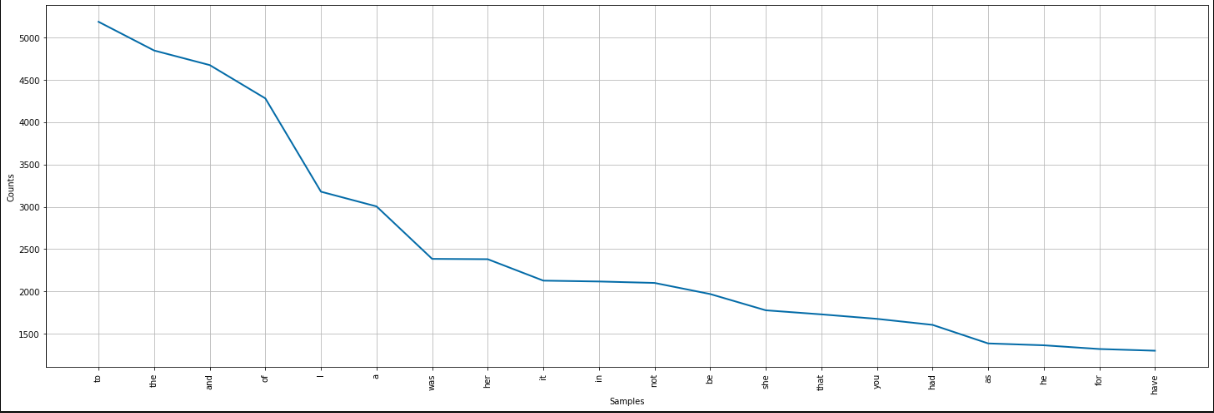
# 해당 단어가 들어간 문장을 찾아봅니다
emma_text.concordance('have', lines=10)

### 출력 결과
Displaying 10 of 1320 matches:
her had died too long ago for her to have more than an indistinct remembrance
amiable temper his talents could not have recommended him at any time Her sist
ng for herself as for them and would have been a great deal happier if she had
serves a good wife and you would not have had Miss Taylor live with us for eve
ar all my odd humours when she might have a house of her own A house of her ow
This is three times as large And you have never any odd humours my dear How of
 Mr Weston s stable papa You know we have settled all that already We talked i
er It was very lucky for I would not have had poor James think himself slighte
 she is a civil pretty spoken girl I have a great opinion of her Whenever I se
in a very pretty manner and when you have had her here to do needlework I obse

# 비슷한 단어 찾아봅니다
emma_text.similar('general')

### 출력 결과
love short it london time fact her which highbury and own well him
kind return vain person despair law bath

emma_text.similar('strong')

### 출력 결과
good much large happy natural grateful interesting clever little long
well soon great odd often right late sorry superior ready

# 여러 개 단어에 의해 공유되는 문맥을 조사합니다
emma_text.common_contexts(['general','strong'])

### 출력 결과
a_expectation

# 전체 텍스트 시각화
plt.figure(figsize=(18, 5))
emma_text.dispersion_plot(['Emma','Kightley','Frank','Robert','Harriet'])

### 출력 결과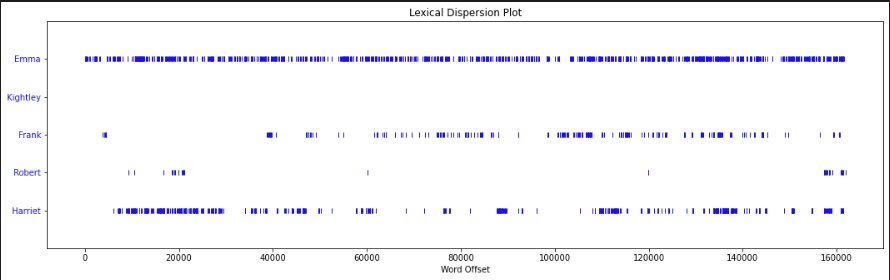
# 단어의 총수를 계산 :
len(emma_text)

### 출력 결과
161983

# 중복을 제거한 단어의 수 :
len(set(emma_text))

### 출력 결과
7723

# 단어의 풍부성 측정 :
len(set(emma_text)) / len(emma_text)

### 출력 결과
0.047677842736583466
단어의 풍부성이 낮을 수록 평균 출현 빈도가 낮다는 말이므로 텍스트의 어휘가 더 다양하고 풍부하다고 해석 할 수 있다.
만약 값이 높다면 특정 단어들이 자주 반복되는 것을 나타낸다.
5. KoNLPy
KoNLPy란?
KoNLPy는 한국어 자연어 처리를 위한 파이썬 라이브러리이다.
이름에서도 알 수 있듯이 “Korean Natural Language Processing in Python”의 약자이다.
KoNLPy는 다양한 한국어 텍스트 처리 작업을 쉽게 수행할 수 있도록 도와주는 도구 모음이다.
주요 기능 및 특징
1. 다양한 형태소 분석기 지원:
- KoNLPy는 한국어 형태소 분석을 위한 다양한 엔진을 제공
대표적으로 Kkma, Hannanum, Komoran, Mecab, Okt (Open Korean Text)등이 있음
각 분석기는 품사 태깅, 명사 추출 등 다양한 기능을 지원2. 편리한 인터페이스:
- 사용자가 간편하게 한국어 텍스트를 분석할 수 있는 편리한 인터페이스를 제공
파이썬의 객체 지향적인 접근 방식으로 구현되어 있어 사용자가 손쉽게 코드를 작성하고 실행할 수 있음3. 다양한 자연어 처리 기능:
- 형태소 분석 외에도 KoNLPy는 문장 분리, 단어 빈도 계산, 원형 복원, 어구 추출 등 다양한 자연어 처리 기능을 제공
이를 통해 텍스트 마이닝, 감정 분석, 정보 추출 등 다양한 NLP 작업을 수행할 수 있음4. 확장성:
- KoNLPy는 다른 파이썬 라이브러리와 쉽게 통합될 수 있음
예를 들어, 데이터 시각화 라이브러리인 matplotlib과 결합하여 분석 결과를 시각화할 수 있음
# !python --version
# !pip install tweepy


import tweepy
tweepy.__version__

### 출력 결과
'4.14.0'

from konlpy.tag import Kkma, Okt
kkma = Kkma()
okt = Okt()

# Kkma, Okt 분석기를 이용한 형태소 분석
print(kkma.morphs("아기다리고기다리던겨울방학"))
print(okt.morphs("아기다리고기다리던겨울방학"))

### 출력 결과
['아', '아', '기다리', '고', '기다리', '더', 'ㄴ', '겨울', '방학']
['아기', '다리', '고', '기다리던', '겨울방학']

# Kkma, Okt 분석기를 이용한 품사 태깅
print(kkma.pos("아 기다리고기다리던겨울방학"))
print(okt.pos("아 기다리고기다리던겨울방학"))

### 출력 결과
[('아', 'VV'), ('아', 'ECS'), ('기다리', 'VV'), ('고', 'ECE'), ('기다리', 'VV'), ('더', 'EPT'), ('ㄴ', 'ETD'), ('겨울', 'NNG'), ('방학', 'NNG')]
[('아', 'Exclamation'), ('기다리고', 'Verb'), ('기다리던', 'Verb'), ('겨울방학', 'Noun')]
꼬꼬마 엔진을 통한 한글 분석
from konlpy.tag import Kkma
kkma = Kkma()

# 문장(Sentence) :
kkma.sentences('2024년 천연가스 가격에 대한 전망은 여러 요인에 따라 다소 복잡하게 전개되고 있습니다.')

### 출력 결과
['2024년 천연가스 가격에 대한 전망은 여러 요인에 따라 다소 복잡하게 전개되고 있습니다.']

sample = '2024년 천연가스 가격에 대한 전망은 여러 요인에 따라 다소 복잡하게 전개되고 있습니다 한국어 분석'
kkma.sentences(sample)   # 마침표가 없어도 문장(Sentence) 로 구분

### 출력 결과
['2024년 천연가스 가격에 대한 전망은 여러 요인에 따라 다소 복잡하게 전개되고 있습니다', '한국어 분석']

# 형태소 분석 :
kkma.morphs(sample)

### 출력 결과
['2024',
 '년',
 '천연',
 '가스',
 '가격',
 '에',
 '대하',
 'ㄴ',
 '전망',
 '은',
 '여러',
 '요인',
 '에',
 '따르',
 '아',
 '다소',
 '복잡',
 '하',
 '게',
 '전개',
 '되',
 '고',
 '있',
 '습니다',
 '한국어',
 '분석']

 # 품사; 명사(Noun) :
kkma.nouns(sample)

### 출력 결과
['2024', '2024년', '년', '천연', '천연가스', '가스', '가격', '전망', '요인', '전개', '한국어', '분석']

# 구문(Phrase) :
kkma.pos(sample)   # NNG(명사), OL(외국어), VCP(조사), EFN(종결어미)

### 출력 결과
[('2024', 'NR'),
 ('년', 'NNM'),
 ('천연', 'NNG'),
 ('가스', 'NNG'),
 ('가격', 'NNG'),
 ('에', 'JKM'),
 ('대하', 'VV'),
 ('ㄴ', 'ETD'),
 ('전망', 'NNG'),
 ('은', 'JX'),
 ('여러', 'MDT'),
 ('요인', 'NNG'),
 ('에', 'JKM'),
 ('따르', 'VV'),
 ('아', 'ECS'),
 ('다소', 'MAG'),
 ('복잡', 'XR'),
 ('하', 'XSA'),
 ('게', 'ECD'),
 ('전개', 'NNG'),
 ('되', 'XSV'),
 ('고', 'ECE'),
 ('있', 'VXV'),
 ('습니다', 'EFN'),
 ('한국어', 'NNG'),
 ('분석', 'NNG')]
한나눔 엔진을 통한 한글 분석
from konlpy.tag import Hannanum
hann = Hannanum()

sample = u"""2024년 천연가스 가격에 대한 전망은 여러 요인에 따라 다소 복잡하게 전개되고 있습니다. 한국어 분석"""
print(hann.analyze(sample))

### 출력 결과
[[[('2024', 'nnc'), ('년', 'nbu')]], [[('천연가스', 'ncn')], [('천연', 'ncn'), ('가스', 'ncn')], [('천연', 'ncps'), ('가스', 'ncn')]], [[('가격', 'ncn'), ('에', 'jca')], [('가격', 'ncpa'), ('에', 'jca')], [('가격', 'ncps'), ('에', 'jca')]], [[('대하', 'pvg'), ('ㄴ', 'etm')], [('대한', 'nq')]], [[('전망', 'ncn'), ('은', 'jxc')], [('전망', 'ncn'), ('은', 'ncn')], [('전망', 'ncpa'), ('은', 'jxc')], [('전망', 'ncpa'), ('은', 'ncn')], [('전', 'xp'), ('망', 'ncn'), ('은', 'jxc')], [('전', 'xp'), ('망', 'ncpa'), ('은', 'jxc')], [('전', 'xp'), ('망', 'ncps'), ('은', 'jxc')]], [[('여러', 'mma')], [('여러', 'mmd')], [('여러', 'nnc')]], [[('요인', 'ncn'), ('에', 'jca')]], [[('따르', 'pvg'), ('아', 'ecs')], [('따르', 'pvg'), ('아', 'ecc')], [('따르', 'pvg'), ('아', 'ecx')]], [[('다소', 'mag')], [('다소', 'ncn')]], [[('복잡', 'ncps'), ('하', 'xsms'), ('게', 'ecc')], [('복잡', 'ncps'), ('하', 'xsms'), ('게', 'ecs')], [('복잡', 'ncps'), ('하', 'xsms'), ('게', 'ecx')], [('복잡', 'ncps'), ('하', 'xsms'), ('게', 'ef')]], [[('전개', 'ncpa'), ('되', 'xsvn'), ('고', 'ecc')], [('전개', 'ncpa'), ('되', 'xsvn'), ('고', 'ecs')], [('전개', 'ncpa'), ('되', 'xsvn'), ('고', 'ecx')], [('전', 'xp'), ('개', 'ncn'), ('되', 'xsvn'), ('고', 'ecc')], [('전', 'xp'), ('개', 'ncn'), ('되', 'xsvn'), ('고', 'ecs')], [('전', 'xp'), ('개', 'ncn'), ('되', 'xsvn'), ('고', 'ecx')]], [[('있', 'paa'), ('습니다', 'ef')], [('있', 'px'), ('습니다', 'ef')]], [[('.', 'sf')], [('.', 'sy')]], [], [[('한국어', 'ncn')]], [[('분석', 'ncpa')]]]

hann.morphs(sample)

### 출력 결과
['2024년',
 '천연가스',
 '가격',
 '에',
 '대하',
 'ㄴ',
 '전망',
 '은',
 '여러',
 '요인',
 '에',
 '따르',
 '아',
 '다소',
 '복잡',
 '하',
 '게',
 '전개',
 '되',
 '고',
 '있',
 '습니다',
 '.',
 '한국어',
 '분석']

 hann.nouns(sample)

 ### 출력 결과
 ['2024년', '천연가스', '가격', '전망', '요인', '복잡', '전개', '한국어', '분석']
Twitter 엔진을 통한 한글 분석
from konlpy.tag import Twitter
twit = Twitter()

from konlpy.tag import Okt
okt = Okt()

twit.nouns(sample)         # 품사(명사) 분석

### 출력 결과
['천연가스', '가격', '대한', '전망', '여러', '요인', '다소', '전개', '한국어', '분석']

okt.nouns(sample)

### 출력 결과
['천연가스', '가격', '대한', '전망', '여러', '요인', '다소', '전개', '한국어', '분석']

twit.morphs(sample)        # 형태소(Morphemes) 분석

### 출력 결과
['2024년',
 '천연가스',
 '가격',
 '에',
 '대한',
 '전망',
 '은',
 '여러',
 '요인',
 '에',
 '따라',
 '다소',
 '복잡하게',
 '전개',
 '되고',
 '있습니다',
 '.',
 '한국어',
 '분석']

 okt.morphs(sample)

 ### 출력 결과
 ['2024년',
 '천연가스',
 '가격',
 '에',
 '대한',
 '전망',
 '은',
 '여러',
 '요인',
 '에',
 '따라',
 '다소',
 '복잡하게',
 '전개',
 '되고',
 '있습니다',
 '.',
 '한국어',
 '분석']

 twit.pos(sample)           # 구문(Phrases) 분석

 ### 출력 결과
 [('2024년', 'Number'),
 ('천연가스', 'Noun'),
 ('가격', 'Noun'),
 ('에', 'Josa'),
 ('대한', 'Noun'),
 ('전망', 'Noun'),
 ('은', 'Josa'),
 ('여러', 'Noun'),
 ('요인', 'Noun'),
 ('에', 'Josa'),
 ('따라', 'Verb'),
 ('다소', 'Noun'),
 ('복잡하게', 'Adjective'),
 ('전개', 'Noun'),
 ('되고', 'Verb'),
 ('있습니다', 'Adjective'),
 ('.', 'Punctuation'),
 ('한국어', 'Noun'),
 ('분석', 'Noun')]

 okt.pos(sample)

 ### 출력 결과
 [('2024년', 'Number'),
 ('천연가스', 'Noun'),
 ('가격', 'Noun'),
 ('에', 'Josa'),
 ('대한', 'Noun'),
 ('전망', 'Noun'),
 ('은', 'Josa'),
 ('여러', 'Noun'),
 ('요인', 'Noun'),
 ('에', 'Josa'),
 ('따라', 'Verb'),
 ('다소', 'Noun'),
 ('복잡하게', 'Adjective'),
 ('전개', 'Noun'),
 ('되고', 'Verb'),
 ('있습니다', 'Adjective'),
 ('.', 'Punctuation'),
 ('한국어', 'Noun'),
 ('분석', 'Noun')]
6. 불용어 처리
불용어란?
불용어(Stopwords)는 자연어 처리(NLP)에서 분석할 때 무시하거나 제거하는 단어들을 말한다.
이러한 단어들은 일반적으로 문장에서 높은 빈도로 등장하지만, 분석에 있어서는 그 자체로는 중요한 정보를 제공하지 않거나 분석 결과에 방해가 되는 경우가 많다.
따라서 이러한 단어들은 분석 전에 제거하여 처리의 효율성을 높이고, 정확도를 향상시키는 데 사용된다.
불용어의 예시
일반적으로 영어에서는 다음과 같은 단어들이 불용어로 취급될 수 있다:
- 조사: a, an, the
- 대명사: I, you, he, she, it
- 전치사: in, on, at, to, for
- 접속사: and, but, or, so
- 부정사: not, don't, can't
한국어에서의 불용어 예시는 다음과 같다:- 조사: 을, 를, 이, 가, 의, 에, 에서
- 접속사: 그리고, 그러나, 그래서
- 대명사: 나, 너, 그, 저
불용어 사용의 이유
1. 불필요한 정보 제거:
- 불용어는 분석에 있어서 중요한 정보를 제공하지 않는 경우가 많다.
- 예를 들어, 문장에서 "the", "and", "is"와 같은 단어들은 문장 구조를 이해하는 데는 필요하지만, 실제 의미 분석에는 기여하지 않는다.
2. 처리 효율성 향상:
불용어를 제거하면 데이터의 크기가 줄어들어 처리 속도가 향상될 수 있다.
특히 대규모 텍스트 데이터에서는 이러한 처리 속도의 향상이 중요하다.3. 모델 성능 향상:
불용어를 제거하면 모델이 데이터의 핵심적인 패턴을 더 잘 학습할 수 있다.
불용어가 포함되어 있으면 모델이 불필요한 정보에 과도하게 반응하여 성능이 저하될 수 있다.
불용어 처리 방법
- 고유 목록 사용: 언어별로 미리 정의된 불용어 목록을 사용하여 제거
- 빈도 기반 제거: 특정 빈도 이상으로 등장하는 단어들을 불용어로 간주하여 제거
- 의미 기반 제거: 문맥적으로 중요하지 않은 단어들을 제거하는 방법도 사용될 수 있음
주의사항
- 문맥에 따라 다름: 특정 문맥에서는 불용어로 간주되는 단어가 다를 수 있으므로, 분석할 데이터의 특성과 목적에 맞춰 적절한 불용어 목록을 사용해야 한다.
- 적절한 필터링: 모든 경우에 모든 불용어를 제거하는 것이 항상 좋은 방법은 아닐 수 있다.
분석 목적에 맞게 필터링을 조정하는 것이 중요
7. Word Cloud : 시각화
from wordcloud import WordCloud, STOPWORDS
import numpy as np
from PIL import Image

alice = open('data/carroll-alice.txt').read()
alice_mask = np.array(Image.open('data/alice_mask.png'))

STOPWORDS     # 불용어 : 큰 의미가 없는 단어(군)

### 출력 결과
{'a',
 'about',
 'above',
 'after',
 'again',
 'against',
 'all',
 'also',
 'am',
 'an',
 'and',
 'any',
 'are',
 "aren't",
 'as',
 'at',
 'be',
 'because',
 'been',
 'before',
 'being',
 'below',
 'between',
 'both',
 'but',
 'by',
 'can',
 "can't",
 'cannot',
 'com',
 'could',
 "couldn't",
 'did',
 "didn't",
 'do',
 'does',
 "doesn't",
 'doing',
 "don't",
 'down',
 'during',
 'each',
 'else',
 'ever',
 'few',
 'for',
 'from',
 'further',
 'get',
 'had',
 "hadn't",
 'has',
 "hasn't",
 'have',
 "haven't",
 'having',
 'he',
 "he'd",
 "he'll",
 "he's",
 'hence',
 'her',
 'here',
 "here's",
 'hers',
 'herself',
 'him',
 'himself',
 'his',
 'how',
 "how's",
 'however',
 'http',
 'i',
 "i'd",
 "i'll",
 "i'm",
 "i've",
 'if',
 'in',
 'into',
 'is',
 "isn't",
 'it',
 "it's",
 'its',
 'itself',
 'just',
 'k',
 "let's",
 'like',
 'me',
 'more',
 'most',
 "mustn't",
 'my',
 'myself',
 'no',
 'nor',
 'not',
 'of',
 'off',
 'on',
 'once',
 'only',
 'or',
 'other',
 'otherwise',
 'ought',
 'our',
 'ours',
 'ourselves',
 'out',
 'over',
 'own',
 'r',
 'same',
 'shall',
 "shan't",
 'she',
 "she'd",
 "she'll",
 "she's",
 'should',
 "shouldn't",
 'since',
 'so',
 'some',
 'such',
 'than',
 'that',
 "that's",
 'the',
 'their',
 'theirs',
 'them',
 'themselves',
 'then',
 'there',
 "there's",
 'therefore',
 'these',
 'they',
 "they'd",
 "they'll",
 "they're",
 "they've",
 'this',
 'those',
 'through',
 'to',
 'too',
 'under',
 'until',
 'up',
 'very',
 'was',
 "wasn't",
 'we',
 "we'd",
 "we'll",
 "we're",
 "we've",
 'were',
 "weren't",
 'what',
 "what's",
 'when',
 "when's",
 'where',
 "where's",
 'which',
 'while',
 'who',
 "who's",
 'whom',
 'why',
 "why's",
 'with',
 "won't",
 'would',
 "wouldn't",
 'www',
 'you',
 "you'd",
 "you'll",
 "you're",
 "you've",
 'your',
 'yours',
 'yourself',
 'yourselves'}

wc = WordCloud(background_color="white", max_words=1000, mask=alice_mask)
wc = wc.generate(alice)       # Generate wordcloud from text
wc.words_

### 출력 결과
{'said': 1.0,
 'Alice': 0.708092485549133,
 'said Alice': 0.3352601156069364,
 'little': 0.31213872832369943,
 'one': 0.29190751445086704,
 'know': 0.26011560693641617,
 'went': 0.2398843930635838,
 'thing': 0.23121387283236994,
 'time': 0.22254335260115607,
 'Queen': 0.21965317919075145,
 'see': 0.1936416184971098,
 'King': 0.18497109826589594,
 'well': 0.18208092485549132,
 'now': 0.17341040462427745,
 'head': 0.17341040462427745,
 'began': 0.1676300578034682,
 'way': 0.16473988439306358,
 'Hatter': 0.16473988439306358,
 'Mock Turtle': 0.16184971098265896,
 'say': 0.15895953757225434,
 'Gryphon': 0.15895953757225434,
 'think': 0.1531791907514451,
 'quite': 0.15028901734104047,
 'much': 0.14739884393063585,
 'first': 0.14739884393063585,
 'thought': 0.14450867052023122,
 'go': 0.14450867052023122,
 'come': 0.13872832369942195,
 'never': 0.13583815028901733,
 'voice': 0.1329479768786127,
 'looked': 0.13005780346820808,
 'got': 0.13005780346820808,
 'must': 0.12716763005780346,
 'Cat': 0.12716763005780346,
 'Duchess': 0.12138728323699421,
 'Mouse': 0.11849710982658959,
 'round': 0.11849710982658959,
 'back': 0.11560693641618497,
 'two': 0.11560693641618497,
 'Dormouse': 0.11560693641618497,
 'make': 0.10982658959537572,
 'Oh': 0.1069364161849711,
 'tone': 0.1069364161849711,
 'eye': 0.10404624277456648,
 'came': 0.10115606936416185,
 'nothing': 0.09826589595375723,
 'tell': 0.09826589595375723,
 'day': 0.0953757225433526,
 'large': 0.0953757225433526,
 'great': 0.0953757225433526,
 'hand': 0.0953757225433526,
 'last': 0.0953757225433526,
 'found': 0.09248554913294797,
 'long': 0.09248554913294797,
 'door': 0.09248554913294797,
 'minute': 0.09248554913294797,
 'looking': 0.09248554913294797,
 'put': 0.08959537572254335,
 'word': 0.08959537572254335,
 'March Hare': 0.08959537572254335,
 'made': 0.08670520231213873,
 'heard': 0.08670520231213873,
 'look': 0.0838150289017341,
 'will': 0.0838150289017341,
 'replied': 0.0838150289017341,
 'might': 0.08092485549132948,
 'Caterpillar': 0.08092485549132948,
 'seemed': 0.07803468208092486,
 'going': 0.07803468208092486,
 'right': 0.07803468208092486,
 'without': 0.07514450867052024,
 'moment': 0.07514450867052024,
 'course': 0.07514450867052024,
 'thought Alice': 0.07514450867052024,
 'Rabbit': 0.07225433526011561,
 'next': 0.07225433526011561,
 'rather': 0.07225433526011561,
 'soon': 0.07225433526011561,
 'away': 0.07225433526011561,
 'yet': 0.07225433526011561,
 'dear': 0.06936416184971098,
 'took': 0.06936416184971098,
 'take': 0.06936416184971098,
 'sure': 0.06936416184971098,
 'sort': 0.06647398843930635,
 'felt': 0.06647398843930635,
 'added': 0.06647398843930635,
 'getting': 0.06358381502890173,
 'Let': 0.06358381502890173,
 'three': 0.06358381502890173,
 'find': 0.06358381502890173,
 'White Rabbit': 0.06358381502890173,
 'upon': 0.06069364161849711,
 'wish': 0.06069364161849711,
 'question': 0.06069364161849711,
 'side': 0.06069364161849711,
 'till': 0.06069364161849711,
 'arm': 0.06069364161849711,
 'anything': 0.057803468208092484,
 'good': 0.057803468208092484,
 'please': 0.057803468208092484,
 'half': 0.057803468208092484,
 'face': 0.057803468208092484,
 'cried': 0.057803468208092484,
 'tried': 0.05491329479768786,
 'even': 0.05491329479768786,
 'house': 0.05491329479768786,
 'tea': 0.05491329479768786,
 'eat': 0.05491329479768786,
 'curious': 0.05491329479768786,
 'use': 0.05202312138728324,
 'wonder': 0.05202312138728324,
 'table': 0.05202312138728324,
 'enough': 0.05202312138728324,
 'something': 0.05202312138728324,
 'jury': 0.05202312138728324,
 'court': 0.05202312138728324,
 'another': 0.049132947976878616,
 'end': 0.049132947976878616,
 'spoke': 0.049132947976878616,
 'perhaps': 0.049132947976878616,
 'talking': 0.049132947976878616,
 'begin': 0.049132947976878616,
 'sat': 0.049132947976878616,
 'asked': 0.049132947976878616,
 'Bill': 0.049132947976878616,
 'ran': 0.046242774566473986,
 'air': 0.046242774566473986,
 'bit': 0.046242774566473986,
 'turned': 0.046242774566473986,
 'garden': 0.046242774566473986,
 'indeed': 0.046242774566473986,
 'hastily': 0.046242774566473986,
 'change': 0.046242774566473986,
 'seen': 0.04335260115606936,
 'idea': 0.04335260115606936,
 'saying': 0.04335260115606936,
 'low': 0.04335260115606936,
 'leave': 0.04335260115606936,
 'gave': 0.04335260115606936,
 'speak': 0.04335260115606936,
 'done': 0.04335260115606936,
 'called': 0.04335260115606936,
 'mean': 0.04335260115606936,
 'mad': 0.04335260115606936,
 'beginning': 0.04046242774566474,
 'hear': 0.04046242774566474,
 'feet': 0.04046242774566474,
 'saw': 0.04046242774566474,
 'remember': 0.04046242774566474,
 'trying': 0.04046242774566474,
 'certainly': 0.04046242774566474,
 'game': 0.04046242774566474,
 'left': 0.04046242774566474,
 'anxiously': 0.04046242774566474,
 'set': 0.04046242774566474,
 'everything': 0.04046242774566474,
 'knew': 0.04046242774566474,
 'sea': 0.04046242774566474,
 'suppose': 0.04046242774566474,
 'talk': 0.04046242774566474,
 'us': 0.04046242774566474,
 'Ye': 0.04046242774566474,
 'mouth': 0.04046242774566474,
 'turn': 0.04046242774566474,
 'Footman': 0.04046242774566474,
 'baby': 0.04046242774566474,
 'creature': 0.04046242774566474,
 'book': 0.03757225433526012,
 'suddenly': 0.03757225433526012,
 'close': 0.03757225433526012,
 'happen': 0.03757225433526012,
 'still': 0.03757225433526012,
 'seem': 0.03757225433526012,
 'people': 0.03757225433526012,
 'behind': 0.03757225433526012,
 'really': 0.03757225433526012,
 'grow': 0.03757225433526012,
 'far': 0.03757225433526012,
 'kept': 0.03757225433526012,
 'used': 0.03757225433526012,
 'lesson': 0.03757225433526012,
 'always': 0.03757225433526012,
 'Dodo': 0.03757225433526012,
 'whole': 0.03757225433526012,
 'better': 0.03757225433526012,
 'room': 0.03757225433526012,
 'gone': 0.03757225433526012,
 'may': 0.03757225433526012,
 'remark': 0.03757225433526012,
 'cook': 0.03757225433526012,
 'CHAPTER': 0.03468208092485549,
 'many': 0.03468208092485549,
 'near': 0.03468208092485549,
 'among': 0.03468208092485549,
 'name': 0.03468208092485549,
 'Dinah': 0.03468208092485549,
 'afraid': 0.03468208092485549,
 'every': 0.03468208092485549,
 'finished': 0.03468208092485549,
 'best': 0.03468208092485549,
 'hardly': 0.03468208092485549,
 'life': 0.03468208092485549,
 'give': 0.03468208092485549,
 'queer': 0.03468208092485549,
 'try': 0.03468208092485549,
 'tail': 0.03468208092485549,
 'live': 0.03468208092485549,
 'old': 0.03468208092485549,
 'turning': 0.03468208092485549,
 'bird': 0.03468208092485549,
 'serpent': 0.03468208092485549,
 'Pigeon': 0.03468208092485549,
 'tree': 0.03468208092485549,
 'Majesty': 0.03468208092485549,
 'sister': 0.031791907514450865,
 'conversation': 0.031791907514450865,
 'mind': 0.031791907514450865,
 'whether': 0.031791907514450865,
 'hurried': 0.031791907514450865,
 'though': 0.031791907514450865,
 'glad': 0.031791907514450865,
 'ask': 0.031791907514450865,
 'matter': 0.031791907514450865,
 'read': 0.031791907514450865,
 'waited': 0.031791907514450865,
 'tears': 0.031791907514450865,
 'child': 0.031791907514450865,
 'growing': 0.031791907514450865,
 'pool': 0.031791907514450865,
 'want': 0.031791907514450865,
 'thinking': 0.031791907514450865,
 'nearly': 0.031791907514450865,
 'silence': 0.031791907514450865,
 'trial': 0.031791907514450865,
 'slate': 0.031791907514450865,
 'keep': 0.031791907514450865,
 'pig': 0.031791907514450865,
 'ear': 0.031791907514450865,
 'soldier': 0.031791907514450865,
 'poor Alice': 0.031791907514450865,
 'sitting': 0.028901734104046242,
 'either': 0.028901734104046242,
 'answer': 0.028901734104046242,
 'sight': 0.028901734104046242,
 'walked': 0.028901734104046242,
 'small': 0.028901734104046242,
 'opened': 0.028901734104046242,
 'bottle': 0.028901734104046242,
 'children': 0.028901734104046242,
 'hold': 0.028901734104046242,
 'foot': 0.028901734104046242,
 'fan': 0.028901734104046242,
 'mine': 0.028901734104046242,
 'party': 0.028901734104046242,
 'explain': 0.028901734104046242,
 'rest': 0.028901734104046242,
 'reason': 0.028901734104046242,
 'place': 0.028901734104046242,
 'repeated': 0.028901734104046242,
 'remarked': 0.028901734104046242,
 'Soup': 0.028901734104046242,
 'hedgehog': 0.028901734104046242,
 'Heart': 0.028901734104046242,
 'lobster': 0.028901734104046242,
 'coming': 0.02601156069364162,
 'top': 0.02601156069364162,
 'hall': 0.02601156069364162,
 'rate': 0.02601156069364162,
 'waiting': 0.02601156069364162,
 'feeling': 0.02601156069364162,
 'size': 0.02601156069364162,
 'work': 0.02601156069364162,
 'help': 0.02601156069364162,
 'different': 0.02601156069364162,
 'sit': 0.02601156069364162,
 'continued': 0.02601156069364162,
 'believe': 0.02601156069364162,
 'piece': 0.02601156069364162,
 'call': 0.02601156069364162,
 'angrily': 0.02601156069364162,
 'shook': 0.02601156069364162,
 'least': 0.02601156069364162,
 'together': 0.02601156069364162,
 'shouted': 0.02601156069364162,
 'timidly': 0.02601156069364162,
 'puzzled': 0.02601156069364162,
 'butter': 0.02601156069364162,
 'interrupted': 0.02601156069364162,
 'Knave': 0.02601156069364162,
 'moral': 0.02601156069364162,
 'dance': 0.02601156069364162,
 'join': 0.02601156069364162,
 'poor little': 0.02601156069364162,
 'feel': 0.023121387283236993,
 'making': 0.023121387283236993,
 'watch': 0.023121387283236993,
 'slowly': 0.023121387283236993,
 'noticed': 0.023121387283236993,
 'four': 0.023121387283236993,
 'opportunity': 0.023121387283236993,
 'distance': 0.023121387283236993,
 "it'll": 0.023121387283236993,
 'sound': 0.023121387283236993,
 'dry': 0.023121387283236993,
 'bright': 0.023121387283236993,
 'fact': 0.023121387283236993,
 'tart': 0.023121387283236993,
 'followed': 0.023121387283236993,
 'lying': 0.023121387283236993,
 'ready': 0.023121387283236993,
 'hard': 0.023121387283236993,
 'changed': 0.023121387283236993,
 'Five': 0.023121387283236993,
 'beg': 0.023121387283236993,
 'eagerly': 0.023121387283236993,
 'meaning': 0.023121387283236993,
 'running': 0.023121387283236993,
 'everybody': 0.023121387283236993,
 'exactly': 0.023121387283236993,
 'story': 0.023121387283236993,
 'nobody': 0.023121387283236993,
 'direction': 0.023121387283236993,
 'window': 0.023121387283236993,
 'appeared': 0.023121387283236993,
 'wood': 0.023121387283236993,
 'mushroom': 0.023121387283236993,
 'pepper': 0.023121387283236993,
 'fish': 0.023121387283236993,
 'verse': 0.023121387283236993,
 'shoulder': 0.023121387283236993,
 'rule': 0.023121387283236993,
 'whiting': 0.023121387283236993,
 'Oh dear': 0.023121387283236993,
 'beautiful Soup': 0.023121387283236993,
 'adventures': 0.02023121387283237,
 'tired': 0.02023121387283237,
 'hot': 0.02023121387283237,
 'world': 0.02023121387283237,
 'deep': 0.02023121387283237,
 'somebody': 0.02023121387283237,
 'fall': 0.02023121387283237,
 'listen': 0.02023121387283237,
 'fancy': 0.02023121387283237,
 'manage': 0.02023121387283237,
 'bat': 0.02023121387283237,
 'begun': 0.02023121387283237,
 'dream': 0.02023121387283237,
 'middle': 0.02023121387283237,
 'wondering': 0.02023121387283237,
 'glass': 0.02023121387283237,
 'open': 0.02023121387283237,
 'high': 0.02023121387283237,
 'larger': 0.02023121387283237,
 'happened': 0.02023121387283237,
 'neck': 0.02023121387283237,
 'drink': 0.02023121387283237,
 'generally': 0.02023121387283237,
 'surprised': 0.02023121387283237,
 'shoes': 0.02023121387283237,
 'kind': 0.02023121387283237,
 'nonsense': 0.02023121387283237,
 'hair': 0.02023121387283237,
 'goes': 0.02023121387283237,
 'repeat': 0.02023121387283237,
 'grin': 0.02023121387283237,
 'learn': 0.02023121387283237,
 'frightened': 0.02023121387283237,
 'chin': 0.02023121387283237,
 'history': 0.02023121387283237,
 'subject': 0.02023121387283237,
 'fetch': 0.02023121387283237,
 'Lory': 0.02023121387283237,
 'important': 0.02023121387283237,
 'others': 0.02023121387283237,
 'chimney': 0.02023121387283237,
 'grown': 0.02023121387283237,
 'business': 0.02023121387283237,
 'puppy': 0.02023121387283237,
 'paw': 0.02023121387283237,
 'nose': 0.02023121387283237,
 'draw': 0.02023121387283237,
 'silent': 0.02023121387283237,
 'pleased': 0.02023121387283237,
 'song': 0.02023121387283237,
 'bread': 0.02023121387283237,
 'treacle': 0.02023121387283237,
 'evidence': 0.02023121387283237,
 'good deal': 0.02023121387283237,
 'Soo oop': 0.02023121387283237,
 'stupid': 0.017341040462427744,
 'trouble': 0.017341040462427744,
 'late': 0.017341040462427744,
 'fell': 0.017341040462427744,
 'nice': 0.017341040462427744,
 'written': 0.017341040462427744,
 'jumped': 0.017341040462427744,
 'roof': 0.017341040462427744,
 'along': 0.017341040462427744,
 'forgotten': 0.017341040462427744,
 'almost': 0.017341040462427744,
 'ten': 0.017341040462427744,
 'box': 0.017341040462427744,
 'cake': 0.017341040462427744,
 'care': 0.017341040462427744,
 'English': 0.017341040462427744,
 'pair': 0.017341040462427744,
 'stop': 0.017341040462427744,
 'gloves': 0.017341040462427744,
 'sir': 0.017341040462427744,
 'Seven': 0.017341040462427744,
 'stay': 0.017341040462427744,
 'understand': 0.017341040462427744,
 'sentence': 0.017341040462427744,
 'pardon': 0.017341040462427744,
 'animal': 0.017341040462427744,
 'dog': 0.017341040462427744,
 'politely': 0.017341040462427744,
 'melancholy': 0.017341040462427744,
 'liked': 0.017341040462427744,
 'hour': 0.017341040462427744,
 'chorus': 0.017341040462427744,
 'prize': 0.017341040462427744,
 'executed': 0.017341040462427744,
 'full': 0.017341040462427744,
 'write': 0.017341040462427744,
 'shriek': 0.017341040462427744,
 'loud': 0.017341040462427744,
 'sharp': 0.017341040462427744,
 'Lizard': 0.017341040462427744,
 'stand': 0.017341040462427744,
 'youth': 0.017341040462427744,
 'sleep': 0.017341040462427744,
 'egg': 0.017341040462427744,
 'sneezing': 0.017341040462427744,
 'told': 0.017341040462427744,
 'dreadfully': 0.017341040462427744,
 'sing': 0.017341040462427744,
 'exclaimed': 0.017341040462427744,
 'procession': 0.017341040462427744,
 'executioner': 0.017341040462427744,
 'school': 0.017341040462427744,
 'little girl': 0.017341040462427744,
 'golden key': 0.017341040462427744,
 'great hurry': 0.017341040462427744,
 'Cheshire Cat': 0.017341040462427744,
 'three gardeners': 0.017341040462427744,
 'guinea pig': 0.017341040462427744,
 'twice': 0.014450867052023121,
 'sleepy': 0.014450867052023121,
 'pocket': 0.014450867052023121,
 'across': 0.014450867052023121,
 'curiosity': 0.014450867052023121,
 'passed': 0.014450867052023121,
 'home': 0.014450867052023121,
 'likely': 0.014450867052023121,
 'aloud': 0.014450867052023121,
 'walk': 0.014450867052023121,
 'new': 0.014450867052023121,
 'asking': 0.014450867052023121,
 'night': 0.014450867052023121,
 'sometimes': 0.014450867052023121,
 'walking': 0.014450867052023121,
 'corner': 0.014450867052023121,
 'sadly': 0.014450867052023121,
 'shut': 0.014450867052023121,
 'hurry': 0.014450867052023121,
 'simple': 0.014450867052023121,
 'cut': 0.014450867052023121,
 'nervous': 0.014450867052023121,
 'altogether': 0.014450867052023121,
 'remembered': 0.014450867052023121,
 'person': 0.014450867052023121,
 'deal': 0.014450867052023121,
 'nine': 0.014450867052023121,
 'dropped': 0.014450867052023121,
 'usual': 0.014450867052023121,
 'morning': 0.014450867052023121,
 'Ah': 0.014450867052023121,
 'wrong': 0.014450867052023121,
 'sounded': 0.014450867052023121,
 'strange': 0.014450867052023121,
 'sudden': 0.014450867052023121,
 'case': 0.014450867052023121,
 'number': 0.014450867052023121,
 'swam': 0.014450867052023121,
 'nearer': 0.014450867052023121,
 'speaking': 0.014450867052023121,
 'shrill': 0.014450867052023121,
 'angry': 0.014450867052023121,
 'offended': 0.014450867052023121,
 'crowded': 0.014450867052023121,
 'tale': 0.014450867052023121,
 'argument': 0.014450867052023121,
 'notice': 0.014450867052023121,
 'dare': 0.014450867052023121,
 'confusion': 0.014450867052023121,
 'reply': 0.014450867052023121,
 'finish': 0.014450867052023121,
 'impatiently': 0.014450867052023121,
 'sighed': 0.014450867052023121,
 'temper': 0.014450867052023121,
 'moved': 0.014450867052023121,
 'swim': 0.014450867052023121,
 'plate': 0.014450867052023121,
 'interesting': 0.014450867052023121,
 'become': 0.014450867052023121,
 'taking': 0.014450867052023121,
 'drew': 0.014450867052023121,
 'sky': 0.014450867052023121,
 'instantly': 0.014450867052023121,
 'surprise': 0.014450867052023121,
 'stick': 0.014450867052023121,
 'height': 0.014450867052023121,
 'quietly': 0.014450867052023121,
 'hookah': 0.014450867052023121,
 'present': 0.014450867052023121,
 'often': 0.014450867052023121,
 'follow': 0.014450867052023121,
 'sob': 0.014450867052023121,
 'ground': 0.014450867052023121,
 'meant': 0.014450867052023121,
 'waving': 0.014450867052023121,
 'asleep': 0.014450867052023121,
 'pack': 0.014450867052023121,
 'knee': 0.014450867052023121,
 'whispered': 0.014450867052023121,
 'execution': 0.014450867052023121,
 'flamingo': 0.014450867052023121,
 'friend': 0.014450867052023121,
 'Turtle': 0.014450867052023121,
 'Tis': 0.014450867052023121,
 'picture': 0.014450867052023121,
 'juror': 0.014450867052023121,
 'witness': 0.014450867052023121,
 'teacup': 0.014450867052023121,
 'officer': 0.014450867052023121,
 'unimportant': 0.014450867052023121,
 'mile': 0.014450867052023121,
 'another moment': 0.014450867052023121,
 'came upon': 0.014450867052023121,
 'little golden': 0.014450867052023121,
 'right size': 0.014450867052023121,
 'feet high': 0.014450867052023121,
 'white kid': 0.014450867052023121,
 'kid gloves': 0.014450867052023121,
 'trembling voice': 0.014450867052023121,
 'offended tone': 0.014450867052023121,
 'play croquet': 0.014450867052023121,
 'Twinkle twinkle': 0.014450867052023121,
 'evening Beautiful': 0.014450867052023121,
 'next witness': 0.014450867052023121,
 'bank': 0.011560693641618497,
 'worth': 0.011560693641618497,
 'natural': 0.011560693641618497,
 'fear': 0.011560693641618497,
 'managed': 0.011560693641618497,
 'true': 0.011560693641618497,
 'fallen': 0.011560693641618497,
 'earth': 0.011560693641618497,
 'several': 0.011560693641618497,
 'Miss': 0.011560693641618497,
 'catch': 0.011560693641618497,
 'passage': 0.011560693641618497,
 'except': 0.011560693641618497,
 'tiny': 0.011560693641618497,
 'alas': 0.011560693641618497,
 'second': 0.011560693641618497,
 'led': 0.011560693641618497,
 'poor': 0.011560693641618497,
 'telescope': 0.011560693641618497,
 'paper': 0.011560693641618497,
 'taught': 0.011560693641618497,
 'deeply': 0.011560693641618497,
 'ventured': 0.011560693641618497,
 'reach': 0.011560693641618497,
 'sharply': 0.011560693641618497,
 'severely': 0.011560693641618497,
 'fond': 0.011560693641618497,
 'boots': 0.011560693641618497,
 'savage': 0.011560693641618497,
 'violently': 0.011560693641618497,
 'age': 0.011560693641618497,
 'Mabel': 0.011560693641618497,
 'besides': 0.011560693641618497,
 'puzzling': 0.011560693641618497,
 'twelve': 0.011560693641618497,
 'capital': 0.011560693641618497,
 'alone': 0.011560693641618497,
 'escape': 0.011560693641618497,
 'water': 0.011560693641618497,
 'digging': 0.011560693641618497,
 'French': 0.011560693641618497,
 'William': 0.011560693641618497,
 'fire': 0.011560693641618497,
 'pale': 0.011560693641618497,
 'shore': 0.011560693641618497,
 'Duck': 0.011560693641618497,
 'uncomfortable': 0.011560693641618497,
 'wanted': 0.011560693641618497,
 'frowning': 0.011560693641618497,
 'solemnly': 0.011560693641618497,
 'pointing': 0.011560693641618497,
 'confused': 0.011560693641618497,
 'short': 0.011560693641618497,
 'bowed': 0.011560693641618497,
 'noise': 0.011560693641618497,
 'whisper': 0.011560693641618497,
 'judge': 0.011560693641618497,
 'breath': 0.011560693641618497,
 'tongue': 0.011560693641618497,
 'particular': 0.011560693641618497,
 'vanished': 0.011560693641618497,
 'run': 0.011560693641618497,
 'stood': 0.011560693641618497,
 'elbow': 0.011560693641618497,
 'chance': 0.011560693641618497,
 'answered': 0.011560693641618497,
 'outside': 0.011560693641618497,
 'hearing': 0.011560693641618497,
 'master': 0.011560693641618497,
 'Thank': 0.011560693641618497,
 'doubt': 0.011560693641618497,
 'lay': 0.011560693641618497,
 'crowd': 0.011560693641618497,
 'held': 0.011560693641618497,
 'plan': 0.011560693641618497,
 'difficulty': 0.011560693641618497,
 'grass': 0.011560693641618497,
 'perfectly': 0.011560693641618497,
 'none': 0.011560693641618497,
 'stuff': 0.011560693641618497,
 'decidedly': 0.011560693641618497,
 'thoughtfully': 0.011560693641618497,
 'green': 0.011560693641618497,
 'screamed': 0.011560693641618497,
 'indignantly': 0.011560693641618497,
 'taken': 0.011560693641618497,
 'letter': 0.011560693641618497,
 'dish': 0.011560693641618497,
 'kitchen': 0.011560693641618497,
 'sneeze': 0.011560693641618497,
 'jumping': 0.011560693641618497,
 'carried': 0.011560693641618497,
 'growl': 0.011560693641618497,
 'busily': 0.011560693641618497,
 'beat': 0.011560693641618497,
 'grunted': 0.011560693641618497,
 'less': 0.011560693641618497,
 'writing': 0.011560693641618497,
 'crumbs': 0.011560693641618497,
 'twinkling': 0.011560693641618497,
 'sigh': 0.011560693641618497,
 'bottom': 0.011560693641618497,
 'M': 0.011560693641618497,
 'flower': 0.011560693641618497,
 'rose': 0.011560693641618497,
 'Consider': 0.011560693641618497,
 'arches': 0.011560693641618497,
 'players': 0.011560693641618497,
 'week': 0.011560693641618497,
 'figure': 0.011560693641618497,
 'porpoise': 0.011560693641618497,
 'verdict': 0.011560693641618497,
 'suppressed': 0.011560693641618497,
 'jurymen': 0.011560693641618497,
 'fit': 0.011560693641618497,
 'rabbit hole': 0.011560693641618497,
 'inches high': 0.011560693641618497,
 'one finger': 0.011560693641618497,
 'Mary Ann': 0.011560693641618497,
 'yer honour': 0.011560693641618497,
 'old fellow': 0.011560693641618497,
 'FATHER WILLIAM': 0.011560693641618497,
 'Wow wow': 0.011560693641618497,
 'Lobster Quadrille': 0.011560693641618497,
 'dance Will': 0.011560693641618497,
 'Beau ootiful': 0.011560693641618497,
 'ootiful Soo': 0.011560693641618497,
 'jury box': 0.011560693641618497,
 'Wonderland': 0.008670520231213872,
 'peeped': 0.008670520231213872,
 'reading': 0.008670520231213872,
 'considering': 0.008670520231213872,
 'White': 0.008670520231213872,
 'hedge': 0.008670520231213872,
 'dark': 0.008670520231213872,
 'filled': 0.008670520231213872,
 'past': 0.008670520231213872,
 'stairs': 0.008670520231213872,
 'somewhere': 0.008670520231213872,
 'knowledge': 0.008670520231213872,
 'grand': 0.008670520231213872,
 'funny': 0.008670520231213872,
 'listening': 0.008670520231213872,
 'hope': 0.008670520231213872,
 'hurt': 0.008670520231213872,
 'lost': 0.008670520231213872,
 'whiskers': 0.008670520231213872,
 'longer': 0.008670520231213872,
 'hanging': 0.008670520231213872,
 'key': 0.008670520231213872,
 'belong': 0.008670520231213872,
 'lock': 0.008670520231213872,
 'delight': 0.008670520231213872,
 'impossible': 0.008670520231213872,
 'marked': 0.008670520231213872,
 'red': 0.008670520231213872,
 'knife': 0.008670520231213872,
 'certain': 0.008670520231213872,
 'taste': 0.008670520231213872,
 'finding': 0.008670520231213872,
 'apple': 0.008670520231213872,
 'candle': 0.008670520231213872,
 'decided': 0.008670520231213872,
 'possibly': 0.008670520231213872,
 'legs': 0.008670520231213872,
 'bring': 0.008670520231213872,
 'smaller': 0.008670520231213872,
 'holding': 0.008670520231213872,
 'remained': 0.008670520231213872,
 'expecting': 0.008670520231213872,
 'dull': 0.008670520231213872,
 'opening': 0.008670520231213872,
 'love': 0.008670520231213872,
 'cry': 0.008670520231213872,
 'pattering': 0.008670520231213872,
 'muttering': 0.008670520231213872,
 'timid': 0.008670520231213872,
 'yesterday': 0.008670520231213872,
 'twenty': 0.008670520231213872,
 'doth': 0.008670520231213872,
 'crossed': 0.008670520231213872,
 'hoarse': 0.008670520231213872,
 'spread': 0.008670520231213872,
 'gently': 0.008670520231213872,
 'play': 0.008670520231213872,
 'putting': 0.008670520231213872,
 'guess': 0.008670520231213872,
 'cause': 0.008670520231213872,
 'worse': 0.008670520231213872,
 'slipped': 0.008670520231213872,
 'general': 0.008670520231213872,
 'notion': 0.008670520231213872,
 'show': 0.008670520231213872,
 'washing': 0.008670520231213872,
 'nurse': 0.008670520231213872,
 'throw': 0.008670520231213872,
 'passion': 0.008670520231213872,
 'Eaglet': 0.008670520231213872,
 'race': 0.008670520231213872,
 'fur': 0.008670520231213872,
 'sulky': 0.008670520231213872,
 'allow': 0.008670520231213872,
 'frog': 0.008670520231213872,
 'crown': 0.008670520231213872,
 'move': 0.008670520231213872,
 'pressed': 0.008670520231213872,
 'handed': 0.008670520231213872,
 'gravely': 0.008670520231213872,
 'thimble': 0.008670520231213872,
 'speech': 0.008670520231213872,
 'cheered': 0.008670520231213872,
 'grave': 0.008670520231213872,
 'simply': 0.008670520231213872,
 'solemn': 0.008670520231213872,
 'choked': 0.008670520231213872,
 'sad': 0.008670520231213872,
 'sighing': 0.008670520231213872,
 'Fury': 0.008670520231213872,
 'met': 0.008670520231213872,
 'attending': 0.008670520231213872,
 'pleaded': 0.008670520231213872,
 'easily': 0.008670520231213872,
 'joined': 0.008670520231213872,
 'pity': 0.008670520231213872,
 'Crab': 0.008670520231213872,
 'venture': 0.008670520231213872,
 'carefully': 0.008670520231213872,
 'suit': 0.008670520231213872,
 'bed': 0.008670520231213872,
 'mentioned': 0.008670520231213872,
 'guessed': 0.008670520231213872,
 'hunting': 0.008670520231213872,
 'mistake': 0.008670520231213872,
 'knocking': 0.008670520231213872,
 'real': 0.008670520231213872,
 'broken': 0.008670520231213872,
 'floor': 0.008670520231213872,
 'effect': 0.008670520231213872,
 'whatever': 0.008670520231213872,
 'ordered': 0.008670520231213872,
 'stopped': 0.008670520231213872,
 'crash': 0.008670520231213872,
 'Pat': 0.008670520231213872,
 'em': 0.008670520231213872,
 'kick': 0.008670520231213872,
 'sense': 0.008670520231213872,
 'moving': 0.008670520231213872,
 'hungry': 0.008670520231213872,
 'picked': 0.008670520231213872,
 'edge': 0.008670520231213872,
 'immediately': 0.008670520231213872,
 'folded': 0.008670520231213872,
 'confusing': 0.008670520231213872,
 'brought': 0.008670520231213872,
 'Pray': 0.008670520231213872,
 'jaw': 0.008670520231213872,
 'eel': 0.008670520231213872,
 'blow': 0.008670520231213872,
 'free': 0.008670520231213872,
 'shaking': 0.008670520231213872,
 'succeeded': 0.008670520231213872,
 'tasted': 0.008670520231213872,
 'settled': 0.008670520231213872,
 'nibbling': 0.008670520231213872,
 'bringing': 0.008670520231213872,
 'livery': 0.008670520231213872,
 'considered': 0.008670520231213872,
 'loudly': 0.008670520231213872,
 'order': 0.008670520231213872,
 'staring': 0.008670520231213872,
 'howling': 0.008670520231213872,
 'instance': 0.008670520231213872,
 'repeating': 0.008670520231213872,
 'nursing': 0.008670520231213872,
 'courage': 0.008670520231213872,
 'grinned': 0.008670520231213872,
 'faster': 0.008670520231213872,
 'advantage': 0.008670520231213872,
 'line': 0.008670520231213872,
 'boy': 0.008670520231213872,
 'tossing': 0.008670520231213872,
 'caught': 0.008670520231213872,
 'shaped': 0.008670520231213872,
 'proper': 0.008670520231213872,
 'sobbing': 0.008670520231213872,
 'explanation': 0.008670520231213872,
 'March': 0.008670520231213872,
 'instead': 0.008670520231213872,
 'civil': 0.008670520231213872,
 'fun': 0.008670520231213872,
 'breathe': 0.008670520231213872,
 "o'clock": 0.008670520231213872,
 'year': 0.008670520231213872,
 'riddle': 0.008670520231213872,
 'cautiously': 0.008670520231213872,
 'music': 0.008670520231213872,
 'fly': 0.008670520231213872,
 'lived': 0.008670520231213872,
 'upset': 0.008670520231213872,
 'manner': 0.008670520231213872,
 'muchness': 0.008670520231213872,
 'beheaded': 0.008670520231213872,
 'watching': 0.008670520231213872,
 'checked': 0.008670520231213872,
 'eager': 0.008670520231213872,
 'guests': 0.008670520231213872,
 'cards': 0.008670520231213872,
 "needn't": 0.008670520231213872,
 'unfortunate': 0.008670520231213872,
 'Hush': 0.008670520231213872,
 'tucked': 0.008670520231213872,
 'alive': 0.008670520231213872,
 'anxious': 0.008670520231213872,
 'mustard': 0.008670520231213872,
 'sorrow': 0.008670520231213872,
 'Tortoise': 0.008670520231213872,
 'Drawling': 0.008670520231213872,
 'advance': 0.008670520231213872,
 'toes': 0.008670520231213872,
 'mark': 0.008670520231213872,
 'snail': 0.008670520231213872,
 'obliged': 0.008670520231213872,
 'part': 0.008670520231213872,
 'around': 0.008670520231213872,
 'Owl': 0.008670520231213872,
 'Panther': 0.008670520231213872,
 'pie': 0.008670520231213872,
 'trumpet': 0.008670520231213872,
 'spectacles': 0.008670520231213872,
 'pencil': 0.008670520231213872,
 'wrote': 0.008670520231213872,
 'list': 0.008670520231213872,
 'prove': 0.008670520231213872,
 'half hoping': 0.008670520231213872,
 'marked poison': 0.008670520231213872,
 'O Mouse': 0.008670520231213872,
 'Caucus race': 0.008670520231213872,
 'stood near': 0.008670520231213872,
 'quite forgetting': 0.008670520231213872,
 'broken glass': 0.008670520231213872,
 'dead silence': 0.008670520231213872,
 'OLD FATHER': 0.008670520231213872,
 'fast asleep': 0.008670520231213872,
 'young lady': 0.008670520231213872,
 'croquet ground': 0.008670520231213872,
 'rose tree': 0.008670520231213872,
 'e e': 0.008670520231213872,
 'e evening': 0.008670520231213872,
 'poor man': 0.008670520231213872,
 'pleasure': 0.005780346820809248,
 'chain': 0.005780346820809248,
 'picking': 0.005780346820809248,
 'remarkable': 0.005780346820809248,
 'afterwards': 0.005780346820809248,
 'occurred': 0.005780346820809248,
 'started': 0.005780346820809248,
 'straight': 0.005780346820809248,
 'dipped': 0.005780346820809248,
 'falling': 0.005780346820809248,
 'plenty': 0.005780346820809248,
 'cupboards': 0.005780346820809248,
 'shelves': 0.005780346820809248,
 'jar': 0.005780346820809248,
 'tumbling': 0.005780346820809248,
 'thousand': 0.005780346820809248,
 'learnt': 0.005780346820809248,
 'showing': 0.005780346820809248,
 'Latitude': 0.005780346820809248,
 'Longitude': 0.005780346820809248,
 'Presently': 0.005780346820809248,
 'downward': 0.005780346820809248,
 "Dinah'll": 0.005780346820809248,
 'milk': 0.005780346820809248,
 'mice': 0.005780346820809248,
 'earnestly': 0.005780346820809248,
 'thump': 0.005780346820809248,
 'wind': 0.005780346820809248,
 'row': 0.005780346820809248,
 'legged': 0.005780346820809248,
 'inches': 0.005780346820809248,
 'rat': 0.005780346820809248,
 'longed': 0.005780346820809248,
 'shutting': 0.005780346820809248,
 'label': 0.005780346820809248,
 "ME'": 0.005780346820809248,
 'beautifully': 0.005780346820809248,
 'wise': 0.005780346820809248,
 'unpleasant': 0.005780346820809248,
 'burn': 0.005780346820809248,
 'usually': 0.005780346820809248,
 'sooner': 0.005780346820809248,
 'mixed': 0.005780346820809248,
 'brightened': 0.005780346820809248,
 'lovely': 0.005780346820809248,
 'crying': 0.005780346820809248,
 'advice': 0.005780346820809248,
 'playing': 0.005780346820809248,
 'Curiouser': 0.005780346820809248,
 'forgot': 0.005780346820809248,
 'bye': 0.005780346820809248,
 '_I_': 0.005780346820809248,
 'sending': 0.005780346820809248,
 'struck': 0.005780346820809248,
 'ashamed': 0.005780346820809248,
 'trotting': 0.005780346820809248,
 'ringlets': 0.005780346820809248,
 'six': 0.005780346820809248,
 'Paris': 0.005780346820809248,
 'Rome': 0.005780346820809248,
 'lap': 0.005780346820809248,
 'neatly': 0.005780346820809248,
 'claws': 0.005780346820809248,
 'smiling': 0.005780346820809248,
 'shrinking': 0.005780346820809248,
 'narrow': 0.005780346820809248,
 'declare': 0.005780346820809248,
 'bad': 0.005780346820809248,
 'railway': 0.005780346820809248,
 'conclusion': 0.005780346820809248,
 'wherever': 0.005780346820809248,
 'sand': 0.005780346820809248,
 'splashing': 0.005780346820809248,
 'swimming': 0.005780346820809248,
 'wink': 0.005780346820809248,
 'Conqueror': 0.005780346820809248,
 'clear': 0.005780346820809248,
 'ago': 0.005780346820809248,
 'ma': 0.005780346820809248,
 'fright': 0.005780346820809248,
 'quiet': 0.005780346820809248,
 'purring': 0.005780346820809248,
 'nicely': 0.005780346820809248,
 'brown': 0.005780346820809248,
 'dinner': 0.005780346820809248,
 'useful': 0.005780346820809248,
 'sorrowful': 0.005780346820809248,
 'hate': 0.005780346820809248,
 'assembled': 0.005780346820809248,
 'wet': 0.005780346820809248,
 'older': 0.005780346820809248,
 'knowing': 0.005780346820809248,
 'authority': 0.005780346820809248,
 'ring': 0.005780346820809248,
 'whose': 0.005780346820809248,
 'Edwin': 0.005780346820809248,
 'Morcar': 0.005780346820809248,
 'earls': 0.005780346820809248,
 'Mercia': 0.005780346820809248}
wc.words_
- 워드 클라우드 객체 wc의 words_ 속성은 생성된 워드 클라우드에서 단어와 그 단어의 상대적인 빈도를 포함하는 사전 형태의 객체를 반환한다.
- 이 사전 객체는 각 단어와 그 단어의 크기(빈도에 비례한 크기)를 보여준다.
- 일반적으로 워드 클라우드에서 크기가 큰 단어일수록 빈도가 높은 단어를 의미
import matplotlib.pyplot as plt

plt.figure(figsize=(12,12))
plt.imshow(alice_mask, interpolation='bilinear')
plt.axis('off')
plt.show()

### 출력 결과
plt.figure(figsize=(12,12))
plt.imshow(wc, interpolation='bilinear')
plt.axis('off')
plt.show()

### 출력 결과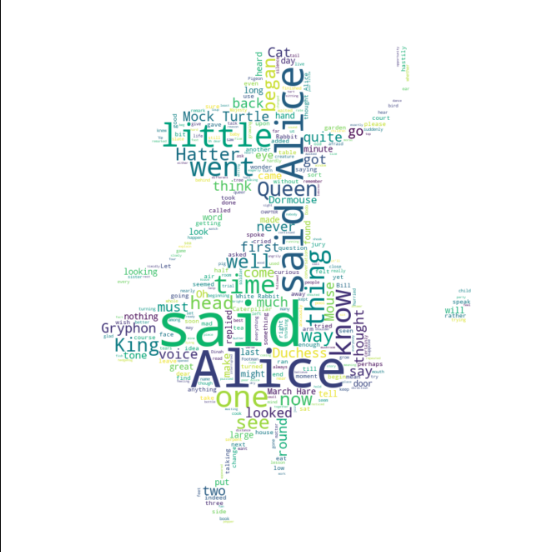
8. 토큰화
8-1) 문장 토큰화
from nltk import sent_tokenize
text_sample = 'The Matrix is everywhere its all around us, here even in this room.  \
              You can see it out your window or on your television. \
               You feel it when you go to work, or go to church or pay your taxes.'
sentences = sent_tokenize(text=text_sample)
print(type(sentences),len(sentences))
print(sentences)

### 출력 결과
<class 'list'> 3
['The Matrix is everywhere its all around us, here even in this room.', 'You can see it out your window or on your television.', 'You feel it when you go to work, or go to church or pay your taxes.']
8-2) 단어 토큰화
from nltk import word_tokenize

sentence = "The Matrix is everywhere its all around us, here even in this room."
words = word_tokenize(sentence)
print(type(words), len(words))
print(words)

### 출력 결과
<class 'list'> 15
['The', 'Matrix', 'is', 'everywhere', 'its', 'all', 'around', 'us', ',', 'here', 'even', 'in', 'this', 'room', '.']
8-3) 여러 문장들에 대한 단어 토큰화
# Type
def tokenize_text(text_sample):
    sentences = sent_tokenize(text_sample)
    word_tokens = [word_tokenize(sentence) for sentence in sentences]
    return word_tokens

word_tokens = tokenize_text(text_sample)
print(type(word_tokens),len(word_tokens))
print(word_tokens)

<class 'list'> 3
[['The', 'Matrix', 'is', 'everywhere', 'its', 'all', 'around', 'us', ',', 'here', 'even', 'in', 'this', 'room', '.'], ['You', 'can', 'see', 'it', 'out', 'your', 'window', 'or', 'on', 'your', 'television', '.'], ['You', 'feel', 'it', 'when', 'you', 'go', 'to', 'work', ',', 'or', 'go', 'to', 'church', 'or', 'pay', 'your', 'taxes', '.']]
8-4) n-gram
n-gram이란?
n-gram은 자연어 처리와 통계적 언어 모델링에서 사용되는 개념으로, 연속된 n개의 항목(일반적으로 단어나 문자)을 나타낸다.
여기서 항목은 일련의 요소를 의미하며, 주로 텍스트에서 발생하는 연속적인 단어나 문자열을 말한다.
종류
1. Unigram (1-gram):
- 텍스트에서 한 번에 하나의 단어나 문자를 나타내는 n-gram
- 예: "The", "quick", "brown", "fox"
2. Bigram (2-gram):
- 텍스트에서 두 개의 연속적인 단어나 문자를 나타내는 n-gram
- 예: "The quick", "quick brown", "brown fox"
3. Trigram (3-gram):
- 텍스트에서 세 개의 연속적인 단어나 문자를 나타내는 n-gram
- 예: "The quick brown", "quick brown fox"
4. N-gram (General N):
- n-gram에서 n은 임의의 숫자로, 텍스트에서 n개의 연속적인 단어나 문자를 나타냄
- 예: 4-gram, 5-gram 등
활용
언어 모델링(Language Modeling):
- n-gram은 문장의 확률을 예측하는 데 사용될 수 있다.
이전 n-1개의 단어(또는 문자)를 기반으로 다음 단어(또는 문자)의 확률을 추정하는 언어 모델을 구축하는 데 유용하다.텍스트 분류 및 정보 검색:
- n-gram은 텍스트 분류나 정보 검색에서 사용되어 특정 패턴을 찾거나 문맥을 이해하는 데 도움을 준다.
예를 들어, "not good"과 같은 bigram은 부정적인 문맥을 나타낼 수 있다.
예시
문장: "The quick brown fox jumps over the lazy dog"
1. Unigram:
- ["The", "quick", "brown", "fox", "jumps", "over", "the", "lazy", "dog"]
2. Bigram:
- ["The quick", "quick brown", "brown fox", "fox jumps", "jumps over", "over the", "the lazy", "lazy dog"]
3. Trigram:
- ["The quick brown", "quick brown fox", "brown fox jumps", "fox jumps over", "jumps over the", "over the lazy", "the lazy dog"]
4. 4-gram:
- ["The quick brown fox", "quick brown fox jumps", "brown fox jumps over", "fox jumps over the", "jumps over the lazy", "over the lazy dog"]
from nltk import ngrams

sentence = "The Matrix is everywhere its all around us, here even in this room."
words = word_tokenize(sentence)

all_ngrams = ngrams(words, 2)
ngrams = [ngram for ngram in all_ngrams]
print(ngrams)

### 출력 결과
[('The', 'Matrix'), ('Matrix', 'is'), ('is', 'everywhere'), ('everywhere', 'its'), ('its', 'all'), ('all', 'around'), ('around', 'us'), ('us', ','), (',', 'here'), ('here', 'even'), ('even', 'in'), ('in', 'this'), ('this', 'room'), ('room', '.')]
from nltk import ngrams
sentence = "The Matrix is everywhere its all around us, here even in this room."
words = word_tokenize(sentence)
all_ngrams = ngrams(words, 4)
ngrams = [ngram for ngram in all_ngrams]
print(ngrams)
### 출력 결과
[('The', 'Matrix', 'is', 'everywhere'), ('Matrix', 'is', 'everywhere', 'its'), ('is', 'everywhere', 'its', 'all'), ('everywhere', 'its', 'all', 'around'), ('its', 'all', 'around', 'us'), ('all', 'around', 'us', ','), ('around', 'us', ',', 'here'), ('us', ',', 'here', 'even'), (',', 'here', 'even', 'in'), ('here', 'even', 'in', 'this'), ('even', 'in', 'this', 'room'), ('in', 'this', 'room', '.')]9. 어간 추출 & 표제어 추출
어간 추출(Stemming)과 표제어 추출(Lemmatization)은 자연어 처리(NLP)에서 텍스트 전처리 과정 중 단어를 원형화하는 기법이다.
이 두 기법은 비슷한 목적을 가지고 있지만, 그 방식과 결과는 다소 다르다.
9-1) 어간 추출 (Stemming)
어간 추출이란?
어간 추출은 단어의 어간(stem)을 추출하는 과정이다.
어간은 단어의 의미를 담고 있는 핵심 부분으로, 접사(suffix)가 제거된 형태아다.
어간 추출은 규칙 기반 알고리즘을 사용하여 단어를 변형시키거나 접사를 제거하여 얻는다.
이 과정에서는 어간 추출기가 특정 규칙을 따라 단어를 자르고 변형시킨다.
영어에서는 Porter 알고리즘과 Snowball 알고리즘이 널리 사용된다.
예를 들어, "running", "runs", "runner" 등의 단어는 모두 "run"이라는 어간으로 축소될 수 있다.
from nltk.stem import LancasterStemmer
stemmer = LancasterStemmer()

print(stemmer.stem('working'),stemmer.stem('works'),stemmer.stem('worked'))
print(stemmer.stem('amusing'),stemmer.stem('amuses'),stemmer.stem('amused'))
print(stemmer.stem('happier'),stemmer.stem('happiest'))
print(stemmer.stem('fancier'),stemmer.stem('fanciest'))

### 출력 결과
work work work
amus amus amus
happy happiest
fant fanciest
9-2) 표제어 추출 (Lemmatization)
표제어 추출이란?
표제어 추출은 단어의 표준 형태인 표제어(lemma)를 찾는 과정이다.
표제어는 사전에 등재된 단어의 기본 형태를 의미한다.
표제어 추출은 단어의 철자, 문법적 속성, 의미 등을 고려하여 변환한다.
따라서 표제어 추출은 문맥을 고려한 정확한 처리를 수행할 수 있다.
영어에서는 WordNet과 같은 사전 기반의 접근 방식이 사용된다.
예를 들어, "am", "are", "is" 등의 단어는 모두 "be"라는 표제어로 변환될 수 있다.
from nltk.stem import WordNetLemmatizer

lemma = WordNetLemmatizer()
print(lemma.lemmatize('amusing','v'),lemma.lemmatize('amuses','v'),lemma.lemmatize('amused','v'))
print(lemma.lemmatize('happier','a'),lemma.lemmatize('happiest','a'))
print(lemma.lemmatize('fancier','a'),lemma.lemmatize('fanciest','a'))

### 출력 결과
amuse amuse amuse
happy happy
fancy fancy
차이점
출력 결과의 정확도:
- 표제어 추출은 사전을 기반으로 정확한 변환을 수행하므로 출력이 보다 정확하다.
반면 어간 추출은 단순히 접사를 제거하는 방식이기 때문에 결과가 정확하지 않을 수 있다.계산 비용:
표제어 추출은 복잡한 알고리즘과 사전 조회에 의존하여 계산 비용이 어간 추출보다 더 크다.
적용 분야:
어간 추출은 속도가 빠르고 단순한 전처리가 필요한 경우에 유용하며, 표제어 추출은 정확한 문맥을 요구하는 자연어 처리 작업에 적합하다.
예시
어간 추출 예시:
- Input: running, runs, runner
- Output: run
표제어 추출 예시:
- Input: am, are, is
- Output: be
사용 사례
- 검색 엔진
- 텍스트 마이닝
- 정보 검색
- 문서 분류
- 감성 분석 등
10. Bag-of-Words
Bag-of-Words란?
Bag-of-Words (BoW)는 자연어 처리에서 가장 기본적이고 간단한 텍스트 표현 방법 중 하나아다.
이 방법은 문서를 단어의 집합으로 표현하고, 각 단어의 발생 빈도를 벡터로 나타내는 방식이다.
Bag-of-Words의 특징
1. 단어 순서 무시:
- Bag-of-Words 모델은 단어들이 문서에서 나타나는 순서를 무시하고 각 단어의 발생 빈도만을 고려함.
따라서 문맥 정보가 유실될 수 있음.2. 희소 표현:
보통 많은 수의 단어가 존재하므로, 각 문서는 매우 큰 차원의 희소 벡터로 표현됨.
이는 저장과 연산에서 비효율적일 수 있음.3. 단어 빈도 기반:
각 단어의 발생 빈도가 중요한 정보로 사용ㄷ함.
일반적으로 단어가 많이 나오면 중요하다고 가정함.
Bag-of-Words 생성 과정
1. 단어 토큰화(Tokenization):
- 문서에서 단어를 추출하고 각 단어를 토큰으로 분리
2. 단어 사전 구축:
- 모든 문서에서 등장하는 고유한 단어들의 집합을 생성
- 이를 통해 각 단어에 고유한 인덱스를 부여
3. 표현 생성:
- 각 문서에 대해 단어가 등장한 횟수를 카운트하여 벡터로 표현
- 예를 들어, 단어의 인덱스를 기준으로 발생 빈도를 카운트하여 벡터를 생성함
Bag-of-Words 예시
- 문서 1: "The cat sat on the mat"
- 문서 2: "The dog ate my homework"
단어 토큰화 후 단어 사전 구축:
- 단어 사전: {"The": 1, "cat": 2, "sat": 3, "on": 4, "the": 5, "mat": 6, "dog": 7, "ate": 8, "my": 9, "homework": 10}
각 문서의 Bag-of-Words 표현:
- 문서 1: [1, 1, 1, 1, 2, 1, 0, 0, 0, 0] (The: 1번, cat: 1번, sat: 1번, on: 1번, the: 2번, mat: 1번)
- 문서 2: [1, 0, 0, 0, 1, 0, 1, 1, 1, 1] (The: 1번, dog: 1번, ate: 1번, my: 1번, homework: 1번)
사용 사례
- 문서 분류(Classification)
- 정보 검색(Information Retrieval)
- 감성 분석(Sentiment Analysis)
- 토픽 모델링(Topic Modeling) 등
import numpy as np
from sklearn.feature_extraction.text import CountVectorizer

# NLP 혹은 tokenizer 기능까지는 아니고, string에서 whitespace로 구분된 영역들을 벡터로 추출해줌.
count = CountVectorizer()
CountVectorizer:
단어들의 카운트(출현 빈도(frequency))로 여러 문서들을 벡터화
카운트 행렬, 단어 문서 행렬 (Term-Document Matrix, TDM))
모두 소문자로 변환시키기 때문에 me 와 Me 는 모두 같은 특성이 된다.
docs = np.array([
    'The moon is dark',
    'The weatherforecast is sweet',
    'The moon is dark and the weatherforecast is sweet'
])

bag = count.fit_transform(docs)
fit_transform() & transform()
fit_transform()과 transform()은 머신러닝에서 데이터 전처리와 관련된 메서드
주로 데이터 변환 작업에서 사용되며, 주로 데이터 스케일링, 특성 추출, 텍스트 처리 등에 적용
fit_transform()
fit_transform() 메서드는 데이터의 변환을 위해 사용
주로 데이터 변환기(Transformers) 클래스의 인스턴스에서 사용
- Fit: 주어진 데이터를 기반으로 변환기가 내부 매개변수(예: 평균, 분산 등)를 학습합니다.
- Transform: 학습된 매개변수를 사용하여 데이터를 변환합니다.
일반적으로 fit_transform()은 학습 데이터셋에 대해서만 사용
학습 데이터에서 매개변수를 학습하고, 동시에 해당 데이터를 변환하여 반환
예를 들어, 데이터 스케일링, PCA(주성분 분석)를 통한 차원 축소 등의 작업에서 사용
transform()
transform() 메서드는 이미 fit() 메서드를 통해 학습된 변환기를 사용하여 주어진 데이터를 변환하는 작업에 사용
학습 데이터에서 학습된 매개변수를 사용하여 새로운 데이터를 변환할 때 사용
차이점
fit_transform():
- 학습 데이터에 대해 fit()과 transform()을 한 번에 수행하는 편리한 메서드
- 학습 데이터에서 매개변수를 학습하고, 동시에 데이터를 변환하여 반환
transform():
- 이미 학습된 변환기를 사용하여 새로운 데이터를 변환하는 메서드
- 학습 데이터에서 학습된 매개변수를 사용하여 변환만 수행
# 단어집의 콘텐츠를 나타낸다. value값은 인덱스를 나타낸다.
print(count.vocabulary_)

### 출력 결과
{'the': 5, 'moon': 3, 'is': 2, 'dark': 1, 'weatherforecast': 6, 'sweet': 4, 'and': 0}

docs

### 출력 결과
array(['The moon is dark', 'The weatherforecast is sweet',
       'The moon is dark and the weatherforecast is sweet'], dtype='<U49')

# 단어집에 있는 단어들의 각각의 카운트 갯수를 나타낸다.
print(bag.toarray())

### 출력 결과
[[0 1 1 1 0 1 0]
 [0 0 1 0 1 1 1]
 [1 1 2 1 1 2 1]]
사이킷런 CountVectorizer 테스트
text_sample_01 = 'The Matrix is everywhere its all around us, here even in this room. \
                  You can see it out your window or on your television. \
                  You feel it when you go to work, or go to church or pay your taxes.'
text_sample_02 = 'You take the blue pill and the story ends.  You wake in your bed and you believe whatever you want to believe\
                  You take the red pill and you stay in Wonderland and I show you how deep the rabbit-hole goes.'
text=[]
text.append(text_sample_01); text.append(text_sample_02)
print(text,"\n", len(text))

### 출력 결과
['The Matrix is everywhere its all around us, here even in this room.                   You can see it out your window or on your television.                   You feel it when you go to work, or go to church or pay your taxes.', 'You take the blue pill and the story ends.  You wake in your bed and you believe whatever you want to believe                  You take the red pill and you stay in Wonderland and I show you how deep the rabbit-hole goes.']
 2
CountVectorizer객체 생성 후 fit(), transform()으로 텍스트에 대한 feature vectorization 수행
from sklearn.feature_extraction.text import CountVectorizer

# Count Vectorization으로 feature extraction 변환 수행.
# 단어 피처에 값을 부여할 때 각 문서에 해당 단어가 나타나는 횟수, 즉, count를 부여하는 경우
cnt_vect = CountVectorizer()
cnt_vect.fit(text)

# 학습 데이터로 fit( )된 CountVectorizer를 이용하여 테스트 데이터를 feature extraction 변환 수행.
# text 으로 완성한 어휘사전 기준으로 vectorize
ftr_vect = cnt_vect.transform(text)
피처 벡터화 후 데이터 유형 및 여러 속성 확인
print(type(ftr_vect), ftr_vect.shape)
print(ftr_vect)  ## tuple 로 구성된 csr_matrix 를 보여준다.

### 출력 결과
<class 'scipy.sparse.csr.csr_matrix'> (2, 51)
  (0, 0)	1
  (0, 2)	1
  (0, 6)	1
  (0, 7)	1
  (0, 10)	1
  (0, 11)	1
  (0, 12)	1
  (0, 13)	2
  (0, 15)	1
  (0, 18)	1
  (0, 19)	1
  (0, 20)	2
  (0, 21)	1
  (0, 22)	1
  (0, 23)	1
  (0, 24)	3
  (0, 25)	1
  (0, 26)	1
  (0, 30)	1
  (0, 31)	1
  (0, 36)	1
  (0, 37)	1
  (0, 38)	1
  (0, 39)	1
  (0, 40)	2
  :	:
  (1, 1)	4
  (1, 3)	1
  (1, 4)	2
  (1, 5)	1
  (1, 8)	1
  (1, 9)	1
  (1, 14)	1
  (1, 16)	1
  (1, 17)	1
  (1, 18)	2
  (1, 27)	2
  (1, 28)	1
  (1, 29)	1
  (1, 32)	1
  (1, 33)	1
  (1, 34)	1
  (1, 35)	2
  (1, 38)	4
  (1, 40)	1
  (1, 42)	1
  (1, 43)	1
  (1, 44)	1
  (1, 47)	1
  (1, 49)	7
  (1, 50)	1

print(cnt_vect.vocabulary_)

### 출력 결과
{'the': 38, 'matrix': 22, 'is': 19, 'everywhere': 11, 'its': 21, 'all': 0, 'around': 2, 'us': 41, 'here': 15, 'even': 10, 'in': 18, 'this': 39, 'room': 30, 'you': 49, 'can': 6, 'see': 31, 'it': 20, 'out': 25, 'your': 50, 'window': 46, 'or': 24, 'on': 23, 'television': 37, 'feel': 12, 'when': 45, 'go': 13, 'to': 40, 'work': 48, 'church': 7, 'pay': 26, 'taxes': 36, 'take': 35, 'blue': 5, 'pill': 27, 'and': 1, 'story': 34, 'ends': 9, 'wake': 42, 'bed': 3, 'believe': 4, 'whatever': 44, 'want': 43, 'red': 29, 'stay': 33, 'wonderland': 47, 'show': 32, 'how': 17, 'deep': 8, 'rabbit': 28, 'hole': 16, 'goes': 14}

cnt_vect = CountVectorizer(max_features=5, stop_words='english')
cnt_vect.fit(text)
ftr_vect = cnt_vect.transform(text)
print(type(ftr_vect), ftr_vect.shape)
print(cnt_vect.vocabulary_)

### 출력 결과
<class 'scipy.sparse.csr.csr_matrix'> (2, 5)
{'window': 4, 'pill': 1, 'wake': 2, 'believe': 0, 'want': 3}
ngram_range 확인
cnt_vect = CountVectorizer(ngram_range=(1,3))
cnt_vect.fit(text)
ftr_vect = cnt_vect.transform(text)
print(type(ftr_vect), ftr_vect.shape)
print(cnt_vect.vocabulary_)

### 출력 결과
<class 'scipy.sparse.csr.csr_matrix'> (2, 201)
{'the': 129, 'matrix': 77, 'is': 66, 'everywhere': 40, 'its': 74, 'all': 0, 'around': 11, 'us': 150, 'here': 51, 'even': 37, 'in': 59, 'this': 140, 'room': 106, 'you': 174, 'can': 25, 'see': 109, 'it': 69, 'out': 90, 'your': 193, 'window': 165, 'or': 83, 'on': 80, 'television': 126, 'feel': 43, 'when': 162, 'go': 46, 'to': 143, 'work': 171, 'church': 28, 'pay': 93, 'taxes': 125, 'the matrix': 132, 'matrix is': 78, 'is everywhere': 67, 'everywhere its': 41, 'its all': 75, 'all around': 1, 'around us': 12, 'us here': 151, 'here even': 52, 'even in': 38, 'in this': 60, 'this room': 141, 'room you': 107, 'you can': 177, 'can see': 26, 'see it': 110, 'it out': 70, 'out your': 91, 'your window': 199, 'window or': 166, 'or on': 86, 'on your': 81, 'your television': 197, 'television you': 127, 'you feel': 179, 'feel it': 44, 'it when': 72, 'when you': 163, 'you go': 181, 'go to': 47, 'to work': 148, 'work or': 172, 'or go': 84, 'to church': 146, 'church or': 29, 'or pay': 88, 'pay your': 94, 'your taxes': 196, 'the matrix is': 133, 'matrix is everywhere': 79, 'is everywhere its': 68, 'everywhere its all': 42, 'its all around': 76, 'all around us': 2, 'around us here': 13, 'us here even': 152, 'here even in': 53, 'even in this': 39, 'in this room': 61, 'this room you': 142, 'room you can': 108, 'you can see': 178, 'can see it': 27, 'see it out': 111, 'it out your': 71, 'out your window': 92, 'your window or': 200, 'window or on': 167, 'or on your': 87, 'on your television': 82, 'your television you': 198, 'television you feel': 128, 'you feel it': 180, 'feel it when': 45, 'it when you': 73, 'when you go': 164, 'you go to': 182, 'go to work': 49, 'to work or': 149, 'work or go': 173, 'or go to': 85, 'go to church': 48, 'to church or': 147, 'church or pay': 30, 'or pay your': 89, 'pay your taxes': 95, 'take': 121, 'blue': 22, 'pill': 96, 'and': 3, 'story': 118, 'ends': 34, 'wake': 153, 'bed': 14, 'believe': 17, 'whatever': 159, 'want': 156, 'red': 103, 'stay': 115, 'wonderland': 168, 'show': 112, 'how': 56, 'deep': 31, 'rabbit': 100, 'hole': 54, 'goes': 50, 'you take': 187, 'take the': 122, 'the blue': 130, 'blue pill': 23, 'pill and': 97, 'and the': 6, 'the story': 138, 'story ends': 119, 'ends you': 35, 'you wake': 189, 'wake in': 154, 'in your': 64, 'your bed': 194, 'bed and': 15, 'and you': 8, 'you believe': 175, 'believe whatever': 18, 'whatever you': 160, 'you want': 191, 'want to': 157, 'to believe': 144, 'believe you': 20, 'the red': 136, 'red pill': 104, 'you stay': 185, 'stay in': 116, 'in wonderland': 62, 'wonderland and': 169, 'and show': 4, 'show you': 113, 'you how': 183, 'how deep': 57, 'deep the': 32, 'the rabbit': 134, 'rabbit hole': 101, 'hole goes': 55, 'you take the': 188, 'take the blue': 123, 'the blue pill': 131, 'blue pill and': 24, 'pill and the': 98, 'and the story': 7, 'the story ends': 139, 'story ends you': 120, 'ends you wake': 36, 'you wake in': 190, 'wake in your': 155, 'in your bed': 65, 'your bed and': 195, 'bed and you': 16, 'and you believe': 9, 'you believe whatever': 176, 'believe whatever you': 19, 'whatever you want': 161, 'you want to': 192, 'want to believe': 158, 'to believe you': 145, 'believe you take': 21, 'take the red': 124, 'the red pill': 137, 'red pill and': 105, 'pill and you': 99, 'and you stay': 10, 'you stay in': 186, 'stay in wonderland': 117, 'in wonderland and': 63, 'wonderland and show': 170, 'and show you': 5, 'show you how': 114, 'you how deep': 184, 'how deep the': 58, 'deep the rabbit': 33, 'the rabbit hole': 135, 'rabbit hole goes': 102}
11. 문서 단어 행렬
문서 단어 행렬이란?
문서 단어 행렬(Document-Term Matrix, DTM)은 자연어 처리에서 텍스트를 수치화하는 중요한 방법 중 하나이.
DTM은 문서 집합을 단어의 출현 빈도를 기반으로 표현한 행렬이.
각 행은 개별 문서를 나타내고, 각 열은 단어를 나타낸.
따라서 DTM은 각 문서에 대해 단어의 출현 빈도를 표현하는 행렬이.
DTM 구성 요소
1. 행 (Rows):
- 각 문서를 나타냄
- 일반적으로 하나의 문서가 하나의 행에 해당
2. 열 (Columns):
- 각 단어를 나타냄
- 전체 문서 집합에서 사용된 모든 고유한 단어들이 열로 표현
3. 셀 값 (Cell Values):
- 각 셀에는 해당 단어가 해당 문서에서 등장한 횟수(빈도)가 저장
때로는 이를 단어의 TF-IDF 값(Term Frequency-Inverse Document Frequency)으로 대체하기도함
DTM 예시 1)
문서 1: "The cat sat on the mat"
문서 2: "The dog ate my homework"
이 문서들을 DTM으로 표현하면 다음과 같다:위 DTM에서 각 행은 각각의 문서를 나타내며, 각 열은 문서 전체에서 등장한 단어들을 나타낸다. 예를 들어, "The"는 모든 문서에서 등장했기 때문에 각 행에서 1로 표시된다. "dog"는 문서 2에서만 등장했기 때문에 문서 2의 해당 열만 1로 표시된다.
The cat sat on mat dog ate my homework 1 1 1 1 1 1 0 0 0 0 2 1 0 0 0 0 1 1 1 1
DTM 예시 2)
문서1 : 먹고 싶은 사과
문서2 : 먹고 싶은 바나나
문서3 : 길고 노란 바나나 바나나
문서4 : 저는 과일이 좋아요
과일이 길고 노란 먹고 바나나 사과 싶은 저는 좋아요 문서1 0 0 0 1 0 1 1 0 0 문서2 0 0 0 1 1 0 1 0 0 문서3 0 1 1 0 2 0 0 0 0 문서4 1 0 0 0 0 0 0 1 1
DTM의 활용
문서 분류(Classification):
- 각 문서를 벡터화하여 머신러닝 알고리즘에 입력으로 사용
정보 검색(Information Retrieval):
- 검색 쿼리와 문서들을 비교하기 위해 사용
토픽 모델링(Topic Modeling):
- 단어 출현 빈도를 기반으로 문서의 토픽을 추론하는 데 사용
감성 분석(Sentiment Analysis):
- 각 단어의 출현 빈도를 분석하여 문서의 감성을 판별하는 데 사용
주의사항
희소성(Sparsity):
- DTM은 일반적으로 매우 희소한 행렬이다.
- 즉, 대부분의 셀이 0이고, 실제 단어 출현 빈도가 많이 발생한 몇 개의 셀만 비어 있지 않다.
단어의 중요도:
- 일반적으로 많이 등장하는 단어들이 문맥을 이해하는 데 중요할 수 있지만, 특정 도메인이나 분석 목적에 따라 불용어(stopwords)를 제거하거나 TF-IDF와 같은 가중치를 적용하여 중요도를 조정해야 할 수도 있다.
12. tf-idf
tf-idf란?
TF-IDF(Term Frequency-Inverse Document Frequency)는 정보 검색과 텍스트 마이닝에서 사용되는 중요한 가중치 지표이다.
이는 각 단어가 문서 내에서 얼마나 중요한지를 평가하는 데 사용돤다.
TF-IDF는 "단어의 빈도(term frequency)"와 "역 문서 빈도(inverse document frequency)"의 곱으로 계산된다.
TF (단어의 빈도, Term Frequency)
TF는 특정 단어가 문서 내에서 얼마나 자주 등장하는지를 나타내는 지표이다.
일반적으로 문서의 각 단어들에 대해 다음과 같이 계산된다:
여기서:
- 는 단어 가 문서 에 등장한 횟수
- 는 문서 에 포함된 모든 단어들의 등장 횟수의 합
즉, TF는 각 문서에서 특정 단어의 상대적인 등장 빈도를 계산한다.
일반적으로 문서 내에서 많이 나타나는 단어는 중요도가 높다고 가정한다.
IDF (역 문서 빈도, Inverse Document Frequency)
IDF는 특정 단어가 전체 문서 집합에서 얼마나 중요한지를 나타내는 지표이다.
IDF는 다음과 같이 계산된다:
여기서:
- 는 전체 문서의 수
- 는 단어 가 포함된 문서의 수
IDF는 단어가 전체 문서 중에서 얼마나 희귀한지를 나타낸다.
즉, 자주 등장하지 않는 단어일수록 IDF 값이 크다.
TF-IDF 계산
TF-IDF는 TF와 IDF의 곱으로 계산된니다:
- TF-IDF는 특정 단어가 특정 문서에서 얼마나 중요한지를 측정하는 방법으로 사용된다.
- TF-IDF 값이 크면 해당 단어가 특정 문서에서 중요하다는 것을 의미하며, TF-IDF 값이 작으면 단어의 중요도가 낮다는 것을 나타낸다.
TF-IDF의 사용
- 정보 검색: 검색 쿼리와 문서 간의 유사성 측정에 사용
- 문서 분류: 각 단어의 중요도를 기준으로 문서를 분류하는 데 사용
- 텍스트 마이닝: 특정 단어들의 패턴을 분석하고 문서들 사이의 관계를 파악하는 데 사용
from sklearn.feature_extraction.text import TfidfTransformer
tfidf = TfidfTransformer()
np.set_printoptions(precision=2)
# tf-idf를 계산한 행렬을 나타낸다.
print(tfidf.fit_transform(count.fit_transform(docs)).toarray())

### 출력 결과
[[0.   0.56 0.43 0.56 0.   0.43 0.  ]
 [0.   0.   0.43 0.   0.56 0.43 0.56]
 [0.4  0.31 0.48 0.31 0.31 0.48 0.31]]
