이번 시간에는 RNN의 연장선인 Bidirectional에 대하여 알아보겠습니다.
코드예제
import numpy as np
from sklearn.metrics import accuracy_score
import torch
import torch.nn as nn
import torch.optim as optim
import random

random.seed(333)
np.random.seed(333)
torch.manual_seed(333) #토치 고정
torch.cuda.manual_seed(333) #gpu 고정

# USE_CUDA = torch.cuda.is_available()
# DEVICE = torch.device('cuda:0'if USE_CUDA else 'cpu')
# print('torch' , torch.__version__, '사용DEVICE : ', DEVICE)

DEVICE = 'cuda:0' if torch.cuda.is_available else 'cpu'
print(DEVICE)


#1. 데이터
datasets = np.array([1,2,3,4,5,6,7,8,9,10])

x = np.array([[1,2,3],
             [2,3,4],
             [3,4,5],
             [4,5,6],
             [5,6,7],
             [6,7,8],
             [7,8,9]])

y = np.array([4,5,6,7,8,9,10])

print(x.shape, y.shape) #(7, 3) (7,)

x = x.reshape(x.shape[0], x.shape[1], 1)
print(x.shape) #(7, 3, 1)

x = torch.FloatTensor(x).to(DEVICE)
y = torch.FloatTensor(y).to(DEVICE)
print(x.shape, y.size()) #torch.Size([7, 3, 1]) torch.Size([7])

from torch.utils.data import TensorDataset #x, y 합친다
from torch.utils.data import DataLoader # batch정의

train_set = TensorDataset(x,y)

train_loader = DataLoader(train_set, batch_size=2, shuffle=True)

# aaa = iter(train_loader)
# bbb = next(aaa) #aaa.next()

# print(bbb)
# # [tensor([[[5.],
# #          [6.],
# #          [7.]],

# #         [[6.],
# #          [7.],
# #          [8.]]], device='cuda:0'), tensor([8., 9.], device='cuda:0')]
# print(bbb[0].size()) #torch.Size([2, 3, 1])

#2. 모델
class RNN(nn.Module):
    def __init__(self):
        super().__init__()
        self.cell = nn.RNN(input_size=1, #피쳐갯수
                           hidden_size=32, #아웃풋 노드의 갯수
                           num_layers=1, # 전설 : 디폴트 아니면 3, 5 좋아.
                           batch_first=True, # batch first를 적용하지 않으면 연산의 결과가 (2, 3, 1) -> (3 ,2, 1)로 출력됨
                           bidirectional=True
                           ) # (3, N, 1) -> (N, 3, 1) -> (N, 3, 32)
        self.fc1 = nn.Linear(3*32*2, 16) # (N, 3*32) -> (N,16)
        self.fc2 = nn.Linear(16, 8) # (N, 16) -> (N, 8)
        self.fc3 = nn.Linear(8, 1) # (N, 8) -> (N, 1)
        self.relu = nn.ReLU()
        self.dropout = nn.Dropout()

    def forward(self, x):
        #model.add(SimpleRNN(32, input_shape=(3,1)))
        # x, hidden_state = self.cell(x)
        x, h0 = self.cell(x)
        # x, _ = self.cell(x)
        x = self.relu(x)
        x = x.contiguous()
        x = x.view(-1, 3*32*2)
        x = self.fc1(x)
        x = self.relu(x)
        x = self.fc2(x)
        x = self.fc3(x)
        return x

model = RNN().to(DEVICE)

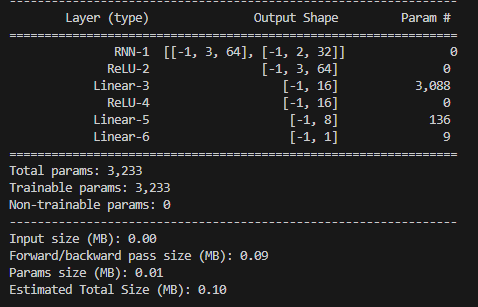
from torchsummary import summary
summary(model, (3, 1))

#3. 컴파일 훈련

criterion = nn.MSELoss()
optimizer = optim.Adam(model.parameters(), lr=0.01)

def train(model, criterion, optimizer, loader):
    epoch_loss = 0

    model.train()

    for x_batch, y_batch in loader:
        x_batch, y_batch = x_batch.to(DEVICE), y_batch.to(DEVICE).float().view(-1, 1) #백터형태를 매트릭스로 변환

        optimizer.zero_grad() # 기울기 0으로 초기화

        hypothesis = model(x_batch)
        loss = criterion(hypothesis, y_batch) # 여기까지 순전파

        loss.backward() # 기울기 계산 역전파 시작
        optimizer.step() # 가중치 갱신

        epoch_loss += loss.item()
    return epoch_loss / len(loader)


def evaluate(model, criterion, loader):
    epoch_loss = 0

    model.eval()

    with torch.no_grad():

        for x_batch, y_batch in loader:
            x_batch, y_batch = x_batch.to(DEVICE), y_batch.to(DEVICE).float().view(-1, 1) #백터형태를 매트릭스로 변환

            # optimizer.zero_grad() # 기울기 0으로 초기화

            hypothesis = model(x_batch)
            loss = criterion(hypothesis, y_batch) # 여기까지 순전파

            # loss.backward() # 기울기 계산 역전파 시작
            # optimizer.step() # 가중치 갱신

            epoch_loss += loss.item()
    return epoch_loss / len(loader)

for epoch in range(1, 1001):
    loss = train(model, criterion, optimizer, train_loader)

    if epoch %20 == 0 : # 20에포마다 학습
        print('epoch: {}, loss: {}'.format(epoch, loss))

#4. 평가 예측

x_predict = np.array([[8,9,10]])

def predict(model, data):
    model.eval()
    with torch.no_grad():
        data = torch.FloatTensor(data).unsqueeze(2).to(DEVICE) # (1,3) -> (1,3,1)

        y_predict = model(data)
    return y_predict.cpu().numpy()

y_predict = predict(model, x_predict)
print('---------------------------------------------------------')
print(y_predict)
print('---------------------------------------------------------')
print(y_predict[0])
print('---------------------------------------------------------')
print(f'{x_predict[0]}의 예측값 : {y_predict[0][0]}')
코드설명
모델
class RNN(nn.Module):
    def __init__(self):
        super().__init__()
        self.cell = nn.RNN(input_size=1, #피쳐갯수
                           hidden_size=32, #아웃풋 노드의 갯수
                           num_layers=1, # 전설 : 디폴트 아니면 3, 5 좋아.
                           batch_first=True, # batch first를 적용하지 않으면 연산의 결과가 (2, 3, 1) -> (3 ,2, 1)로 출력됨
                           bidirectional=True
                           ) # (3, N, 1) -> (N, 3, 1) -> (N, 3, 32)
        self.fc1 = nn.Linear(3*32*2, 16) # (N, 3*32) -> (N,16)
        self.fc2 = nn.Linear(16, 8) # (N, 16) -> (N, 8)
        self.fc3 = nn.Linear(8, 1) # (N, 8) -> (N, 1)
        self.relu = nn.ReLU()
        self.dropout = nn.Dropout()
  def forward(self, x):
        #model.add(SimpleRNN(32, input_shape=(3,1)))
        # x, hidden_state = self.cell(x)
        x, h0 = self.cell(x)
        # x, _ = self.cell(x)
        x = self.relu(x)
        x = x.contiguous()
        x = x.view(-1, 3*32*2)
        x = self.fc1(x)
        x = self.relu(x)
        x = self.fc2(x)
        x = self.fc3(x)
        return x
model = RNN().to(DEVICE)
from torchsummary import summary
summary(model, (3, 1))

매일 조금씩!