Sequential Data
- 시간의 흐름에 따른 패턴을 분석
순환 신경망 RNN(Recurrent Neural Networks)
- 입력들의 순차적이고 연속적인 데이터를 처리하고, 다음 입력의 시퀀스를 처리하는 동안 입력받은 데이터를 계속 유지하는 인공신경망 클래스
RNN을 위한 데이터 전처리
- 데이터 분할 1: x, y
- 스케일링
- x는 필수, y는 크면 최적화를 위해 ➡️ 평가시 원래값으로 복원
- 3차원 데이터셋 만들기
- 데이터분할 2: train, val
3차원 데이터셋 만들기
2차원 데이터셋(sliding window) ➡️ timesteps 단위로 잘라서 3차원 구조 생성
SimpleRNN Layer
노드 수 1개
- 레이어의 출력 형태 : timesteps * 노드 수
model = Sequential([Input(shape = (timesteps, nfeatures)),
					SimpleRNN(1, return_sequences=False),
                    Dense(1) ])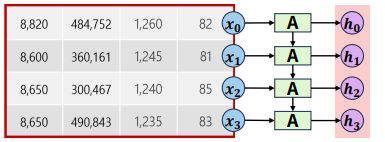
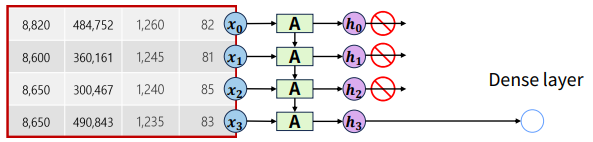
return_sequences: 출력 데이터를 다음 레이어에 전달할 크기 결정- True : 출력크기 그대로 전달 ➡️ timesteps * node수
- False : 가장 마지막(최근) hidden state 값만 전달 ➡️ 1 * node수
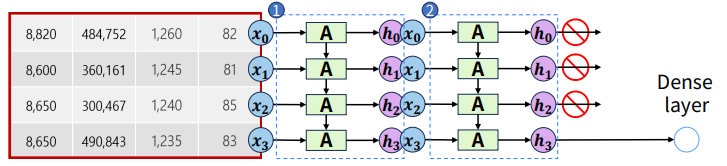
노드 수 여러개
model = Sequential([Input(shape = (timesteps, nfeatures)),
                    SimpleRNN(8, return_sequences = True),
                    SimpleRNN(4),
                    #Flatten(),
Dense(1)])return_sequences- 마지막을 제외한 모든 RNN Layer : True
- 마지막은 모두 사용 가능
- 단, True를 사용하려면
Flatten으로 펼친 후 Dense Layer로 연결
- 단, True를 사용하려면
- Flatten 펼치기 : 중간과정의 hidden state 값 2차원구조 ➡️ 1차원
LSTM (LongShort-Term Memory)
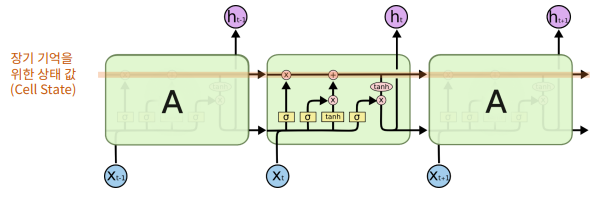
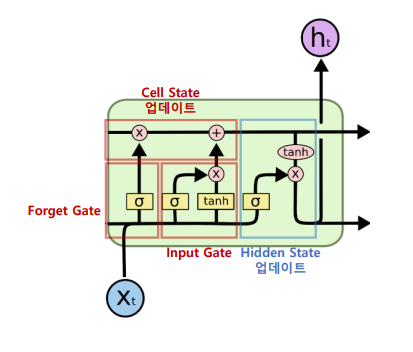
- time step 간에 두 종류의 상태 값 업데이트 관리
- hidden state 업데이트
- cell state 업데이트 : 긴 시퀀스 동안 정보를 보존하기 위한 상태 값이 추가됨
- Forgot Gate, Input Gate
💡 RNN의 장기 의존성(long-term dependencies) 문제
💡 긴 기간동안 정보 유지와 활용에 어려움
| Cell State 업뎃 | Hidden State 업뎃 |
|---|---|
| - 불필요한 과거는 잊어라(Forget Gate) - 현재 정보 중 중요한 것은 기억하라(Input Gate) - Input Gate 와 Forget Gate 을 결합해서 장기 기억 메모리에 태워라(Update) |
[업데이트된 Cell State]와 [input, 이전셀의 hidden state]으로 새 hidden state 값 생성해서 넘기기 |
RNN 모델링
# x, y 분리
x = data.loc[:,'AvgTemp']
y = data.loco[:,'y']

#스케일링
scaler = MinMaxScaler()
x = scaler.fit_trainsform(x)

#3차원 구조 만들기
x2, y2 = temporalize(x, y, 4)

#데이터 분할
# shuffle = False : 섞지마라, 랜덤분할 하지마라
# test_size : 소수=비율, 자연수=개수
x_train, x_val, y_train, y_val = train_test_split(x2, y2, test_size= 53, shuffle = False)

# 모델구조 설계
x_train.shape #(208,4,1)
timesteps = x_train.shape[1]
nfeatures = x_train.shape[2]

clear_session()

model = Sequential([Input(shape = (timesteps, nfeatures)),
                    SimpleRNN(8), #LSTM
                    Dense(1)])

model.summary()

#컴파일 & 학습
model.compile(optimizer = Adam(learning_rate = 0.01), loss = 'mse' )
history = model.fit(x_train, y_train, epochs = 100, validation_split = .2).history

#학습곡선
dl_history_plot(history)

# 예측
pred = model.predict(x_val)

# 평가
print(mean_absolute_error(y_val, pred))
print(mean_absolute_percentage_error(y_val, pred))
# 학습곡선 함수
def dl_history_plot(history):
plt.figure(figsize=(10,6))
plt.plot(history['loss'], label='train_err', marker = '.')
plt.plot(history['val_loss'], label='val_err', marker = '.')
plt.ylabel('Loss')
plt.xlabel('Epoch')
plt.legend()
plt.grid()
plt.show()
난 성미다.