Parameterizing Probaility Distribution
Probaility는 다음과 같은 특징을 가진다.
- non-negative:
- sum-to-one: or
일반적으로 non-negative 특징을 만족시키기는 어렵지 않다. (exponetial function, square function 등을 이용) 그러나 모든 probability의 합이 1이 되도록 모델링하는 것은 꽤나 어려운 일이다.
sum-to-one을 해결하기 위한 방법으로 normalizing 방법을 생각 할 수 있다.
위 식에서 를 normalize constant로 볼 수 있다. 위 식에 따르면, probability를 구하기 위해서는 의 integral을 구해야한다. 따라서 는 analytical integration이 되면 좋다. analytical integration이 되도록 를 설정한 대표적인 예시가 Exponential family distributions 이다.(Normal distributnion, Poisson distribution 등) 그러나 이는 꽤 큰 제약 사항으로 모델의 자유도를 떨어뜨린다.
Energy-based Model
다음은 energy-based model의 probability 식이다.
- ,
위 식에서 를 partition function이라고 부른다. 위 식이 energy-based model인 이유는 를 energy라고 부르기 떄문이다. 는 non-negative 성질을 만족하며, 매우 큰 variations에 대응하기 좋다.
Energy-based model은 아무 를 설정 할 수 있다는 점에서 매운 큰 자유도를 가지며 이는 큰 장점이다. 그러나 다음과 같은 단점을 갖는다.
- sampling from is hard
- evaluating and optimizing likelihood is hard
- no feature learning
또한 는 의 dimension이 커질 수록 필연적으로 computation 양이 많아지게 된다. 다행히 energy-based model을 를 모른 채로 이용할 수 있는 방법이 몇가지 존재한다.
Application of Energy-based Models
이 주어졌을 때, 두 probability의 ratio는 partition function을 필요로 하지 않는다.
이를 이용해 anomaly detection이나 denosing 같은 응용이 가능하다. (응용 케이스에 대한 설명들은 skip)
Training Intuition
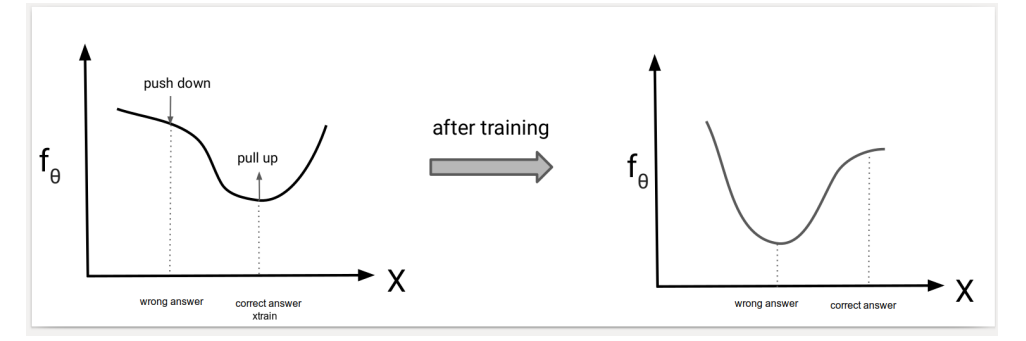
Energy-based model의 training 목표는 의 최대화 이다. (maximum likelihood) 최대화 방향은, 식의 분자를 크게 만들고 분모를 작게 만드는 방향이다. 직관적으로 model 는 에 대해 높은 값을 가져야 한다. 그러나 를 단순히 을 높이는 방향으로 학습하는 것이 이 다른 sample에 비해 상대적으로 높은 probability를 갖도록 하지는 못한다. 왜냐하면 는 normalize 되어있지 않기 때문이다. 따라서 학습은 의 값을 높이고 나머지 다른 sample들 ()의 값을 낮추 도록 학습 되어야 한다. 즉, wrong point에 대한 의 값은 push down을 하고 correct point에 대한 의 값은 pull up을 시켜야 한다.
Contrastive Divergence
앞서 말한 것처럼 partition function은 의 dimension이 커질 수록 연산이 어렵다. 따라서 이를 직접 evaluating 하는 것 대신 approximation하는 것이 좋다. 이때 Monte Carlo estimation을 이용할 수 있다. contrastive divergence algorithm은 Mote Carlo estimation을 이용해 gradient를 구한다.
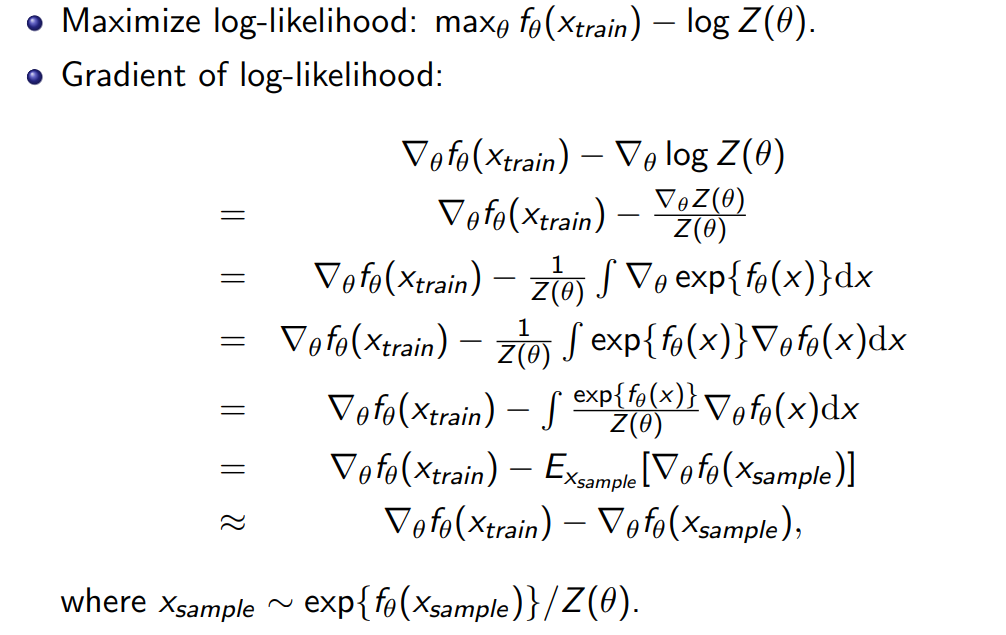
문제는 을 로 부터 구해야 한다는 것이다. 따라서 partiton function에 관계 없는 sampling이 필요하다.
Sampling from Energy-based Models
Energy-based model을 sampling 하는 것은 어렵다. 왜냐하면 autoregressive model이나 flow model 처럼 바로 sampling 하는 것이 어렵기 때문이다. (모델 외에 연산이 필요하다.) 그러나 enery-based model의 application에서 처럼, 두 samples를 비교하는 것은 쉽다. Markov Chain Monte Carlo(MCMC)를 이용하면 두 sample을 비교하는 방식으로 sampling이 가능하다. 아래는 MCMC 알고리즘 중 하나인 Metropolis-Hastings 을 이용한 sampling 과정이다.
- 를 random initialize.
- 이면,
- 반대의 경우 의 확률로
- 수렴할 떄 까지 2번 반복
그러나 위와 같은 방식은 이론적으로 가능하지만 현실적으로 수렴하는데 너무 많은 시간이 걸린다.
Reference