Evaluating estimators

deejayosamu·2025년 8월 3일

통계 기본 개념

목록 보기
16/20

MSE(Mean Squared Error)

MSE(θ^)=E(θ^θ)2MSE(\hat{\theta})=E(\hat{\theta}-\theta)^2

Bias

bias(θ^)=E(θ^)θbias(\hat{\theta})=E(\hat{\theta})-\theta

  • Some facts
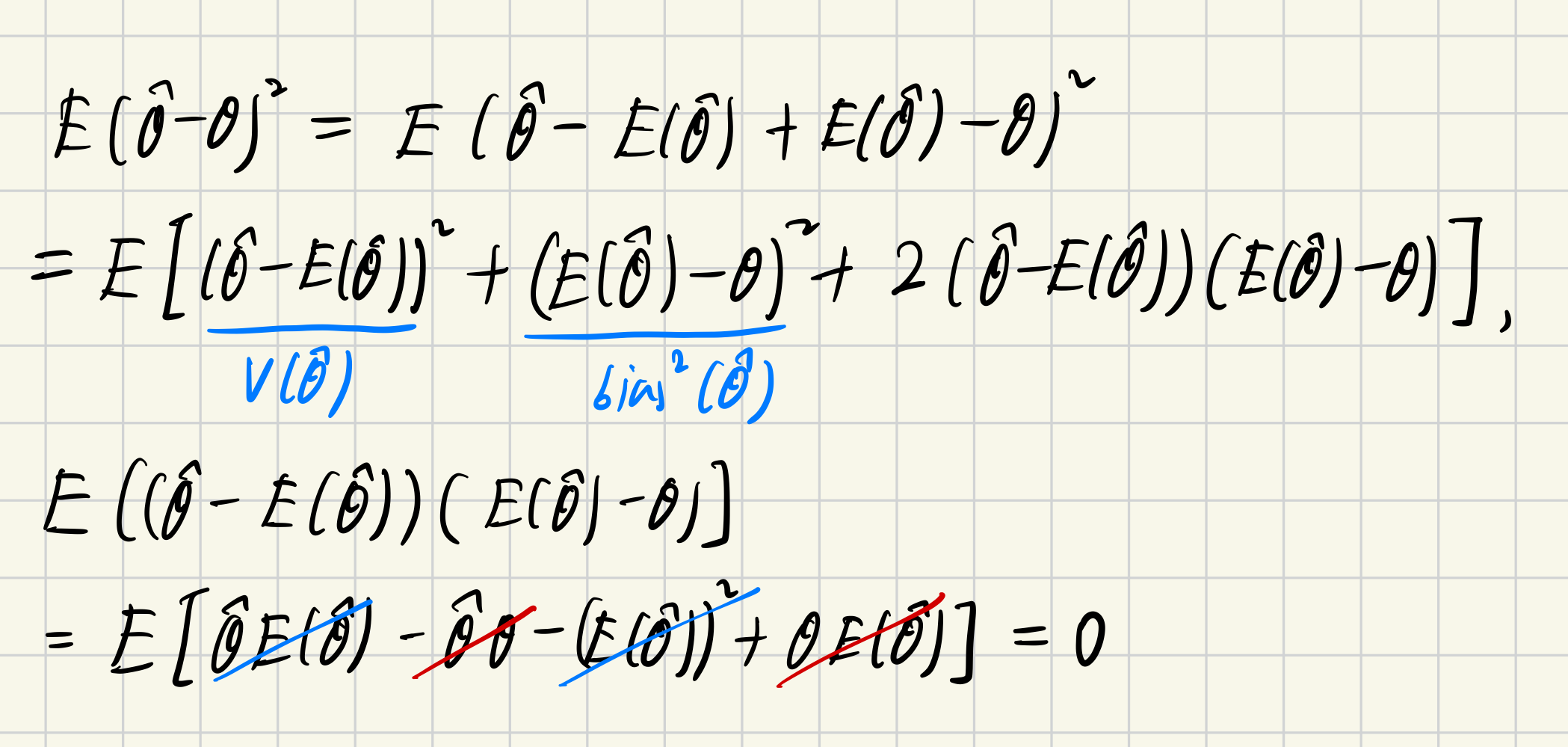
    MSE(θ^)=V(θ^)+bias2(θ^)MSE(\hat{\theta})=V(\hat{\theta})+bias^2(\hat{\theta})
    pf)
    mse-pf
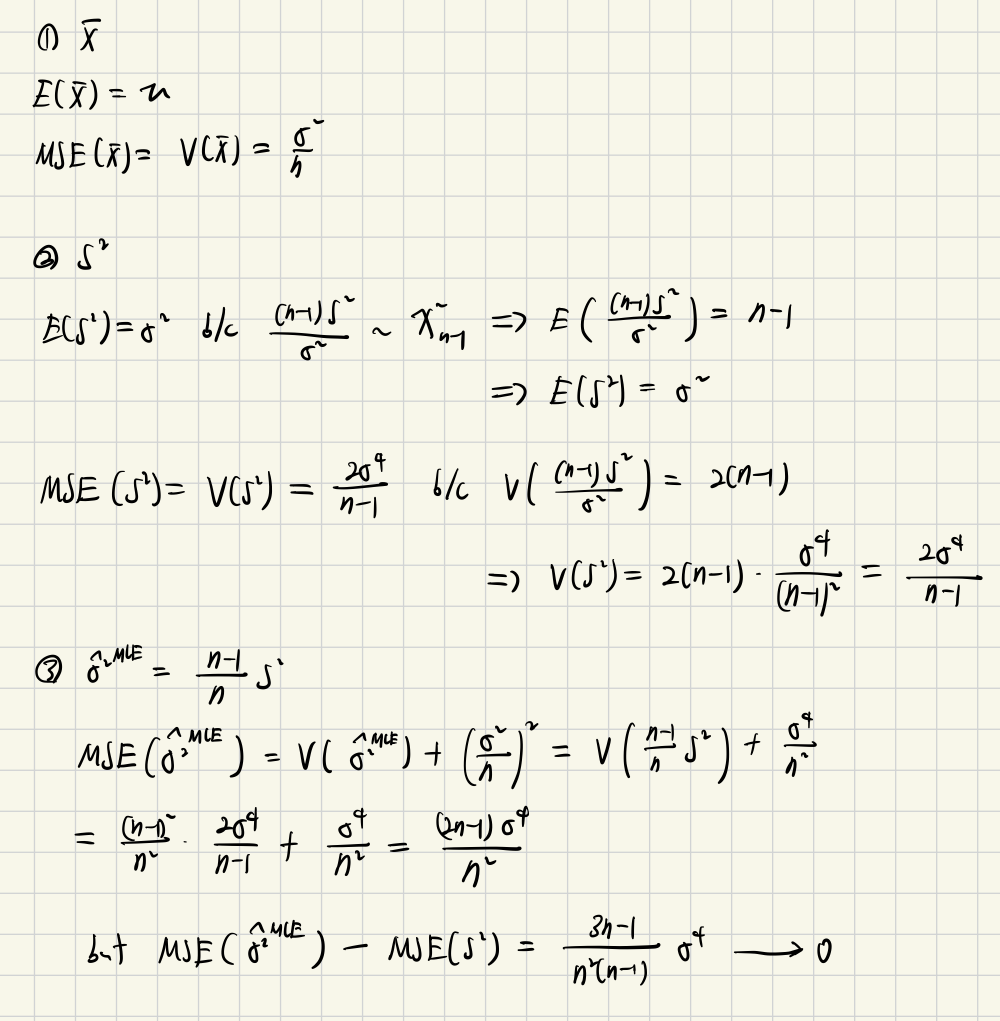
    ② If θ^\hat{\theta} : unbiased, MSE(θ^)=V(θ^)MSE(\hat{\theta})=V(\hat{\theta})

ex1) X1,...,XniidN(μ,σ2)X_1,...,X_n \overset{iid}{\sim} N(\mu,\sigma^2)
mse&bias-ex1

MVUE(Minimum Variance Unbiased Estimator)

Let Cτ={θ^:E(θ^)=τ(θ)}C_\tau= \{ \hat{\theta}: E(\hat{\theta})=\tau(\theta) \}

Def)
θ^\hat{\theta}^* is called MVUE if θ^Cτ,V(θ^)V(θ^)\forall \hat{\theta} \in C_\tau, V(\hat{\theta}^*) \leq V(\hat{\theta})
θ^\hat{\theta}^* is called UMVUE if θΩ,θ^\forall \theta \in \Omega, \hat{\theta}^* is MVUE

Theorem) Cramer-Rao inequality
Let X1,...,Xniidf(x;θ),θ^CτX_1,...,X_n \overset{iid}{\sim} f(x;\theta), \hat{\theta} \in C_\tau
If ddθf(x;θ)dx=ddθf(x;θ)dx\frac{d}{d \theta} \int f(x;\theta) dx= \int \frac{d}{d \theta} f(x;\theta) dx and V(θ^)<V(\hat{\theta})<\infty, then
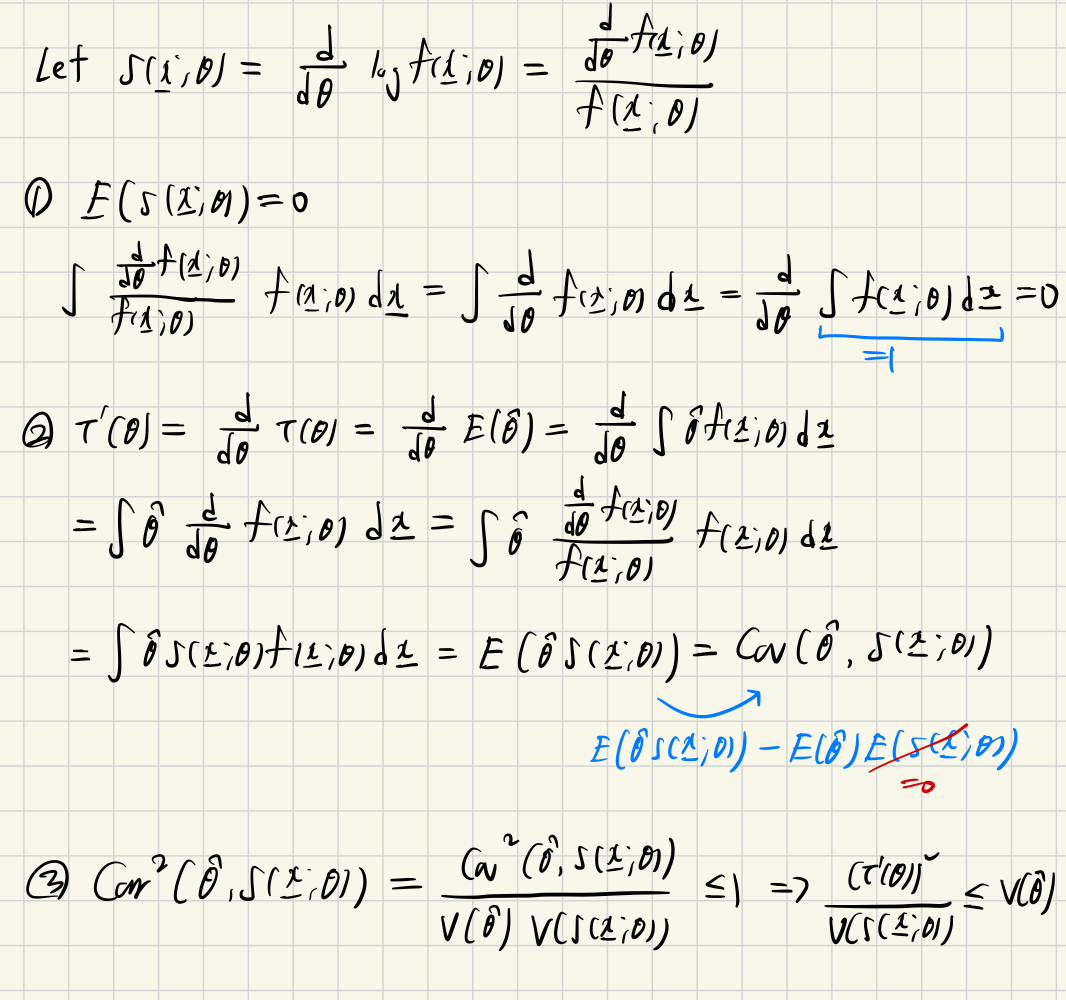
V(θ^)(τ(θ))2V(ddθlogf(x;θ))V(\hat{\theta}) \geq \frac{(\tau'(\theta))^2}{V(\frac{d}{d \theta}log f(\underline{x};\theta))}
pf)
cr-pf
✔︎ For iid case,
In(θ)=E[(ddθlogf(x;θ))2]=E[(iddθlogf(x1;θ))2]=nI(θ)I_n(\theta)=E[(\frac{d}{d \theta} log f(\underline{x};\theta))^2]=E[(\sum_i\frac{d}{d \theta} log f(x_1; \theta))^2]=nI(\theta)

Lemma)
Let s(x;θ)=ddθlogf(x;θ)s(x;\theta)=\frac{d}{d\theta} log f(x;\theta)
If ddθddθf(x;θ)dx=d2dθ2f(x;θ)dx,\frac{d}{d \theta} \int \frac{d}{d \theta} f(x;\theta) dx= \int \frac{d^2}{d \theta^2} f(x;\theta) dx, then
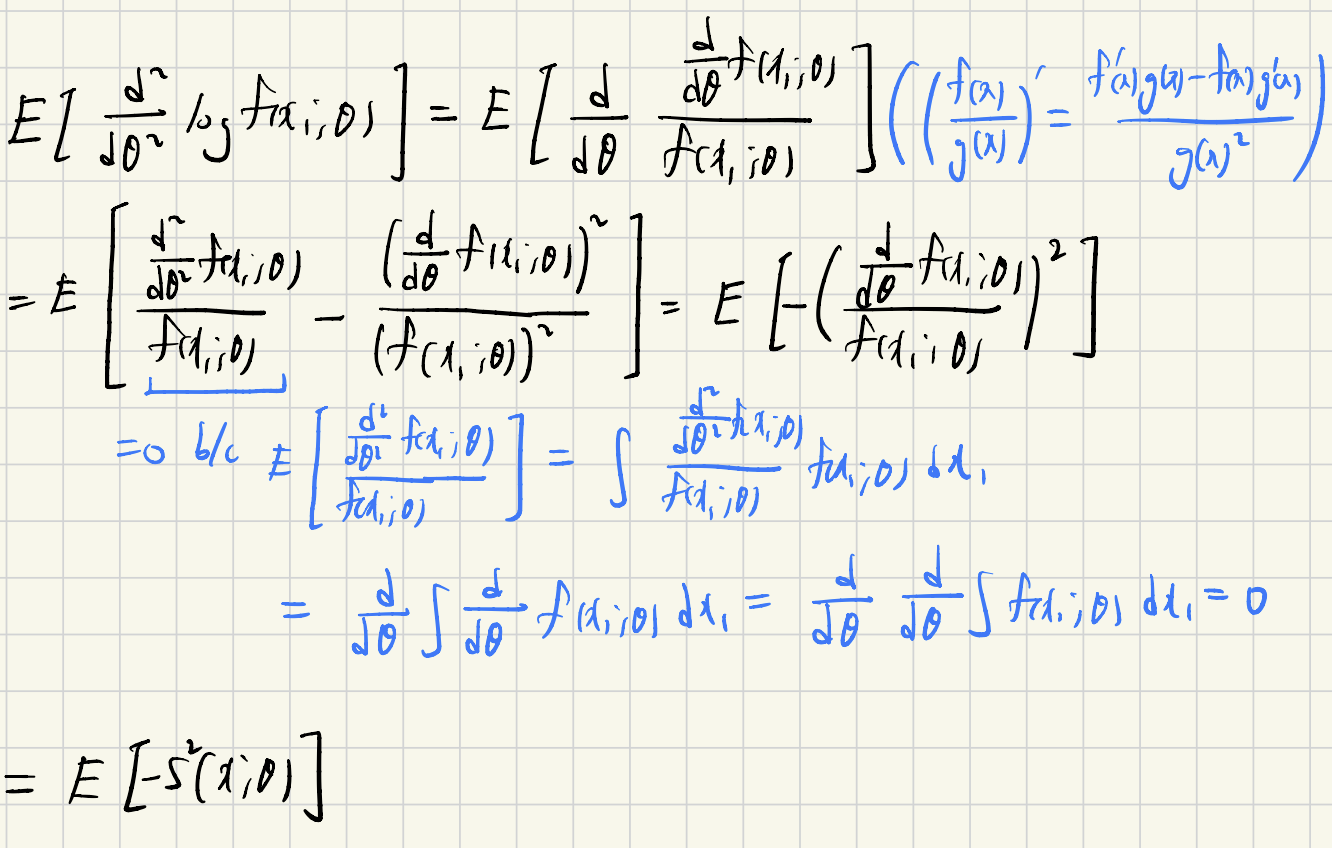
V(s(x1;θ))=E[(ddθlogf(x1;θ))2]=E(d2dθ2logf(x1;θ))V(s(x_1;\theta))=E[(\frac{d}{d\theta} log f(x_1;\theta))^2]=-E(\frac{d^2}{d \theta^2}log f(x_1;\theta))
pf)
lemma-pf

Remark)
If θ^\hat{\theta} is unbiased and V(θ^)=(τ(θ)2)In(θ)V(\hat{\theta})=\frac{(\tau'(\theta)^2)}{I_n(\theta)}, then θ^\hat{\theta} is UMVUE

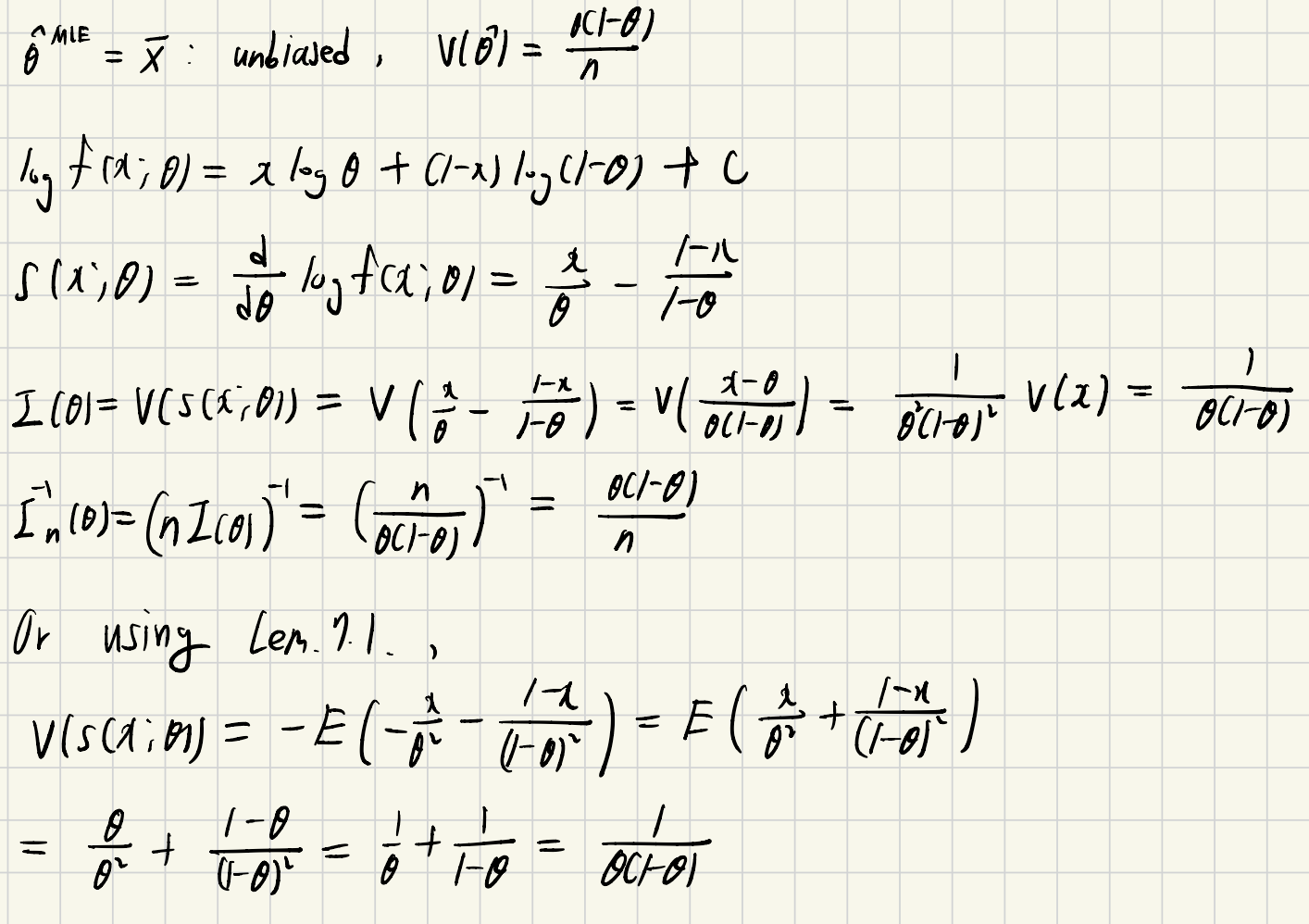
ex1) X1,...,Xniidb(1,θ)X_1,...,X_n \overset{iid}{\sim} b(1,\theta)
cr-ex1

Multivariate case of CR inequality

Let X1,...,Xniidf(x1,...,xn;θ)X_1,...,X_n \overset{iid}{\sim} f(x_1,...,x_n;\theta) and θ=(θ1,θ2)T\underline{\theta}=(\theta_1,\theta_2)^T

  • score vector
    s(x;θ1,θ2)=(θ1logf(x;θ1,θ2),θ2logf(x;θ1,θ2))Ts(\underline{x};\theta_1,\theta_2)=(\frac{\partial}{\partial \theta_1} log f(\underline{x};\theta_1,\theta_2), \frac{\partial}{\partial \theta_2} log f(\underline{x};\theta_1,\theta_2))^T
  • information
    I(θ1,θ2)=E(s(x;θ1,θ2)sT(x;θ1,θ2))=E(d2dθ2logf(x;θ))I(\theta_1,\theta_2)=E(s(\underline{x};\theta_1,\theta_2)s^T(\underline{x};\theta_1,\theta_2))=-E(\frac{d^2}{d \underline{\theta}^2} log f(\underline{x};\underline{\theta}))

    => If E(θ^)=θE(\hat{\underline{\theta}})=\underline{\theta},
    V(θ^)=(V(θ1^)Cov(θ1^,θ2^)Cov(θ1^,θ2^)V(θ2^))I1(θ1,θ2)V(\hat{\underline{\theta}})=\begin{pmatrix} V(\hat{\theta_1}) & Cov(\hat{\theta_1},\hat{\theta_2}) \\ Cov(\hat{\theta_1},\hat{\theta_2}) & V(\hat{\theta_2}) \\ \end{pmatrix} \geq I^{-1}(\theta_1,\theta_2)

    => If E(θ^)=(τ1(θ),τ2(θ))T,V(θ)A(θ)I1(θ)AT(θ) where A(θ)=(θ1τ1(θ1,θ2)θ2τ1(θ1,θ2)θ1τ2(θ1,θ2)θ2τ2(θ1,θ2))E(\hat{\underline{\theta}})=(\tau_1(\underline{\theta}),\tau_2(\underline{\theta}))^T,\\ V(\underline{\theta}) \geq A(\underline{\theta}) I^{-1}(\underline{\theta}) A^T(\underline{\theta}) \space where \space A(\underline{\theta})= \begin{pmatrix} \frac{\partial}{\partial \theta_1} \tau_1(\theta_1,\theta_2) & \frac{\partial}{\partial \theta_2} \tau_1(\theta_1,\theta_2) \\ \frac{\partial}{\partial \theta_1} \tau_2(\theta_1,\theta_2)& \frac{\partial}{\partial \theta_2} \tau_2(\theta_1,\theta_2)\\ \end{pmatrix}

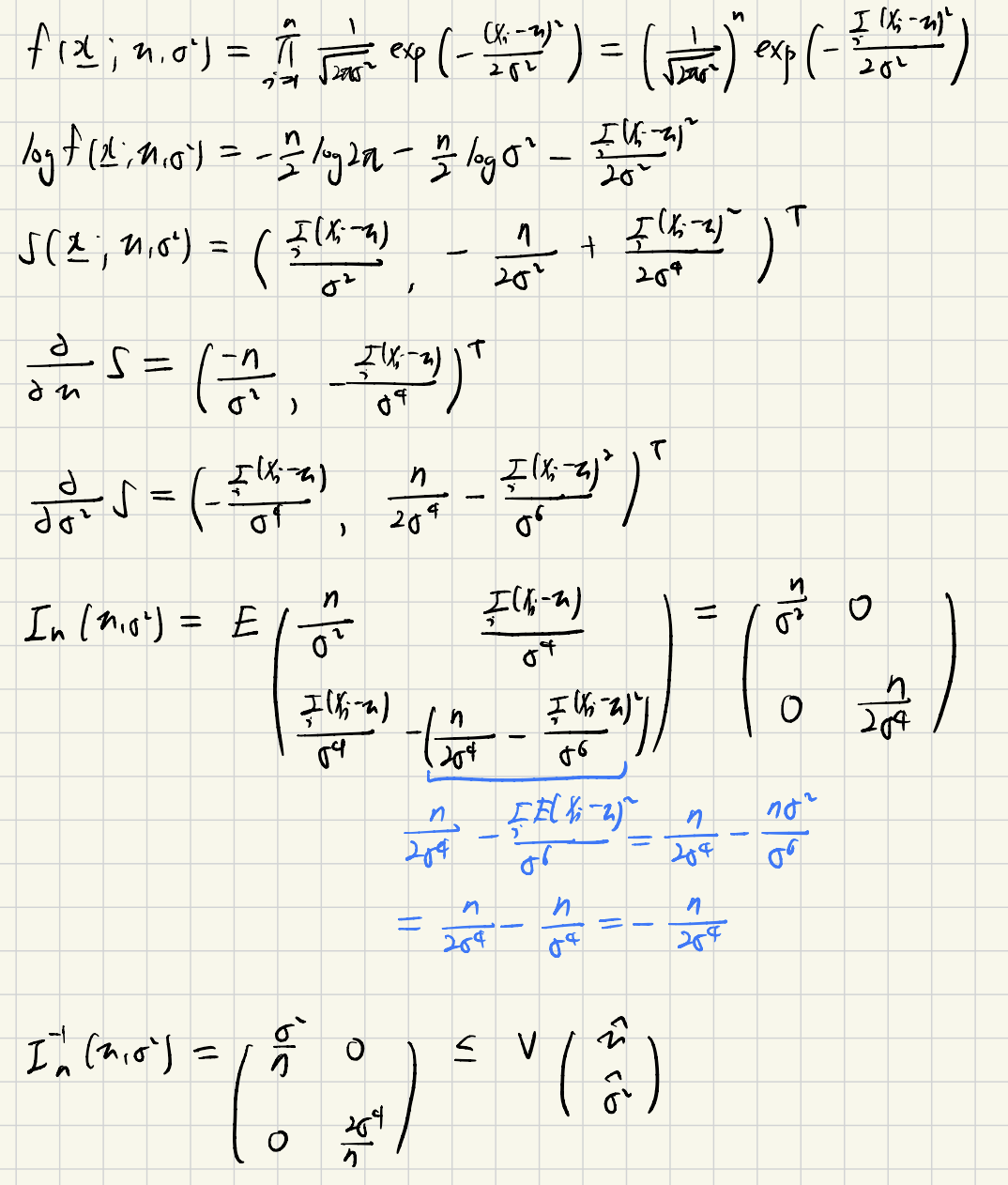
ex1) X1,...,XniidN(μ,σ2)X_1,...,X_n \overset{iid}{\sim} N(\mu,\sigma^2)
cr-multi-ex1

0개의 댓글