✅ 1. 텍스트 벡터화 개념
- 자연어 텍스트를 머신러닝 모델에 입력 가능하도록 숫자 벡터 형태로 변환하는 과정임
- 대표적 방법:
➊ Count 기반 Bag of Words (BoW)
➋ TF-IDF (Term Frequency-Inverse Document Frequency) - 희소 행렬 형태로 변환하여 저장 공간과 계산 효율성 확보 가능함
✅ 2. CountVectorizer 개념
- 문서 안의 단어 출현 빈도(Frequency)를 기준으로 벡터화하는 방식임
- 단어의 출현 횟수를 그대로 사용함
- 단순하지만 자주 등장하는 의미 없는 단어(불용어)도 반영됨
- 높은 빈도를 가지는 단어는 중요도가 높다고 판단할 수 없기 때문에 주의 필요함
➡️ CountVectorizer 코드 예시
from sklearn.feature_extraction.text import CountVectorizer

vectorizer = CountVectorizer(
    max_df=0.95,     # 전체 문서에서 95% 이상 등장하면 제외함 (너무 흔한 단어 제거)
    min_df=2,        # 2회 미만 등장하면 제외함 (너무 희귀한 단어 제거)
    max_features=2000,  # 빈도 높은 단어 2000개까지만 사용함
    stop_words='english',  # 영어 불용어 제거함
    ngram_range=(1,2)  # 단어 1개와 2개 연속된 조합 추출함
)

text_data = [
    "Natural Language Processing is amazing!",
    "I love learning about Machine Learning.",
    "Deep Learning is a subset of Machine Learning."
]

X = vectorizer.fit_transform(text_data)
print("특성 이름:", vectorizer.get_feature_names_out())
print("DTM 행렬:\n", X.toarray())
out:
특성 이름: ['learning' 'machine' 'machine learning']
DTM 행렬:
 [[0 0 0]
 [2 1 1]
[2 1 1]]- 결과: DTM (Document-Term Matrix) 형태로 변환함
- 행: 문서 / 열: 단어 / 값: 해당 단어의 빈도
✅ 3. CountVectorizer 직접 구현
- 사이킷런과 비슷한 기능을 수행하는
myCountVectorizer클래스 직접 구현 가능함 - 입력: 이미 토큰화된 리스트
- 출력: DTM 행렬 (numpy array 형태)
➡️ myCountVectorizer 클래스 예시
import numpy as np

class myCountVectorizer():
    def __init__(self):
        self.vocabulary_ = {}

    def fit(self, docs):
        for words in docs:
            for word in words:
                self.vocabulary_[word] = self.vocabulary_.get(word, len(self.vocabulary_))
        return self

    def transform(self, docs):
        m = np.zeros((len(docs), len(self.vocabulary_)))
        for i, words in enumerate(docs):
            for word in words:
                j = self.vocabulary_.get(word.lower())
                if j is not None:
                    m[i, j] += 1
        return m

    def fit_transform(self, docs):
        self.fit(docs)
        return self.transform(docs)

documents = [
    ['Hello', 'world', 'hello'],
    ['machine', 'learning', 'is', 'fun'],
    ['hello', 'machine', 'learning']
]

vectorizer = myCountVectorizer()
X = vectorizer.fit_transform(documents)
print("단어 인덱스:", vectorizer.vocabulary_)
print("DTM:\n", X)- 각 단어마다 인덱스를 부여함
- 각 문서별 단어 등장 횟수로 DTM 생성함
✅ 4. 희소 행렬(Sparse Matrix)
- 대부분 값이 0인 벡터를 효율적으로 저장하기 위한 방식임
- COO 형식(좌표 리스트), CSR 형식(압축 행 방식) 있음
➡️ COO 형식 예시
from scipy import sparse
import numpy as np

# 0이 아닌 배열(Values)
data = np.array([3,4,5,7,6,8,9])

# 데이터가 위치한 행(Row) 인덱스
row_pos = np.array([0,1,2,2,3,4,4])

# 데이터가 위치한 열(Column) 인덱스
col_pos = np.array([2,4,0,3,1,2,4])

# COO 형식의 희소 행렬 생성 (COO Matrix)
sparse_coo = sparse.coo_matrix((data, (row_pos, col_pos)),shape=(5,5))

# 결과 출력
print("희소 행렬(Sparse Matrix) 타입", type(sparse_coo))
print("COO 형식 희소 행렬 : \n", sparse)

#희소행렬을 밀집 행렬(Dense Matrix)로 변환
dense_matrix = sparse_coo.toarray()

# 희소 행렬을 밀집 행렬(Dense Matrix)로 변환
print("\n 변환된 밀집 행렬(Dense Matrix) 타입", type(dense_matrix))
print("밀집 행렬: \n", dense_matrix)
out:
희소 행렬(Sparse Matrix) 타입 <class 'scipy.sparse._coo.coo_matrix'>
COO 형식 희소 행렬 :
 <module 'scipy.sparse' from 'c:\\Users\\user\\anaconda3\\Lib\\site-packages\\scipy\\sparse\\__init__.py'>

 변환된 밀집 행렬(Dense Matrix) 타입 <class 'numpy.ndarray'>
밀집 행렬:
 [[0 0 3 0 0]
 [0 0 0 0 4]
 [5 0 0 7 0]
 [0 6 0 0 0]
[0 0 8 0 9]]- (행, 열, 값) 좌표로 0이 아닌 값만 저장함
➡️ CSR 형식 예시
from scipy import sparse

dense2 = np.array([[0,0,1,0,0,5],
                   [1,4,0,3,2,5],
                   [0,6,0,3,0,0],
                   [2,0,0,0,0,0],
                   [0,0,0,7,0,8],
                   [1,0,0,0,0,0]])

# 0 이 아닌 데이터 추출
data2 = np.array([1, 5, 1, 4, 3, 2, 5, 6, 3, 2, 7, 8, 1])

# 행 위치와 열 위치를 각각 array로 생성
row_pos = np.array([0, 0, 1, 1, 1, 1, 1, 2, 2, 3, 4, 4, 5])
col_pos = np.array([2, 5, 0, 1, 3, 4, 5, 1, 3, 0, 3, 5, 0])

# COO 형식으로 변환
sparse_coo = sparse.coo_matrix((data2, (row_pos,col_pos)))

# 행 위치 배열의 고유한 값들의 시작 위치 인덱스를 배열로 생성
#(인덱스의 시작점으로 보면 좋음.)
#0이 2개, 1이 5개, 2가 2개, 3이 1개, 4가 2개,5가 1 : 총 13개
row_pos_ind = np.array([0, 2, 7, 9, 10, 12, 13])

# CSR 형식으로 변환
sparse_csr = sparse.csr_matrix((data2, col_pos, row_pos_ind))

print('COO 변환된 데이터가 제대로 되었는지 다시 Dense로 출력 확인')
print(sparse_coo.toarray())
print('CSR 변환된 데이터가 제대로 되었는지 다시 Dense로 출력 확인')
print(sparse_csr.toarray())
out:
COO 변환된 데이터가 제대로 되었는지 다시 Dense로 출력 확인
[[0 0 1 0 0 5]
 [1 4 0 3 2 5]
 [0 6 0 3 0 0]
 [2 0 0 0 0 0]
 [0 0 0 7 0 8]
 [1 0 0 0 0 0]]
CSR 변환된 데이터가 제대로 되었는지 다시 Dense로 출력 확인
[[0 0 1 0 0 5]
 [1 4 0 3 2 5]
 [0 6 0 3 0 0]
 [2 0 0 0 0 0]
 [0 0 0 7 0 8]
[1 0 0 0 0 0]]- 압축 형태로 저장해 효율적임
row_pos_ind: 등차수열이라고 생각하셈
✅ 5. TF-IDF 개념
- TF (Term Frequency): 문서에서 특정 단어의 등장 빈도
- IDF (Inverse Document Frequency): 단어의 희귀도를 반영하는 지표
- 자주 등장하지만 모든 문서에 다 있는 단어는 중요도가 낮음
- 특정 문서에서만 자주 나타나는 단어는 중요도가 높음
- TF * IDF 값이 높을수록 중요한 단어로 간주함
✅ TF-IDF 공식
- : 단어 t의 문서 d에서의 빈도
- : 해당 단어가 등장한 문서 수
- : 전체 문서 수
➡️ TF-IDF 직접 구현 코드
import pandas as pd
from math import log
docs = [
  '먹고 싶은 사과',
  '먹고 싶은 바나나',
  '길고 노란 바나나 바나나',
  '저는 과일이 좋아요'
]
vocab = list(set(w for doc in docs for w in doc.split()))
vocab.sort()
vocab
out :
['과일이', '길고', '노란', '먹고', '바나나', '사과', '싶은', '저는', '좋아요']TF, IDF, TF-IDF 함수 만들기
N = len(docs)

def tf(t,d):
    return d.count(t)

def idf(t):
    df = 0
    for doc in docs:
        df += t in doc
    return log(N/(df+1))

def tfidf(t,d):
    return tf(t,d)*idf(t)
TF 출력
# TF를 구해보자. -> DM, TDM을 데이터프레임에 저장하여 출력
result = []
for i in range(N): #각 문서에 대해서 for문을 작동
    result.append([]) # 새로운 문서에 대한 리스트 생성
    d = docs[i] # docs: 단어 리스트로 구성된 문서들의 리스트.
    for j in range(len(vocab)): # vocab : 전체 문서에서 등장하는 고유한 단어들의 리스트
        t = vocab[j] # 현재 단어 선택
        result[-1].append(tf(t,d)) # 문서에서 해당 단어의 빈도를 계산하여 추가
tf_ = pd.DataFrame(result, columns = vocab)
print(tf_)
out:
   과일이  길고  노란  먹고  바나나  사과  싶은  저는  좋아요
0    0   0   0   1    0   1   1   0    0
1    0   0   0   1    1   0   1   0    0
2    0   1   1   0    2   0   0   0    0
3    1   0   0   0    0   0   0   1    1
idf 구하기
#idf를 구해보자
result = []
for j in range(len(vocab)):
    t = vocab[j]
    result.append(idf(t))
idf_ = pd.DataFrame(result, index = vocab,columns=['IDF'])
print(idf_)
out :
          IDF
과일이  0.693147
길고   0.693147
노란   0.693147
먹고   0.287682
바나나  0.287682
사과   0.693147
싶은   0.287682
저는   0.693147
좋아요  0.693147
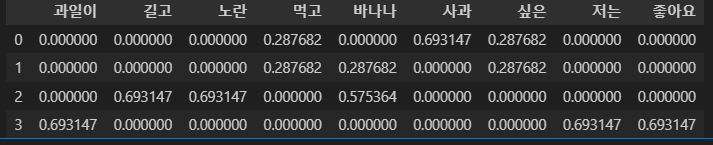
tf-idf 행렬
# tf-idf 행렬 생성
result = []
for i in range(N):
    result.append([])
    d = docs[i]
    for j in range(len(vocab)):
        t = vocab[j]
        result[-1].append(tfidf(t,d))
tfidf_ = pd.DataFrame(result, columns = vocab)
tfidf_
out :
✅ 6. 직접 구현하기
def doc(*args):
    doc_list = []
    tf = pd.DataFrame()
    idf = pd.DataFrame()
    tf_idf = pd.DataFrame()

    # 단어 리스트 생성
    for i in args:
        # 단어 분해
        tmp_list = i.split(' ')
        # 리스트 결합
        doc_list += tmp_list
    doc_list = list(set(doc_list))

    # DF
    df = []
    for i in doc_list:
        tmp = 0
        for j in args:
            # 단어 분해
            tmp_list = list(set(j.split(' ')))
            if i in tmp_list:
                tmp += 1
        df.append(tmp)

    # TF(DTM), IDF, TF-IDF
    for i in range(len(doc_list)):
        tmp = []
        tmp2 = []
        tmp3 = []
        for j in args:
            # 단어 분해
            tmp_list = j.split(' ')
            # 단어 세기
            tmp.append(tmp_list.count(doc_list[i]))
            tmp2.append(log(len(args) / (df[i] + 1)))
            tmp3.append((tmp_list.count(doc_list[i])) * (log(len(args) / (df[i] + 1))))
        # 데이터 프레임 추가
        tf[doc_list[i]] = tmp
        idf[doc_list[i]] = tmp2
        tf_idf[doc_list[i]] = tmp3
    return tf, df, idf, tf_idf

tf, df, idf, tf_idf = doc(doc1, doc2, doc3)
- 자동으로 단어 분리, TF-IDF 계산 및 벡터화 진행함
✅ 정리
| 구분 | 설명 |
|---|---|
| CountVectorizer | 단어 빈도 기반으로 벡터화함. 등장 횟수가 중요함. |
| TF-IDF | 빈도 + 희귀도 반영함. 단어의 상대적 중요도 계산함. |
| Sparse Matrix | 대부분이 0인 데이터에서 메모리 절약 및 연산 효율성 확보 방법. |
| CSR / COO | 희소 행렬을 저장하는 방식임. |

gpt로 다시 배우는 개발