LCD vs OLED in Embedded Systems: A Practical Engineering Comparison
When designing an embedded device—whether an HMI panel, IoT terminal, or industrial controller—the choice between LCD and OLED displays affects performance, durability, power consumption, and long-term reliability. Although both technologies are widely used, their characteristics make them suitable for very different engineering requirements.
This article provides a practical comparison from the perspective of embedded developers, focusing on real-world behavior rather than consumer-grade marketing claims.
1. How LCD and OLED Technologies Work
LCD (Liquid Crystal Display) panels rely on a constant backlight. Liquid crystal cells twist to modulate this light, creating the final image.
Key traits:
- Mature, cost-efficient technology
- Excellent outdoor readability when paired with high-brightness backlights
- Long operational lifetime without image retention
OLED (Organic Light-Emitting Diode) panels emit light at each pixel individually, eliminating the need for a backlight.
Key traits:
- Very high contrast and deep blacks
- Wide viewing angles
- Extremely thin display stack
The structural difference between the two technologies is foundational and influences almost every design trade-off in embedded systems.
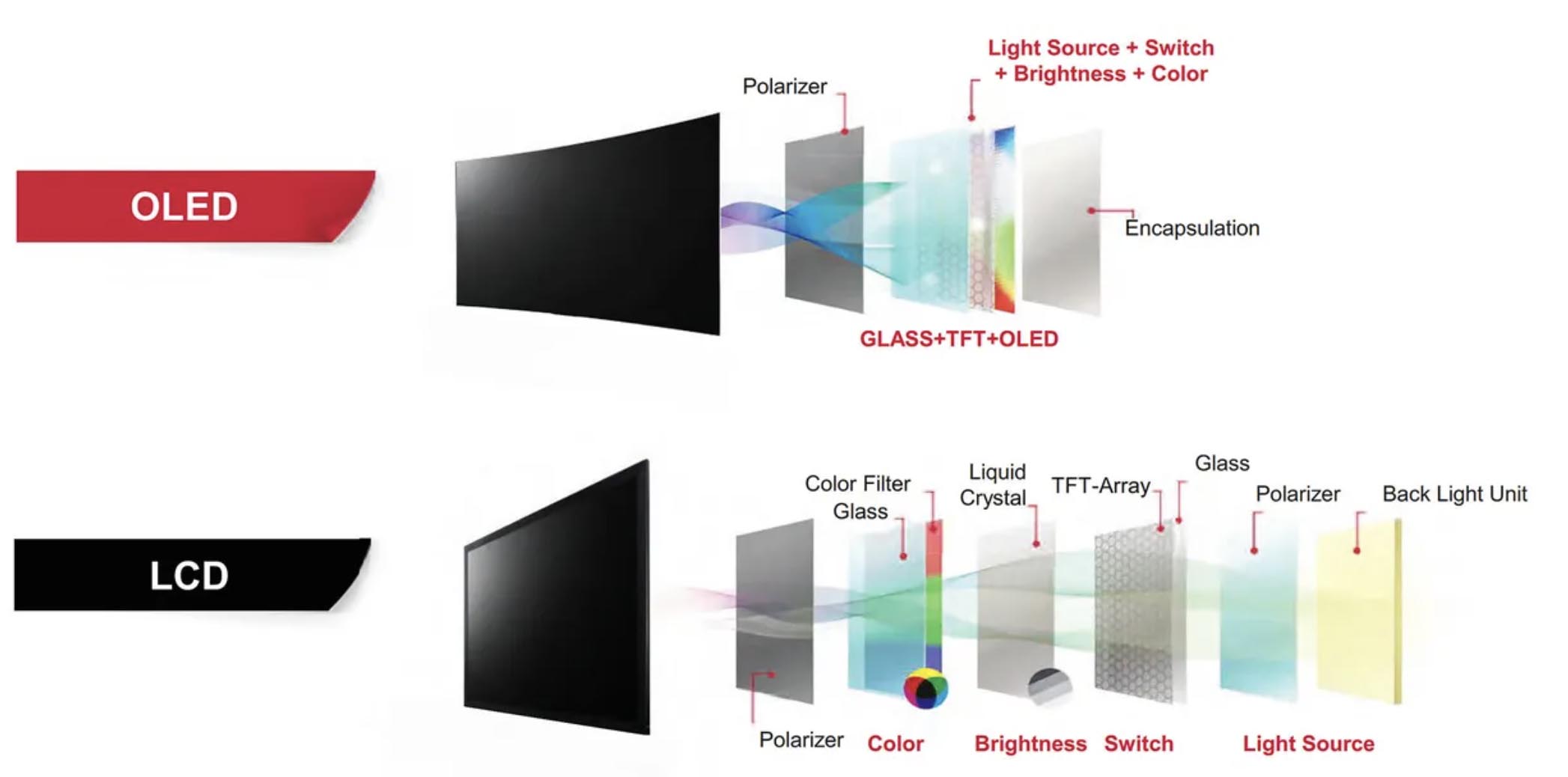
2. Contrast, Dark Performance, and UI Behavior
OLED displays offer near-infinite contrast because black pixels emit no light. This makes them ideal for visually rich interfaces, animations, and consumer devices.
LCDs, especially IPS variants, cannot fully block backlight, resulting in lower contrast. However, for static UI layouts—such as dashboards, meters, and industrial HMIs—LCD clarity remains more than sufficient.
Engineering takeaway:
OLED is superior for dynamic visual experiences; LCD remains consistent and reliable for static or semi-static UIs.
3. Viewing Angles and Color Reproduction
OLED panels maintain color accuracy and brightness across wide viewing angles. IPS LCDs also perform well in this area but may shift slightly under extreme angles.
For embedded devices that require clear visibility from multiple operator positions—such as medical monitors or vehicle dashboards—both can work, but OLED provides the most uniform appearance.
4. Burn-In Risks and Longevity
A critical engineering consideration is OLED’s susceptibility to burn-in. Long-displayed static elements (icons, grids, toolbars, labels) can permanently imprint over time. This is a serious limitation for industrial, medical, and kiosk applications where content rarely changes.
LCDs do not suffer from burn-in, making them better suited for:
- 24/7 operation
- Repetitive UI layouts
- Monitoring systems with static graphics
Engineering takeaway:
If longevity and static display safety are priorities, LCD is the preferred option.
5. Power Consumption Differences
OLED power usage depends on how bright the pixels are.
- Dark interfaces → very low power
- White or bright backgrounds → often higher power than LCD
- High-brightness outdoor readability → OLED efficiency drops significantly
LCDs have predictable, stable power consumption because the backlight is constant.
For battery-powered embedded devices operating outdoors or under bright conditions, LCD modules are generally more energy-efficient.
6. Integration with Embedded Platforms
LCD modules are available with diverse interface standards:
- RGB
- LVDS
- MIPI-DSI
- HDMI / eDP (for higher-end systems)
These interfaces match well with popular embedded processors and microcontrollers.
OLED modules, particularly larger ones, may require:
- Additional power regulation
- Strict thermal design
- Specialized drivers or initialization sequences
LCD’s ecosystem is significantly broader, simplifying prototype development and long-term sourcing.
7. Cost and Supply Chain Stability
LCD technology has decades of supply chain maturity. Industrial-grade LCDs are:
- Widely available
- Cost-effective
- Consistent across vendors
- Supported with long lifecycle guarantees
OLED costs have decreased but remain higher for mid-size panels used in embedded products. Lead times may fluctuate more, especially during periods of consumer electronics demand.
8. Choosing the Right Display for Your Application
| Application Type | Preferred Display | Engineering Reasoning |
|---|---|---|
| Industrial HMI Panels | LCD | No burn-in, long-term stability |
| Medical Devices | IPS LCD or OLED | OLED for clarity; LCD for reliability |
| Wearables / Compact IoT | OLED | Excellent contrast, low power for dark UI |
| Automotive Displays | OLED (budget permitting) | Wide angles, premium visual quality |
| Outdoor Terminals | LCD | Higher brightness and predictable power |
9. Summary and Engineering Recommendation
Both LCD and OLED technologies are well-suited for embedded devices, but their strengths differ sharply:
- Choose LCD when durability, long-term operation, and predictable performance matter more than visual perfection.
- Choose OLED for premium UX, rich multimedia interfaces, compact devices, or scenarios where deep contrast is essential.
Instead of asking which technology is universally better, engineers should evaluate:
- UI behavior
- Power constraints
- Environmental requirements
- Lifetime expectations
- Supply chain stability
Selecting the right display early in the design process ensures a more efficient, resilient, and cost-effective embedded product.