BinaryViT: Pushing Binary Vision Transformers Towards Convolutional Models
BinaryViT에 대한 내용
Abstract
Binarization은 weight와 activation이 binary 상태일 때, popcount 연산을 사용함으로써, ViT model의 크기와 computational cost를 크게 줄일 수 있다.
Vanilla ViT들은 CNN이 갖고 있는 핵심적인 구조적 특성들이 결여되어 있어, binary CNN보다 representational capability가 현저히 떨어진다.
1. Introduction
Activation, Weight 모두 binarize된 ViT의 accuracy를 full-precision model과 비슷하게 하기 위한 방법들
- Distillation
- Scaling factor를 learnable parameter로 설정
- Bi-RealNet: 추가적인 residual connection을 통해, 정보를 보존
- ReActNet: sign함수 앞에 learnable threshold를 추가하고, 각 residual connection 뒤에 RPReLU activation 함수를 추가하여, output distribution을 재구성
- BiMLP: multibranch block을 제안하여 patch 혼합과, channel 혼합이 동시에 이루어지게 하여, FC layer의 제한된 표현력을 극복
2. Designing a full binarized ViT baseline
CNN과 BERT에 적용된 기존 binarization 기법을 활용하여, A1W1 Vanilla ViT 설계
2.1. Binarized fully-connected layer
에 sign()를 적용하기 직전에,
threshold vector 를 적용한다.
의 threshold는 이다. 는 의 평균이다.
전체 행렬 곱셈식은 다음과 같다.
실제 구현은 조금 다르다(가 없고, popcount가 아니며, 가 에 곱해진다. 아래 코드를 실행하면 그 과정을 알 수 있다.
PS) 아니다, 가 없는게 아니고, 를 호출하는 쪽에서 처리를 하고, 로 넣기에 BinaryQuantizer에 없는 것이다.
import torch
import torch.nn as nn

# BinaryQuantizer: 이진 양자화를 위한 autograd.Function
class BinaryQuantizer(torch.autograd.Function):
    @staticmethod
    def forward(ctx, input):
        # forward 단계: 입력 텐서를 이진화 (부호 함수: -1, 0, 1 반환)

        ctx.save_for_backward(input)  # backward 단계에서 사용하기 위해 입력 저장
        out = torch.sign(input)
        return out

    @staticmethod
    def backward(ctx, grad_output):
        # backward 단계: 기울기를 계산함

        input = ctx.saved_tensors  # 저장한 입력값을 불러옴
        input = input[0]
        # 입력이 [-1, 0] 구간에 해당하는지 판별 (float 텐서로 변환)
        indicate_leftmid = ((input >= -1) & (input <= 0)).float()
        # 입력이 (0, 1] 구간에 해당하는지 판별
        indicate_rightmid = ((input > 0) & (input <= 1)).float()
        # 각 구간에 대해 선형 보정된 기울기를 계산한 후 grad_output과 곱함
        grad_input = (indicate_leftmid * (2 + 2 * input) + indicate_rightmid * (2 - 2 * input)) * grad_output.clone()
        return grad_input

    # QuantizeLinear: 양자화된 선형(fully-connected) 계층

class QuantizeLinear(nn.Linear):
    def __init__(self,  *kargs, bias=False, config=None):
        super(QuantizeLinear, self).__init__(*kargs, bias=bias)
        # 가중치와 입력의 양자화 비트 수를 config에서 가져옴
        self.weight_bits = config.weight_bits
        self.input_bits = config.input_bits

        # 가중치 양자화 방법 선택 (비트 수에 따라 다른 양자화 함수 사용)
        if self.weight_bits == 1:
            self.weight_quantizer = BinaryQuantizer
        elif self.weight_bits == 2:
            # self.weight_quantizer = TwnQuantizer
            # 가중치 클리핑 범위를 버퍼에 등록
            self.register_buffer('weight_clip_val', torch.tensor([-config.clip_val, config.clip_val]))
        elif self.weight_bits < 32:
            # self.weight_quantizer = SymQuantizer
            self.register_buffer('weight_clip_val', torch.tensor([-config.clip_val, config.clip_val]))

        # 입력(activation) 양자화 방법 선택
        if self.input_bits == 1:
            self.act_quantizer = BinaryQuantizer
        elif self.input_bits == 2:
            # self.act_quantizer = TwnQuantizer
            self.register_buffer('act_clip_val', torch.tensor([-config.clip_val, config.clip_val]))
        elif self.input_bits < 32:
            # self.act_quantizer = SymQuantizer
            self.register_buffer('act_clip_val', torch.tensor([-config.clip_val, config.clip_val]))


    def forward(self, input):

        # 가중치 양자화: 비트 수에 따라 다르게 처리
        if self.weight_bits == 1:
            print("=== Weight ===\n")
            print(f"W : {self.weight}\n")

            # 이진 가중치의 경우, 각 행별 평균 절댓값을 스케일링 팩터로 사용
            scaling_factor = torch.mean(abs(self.weight), dim=1, keepdim=True)
            print(f"a_W : {scaling_factor}\n")
            scaling_factor = scaling_factor.detach()

            real_weights = self.weight - torch.mean(self.weight, dim=-1, keepdim=True)
            print(f"M(W) : {torch.mean(self.weight, dim=-1, keepdim=True)}\n")
            print(f"W - M(W) : {real_weights}\n")

            binary_weights_no_grad = scaling_factor * torch.sign(real_weights)
            print(f"sign(W - M(W)) : {torch.sign(real_weights)}\n")

            cliped_weights = torch.clamp(real_weights, -1.0, 1.0)
            # 이진화된 가중치로 기울기 흐름은 유지하면서 클램핑된 값을 사용
            weight = binary_weights_no_grad.detach() - cliped_weights.detach() + cliped_weights
            print(f"a_W * sign(W - M(W)) : {weight}\n")
        elif self.weight_bits < 32:
            # 지정된 양자화 함수를 적용하여 가중치를 양자화
            weight = self.weight_quantizer.apply(self.weight, self.weight_clip_val, self.weight_bits, True)
        else:
            # 양자화를 사용하지 않는 경우 원래의 가중치를 사용
            weight = self.weight

        # 입력(activation) 양자화: 입력이 이진인 경우에만 적용
        if self.input_bits == 1:
            print("=== Activation ===\n")

            print(f"X : {input}\n")
            input = self.act_quantizer.apply(input)
            print(f"sign(X + b_X) : {input}\n")

        # 선형 연산 수행
        print("=== Y ===\n")
        out = nn.functional.linear(input, weight)
        print(f"(sign(X + b_X)) * (a_W * sign(W - M(W))) : {out}\n")

        # bias가 존재하면 bias 추가 (출력 텐서 크기에 맞게 확장)
        if not self.bias is None:
            out += self.bias.view(1, -1).expand_as(out)

        return out


# ------------------------------------------------------------------------------
# 테스트 코드를 위한 DummyConfig 클래스 정의 (실제 config 대신 사용)
class DummyConfig:
    def __init__(self, weight_bits, input_bits, clip_val):
        self.weight_bits = weight_bits
        self.input_bits = input_bits
        self.clip_val = clip_val

# QuantizeLinear 테스트 함수
def test_quantize_linear():
    print("\n=== QuantizeLinear 테스트 ===\n")
    # Dummy config 생성: 가중치와 입력 모두 1비트, 클리핑 값 1.0
    config = DummyConfig(weight_bits=1, input_bits=1, clip_val=1.0)
    # 입력 차원 5, 출력 차원 3인 QuantizeLinear 계층 생성
    qlinear = QuantizeLinear(5, 3, bias=False, config=config)
    # print(f"초기 W : {qlinear.weight}\n")

    # 더미 입력 생성: 배치 크기 2, 입력 차원 5
    dummy_input = torch.randn(2, 5)
    # print(f"X : {dummy_input}\n")

    # forward pass 실행
    output = qlinear(dummy_input)
    print(f"Y : {output}\n")

if __name__ == "__main__":
    test_quantize_linear()
이렇게 행렬 곱셈 이후엔, Batch Normalization을 적용하고, residual connection을 연결하고, RPReLU activation function을 적용한다.
2.2. Binarized vision transformer
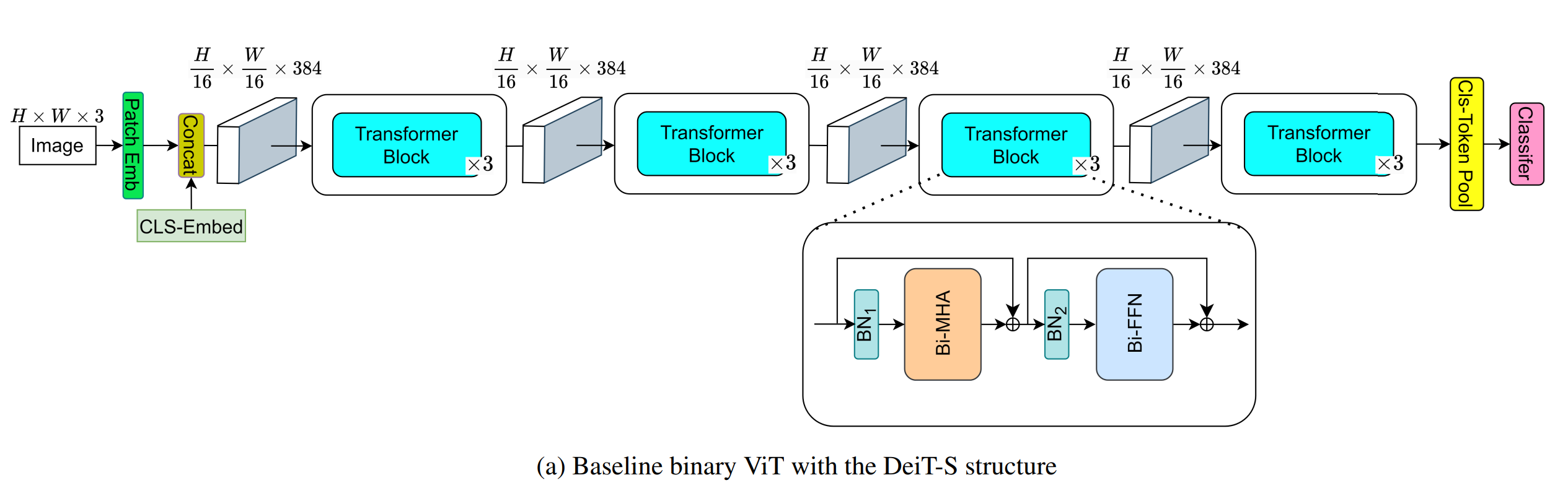
기존 Binary ViT의 과정
-
처음 이미지 는 embedding layer에서, patch 로 분할된다. (이때, patch의 수 이다.)
-
각 patch에 대해 linear projection, 가 적용되어, 가 되고,
class token embedding 가 추가되어 가 되고,
position embedding 가 더해져,
가 출력된다.
(';'는 행방향으로 붙이는 것임) -
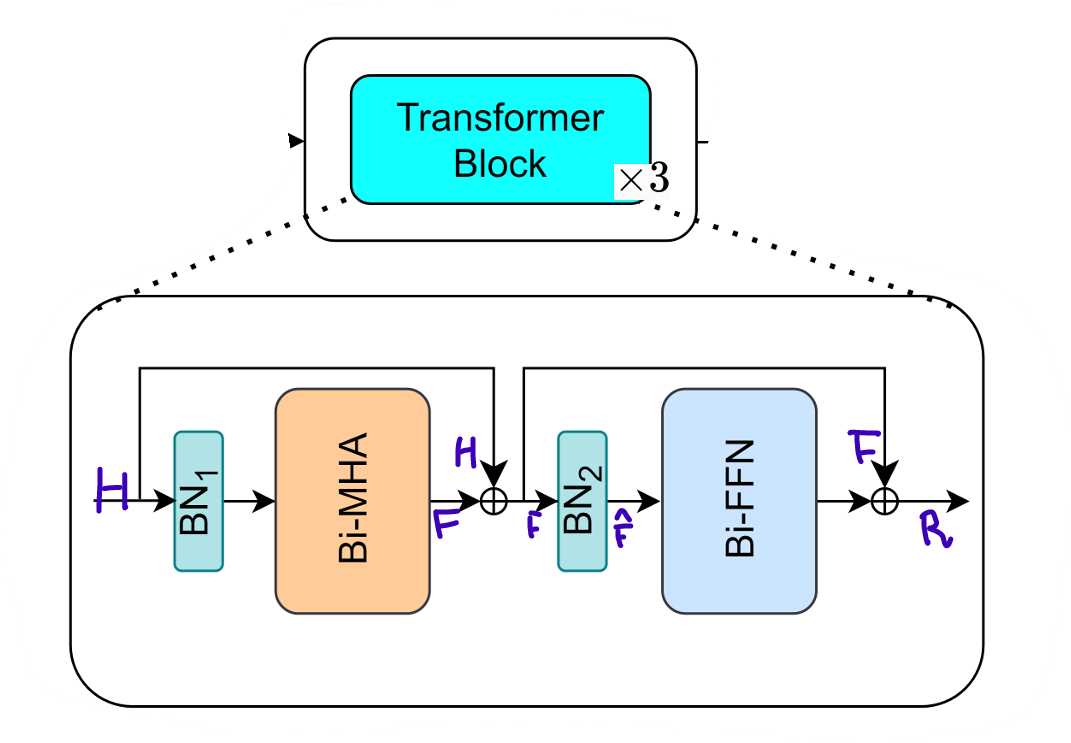
Embedding layer의 output 가 첫 번째, transformer block(encoder block)에 입력으로 들어간다.
-
Transformer block에서 입력 는 pre-batch-normalization layer를 거쳐, 로 변환 된다.
-
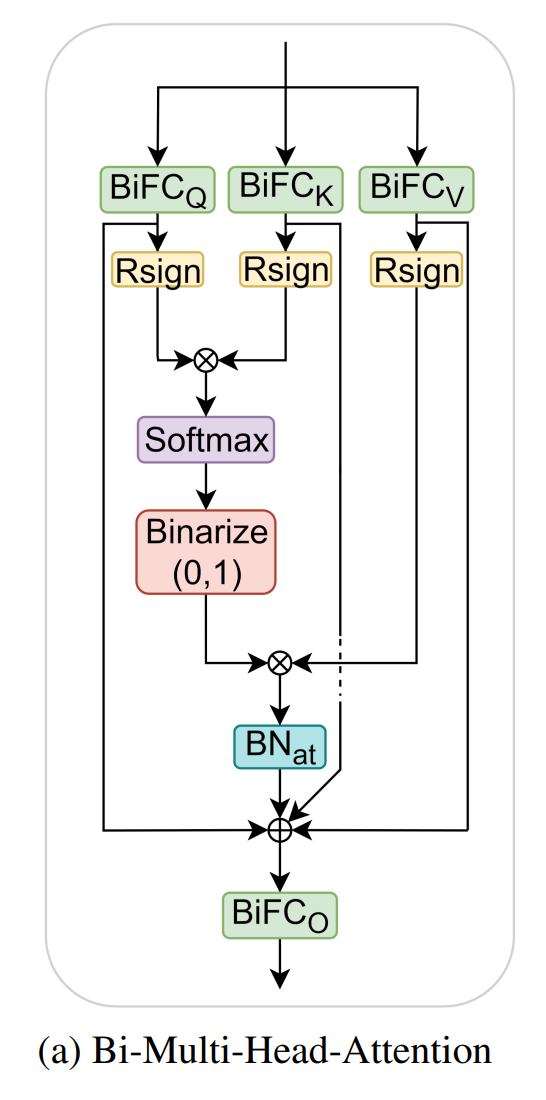
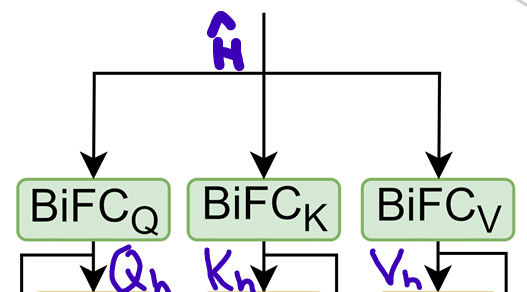
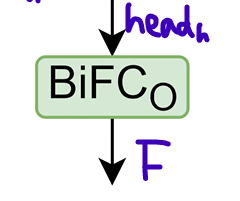
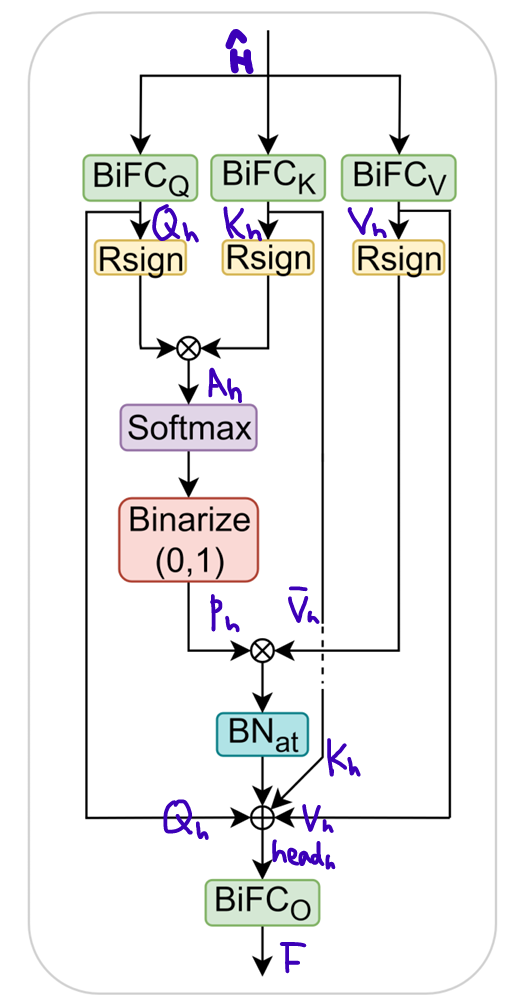
개의 atttention head를 가진 binarized된 MHA module에서 를 BiFC(Binarized FC)에 넣으면, 가 다음과 같이 계산된다.
-
Attention score 구하기. Attention score은 다음과 같이 계산된다.
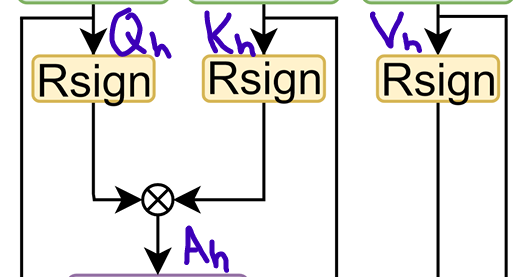
-
Attention score 를 softmax하고, 0 또는 1로 binarize하여, attention probability를 얻는다. 그 식은 다음과 같다.
이때, 는 learnable scaling factor이다.
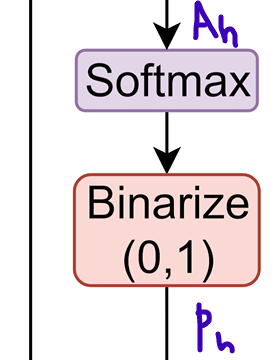
-
Attention probability 를 으로 binarized된 과 곱하여, 각 token에 대해 value 정보를 반영한다.
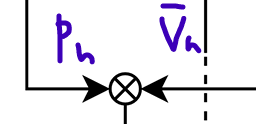
-
Token에 대한 value 정보가 반영된 attention probability를 BatchNormalization 해주고,
Q, K, V 정보 보존을 위해, 를 residual connection으로 연결한다.
그 값을 RPReLU를 거치면, 하나의 head에 대한 output이 나온다.
그 식은 아래와 같다.
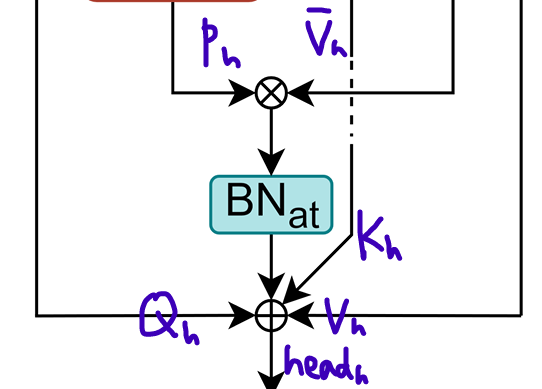
-
모든 head()의 output()는 서로 concatenate된 후, 를 거치면, 전체 Bi-MHA의 output이 나온다.
그 식은 아래와 같다.
-
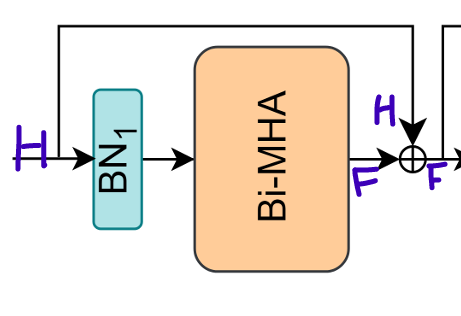
Main residual connection이 Bi-MHA의 output에 적용된다.
그 식은 아래와 같다.
이때, 는 다음과 같고, 2번 과정에서의 이다.
-
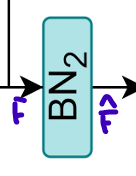
Residual output 는 두 번째 pre-batch-normalization layer인 를 거쳐 정규화된다.
그 식은 아래와 같다.
-
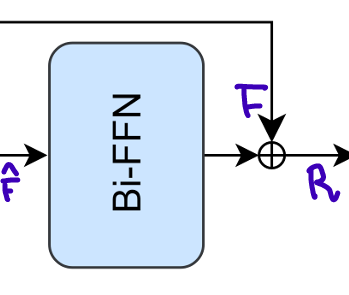
정규화된 는 두 개의 BiFC로 구성된 BiFFN을 통과하고, 마지막으로 BiFFN의 output에 두 번째 main residual connection이 적용되어, 다음과 같이 최종 출력 을 얻는다.
Distillation
Binarized된 ViT의 성능을 향상시키기 위해, student model의 logit과 teacher model의 logit 간의 soft crossentropy loss를 최소화함으로써, full-precision model의 knowledge를 binarized model로 distill한다.
3. What else do binary CNNs have that binary transformers do not have?
위 2장에서 언급된 모든 기법들을 적용하더라도 (Table 1의 ReActNet), 정확도가 낮다. 이는 대부분의 SOTA binary CNN 정확도보다 훨씬 낮다.
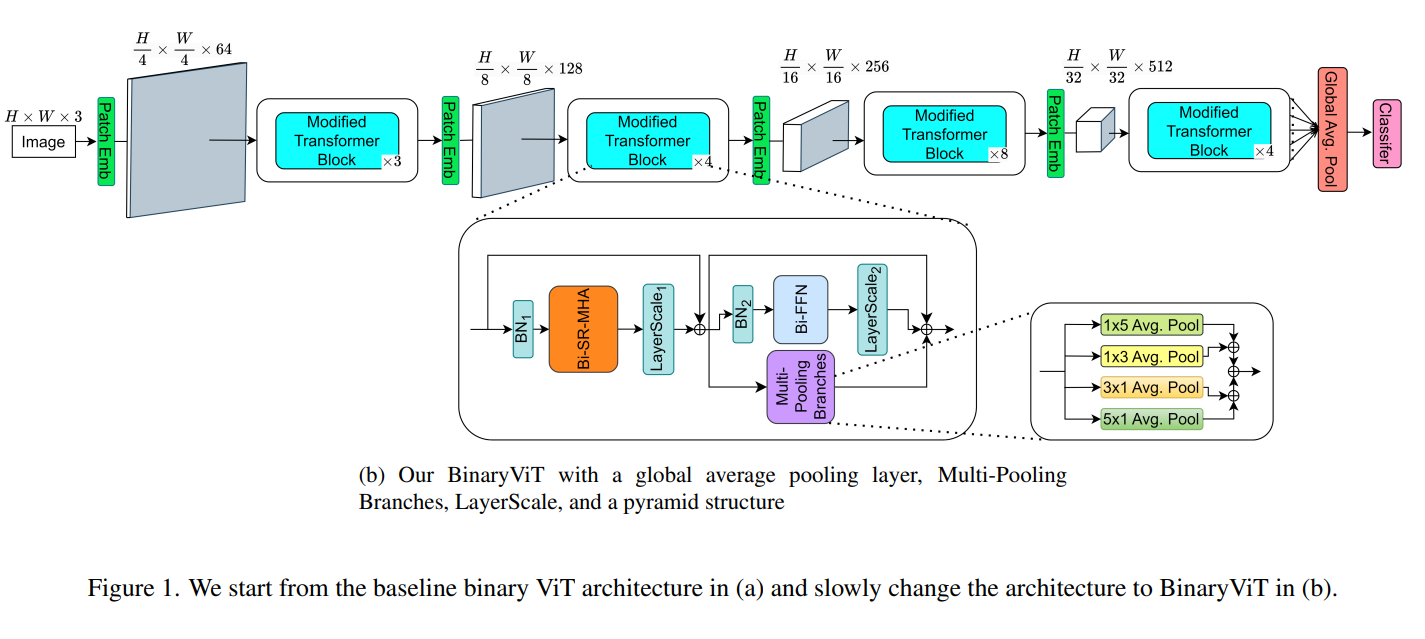
=> CNN architecture의 세부 요소 및 특성을 분석하여, ViT에 적용
=> Binary activation / weight로도 많은 수의 클래스를 가진 dataset에서도 accuracy ↑
그러기 위해, Binary ViT의 표현력을 증가시키는 방법 3가지
-
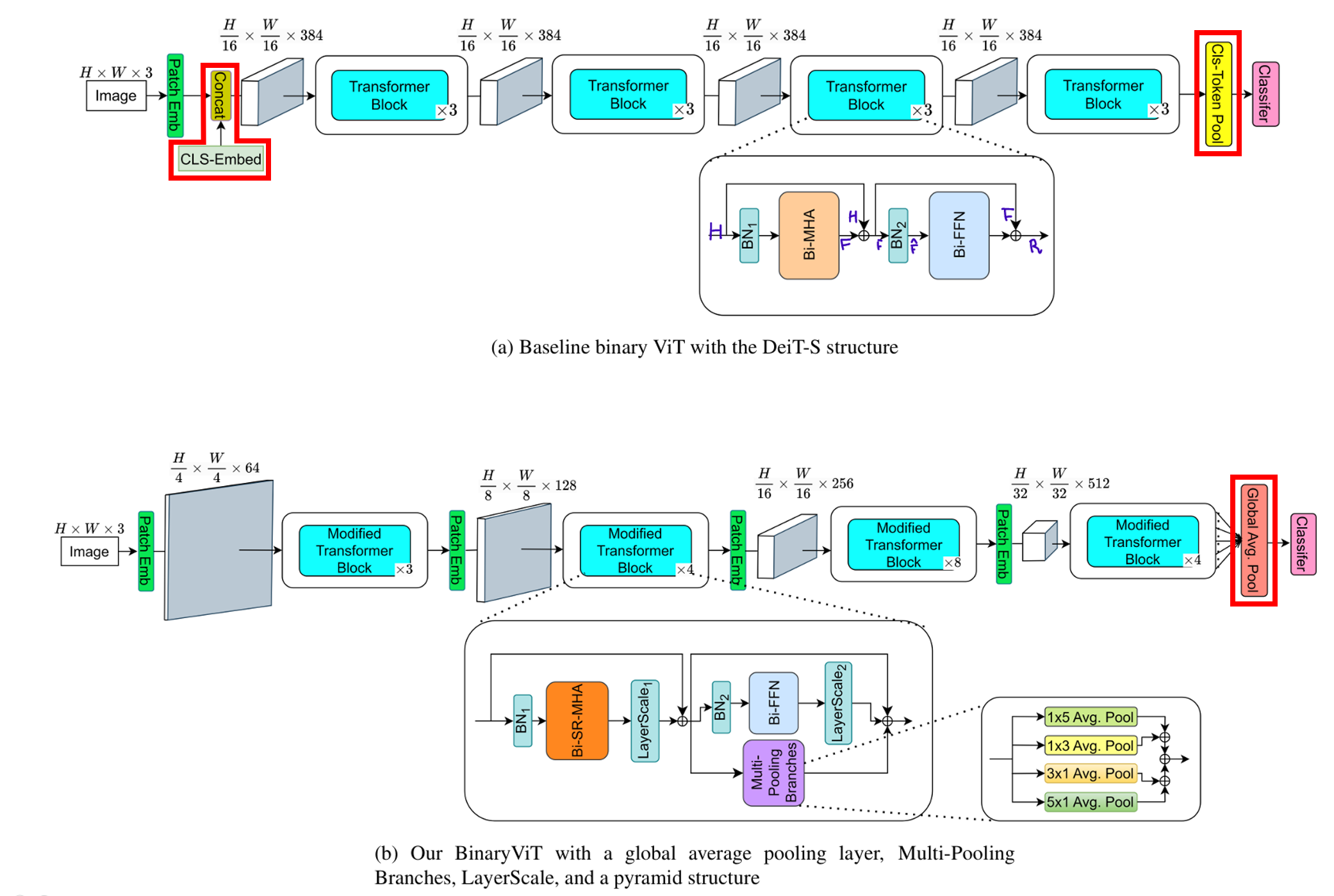
Global Average Pooling(GAP)를 classifier layer 전에 삽입
-
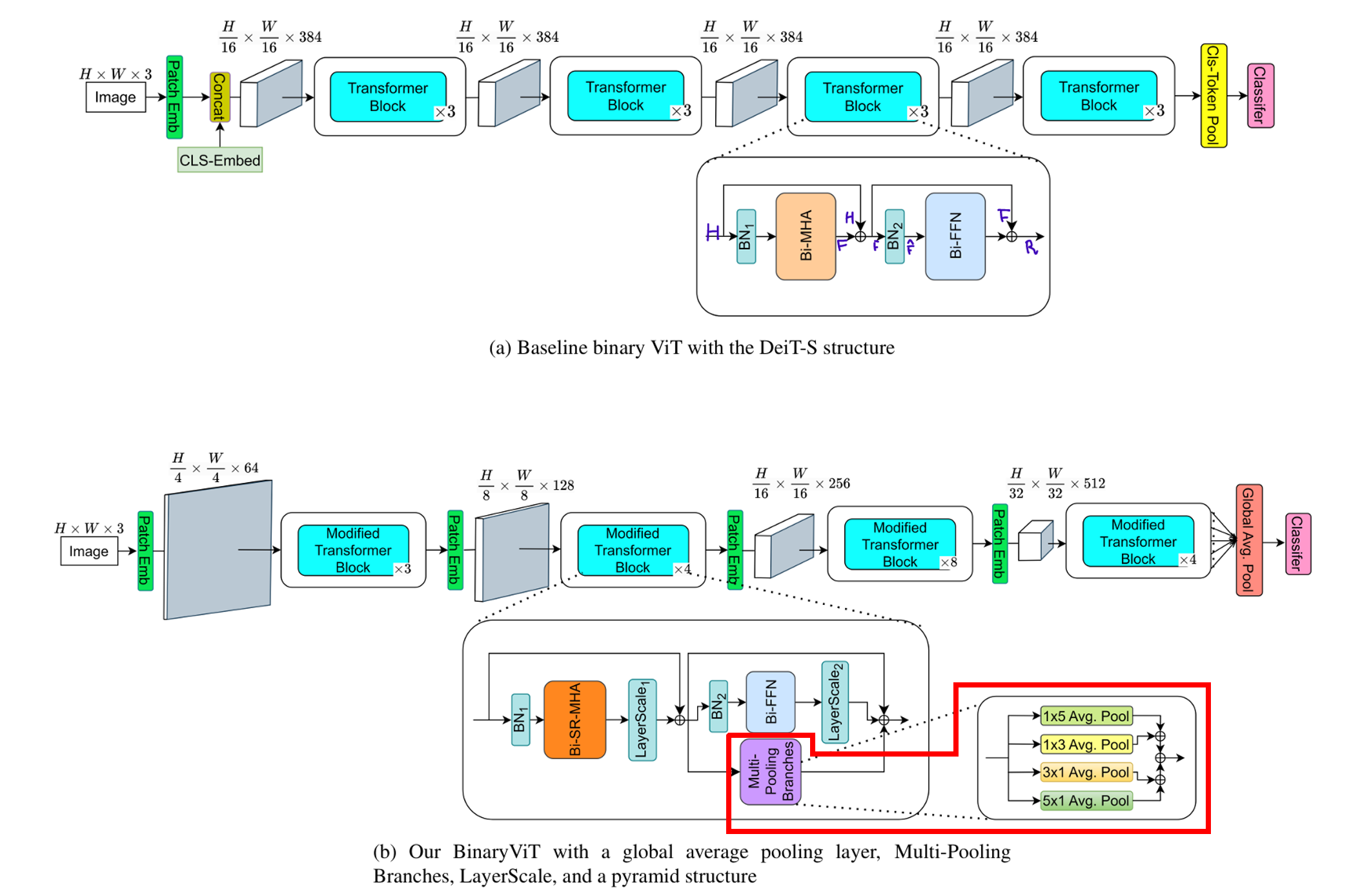
Multiple average pooling branch를 추가
-
CNN에서 피라미드 구조를 차용하기
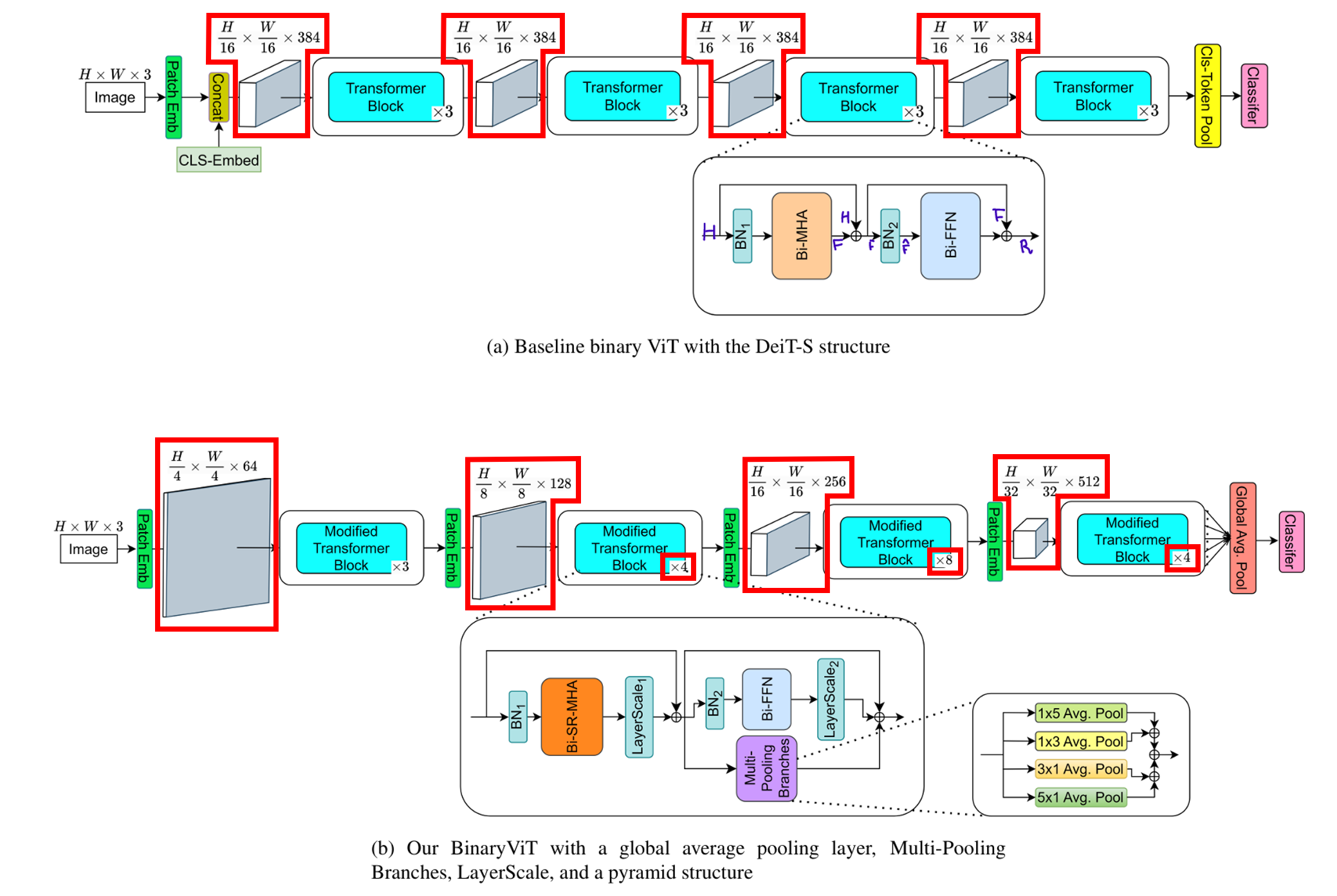
추가적으로 ResNet, MobileNet의 설계 아이디어 차용
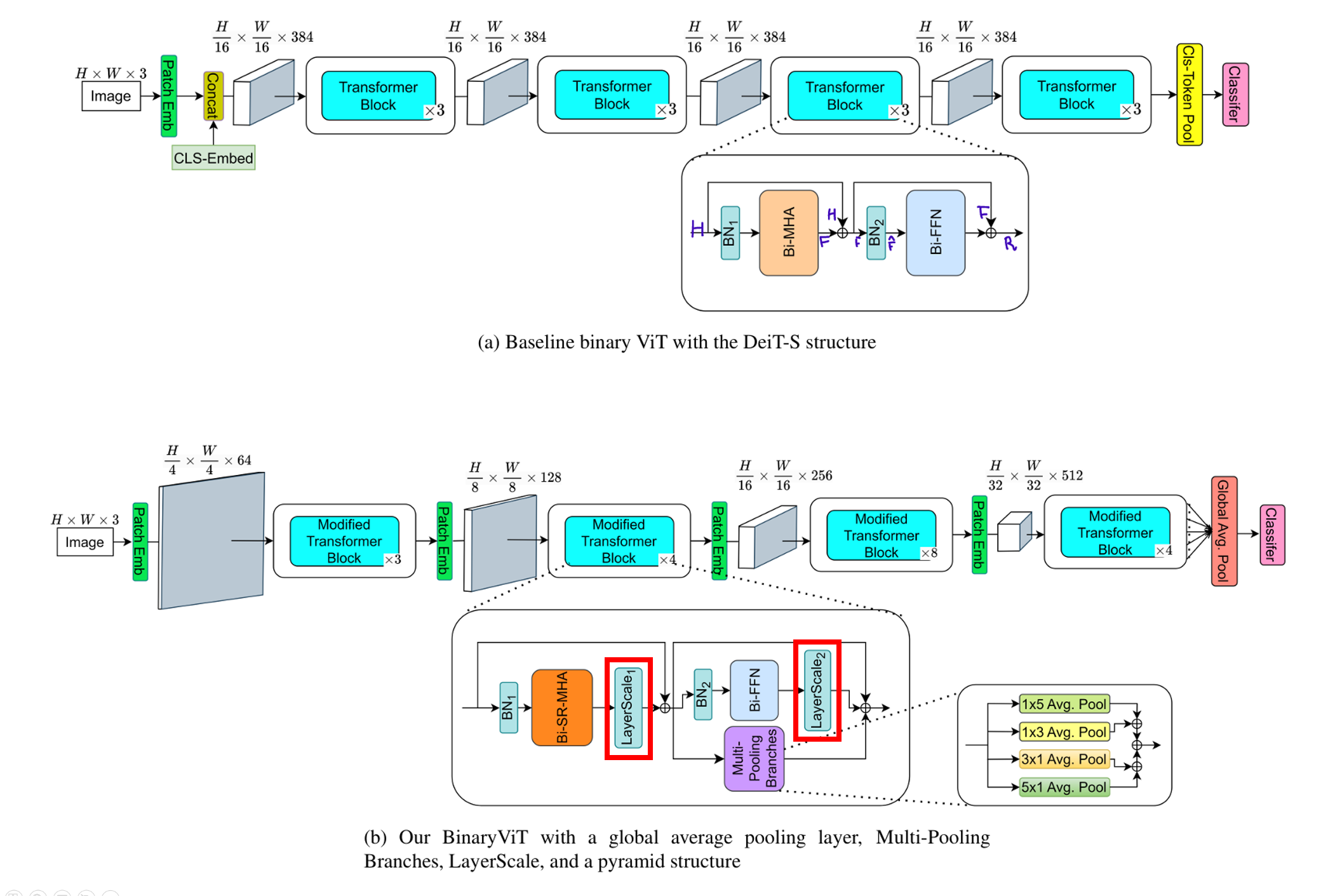
Main residual branch의 scale이 Bi-MHA, Bi-FFN 출력 같은 main branch의 scale을 압도하지 않도록 residual branch 앞에 affine 변환을 배치.
3.1. Global average pooling before classifier layer
Binary CNN: classifier 앞에 average pooling layer 有
Vanilla ViT: classifier 앞에 단일 cls-token pooling layer만 有
==> cls-token pooling을 Gloval average pooling(GAP)을 통해 모든 token 정보를 반영하자!
+
Embedding에서 cls-token embedding을 제거하자!
==> 위 2.2.의 과정 2의
이
로 교체된다.
그렇게 되면 당연히, 가 된다.
// 연산량 소폭증가, 성능 대폭 증가
3.2. More branches
Binary Conv layer가 Binary FC layer보다 3배 정도 높은 표현력을 가진다.
==> Transformer block 내부의 Bi-FFN 옆에 4개의 average pooling branch를 추가.
각 average pooling layer는 다음과 같다.
- 1⨉5 Avg. Pool
- 1⨉3 Avg. Pool
- 5⨉1 Avg. Pool
- 3⨉1 Avg. Pool
// 연산량 소폭증가, 성능 대폭 증가
3.3. Scaling right before residual connection
사전 지식: Affine 변환(선형 변환으로 생각하면 됨)(ex, BN)은 model의 표현력에 영향을 미치지 않는다.
깊은 layer의 main branch에서 전달되는 정보가 residual branch에 의해 압도되어, 제 성능 발휘 못하는 문제가 생긴다.
Affine 변환이 표현력에 영향을 미치지 않지만,
여러가지 실험을 통해 residual connection 전에 affine 변환을 사용하는 것이 전혀 사용하지 않는 것보다 좋다는 것을 알게되었다.
==> Attention과 FFN의 각 main residual connection 마다 main branch(Bi-MHA, Bi-FFN의 output)에 affine 변환을 한다.
기존 방법
Main branch에 Affine transformation 적용 방법
코드 비교
ReActNet
DATA_DIR=/path/to/dataset

torchrun --nproc_per_node=8 main.py \
    --num-workers=40 \
    --batch-size=64 \
    --epochs=300 \
    --dropout=0.0 \
    --drop-path=0.0 \
    --opt=adamw \
    --sched=cosine \
    --weight-decay=0.00 \
    --lr=5e-4 \
    --warmup-epochs=0 \
    --color-jitter=0.0 \
    --aa=noaug \
    --reprob=0.0 \
    --mixup=0.0 \
    --cutmix=0.0 \
    --data-path=${DATA_DIR} \
    --output-dir=logs/reactdeit-small-patch16-224 \
    --teacher-model-type=deit \
    --teacher-model=configs/deit-small-patch16-224 \
    --teacher-model-file=logs/deit-small-patch16-224/best.pth \
    --model=configs/deit-small-patch16-224 \
    --model-type=extra-res \
    --replace-ln-bn \
    --weight-bits=1 \
    --input-bits=1 \
    --enable-cls-token \
    --disable-layerscale \
    # --resume=logs/reactdeit-small-patch16-224/checkpoint.pth \
    # --current-best-model=logs/reactdeit-small-patch16-224/best.pth \
BinaryViT
DATA_DIR=/path/to/dataset

torchrun --nproc_per_node=8 main.py \
    --num-workers=32 \
    --batch-size=64 \
    --epochs=300 \
    --dropout=0.0 \
    --drop-path=0.0 \
    --opt=adamw \
    --sched=cosine \
    --weight-decay=0.00 \
    --lr=5e-4 \
    --warmup-epochs=0 \
    --color-jitter=0.0 \
    --aa=noaug \
    --reprob=0.0 \
    --mixup=0.0 \
    --cutmix=0.0 \
    --data-path=${DATA_DIR} \
    --output-dir=logs/binaryvit-small-patch4-224 \
    --teacher-model-type=deit \
    --teacher-model=configs/deit-small-patch16-224 \
    --teacher-model-file=logs/deit-small-patch16-224/best.pth \
    --model=configs/binaryvit-small-patch4-224 \
    --model-type=extra-res-pyramid \
    --replace-ln-bn \
    --weight-bits=1 \
    --input-bits=1 \
    --avg-res3 \
    --avg-res5 \
    # --resume=logs/binaryvit-small-patch4-224/checkpoint.pth \
    # --current-best-model=logs/binaryvit-small-patch4-224/best.pth \
ReActNet, BinaryViT 두 코드 모두에서의 Transformer block(class ViTLayer(nn.Module))에서Bi-MHA, Bi-FFN이 호출하는 class ViTOutput(nn.Module)
class ViTOutput(nn.Module):
    def __init__(self, config: ViTConfig, layer_num, drop_path=0.0) -> None:
        super().__init__()
        self.dense = QuantizeLinear(config.intermediate_size[config.stages[layer_num]], config.hidden_size[config.stages[layer_num]], config=config)
        self.dropout = nn.Dropout(config.hidden_dropout_prob)
        self.drop_path = DropPath(drop_path) if drop_path > 0. else nn.Identity()

        self.move = nn.Parameter(torch.zeros(config.intermediate_size[config.stages[layer_num]]))
        self.norm = config.norm_layer(config.hidden_size[config.stages[layer_num]], eps=config.layer_norm_eps)
        self.rprelu = RPReLU(config.hidden_size[config.stages[layer_num]])
        self.pooling = nn.AvgPool1d(config.intermediate_size[config.stages[layer_num]] // config.hidden_size[config.stages[layer_num]])
        self.layerscale = LayerScale(config.hidden_size[config.stages[layer_num]]) if not config.disable_layerscale else nn.Identity()


    def forward(self, hidden_states: torch.Tensor) -> torch.Tensor:
        out = self.norm(self.dense(hidden_states + self.move)) + self.pooling(hidden_states)
        out = self.rprelu(out)
        out = self.dropout(out)

        out = self.layerscale(out)

        out = self.drop_path(out)

        return out
위 2개의 script를 보면,
ReActNet의 방법에서는 --disable-layerscale을 통해, **Affine 변환을 disable하고 있어, self.layerscale = nn.Identity()로 아무 일이 일어나지 않다.
반면, BinayViT에서는 Affine 변환을 하고 있음을 알 수 있다.
3.4. Pyramid structure
최신 SOTA Binary CNN은 고해상도에서 저해상도로 점진적으로 feature map 크기를 줄이고, hidden dimension은 증가시키는 pyramid structure를 갖는다.
이런 pyramid structure는 binary nn의 표현력을 향상시킨다.
==> pyramid structure를 통해, 계산 복잡도를 증가시키지 않으면서도, 표현력 ↑
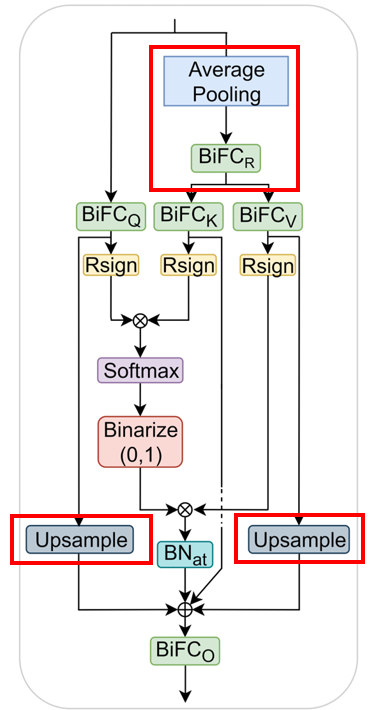
첫 번째와 두 번째 스테이지에서 sequence size가 3316과 784이므로, 이 크기에서 attention을 적용하는 것은 계산 비효율적이다.
==> key, value 행렬을 계산하기 직전에 입력에 downsampling을 한다.
이렇게 downsampling된 값들은 residual connection 이전에 upsampling된다.
그 전체 식은 아래와 같다.
여기서 은 upsampling으로, nearest-neighbor interpolation function이다.
은 kernel 크기와 stride가 R인 average pooling이다.
- 피라미드 코드의 ViTEncoder 부분의 ViTLayer를 반복 호출하는 루프에서 PatchEmbed 클래스를 주기적으로 호출하는 부분이다.