
💡Neural Network
A machine learning model that mimics the way the human brain processes information
🎨 Batch
A method of dividing the entire dataset into several small groups to solve memory and computation speed issues during dataset training
Emergence of Batch
- Structure of Neural Network
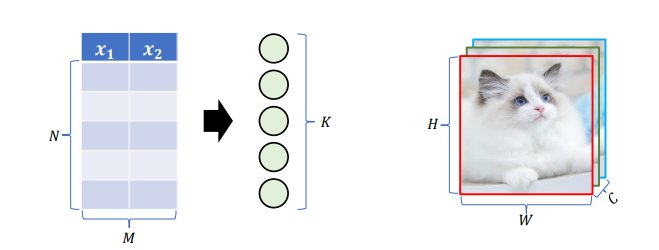
- Neural networks consist of an input layer that receives data, hidden layers that compute the input data, and an output layer that makes predictions based on the computed results
- If the data entering the input layer is in format, the hidden layer corresponding to the first layer must be in format (where K is the number of neurons)
- Note that image data is 3-dimensional data (height, width, channel), so the first hidden layer must be designated in a 3-dimensional format
Understanding Batch
- Passing data through the neural network one by one tens of thousands of times can take an immense amount of time
- Therefore, a method of grouping data together and passing them through all at once is used; this group of data is called a Batch
- However, if too much data is grouped and passed through the neural network, it becomes heavy, so we break the data into smaller portions and pass them, which is called Mini Batch
- Key Concepts
- Batch Size: The number of data samples processed by the model in one learning step
- For example, if there are 10,000 samples in the dataset and the Batch Size is 32, 32 samples are used in one training step
- This process of the model learning through several batches of the dataset is repeated
- Epoch: The process of passing the entire dataset through the model once
- For example, if the dataset is divided into 1,000 batches, completing 1 epoch means all 1,000 batches have been used
- Iteration: The process of processing one batch
- For example, if the Batch Size is 32 and the dataset has 1,000 samples, you need to train 31 times with 32 samples to process the entire dataset once -> These 31 processes are each called an iteration
- Batch Size: The number of data samples processed by the model in one learning step
- Stages of Batch Training
- Forward Propagation: Input a batch of data into the model to compute predictions -> Each data point is processed by the model’s parameters (weights, biases) to make predictions
- Loss Calculation: Compare the predicted values with the actual values and calculate the error through the Loss Function
- Backpropagation: Calculate gradients for each parameter based on the loss value
- Gradients represent how much each parameter affects the loss
- The backpropagation algorithm is used to calculate gradients for each parameter and optimize them
- Weight Update: Use an optimization algorithm (e.g., SGD or Adam) to update the parameters
- Iteration: After completing the above steps for one batch, process the next batch -> This process is repeated for the entire dataset several times for learning
- Types of Batch Processing
- SGD (Stochastic Gradient Descent): Sets the batch size to 1, processes one sample at a time, and updates the weights for each sample
- Uses less memory and computes faster, but may have slower convergence due to noise generated by processing each sample
- Mini-Batch Gradient Descent: The most commonly used method, processes the data in smaller batches
- Batch sizes are typically set to values like 16, 32, 64, or 128
- Balances between the instability of SGD and memory efficiency, achieving a good balance of training speed and stability
- Batch Gradient Descent: Processes the entire dataset in one go
- Has very high memory usage and may take a long time to process, but its convergence is stable
- May not be practical for large datasets due to memory limitations
- SGD (Stochastic Gradient Descent): Sets the batch size to 1, processes one sample at a time, and updates the weights for each sample
🎨 Cross-Entropy Error
A Loss Function used to measure the difference between the predicted probability distribution and the actual target distribution, evaluating how close the predicted values are to the actual values.
Cross Entropy
-
Definition: A function that measures the difference between two probability distributions
- Mainly used to evaluate how closely the predicted distribution matches the actual distribution in classification problems.
- Here, "probability distribution" refers to the probability that the predicted value belongs to each class, and Cross Entropy numerically evaluates how accurate that prediction is.
- The further the prediction is from the actual value, the larger the Cross Entropy value becomes -> This is designed to give large penalties for incorrect predictions.
-
Formula
- General Cross Entropy Formula
- It calculates the difference between the true distribution and the predicted distribution by taking the logarithm, numerically quantifying the error for each prediction.
-
: True probability distribution of the data
-
: Predicted probability distribution of the model
-
: The set of all possible outcomes
-
Binary Cross Entropy: Assigns large penalties for incorrect predictions, guiding the model towards correct predictions.
- When is 1, meaning the class is correct, is emphasized. The closer is to 1, the smaller the loss.
- When is 0, the term becomes important. The closer the prediction is to 0, the smaller the loss.
- : Actual label (0 or 1)
- : Predicted probability (value between 0 and 1)
-
Categorical Cross Entropy: Imposes a large penalty when the model fails to predict the correct class with high probability.
- The logarithm of the predicted probability for the actual class is used for each data point -> The larger the predicted probability for the actual class, the smaller the loss.
- : Number of classes
- : Actual class (1 if the class is correct, otherwise 0)
- : Predicted probability for class
- General Cross Entropy Formula
Relationship with Softmax Function
-
The Softmax function converts the logits predicted by the model into probabilities, allowing Cross Entropy to evaluate the probabilities for each class.
- : Logit for class (model output value)
-
The Softmax function calculates the probabilities for each class and normalizes them so that the sum of all class probabilities equals 1.
-
Cross Entropy then calculates the difference between these probabilities and the actual labels.
Example Usage of Cross Entropy
-
Problem Setup
- Assume the model is classifying among three classes. For example, the classes are:
- Class 1: Cat
- Class 2: Dog
- Class 3: Elephant
- Assume the logits predicted by the model are:
- Logit values: , ,
- The actual label is Class 1 (Cat), and in one-hot encoding:
- Assume the model is classifying among three classes. For example, the classes are:
-
Softmax Function Calculation
-
Calculate the probability for each class:
-
Predicted probabilities:
-
-
Cross Entropy Loss Calculation
-
Given the actual label and the predicted probabilities :
-
Thus,
-
Therefore, the Cross Entropy Loss is 0.417.
-