Fair Share Scheduling
New goal: Fairness
- From now on, schedulers are designed to optimize performance
- Minimize response time, turnaround time
MLFQ achieves these goals, but complicated
- Non-trivial to implement
- Difficult to tune parameters (e.g. distribution of CPU time)
Lottery Scheduling
Key idea
- Give each process tickets
- Each time slice, scheduler holds a lottery
- Process holding the winning ticket runs
Probabilistic scheduling
- Over time, run time for each process converges to the correct value
Implementation Advantages
- Fast scheduler execution
- All the scheduler needs to do is run random()
- (Actually, real random generator in OS is difficult)
- No need to manage priority queues
- No need to store state
- Scheduler needs to know the total number of tickets
- But, No need to track process behavior(total CPU time)
-
Automatically balances CPU time across processes
- New processes get some tickets, adjust the overall size of the ticket pool
-
Easy to prioritize processes
- High priority processes many tickets
- Low priority processes a few tickets
- Priorities can change via ticket inflation
So is Lottery scheduling fair?
- Assume two processes with equal tickets
- Unfairness ratio =
- If unfairness ratio = 1, then both processes finish at the same time
= Fair scheduler
- If unfairness ratio = 1, then both processes finish at the same time
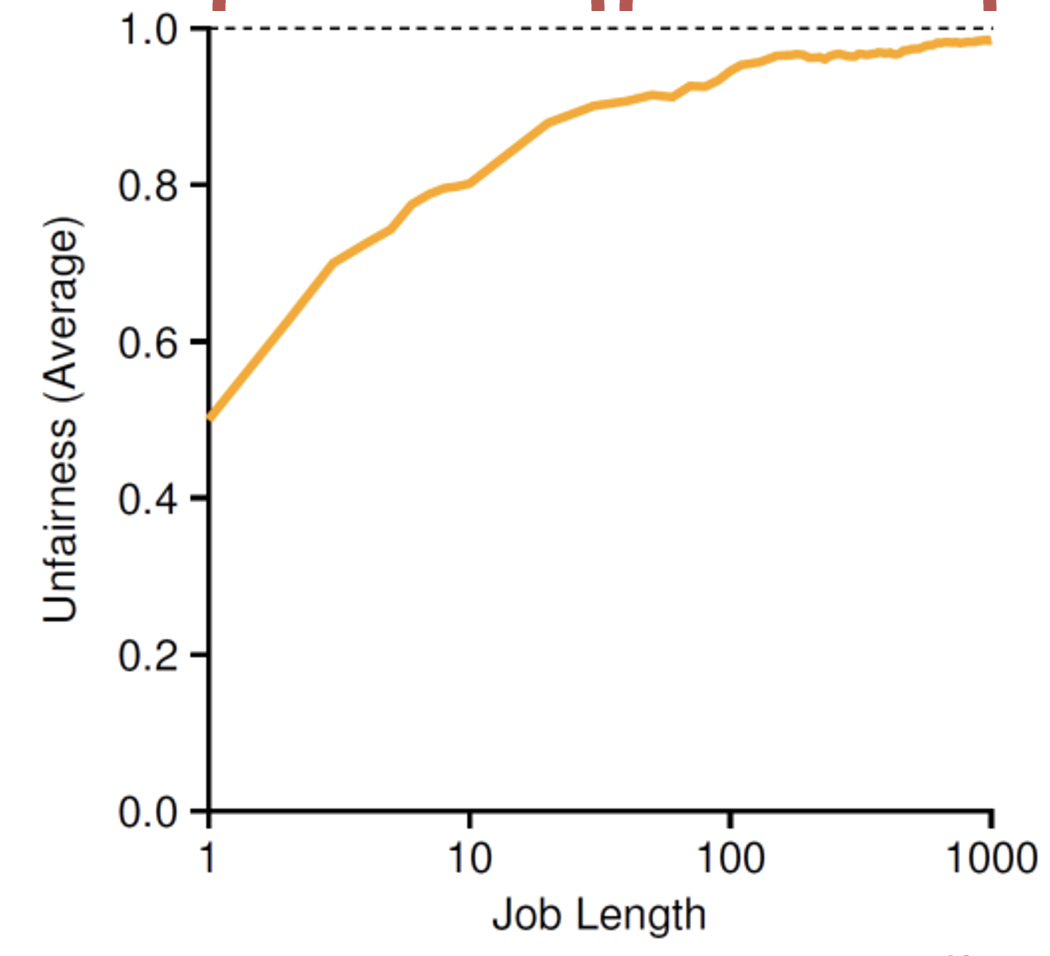
- Unfair to short job due to randomness
- Over time, randomness is amortized
Stride Scheduling
Motivation
- Randomness makes us build a simple and approximately fair scheduler
But, Fairness is not guaranteed
Build a deterministic, fair scheduler
Key idea
- Each process is given some tickets
- Each process has a stride =
- Each time a process runs, its pass += stride
- Scheduler chooses process with the lowest pass to run next
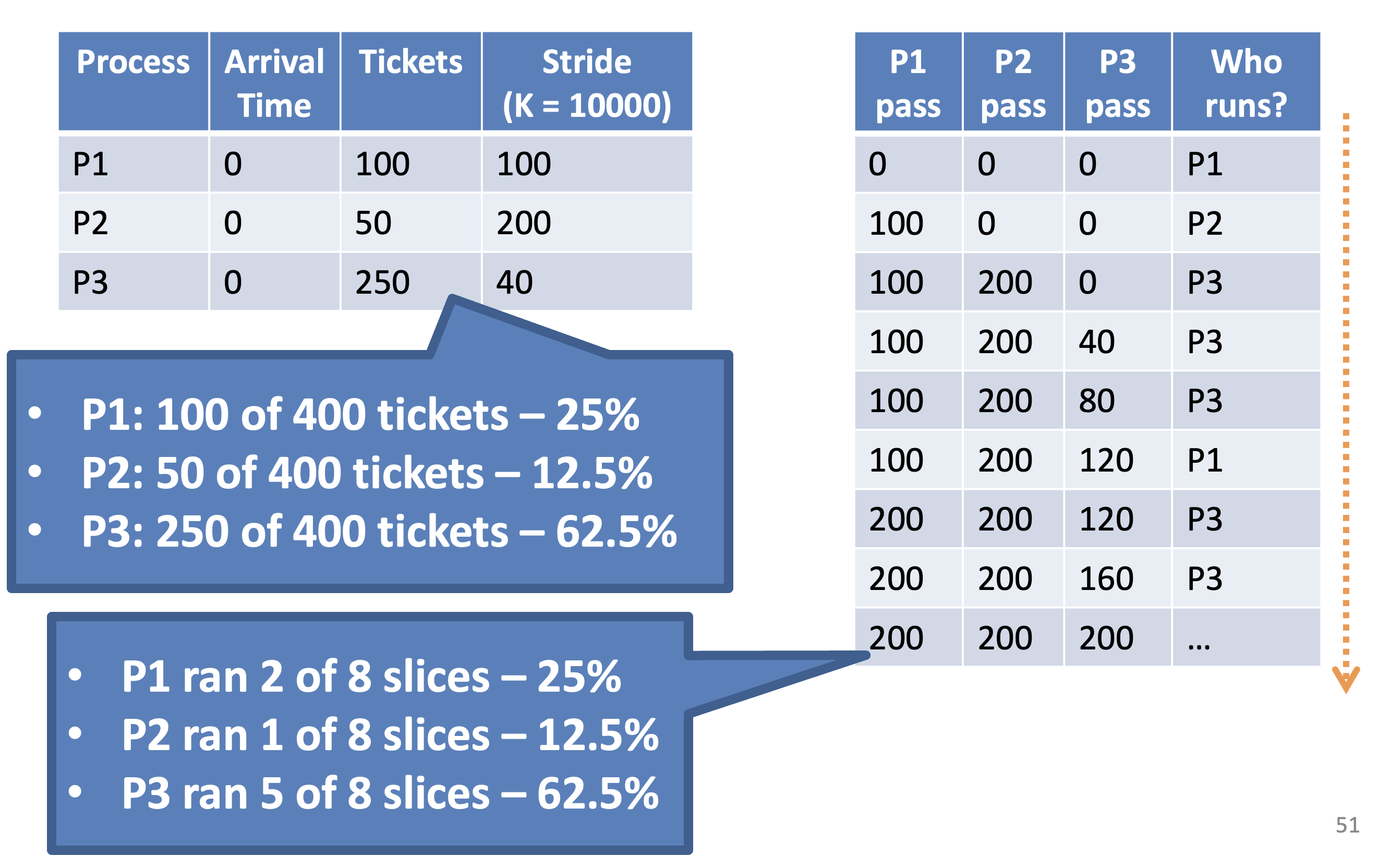
- When the passes reach to the least common multiple of Stride(=200),
fairness is guaranteed
Issues
Why choose lottery over stride scheduling?
- Stride schedulers need to store a lot more state
- What about new processes?
- If Pass = 0, then it will dominate CPU
Both schedulers require tickets assignment
- How many tickets to assign?
