Basics
Setting
Assumption
- N CPUs, P process/threads
Questions needed to be addressed
- In what order should the process be run?
- On what CPU should each process run?
Focus on scheduling in case of 1 CPU
Factors Influencing Scheduling
Characteristics of the process
- I/O bound or CPU bound
- CPU bound means the process is CPU intensive tasks
- Any metadata about the process
- If we have deadlines, we can take into account when scheduling
- Predictable?
- If the running time is predictable, we can take into account
Characteristics of the machine (Hardware + OS)
- #CPUs
- Can we preempt process?
Characteristics of the user
- Interactive? (desktop apps (mouse, keyboard))
Basic Scheduler Architecture
Scheduler selects from the ready processes
Scheduling decisions are made when a process
- No preemption
- Switches from running to waiting
- Terminates
- Preemption
- Switches from running to ready
- e.g. yield
- Switches from waiting to ready
- After I/O finish
Dispatch Latency
Dispatcher gives control of the CPU to the process selected by the scheduler
- Switches context
- Switching to/from kernel mode/user mode
- Saving the old EIP, loading the new EIP
Dispatching incurs a cost
- Context switching and mode switch are expensive
- Memory accessing is high-cost
Minimizing process switching is advantegeous
Note on Process & Thread
Process and thread are equivalent for scheduling purposes
SCS: System-contention scope
- Kernel supports threads = kernel threads
PCS: Process contention scope
- Kernel does not support threads = user threads
- Each process handles it's own thread scheduling
Basic Process Behavior
Process alternate between working and waiting
- Work -> CPU burst
- Processes vary I/O bound or CPU bound
so that make scheduler designing difficult
Scheduling Optimization Criteria
Max CPU utilization
- Keep the CPU as busy as possible
Max throughput
- # of processes that finish over time
- Min turnaround time: amount of time to finish a process (Arrival ~ Completion)
- Min waiting time: amount of time a ready process has been waiting (Waiting time in ready queue)
- Turnaround time - Waiting time = Execution time
Maximizing CPU utilization and maximizing throughput are independent
- If a process with a very long CPU usage time occupies,
CPU utilization goes up, but throughput goes down
Min response time
- amount of time between submitting a request and receiving a response (Arrival ~ Execute)
- Cliking a button and Seeing a response
Fairness
- All processes receive min/max fair CPU resources
- If one thread occupy CPU less than the other,
Process completion time will increase
Classic Schedulers
FCFS: First Come, First Serve
Processes stored in a FIFO queue
- Served in order of arrival
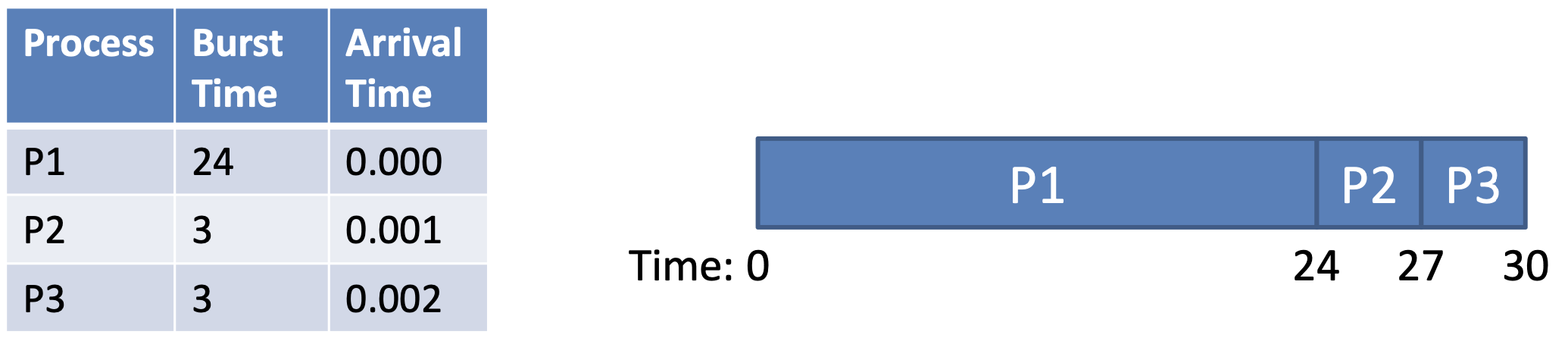
Turnaround time = completion time - arrival time
- P1 = 24, P2= 27, P3=30
- Average turnaround time:
Convoy Effect (= Head-of-line Blocking)
- Long process can impede short processes
- Serving a process that has long burst time leads to long turnaround time
SJF: Shortest Job First
Schedule process based on the length of next CPU burst time
- Shortest processes go first
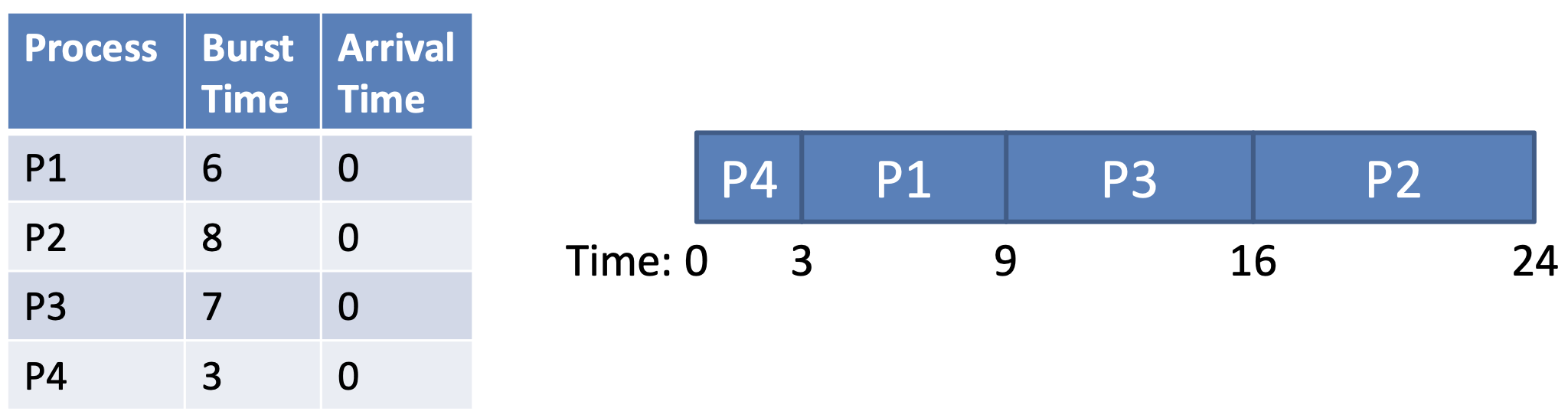
Turnaround time = completion time - arrival time
- Average turnaround time:
SJF is optimal: guarantees minimum wait time
STCF: Shortest Time-To-Completion First
= PSJF: Preemptive SJF or SRTF: Shortest Remainig-Time First
Process with long bursts can be context switched out short processes
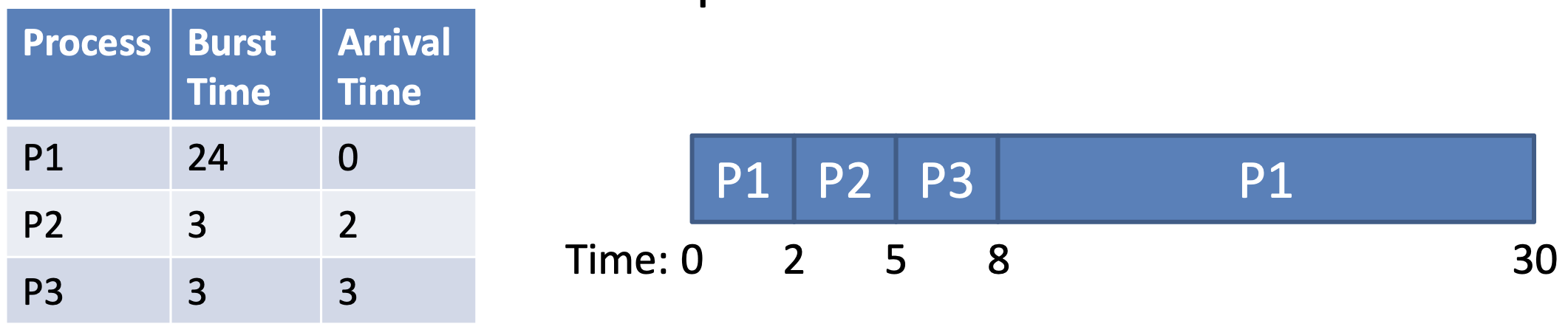
- At time 2, Compare 22(P1) with 3(P2)
- Average turnaround time:
STCF is also optimal (among Preemptive scheduling)
- Assuming we know future CPU burst times
Interactive Systems
Typing / Clicking in a desktop app
- User doesn't care about turnaround time
- User Does care about responsiveness
Response time = First run time - arrival time
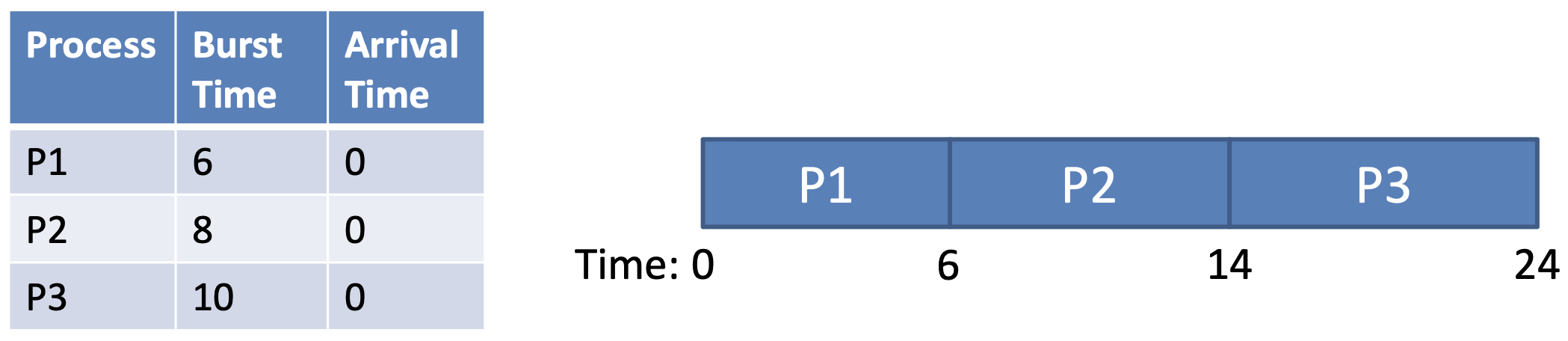
Average turnaround time:
Average response time:
RR: Round Robin (=Time slicing)
RR is designed to reduce response times
- RR runs jobs for a time slice (= scheduling quantum)
RR vs STCF
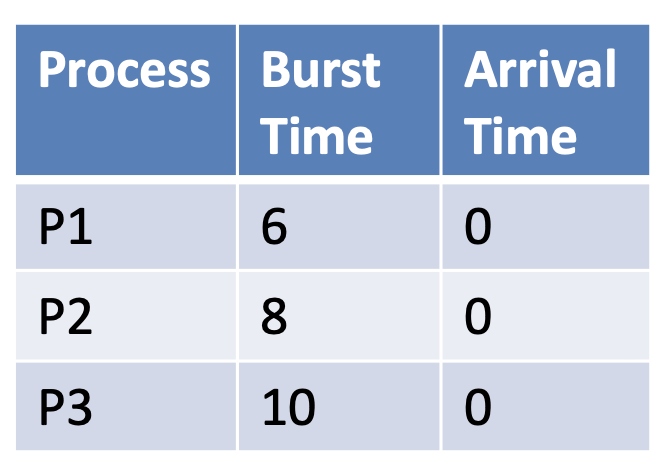
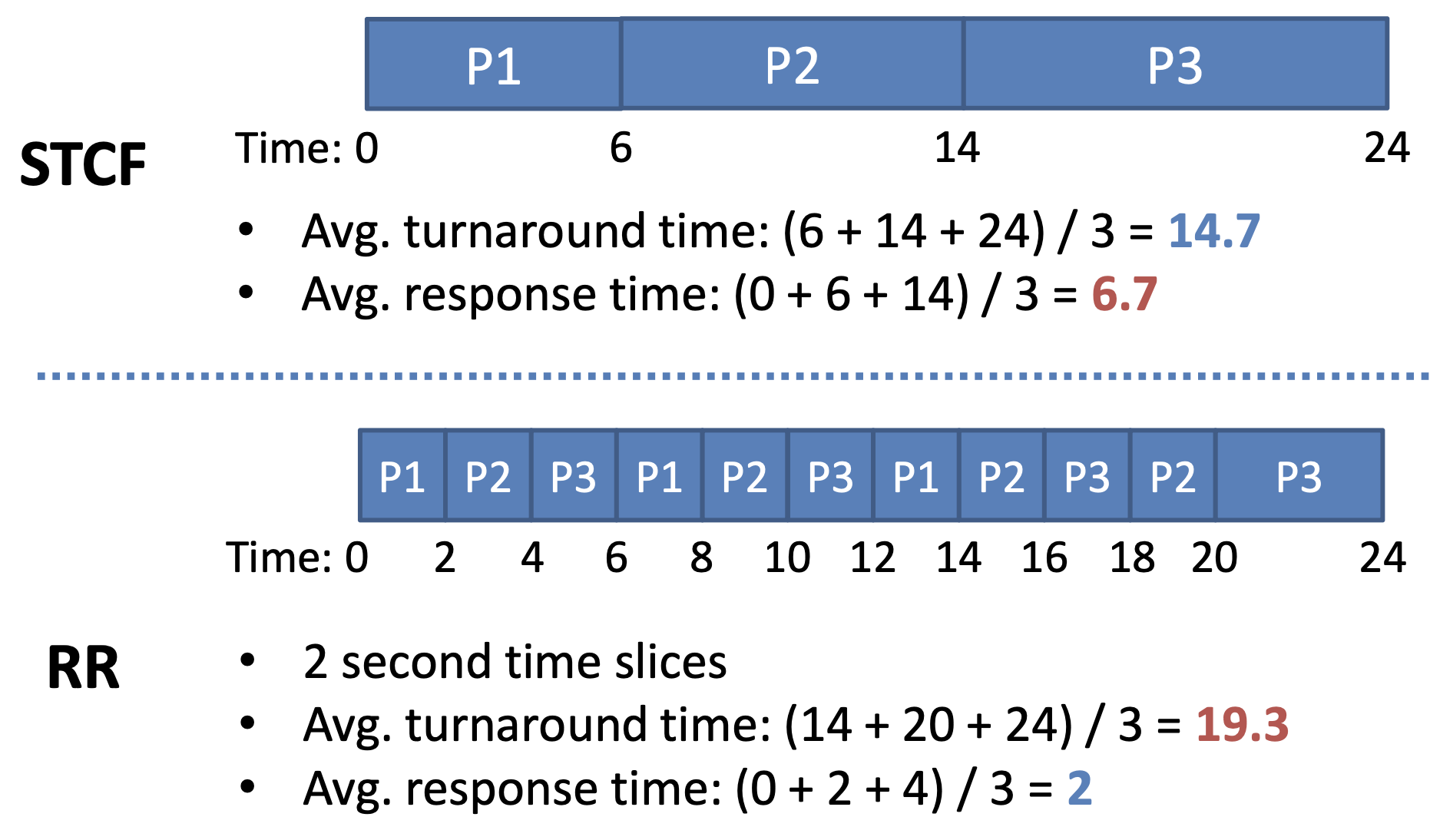
- No process waits more than time slices
- Case) # processes N=3, time slice Q=2
The last process P3 waits for (3-1)2 = 4
- Case) # processes N=3, time slice Q=2
Tradeoffs
| RR | STCF | |
|---|---|---|
| Response time | Good response time | Bad response time |
| Turnaround time | Worst possible (Q is large FIFO behavior) | Achieves optimal, low turnaround times |
| Fairness | Achieves fairness | Unfair |
| # Context Switch | Many times | A few times |
Selecting the Time Slice
- Smaller time slices = faster response times
- Advance on hardware spawns a tiny time slice
- Context switching overhead
- Context switch wastes CPU time
- If time slice is too short, context switch overhead will dominate
- This results in another trade off
