2024.03 arXiv, Gholami
- keyword: memory bandwidth, bottleneck
Introduction
-
LLM의 main performance bottlenck은 (기존 computing에서) memory bandwidth이 되어가고 있다.
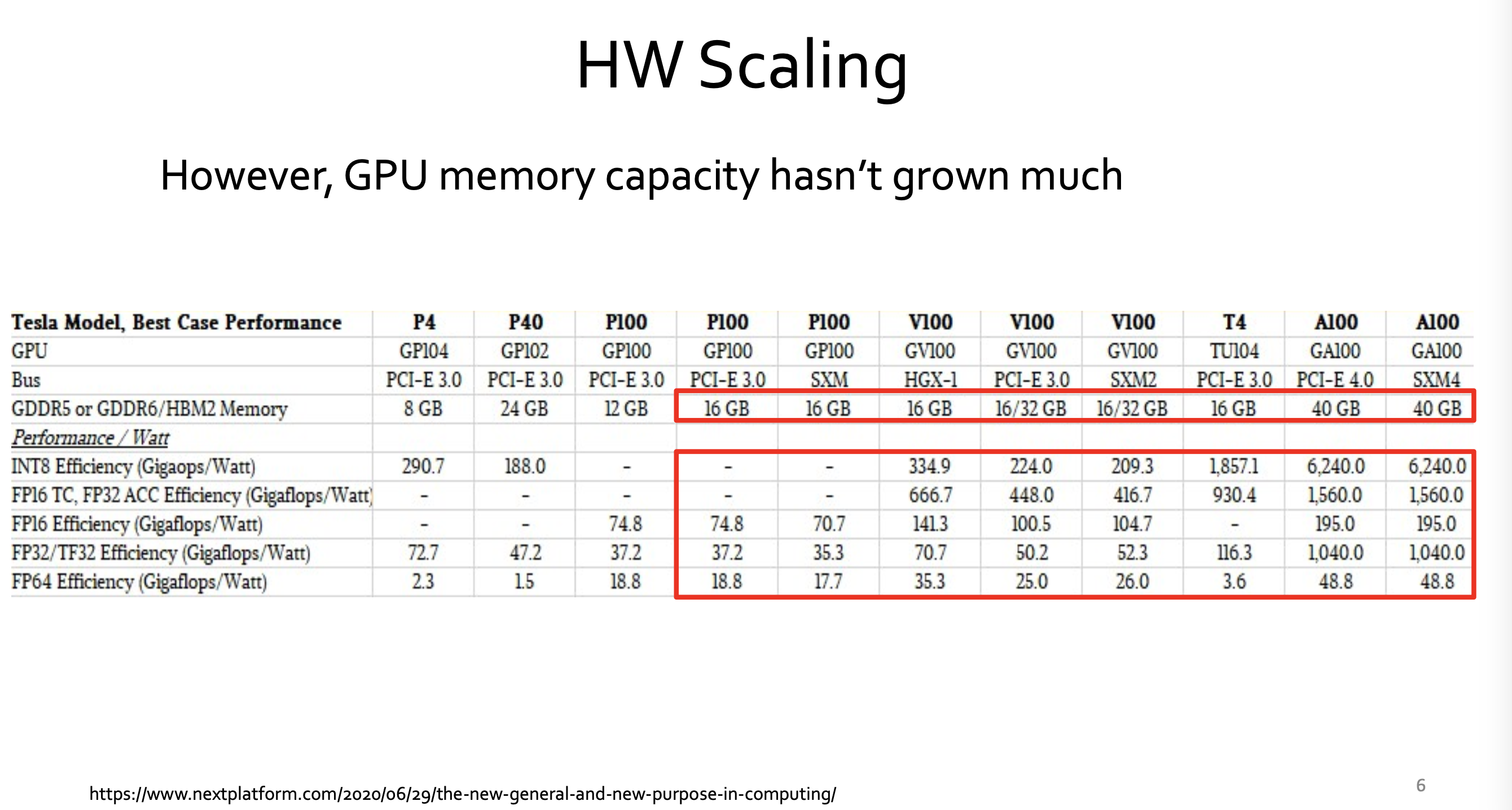
(특히 LLM serving에서)- computing: 과거 20년 동안, 60,000X 이상 향상 peak server hardware FLOPS는 3.0x/2yrs로 scaling.
- memory: 과거 20년 동안,
DRAM은 100X 향상, 1.6x/2yrs로 scaling
interconnect bandwidth는 30X 향상, 1.4x/2yrs로 scaling.
- computing: 과거 20년 동안, 60,000X 이상 향상 peak server hardware FLOPS는 3.0x/2yrs로 scaling.
-
LLM을 train하기 위해 필요한 연산량은 750x/2yrs로 증가하고 있다.
- 이러한 exponention trend는 AI accelerator가 hardware의 peak compute를 증가하는데 focus하게 한다.
- (often at the expense of simplifying other parts such as memory hierarchy. )
-
operation(연산)을 완료하는데 걸리는 시간은 두 가지에 의존.
-
compute: arithmetic을 얼마나 빨리 수행할 수 있는지
-
memory bandwidth: hardware의 arithmetic units에 data를 얼마나 빨리 feed할 수 있는지.
-
-
hardware가 computing(arithmetic)을 아무리 빠르게 하더라도, DRAM bandwidth 때문에 제한된다.
-
data는 Cache에 이미 있거나,
DRAM에서 fetch해야 하거나 -
80%의 데이터가 cache에 즉시 사용 가능한 상태로 있고
단 20%만 DRAM에서 가져와야 한다고 해도,
만약 이 20%의 cache-miss 데이터를 가져오는 데 5 cycles 이상 걸린다면,
전체 operation 완료 시간은 전적으로 DRAM에 의해 제한된다.
-
-
문제
- capacity
- bandwidth of memory transfer
- latency (bandwidth보다 향상 어려움)
-
different levels of "memory data transfer"
- between 'compute logic' and 'on-chip memory'
- between 'compute logic' and 'DRAM memory'
- between 'different processors on different sockets'
- 이 모든 case에 대해서, capacity와 data transfer speed는 hardware compute 성능보다 크게 뒤떨어져 있음.
-
compute는 bottlececk이 아니다. memory가 bottleneck.
- 최근 모델을 train 하는데 필요한 compte / FLOPs 는 750X/2yrs로 증가 (2018-2022) 했지만,
compute는 bottleneck이 아니다. 특히 model serving에서.
- 최근 모델을 train 하는데 필요한 compte / FLOPs 는 750X/2yrs로 증가 (2018-2022) 했지만,
-
single chip memory capacity << LLM size
-
LLM size는 410x/2yrs로 증가 (2018-2022)
-
이는 single chip의 memory capacity를 초과.
-
가능한 반문: single chip의 memory capacity와 bandwidth 문제를 해결하기 위해,
distributed-memory parallelism을 사용해서 multiple accelerator들로 training/serving을 scaling out하면 되지 않냐?- 하지만, multiple process를 distributing하는 것도 memory wall 문제에 부딪힘.
NN accelerator들 간에 data를 이동하는 communication bottleneck
(on-chip data 이동보다 느리고 비효율적인)
- 하지만, multiple process를 distributing하는 것도 memory wall 문제에 부딪힘.
-
model이 single chip에 fit하더라도,
intra-chip memory transfer가 bottleneck.
(from/to registers, L2 cache, global memory, etc.)- 최근의 specialized compute unit (Tensor core 같은) 발전으로, large set arithmetic 연산들은 몇 cycle 이내에 끝낸다.
- 따라서 이러한 arithmetic unit들을 항상 활용(utilized) 상태로 유지하려면,
대량의 data를 빠르게 공급(feed)해야 하는데, 바로 이 지점에서 chip memory bandwidth가 bottleneck.
-
Case Study
Transformer의 두 가지 architecture를 실험.
encoder architecture(e.g. BERT), decoder architecture(e.g. GPT)
A. Arithmetic Intensity
-
Arithmetic Intensity의 필요성
-
performance bottleneck을 measure하기 위한 popular method는
encoder-only, decoder-only model을 compute하기 위한 total number of FLOPs -
하지만, 이것만 놓고 보는 것은 잘못된 해석으로 이끌 수 있다.
-
operation의 arithmetic intensity를 봐야 한다.
-
-

-
Arithmetic Intensity: memory로부터 load되는 per byte(즉, data) 당 수행되는 num of FLOPs를 의미.
(MOPs: Memory Operation)
B. Profiling
-
Tansformer workloads의 bottleneck을 분석하기 위해,
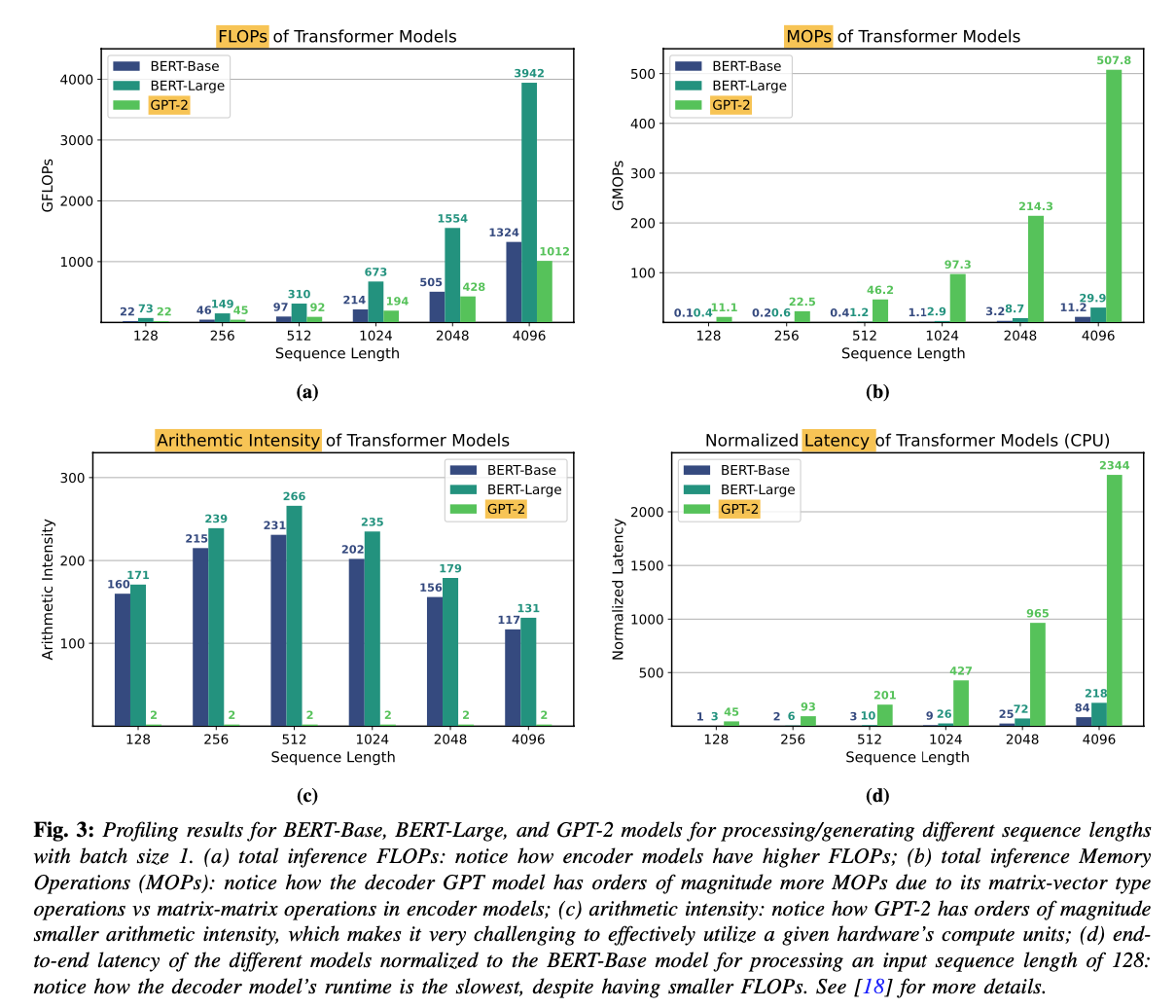
Transformer inference를 intel Gold 6242 CPU에서 profiling. -
결과
-
-
decoder-only (GPT-2)의 latency가 encoder-only(BERT 계열)보다 훨씬 큼
(각 sequence length에 대해서. BERT-Base와 GPT-2는 거의 동일한 model config를 갖고 있음에도) -
이는 GPT의 auto-regressive inference에 내재된
higher memory operations와 lower arithmetic intensity of matrix-vector operations 때문.-
deocder model
-
auto-regressive inference: 이전에 생성된 token들을 기반으로, 한 번에 하나의 token 생성.
-
따라서, sequential하게, 각 step에서 matrix-vector multiplication 수행
(weight matrix와 지금까지 생성된 token들의 hidden states(embeddings) 간의 multiplication) -
각 token마다 이전에 생성된 token들을 retrieve하기 위해 frequent한 memory access가 필요.
-
fewer computations relative to the amount of memory being accessed (= lower arithmetic intensity)
-
bottleneck = memory bandwidth
-
-
encoder model
-
모든 token들을 parallel로 처리.
-
한 번에 matrix-matrix multiplication 수행.
-
larger data chunks and more computations per memory access (=high arithmetic intensity)
-
-
-
arithmetic intensity가 높은 model은 낮은 model보다 더 빠르게, (동일한, 혹은 더 많은 FLOPs에서도) 실행 가능하다.
-
이는 decoder models (at low batch sizes)에서 major bottleneck은 compute가 아닌 memory wall임을 명확히 보여준다.
-
Promising Solutions for Breaking the Wall
A. Efficient Training Algorithms
challenge(for training NN models)와 promising approache들
-
challenge 1: need for brute-force hyperparameter tuning.
- learning rate, its annealing schedule, the number of iterations needed to converge...
- 주요 원인: first-order SGD methods는 hyperparam tuning에 robust하지 않음.
- promising approach: to use second- order stochastic optimization methods
- AdaHessian
- robust to hyperparameter tuning
- 한계: 3–4× higher memory footprint
- Zero framework from Microsoft
- train 8× bigger models with the same memory capacity
by removing/sharding redundant optimization state variables
- train 8× bigger models with the same memory capacity
-
promising approach: reducing memory footprint &
increasing the data locality of optimizatino algorithms,
at the expense of performing computation- communication avoiding algorithms
Minimizing communication in numerical linear algebra - rematerialization
- only store/checkpoint a subset of activations during the forward pass,
instead of saving all activations. - it reduces the feature map’s memory footprint.
- rest of the activations could then be recomputed when needed
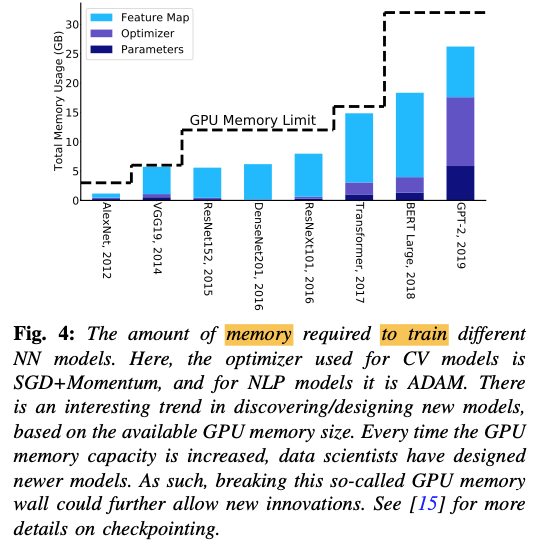
- allow practitioners to train large models on single-chip memory rather than utilize distributed training, which is often difficult to set up
- only store/checkpoint a subset of activations during the forward pass,
- communication avoiding algorithms
-
promising approach: low-precision training에 robust한 optimization 알고리즘.
- breakthrough in AI accelerators: half-precision (FP16) arithmetic 사용,
instead of single precision- hardware compute capability 10× 이상 증가.
- challenge: half-precision to INT8,
without accuracy degradation - promising trend: mixture of FP8 and FP16 (and even most recently FP4)
- breakthrough in AI accelerators: half-precision (FP16) arithmetic 사용,
B.Efficient Deployment
Model compression
-
Approach 1: Quantization(reducing precision)
- 현재 여기까지 가능
- training에선 FP16 이하가 어렵지만,
inference에선 ultra-low로 가능. - 현재 INT4까지는 accuracy 최소 영향으로 가능.
- training에선 FP16 이하가 어렵지만,
- challenge: sub-INT4 precision은 매우 어렵고, 현재 활발한 연구 분야.
- 현재 여기까지 가능
-
Approach 2: Pruning(removing redundant parameters)
-
현재 여기 까지 가능.
- Structured sparsity: Up to 30% of neurons
- Unstructured sparsity: Up to 80%
-
challenge: 이 이상으로 하는거.
-
-
Approach 3: Design small LLMs
- new frontiers
- It’s not just size that matters: Small language models are also few-shot learners
- Transformer 모델이 2017에 소개된 이후, LLM의 모델은 바뀌지 않음.
- data랑 model size를 키우면서 LLM 모델의 능력이 점프했지만,
- 최근엔 small LLM이 promising result를 보임.
- model이 on-chip에 완벽하게 fit한다면, speedup과 energy 절약이 매우 어마어마함.
C.Rethinking the Design of AI Accelertators
-
peak compute를 희생해서, compute/bandwidth trade-off를 달성할 수도 있음.
-
CPU 구조는 최적화된 cache hierarchy 이미 사용.
-
이것이 CPU가 GPU보다 bandwidth-bound 문제에 더 좋은 성능을 보이는 이유.
-
CPU의 challenge: peak compute capability (즉, FLOPS)가 GPU나 TPU와 같은 AI accelerator들보다 매우 낮음.
-
-
AI accelerator들이 주로 maximum peak compute를 달성하도록 설계되었기 때문.
- 더 많은 compute logic을 추가하기 위해 cache hierarchy와 같은 component들을 제거
-
가능한 대안
- 더 효율적인 caching을 갖추기.
- 더 높은 capacity의 DRAM (다양한 bandwidth를 가진 DRAM들의 hierarchy) 갖추기.
- distributed-memory communication bottleneck들을 완화하는 데 도움.