
-
Sensitivity-based non-uniform Q
-
Dense-and-Sparse decomposition (= outlier extraction)
-
sparse part: stores outliers and sensitivity weight values in an sparse format.
-
dense part: compact range to aid Q.
-
Motivation
-
main bottleneck for LLM inference: memory bandwidth
(rather than compute, specifically for single batch inference.)-
LLaMA-65B: 130GB+ RAM for FP16 deployment >> current GPU capacity.
-
speed for load and store parameters
-
non-uniform Q
-
uniform Q의 두 가지 main issue
-
LLM의 weight distribution은 non-uniform patterns
-
uniform Q의 main 이점은 efficient integer computation인 반면, memory bound한 end-to-end latency를 향상시키진 않음.
- (Appendix A) recent hardware trends indicate that faster computation does not necessarily translate to improved end-to-end latency or throughput (Gholami et al., 2024), particularly in memory-bound tasks like generative LLM inference.
-
Dense-and-Sparse Decomposition
-
Matrix를 dense, sparse로 decomposition하는 것은attention map decomposition에서 연구됨.
- ScatterBrain, Vitality
- leverage the fact that attention patterns often present low-rank characteristics with a few outliers
-
dense-and-sparse decomposition 전략을 Q 성능을 높이기 위해서, weight matrics에 적용한 것이 우리가 처음
Memory Wall
-
아래 논문 기반으로 정리해 놓은 듯.
-
Inference behavior는 크게 두 가지 범주로 나눌 수 있음.
- 계산 처리량에 의해 제한되는 compute-bound inference
- 메모리에서 처리 코어로 데이터를 공급하는 속도에 의해 병목 현상이 발생하는 memory-bound inference
-
Arithmetic intensity
- 메모리 연산 대비 계산 연산의 비율
- high arithmetic intensity는 compute-bound 문제를,
low arithmetic intensity는 memory-bound 문제를 나타내는데 사용되는 지표
-
Memory-bound 문제
- 하드웨어의 계산 유닛이 종종 메모리로부터 데이터를 받기 위해 대기하며 충분히 활용되지 않기 때문에,
계산량을 줄이는 것보다 메모리 트래픽을 줄임으로써 속도 향상을 달성할 수 있음.
- 하드웨어의 계산 유닛이 종종 메모리로부터 데이터를 받기 위해 대기하며 충분히 활용되지 않기 때문에,
-
생성형 LLM inference는 다른 workload에 비해 극도로 낮은 arithmetic intensity를 보임.
-
거의 전적으로 matrix-vector multiplication으로 구성되어 있기 때문.
각 weight load가 단일 token에 대한 단일 vector만 처리할 수 있고,
여러 token에 대한 다중 vector로 분산되지 못하므로 데이터 재사용이 제한. -
이러한 낮은 arithmetic intensity는 일반적인 GPU의 계산 연산과 대조될 필요가 있음.
GPU의 계산 연산은 memory 연산보다 수 단위 이상 높음. -
계산 능력과 memory bandwidth 사이의 이러한 격차, 그리고 deep learning의 증가하는 memory 요구사항은 Memory Wall 문제로 불리고 있음.
-
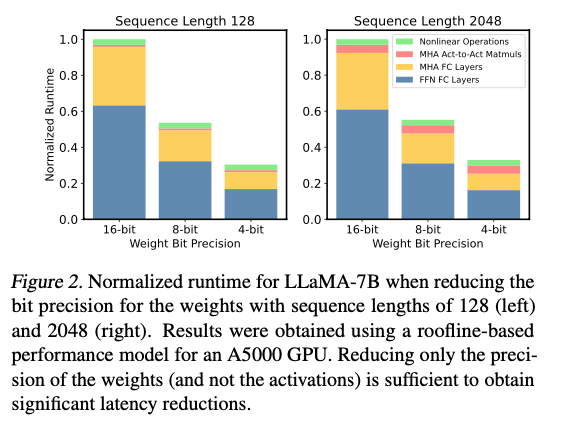
이 문제를 더 자세히 설명하기 위해, 우리는 간단한 roofline 기반 성능 모델링 접근법(Kim et al., 2023)을 사용하여,
A5000 GPU에서 다양한 bit precision으로 LLaMA-7B의 runtime을 연구함. (Fig 2)
-
모든 computation이 FP16에서 유지된다고 가정하더라도, bit precision을 줄일수록 latency가 선형적으로 감소하는 것을 볼 수 있음.
이는 주요 bottleneck이 compute가 아닌 memory임을 나타냄.
-
-
요약하면, 생성형 LLM inference에서 weight를 memory에 loading하는 것이 주요 bottleneck이며,
dequantization과 FP16 computation의 비용은 상대적으로 작음.-
따라서, activation은 full precision으로 유지한 채
weight만 lower precision으로 quantizing함으로써,
상당한 speedup과 함께 model size 감소를 얻을 수 있음. -
이러한 insight를 바탕으로, 전략은 arithmetic operation에 overhead를 추가하더라도 memory size를 최소화하는 것.
-
Method
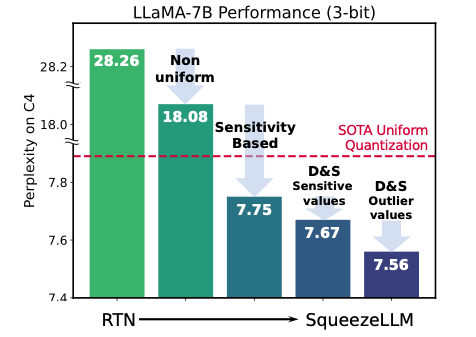
1. Sensitivity-based Non-uniform Q
-
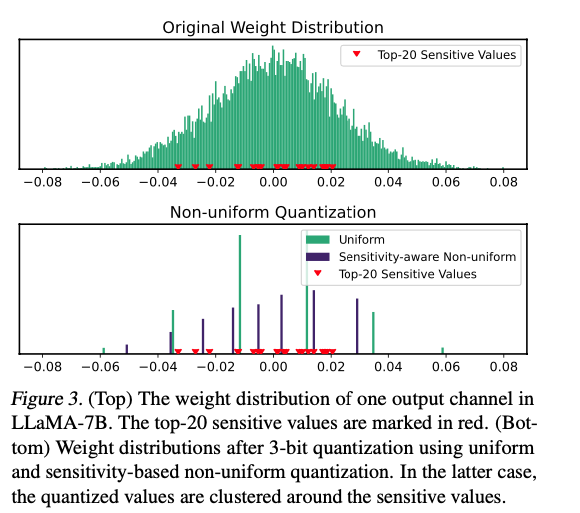
LLM의 weight distribution은 non-uniform pattern을 가짐.
-
SqueezeLLM이 non-uniform Q를 선택한 이유
-
uniform Q의 두 가지 main issue
-
1.LLM의 weight distribution은 non-uniform patterns
-
2.uniform Q의 main 이점은 efficient integer computation인 반면, memory bound한 end-to-end latency를 향상시키진 않음.
-
-
-
non-uniform Q의 optimal config를 찾는 것은 결국
"k-means problem"을 푸는 것과 같다.-
weight distribution이 주어졌을 때,
목표는 개의 centroid를 결정하는 것. (e.g., =8 for 3-bit) -
formulation of "optimization problem for non-uniform Q"

- : quantized weights, represented by distinct values
-
optimal solution 는 1D k-means clustering으로 구할 수 있다.
(parameter들을 k개의 cluster로 묶고, 각 cluster의 centroid를 q_j로 할당.)
-
-
이 방법은 이미 uniform Q보다 성능이 좋지만,
본 연구에서는 더 향상된 sensitivity-based clustering 알고리즘을 제안.
⭐ Sensitivity-Based K-means Clustering
- Quantization의 목표는 model weight를 low-bit precision으로 표현하면서 model output의 변화(perturbation)를 최소화하는 것.
-
Quantization은 각 layer마다 perturbation을 일으키지만,
각각의 layer에 focus하기 보단,
final loss에 관한 overall perturbation을 최소화해야 한다.
(Q 이후의 end-to-end 성능 하락에 더 direct한 measure)이기 때문.- 따라서, k-means centroid를 final loss에 관해 더욱 sensitive한 value 근처에 위치시켜야 한다.
-
더욱 sensitive한 value를 결정하기 위해,
weights 의 변화(perturbation)에 따른 loss의 변화를
Taylor expansion을 사용해서 .

= gradient, = hessian -
model이 converged 됐다고 가정하면, gradient
weights 의 변화(perturbation)에 따른 loss의 변화는 다음과 같다.
(즉, 새롭게 정의된 optimization problem은 다음과 같다.)

- perturbation of each weight after Q, i.e. 에
scaling factor로 second-order derivative 가 곱해지는(weighted되는) 꼴이다. - 따라서, 큰 Hessian 값을 가진 weight들에 대한 변화(perturbation)를 최소화하는 것이 중요하다!!!
- perturbation of each weight after Q, i.e. 에
-
: Hessian을 Fisher info로 approx.
-
Hessian 를 computing하는건 비싸므로,
Hessian을 Fisher information 를 기반으로 .

-
단지 일련의 sample에 대한 gradient를 계산하면됨.
-
-
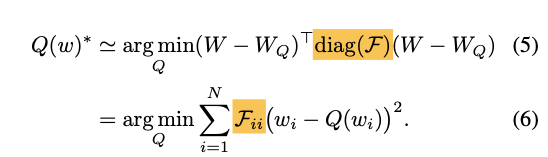
: Fisher info에서 diagonal만 사용.
-
Fisher information matrix에서 diagonal matrix만 사용.
-
diagonal(weight themselves)이 아닌(weight 간의 interaction)은 무시할만 한다고 가정.
-
-
-
Eq (5)의 중요한 결론은 이 문제가 weighted k-means clustering 문제로 해석될 수 있다는 점.
- centroid들은 sensitive한 weight 값들에 더 가깝게 끌려감.
-
Fig 3에서는 예시로 든 weight distribution의 Fisher information을 기반으로 상위 20개의 sensitive value를 보임.
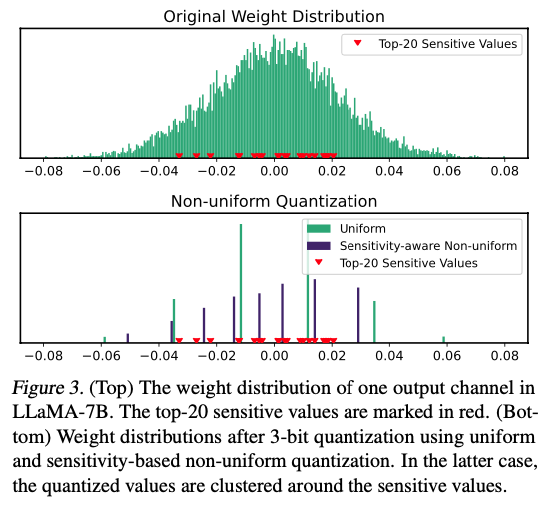
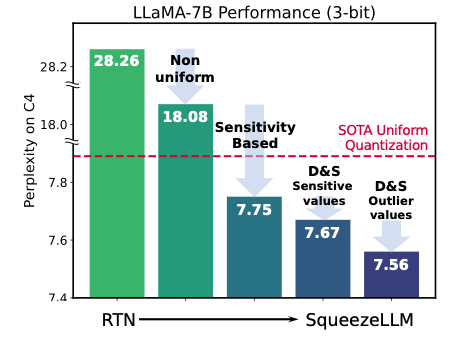
- Sensitivity-based 접근법은 centroid를 sensitive value 근처에 배치함으로써 더 나은 trade-off를 달성하며, 이를 통해 quantization error를 효과적으로 최소화.
2. Dense-and-Sparse Q
-
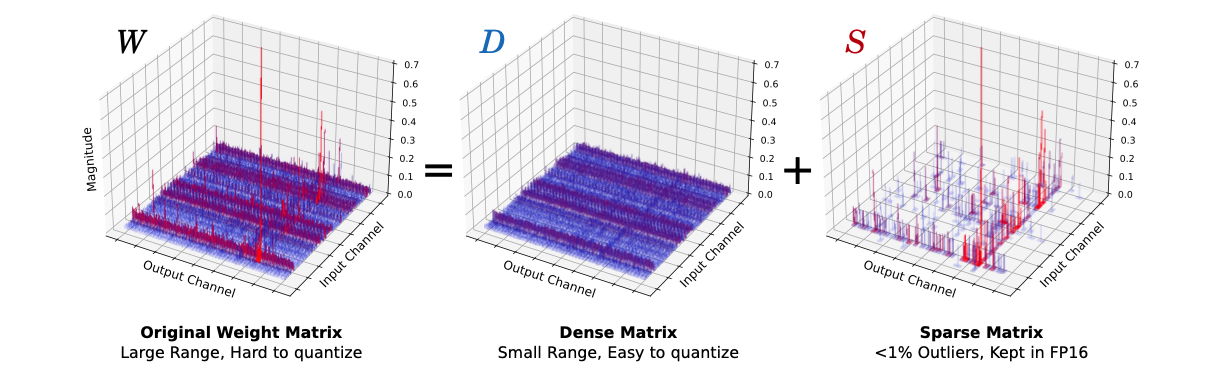
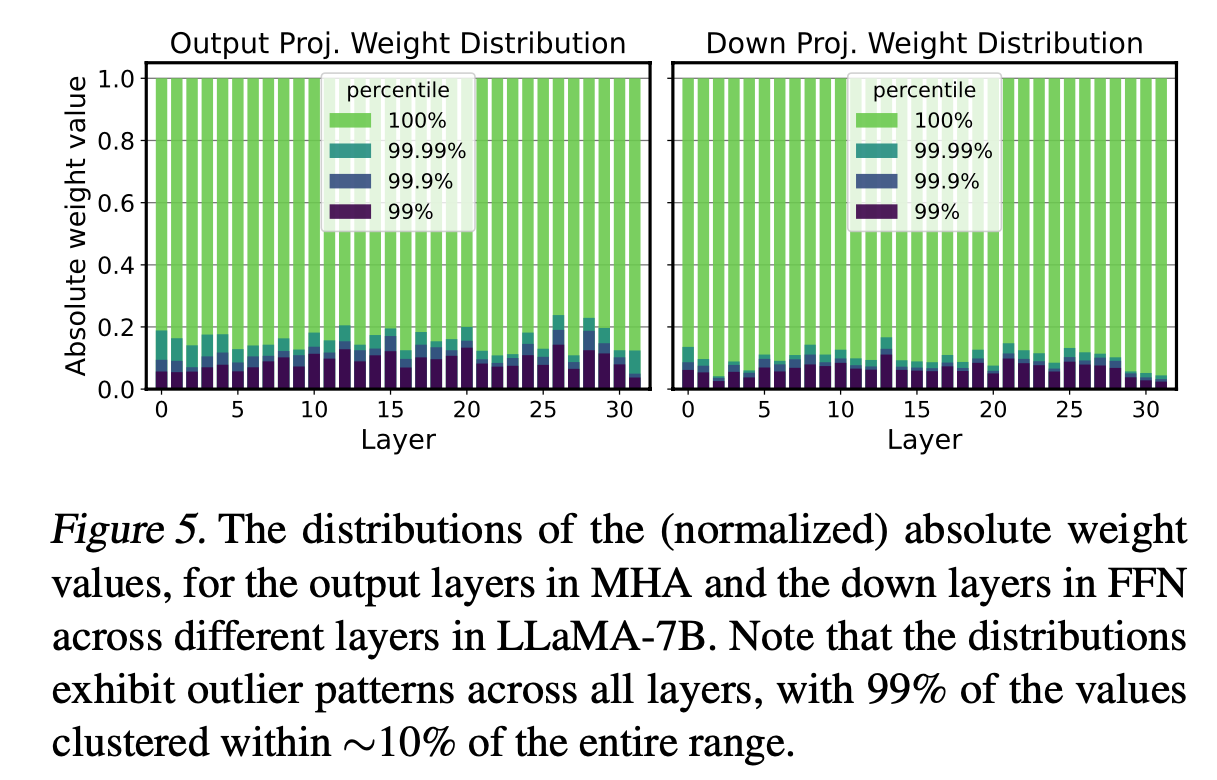
weight의 ~99.9%는 전체 range의 ~10% 범위에 집중되서 분포.
-
-
따라서, 단순히 weight를 Q하면, 성능 심각하게 하락.
-
하지만 이는 기회이기도 함.
소수의 outlier value (예를 들어, 0.1%)만 제거함으로써
weight value의 범위를 10배 정도 축소 가능.- 이는 quantization resolution 개선 가능.
- 이는 sensitivity-based k-means의 centroid들이 소수의 outlier보다는 sensitive value들에 더 집중할 수 있도록 도와줌.
-
-
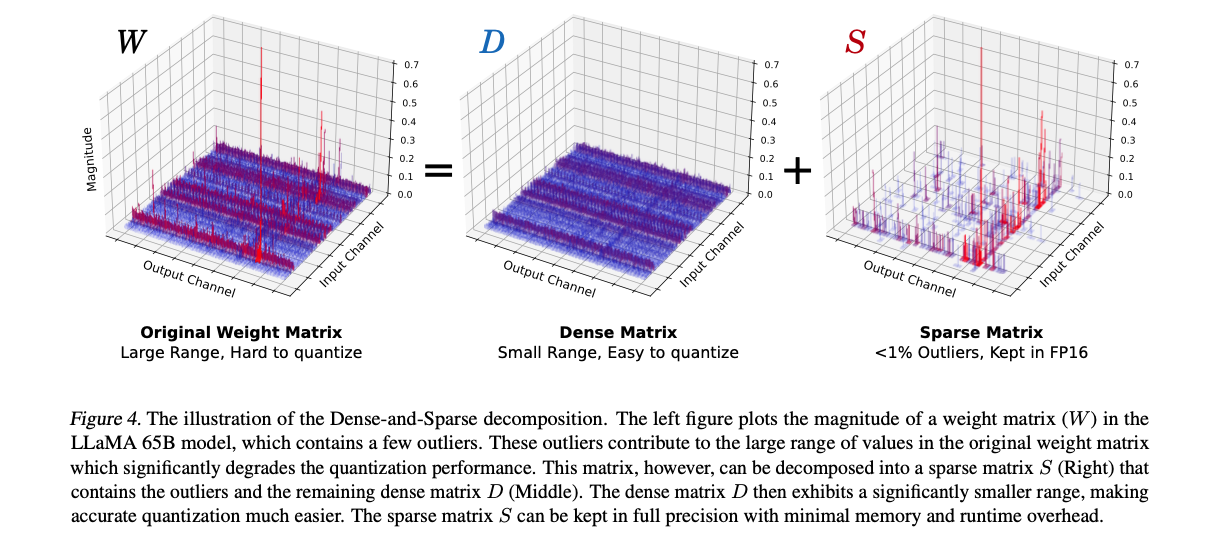
weight matrix 를 S와 D로 decomposition
-
-
sparse matrix(S)
- outlier 포함.
-
dense matrix(D)
- 나머지.
-
는 distribution의 percentile을 토대로,
outlier를 정하는 threshold.
-
-
-
중요한 점은 이 decomposition의 overhead가 최소라는 점.
- 이는 outlier value의 수가 적기 때문(예: 전체 value의 0.5%).
- 따라서 sparse matrix는 compressed sparse row (CSR) 형식과 같은 방법을 사용하여 효율적으로 저장 가능.
- Inference 또한 이 decomposition을 통해 간단해짐.
- WX = DX + SX 형태로, dense와 sparse multiplication을 위한 두 kernel을 오버랩 가능.
Sensitivity-Based Sparse Matrix
- Outlier를 sparse matrix로 분리하는 것 외에도,
소수의 highly sensitive한 weight matrix value를 정확하게 표현하는 것의 이점을 발견.
- sensitive한 value는 Fisher information을 기반으로 쉽게 식별했음.
- sensitive value들을 FP16으로 유지하여
- 1) model output에 미치는 영향을 방지할 뿐만 아니라,
- 2) Eq. 5의 centroid들이 sensitive value들로 치우치는 것을 막아줌.
- Sensitive value들을 sparse matrix로 분리함으로써, 이 값들은 k-means clustering 과정에서 제외됨.
- 결과적으로, 남은 weight들에 대해 더 균형 잡힌 clustering이 가능해짐.
- 이는 centroid들이 극단적인 값들에 과도하게 영향받지 않고, 전체 분포를 더 잘 대표할 수 있게함.
- layer 전체에서 단 0.05%의 sensitive value들만 추출해도 quantization 성능을 상당히 향상시킬 수 있음을 관찰함.
GPTQ와의 차이점
-
-
SqueezeLLM: minimize the perturbation to the end layer
-
GPTQ try to minimize the perturbation not to the end layer, but to the specific layer that is being quantized.
-
Optimal Brain Damage [1] (which minimizes perturbations to the end layer/loss and is also used by our method)
vs
Optimal Brain Surgeon [4] (which minimizes perturbations to a specific layer in isolation and used by methods such as GPTQ). -
This is expected since perturbation errors in a particular layer may not be important if the predictions of the network are not sensitive to that particular layer. (squeezeLLM authors)
-