Bias-Variance Tradeoff

김민재·2024년 6월 8일
0

ML

목록 보기
12/17

Approximation-generalization tradeoff

우리의 목적은 out of sample error, 즉 EoutE_{\text{out}}이 낮은 learner을 얻고자 하는 것이다.
이 learner을 얻기 위해서는 우리가 2가지 방법을 생각할 수 있다.

  • More complex H\mathcal{H} \Rightarrow better chance of approximating ff

  • Less complex H\mathcal{H} \Rightarrow better chance of generalizing out of sample

과연 우리가 모델을 더 복잡하게 만들것이냐, 아니면 hypothesis를 좀더 일반화할것이냐에 따라 달렸다.

그렇다면 우리가 만들어야 하는 ff는 얼마나 hypothesis를 잘 예측하는지와, 주변을 얼마나 잘 cover하는지를 따져야 한다.


out of sample error부터 시작해보자.
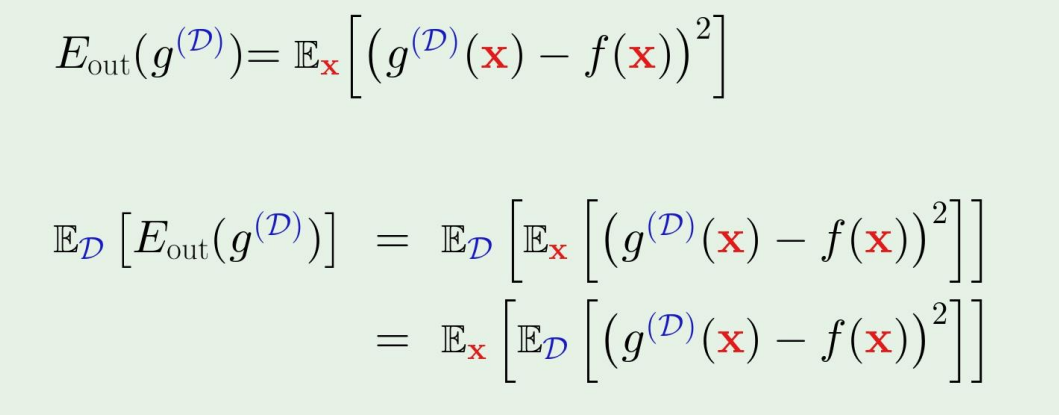
아래의 수식에서 D\mathcal{D}는 data set이고, gg는 candidate of best hypothesis이다.

EoutE_\text{out}는 내 data set에 dependent 하므로 위의 수식에서 아래처럼 쓸수있고, 맨 마지막줄의 ED[g(D)(x)f(x)2]\mathbb{E}_{\color{Blue}\mathcal{D}}\left [ g^{({\color{Blue}\mathcal{D}})}({\color{Red} \mathbf{x}})-f({\color{Red} \mathbf{x}})^2 \right ]는 data set에 대한 out of sample error의 expectation이다.

그렇다면 이제, ED[g(D)(x)f(x)2]\mathbb{E}_{\color{Blue}\mathcal{D}}\left [ g^{({\color{Blue}\mathcal{D}})}({\color{Red} \mathbf{x}})-f({\color{Red} \mathbf{x}})^2 \right ]를 살펴보자.

The average hypothesis

ED[g(D)(x)f(x)2]\mathbb{E}_{\color{Blue}\mathcal{D}}\left [ g^{({\color{Blue}\mathcal{D}})}({\color{Red} \mathbf{x}})-f({\color{Red} \mathbf{x}})^2 \right ]를 evaluate하기 위해 새로운 변수를 하나 정하자.

average hypothesis gˉ(x):\text{average hypothesis } \bar{g}({\color{Red} \mathbf{x}}):
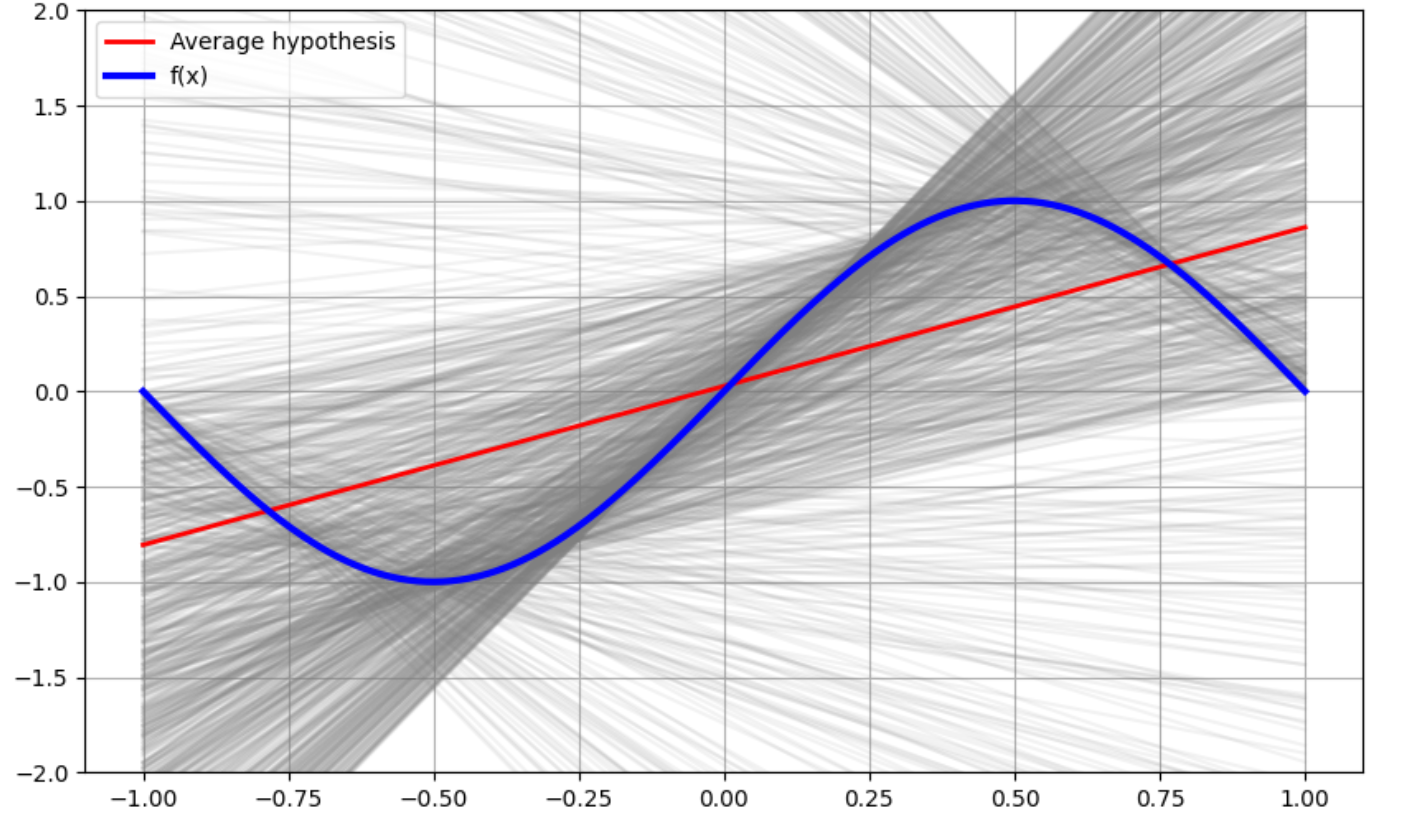
gˉ(x)=ED[g(D)(x)]\bar{g}({\color{Red} \mathbf{x}}) = \mathbb{E}_{\color{Blue}\mathcal{D}}\left [g^{({\color{Blue}\mathcal{D}})}({\color{Red} \mathbf{x}}) \right ]
gˉ(x)1Kk=1Kg(Dk)(x)\bar{g}({\color{Red} \mathbf{x}})\approx\frac{1}{K}\sum_{k=1}^Kg^{{\color{Blue}(\mathcal{D}_k)}}({\color{Red}\mathbf{x}})

Bias and variance

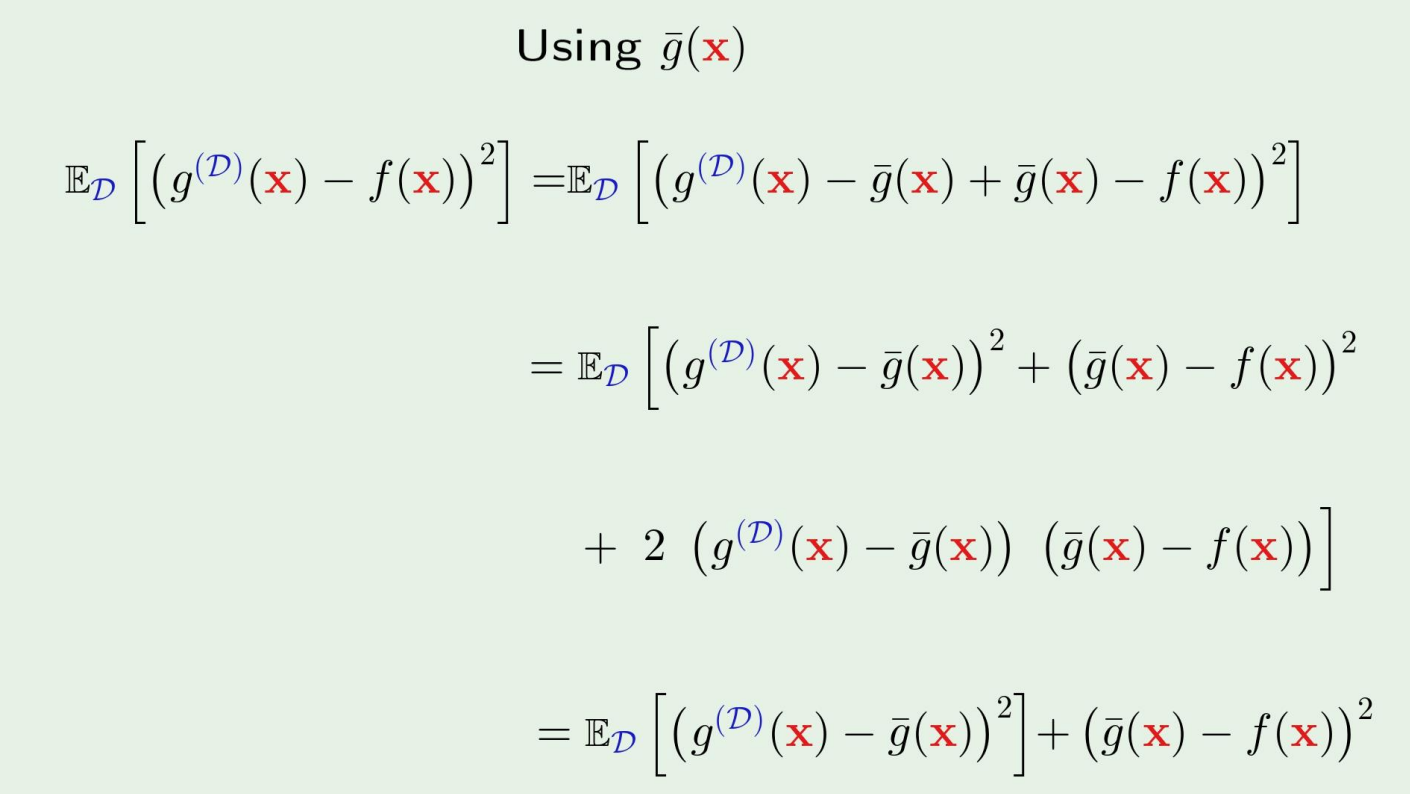
ED[g(D)(x)f(x)2]=ED[(g(D)(x)gˉ(x))2]var(x)+(gˉ(x)f(x))2bias (x)\mathbb{E}_{\color{Blue}\mathcal{D}}\left [ g^{({\color{Blue}\mathcal{D}})}({\color{Red} \mathbf{x}})-f({\color{Red} \mathbf{x}})^2 \right ] = \underbrace{\mathbb{E}_{\color{Blue}\mathcal{D}}\left [ (g^{({\color{Blue}\mathcal{D}})}({\color{Red} \mathbf{x}})-\bar{g}({\color{Red} \mathbf{x}}))^2 \right ]}_{\text{var}({\color{Red} \mathbf{x}})}+\underbrace{(\bar{g}({\color{Red}\mathbf{x}})-f({\color{Red}\mathbf{x}}))^2}_{\text{bias }({\color{Red} \mathbf{x}})}

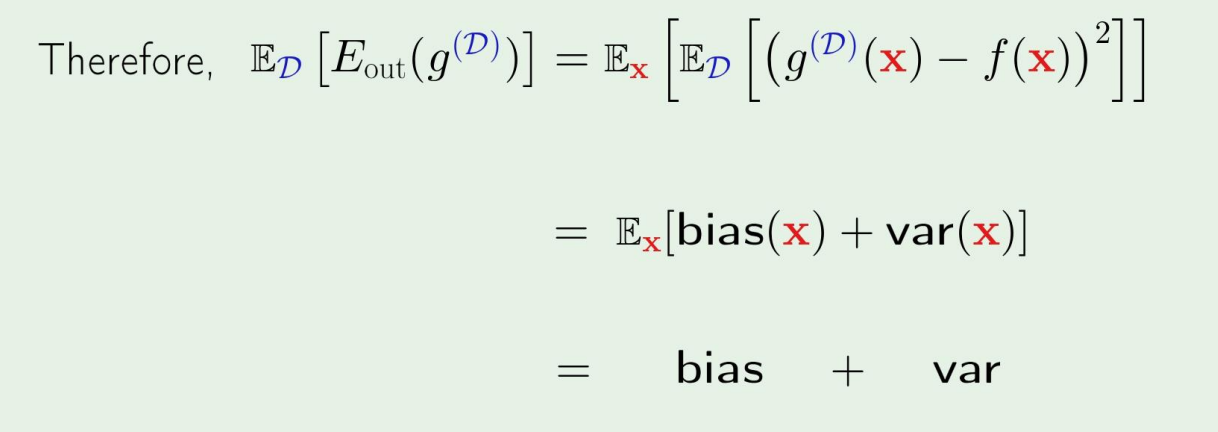
그렇다면, 다음과 같은 식이 되어 bias와 var에 dependent하게 된다.
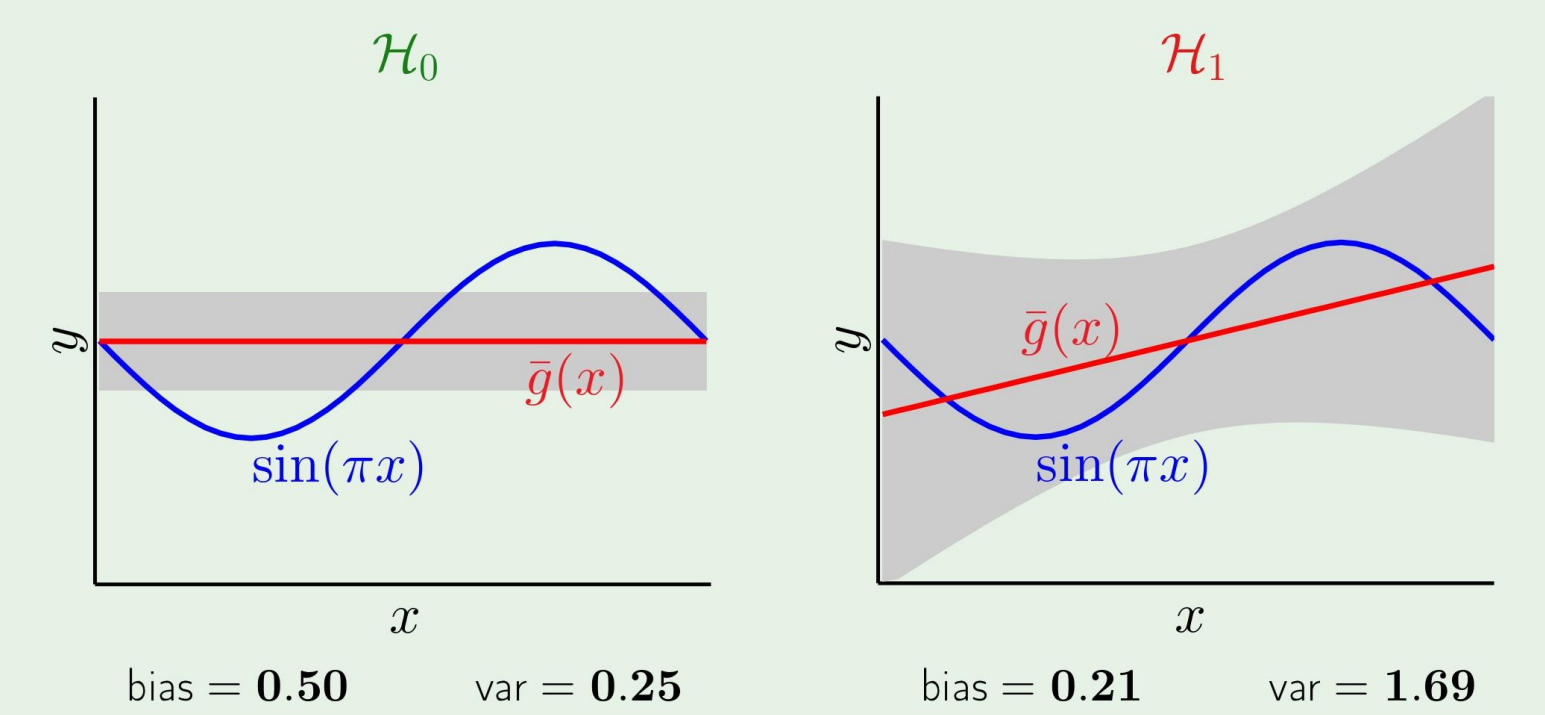
bias와 var의 예시를 그림으로 들자면,
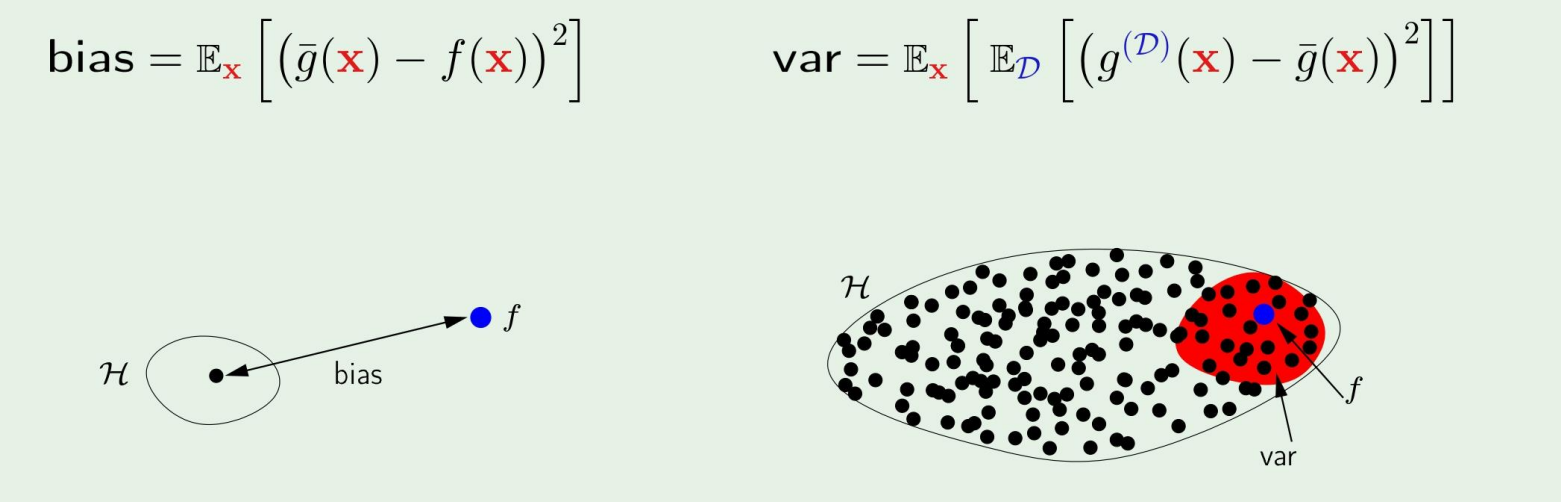
왜 tradeoff 문제라고 불릴까?

우리가 set of hypothesis를 크게 만들면 bias가 좀 크더라도 set을 작게 만드는것에 비해 작아질것이다. 그러나 이 경우의 variance가 증가한다.
반대로, variance를 작게 만든다면, bias가 증가한다.

따라서 이 둘을 적절히 조절해야 한다.

한가지 예제를 살펴보자


Example: sine target

f:[1,1]Rf(x)=sin(πx)f:[-1,1]\to\mathbb{R} \qquad f(x) =sin(\pi x)

이 함수를 target function이라 생각하고, 오직 2개의 training example이 있다고 생각하자.

Two model used for learning

H0:h(x)=bH1:h(x)=ax+b\begin{aligned} {\color{Green}\mathcal{H}_0}:& h(x) = {\color{Green} b}\\ {\color{Red} \mathcal{H}_1} :& h(x) = {\color{Red} ax + b} \end{aligned}

이 경우에 어떤 hypothesis가 더 좋을까?

만약 우리가 target function을 안다면,
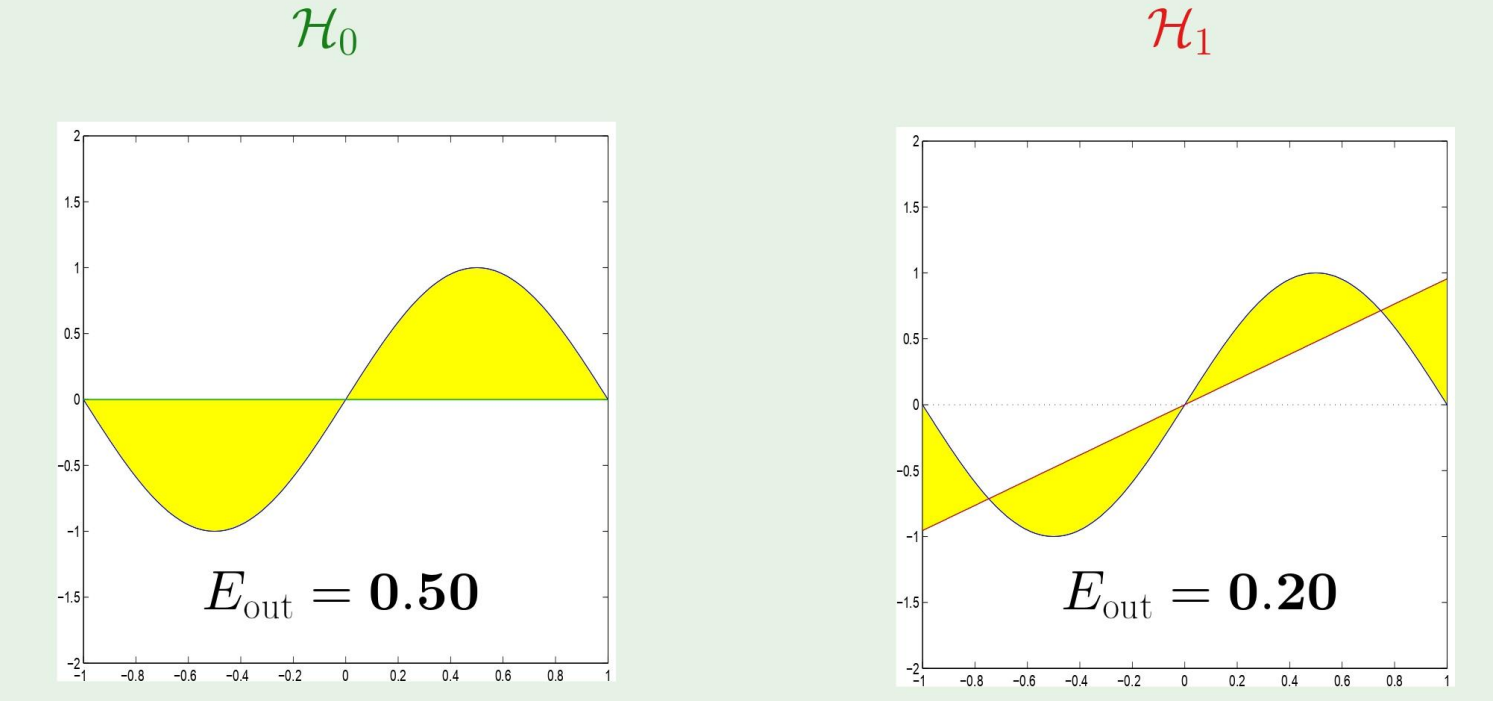
당연히 EoutE_{\text{out}}가 낮은 H1\mathcal{H}_1이 더 좋다고 할것이다.
그러나, 우리는 target function을 모르기 때문에, bias variance trade off를 통해 더 나은 hh를 찾아야 한다.

결과를 보면, 아까의 식에서 본것처럼 bias와 variance를 더한것이 우리의 average였으므로, 이 경우에는 H0\mathcal{H}_0가 더 좋은 hh라 할수있다!

즉, model complexity는 우리가 알수없는 target function에 집중하는것이 아닌, 우리가 실제로 얻은 data에 맞춰야 한다!!


위 과정을 구현해놓았으니 궁금하신분들은 이미지를 누르시면 구현 코드를 확인하실 수 있습니다.

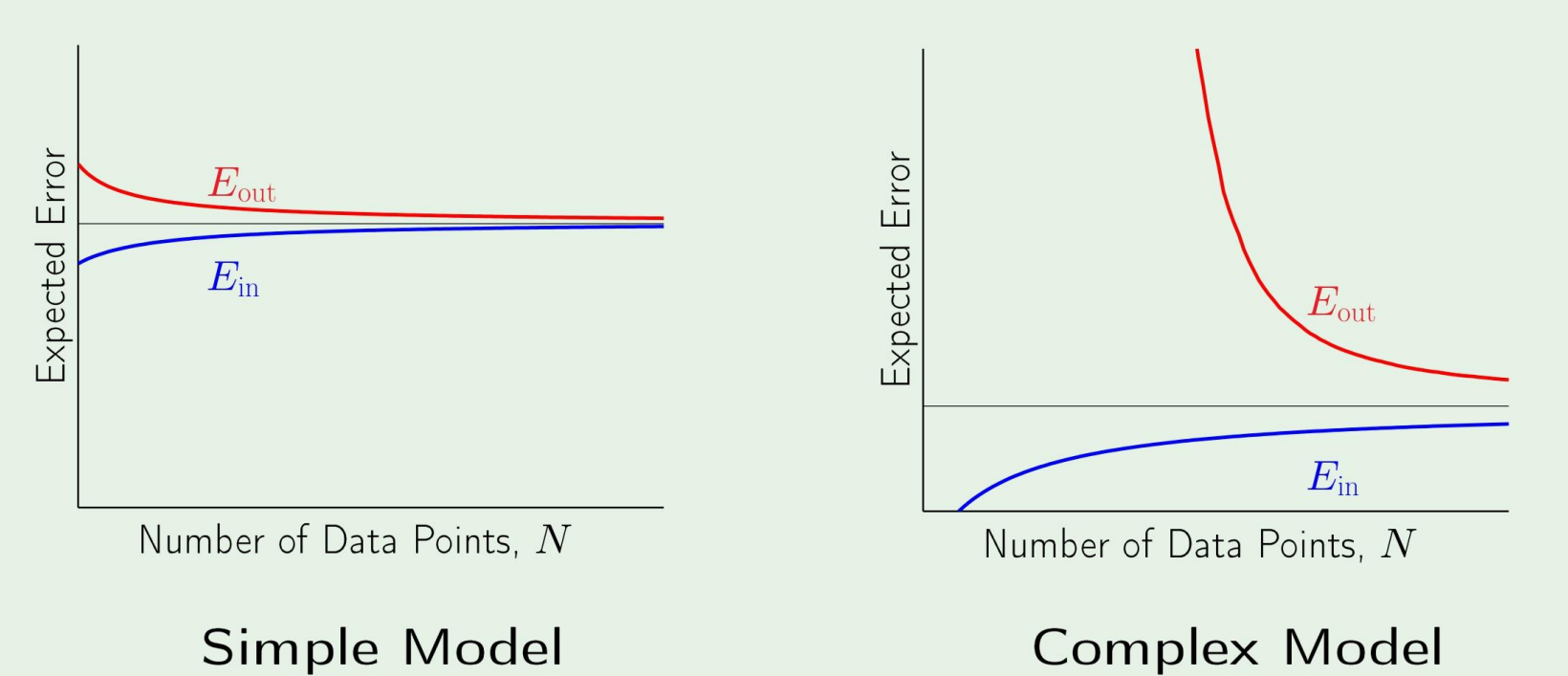
이번엔 sample의 갯수 NN이 증가할수록, Ein,EoutE_{\text{in}} , E_{\text{out}}이 어떻게 될지 예측해보겠다.

일반적으로, simple model과 complex model에 대한 error는 다음과 같다.
VC analysis vs bias-variance analysis
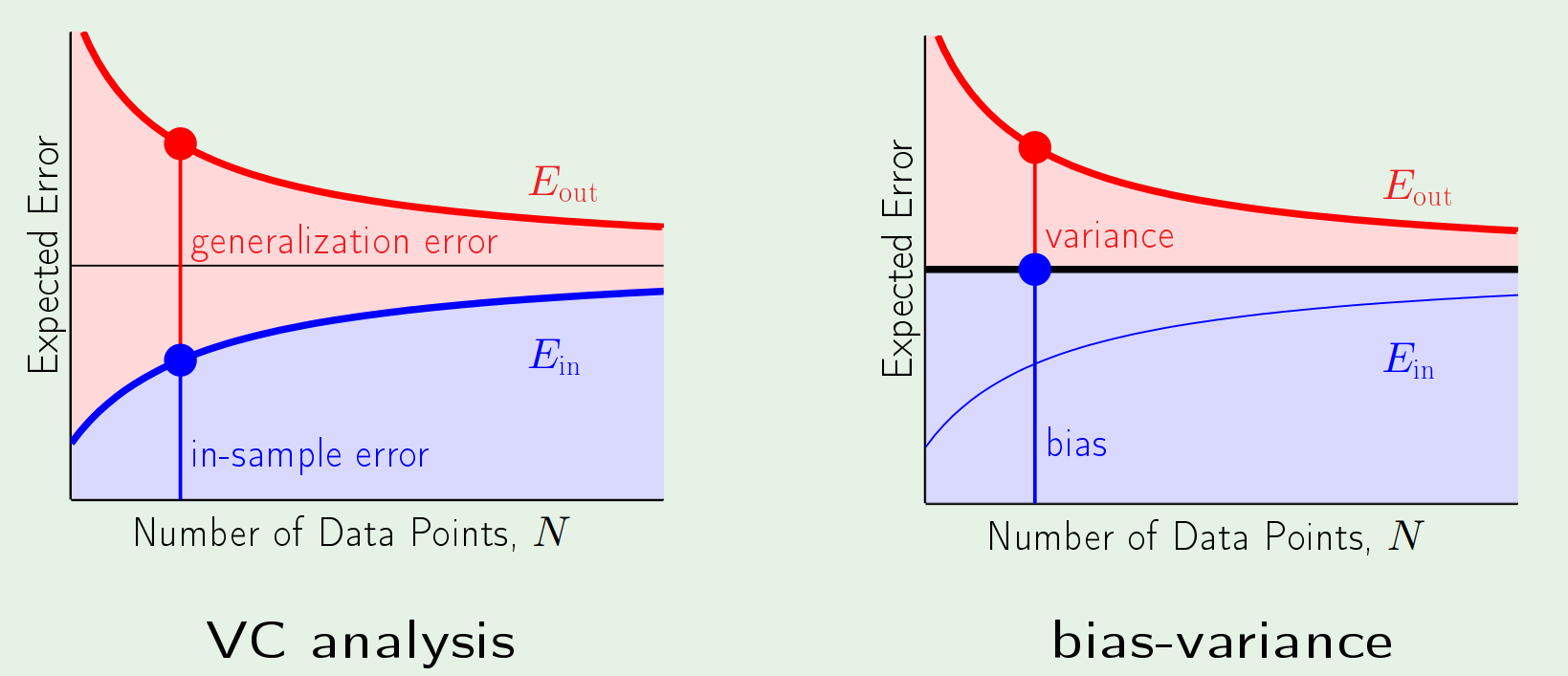
VC analysis에서는 작은 number의 sample에 대해서는 쓸수없다.

0개의 댓글