Support Vector Machines
- Here we approach the two-class classification problem in a direct way :
We try and find a plane that seperates the classes in feature space
- If we cannot, we get creative in two ways :
- We soften what we mean by
seperates, and - We enrich and enlarge the feature space so that separation is possible
- We soften what we mean by
What is a Hyperplane?
- A
hyperplanein dimensions is a flat affine subspace of dimension - In general the equation for a
hyperplanehas the form - In dimensions a
hyperplaneis a line - If the
hyperplanegoes throught the origin, otherwise not - The vector is called the normal vector - it points in a direction
orthogonalto the surface of ahyperplane
Separating Hyperplanes
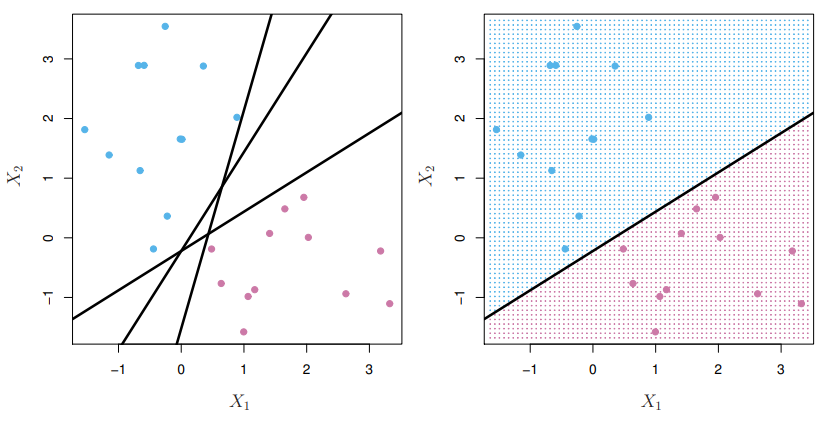
- If , then for points on one side of the
hyperplane, and for points on the other - If we code the colored points as for blue, say, and for mauve, then if for all , defines a
separating hyperplane
Maximal Margin Classifier
- Among all seperating
hyperplanes, find the one that makes the biggest gap ormarginbetween the two classes
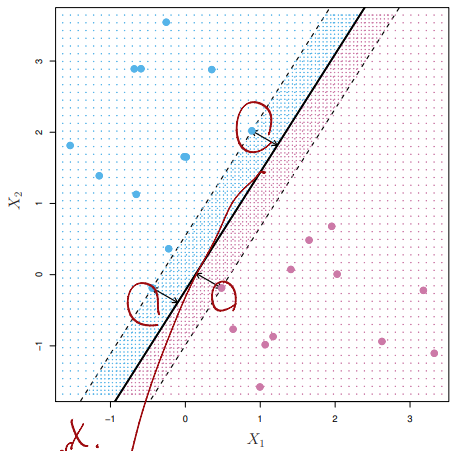
- Constrained optimization problem
Non-separable Data
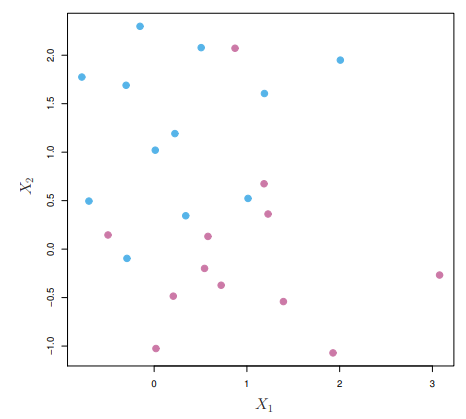
- The data are not separable by a linear boundary
- This is often the ase, unless
Noisy Data
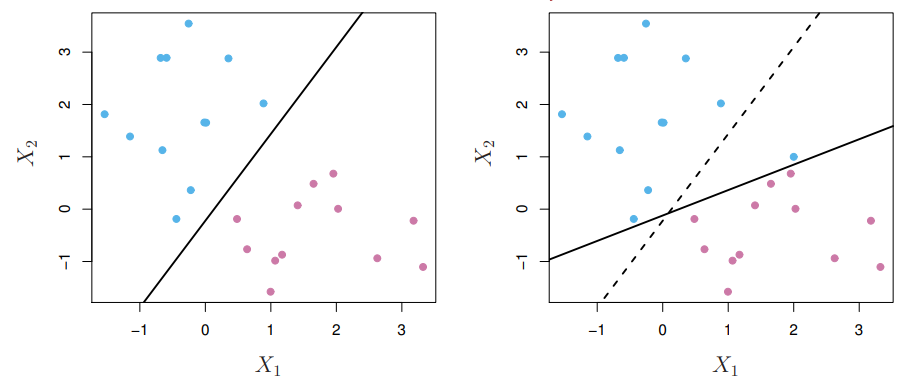
- Sometimes the data are separable, but noisy
- This can lead to a poor solution for the
maximal-marginclassifier - The
support vector classifiermaximizes asoft margin
Support Vector Classifier
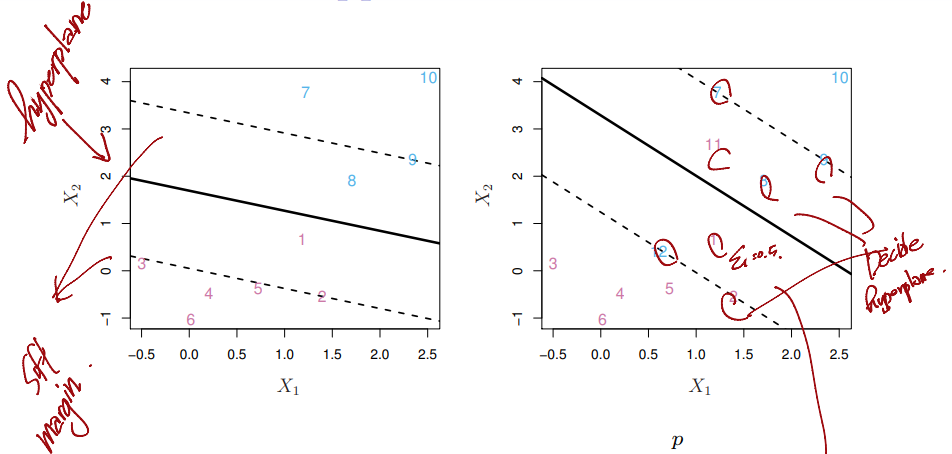
- : slack variable
- : Budget
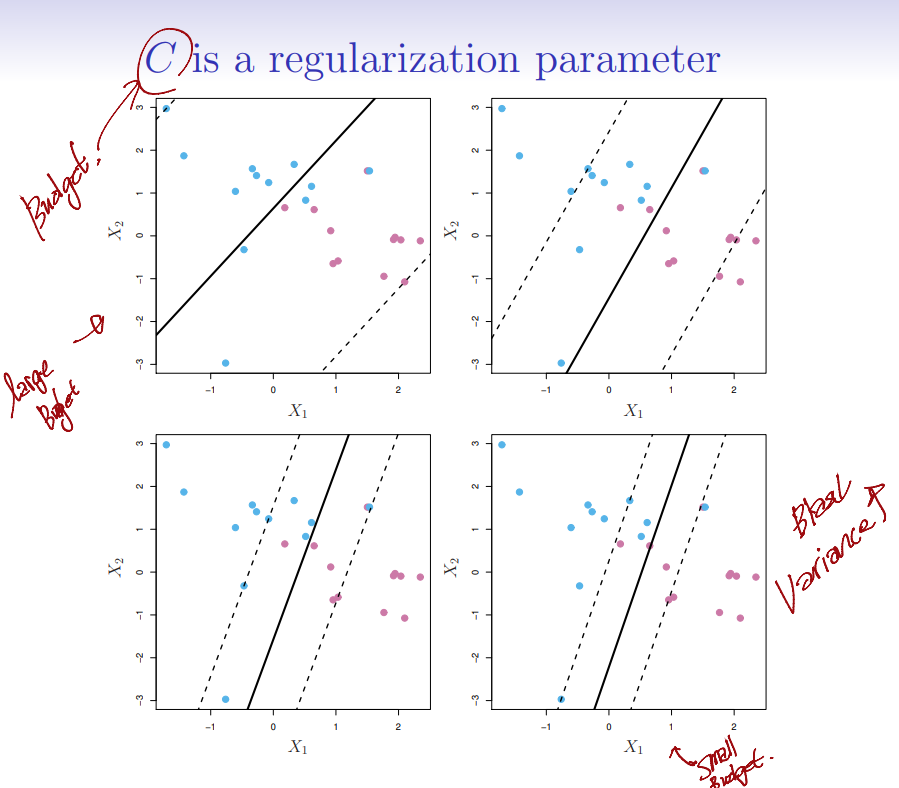
Linear boundary can fail
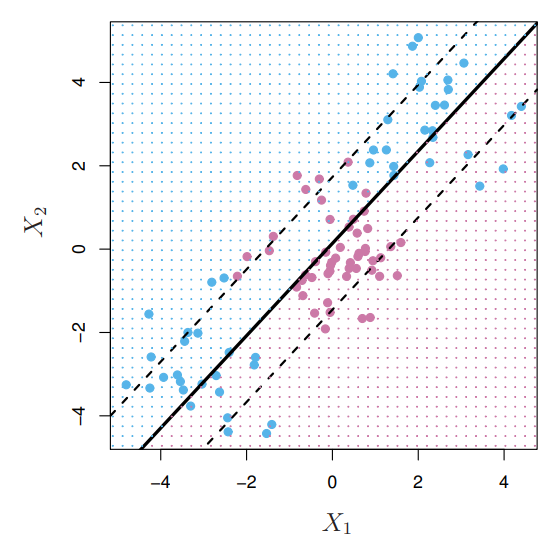
- Sometimes a linear boundary simply won't work, no matter what value of
- The example on the left is such a case. What to do?
Featue Expansion
- Enlarge the space of features by including transformations;
e.g. Hence go from a -dimensional space to a dimensional space - Fit a
support-vectorclassifier in the enlarged space - This results in
non-lineardecision boundaries in the original space - Example : Suppose we use instead of just . Then the decision boundary would be of the form
- This leads to nonlinear decision boundaries in the original space(quadratic conic sections)
Cubic Polynomials
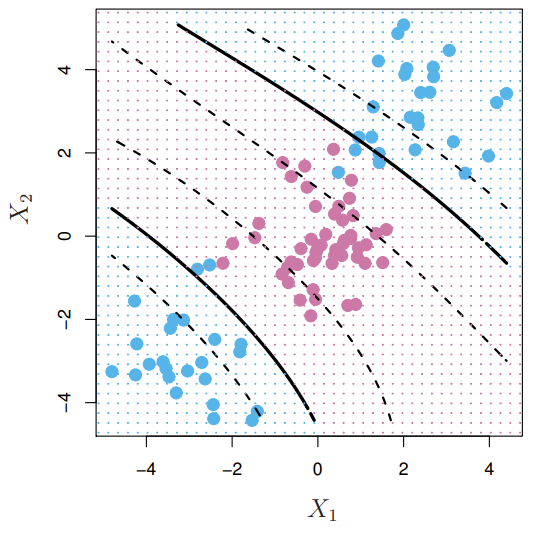
- Here we use a basis expansion of cubin polynomials
- From variables to
- The
support-vector classifierin the enlarged space solves the problem in the lower-dimensional space
Nonlinearities and Kernels
- Polynomials (especially high-dimensional ones) get wild rather fast
- There is a more elegant and controlled way to introduce nonlinearities in
support-vectorclassifiers - through the use ofkernels - Before we discuss these, we must understand the role of
inner productsinsupport-vectorclassifiers
Inner products and Support Vectors
- The linear
support vectorclassifier can be represented as - To estimate the parameters and , all we need are the inner products between all pairs of training observations
- It turns out that most of the can be zero :
- is the
support setof indies such that
Kernels and Support Vector Machines
- If we can compute inner-products between observations, we can fit a
SVclassifier. Can be quite abstract! - Some special
kernel functionscan do this for uscomputes thisinner-productsneeded for dimensional polynomials - basis functionsTry it for and
- The solution has the form
Radial Kernel
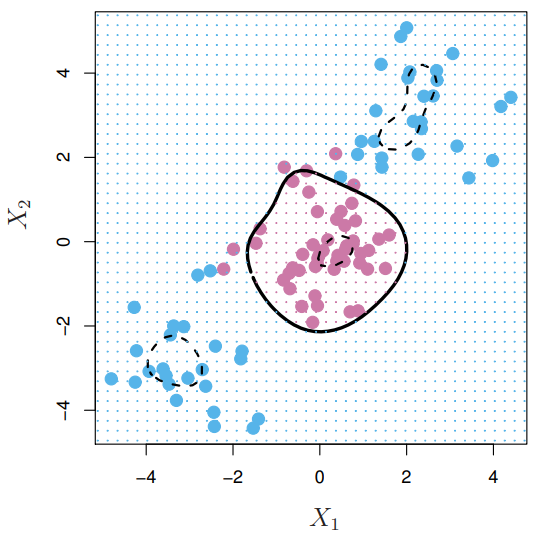
- Implict feature space; very high dimensional
- Controls variance by squashing down most dimensions severely
Example : Heart Data
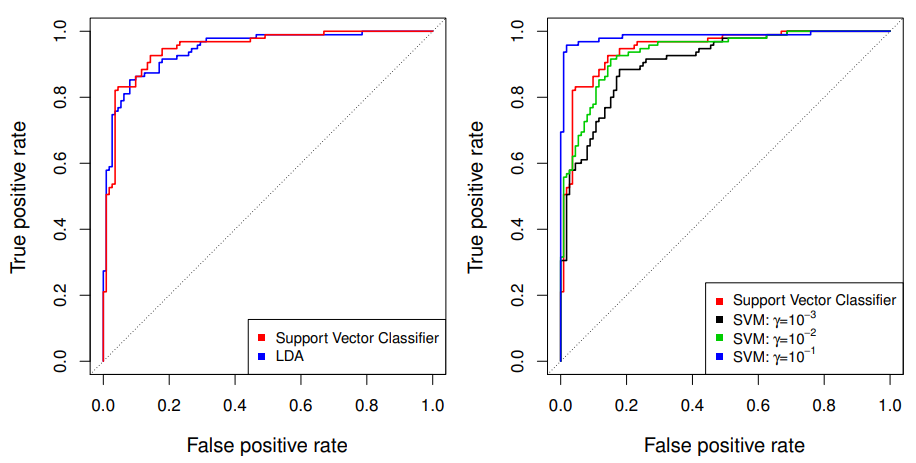
ROC Curveis obtained by changing the threshold to threshold in , and recordingfalse positiveandtrue positiverates as varies- here we see
ROC curveson training data
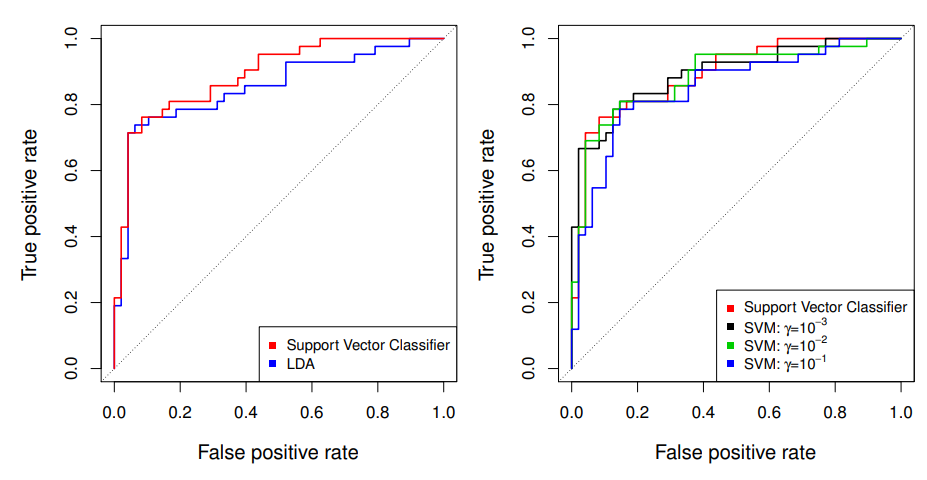
SVMs : more than 2 classes?
- The
SVMas defined works for classes - What do we do if we have classes?
OVA: One versus All.
Fit different 2-classSVM classifierseach class versus the rest
Classify to the class for whichOVO: One versus One
Fit all pairwise classifiers
Classify to the class that wins the most pairwise competitions
- Which to choose? If is not too large, use
OVO
Support Vector vs Logistic Regression?
-
With can rephrase
support-vectorclassifier optimization as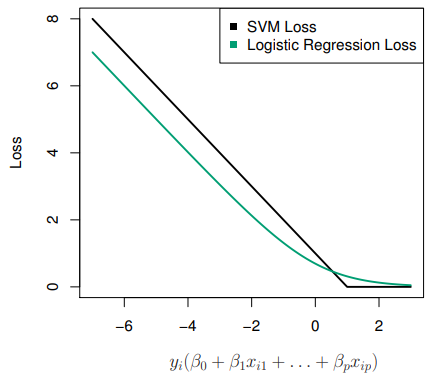
-
This has the form
loss plus penalty -
The loss is known as the
hinge lossvery similar tolossin logistic regression (negative log-likelihood)
Which to use : SVM or Logistic Regression
- When classes are (nearly) separable,
SVMdoes better thanLR. So doesLDA - When not,
LR(with ridge penalty) andSVMvery similar - If you wish to estimate probabilities,
LRis the choice - For nonlinear boundaries, kernel
SVMs are popular - Can use kernels with
LRandLDAas well, but computations are more expensive

AI, Security